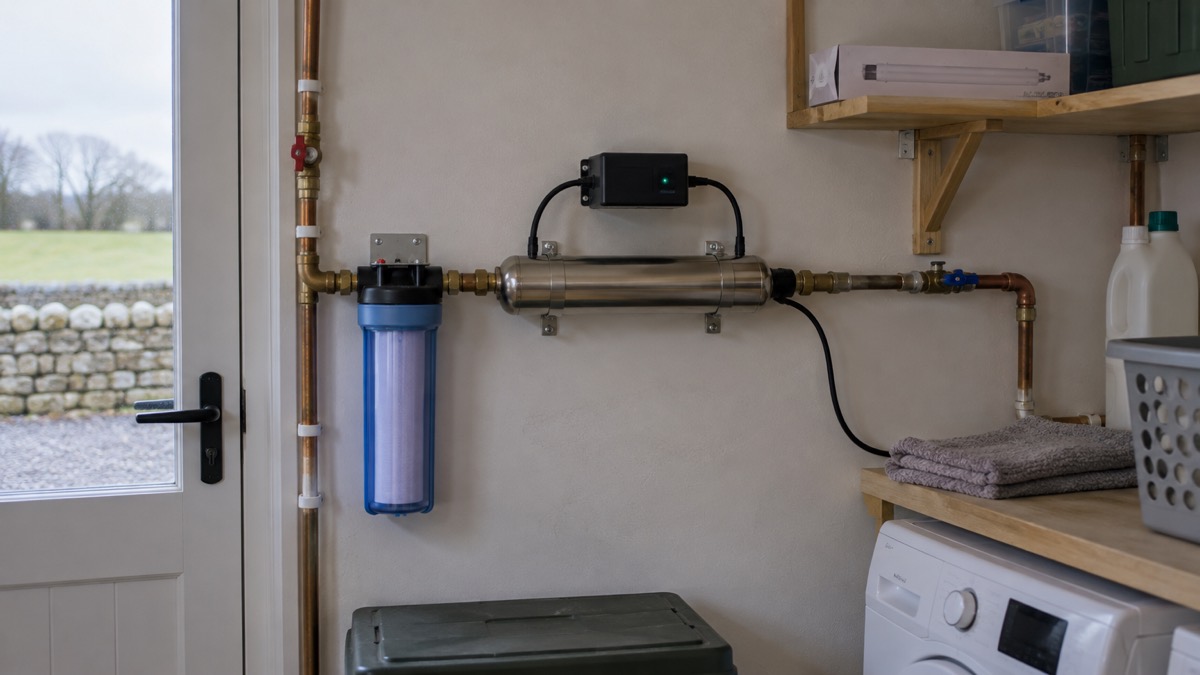
If your home draws its water from a spring, well, borehole, stream or loch rather than from a water company, the safety of that water is your responsibility. The single most important rule is that treatment must be fitted at the point of entry, so that it treats all the water entering the property, not just the water at one tap1. A filter on the kitchen tap is no longer considered acceptable, because it is not sufficient to have only one tap in the house that is safe to drink from or wash with2.
A permanent system for most households combines source protection with treatment: keeping manure, slurry and runoff away from the spring or well, then filtering the water and disinfecting it, usually with ultraviolet (UV) light3. The Drinking Water Inspectorate's advice is to prevent storage or spreading of manure within 50 metres of the water source4. Councils risk assess most supplies, usually every five years, and in Scotland a non-means-tested grant of up to £800 per property can help pay for improvements5.
Treat all the water where it enters the house
Any treatment on a private supply should be designed to treat all of the water entering the property1. Councils that regulate these supplies are explicit that point of use treatment, applied to only one tap, is no longer acceptable1. The reason is practical: a private supply feeds every outlet in the home, and domestic use includes drinking, washing and bathing, showering, laundry, toilet flushing and central heating9. Bacteria in an untreated bathroom tap reach you when you brush your teeth or wash a cut, so a single safe tap does not make a safe house.
Where the treatment sits matters too. A point of entry system is installed on the main supply pipe after any storage tank and before the water divides to the taps, so every litre passes through filtration and disinfection. When you ask an installer for quotes, or when a council risk assessor visits, the whole supply is assessed from the source to the taps, with areas of potential contamination identified and advice given on reducing the risks3.
If you are buying a property served by a private supply, ask specifically whether there is any water treatment within the property, such as filters or UV disinfection units, whether it is appropriate and effective, and whether it complies with the regulations9. Treatment that exists but is undersized, unmaintained or fitted after the storage tank rather than before it gives a false sense of security.
Why the water can look fine and still make you ill
Contaminated water may smell, taste and look completely normal, so you may not be able to tell whether your water is safe1. This is the central difficulty with private supplies: the organisms that cause illness are invisible, and a supply that ran clear for years can become contaminated overnight after heavy rain without any change in appearance.
The quality of private water supplies is variable. Some are very good, with adequate treatment and good management; others present a risk to health because of the quality of the water10. Outbreaks of disease attributed to private water supplies have occurred in Scotland10, and waterborne infections such as Campylobacter, E. coli O157, Cryptosporidium and Giardia can cause diarrhoea and vomiting1. Chemical contaminants behave differently: they are more likely to lead to long-term health effects rather than a sudden illness1.
A private supply can look clear and taste normal and still carry problems: chemical contaminants are more likely to lead to long term health effects rather than a sudden illness, so what you cannot see in the water matters as much as what you can1. Contamination often arrives from the collection area itself, which is why the advice for rainwater harvesting systems is to remove or avoid roof-mounted aerials or overhanging trees in the collection area, discourage birds from perching on roof collection areas, and consider diverting the first flush of rainwater to waste11. For surface water supplies, limit or control recreational use of the source water near the intake point11. The lesson is not that private supplies are unusable, but that they need protection and treatment together, and that checking the source after unusual weather is worthwhile.
If you think your water supply may be affecting your health, contact your GP, and tell your local authority so they can investigate the supply1.
What gets into a private supply: waste, runoff and minerals
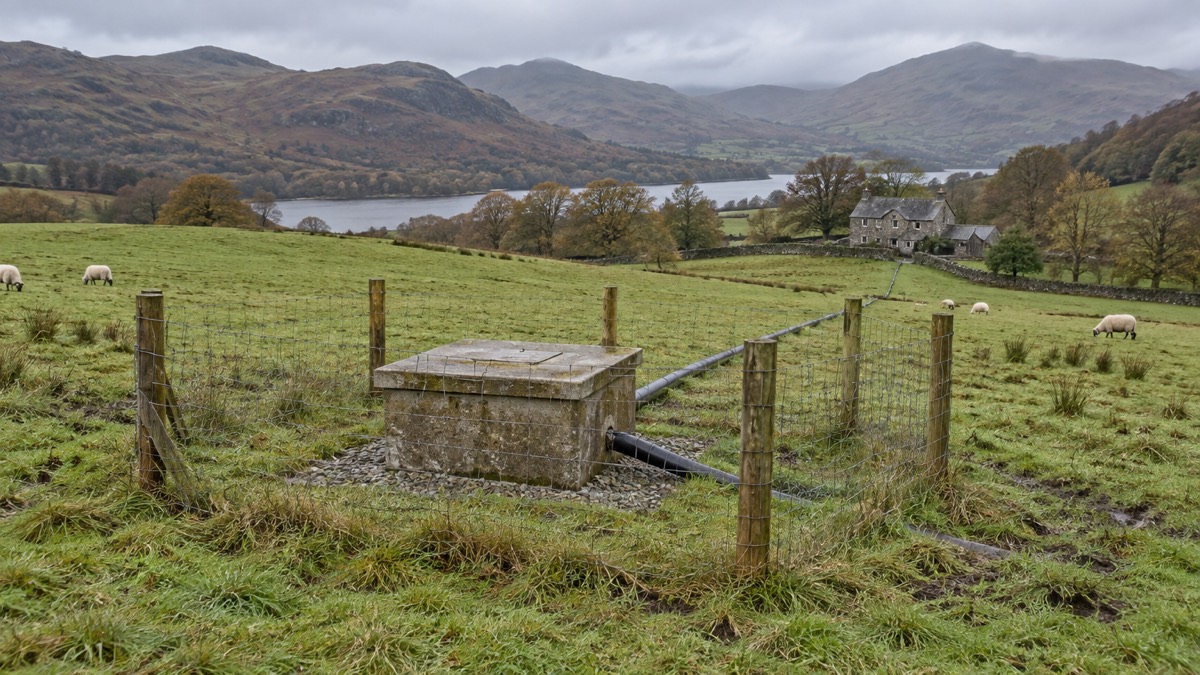
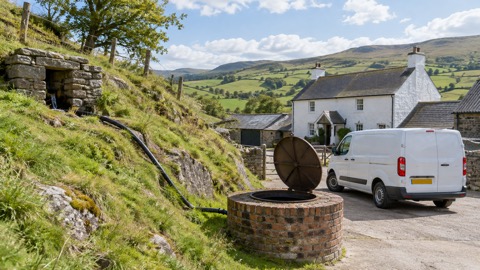
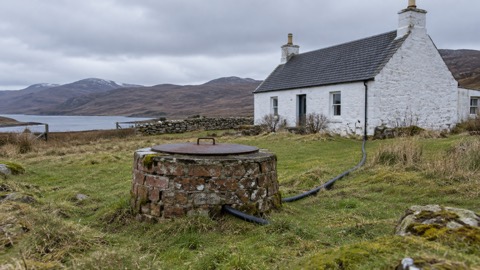
Private supplies come from springs, wells, boreholes, rivers, lochs, streams and ponds12. Most are in rural areas where mains water is not available14, and a supply might serve one property, or many properties through a network of pipes and reservoirs13.
The common contaminants fall into three groups. Animal waste, and fertiliser or pesticide runoff, carry bacteria and chemicals from the land into the source. High mineral levels, for example iron or manganese, and water that is too acidic or too alkaline (low or high pH), affect taste, colour and whether treatment works properly. Changes in water colour are often the first visible sign that something has shifted in the source14. Councils test private water supplies for bacteria, chemicals and metals5.
The case studies show how these contaminants arrive. At one supply, a local authority risk assessment in March 2011 identified a risk of contamination from slurry spreading around the springs15. At another, faecal matter from livestock and wildlife posed a potential danger to human health16. In both cases the water had previously been considered acceptable: the risk only became clear when someone walked the ground between the farm activity and the source.
UV, filters and pH correction: what a permanent system does
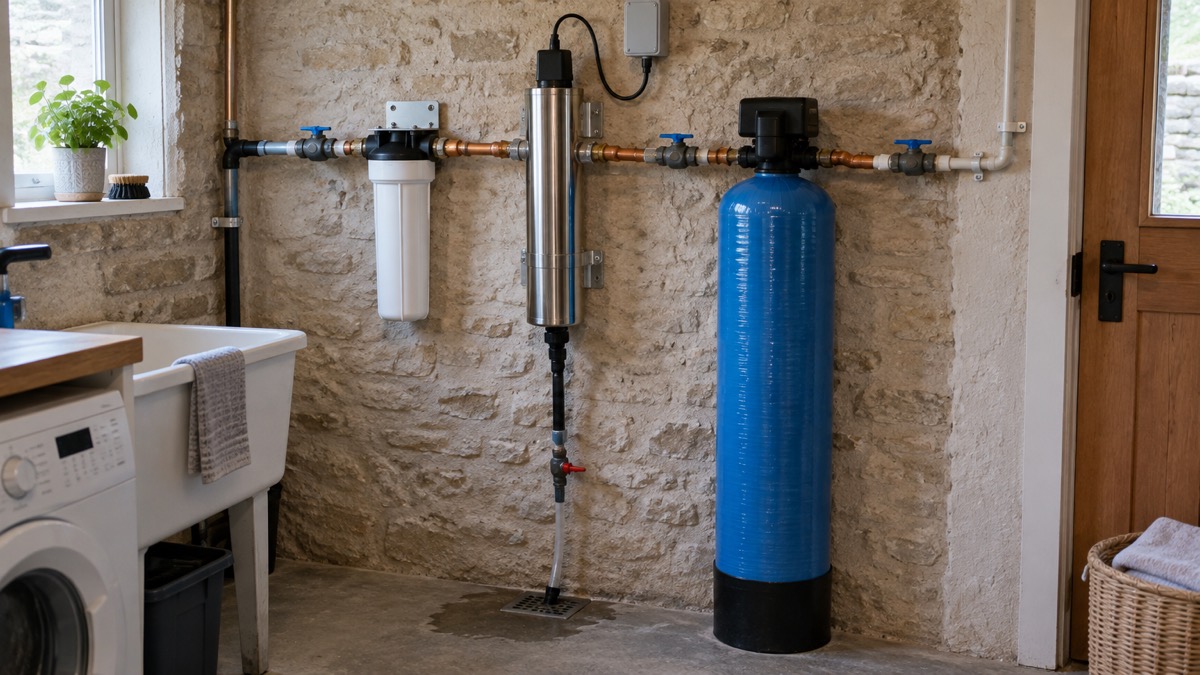
A permanent treatment system is built in stages, each dealing with a different problem. The exact combination depends on your raw water quality and flow rate, which is why the design should follow a risk assessment rather than a guess.
| Stage | What it does | What to check |
|---|---|---|
| Sediment pre-filter | Removes particles and solids so later stages work | Replace as required, depending on source water quality1 |
| UV disinfection | Removes bacteria such as E. coli13 | Bulb operational, renewed within the previous year or per the maker's handbook, quartz sleeve clean6 |
| pH correction | Adjusts acid or alkaline water so it is not corrosive | Part of the treatment train where the source water needs it15 |
| Iron and manganese removal | Takes out metals that discolour water and foul filters | Included where testing shows high mineral levels17 |
| Chlorination | Continuous disinfection, an alternative to UV | Dosing checked by a competent contractor18 |
Two warnings come with any system. First, even having treatment, whether filters, UV disinfection or chlorination, is no guarantee of safe water unless the treatment is adequately designed to cope with the raw water quality and the flow rate, and is carefully and regularly maintained according to the manufacturer's instructions7. An undersized UV unit on a fast-flowing, cloudy supply will let organisms through. Second, ensure any UV disinfection treatment is designed for drinking water, and keep spare parts such as UV bulbs available in accordance with the manufacturer's instructions4.
On how often to replace a UV lamp: the official advice after floods and storms is that the bulb must have been renewed within the previous year, or as required by the manufacturer's handbook, and the quartz sleeve must be clean6. UV treatment should be regularly checked to confirm it is operating correctly, with the pre-filter replaced as required depending on the quality of the source water1. Where a supply uses chlorine dosing instead, a water treatment specialist contractor can "shock chlorinate" the system by manually increasing the chlorine residual, as was done to remedy one contaminated supply18.
Protecting the spring or source: the 50 metre rule
The most effective treatment is stopping contamination before it reaches the water. The Drinking Water Inspectorate's advice is plain: prevent storage or spreading of manure within 50 metres of the water source4. But that figure is a general guide, not a guarantee. In one case study, after a contamination incident the local authority required the exclusion zone around the springs to be widened to above the contour line of both spring sources, because the generic 50m rule was not enough for that ground15. Exclusion zones need to be tailored to the situation: on sloping ground, everything uphill of the spring is uphill of your drinking water.
Beyond the exclusion zone, a short list of checks covers most source protection:
- Divert rainwater runoff so it does not flow into your supply, for example with a small ditch leading away from it1
- Ensure the water being collected is not contaminated by discharges from a septic tank, slurry spreading, or nearby pollution sources such as pesticide or oil storage1
- Check that pipework bringing water from the source is in good condition, does not leak, and is protected from damage by weather, animals or farm machinery1
- Put fencing around the source or collection tanks to keep grazing livestock and other animals away, and fit tight-fitting lids on collection chambers13
- For rainwater harvesting systems, remove or avoid roof-mounted aerials and overhanging trees in the collection area, discourage birds from perching there, and consider diverting the first flush of rainwater to waste4
- For surface water supplies, limit or control recreational use of the source water near the intake point4
Cornwall Council's private water supplies team puts it simply: clean, safe drinking water is achieved by protecting the source first, then secondary treatment such as filtration and disinfection19. If you also collect rainwater for the garden or home, the same separation thinking applies, and you can read more in our guides to rainwater harvesting and what harvested rainwater can be used for.
Heavy rain, floods and drought: when the risk rises
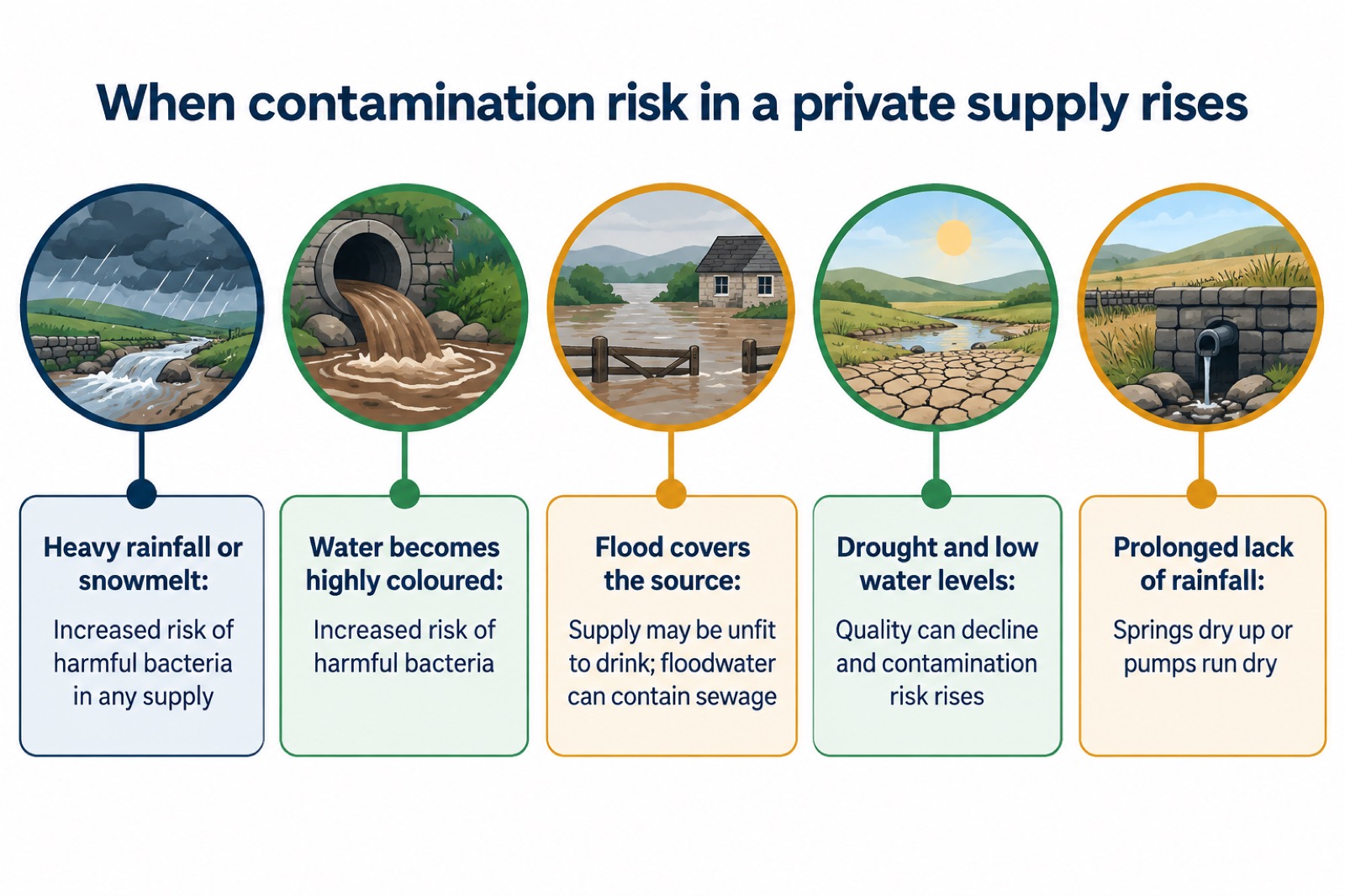
There are occasions when there is an increased risk of harmful bacteria affecting any supply, and this is most likely after heavy rainfall or snowmelt, or when the water is highly coloured20. The Public Health Wales review found heavy rainfall was linked to sudden increases in contamination21. The mechanism is simple: rain moves whatever is on the land, including animal waste, through the soil and into the source.
Flooding is the sharpest version of this. Private water supplies may be contaminated with floodwater and may not be suitable for drinking, because floodwater can contain sewage and harmful microorganisms6. There are risks of animal and human waste contaminating supplies wherever there is flooding22. If a private supply has been covered by floodwater, or the water becomes discoloured or changes in taste or smell, treat it as suspect22. If chemical contamination is suspected, an alternate source of water must be provided22. After a flood, check the supply from the abstraction point to the taps for damage, expect to change filters more frequently because of suspended solids, clean storage and loft tanks, and check collection points for dislodgement or blockage6. Do not rely solely on treatment systems after a flood: they will be under a lot of pressure, so have them checked and serviced and seek advice from your water engineer22.
Drought works from the other direction. Water quality can decline during drought conditions, and supplies can become contaminated when water levels are low, which could make someone who drinks that water unwell23. Houses on private supplies may be more vulnerable to drought because private supplies often rely on small water sources that can dry up quickly23. When there is a lack of rainfall over a long period, groundwater levels can become exceptionally low, causing spring sources to dry up or pumps to run dry24. Our page on when a private water supply runs low or dry covers that situation in detail.
Keeping the system working: maintenance and pump safety
Water treatment is not "fit and forget", and private supplies require active management if they are to provide a safe supply at all times17. Your treatment system needs regular maintenance following the manufacturer's instructions, and the maintenance frequency will need to be increased during prolonged periods of heavy rainfall1. Keep a record of all maintenance carried out on the system1.
What active management looks like in practice comes from a case study of a supply serving 34 dwellings. The owner put in place weekly operating checks by a nominated person living on site: weekly visual checks and recording of the UV system and pre-filter to assess whether parts needed replacement15. By August 2013 the owner had completed a water safety plan covering the weekly checks, annual servicing, alternative supply arrangements and instructions on using diversion valves to isolate a source from the reservoir15. Another supply, at charity premises, was covered by an annual inspection and maintenance contract with a contractor17. A household need not go this far, but the pattern is worth copying at whatever scale suits: a weekly glance at the UV indicator and filter, an annual service, and a written note of both.
Adding valves, overflows and bypass pipes enhances the resilience of a supply, making it easy to deal with adverse situations and carry out routine maintenance15. In the same case, when contamination struck, the emergency response was to divert the spring to waste through the overflow and block off the pipework to the reservoir, preventing more contaminated water entering the supply15.
Pump safety matters most when water is scarce. Ensure your pump is positioned below the water level: a pump can be damaged if it is trying to pump in a dry well or borehole and can be costly to replace, so consider lowering the pump if possible24. Regularly monitor the water levels in your well or borehole, or check spring flows24. Storage tanks need inspection too: the tank must be inspected regularly, at least annually and preferably every six months11. When a storage system is first commissioned, or after work on it, it should be disinfected by filling with a 20 mg/L solution of chlorine, leaving it to stand for several hours, preferably overnight, then draining and rinsing thoroughly with treated water11.
Emergency boiling and filtering: how it differs from permanent treatment
Permanent treatment runs constantly and quietly in the background. Emergency treatment is what you do when the permanent system is overwhelmed, unproven or switched off, and it is a temporary measure only.
For most bacteriological issues, boiling water before use is required: boil it for consumption, including drinking, ice making and washing of foods, and for personal hygiene such as tooth brushing7. Boiling deals with bacteria but not with everything. If the water source has been contaminated, the usual treatment processes may not provide adequate treatment, particularly if the water is coloured or cloudy, and the water may need to be filtered and boiled before use6. Cloudy water defeats UV disinfection, which is why the pre-filter matters and why, in an emergency, filtering before boiling is the safer order.
If you have no treatment fitted at all, note that your council may decline to sample for bacteriological contamination, because untreated supplies are all recommended to have treatment fitted3. That is a strong signal: the answer is a proper point of entry system, not repeated emergency boiling.
Two further points on emergencies. First, do not assume anyone will bring you water. Water companies may not always be able to provide an emergency supply in bowsers or bottles, for example if they have their own ongoing emergency such as a burst main25. Where a contingency plan is not in place, there is no obligation on the local authority or water company to provide an alternative supply, except where the local authority considers the circumstances pose a danger to life or human health25. Households are encouraged to consider how they would deal with any disruption to their drinking water now, and not wait until it runs out26. Second, while a supply is unusable, use alternative water such as bottled water solely for drinking, washing your hands and food preparation27. Our wider guide to water in an emergency covers how much to store and how to keep it safe.
Risk assessments and testing: usually every five years
A risk assessment looks at the whole supply from the source to the taps, identifies areas of potential contamination, gives advice on reducing the risks, and takes samples to assess the quality of the drinking water3. The visit is likely to take 1 to 4 hours, depending on the complexity of the supply3. You will receive a feedback letter and report detailing any improvements required, which also provides the basis for obtaining quotes from tradesmen if you are applying for a grant3.
How often testing happens depends on the type of supply:
| Supply type | Risk assessment | Sampling |
|---|---|---|
| Single domestic dwelling, owner-occupied | Not required unless requested, or if rented to tenants, or if the council believes there is a health risk9 | On request5 |
| Small supply serving two or more properties, up to 50 people | Every 5 years19 | Every 5 years19 |
| Regulated or commercial supply (holiday lets, food businesses, hotels, campsites) | At least once every 5 years, and more often if changes occur20 | At least once a year, more often if high risk or failing20 |
Local authorities must take account of any potential or actual lead risk as part of a regulatory risk assessment, which is reviewed every five years28. Consumers on supplies serving a single dwelling in isolation are not subject to mandatory risk assessments or testing for lead28. Local authorities should also require contingency plans for insufficiency as part of these risk assessments and their five-yearly reviews25. The rules behind these categories, including who is responsible for what, are set out on our page about private water supply regulations.
Where to get help with a private supply
Your first port of call is your local authority's environmental health or private water supplies team. In Cornwall, for example, risk assessments are undertaken by professionals who identify any vulnerability in the supply and give advice on how best to protect the water source from contamination19. In Argyll and Bute, you can contact the council on 01546 605519 or email envhealth@argyll-bute.gov.uk outlining your private water supply situation3. In Shropshire, the Customer Resolution Team can be reached on 0345 678 9067 (option 7) or pws@shropshire.gov.uk22. In Wales, contact your water company or local council for information on connecting to a nearby mains supply, and contact your local authority if water quality concerns arise24.
In Scotland, all private water supplies must be registered with the council, which continually updates its register; the register may be shared with other public bodies such as the Scottish Environmental Protection Agency20. The Scottish Government provides advice and information for owners and users through its mygov.scot site10, and funds local councils to deliver the private water supply grant scheme, offering up to £800 to eligible persons improving their existing supply8. The grant is non-means-tested1, and can assist in the provision of increased storage where adequate treatment already exists and insufficiency is a regular issue26. Grants cannot be issued retrospectively for works already started or completed, or to allow users to connect to the public mains water supply1. Our page on the private water supply grant in Scotland covers what it can be used for.
Where circumstances pose a danger to life or human health, the local authority has powers to require the water company to provide an alternative supply, such as bottled water, at a cost to those to which the supply is provided29. That is a last resort, not a plan: the households who get through droughts, floods and contamination incidents well are the ones who protected the source, fitted proper point of entry treatment, kept the maintenance record, and knew who to call before anything went wrong.
Sources (29)
- Private water supplies: treatment and maintenance, Scottish Borders Council, 2026
- Private water supplies at your property, Argyll and Bute Council, 2026
- Private water supplies: help and risk assessments, Argyll and Bute Council, 2026
- Protecting your private water supply, Drinking Water Inspectorate, 2026
- Types of private water supply and testing frequency, Cumberland Council, 2026
- Private water supplies after floods or storms, Argyll and Bute Council, 2026
- Private water supplies: water sampling, Argyll and Bute Council, 2026
- Private water supply grant scheme, Scottish Government, 2026
- Buying a dwelling with a private water supply, Drinking Water Inspectorate, 2026
- Private water supplies in Scotland, Drinking Water Quality Regulator for Scotland, 2026
- Water storage in private supply networks, Drinking Water Inspectorate, 2025
- Learn more about private water supplies, Drinking Water Inspectorate, 2026
- Private water supplies: sources and improvements, Somerset Council, 2026
- Private water supplies for homeowners and renters, The Highland Council, 2025
- Water safety plan approach to improving the safety of a private supply, Drinking Water Inspectorate, 2022
- Lead in drinking water: the overlooked health risk in small domestic private supplies, Drinking Water Inspectorate, 2011
- Private supplies require active management to ensure they are safe, Drinking Water Inspectorate, 2013
- Faecal contamination of a supply, Drinking Water Inspectorate, 2022
- Private water supplies: source protection and treatment, Cornwall Council, 2026
- Private water supplies: registration and monitoring, Argyll and Bute Council, 2026
- Private water supplies: a rapid scope of the literature, Public Health Wales, 2023
- Flooding advice for properties using a private water supply, Shropshire Council, 2026
- How to stay safe during a drought, NHS inform Scotland, 2026
- Drought planning and management, Natural Resources Wales, 2026
- Managing insufficiency of private water supplies, Drinking Water Inspectorate, 2025
- Loss of supply for private water supply users, Argyll and Bute Council, 2026
- Water supply interruptions or outages, Prepare Campaign, 2026
- Lead in private water supplies, Drinking Water Inspectorate, 2026
- Drought: how it is managed in England, UK Government, 2026
 Composting Toilet Kit Checklist
 Garden Harvesting Kit Checklist
 Rainwater Winter Checklist
 Above-Ground Rainwater Tanks
 Composting Toilets
 Direct vs Gravity Feed Systems
 Planning Permission for Systems
 Private Water Supply Running Low
 Private Water Supply Regulations
 Private Water Supplies Scotland
 Rainwater Filter Types
 How Rainwater Harvesting Works
 Rainwater System Maintenance
 Pumps for Rainwater Tanks
 Rainwater Systems and the Law