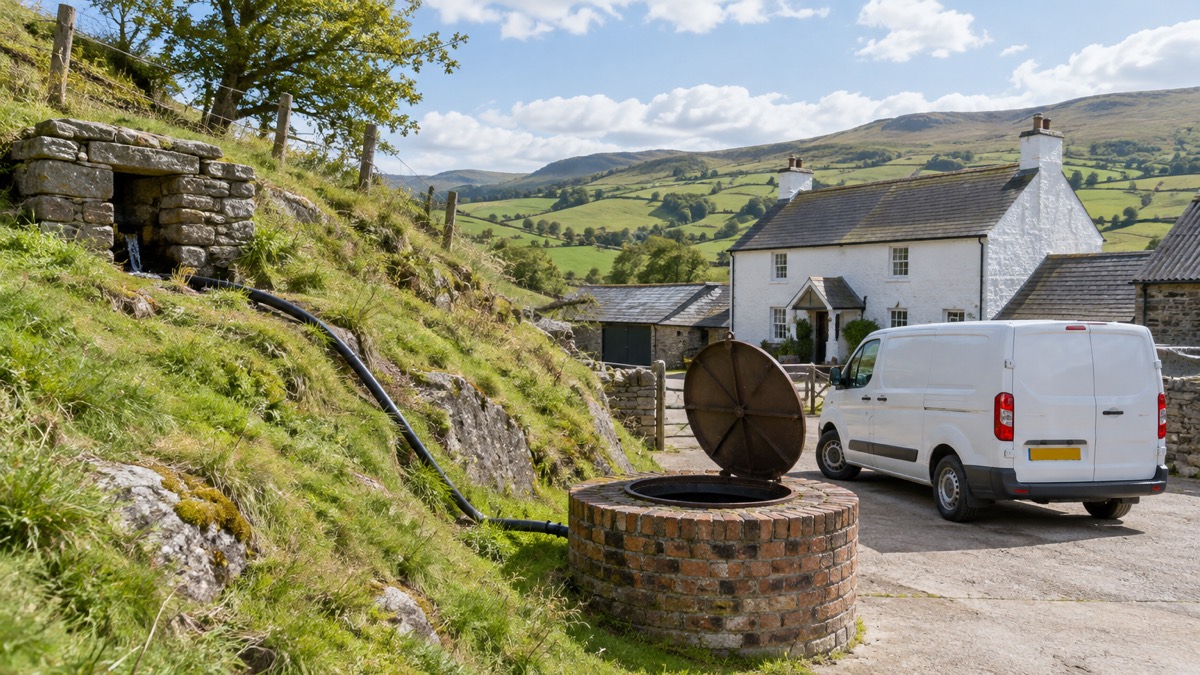
A private water supply is any water supply to a property that does not come from a mains supply or a licensed water supplier: typically a well, borehole, spring, stream, river or pond, most often in rural areas where mains water is not available1. Around 1 million people in England use some 40,000 private supplies, of which just over half are domestic supplies2. If you own, rent or are buying such a property, the practical rules are these: your local authority is the regulator, it must risk assess and test shared and commercial supplies, and a supply serving a single owner-occupied home is only risk assessed and tested if you ask, or if the council suspects a risk to health3.
The regulations exist because private supplies can make people ill. The water must be wholesome and must not constitute a danger to human health5, and the local authority has legal powers, including boil notices and enforcement notices, to make sure it is4. This page sets out how the system works across England, Wales, Scotland and Northern Ireland, what you have to do, and where to get help. For storing water and using it in an emergency generally, see our guide to water in an emergency.
What counts as a private water supply
A private water supply is any supply that is not provided by a water company1. In Scotland the definition is the same in substance: supplies not provided by Scottish Water11. The source could be a spring, a well, a borehole, a river, a stream or a pond9, and in Scotland lochs are also common sources12. Most are in rural areas where mains water is not available12.
A supply might serve one property, or many properties through a network of pipes and reservoirs9. That distinction matters throughout this page, because the regulations treat a single-home supply very differently from a shared one. A shared supply might be two neighbouring cottages drawing from one spring, or a whole hamlet served by a borehole and a storage reservoir. In one case study followed by the Drinking Water Inspectorate, a single supply served 34 domestic dwellings after a property conversion13.
The scale of use varies across the UK. Around 1 million people in England use private supplies2, about 80,000 people in Wales have one14, and approximately 3% of the Scottish population uses a private supply for drinking water, with many more people encountering one when they stay in holiday accommodation in the remoter parts of Scotland15. If you are one of those visitors rather than an owner, our page on staying somewhere with a private water supply covers what to look out for.
"Domestic purposes" has a specific meaning in the regulations: drinking, washing, bathing and showering, washing of laundry, toilet flushing and central heating4. A supply used for these purposes is regulated differently from one used commercially, which is the subject of the next section.
Regulated or exempt: which rules apply to your supply
Which rules apply depends on what the supply serves. In Scotland there are two types: larger supplies, or those with a commercial activity, are Regulated supplies, while smaller supplies serving only domestic premises are Exempt supplies, governed by different legislation15. Supplies serving 50 or more persons in total, or supplies to commercial or public activities irrespective of size, fall in the Regulated category7.
In England and Wales the dividing line is similar in practice. Highland Council explains that a supply serving more than 50 people, or used for commercial purposes, is classed as a regulated supply, while other supplies, such as those for owner-occupied homes, are not regulated12. Cornwall Council states the duty from the other direction: local authorities must carry out sampling at all supplies except those which serve only one domestic property which is owner occupied5.
Commercial use is defined broadly. Examples include food businesses, holiday accommodation, visitor attractions, campsites, workplaces and rented homes12. Scottish Borders Council lists self catering properties, food businesses, factories, sports centres, hotels, B&Bs, schools and campsites10. If you let a holiday cottage or run any business where people drink the water, your supply is regulated no matter how small it is.
| What the supply serves | Status | What the council must do |
|---|---|---|
| One owner-occupied home | Not regulated / exempt | Nothing unless requested, or a risk to health is suspected4 |
| One rented home | Treated as regulated in defined circumstances | Risk assessment and testing apply4 |
| Two or more properties, up to 50 people | Regulated (small) | Risk assessment every 5 years; sampling every 5 years5 |
| More than 50 people, or any commercial use | Regulated | Risk assessment every 5 years; sampling at least once a year7 |
One further threshold is worth knowing. Somerset Council advises that if you plan to abstract more than 20 cubic metres per day you will also need to check guidance on abstraction licences from the Environment Agency9. A normal household supply is far below this. Abstraction licence holders can sign up to water abstraction alerts by email, which lets the Environment Agency tell them quickly when a restriction on their licence is in force or when it has been lifted2.
Single homes: risk assessed and tested only on request
If a supply provides water for domestic purposes to only a single dwelling, the regulations do not require a risk assessment or testing unless the owner or occupier requests it, the dwelling is in Wales and rented to tenants, the dwelling is in England, rented to tenants and meets the criteria in the guidance on regulation 9, or the local authority believes there to be a risk to health4. Consumers on supplies serving a single dwelling in isolation are likewise not subject to mandatory risk assessments or testing for lead17.
In practice, many single-home supplies have never been tested. Argyll and Bute Council is blunt about it: if your property is served by a single domestic supply, it may not have been sampled and there are currently no plans to sample such supplies unless a problem is drawn to the council's attention7. Scottish Borders Council says the same10. Should you wish to have your supply sampled, it can be arranged, and a charge is made for the service10.
That has a real consequence if you are buying a property. The Drinking Water Inspectorate warns prospective buyers that in the absence of any risk assessment or test results, the quality of water may be unknown and potentially not of the required regulatory standard, and may be a risk to human health4. Ask the seller for the most recent risk assessment and sample results, and if none exist, consider asking the local authority to test before you commit. If you are worried at any stage, the Inspectorate gives consumer advice on water standards and publishes a range of water quality advice leaflets4.
There are two limits on council testing worth knowing. First, where a supply serves multiple dwellings or properties, the local authority will only collect one sample per supply for analysis on each visit, and is not required to take samples from every property on the supply each time4. Second, if you have no treatment on your supply, the council may not sample for bacteriological contamination, as untreated supplies are all recommended to have treatment fitted18. Somerset Council expects that a suitable treatment system will be installed and maintained on all water supplies to ensure the water is safe for human consumption9; our page on treating a private water supply covers the options.
Shared and commercial supplies: risk assessed every five years, tested at least once a year
Any private water supply used for domestic purposes that supplies two or more dwellings and/or other properties must be risk assessed every 5 years and regularly tested in accordance with the regulatory requirements by the local authority4. Cornwall Council sets out the sampling interval for smaller shared supplies: those serving two or more properties and up to 50 people need to be sampled every five years5. Cumberland Council summarises the same rule: a small supply serving fewer than 50 people, or less than 10 cubic metres of water per day, is tested every 5 years16.
For supplies serving the public or commercial operations, the duty is heavier. Scottish Borders Council and Argyll and Bute Council both state they have a legal duty to assess and sample the supply at least once a year10. Argyll and Bute adds that the frequency of monitoring depends on various risk factors but will be at least once in every calendar year, with higher risk supplies, or supplies that fail to meet the required standards, sampled more often7. Cornwall Council says commercial supplies must be sampled at least once every year, and more frequently if a high volume of water is used5. In Scotland, Regulated supplies must have a risk assessment carried out by the local authority at least once in every 5 years, and more frequently if changes occur7.
A risk assessment covers the whole supply from the source to the taps. Areas of potential contamination are identified, advice is given on how to reduce the associated risks, and samples are taken to assess the quality of the drinking water10. Local authorities must take account of any potential or actual lead risk as part of a regulatory risk assessment, which is reviewed every five years; for small, shared supplies below 10 cubic metres per day, lead is only tested where it is considered a risk17.
The costs fall on the supply side. The costs of sampling and risk assessing are payable by the supply owner, the supply users, or any person who requests the sampling or risk assessment9. In Scotland, the cost of sampling commercial and public supplies is borne by the owners of the properties served by the supply7. The regulations allow the local authority to recover these costs, and charging rates should be available on their websites, usually found by searching for "private water supplies"4. One exception: no charge is made where the local authority has concerns that a supply to a single domestic dwelling is a risk to human health and investigates4.
Who is responsible for a private supply
The regulator for private water supplies is the relevant local authority, whose functions in relation to water quality are prescribed in sections 77 to 85 of the Water Industry Act 19913. Local authorities have a duty to enforce the regulations, and this work is overseen by the Drinking Water Inspectorate5. The Inspectorate itself has no direct enforcement powers under the regulations in relation to private water supplies; its role is to provide technical guidance in England and Wales20.
Day to day, responsibility for the supply itself lies elsewhere. When a private supply runs dry or fails, the responsibility lies with the users of the supply or any third party who provides or manages the supply by contract21. Public Health Wales puts the same point to households: the problem needs to be dealt with by the owner or occupier of the home, or anyone else with ownership or control over the water source or supply, though your local authority can advise you22. There is no water company to call.
For shared supplies, the Drinking Water Inspectorate advises that, where possible, the relevant persons establish agreements, preferably written and legally binding, setting out clear accountabilities and responsibilities for running the supply, including costs and contingency arrangements3. If your shared supply has no such agreement, that is the first thing to fix.
Landlords have specific duties. A landlord in charge of a private water supply should not deliberately disconnect water to tenants served by that supply in a bid to remove them from the premises, under the Protection from Eviction Act 197720. Rented homes count as commercial use for regulatory purposes12, so a landlord's supply to tenants is risk assessed and sampled rather than left alone.
Where a supply is deemed a potential or actual danger to human health by the local authority, a relevant person is liable to be served a notice under regulation 18 in England, or regulation 20 in Wales, of the respective private water supplies regulations4. Anyone who constitutes a relevant person as defined in section 80 of the Water Industry Act 1991 could potentially be served an enforcement notice to remediate a lead risk17. If you receive a boil water notice on a private supply, it will come from your local authority23.
What testing checks for, and why safe-looking water can still make you ill
Councils test private water supplies for bacteria, chemicals and metals16. The legal standard behind that testing is that all water intended for human consumption must be wholesome and must not constitute a danger to human health5.
The critical point for a household is that you cannot judge your water by eye or by taste. Contaminated water may smell, taste and look normal, so you may not be able to tell whether your water is safe10. The quality of private supplies is variable: some are very good, with adequate treatment and good management, while others present a risk to health15. Outbreaks of disease attributed to private water supplies have occurred in Scotland15, and Highland Council warns that contamination issues can make the water unsafe to drink12.
The contaminants split into two groups with different effects. Waterborne infections such as Campylobacter, E.coli (O157), Cryptosporidium and Giardia can produce acute gastrointestinal symptoms, including sickness and diarrhoea19, while chemical contaminants are more likely to lead to long term health effects10. Common problems include animal waste, fertiliser or pesticide runoff, high mineral levels such as iron or manganese, low or high pH, and changes in water colour12.
The Inspectorate's case studies show how this plays out. In one supply with a single borehole, nitrate removal by ion exchange and automated chlorination still ran into contamination, and the operator's treatment specialist had to "shock chlorinate" the system6. Even a supply that looks and tastes normal can be unsafe, because contaminated water may smell, taste and look normal8. The lesson is that treatment needs active management, not just installation.
Cornwall Council advises households to check water levels and flow rates regularly, monitor pumps, treatment systems and storage tanks, watch for unusual changes in water pressure, and look out for changes in colour, smell, taste or clarity5. If you think your water supply may be affecting your health, contact your GP10, and report problems to your council's environmental health department24.
Keeping the source protected: manure no closer than 50 metres
The single most important protection rule is distance from contamination. The Drinking Water Inspectorate's advice to supply owners is to prevent storage and/or the spreading of manure within 50 metres of the water source8. The same 50 metre rule appears in the oil storage regulations: a bund, that is secondary containment around an oil tank, is needed within 50 metres of a drinking water source such as a well, borehole or spring25.
The 50 metre figure is a general guide rather than an absolute. A Drinking Water Inspectorate case study, in which a March 2011 risk assessment identified contamination from slurry spreading around a supply's springs and a 50 metre exclusion zone was created, concluded that exclusion zones need to be tailored to the situation, and the generic 50 metre rule is only a general guide13. In that case the notice eventually required the exclusion zone to be widened to above the contour line of both spring sources13.
Beyond distance, protect the physical integrity of the source. Check that the source is adequately protected by watertight covers to stop surface water entering your supply, ensure the water is not contaminated by discharges from a septic tank, slurry spreading, or nearby sources of pollution such as pesticide or oil storage, check that neighbouring farmers are aware of the supply, fence out animals, and divert rain water run off so it does not flow into the supply, for example with a small ditch leading away from it10. Check that pipework bringing the water from your source is in good condition, does not leak, and is protected from damage by weather, animals or farm machinery10.
For surface water supplies, limit or control recreational use of the source water near the intake point8. For rainwater harvesting systems, remove or avoid roof-mounted aerials or overhanging trees in the collection area, discourage birds from perching on roof collection areas, and consider diverting the first flush of rainwater to waste8. Cornwall Council's summary of the whole approach is that clean, safe drinking water is achieved by protecting the source and by secondary treatment, such as filtration and disinfection5. Our pages on rainwater harvesting and rainwater filters cover the collection side.
When a supply runs dry or fails: drought, freezing and council powers
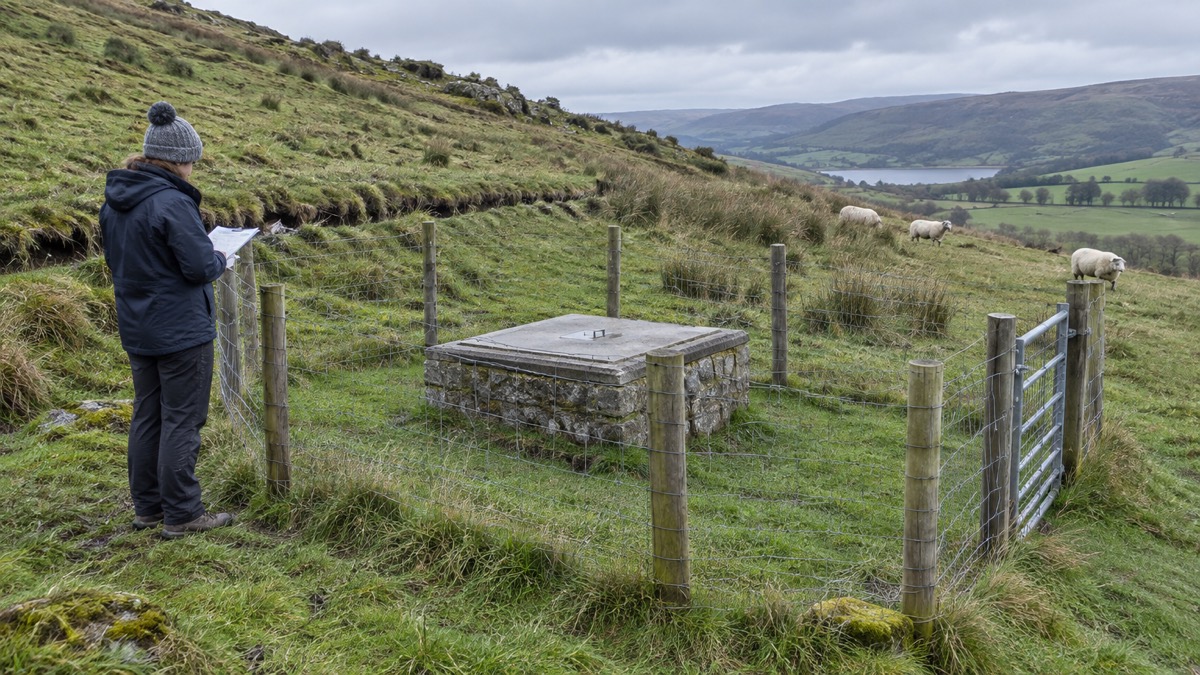
Private supplies fail for reasons beyond contamination. The causes include periods of drought or severe cold weather, when the source dries up or freezes, undetected leaks, pipe bursts, pump failures, and users being permanently disconnected by a person who has control of the supply10. Houses with a private supply may be more vulnerable to drought because private supplies often rely on small water sources that can dry up quickly27. Somerset Council reports that each summer it gets calls from private supply users whose springs, wells or boreholes have dried up, sometimes for many months9. In Wales, during periods of very low rainfall, groundwater levels can become exceptionally low, causing spring sources to dry up or pumps to run dry28.
Protect your pump before that point. Natural Resources Wales advises: ensure your pump is positioned below the water level, because a pump can be damaged if it is trying to pump in a dry well or borehole and can be costly to replace, and consider lowering the pump if possible28. Regularly monitor the water levels in your well or borehole, or check spring flows28. The Scottish Environment Protection Agency asks anyone having supply issues due to dry weather to contact their local authority29.
If water levels are very low, take action to seek an alternative supply of water. Speak to neighbours to find out if they can help, ensure containers used to transfer water are cleaned and disinfected to prevent contamination, and find out if there is a nearby mains supply to connect to28. Water quality can also decline during drought: supplies can become contaminated when water levels are low, which could make someone who drinks that water unwell27.
The local authority has powers when a failure is serious. Section 80 of the Water Industry Act 1991 gives local authorities discretionary powers to serve a notice on one or more relevant persons when a private supply is failing, has failed or is likely to fail to provide a sufficient supply of wholesome water3. Where circumstances pose a danger to life or human health, the local authority has power to require, if practicable at reasonable cost, the local water company to supply water by means other than in pipes for a specified period, with costs recoverable from the relevant persons20. The government describes the same power as requiring the water company to provide an alternative supply, such as bottled water, at a cost to those the supply is provided to2.
Two limits on those powers matter to households. Somerset Council notes that in section 80, the council's powers are directed at ensuring that a private water supply is sufficient by being well maintained, not at requiring a private individual to continue supplying water to others indefinitely, or at resolving private law disputes9. And the Drinking Water Inspectorate defines an insufficient supply as one that fails to provide enough water for human consumption, including all domestic purposes: drinking, washing, cooking, central heating and sanitary purposes20. Our page on when a private supply runs low or dry goes into the practical steps in detail.
Scotland, Wales and Northern Ireland: who regulates and who to contact
The framework is broadly the same across the UK, but the bodies and legislation differ.
In Scotland, private water supplies are regulated by local authorities30. If you have a query or would like advice about how to manage your supply, you should talk to your local authority30. The Scottish Government provides advice and information for owners and users through its mygov.scot site11, and the Drinking Water Quality Regulator for Scotland oversees the system15. Scottish supplies fall under the Private Water Supplies (Scotland) Regulations for the type of supply concerned7, and all private water supplies must be registered with the council7. The Private Water Supply grant is also administered by local authorities, on behalf of the Scottish Government30. Our Scotland page covers this in full, and the grant page explains what it covers.
In Wales, about 80,000 people have a private water supply14. Contact your water company or local council for information on connecting to a nearby mains supply, and contact your local authority if water quality concerns arise28. Public Health Wales recommends contacting your water company in the first instance, or your local authority if you are on a private water supply14. Enforcement notices in Wales are served under regulation 20 rather than regulation 184.
In Northern Ireland, the Drinking Water Inspectorate (NI) is responsible for monitoring private water supplies which serve two or more properties, public premises or a commercial premises31. For concerns, contact the DWI (NI) or the Environmental Health department of your local council31. Your local council will normally lift a sample, when asked, from a private water supply which serves a single private home31. For public drinking water supplies, contact Waterline on 03457 44 00 8832.
| Nation | Regulator | Who to contact |
|---|---|---|
| England | Local authority, overseen by the DWI5 | Your council's environmental health department24 |
| Wales | Local authority, overseen by the DWI5 | Your local authority for quality concerns28 |
| Scotland | Local authority30 | Your local authority; advice via mygov.scot30 |
| Northern Ireland | DWI (NI) for shared, public and commercial supplies31 | DWI (NI) or your council's Environmental Health department31 |
The Drinking Water Inspectorate can be reached on 0330 041 650120 and gives consumer advice on water standards, with a range of water quality advice leaflets if you are worried24. Remember, though, that it has no direct enforcement powers over private supplies in England and Wales: the enforcement body is your local authority20.
Sources (32)
- Private water supplies: what they are, Drinking Water Inspectorate
- Drought: how it is managed in England, GOV.UK
- Managing insufficiency of private water supplies, Drinking Water Inspectorate
- Buying a dwelling with a private water supply, Drinking Water Inspectorate
- Private water supplies, Cornwall Council
- Faecal contamination of a supply: case study, Drinking Water Inspectorate
- Private water supplies, Argyll and Bute Council
- Protecting your private water supply, Drinking Water Inspectorate
- Private water supplies, Somerset Council
- Private water supplies, Scottish Borders Council
- Private supply, Drinking Water Quality Regulator for Scotland
- Private water supplies, The Highland Council
- Water safety plan approach to improving the safety of a private supply: case study, Drinking Water Inspectorate
- Water and health, Public Health Wales
- Private water supplies, Drinking Water Quality Regulator for Scotland
- Types of private water supply, Cumberland Council
- Lead in private water supplies, Drinking Water Inspectorate
- Private Water Supplies - | Argyll and Bute Council, Argyll and Bute Council
- Private water supplies: water sampling, Argyll and Bute Council
- Managing insufficiency of private water supplies, Drinking Water Inspectorate
- Loss of supply for private water supply users, Argyll and Bute Council
- Weather and health, Public Health Wales
- Receiving a boil water notice, Drinking Water Inspectorate
- Check drinking water quality, GOV.UK
- Oil storage regulations and safety at home, GOV.UK
- Private water supplies: your property, Argyll and Bute Council
- How to stay safe during a drought, NHS inform
- Drought planning and management, Natural Resources Wales
- FAQs for private water supply users, Scottish Environment Protection Agency
- Owners and users of private water supplies, Drinking Water Quality Regulator for Scotland
- Dealing with drinking water problems, nidirect
- Drinking water and blue green algae, DAERA Northern Ireland
 Composting Toilet Kit Checklist
 Garden Harvesting Kit Checklist
 Rainwater Winter Checklist
 Above-Ground Rainwater Tanks
 Composting Toilets
 Direct vs Gravity Feed Systems
 Planning Permission for Systems
 Private Water Supply Running Low
 Private Water Supplies Scotland
 Treating a Private Water Supply
 Rainwater Filter Types
 How Rainwater Harvesting Works
 Rainwater System Maintenance
 Pumps for Rainwater Tanks
 Rainwater Systems and the Law