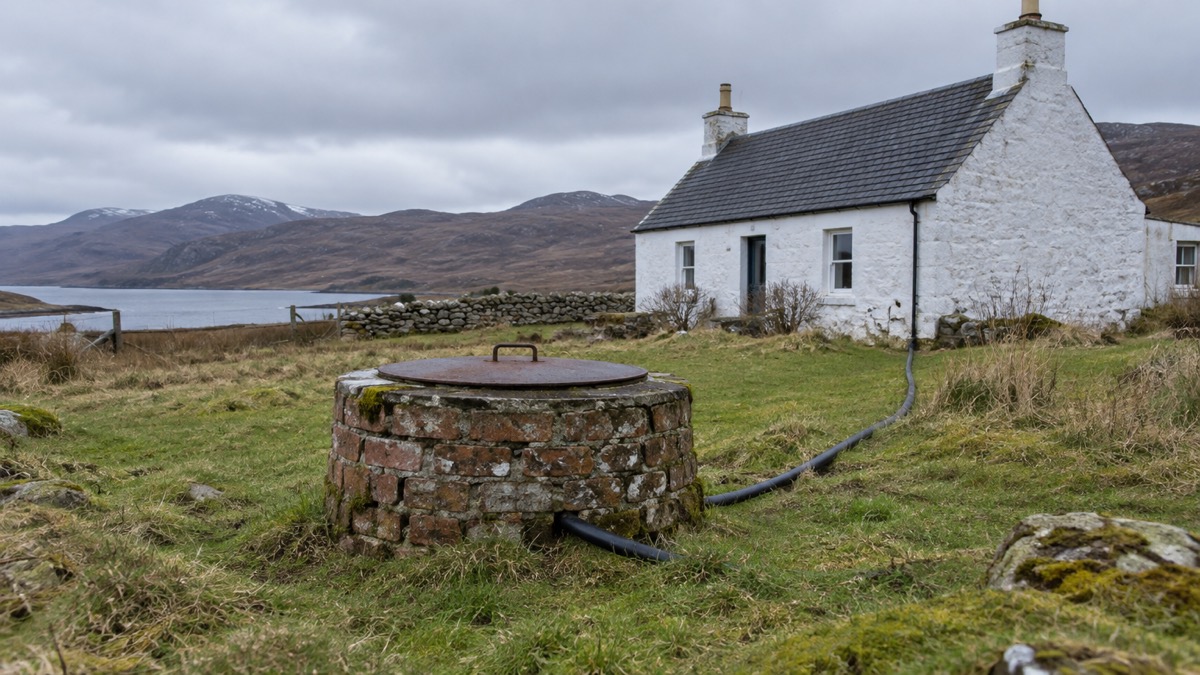
Around 3% of Scotland's population gets its drinking water from a private water supply, one that is not owned or operated by Scottish Water1. Most of these supplies are in remote and rural areas and draw from sources like lochs, streams or boreholes1. If your home is one of them, the law is clear about who stands behind the water that comes out of your tap: you do. It is your responsibility to manage your supply and keep it safe, and your local authority is there to advise you, assess the risk and sample the water2.
That responsibility is real rather than theoretical. The quality of private water supplies in Scotland is variable: some are very good, with adequate treatment and good management, while others present a risk to health because of the quality of the water3. Outbreaks of disease attributed to private water supplies have occurred in Scotland3, and waterborne infections such as Campylobacter, E.coli O157, Cryptosporidium and Giardia can produce acute gastrointestinal symptoms including sickness and diarrhoea4. The hardest part for a household is that contaminated water may smell, taste and look completely normal, so you may not be able to tell whether your water is safe5.
This page sets out how the system works in Scotland: who is responsible for what, how to register your supply, which rules apply to you, what testing involves and costs, what treatment should do, what to do when a sample fails, why supplies run dry or freeze, and what grants and mains connection options exist. For the wider UK picture on duties and testing, see private water supply regulations; for treatment options in detail, see treating a private water supply.
Who is responsible: your supply, your council and Scottish Water
In Scotland, a private water supply is defined as any water supply that is not provided by Scottish Water10. That single definition splits the country into two worlds. On the public side, 97% of homes receive drinking water from Scottish Water, water that has been treated to make it safe and has to meet stringent regulations6. Scottish Water is responsible for the public supply and distribution, and for the pipes that lead up to your property boundary, including the communication pipe in the street; it will fix bursts in those pipes6.
On the private side, the responsibility lies with the users of the supply, or any third party who provides or manages it by contract12. Treatment of private water supplies is usually the responsibility of the owner of the supply or property13. There is no water company standing behind your tap water: if the source becomes contaminated, the pump fails or the filter blocks, it is for the owner and users to deal with, with the council's environmental health team available for advice2.
The division of labour between the bodies is worth knowing:
| Body | What it does for private supplies |
|---|---|
| You (owner and user) | Manage the supply, keep it safe, install and maintain treatment2 |
| Your local authority | Registers supplies, gives advice, carries out risk assessments and statutory sampling, administers the improvement grant2 |
| The DWQR | Ensures drinking water in Scotland is safe to drink; publishes guidance for owners and users7 |
| Scottish Water | Responsible only for the public supply; not for private supplies1 |
| SEPA | Assesses water scarcity, including reports from private supply users16 |
The Scottish Government provides advice and information for owners and users of private water supplies through its information site mygov.scot, including how to get your supply tested, the charges for testing, and the grant that can help improve it17. If you have a query or would like advice about managing your supply, talk to your local authority17. If your supply is cut off or contaminated during flooding, NHS inform advises contacting Scottish Water for public supplies, or your local authority if you use a private supply18.
Registering your supply with the council
All private water supplies must be registered with the council8. This is not optional and it is not a formality: the register is what allows the council to contact you when there is a problem in your area, to carry out its risk assessment and sampling duties, and, in a drought, to know where help is needed. Users of private supplies are required by law to register them with their local authority19.
Councils keep these registers continually updated, and the register may be shared with other public bodies such as the Scottish Environment Protection Agency (SEPA)8. The scale varies enormously by area: Argyll and Bute alone has approximately 3,500 private water supplies serving over 8,000 inhabitants, and many more visitors8.
To register, contact the environmental health team at your council. Two examples of how councils take these enquiries:
- Scottish Borders Council: telephone 0300 100 1800, or write to Council Headquarters, Newtown St. Boswells, Melrose, TD6 0SA5
- Argyll and Bute Council: telephone 01546 605519, or email envhealth@argyll-bute.gov.uk outlining your private water supply situation20
Contact details for every Scottish council's environmental health department can be found on the CoSLA website21. If you are unsure whether your property is on a private supply at all, there are tell-tale signs: the property being in a remote location, since most but not all private supplies are in areas the public mains do not reach, and a lack of chlorine smell, since the mains supply usually has a faint chlorine or bleach-like odour while most private supplies are not chlorinated13.
One point on maps: the DWQR no longer displays a map of private water supply locations on its website because it is unable to verify the accuracy of the data3. There is no reliable national map to check; the council register is the authoritative record.
Regulated and exempt supplies: which rules apply to you
There are two types of private water supply in Scotland, and the legislation relating to each is different10. Which type you have determines whether the council must sample your water, how often, and what you must do as an owner.
| Regulated supplies | Exempt supplies | |
|---|---|---|
| Who they serve | 50 or more persons in total, or any commercial or public activity, irrespective of size8 | Only domestic premises, fewer than 50 persons in total8 |
| Legislation | The Water Intended for Human Consumption (Private Supplies) (Scotland) 20178 | The Private Water Supplies (Scotland) Regulations 20068 |
| Council sampling | Routinely sampled as part of a statutory programme; at least once a year where the supply serves the public, a commercial operation or is a large domestic supply4 | May not be sampled unless a problem is suspected or sampling is requested4 |
| Typical examples | Self-catering properties, food businesses, factories, sports centres, hotels, B&Bs, schools, campsites5 | A single home or a small group of homes served by one spring or well |
The commercial category is broader than many owners expect. It includes all holiday letting premises and self-catering units and caravans, food premises, workplaces and domestic residential lets8. Highland Council gives similar examples: food businesses, holiday accommodation, visitor attractions, campsites, workplaces and rented homes22. If you let your property, even occasionally, your supply is almost certainly a Regulated supply.
That brings two legal duties. Commercial properties on a supply, including self-catering accommodation, must legally have a formal risk assessment carried out and are subject to routine sampling, with all supplies serving a commercial premise sampled at least annually13. And if you have a commercial premises served by a private supply in Scotland, you are required by law to display a Drinking Water Poster to notify all users8.
For purely domestic supplies, the rules are lighter but not absent. Any private water supply used for domestic purposes that supplies two or more dwellings or other properties must be risk assessed every 5 years and regularly tested in accordance with the regulatory requirements by the local authority23. A supply serving only one owner-occupied domestic property sits at the lightest end: councils may not sample it unless a problem is suspected or you ask them to4. Many more people encounter private supplies only as visitors, when they stay in holiday accommodation in the more remote parts of Scotland10; if that is you, see staying somewhere with a private water supply.
Contaminated water can look, smell and taste normal
The single most important thing to understand about private supply safety is that you cannot judge it with your senses. You may not be able to tell whether your water is safe, as contaminated water may smell, taste and look normal5. Scottish Borders Council gives the same warning9.
Contamination comes from several directions. It can be bacteriological, from faecal matter such as human sewerage or animal droppings; or chemical, from fertiliser or pesticide run-off from fields, from deterioration of distribution pipework (lead, copper, nickel or zinc), or from natural sources in soils and rocks such as iron, manganese and arsenic8. Waterborne infections such as Campylobacter, E.coli O157, Cryptosporidium and Giardia can produce acute gastrointestinal symptoms, including sickness and diarrhoea4.
Because you cannot see the problem, the practical habits are:
- Watch for changes in colour, smell, taste or clarity, and treat any change as a reason to test24
- Check water levels and flow rates, and monitor pumps, treatment systems and storage tanks24
- Watch for unusual changes in water pressure, which can point to leaks or a failing source24
- Remember that a lack of chlorine smell is normal for most private supplies, not a sign of purity13
For contrast, on the public supply a slight taste or smell, particularly of chlorine, is normal and no cause for worry; Scottish Water advises contacting it immediately only if you notice a particularly bad or strong smell or taste that means you cannot drink the water, or a smell or taste for the first time25. If you are at all concerned about the quality of a public supply, contact Scottish Water in the first instance; if the supply is a private one, speak to the environmental health section of your local authority14.
Lead deserves a special mention because it is invisible and it comes from the pipes, not the source. If you have reason to believe lead is present in your supply, you can contact Scottish Water and ask it to take a sample from your property and tell you the results11. If high lead levels are found, you will be contacted, steps will be taken to reduce exposure, and you may be advised not to drink tap water temporarily21. NHS inform notes that contact details for your local council environmental health department can be found on the CoSLA website if you have a private supply21.
Testing your water: what it costs and how long results take
Water sampling is carried out to determine the presence of bacterial or chemical contaminants which may have adverse health implications, which may affect the efficiency of any treatment installed, or the aesthetics of the water4. Testing checks for bacteria, chemicals and metals10.
How the process works depends on your supply type:
- Regulated (Type A) supplies are routinely sampled as part of the council's statutory sampling programme4.
- Supplies serving the public or a commercial operation are assessed and sampled at least once a year as a legal duty4.
- Small domestic supplies may not have been sampled, and there are currently no plans to sample them unless a problem is suspected or sampling is requested4. You can ask your council to test.
There is a charge for testing, paid at the time of your request4. For small domestic supplies, a fee is charged to cover sample and analysis costs4. The Scottish Government's mygov.scot site sets out how to get your supply tested, the charges for this, and the private water supply grant that can help improve your supply17.
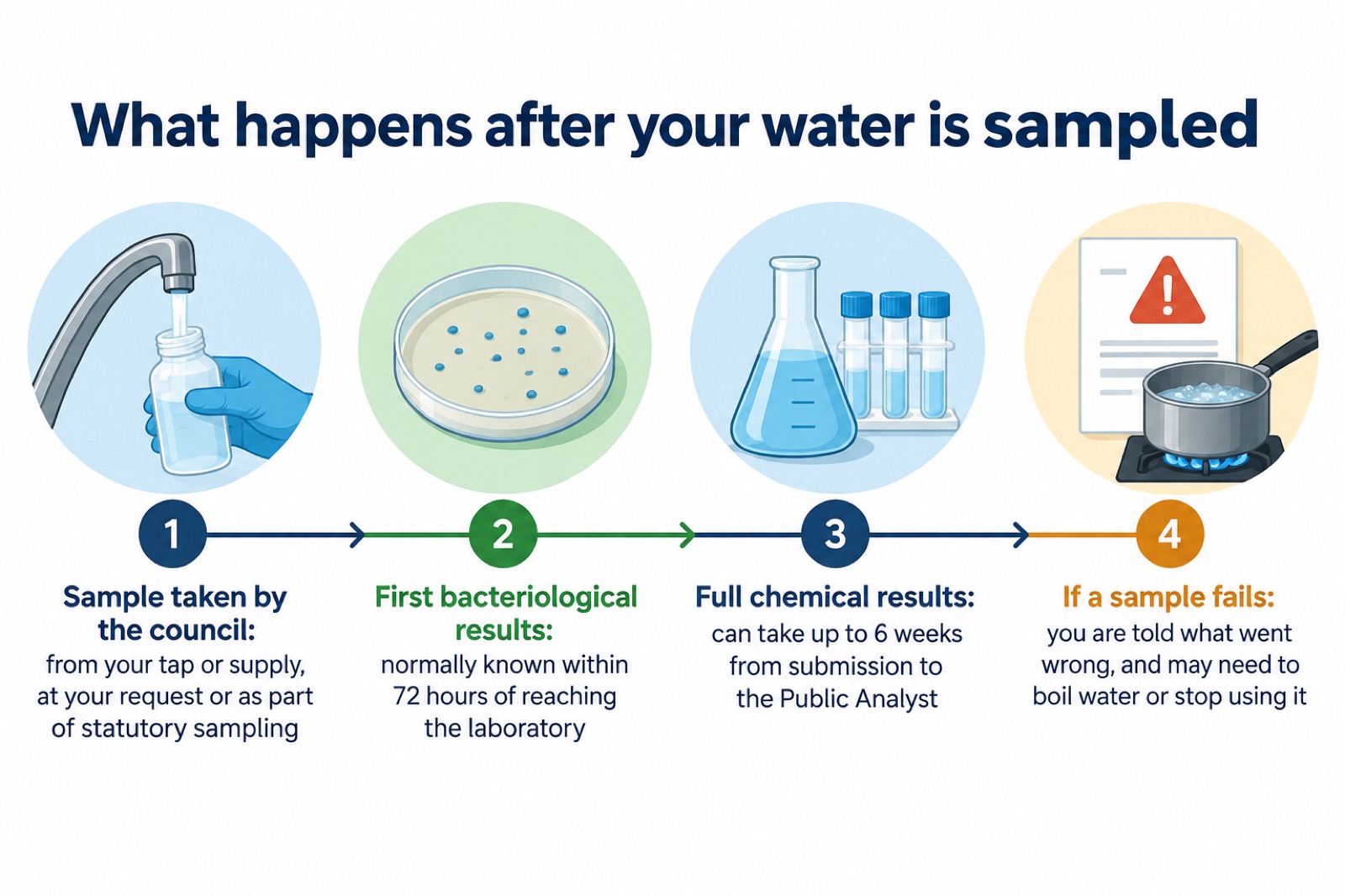
Results take different times depending on what is being looked for. The first bacteriological results are normally known within 72 hours of the sample reaching the laboratory; full chemical samples can take up to 6 weeks from the date of submission to the Public Analyst4.
One caution from a published case study: a single, one-off water sample does not adequately assure a safe, sufficient and reliable drinking water supply, even when the results are compliant with the regulatory standards on that occasion22. Regular sampling, matched to a risk assessment of the source, is what protects a household.
If you are buying a property served by a private supply, ask about the sampling history and the risk assessment before you commit: supplies serving two or more dwellings must be risk assessed every 5 years and regularly tested23. The council can also carry out a risk assessment of the supply and produce a report of Approved Improvement Works, which is the document you will need if you apply for an improvement grant4.
Treatment that protects the whole house
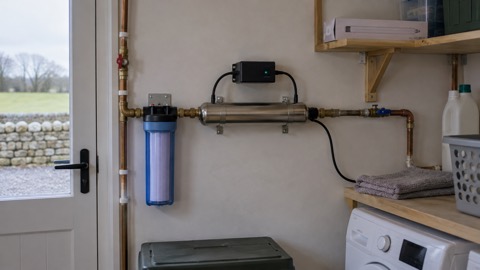
To ensure the water supply is safe for human consumption, councils expect that a suitable treatment system will be installed and maintained on all water supplies13. The key design rule is that any treatment should be point of entry, designed to treat all of the water entering the property, not point of use on a single tap9. The reason is simple: all water used on the premises must be safe for drinking and hygiene purposes, such as showering and tooth brushing20.
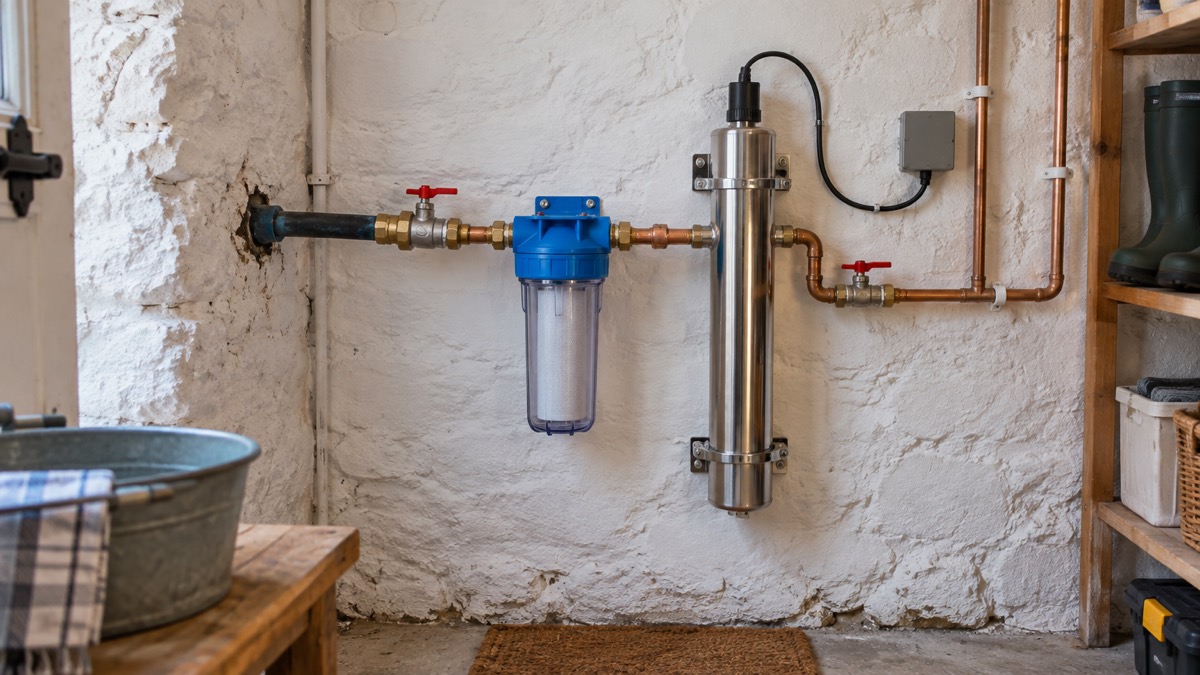
Treatment works in two stages: protecting the source in the first place, and secondary treatment such as filtration and disinfection24. In Argyll and Bute, the most common treatment method is pre-filtered ultraviolet disinfection13. A published case study of a supply serving 34 domestic dwellings used UV treatment and pH correction before the water was distributed to the properties23.
Two warnings from the councils that run these systems. First, an untreated supply is expected to fail bacteriologically numerous times throughout the year, especially if the supply comes from or is affected by surface waters4. Second, even having treatment, such as filters, ultraviolet disinfection or chlorination, is no guarantee of safe water unless the treatment is adequately designed to cope with the raw water quality and the flow rate, and systems must be carefully and regularly maintained according to the manufacturer's instructions4. Chemical failures matter here too: failure of certain chemical or aesthetic parameters may pose a risk to human health and may also affect the efficiency of any treatment system in place, particularly UV disinfection or chlorination4.
For the practical side of choosing and maintaining filters, UV units and source protection, see treating a private water supply.
When a sample fails: boiling water and telling users
If your water fails a test, you will be told what went wrong, you may need to boil water or stop using it, you will get advice on how to fix the issue, and you may receive a legal notice requiring improvements10.
For most bacteriological issues, boiling of water prior to use is required: for consumption such as drinking, ice making and washing of foods, and for personal hygiene purposes such as tooth brushing4. Boil advice is not just informal guidance in serious cases. In one case study, the owner of a supply issued boil water advice to all the properties and commenced an investigation, and the local authority then formalised the boil water advice in a Regulation 18 Notice23. In another, after faecal contamination of a supply, the local authority served a Regulation 18 Notice which instructed users of the supply to boil water before consumption23.
If you are responsible for other properties or users, such as tenants, holiday visitors, customers or staff, you must:
- Inform users about the sample failure or failures4
- Notify in writing all consumers of the water at the properties that you are responsible for9
- Ensure temporary measures, such as boil advice, are put into action until the cause has been investigated and rectified4
- Request a further sample to confirm the remedial works have been successful4
Councils also have formal enforcement powers. Section 80 of the Water Industry Act 1991 gives local authorities discretionary powers to serve a notice on one or more relevant persons when a private supply is failing, has failed or is likely to fail to provide a sufficient supply of wholesome water24. In practice, most cases are resolved through advice and voluntary improvements before that stage.
Dry spells, freezing and other reasons a supply fails
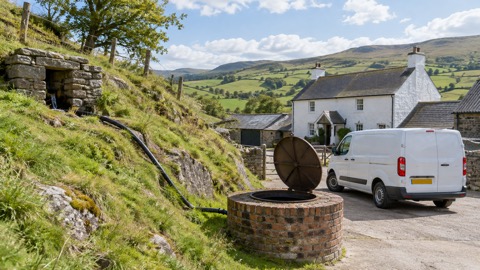
Private supplies fail for reasons beyond contamination, and the causes cluster around weather and equipment. Supplies can be lost during periods of drought or severe cold weather, when the source dries up or freezes, but also through undetected leaks, pipe bursts, mechanical failures such as pump failures or blocked filters, and users being permanently disconnected by a person who has control of the supply20.
Prolonged dry weather brings its own sequence of problems: reduced water levels in springs, wells, boreholes and streams, lower water pressure and reduced flow rates, complete loss of supply in some cases, and changes in water quality due to lower water volumes24. There is a further trap at the end of a dry spell: dry spells often end with heavy rain that causes run-off into abstraction areas, which can bring high levels of sediment and contamination to tanks and affect treatment20.
What to do, in order:
- Contact your local authority if you are having supply issues due to the effects of dry weather16. This is the first and correct call for a private supply.
- Report the impact to SEPA as well. By reporting the impact of dry weather on your supply to SEPA, you help it better assess water scarcity stress in your area16.
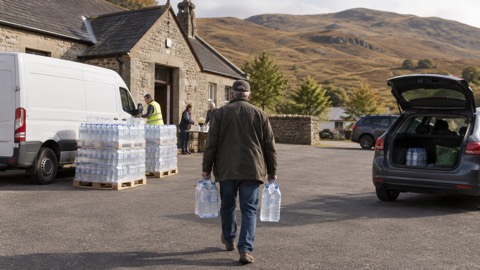
- Ask about bottled water. If issues occur in a period of Water Scarcity declared by the Scottish Government, some councils may be able to arrange for you to collect a limited supply of bottled water from one of their offices, without charge15.
- Check for the other causes. Before assuming drought, rule out undetected leaks, pipe bursts and pump failures, which are all common causes of loss of supply12.
For the fuller picture on managing a supply that runs low, see when a private water supply runs low or dry. Scottish Water reports the raw water available in storage reservoirs and rivers across the country on a weekly basis, which gives a picture of how dry the wider system is16.
Grants and connecting to the mains
The Scottish Government provides funding to local councils to deliver the private water supply grant scheme, offering up to £800 to eligible persons improving their existing private water supply1. The grant is non-means tested, at up to £800 per property9, and is administered by local authorities on behalf of the Scottish Government17. Argyll and Bute describes it as non-means tested grant funding of up to £800 per property that may be available to improve your private water supply9.
Two limits on the grant matter before you plan any work:
- Grants cannot be issued retrospectively for works that are already started or completed9
- Grants cannot be used to allow users to connect to the public mains water supply9
So apply before you begin improvement works, and use the grant for treatment, source protection, storage or pipework on the private supply itself. The council's risk assessment and its report of Approved Improvement Works is the natural starting point for an application4. For the detail on eligibility and what the grant covers, see the private water supply grant in Scotland.
On connecting to the mains, the position has recently changed. The Scottish Government ran a private water supply connections pilot project, delivered with Scottish Water, Consumer Scotland and local councils, to improve Scotland's resilience to water scarcity, to better understand the challenges of extending the public water network to communities with private supplies, and to learn lessons for future climate change projects1. It was a Scotland-wide scheme in which councils nominated affected communities, and it helped eligible communities affected by water scarcity explore opportunities for connection1.
The pilot scheme has now ended, and no further communities are being considered for connection through this project1. If you missed the pilot, the practical routes are: improving your own supply with the grant, and speaking to your council about your situation, since councils remain the delivery body for private water supply policy in their areas1.
Where to get help
- Your council's environmental health team: the first contact for registering a supply, advice on managing it, risk assessments, sampling, and dry weather problems2. Scottish Borders Council: 0300 100 18005. Argyll and Bute Council: 01546 605519 or envhealth@argyll-bute.gov.uk20.
- The DWQR: guidance for owners and users of private water supplies, and oversight of drinking water safety in Scotland3.
- mygov.scot: the Scottish Government's information on testing, charges and the improvement grant17.
- SEPA: report the impact of dry weather on your supply, to help it assess water scarcity16.
- Scottish Water: for anything to do with the public supply, contact it online in the first instance or call 0845 601 88559. Its website also lets customers see the status of the supply in their area and report problems5. If you have problems with the water in your home, such as supply or quality issues, problems with pipes or sewers, blocked or flooded sewers, or sewerage flooding or pollution, the Scottish Water website has information on what to do and who to contact5.
- Your GP: if you think your water supply may be affecting your health, contact your GP, who can provide containers for a stool sample, and contact the council water team, who can arrange to take a sample if appropriate4.
For storing water at home as a buffer against supply failures, see water in an emergency, and for the wider context of household self-reliance, see self-reliance at home.
Sources (25)
- Private water supplies policy, Scottish Government, 2026
- Owners and users of private water supplies, Drinking Water Quality Regulator for Scotland, 2026
- Private water supplies guidance, Drinking Water Quality Regulator for Scotland, 2026
- Private water supplies water sampling, Argyll and Bute Council, 2026
- Private water supplies, Scottish Borders Council, 2026
- Domestic consumers: public water supply, Drinking Water Quality Regulator for Scotland, 2026
- Private supply overview, Drinking Water Quality Regulator for Scotland, 2026
- Private water supplies in Argyll and Bute, Argyll and Bute Council, 2026
- Private water supply running dry, Argyll and Bute Council, 2026
- Private water supply: your property, Argyll and Bute Council, 2026
- Lead in drinking water, Drinking Water Quality Regulator for Scotland, 2024
- Loss of supply for private water supply users, Argyll and Bute Council, 2026
- Private water supplies: Highland Council, Highland Council, 2025
- Drinking water quality FAQs, Drinking Water Quality Regulator for Scotland, 2026
- Water scarcity FAQs for private water supply users, Scottish Environment Protection Agency, 2026
- Water scarcity FAQs for the public, Scottish Environment Protection Agency, 2026
- Taste and smell FAQs, Drinking Water Quality Regulator for Scotland, 2026
- How to protect your health when flooding occurs, NHS inform, 2025
- Lead poisoning, NHS inform, 2026
- Private water supplies: public health and housing, Argyll and Bute Council, 2026
- Buying a dwelling with a private water supply, Drinking Water Inspectorate, 2026
- Water safety plan approach to improving the safety of a private supply, Drinking Water Inspectorate, 2022
- Faecal contamination of a supply: case study, Drinking Water Inspectorate, 2017
- Managing insufficiency of private water supplies, Drinking Water Inspectorate, 2025
- Water supply interruptions or outages, UK Prepare Campaign, 2026
 Composting Toilet Kit Checklist
 Garden Harvesting Kit Checklist
 Rainwater Winter Checklist
 Above-Ground Rainwater Tanks
 Composting Toilets
 Direct vs Gravity Feed Systems
 Planning Permission for Systems
 Private Water Supply Running Low
 Private Water Supply Regulations
 Treating a Private Water Supply
 Rainwater Filter Types
 How Rainwater Harvesting Works
 Rainwater System Maintenance
 Pumps for Rainwater Tanks
 Rainwater Systems and the Law