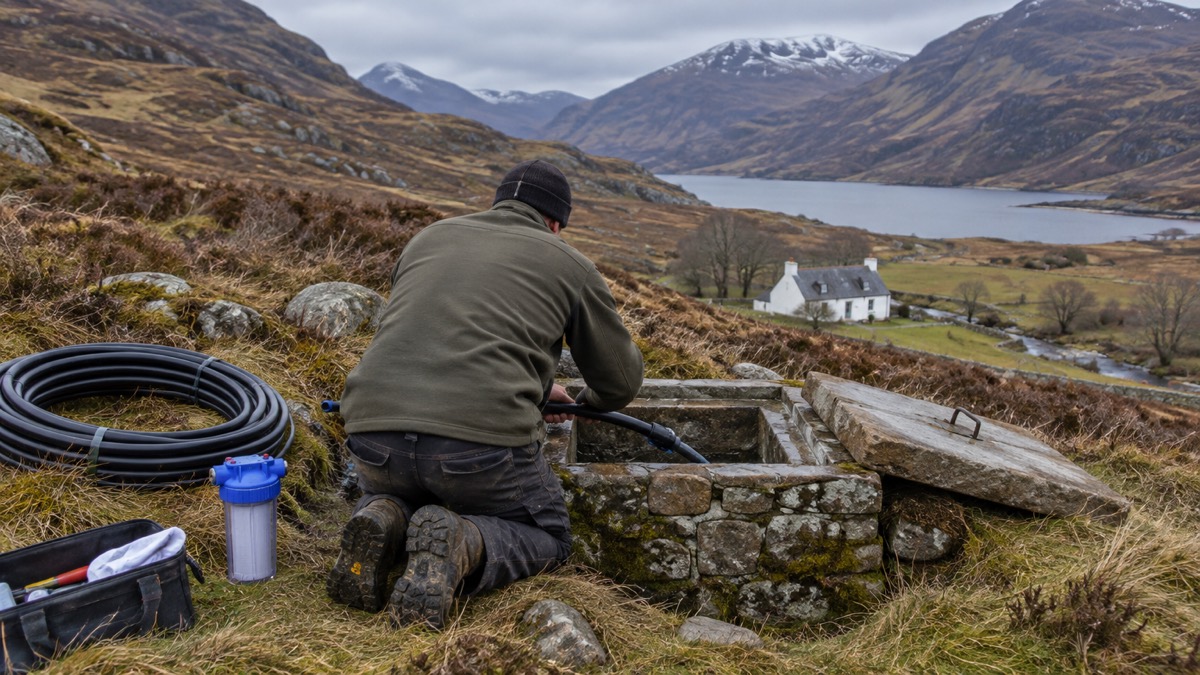
If your home in Scotland gets its water from a well, borehole, spring or watercourse rather than from Scottish Water, the Scottish Government will help pay to improve that supply. The private water supply grant scheme offers up to £800 per property, it is not means tested, and it is delivered through your local council1. Around 3% of Scotland's population gets drinking water this way, from supplies that are not owned or operated by Scottish Water1.
Applications for the grant can be made by owners, occupiers or landlords2. The single most important rule is timing: grants cannot be issued retrospectively for works that are already started or completed, so you must have the grant approved before anyone lifts a spade2.
This page sets out who can apply, what the money can cover, how the application works through your council, and where to get advice before and after. It also covers what happens if you are buying a home on a private supply, and why the grant cannot be used to connect to the public mains.
What the grant is and how much it pays
The private water supply grant scheme is funded by the Scottish Government and delivered by local councils, offering up to £800 to eligible persons improving their existing private water supply1. Councils describe it consistently: non-means tested grant funding of up to £800 per property may be available to improve your private water supply5, and grants of up to £800 per property are available without means testing2. The figure is per property served, which matters for shared supplies: a supply serving several dwellings attracts the grant for each property it serves, not one payment for the whole scheme6.
The grant exists because private supplies fail in ways mains water does not. A private water supply is any water supply which is supplied to a property and does not originate from a mains supply or licensed water supplier7. Sources include boreholes, natural springs and watercourses7, and each of these can be contaminated by grazing animals, slurry spreading, run-off or ageing pipework. Councils expect that a suitable treatment system will be installed and maintained on all water supplies to ensure the water is safe for human consumption8, and the grant is one of the main ways households pay for that work.
The £800 will not always cover the whole job. It is a contribution towards the cost of improvement works9, and for larger schemes on shared supplies the per-property structure means the money adds up across the properties served. Before you plan around the grant, ask your council what has already been claimed on the property, because eligibility depends in part on whether a grant has been paid before10.
Who can apply: owners, occupiers and landlords
Applications can be made by owners, occupiers or landlords2. That breadth is deliberate: the person who pays for improvements is not always the person who owns the supply. The Drinking Water Quality Regulator for Scotland advises that if you have a query or would like advice about how to manage your supply, you should talk to your local authority3, and the grant application goes to the same place.
Responsibility for a private supply follows ownership and control. Public health guidance is clear that a problem with a private supply needs to be dealt with by the owner or occupier of the home, or anyone else with ownership or control over the water source or supply, with the local authority able to advise11. For a landlord, that means a tenant's drinking water is the landlord's problem to fix, and the grant is open to landlords precisely for that reason. Supplies serving the public or commercial operations are treated more strictly: if your private water supply serves the public or a commercial operation, you are required by law to have it tested12. That includes self catering properties, food businesses, factories, sports centres, hotels, B&Bs, schools and campsites2.
For shared and community supplies, the Drinking Water Inspectorate advises that, where possible, the relevant persons establish agreements, preferably written and legally binding, setting out clear accountabilities and responsibilities for running the supply, including costs and contingency arrangements13. If several households share a spring and each wants grant-funded work, having that agreement in place first makes the application and the works far simpler.
What the grant can pay for
The grant funds work that makes a private supply safe and reliable. Councils list the kinds of improvement works it covers8:
| Improvement work | What it does |
|---|---|
| Fencing around the source or collection tanks | Keeps grazing livestock and other animals away from the water8 |
| Drainage ditches | Prevents ground water run-off reaching the source8 |
| Repairing collection chambers, fitting tight lids | Stops debris and animals getting into the collected water8 |
| Clearing overgrown vegetation | Reduces contamination risk around the source8 |
| Repairing old leaking pipes and taps | Prevents water loss and entry points for contamination8 |
| Replacing lead pipe | Removes a direct health risk from the drinking water8 |
| Installing appropriate water treatment | Makes the water wholesome at the tap8 |
Replacing defective or otherwise unsuitable treatment is specifically covered: if you have not already received a non-means tested grant you may still be eligible to receive one to carry out improvements to your supply or replace defective or otherwise unsuitable treatment4. Case studies from the Drinking Water Inspectorate show what this looks like in practice. At one site, water was treated with UV treatment and pH correction before being distributed to the properties, and when problems arose the local authority's notice required the treatment system to be checked and, if necessary, improved by a competent person14. At another, a sand filter was installed as additional pre-treatment to deal with high colour and turbidity, with annual inspections thereafter14. A third supply's treatment comprised iron and manganese removal, pH adjustment, filtration and UV disinfection15.
The lesson from those cases is that treatment is not a one-off purchase. As one Inspectorate case study puts it:
"Premises owners must appreciate that water treatment is not 'fit and forget'"
The same case study records that the owner arranged an annual inspection and maintenance contract alongside the installation15. The grant can pay to put right a treatment system that was badly installed or has failed, but budget for its ongoing servicing separately.
Extra water storage when the supply runs short
Insufficiency, where a supply cannot keep up with demand or dries up altogether, is a growing reason for grant-funded work. Somerset Council reports that insufficiency is becoming an ever increasing problem with private supplies, due to the impact of climate change, and that each summer it gets calls from private supply users whose springs, wells or boreholes have dried up, sometimes for many months8. NHS inform in Scotland notes that houses with a private water supply may be more vulnerable to drought because private supplies often rely on small water sources that can dry up quickly16.
The grant can help here, with a condition. Argyll and Bute Council states that the current private water supply grant scheme can assist in the provision of increased storage where adequate treatment of the supply already exists, where insufficiency is a regular issue9. So if your spring reliably runs dry each summer but the water is properly treated when it flows, storage is a legitimate grant-funded improvement. If treatment is inadequate as well, expect the council to want the treatment addressed.
Storage on a private supply takes practical forms. Inspectorate guidance describes how storage may take the form of a small covered reservoir, providing sufficient head to supply more than one property, or may be a suitably positioned storage tank, for instance in the roof space of the property, from which water flows under gravity to the taps17. Its purpose is to provide a reserve of drinking water to cater for fluctuations in demand, time out for planned maintenance or any problems17. In one Inspectorate case study, water is pumped to a covered holding reservoir before being gravity fed to the properties18.
Alongside storage, Natural Resources Wales advises owners to consider deepening a well or borehole to reduce the chances of it drying up, and to consider installing water storage tanks to make the supply more resilient in dry weather19. When a supply does run low, Scottish Borders Council advises that first steps are likely to include reducing current usage to conserve the supply and considering where you could access drinking water should the supply stop2. Cornwall Council adds the short-term options: alternative drinking water supplies, bottled water for drinking and food preparation, water delivery by tanker, and reducing water-intensive activities20. Our page on when a private water supply runs low or dry covers those immediate steps in full.
Buying a home on a private supply
If you are buying, or have just bought, a home served by a private supply, the grant question comes with the purchase. Argyll and Bute Council's advice to buyers is direct: have the owners or previous owners already had a private water supply grant? If not, you will probably be eligible for a non-means tested grant10. Ask the seller, and confirm with the council, because the answer shapes what you can claim after moving in.
It is worth understanding what you are taking on. Inspectorate guidance for buyers explains that any private water supply used for domestic purposes that supplies two or more dwellings and/or other properties must be risk assessed every 5 years and regularly tested in accordance with the regulatory requirements by the local authority21. If the supply provides water for domestic purposes to only a single dwelling, the regulations do not require a risk assessment or testing unless requested by the owner or occupier, unless the dwelling is in Wales and rented to tenants, unless it is in England, rented and meets the criteria in the guidance on regulation 9, or unless the local authority believes there to be a risk to health21. The frequency of testing for multi-dwelling supplies depends on the supply type21.
A risk assessment is a worthwhile pre-purchase check to commission. During a risk assessment the whole supply will be assessed from the source to the taps, areas of potential contamination will be identified, and advice will be given on how to reduce the associated risks, with samples taken to assess the quality of the drinking water2. The Inspectorate's case studies show why this matters: at one site a risk assessment found the supply source was contaminated with animal faeces after the water turned brown following heavy rainfall15, and at another, lead in drinking water was identified as an overlooked health risk in small domestic private supplies, with a connection to the public mains supply among the options considered22. Our page on private water supply regulations explains the testing regime in more detail.
Works must not start before the grant is approved
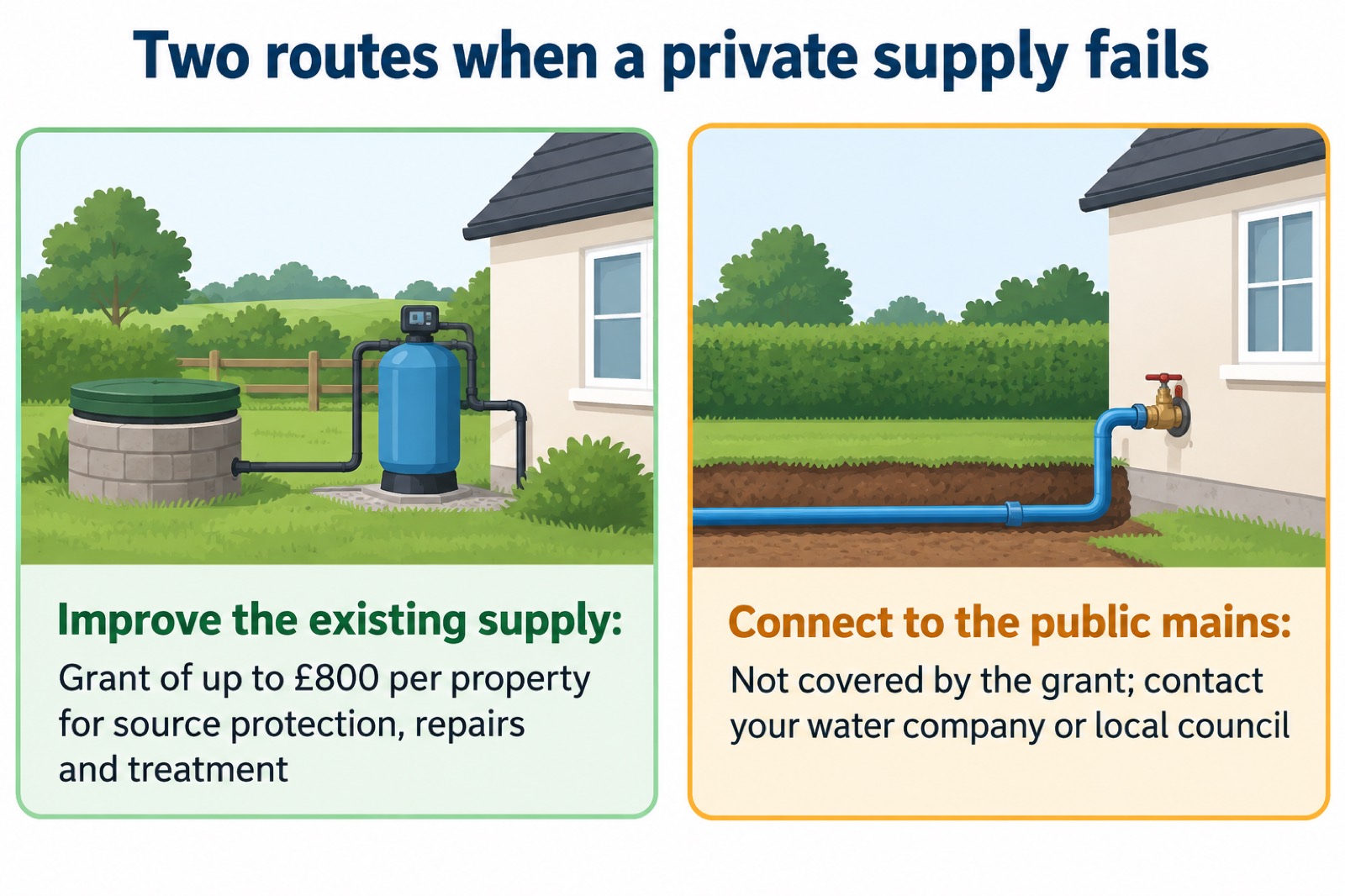
This is the rule that catches households out. Scottish Borders Council states it plainly: grants cannot be issued retrospectively for works which are already started or completed, or to allow users to connect to the public mains water supply2. The same council confirms the grant is non-means tested and that applications can be made by owners, occupiers or landlords2, so the timing rule, not your finances, is the usual obstacle.
The exclusion on mains connection is worth repeating because households often assume the grant could fund a permanent fix by joining the public network. It cannot2. If your long-term answer is a mains connection, that is a separate process: contact your water company or local council for information on connecting to a mains supply19. In one Inspectorate case study, the owners were advised to seek long-term mitigation through a connection to a public supply or to substantially improve the supply to the satisfaction of the local authority23, which shows the two routes councils point to, and only the second is grant-funded.
How to apply through your local council
The Scottish Government provides funding to local councils to deliver the private water supply grant scheme1, so the application is made to your own council, normally through its environmental health or public health team. The steps below follow the process councils describe.
- Register the supply. All private water supplies must be registered with the council; Argyll and Bute, for example, keeps a continually updated register and notes that the register may be shared with other public bodies such as the Scottish Environmental Protection Agency (SEPA)12.
- Ask for a risk assessment. During a risk assessment the whole supply will be assessed from the source to the taps, with samples taken to assess drinking water quality4.
- Use the feedback letter and report. A feedback letter and report will detail improvements if required, providing the basis for obtaining quotes from tradesmen for the grant4.
- Get quotes for the work. The report is what your quotes should be priced against, so the works match what the council has identified4.
- Submit the application and wait for approval. Do not start works until the grant is approved2.
- Complete the works and claim. Follow your council's instructions on evidence and invoicing, which the environmental health team will set out when the grant is approved5.
Contact details vary by council. Argyll and Bute Council asks enquirers to contact it on 01546 605519, or to email envhealth@argyll-bute.gov.uk outlining the private water supply situation4. Scottish Borders Council takes private water supply calls on 0300 100 18002. If you are unsure which team handles supplies in your area, the Drinking Water Quality Regulator for Scotland's guidance for owners and users points you to your local authority for queries or advice about managing your supply3.
Be aware that the council may charge for some of its private water supply activities. The Regulations allow the local authority to recover these costs, and charging rates should be available on their websites, usually found by searching for "private water supplies"21. Ask the environmental health team what the risk assessment and sampling will cost before you commission them.
Getting your supply tested
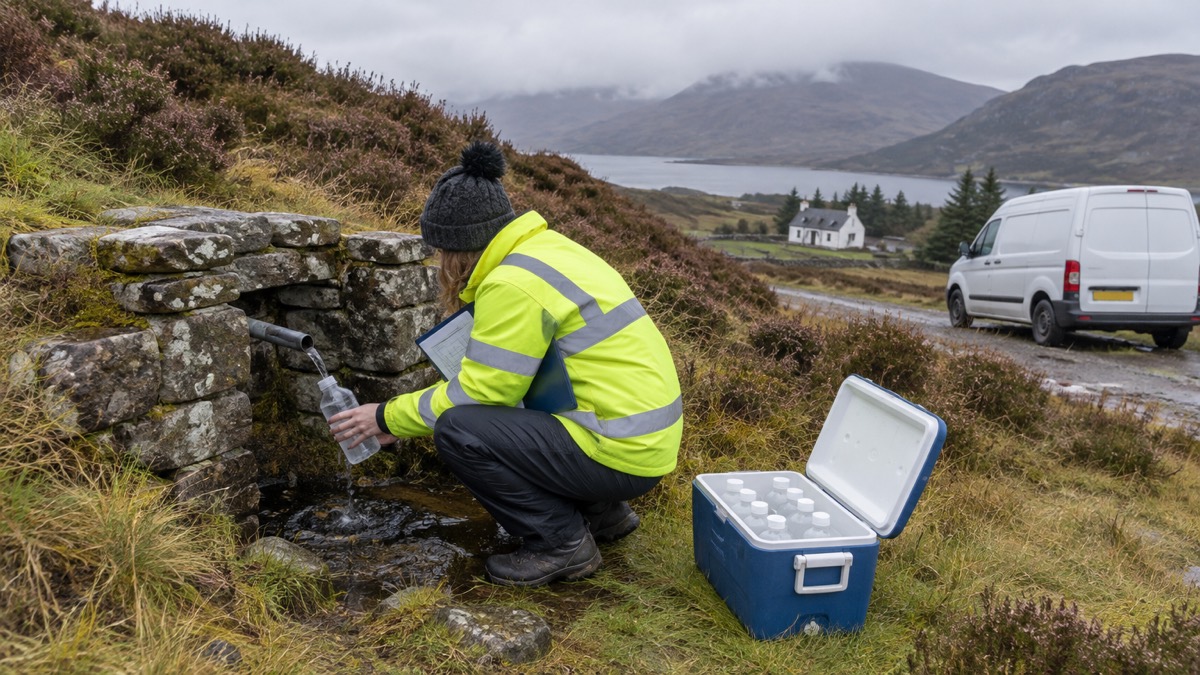
Testing is the evidence base for the grant. Councils test private water supplies to check for bacteria, chemicals and metals24, and the risk assessment report that follows is what tells you, and the grant process, what needs fixing4.
What testing is required depends on the supply. In Scotland there are two types of private water supply, and the legislation relating to each is different25. Supplies serving 50 or more persons in total, or supplies to commercial or public activities irrespective of size, fall into the stricter regulated category12. Any supply used for domestic purposes that serves two or more dwellings must be risk assessed every 5 years and regularly tested in accordance with the regulatory requirements21. A single-dwelling supply is not routinely tested unless the owner or occupier requests it, the dwelling is rented in certain circumstances, or the local authority believes there is a risk to health21. Private distribution supplies, where water comes from a company and is shared with others, for example at caravan parks, are tested based on risk24.
If your supply serves the public or a commercial operation, testing is a legal requirement, not a choice12. Commercial purposes include food and drink production businesses, holiday lets and short-stay accommodation, tenanted properties, cafes and teashops20. Landlords and holiday-let owners should treat the annual check as part of running the business.
Where to get advice on your private water supply
In Scotland, the first stop for advice is your local authority's environmental health team3. Beyond the council, the Scottish Government provides advice and information for owners and users of private water supplies in Scotland through its information site mygov.scot25. That site includes information about getting your private water supply tested, charges for this, and the private water supply grant to help improve your supply3. The grant itself is administered by local authorities, on behalf of the Scottish Government3, so mygov.scot is where you read about the scheme, and your council is where you apply.
The Drinking Water Quality Regulator for Scotland also publishes guidance for owners and users at dwqr.scot, and councils such as Argyll and Bute direct private supply queries there for more information12. Argyll and Bute's own pages cover requesting assistance, sampling, and what to do on losing a supply4.
Elsewhere in the UK the arrangements differ. In Northern Ireland, your local council will normally lift a sample, when asked, from a private water supply which serves a single private home, and for concerns you should contact the Drinking Water Inspectorate (Northern Ireland) or the Environmental Health department of your local council26. In Wales, contact your water company or local council for information on connecting to a nearby mains supply, and contact your local authority if water quality concerns arise27. In England, local authorities carry out the equivalent regulatory role, sampling all supplies except those which serve only one domestic property which is owner occupied20. There is no UK-wide equivalent of the Scottish grant scheme in the facts available to households in England, Wales and Northern Ireland, so if you live outside Scotland, ask your own council what help exists locally.
Connecting to the public mains
The grant cannot fund a mains connection2, but the Scottish Government has run a separate route for communities whose supplies are failing in dry weather. The private water supply connections pilot project helped eligible communities affected by water scarcity explore opportunities to extend the public water network to them1. It was a Scotland-wide scheme where councils nominated affected communities, and the pilot assessed the extension of the public water supply to shortlisted communities1. It was delivered with Scottish Water, Consumer Scotland and local councils1.
The project's aims were to improve Scotland's resilience to water scarcity, to better understand the challenges of extending the public water network to communities with private supplies, and to learn lessons for future climate change projects1. If your community's supply repeatedly fails in droughts, it is worth asking your council whether any future scheme is planned, while pursuing grant-funded improvements to the existing supply in the meantime.
Sources (27)
- Private water supplies policy, Scottish Government, 2026
- Private water supplies: grants and advice, Scottish Borders Council, 2026
- Owners and users of private water supplies, Drinking Water Quality Regulator for Scotland, 2026
- Private water supplies: assistance and grants, Argyll and Bute Council, 2026
- Public health and housing: private water supply improvement grant, Argyll and Bute Council, 2026
- Private water supplies water sampling, Argyll and Bute Council, 2026
- Learn more about private water supplies, Drinking Water Inspectorate, 2026
- Private water supplies, Somerset Council, 2026
- Loss of supply: private water supply users, Argyll and Bute Council, 2026
- Private water supplies: your property, Argyll and Bute Council, 2026
- Weather and health: private water supplies, Public Health Wales, 2026
- Private water supplies, Argyll and Bute Council, 2026
- Managing insufficiency of private water supplies, Drinking Water Inspectorate, 2025
- Water safety plan approach to improving the safety of a private supply, Drinking Water Inspectorate, 2022
- Private supplies require active management to ensure they are safe, Drinking Water Inspectorate, 2013
- How to stay safe during a drought, NHS inform Scotland, 2026
- Water storage on private supply networks, Drinking Water Inspectorate, 2025
- Faecal contamination of a supply, Drinking Water Inspectorate, 2022
- Drought planning and management, Natural Resources Wales, 2026
- Private water supplies, Cornwall Council, 2026
- Buying a dwelling with a private water supply, Drinking Water Inspectorate, 2026
- Lead in drinking water: the overlooked health risk in small domestic private supplies, Drinking Water Inspectorate, 2011
- Change of supply for long term remediation, Drinking Water Inspectorate, 2018
- Types of private water supply, Cumberland Council, 2026
- Private water supplies in Scotland, Drinking Water Quality Regulator for Scotland, 2026
- Dealing with drinking water problems, nidirect, 2026
- Drought planning and management (Wales), Natural Resources Wales, 2026