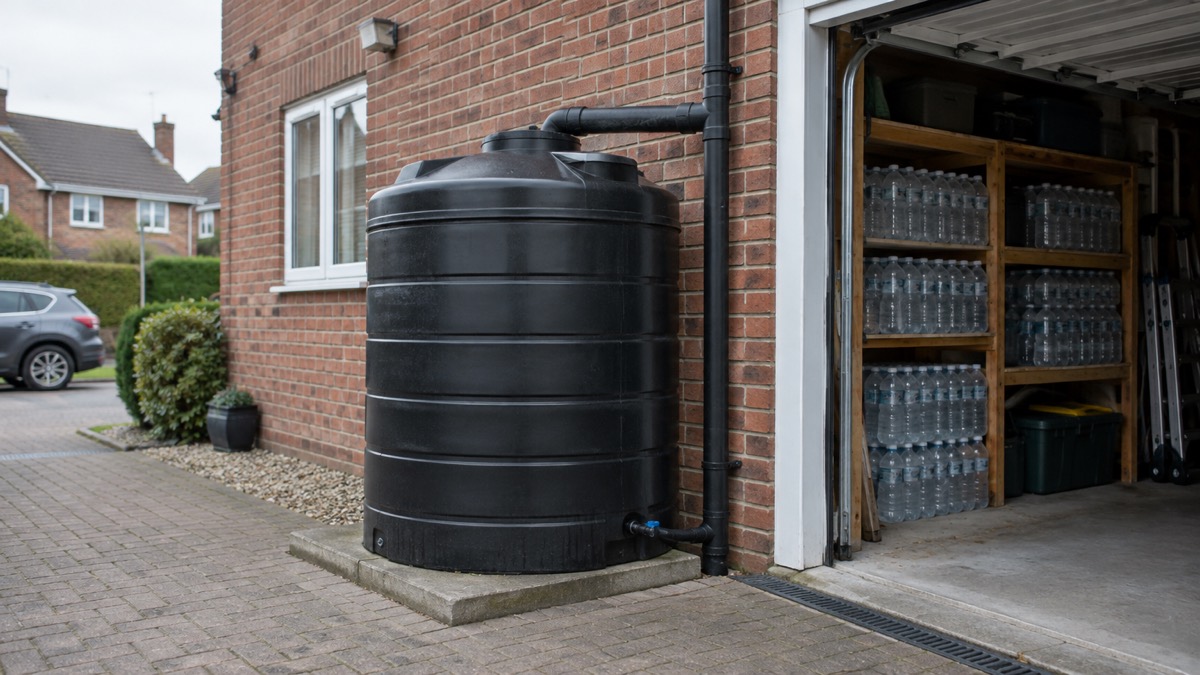
For most households, bottled water is the simpler and safer answer. The government's water supply guidance is direct: "Bottled water is the safest way to prepare for water outages"1. Keep at least three days' worth at 3 litres per person per day for drinking, and more for cooking and washing2. A storage tank earns its place only when you have a reason to hold a larger reserve, such as a private supply, a rural property or a long history of interruptions, and only if you can keep it clean.
The two behave very differently when the mains fail. Bottles are sealed, portable and ready the moment you need them, but they take up space, need rotating and run out. A tank holds far more, but it is fixed, it needs inspecting and cleaning, and water sitting still in it can deteriorate. Your water company also has its own plans: bottled water held for customers, static tanks and mobile bowsers for major incidents, and tankers to fill them3.
This page sets out how each option behaves, how much to store, how to keep both safe, where a tank must never go, and what hosepipe bans and water company supplies mean for your own stocks.
| Bottled water | Storage tank | |
|---|---|---|
| Suits | Most households, flats, anyone who may need to leave | Homes with space, private supplies, frequent or long interruptions |
| Ready to use | Immediately, if in date | After installation and a cleaning routine |
| Maintenance | Rotate stock before expiry9 | Inspect at least annually, preferably every six months8 |
| Risk if neglected | Out of date, warm storage, contamination once opened10 | No lid, warm water, low turnover, unsuitable materials, unqualified work5 |
| Portability | Full | None once installed |
Bottled water or a storage tank: how each behaves when the supply stops
The first thing to understand is that a supply interruption is usually short and your water company is already planning for it. Companies hold bottled water for customers during planned interruptions and incident response, arrange collection from stockpiles and doorstep delivery, and deploy static tanks, mobile bowsers and emergency tankers for major incidents3. That does not remove the case for your own store, because companies may not always be able to provide an emergency supply in bowsers or bottles, for example if they are dealing with their own emergency such as a mains burst7.
Bottled water suits most homes because it is sealed, needs no maintenance and can go in a cupboard, a garage or a bag if you have to leave. Its weakness is volume: bottles take up shelf space and need replacing, and keeping water usage to a minimum will prolong alternative sources of water such as water tanks3.
A storage tank suits households that want a larger reserve on site. Official guidance on private supplies describes tanks as a reserve of drinking water to cater for fluctuations in demand, planned maintenance or any problems, and says the tank should hold enough for peak demand and the maximum period of interruption, but not so much that water remains static for lengthy periods8. That balance is the whole art of tank storage.
How much water a household needs to store
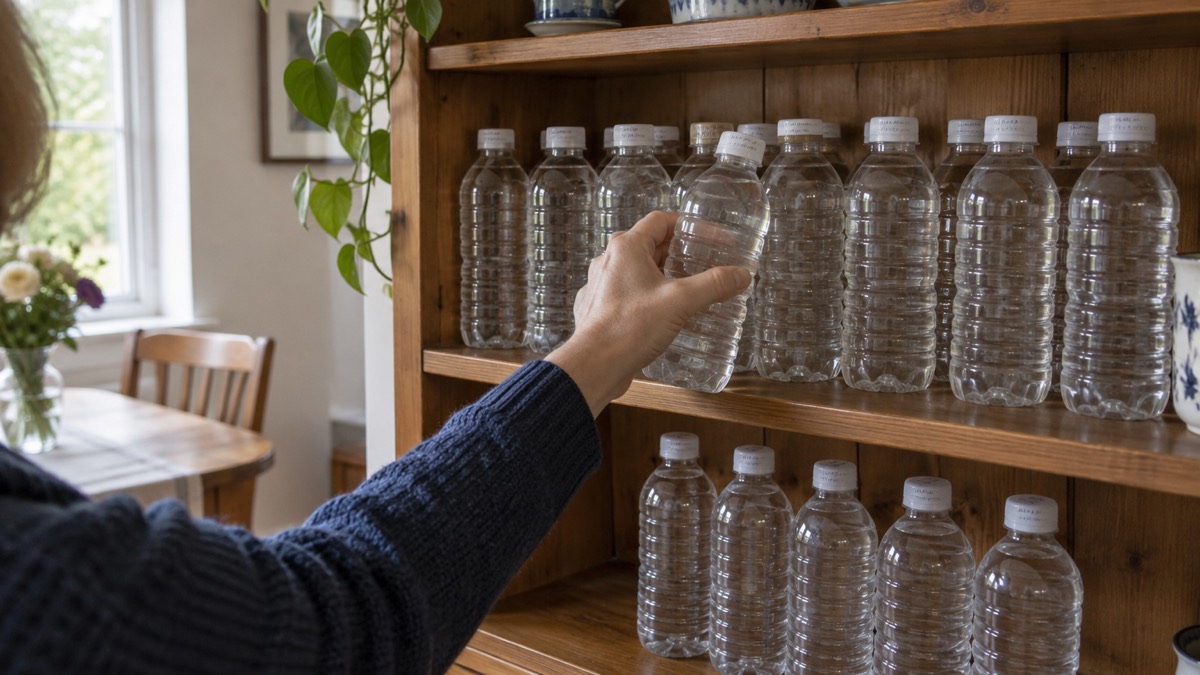
Official figures vary slightly, and the differences matter less than picking one and sticking to it. The Be Ready checklist says bottled water for 3 days at 3 litres per person per day for drinking, with more needed for cooking and washing2. Greater Manchester's resilience guidance gives a minimum of 2.5 to 3 litres per person per day for survival, and 10 litres per person per day for basic cooking and hygiene as well4. Dumfries and Galloway lists 2.5 litres of bottled water per person for each day11, and Worcestershire's household plan recommends a minimum of 2.5 to 3 litres per person per day12.
For a tank, the sizing rule is different: enough for peak demand and the longest interruption you expect, without letting water sit static for long8. A typical home cold water tank of 250 litres is described as quite sufficient for most homes, partly because a smaller tank keeps water turning over5.
Add the extras before you settle on a number. Additional water might be needed to make up baby formula, for medical devices and for pets4, and the Be Ready checklist lists pet food and bottled water in a pet kit2.
- Drinking only: 3 litres per person per day for 3 days2
- Drinking, cooking and basic hygiene: 10 litres per person per day4
- Babies, medical devices, pets: add their needs on top4
- Tank sizing: peak demand plus the longest interruption, kept small enough for turnover8
Our guide to how much drinking water to store per person works through the arithmetic for different household sizes.
Keeping bottled water safe to drink
Bottled water is not sterile, and it does not stay the same forever. NHS Scotland pharmacy guidance notes that the bacteria count in bottled water is much higher than in tap water, varies with the temperature at which it is stored, and can be very high if someone has drunk from the bottle10. Store bottles cool and dark, keep opened bottles for the shortest time you can, and never let anyone drink from a bottle you are keeping for an emergency.
Rotation is the discipline that makes a bottled store work. Wiltshire and Swindon's guidance on a national power outage advises holding a small amount of bottled water and making sure it is not past its expiry date9. Denbighshire's emergency supplies kit is blunter: bottled water will have to be replaced every six months13. Check dates when you buy, write the purchase date on the pack, and use the oldest first.
If you are storing tap water in bottles rather than buying it, the rules are slightly different. Bradford's flood pack says to store water in plastic containers such as soft drink bottles, and to avoid containers that will decompose or break, such as milk cartons or glass bottles5. Our page on storing tap water safely at home covers cleaning and filling.
Setting up a storage tank so the water stays clean
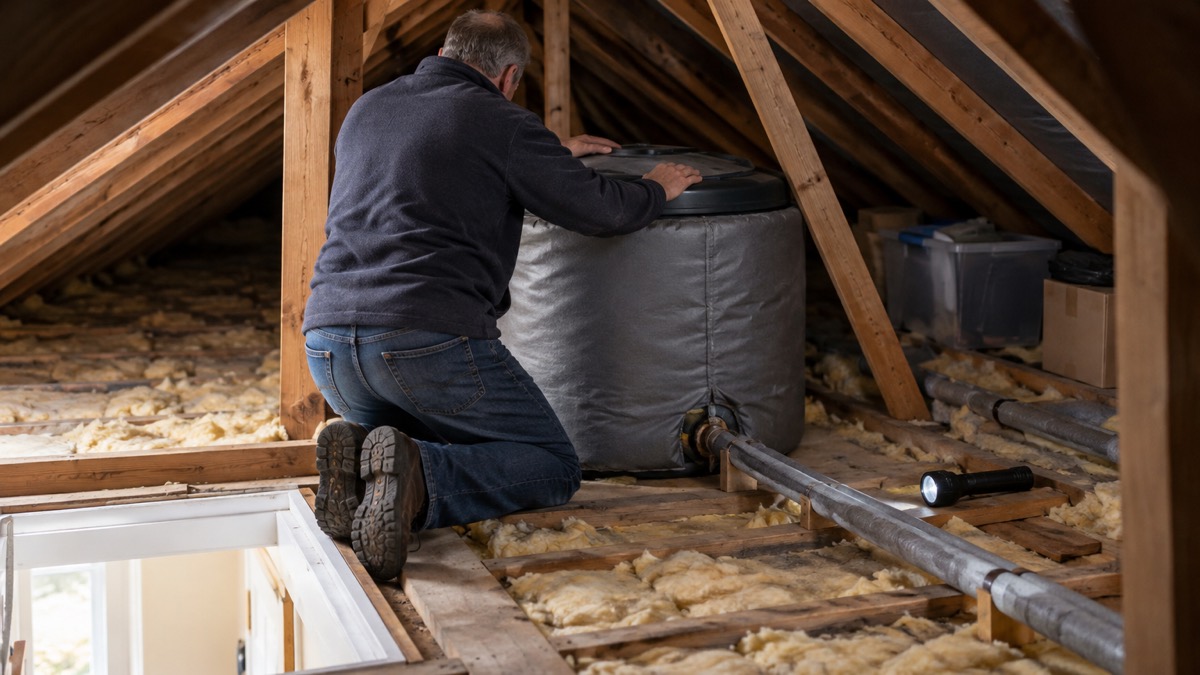
A tank is only as good as its installation and its routine. The Drinking Water Inspectorate's consumer guidance is reassuring but conditional: if your drinking water comes from a storage tank, it will be safe to use if the tank is properly designed, correctly installed and kept in good condition5. The same page lists exactly how water in a tank deteriorates: no lid on the tank, the water becoming warm, too much water stored so turnover is low, a tank made from or lined with an unsuitable material, and work on the tank carried out by an unqualified person5.
The physical requirements are specific. A tank must be fitted with a robust, lockable, well fitting but not airtight lid to exclude light and pollutants8. All storage tanks must be insulated to guard against freezing in winter and excessive warming in summer8. Tanks should be covered to reduce evaporation, which also reduces the risk of contamination14. Check the instructions supplied with the tank, as they should contain details of how to maintain and clean it5.
Then keep to a routine:
- Inspect at least annually, preferably every six months8.
- Check condition and water quality annually if the tank stores drinking water5.
- Clean to the maker's instructions, and if you are unsure, contact your water company for advice or use a WaterSafe registered plumber5.
- Keep the lid on and the insulation intact year round8.
- Watch turnover: if water sits for long periods, the store is too big for your use5.
If your supply comes from a well, borehole or spring rather than the mains, our guide to private supplies covers the extra checks, including what to do after floods or storms, when the supply should be checked from abstraction point to taps for damage, filters changed more often, and storage, intermediate and loft tanks cleaned15.
Where a stored water tank must never go
Most of the danger with stored water is not the water itself but what ends up beside it. The clearest rule is about chemicals: do not store cleaning liquids in unmarked containers or bottles, and keep them in the container they came in to avoid confusion16. A bottle of clear liquid next to a water container is an accident waiting to happen, particularly with children in the house.
Other siting rules from official guidance:
- Away from light and pollutants: the tank lid must exclude both8.
- Not in a place where it freezes or overheats: insulation is required for both8.
- Not so large that water stagnates: oversizing is a contamination risk, not a safety margin5.
- Not installed or worked on by an unqualified person5.
- Away from intense heat and direct sunlight if you store fuel containers nearby, which should never be filled completely and must be stowed securely upright17.
There is one more placement rule that catches people out. If you keep a Message in a Bottle, the scheme for recording medical details for emergency services, the bottle is kept in the fridge, where the emergency services will expect to look for it, with a sticker on the fridge door and another by the front door18. Do not move it into a water store or a cupboard.
Hosepipe bans and drought restrictions: what they mean for stored water
A hosepipe ban does not tell you to stop storing water. It restricts how you use mains water outdoors. If a hosepipe ban is in place where you live, you cannot use a hosepipe connected to your mains water supply for things like watering your garden, filling a paddling pool or washing your car19. Westminster's guidance puts it the same way: if your water company has declared a Temporary Usage Ban or hosepipe ban, avoid filling a paddling pool, washing your car and watering your garden20. Water companies may choose to enforce these bans to help conserve water19.
Stored water is a different matter. A covered tank or a shelf of bottles is your reserve for an interruption, not a garden supply, and nothing in the drought guidance restricts keeping it. What the guidance does encourage is capturing rain and using less mains water outdoors: install a water butt for rainwater from your downpipes, which can be connected to greywater systems such as toilet flushing and garden watering20, and in the garden use a watering can instead of a hosepipe and install a water butt if you can19. Scotland's hot weather guidance gives the same watering can advice21.
Drought also affects how companies treat their own storage. During dry weather, water companies have arrangements to provide alternative safe drinking water such as bottled water if restrictions are needed to protect treatment plants22. If you have a private supply, drought guidance covers what happens when a source runs low, including alternative supplies such as bottled water or water supplied in tanks or bowsers23.
When your water company provides bottled water
If the mains fail, help usually arrives in one of two forms. You may be given bottled water, or have water tankers or bowsers parked near your home for you to collect water from6. Companies hold bottled water for planned interruptions and incident response, arrange collection from stockpiles and doorstep delivery, and deploy static tanks and mobile bowsers for major incidents, filled by emergency tankers3. Our page on bottled supplies, tankers and bowsers explains what to expect at a collection point.
Two practical points. First, use less. Keeping water usage to a minimum will prolong alternative sources of water such as water tanks1. Second, know your own limits: companies may not always be able to provide an emergency supply in bowsers or bottles if they are dealing with their own emergency7, which is why the three day store matters.
If a notice says your water is unsafe, the instruction is to drink bottled water or an alternative supply provided by your water company or water provider24. If the drinking water is unsafe, do not use it to wash children; use tanker or bottled water25. Our guide to do not drink and do not use notices covers the difference between the two.
Some households should not wait for an incident to ask for help. The Priority Services Register can include access to bottled water during a water supply interruption, priority assistance, and tailored support if there is a power or gas outage26. Contact your water company to be added, and see our guide to extra help in an emergency for the wider picture.
Sources (26)
- Water supply interruptions or outages, Prepare (UK Government), 2026
- Be Ready Checklist, Be Ready (UK Government), 2026
- Loss of essential services, Greater Manchester Combined Authority, 2026
- Power, gas and water: what if they fail, Surrey County Council, 2025
- Water storage tanks and cisterns, Drinking Water Inspectorate, 2026
- Water risks message, NHS Scotland Community Pharmacy, 2024
- Alternative supplies for private water supplies, Drinking Water Inspectorate, 2017
- Water storage, Drinking Water Inspectorate, 2025
- What is a national power outage, Wiltshire and Swindon Prepared, 2026
- Emergency supplies kit, Denbighshire County Council, 2020
- Prepare for emergencies, Dumfries and Galloway Council, 2026
- Household emergency plan, Worcestershire County Council, 2026
- Create a flood pack, Bradford Council, 2026
- Loss of supply for private water supply users, Argyll and Bute Council, 2026
- Private water supplies after floods or storms, Argyll and Bute Council, 2026
- Safety for medicines and poisons, NHS West Yorkshire Healthier Together, 2026
- Fire risk on boats, Devon and Somerset Fire and Rescue Service, 2022
- Message in a Bottle scheme, Torbay and South Devon NHS Foundation Trust, 2019
- Droughts, Prepare (UK Government), 2026
- Advice and support on drought, Westminster City Council, 2026
- Hot weather, Ready Scotland, 2026
- What to do in a radiation emergency, GOV.UK, 2024
- Drought guidance for private water supplies, Drinking Water Inspectorate, 2026
- Receiving a boil water notice, Drinking Water Inspectorate, 2024
- Keeping children safe during a flood, nidirect, 2025
- Wellbeing and safety, Surrey County Council, 2026
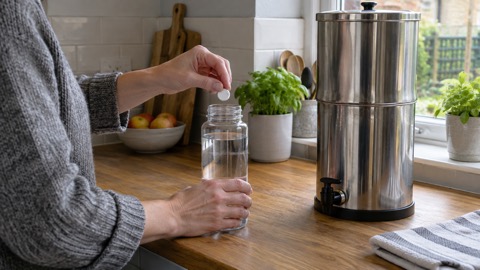 Tablets vs Gravity Filter
 Gravity vs Under-Sink Filter