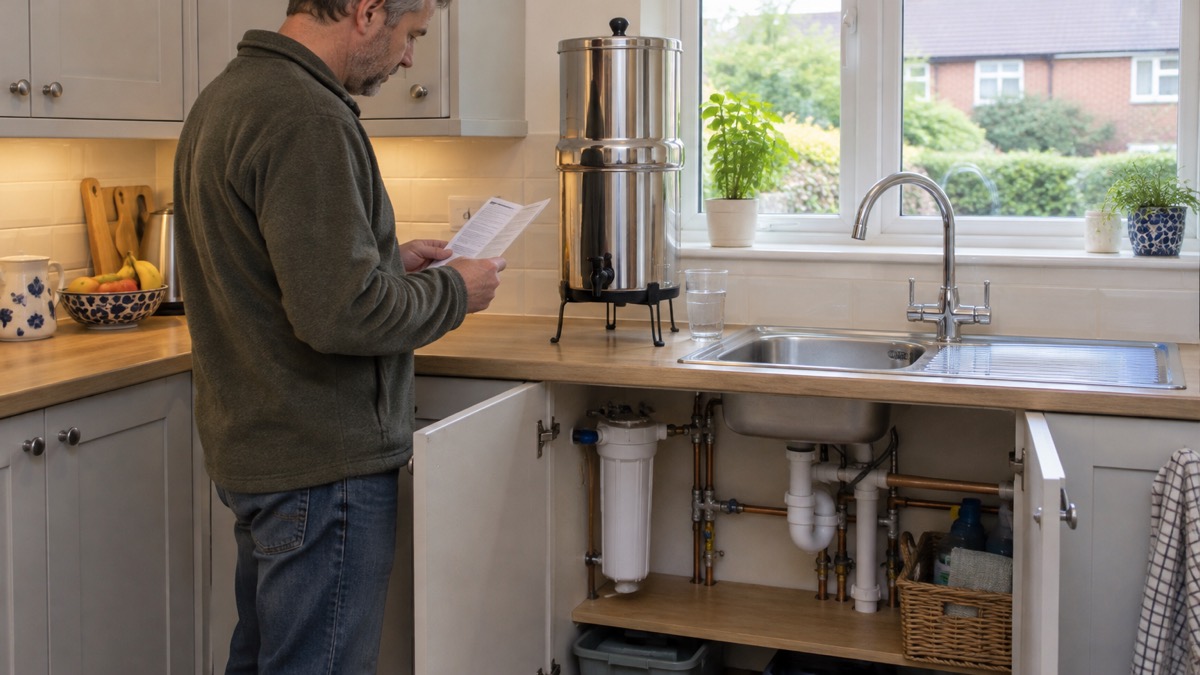
If you are choosing between a gravity filter and an under-sink filter, the decision turns on one question: what happens when the mains water or the power stops? A gravity filter needs no electricity and no plumbing. Water goes in the top, passes through ceramic elements under its own weight, and collects in the bottom chamber. The maker says these systems work during water or power outages1. An under-sink filter is plumbed into your supply and gives filtered water on tap, but it depends on mains pressure to push water through, and the maker recommends 30psi/2bar or more2.
That difference matters most in an emergency. A gravity system can be filled from a bottle, a bowser or a stored container and will still produce filtered water when the taps are dry. An under-sink system cannot: with no mains pressure there is nothing to filter. For a household preparing for interruptions, the gravity filter is the one that keeps working. For everyday filtered water with no refilling, the under-sink system is the more convenient choice.
This page sets out how each works, what each needs, how to set up and look after either one, and where a filter cannot help at all.
| Gravity filter | Under-sink filter | |
|---|---|---|
| Driven by | Gravity, no electricity1 | Mains water pressure2 |
| Works in an outage | Yes, during water or power outages1 | No, needs pressure to push water through2 |
| Fitting | None: place it where you want it10 | Plumbed in, ideally on a separate tap line9 |
| Refilling | Manual refilling required11 | Filtered water on tap9 |
| Speed | Slower, especially with ceramic8 | Faster, driven by pressure5 |
| Space | Takes up counter top space9 | Uses under-sink cupboard space9 |
How each filter works
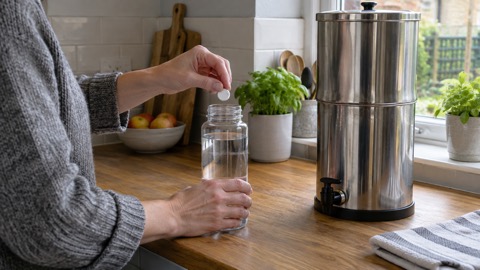
A gravity filter is two chambers stacked one on top of the other. You fill the top chamber with water, and gravity pulls it down through the filter elements into the bottom chamber6. The maker describes the contact time with the ceramic filter as helping to further reduce a range of contaminants7. There is nothing to plumb in and nothing to plug in. The trade-off is speed: the maker calls gravity, especially with ceramic elements, one of the slower methods of filtering water, and says that the more filters you install, the faster the water will flow through8.
An under-sink filter is an in-line unit fitted beneath the kitchen tap. The maker recommends running it on a separate line through a three-way tap or a pillar tap, so that your regular water pressure is not affected and you only filter the water you want to9. Water is pushed through the cartridge by the pressure in your pipes, which is why the system stops when the supply does. In return you get filtered water on demand, which the maker describes as better than a jug and just as good as a gravity system9.
A gravity filter keeps working when the mains water stops
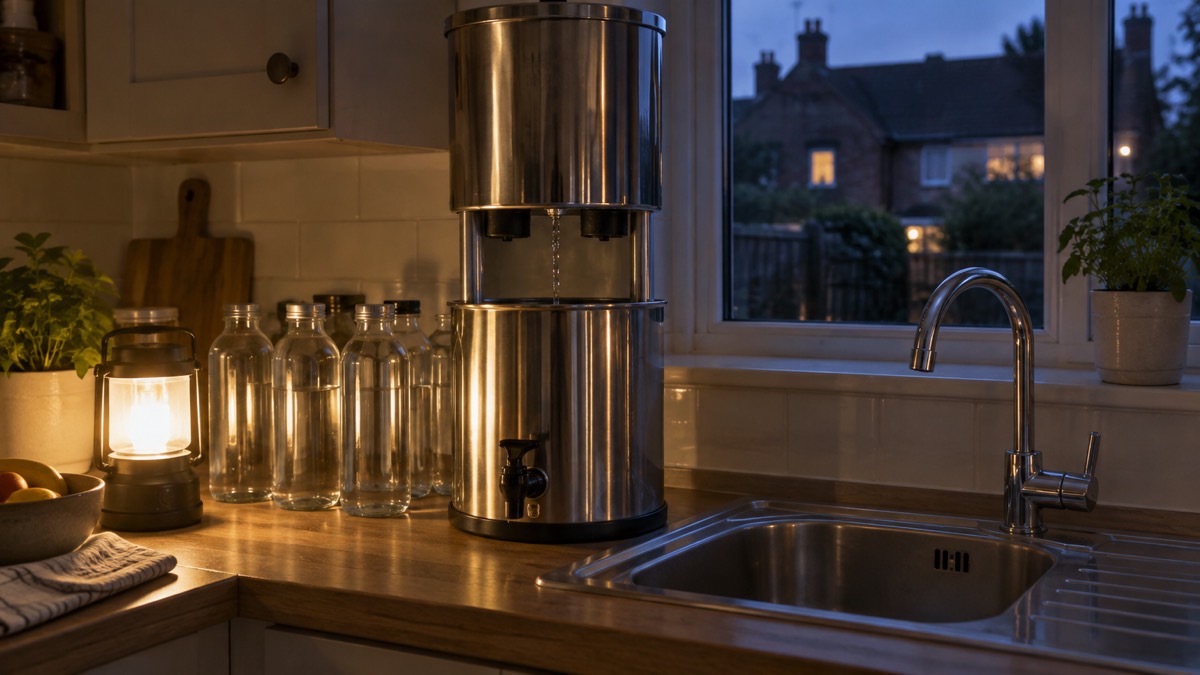
The case for a gravity filter in a UK household is mostly about the days when the supply is not normal. The maker states plainly that its gravity-fed systems work during water or power outages1. That covers the two failures a household is most likely to meet: a burst main or planned work that leaves the taps dry, and a power cut that takes out a pumped supply or a booster.
The system is also portable. The maker says it can be placed in a variety of locations inside and outside the home, including an office, garden or event, and that some people use them for off-grid living in narrowboats or motorhomes10. British Berkefeld describes its systems as perfect for use in emergency situations, allowing larger capacities of water to be stored and filtered12. That combination, storage plus treatment in one vessel, is what makes it useful when you cannot rely on the tap.
There are limits to plan around. Gravity filtration is slow, so start filling early rather than at the moment you need a drink. The maker also notes that a gravity system takes up counter top space and needs manual intervention9. In a household of several people, that means someone has to keep an eye on the top chamber and top it up.
An under-sink filter needs mains pressure to work
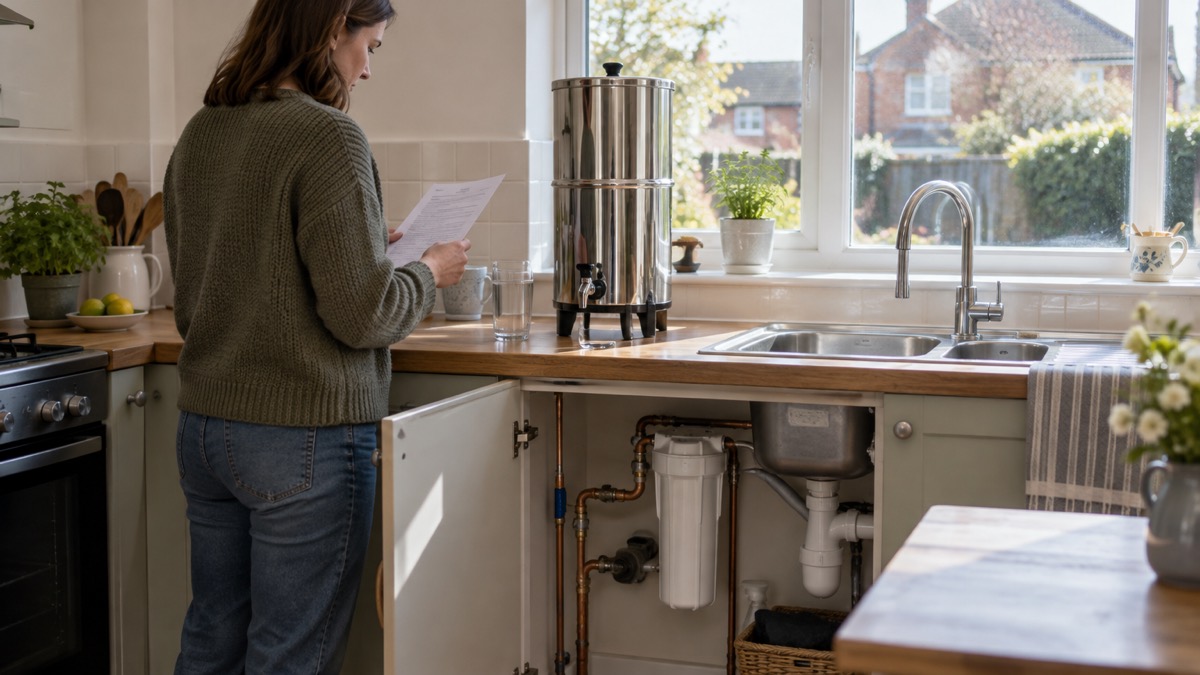
An under-sink filter is only as good as the pressure behind it. The maker of the Doulton Kingfisher system recommends checking your mains water pressure, ideally 30psi/2bar or more2. The HIP TRIO system carries the same guidance13. If your pressure is marginal, the maker gives you a way to test it at the kitchen tap: fill a 1 litre jug and time it. If it took anything over 12 seconds, the maker would not recommend using an under-sink system without seeking advice on your mains water pressure3.
That test is worth doing before you buy, not after. Low pressure is common in some UK homes, particularly at upstairs taps or where a system is fed from a tank rather than the mains. If your flow test comes out slow, the maker suggests considering the British Berkefeld range, which needs no plumbing14.
The other thing to understand is that an under-sink filter is a fair-weather friend in an emergency. It has no reservoir and no manual pump. When the mains stop, the filter stops with them, and when the power goes and your supply depends on a pump, the same applies. It is a convenience for normal days, not a resilience measure for the bad ones.
Setting up and using a gravity filter in an emergency
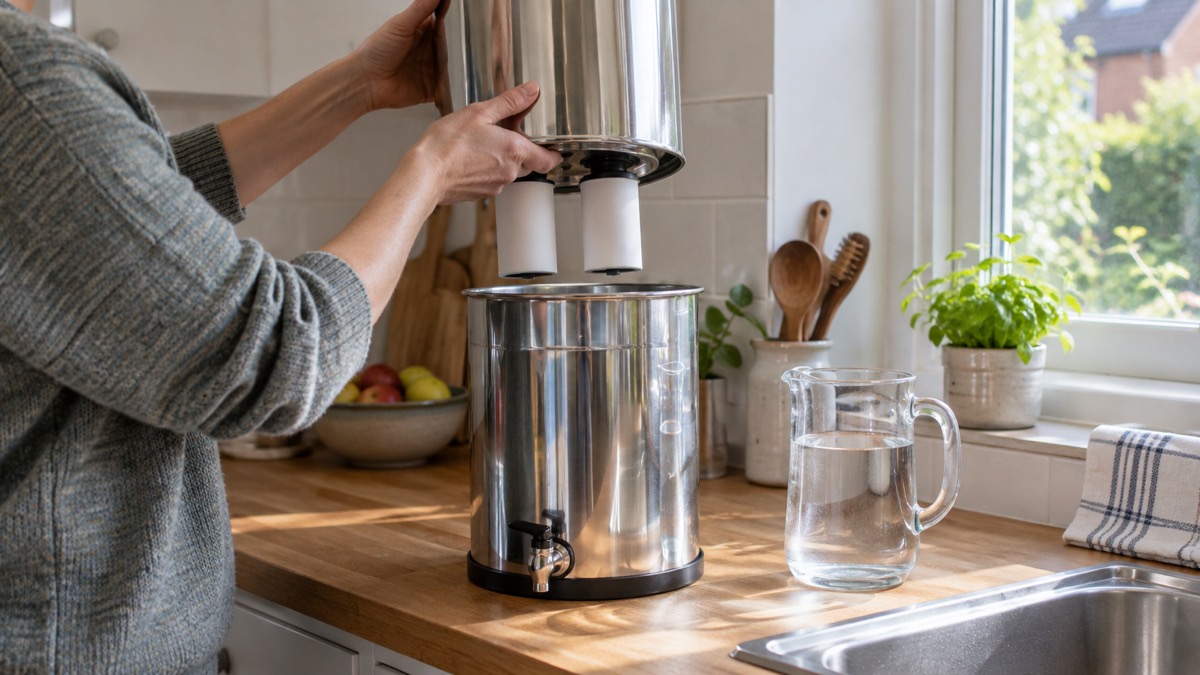
Setting up a gravity filter is deliberately simple. The maker says it is a case of installing the filter elements inside the top chamber and placing this over the bottom chamber10. For the first few uses, flush the water through and discard it11. The British Berkefeld manual describes the same two-container construction: an upper container filled with untreated water, filtering down through the filter elements into the bottom chamber15.
How many elements you fit decides how fast it runs and how much it can keep up with. British Berkefeld advises a minimum of two filter elements for two people, and a family of four or more should use four filter elements4. The larger 8.5 and 12 litre systems take up to four filters8.
In an emergency, work through it in this order:
- Fill the top chamber from your stored water, a bowser or a bottle, and put the lid on.
- Let it filter through under gravity. Do not expect it to be quick, especially with ceramic elements8.
- Draw filtered water from the bottom chamber. The maker states that all water that comes into the bottom chamber will be filtered water11.
- Top up the top chamber as soon as it empties, so the next batch is already filtering.
- Keep the outside of the housing clean and dry, and wipe up any spillage at once16.
Fitting and looking after an under-sink filter
An under-sink filter is a plumber's job, or at least a job for someone confident with pipework. The maker recommends a separate line through a three-way tap or a pillar tap9. The trade-offs are set out plainly by the maker: more difficult installation, loss of under-sink storage space and a higher initial cost9. In exchange you get higher capacities for lower maintenance and moderately improved functionality9.
Maintenance is mostly about cartridges. The Kingfisher and HIS systems are designed for use only with the Biotect Ultra and Biotect Ultra SI cartridges3. When you replace the pre-filter cartridge and the ceramic filter, only the filters themselves change; the housing remains in place14. For more targeted contaminant reduction, the maker points to its DUO or TRIO systems17.
| Under-sink task | What the maker says |
|---|---|
| Check pressure first | Ideally 30psi/2bar or more2 |
| Flow test | Over 12 seconds for 1 litre means seek advice before fitting3 |
| Tap arrangement | Separate line through a three-way or pillar tap9 |
| Cartridges | Biotect Ultra and Biotect Ultra SI only3 |
| Replacement | Filters and cartridges change; housing stays14 |
Where a filter cannot make water safe
A filter is a treatment device, not a guarantee. Two limits matter for a household.
The first is the boil notice. If your water company issues a boil notice, the instruction is to boil your water, and a filter does not replace that. Read what to do if you get a boil water notice and follow it. A gravity filter will keep running during the interruption, but running is not the same as making unsafe water safe.
The second is the source. A ceramic candle filters under gravity without electricity, but that tells you how it is powered, not what it removes from a stream or a rainwater butt18. The maker states that its Biotect Ultra cartridge is not suitable for use in gravity filter systems19, so do not assume any cartridge fits any housing. If you plan to treat collected water, read drinking from streams, rivers and other sources safely and what each filter type removes before you rely on it.
Choosing the right filter for your household
The choice comes down to what you want the filter to do.
Choose a gravity filter if you want water security during interruptions, if your mains pressure is low, if you rent and cannot plumb anything in, or if you want one vessel that stores and treats water. The maker suggests a gravity system suits households with varying numbers of users, because you can place it where needed and keep it topped up accordingly9. It is also the option for off-grid settings such as a narrowboat or motorhome10.
Choose an under-sink filter if your priority is filtered water on tap every day with minimal effort, your pressure passes the flow test, and you have cupboard space to give up9. It is the more permanent solution in the heart of the home7.
| Your situation | Better fit |
|---|---|
| Want filtered water during outages | Gravity1 |
| Low mains pressure or slow flow test | Gravity, which needs no plumbing14 |
| Want filtered water on tap daily | Under-sink9 |
| Renting, or cannot alter pipework | Gravity, placed where you like10 |
| Off-grid, narrowboat or motorhome | Gravity10 |
| Family of four or more | Gravity with four elements4 |
Whichever you choose, keep a store of bottled or stored water alongside it. A filter treats what you put in; it does not replace a reserve. Our water section sets out the wider picture, and the supply interruption checklist lists what to have ready before the taps stop.
Sources (19)
- Countertop Water Filter Systems, Doulton, 2026
- Doulton Kingfisher Under Sink Water Filter System with Biotect Ultra, Doulton, 2026
- Doulton Kingfisher Under Sink Water Filter System with Biotect Ultra (Canada), Doulton, 2026
- British Berkefeld Stainless Steel Gravity System + Ultra Sterasyl Ceramic Filters, Doulton, 2026
- Countertop Water Filter Systems (EU), Doulton, 2026
- British Berkefeld, Doulton, 2026
- Ceramic Water Filters: What They Are and How They Work, Doulton, 2026
- British Berkefeld (Poland), Doulton, 2026
- How Do I Choose a Water Filter, Doulton, 2026
- Countertop Water Filter Systems (US), Doulton, 2026
- Countertop Water Filter Systems (France), Doulton, 2026
- Portable Water Filters, Doulton, 2026
- Doulton HIP TRIO Under Sink Water Filter System with Biotect Ultra, Doulton, 2026
- Doulton Kingfisher Under Sink Water Filter System with Biotect Ultra (EU), Doulton, 2026
- British Berkefeld Gravity Filter Instructions, Doulton, 2025
- British Berkefeld SS2 Ultra Sterasyl Gravity System Instructions, Doulton, 2025
- Doulton HIS Push-fit Under Sink Water Filter System with Biotect Ultra, Doulton, 2026
- Water Filter Candles, Drinking Water Quality Regulator for Scotland, 2026
- Test Data, Doulton, 2026
 Tablets vs Gravity Filter
 Storage Tank vs Bottled Water