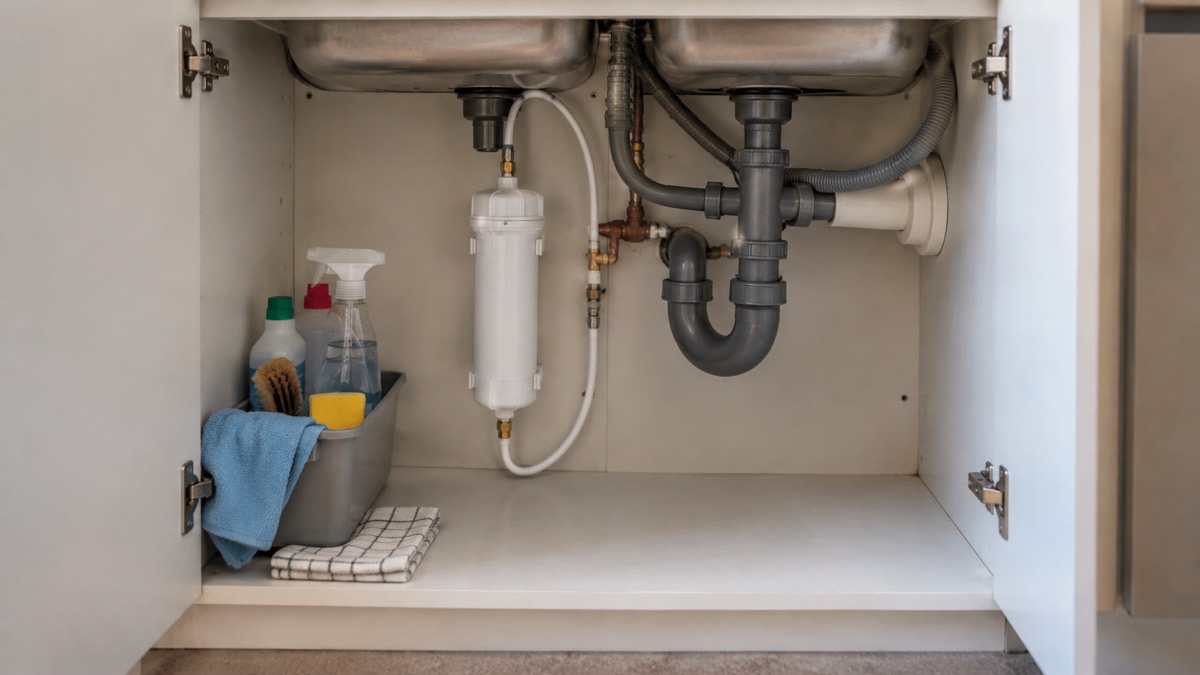
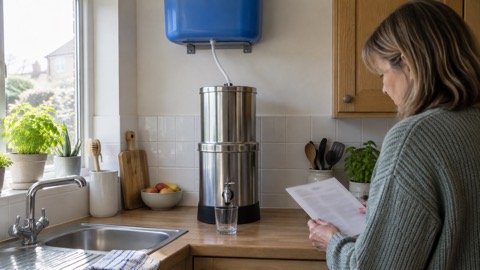
The Doulton HIS is an under-sink water filter: a stainless steel housing that sits in the cupboard below your kitchen tap, fed from the cold mains, holding a ceramic filter cartridge that the maker says reduces chlorine, microplastics, bacteria and cysts, insecticides and herbicides, and heavy metals1. For a household getting ready for emergencies, its value is simple and its limits are just as simple. It gives you good-tasting filtered water every day from your own tap, so you are not buying bottled water as a matter of routine, and it keeps doing that through most of the small disruptions a household actually meets. What it cannot do is make water appear when the supply stops, or make contaminated mains water safe to drink during a boil notice.
So the practical answer is this. Fit the HIS if you want a permanent, plumbed filter at the kitchen sink and you are comfortable with a push-fit connection, which the maker says needs no plumber, dependent on your DIY expertise2. Keep a separate store of drinking water for interruptions, because the filter depends on mains pressure. And when your water company issues a boil notice, stop drinking from the filter, boil your water as instructed, and change the cartridge once the notice is lifted3.
The rest of this page sets out what the HIS does, how its versions differ, what the specifications mean for your cupboard, how to fit and look after it, and where it sits in a household water plan alongside stored water and portable filters.
What the Doulton HIS does for a household
The HIS is a point-of-use filter. Water comes off the cold mains, passes through the Biotect Ultra cartridge and leaves through a dedicated spout or a three-way tap. Doulton lists the reductions as chlorine, microplastics, bacteria and cysts, insecticides and herbicides, and heavy metals1. In ordinary use that means better-tasting water without the recurring cost and storage burden of bottled supplies, and one less thing to think about in the weekly shop.
For emergency planning, think of it as the everyday layer of a water plan rather than the emergency layer. It improves the water you already have. It does not create water, store water or treat water you have collected from elsewhere. The maker's own framing of the problem is instructive: Doulton says that natural disasters, supply interruptions or boil water advisories can leave you limited water supplies, and points to its portable filters, which need no plumbing or electricity, as the answer for that situation6. The HIS is the plumbed, permanent member of the same family.
That division of labour is worth setting out plainly, because it decides what you buy and what you keep in the cupboard.
| What you need it to do | Does the HIS do it? | What to use instead |
|---|---|---|
| Improve the taste and quality of mains water every day | Yes: it reduces chlorine, microplastics, bacteria and cysts, insecticides and herbicides, and heavy metals1 | Nothing else needed |
| Give you water when the mains supply stops | No, it depends on mains pressure | Stored water, and a supply interruption checklist |
| Make collected rainwater, stream or bowser water safe | No, it is a plumbed mains unit | A gravity filter or filter bottle |
| Keep working in a power cut | Yes, it needs no electricity | Nothing else needed |
| Protect you during a boil notice | No, you must still boil | What to do if you get a boil water notice |
The last two rows are the ones households most often get wrong. The HIS has no electrical parts, so a power cut does not affect it, which is a genuine advantage over anything with a pump or a UV lamp. But a boil notice is a statement that the water reaching your tap may be contaminated, and a filter downstream of that tap does not change the instruction to boil3.
Versions: HIS, HIS Push-fit and HIS Stainless Steel PushFit Undercounter
Doulton sells the HIS in more than one form, and the names overlap enough to confuse a buyer. The core product is the HIS Push-fit Under Sink Water Filter System with Biotect Ultra: a WRAS-approved undermount filter with push-fit connectors and a Biotect Ultra cartridge, supplied with a Doulton Undercounter Installation Kit2. The maker describes it as an under-sink mains water filter with push-fit connectors2, and lists it in its systems collection as the HIS push fit system undercounter8.
The stainless steel variant is the same system with a stainless steel sump, which the maker describes as sleek2. On the UK product page at the time of writing, that variant is listed as sold out or unavailable2. If you specifically want the stainless steel finish, check availability before planning around it; the standard finish does the same filtering job.
Whichever version you buy, the cartridge compatibility is fixed. The system is designed for use only with the Biotect Ultra and Biotect Ultra SI filter cartridges1. If you want more targeted contaminant reduction, Doulton directs you to its DUO or TRIO under-sink systems instead1. That is a statement about the product range, not a judgement about which is better for you: the HIS is the single-cartridge model, and the DUO and TRIO are the multi-stage ones.
The box contents are the same across the standard listings: one Doulton Biotect Ultra (2501) filter and one Doulton Undercounter Installation Kit2. The manual that covers the push-fit filter is dated October 2017 and carries the reference W2393021 Issue 45. It is worth reading before you start, because it contains the clearance and servicing details that decide whether the job goes smoothly.
Specifications that decide which version fits
The HIS is compact, but an under-sink cupboard is a crowded place, and the numbers that matter are the ones about space and connections rather than flow rate.
| Specification | Figure | Source |
|---|---|---|
| Dimensions (width x depth x height) | 300 mm x 300 mm x 600 mm | 2 |
| Clearance below the filter body | At least 4 inches, to remove the element | 5 |
| Low-clearance method | If less than 10 inches below the base of the housing, seat the body over the element before screwing it into the head | 5 |
| Connection size | 3/8 inch push-fit connections | 5 |
| Recommended tubing | Medium density polyethylene | 5 |
| Tubing tolerance | +0.001 inch, -0.004 inch, 3/8 inch head type | 5 |
| Cartridge compatibility | Biotect Ultra and Biotect Ultra SI only | 1 |
| Certification | WRAS-approved | 2 |
| Tap options | 3-way mixer tap, single spout, or a separate pillar tap | 1 |
The height figure of 600 mm is the one that catches people out. Measure the inside of your cupboard, including any shelf, before ordering, and remember that the 4 inch clearance below the body is a servicing requirement, not a comfort margin: without it you cannot get the element out to change it5. The manual offers a workaround for tight spaces, but it involves fitting the body over the element before screwing it into the head, which is more fiddly than a straightforward install5.
The tap arrangement is a choice you make at the same time. Doulton lists a three-way mixer tap delivering hot, cold and filtered water, a single spout, or a pillar tap installed separately from the main tap1. For a household that wants filtered drinking water without changing the look of the kitchen, the three-way mixer is the neatest; for a rental or a quick installation, the separate pillar tap avoids disturbing the existing tap.
Fitting the HIS under the sink
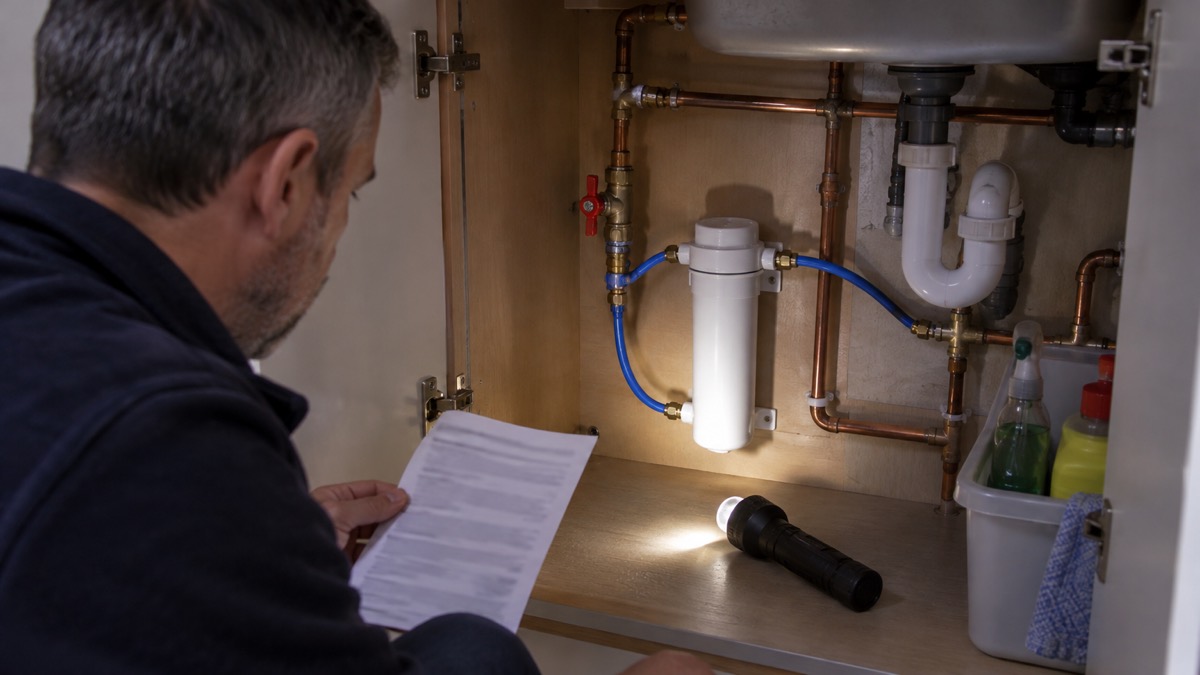
Doulton describes the connection as easy push-fit, with no plumber required, and adds the caveat that this depends on your DIY expertise2. That caveat is doing real work. Fitting a filter means interrupting a cold water pipe, and if you are not confident with that, a plumber is the sensible route. The maker's manual is the authority on the job, and it sets out the sequence.
- Read the manual first. The HIS Push-Fit instructions are dated October 2017 and cover the connection, the element and the servicing clearances5.
- Check the space. You need room for a unit 300 mm wide, 300 mm deep and 600 mm high, plus at least 4 inches below the body to remove the element2.
- Use the right tubing. The manual recommends medium density polyethylene tubing and specifies 3/8 inch push-fit connections5.
- Fit the element correctly. Ensure a sealing washer is on the element's threaded mount stem, screw it into the head until you feel washer resistance, and do not over-tighten5.
- Fit the body. Moisten the O ring on the filter body, check it is seated correctly, screw the body to the head and hand tighten only5.
- Flush before first use. Doulton's general installation guidance is to flush the filter by running water through it for a few minutes before first use9.
- Connect to cold only. The filter cannot be used for hot water and should only be connected to the cold supply5.
If your cupboard is tighter than 10 inches below the base of the housing, the manual gives an alternative order of assembly: place the filter body in position over the element before screwing the element into the head5. It is a tighter job, and worth doing with the water off and a towel down.
Using and maintaining the filter safely
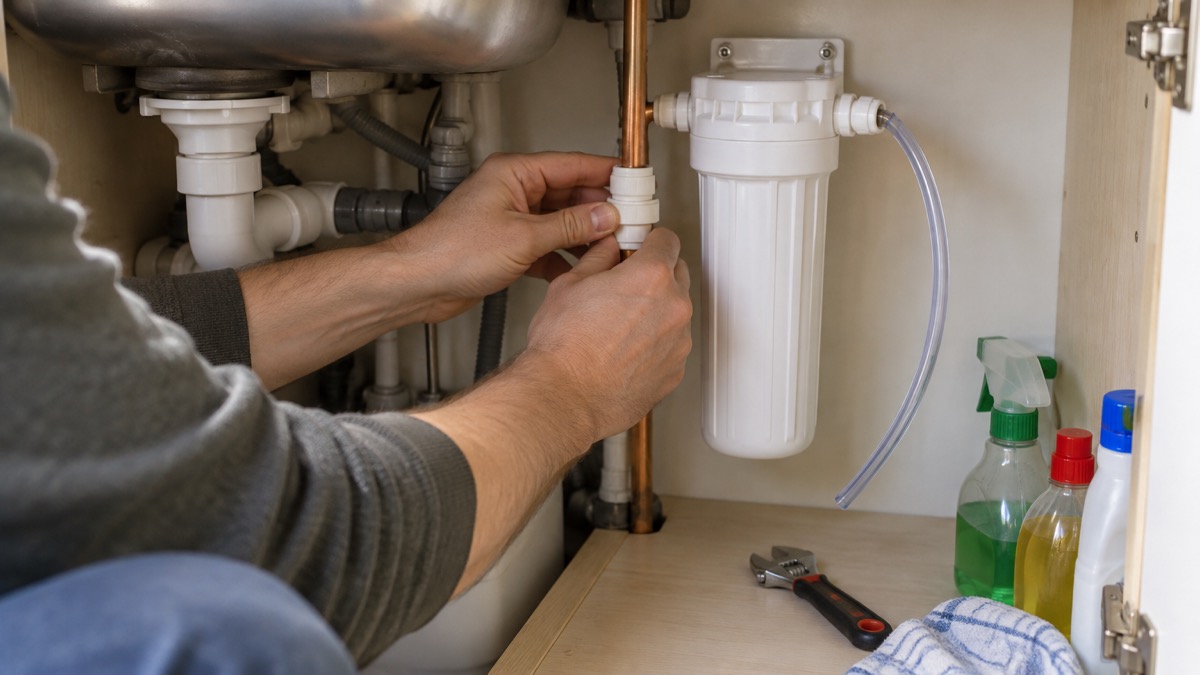
The HIS is low-maintenance, but the maintenance it does need is the kind that decides whether it keeps working. The maker's manual gives a typical replacement period of six months' usage, in line with the rated service capacity5. Put a date on the housing when you fit a cartridge so you do not lose track.
Between changes, the ceramic element can be cleaned, which Doulton says helps maintain its lifespan and effectiveness10. When you service it, the manual is specific about hygiene: wear rubber gloves or wash your hands thoroughly before and after servicing the filter and filter element5. It also warns to take care at all times not to contaminate the threaded part of the mount with unfiltered water11. That is the single most important servicing instruction on the page: the clean side of the system must stay clean.
Cleaning the outside is simple. Wipe the housing externally with a warm damp cloth5. Doulton's general guidance for its systems is to wipe the surface with a damp cloth and mild detergent, avoid abrasive cleaners or harsh chemicals, and make sure the system is dry before reassembling12. The manual lists substances to avoid: strong oxidising agents such as bleach or Milton solution, all strong acidic materials including some descalents, and strong alkaline material5. Keep the bleach spray away from it.
You can tell whether the filter is working. Doulton lists the signs of correct operation as clear, clean-tasting water, consistent water flow, and no visible sediment or particles in the filtered water9. If the flow drops or the taste changes, check the cartridge date and service the element before assuming the unit has failed.
If you need to take the system out of use, for a move or a long absence, Doulton's storage guidance is to remove the ceramic filter candle and let it dry completely, store it in a cool dry place, and ensure all components are clean and dry, rinsing thoroughly before reuse9.
Where the HIS fits in your emergency water plan
The HIS is the everyday layer of a water plan, and a good one, but a household preparing for emergencies needs three layers, not one.
Layer one: the plumbed filter. The HIS gives you filtered water at the tap for as long as the mains runs and the cartridge is in date. It needs no electricity, so it keeps working in a power cut, which is more than can be said for anything with a pump or a lamp.
Layer two: stored water. Because the HIS depends on mains pressure, it gives you nothing when the supply stops. Work out how much you need with the guidance on how much drinking water to store per person, and keep it in clean containers as set out in storing tap water safely at home. A home drinking supply storage checklist is a sensible way to keep on top of rotation.
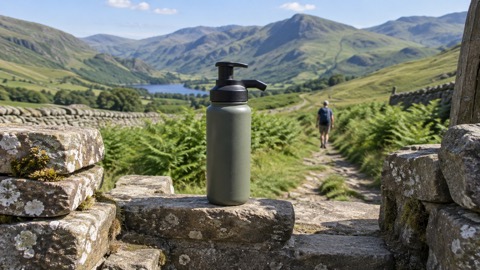
Layer three: a portable filter. For water you have collected rather than water from the mains, you need something that does not depend on plumbing. Doulton's portable range is described as needing no plumbing or electricity, which makes it suitable when supplies are limited6. The site's guide to emergency filters sets out the gravity, pump, bottle and straw types, and what each type removes explains the difference between ceramic, carbon, hollow-fibre and reverse osmosis.
During a drought, the HIS does not change what you are allowed to do. Cambridge Water's household guidance notes that saving water reduces the chances of restrictions such as hosepipe bans during a drought14, and Portsmouth Water's advice includes using washing up water in the garden15. A filter makes the water you are permitted to draw pleasanter; it does not add to the supply. Doulton's own advice for limited supplies points to the portable range rather than the under-sink unit6.
For households with medical needs, the water plan matters more. If someone at home depends on equipment that stops working in a power cut, such as a ventilator, oxygen concentrator, electric wheelchair, hoist, communication device or feeding pump, the Scottish Government's ready campaign advises ensuring your care provider, clinical care team or equipment supplier has given you enough information to understand how the equipment works and what to do in a disruption16. Kidney Care UK advises home dialysis patients who think a power cut will be long to contact their unit as soon as possible so a back-up dialysis slot can be arranged17. The site's guide to home dialysis and medical needs during an interruption covers this in more detail.
Support, warranty and safety notices
Doulton's warranty covers manufacturing defects and workmanship, and the maker states that the specific terms and duration vary by product, with some systems eligible for an extended warranty by registration12. To register, visit the Product Registration page on the Doulton website, provide your product model and purchase information, and submit the form to activate the warranty12. Do that as soon as the unit arrives, before you need it.
Returns are listed as 14 days on the maker's product pages2. Delivery is listed as next working day for orders placed by 11:00 Monday to Friday, subject to destination and courier availability1. Neither matters much in an emergency, but both matter when you are replacing a failed unit in a hurry.
On safety, the notices that bear on a household are these. Connect to cold water only5. Do not use hot water, which can damage the ceramic filter and reduce its effectiveness9. Avoid bleach, Milton solution, strong acids including some descalents, and strong alkaline materials when cleaning the housing5. Wear gloves or wash thoroughly before and after servicing, and keep unfiltered water away from the threaded mount5. Use genuine Doulton replacement elements and components to guarantee the manufacturer's performance claims5.
Boil notices are not rare. Bristol Water issued a precautionary boil water notice for the Norton Malreward and Hursley Hill area for customers who received the yellow warning card18, and Dwr Cymru's guidance sets out the same core instruction: boil your water for drinking, preparing food, baby feeds, cleaning your teeth and ice making3. The site's boil notice checklist walks through the household steps.
For anything beyond the filter itself, the maker's FAQs cover installation, cleaning, storage and warranty12. The site's Doulton brand page gathers the maker's other systems, and the under-sink versus gravity filter comparison helps if you are deciding which kind of filter suits your household.
Sources (18)
- Doulton HIS Push-fit Under Sink Water Filter System with Biotect Ultra, Doulton, 2026
- Doulton HIS Push-fit Under Sink Water Filter System with Biotect Ultra (EU), Doulton, 2026
- Boil Water Notice, Dwr Cymru Welsh Water, 2026
- Boil Notice for Customers in Tunbridge Wells, South East Water, 2026
- HIS Push Fit Instructions (W2393021 Issue 4), Doulton, October 2017
- Doulton Portable Water Filters (CA), Doulton, 2026
- Doulton HIS Push-fit Under Sink Water Filter System with Biotect Ultra (US), Doulton, 2026
- Doulton Systems collection, Doulton, 2026
- Doulton FAQs (FR), Doulton, 2026
- Ceramic Water Filters: What They Are and How They Work, Doulton, 2026
- Doulton Filter Elements Operating and Changing Instructions, Doulton, 2026
- Doulton FAQs, Doulton, 2026
- Doulton Portable Water Filters (US), Doulton, 2026
- Saving Water FAQs, Cambridge Water, 2026
- Emergency Contact Numbers, Belfast City Council, 2026
- Power Cuts, UK Government Be Ready, 2026
- Home Dialysis Tips: Power Cuts and Water Supply Failure, Kidney Care UK, 23 January 2024
- Norton Malreward, Bristol Water, 7 July 2025

 LifeSaver Bottle
 LifeSaver Liberty
 LifeSaver Jerrycan
 LifeSaver Jerrycan Graphene
 LifeSaver Cube
 LifeSaver Wayfarer
 LifeSaver Lifeline
 LifeSaver C1
 LifeSaver C2
 Katadyn Micropur Classic
 Katadyn Micropur Forte
 Katadyn Micropur Antichlor