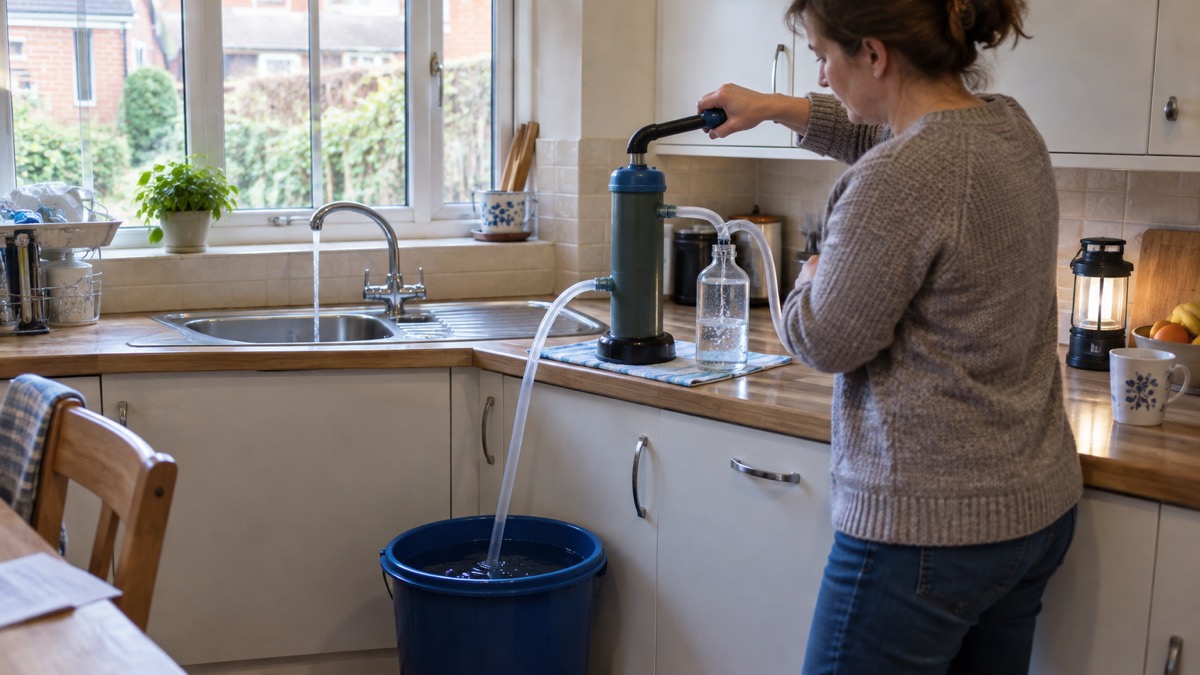
A hand pump water filter is one of the simplest pieces of emergency kit you can own: you dip a hose into collected water, work a small hand pump, and filtered water comes out into your bottle or pan. Nothing needs to be plumbed in, nothing needs to be plugged in, and nothing needs to be installed before it works. The maker Doulton describes its portable filter range as reducing contaminants as water passes through the filter, and notes that portable filter systems "generally don't need plumbing or electricity to function"1.
That independence from the mains is the whole point for a household. During a supply interruption, a burst main, a flood or a storm, the water in your pipes may stop, and a pump filter lets you treat water you have collected, whether that is bottled stock, water from a household storage tank, or supplies already in your pipes and cistern, so long as the filter you own is designed for the water you are putting through it. One important limit applies from the outset: Doulton states plainly that it does not test or advise using anything but treated drinking water in its portable filter systems, and that for drinking water from open water sources you would need to look beyond its range1. So the first rule of choosing a pump filter is to match it to the water you realistically expect to have.
This page explains how pump filters work, how they compare with bottle, straw and gravity filters, what a filter does and does not remove, how to deal with a filter that has become hard to pump, and how to keep one ready. For the wider picture of making water safe, see how to make water safe to drink in an emergency.
How a portable filter makes collected water safer
Every portable filter works on the same principle: water is forced through a filter medium, and contaminants are reduced as they pass through it. Doulton explains that the different types differ mainly in speed: "Some of them, such as the bottle and straw options, will do this instantaneously as you drink. Others will do it through" a more gradual process1. A hand pump filter sits between the two. You provide the pressure yourself with each stroke of the pump, so water arrives at a steady, controllable rate into whatever container you hold under the outlet. That makes a pump filter useful when you want to fill a pan for cooking as well as a bottle for drinking, and when several people share one device.
The filter element itself is what does the work. In the ceramic candle filters used in private water supplies, which the Drinking Water Quality Regulator for Scotland describes in its technical guidance, the element can be cleaned and reused: the regulator advises that the filters "can be unscrewed from their plastic casing" and cleaned with clean warm water and a soft brush or damp cloth, wearing rubber gloves2. The same principle of a cleanable element applies to pump filters with ceramic or similar media: as the surface clogs, you clean it rather than throwing it away, which is what makes these filters economical over a long emergency.
What the filter actually removes depends on its media, and that is where households most often go wrong. A filter sold for improving taste is not the same as one designed to make questionable water safe. The what each filter media removes page sets the media out in detail; the essentials are below.
No plumbing or electricity needed
The strongest argument for a pump filter, or any portable filter, in a household emergency kit is that it works when nothing else does. Doulton's guidance on choosing a filter states of gravity systems: "They require no plumbing or electricity, so you can just set up the system and start to fill up as needed"5. Its countertop product pages make the same point in specification form: "No electricity needed" and "No plumbing required"6. The Scottish regulator says the same of ceramic candle filters: "They do not require electricity to run as the water is filtered under gravity"2.
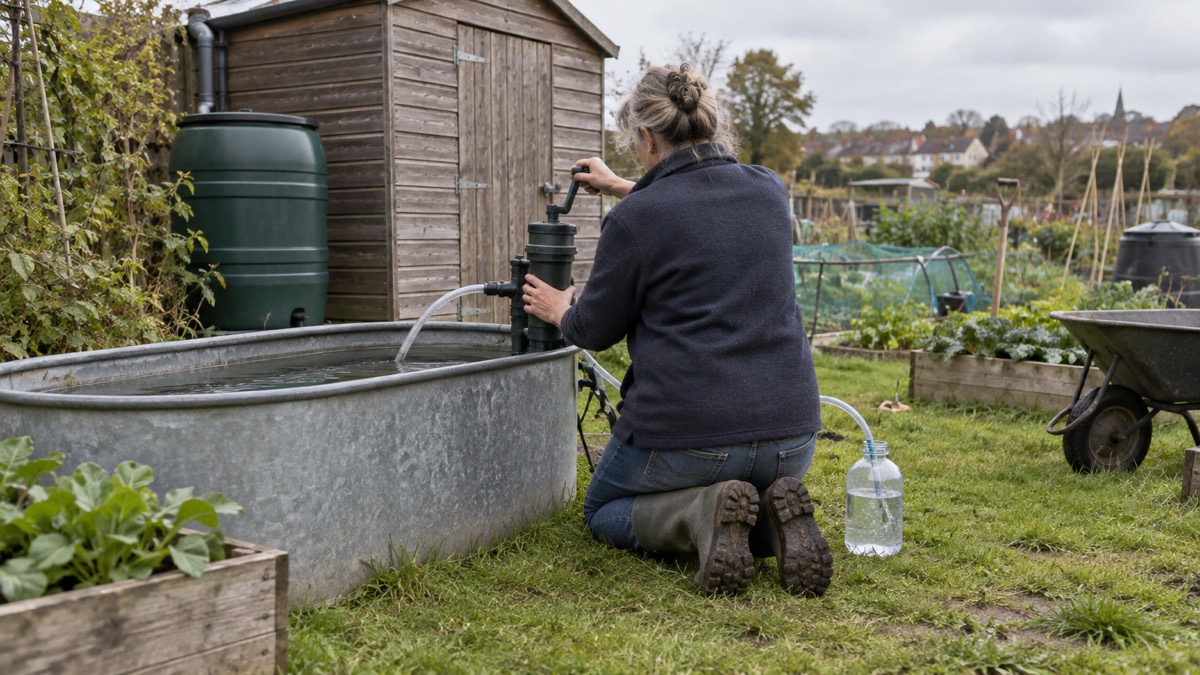
For a pump filter the position is even simpler: the only power source is your arm. There is nothing to install, nothing to connect to the household wiring, and nothing that a power cut can stop. Compare that with an under-sink filter, which depends on the mains pressure in your pipes, or a UV purifier pen, which depends on its battery. In a power cut combined with a water supply failure, a hand pump keeps working.
Two practical consequences follow. First, you can take the filter anywhere: to a relative's house, into a car, or into an evacuation, and it will work there just as it does at home. Second, you can store it for years without any standby power or maintenance schedule, because it needs no electricity and no plumbing to run2. If you are building a kit around the idea of losing both mains water and mains power at once, a filter that needs neither is the natural choice.
What is inside: mesh for sediment, carbon for taste and odour
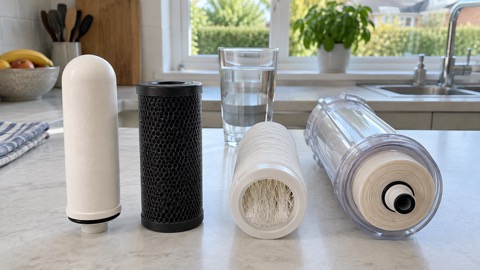
A portable filter usually combines more than one medium, and each does a different job.
Sediment and mesh. The first stage in any filter dealing with collected water is the removal of visible particles: silt, rust, grit and other suspended solids. This matters for two reasons. It makes the water look and taste better, and it protects the finer filter stages behind it from clogging. After floods or storms, Argyll and Bute Council's guidance on private water supplies warns that "filters are likely to need changing more frequently" precisely because flood water carries suspended solids3. A mesh or pre-filter stage catches the worst of this before it reaches the main element.
Activated carbon. Carbon is the taste and odour specialist. United Utilities tells customers wanting to remove a chlorine taste that "You will need a filter containing activated carbon, which absorbs chlorine and other substances that can influence the taste of the water"7. Doulton's choosing guide lists the strengths of an activated carbon filter as: "Inexpensive, good for improving taste and odour, good flow rate, some are effective at reducing chemicals & metals, wide availability"5.
That phrase, basic water polishing, is the honest description of what carbon does. It is excellent at the job it is designed for and it is not a barrier against every hazard. United Utilities adds a caution that applies to any filter: "poorly maintained devices may cause problems with water quality"7. A carbon stage left unchanged can become a problem in itself, which is why the cleaning and replacement rules later in this page matter as much as the choice of filter.
| Filter medium | What it does | Where it fits in your set-up |
|---|---|---|
| Mesh or pre-filter | Removes visible sediment and particles | Protects the main element from clogging, first stage for cloudy water |
| Activated carbon | Absorbs chlorine and other substances affecting taste and odour | Makes safe water pleasant to drink |
| Ceramic element | Cleanable barrier that can be brushed and reused | Long-term use with proper care |
Pump, bottle, straw or gravity: four ways to deliver the water
Portable filters come in four broad forms, and the differences between them decide which suits your household.
Pump filters use your hand to push water through the element. You control the pace, you can fill any container, and the filter works at a height, so you can pump from a bucket on the floor into a bottle on the counter. The trade-off is effort: every litre costs you strokes, and a clogged element makes itself known immediately as resistance in the handle, which is also, usefully, an early warning that the filter needs cleaning.
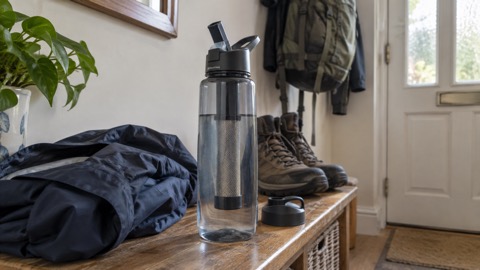
Bottle and straw filters filter as you drink. They suit one person, on the move, and they are the lightest option. They do not suit filling a pan.
Gravity filters do the work for you. Doulton describes the method: "Gravity Water Filter systems use natural pressure to filter the water through from the top chamber through to the bottom"5. You pour water in the top and collect it from the bottom.
Countertop systems come, in Doulton's words, "in two forms: tap-mounted and gravity-fed"6. The tap-mounted kind needs a working tap, so it is a convenience for everyday use rather than an emergency tool; the gravity-fed kind does not.
| Type | How it delivers | Who it suits |
|---|---|---|
| Pump filter | Hand pressure, fills any container | A household treating collected water in set batches |
| Bottle or straw filter | Filters as you drink | One person, mobile use |
| Gravity filter | Natural pressure from top chamber to bottom | A household at a base, hands-free output |
| Tap-mounted countertop | Mains pressure at the tap | Everyday taste improvement, not outages |
For one-person options see filter bottles and straw filters; for the household-scale options see gravity filters and ceramic candles explained.
Gravity systems for a household at home
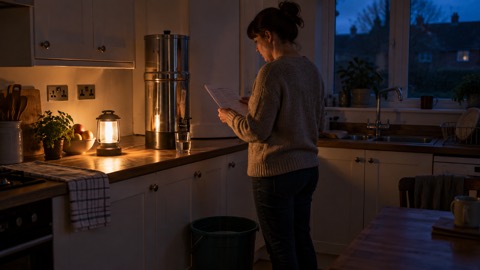
If your reason for buying a filter is an emergency at home rather than an emergency on a walk, a gravity system is usually the better choice, and a pump filter becomes the backup or the personal item. Doulton's guidance is direct about this: for households with varying numbers of users, "a gravity filter system could be perfect, as you have the flexibility to place it where needed and can keep the water topped up accordingly"5.
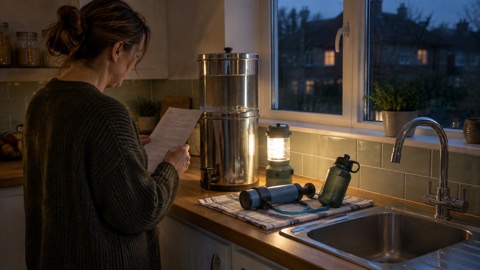
A gravity system is, in Doulton's description, a "Standalone unit, sits on a counter, manually fed with water"5. You ladle or pour water into the upper chamber, and it drips through the filter element or elements into the lower chamber, from which you draw it by tap. Because the process is continuous, one unit can keep a family supplied without anyone standing over it: you top it up when you pass, and filtered water accumulates below.
The honest downsides are the ones Doulton lists: it "Takes up counter top space and needs manual intervention"5. You have to remember to fill it, and it occupies workspace permanently. Against that, it "Can be moved around and taken with you on house moves, or holidays"5, and it needs no plumbing or electricity6.
For scale, a whole-house plumbed system is a different proposition altogether. Doulton describes it as "Full centralised water treatment upon entry to home", with the advantage of "Comprehensive water filtration for all uses" but the disadvantages of "Very high installation and equipment costs, specialist plumbing skills needed, may still need point of use filters"5. For emergency preparedness, that is the wrong tool: expensive, dependent on the mains, and needing a plumber. A counter-top gravity unit plus a pump filter in the grab bag covers far more scenarios for far less.
What a portable filter does not remove
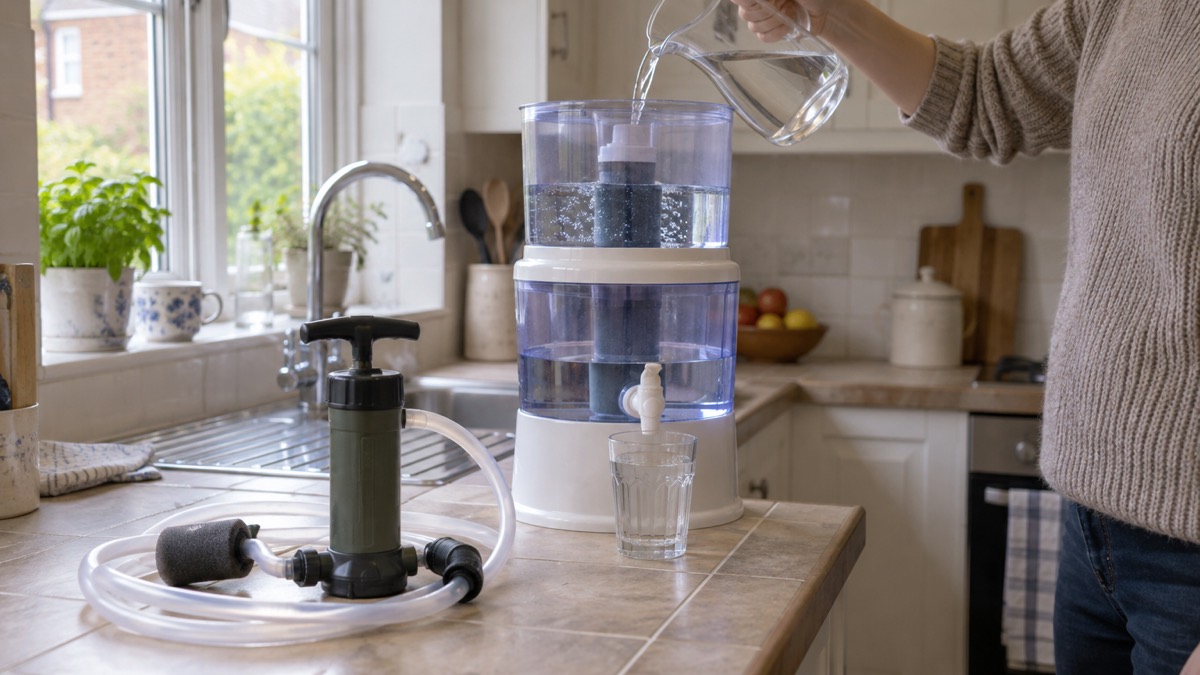
This is the section that matters most for your safety, and it is where the marketing and the reality diverge.
The clearest statement comes from the maker itself. Doulton says: "We do not test or advise using anything but treated drinking water in Doulton portable water filter systems"1, and that "if you need your portable water filter system for use drinking water from open water sources, will need to explore options beyond the Doulton Water Filters range"1. In other words, a filter intended for polishing treated water is not certified for making raw stream or river water drinkable. If your emergency plan involves drinking from streams, rivers and other sources, you need a filter designed and tested for exactly that, and you should check what any claim of removal actually means on the filter claims and certification page.
The second limit is contamination after floods. Argyll and Bute Council's guidance on private water supplies after floods or storms states: "If the water source has been contaminated, the usual treatment processes may not provide adequate treatment, particularly if water is coloured or cloudy, and water may need to be filtered and boiled before use"3. Filtering alone is not assumed to be enough in those conditions.
Should you boil as well as filter?
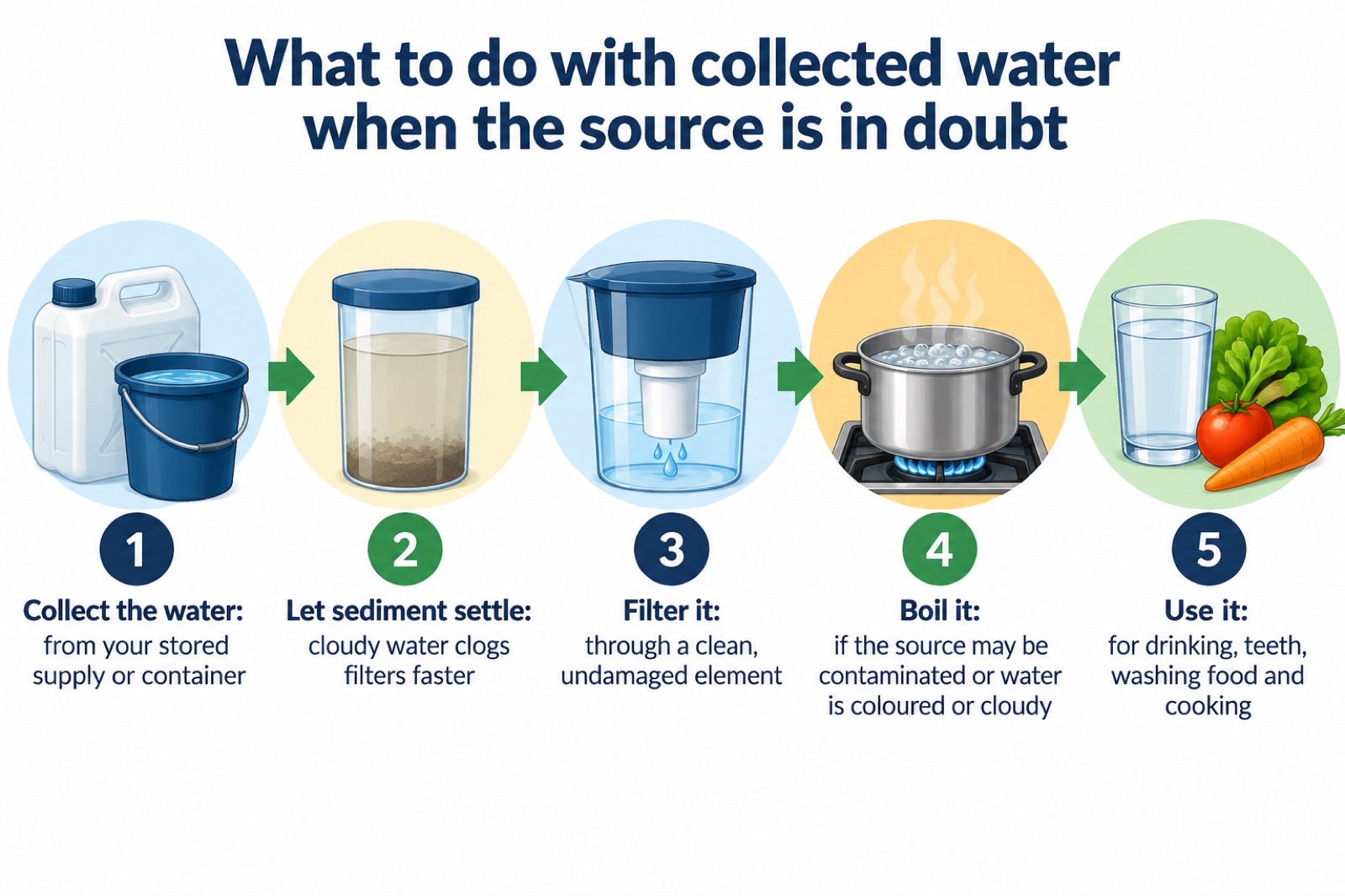
When the source is in doubt, yes. Surrey County Council's advice on staying healthy and safe after flooding is: "Follow the advice of your local water company regarding the safety of the water supply. If in doubt, boil all water intended for drinking, brushing teeth, washing food and cooking"8. Filtering and boiling do different jobs: the filter removes particles and improves taste, and boiling to kill germs addresses the microbes that a taste-polishing filter may pass through. Purification tablets are the third leg of this approach, and the purification tablets or a gravity filter comparison sets out when each suits.
Why is my filter hard to pump, and what to do about it
A pump filter that suddenly resists your hand is not broken; it is almost certainly clogged, and the fix is cleaning rather than replacement. The resistance you feel is sediment and particles packed into the surface of the filter element, and the more cloudy your source water, the faster it builds. This is why Argyll and Bute Council warns filters "are likely to need changing more frequently" after floods, when water carries suspended solids3.
The cleaning method comes from the Scottish regulator's guidance on ceramic filter candles: the filters "can be unscrewed from their plastic casing. It is recommended that rubber gloves should be worn and that the" element is cleaned with clean warm water and a soft brush or damp cloth2. Follow your own filter's instructions for disassembly, but the principle is the same: brush the clogged surface under clean warm water, wear gloves, and reassemble.
Three rules protect you around a clogged or aging element:
- Check for damage before every use. The regulator calls this good practice, and a cracked element can let unfiltered water through2.
- Wash your hands after cleaning or replacing a filter. The regulator's reason is that "the filters can collect microbes"2.
- Clean or replace according to the manufacturer's instructions. The Drinking Water Inspectorate's guidance for private supply customers says cartridge filters "need to be cleaned or replaced according to manufacturer's instructions"4.
If cleaning does not restore the flow, the element has reached the end of its life and must be replaced. A ceramic candle "can last for many months with the proper care"2, but that care includes regular cleaning and protection from damage.
Cloudy and muddy water: what it means and what to do
Not all cloudiness is a filtration problem, and it is worth knowing the difference before you reach for the pump.
If your tap water turns cloudy, United Utilities advises: fill a glass and let it stand for a few minutes. "If the water starts to clear from the bottom upwards this indicates that the water contains trapped air"9, which is harmless and usually the result of "air bubbles that have become trapped in the water while we've been opening and closing valves or" carrying out repairs9. That cloudiness needs no treatment at all. See why is my tap water cloudy or milky for the full picture.
If cloudiness appears only in hot water while the cold runs clear, Affinity Water says the cause is on your side and "You could contact the manufacturer, or a WaterSafe plumber, or GasSafe heating engineer"10. Brief running that clears it may point to pipes needing lagging, and dripping taps may just need new washers10.
Collected water that is muddy is a different matter. Let it settle first, so the coarse sediment drops out before it reaches your filter, then filter it, and if the source may be contaminated, boil it as well, because coloured or cloudy water is exactly the case where official guidance says filtering alone may not be adequate3. After a flood, check your supply end to end: Argyll and Bute Council advises checking "from abstraction point to taps for damage", changing filters more frequently, and cleaning storage, intermediate and loft tanks3.
Keeping a filter ready for an emergency
A filter you cannot find, or that has sat damaged for two years, is not preparedness. Official guidance across the UK is consistent about what readiness looks like.
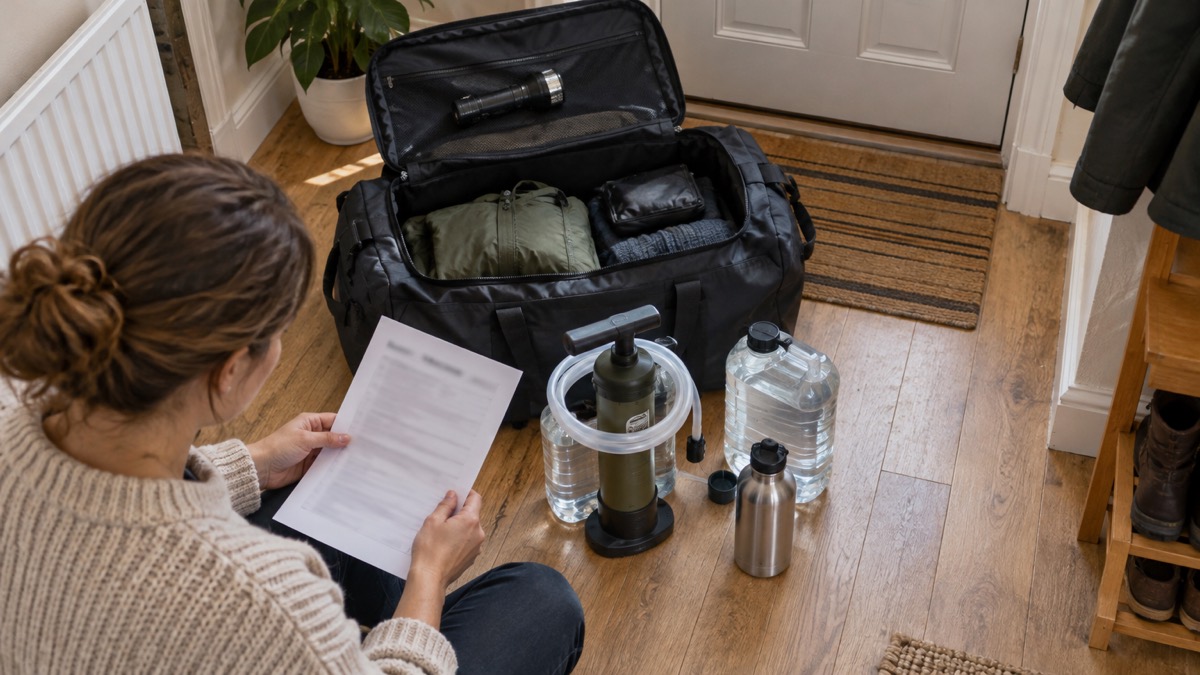
Keep it in the emergency kit, in a waterproof bag. Ready Scotland advises: "You could keep some of the kit in a waterproof bag in case you need to leave your home without notice. For example, if y" our home is at risk of flooding11. Carmarthenshire Council says the same: "Keep it in a safe place at home where you can reach it easily. Your kit should be kept in a waterproof bag"12. The kit should include water for drinking and sanitation, and hand sanitiser and wet wipes "for hygiene purposes when the water is off"13, advice echoed by Which? for maintaining basic hygiene when the water is turned off14. Nottinghamshire County Council adds the food side: "have a supply of bottled water, ready to eat food (for example tinned) and a tin opener in your home"15.
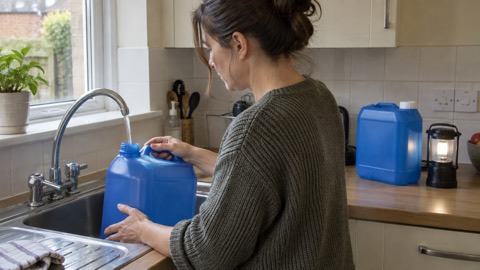
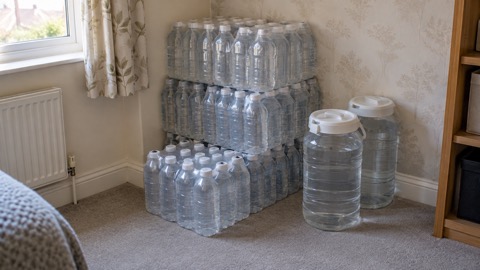
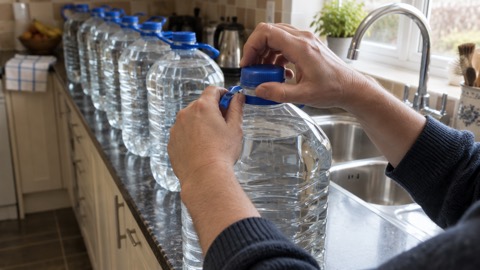
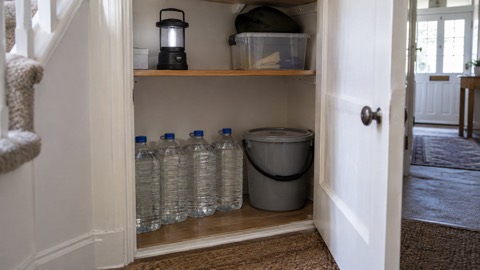
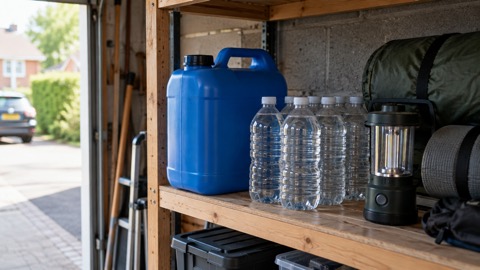
Store enough water to make the filter useful. A filter treats water; it does not create it. Work out how much drinking water to store per person and keep it in suitable containers and jerrycans, following the rules for storing tap water safely at home.
Flush the filter after storage. Before using a filter that has stood unused, the Scottish regulator advises: "It is advised to run the water through the filter for about 5 minutes. It is good practice to check the filter for damag" e before use2. Build that five minutes into your expectations: the first water through a stored filter is flushing water, not drinking water.
Keep a first aid kit alongside. The NHS advises keeping "a home first aid kit or car first aid kit handy by buying a ready-made one or putting together your own in a clean, waterproof box"16. If a compromised filter does cause illness, you want basic supplies to hand, and you should know the warning signs: vomiting and diarrhoea are the symptoms the regulator associates with a blocked or damaged filter2.
Keep a household plan with it. Ready Scotland's emergency plan guidance says to "Keep a printed or handwritten copy somewhere handy and make sure everyone in your home knows where it is"17. A filter only helps if everyone in the house knows it exists, where it is, and how to use it.
After a flood, hygiene comes first. Perth and Kinross Council's flooding checklist for residents says: "Wash your hands regularly with soap and warm clean water or use wet wipes if there is no clean water available. Keep cut" s clean and use waterproof plasters18. Anyone handling flood water, filters or containers should follow this, because the filter element itself can collect microbes2.
When the tap water fails: where to get help
A filter is your fallback, not your first response. When the supply fails, the first steps are diagnosis and information.
Check whether the problem is yours or the mains. Richmond Council's utilities failure advice: "The main water supply normally enters your home in the cold kitchen or utility room tap", so try that tap first; if water comes out of it but not elsewhere, the problem is with your internal plumbing19. If you cannot find your stopcock, the London Resilience Partnership's flooding advice is to "ask someone with practical experience or a plumber to help you"20.
Contact your water company and register for extra help. Water companies will "tell you if they are going to turn off your water"21, so make sure they can reach you. If someone in your household is older, disabled or medically dependent on water, ask your water company about the Priority Services Register, and see the bottled water delivery page for how supplies reach households that need them.
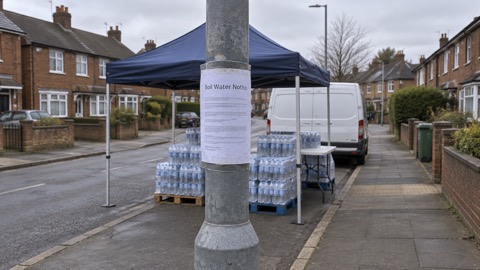
Follow the company's advice on safety. Water companies will "tell you if they are going to turn off your water"21, so treat what they say about the safety of the supply as the instruction to follow. If a boil water notice or a do not drink notice is issued, that notice overrides everything on this page: no household filter is a substitute for obeying it.
Use the filter for what it is for. Between the failure and the restoration, your filter earns its place: treating water from your stored supplies, from a bottled water station top-up, or from a tanker. For the wider picture of how water companies respond to a major incident, and for how long until your supply is restored, see those pages.
Sources (21)
- Portable Water Filters, Doulton, 2026-10-28
- Water Filter Candles: Technical Guidance, Drinking Water Quality Regulator for Scotland, 2026-10-28
- Private Water Supplies After Floods or Storms, Argyll and Bute Council, 2026
- Protecting Your Private Water Supply, Drinking Water Inspectorate, 2026-10-28
- How Do I Choose a Water Filter, Doulton, 2026-10-28
- Countertop Water Filter Systems, Doulton, 2026-10-28
- Your Water FAQs, United Utilities, 2026-10-28
- Staying Healthy and Safe After Flooding, Surrey County Council, 2026-09-23
- Discoloured Water Advice, United Utilities, 2026-10-28
- Water Quality: Appearance, Affinity Water, 2026-10-28
- Prepare: Emergency Kit, Ready Scotland, 2026-10-29
- Get Prepared, Carmarthenshire County Council, 2026-10-28
- Household Emergency Planning, Devon Communities Together, 2026-10-29
- Emergency Kit Packing List, Which?, 2026-09-30
- Preparing for an Emergency, Nottinghamshire County Council, 2026-10-29
- What Should I Keep in My First Aid Kit, NHS, 2026-10-25
- Emergency Plan, Ready Scotland, 2026-03-24
- Flooding Checklist for Residents, Perth and Kinross Council, 2024-08-01
- Utilities Failure, London Borough of Richmond upon Thames, 2026-05-22
- Preparing Yourself: Flooding Incidents, Greater London Authority, 2026-10-25
- Priority Services Register, Surrey County Council, 2026-10-28
 Supply Interruption Checklist
 Boil Notice Checklist
 Drinking Supply Checklist
 How Much Water to Store
 Storing Tap Water Safely
 Containers and Jerrycans
 Household Storage Tanks
 Water Already in Your Pipes
 Making Water Safe to Drink
 Boiling Water to Kill Germs
 Purification Tablets
 Emergency Filter Types
 What Water Filters Remove
 Gravity Filters Explained
 Filter Bottles and Straw Filters