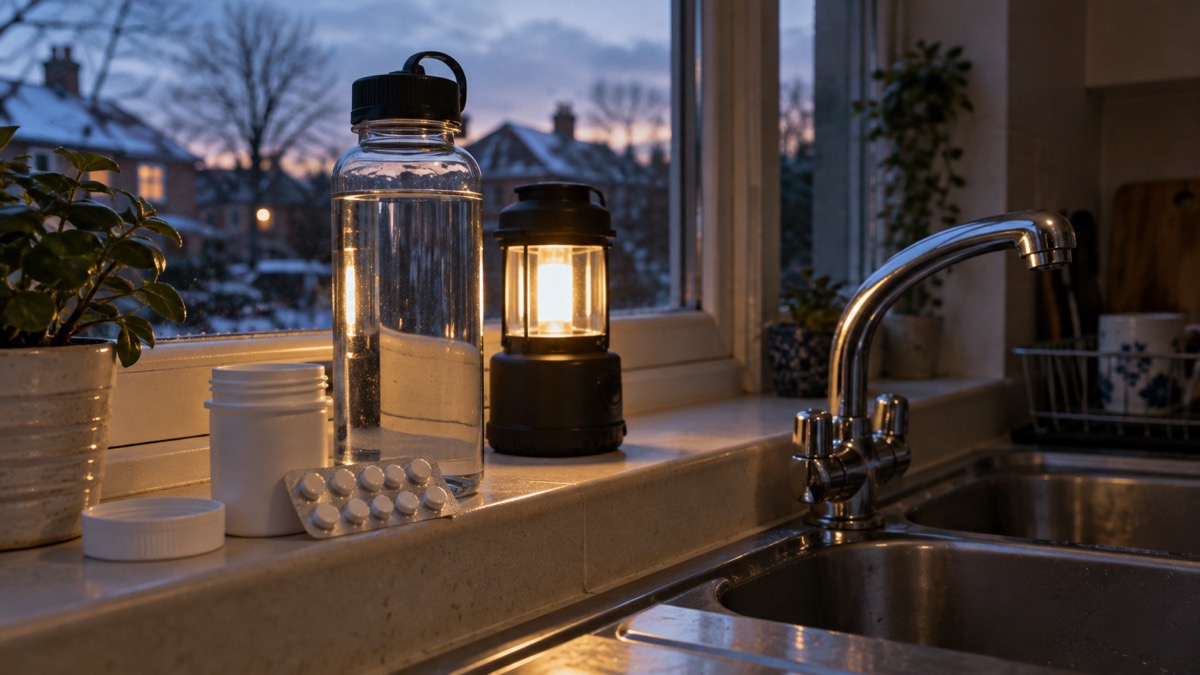
If your tap supply fails or a boil water notice is issued, purification tablets are one of the simplest ways to make collected water safe to drink. They are small, light, keep for years and need no power. A pack of chlorine tablets from Life Systems treats up to 60 litres of water, and an unopened tablet lasts up to 5 years from its date of manufacture1.
Tablets are not a substitute for everything, though. Official guidance is clear on two points: most alternative water sources will also need to be filtered before using the tablets, and you should always follow the instructions on the product label because the tablets come in different strengths2. And under a boil water notice, Anglian Water's advice is blunt: purification tablets cannot be relied upon to remove the bacteria, and the water still needs to be boiled before use3. Tablets are a useful layer of treatment, not a guarantee on their own.
This page explains what each type of tablet does, how to use them, what they leave behind in the water, and where the limits are.
What purification tablets do, and what they cannot do
Purification tablets work by releasing a disinfecting chemical into water, in much the same way water companies disinfect the public supply. Chlorine is added to tap water to disinfect it and keep it safe to drink, and it has been used in the UK for 100 years5. Tablets put that same principle into a portable form: you collect water from a usable alternative source, filter it, add a tablet, wait for the chemical to work, and the water is disinfected.
What they do not do is remove dirt, sediment or chemicals. A tablet disinfects; it does not clean. That is why the government's advice pairs tablets with filtering, and why a cloudy puddle is a poor candidate for tablet treatment even after waiting. Katadyn's instructions for its Micropur MP1 purifier tablets list the suitable water sources as tap water and clear water6, and the same clear-water rule appears in the maker's safety warning for the SteriPEN Ultra UV purifier: use only on clear water, because cloudy, sediment-laden water hinders effectiveness7.
There is also a situation where tablets are explicitly not enough. When a water company issues a Boil Your Tap Water notice, it is because the supply may contain bacteria that tablets may not reliably deal with. Anglian Water's boil notice FAQ states that water purification tablets cannot be relied upon to remove the bacteria and the water still needs to be boiled before use3. If you receive such a notice, follow it: boil the water as instructed, and read the notice carefully because some also restrict using the water for washing and brushing teeth. Our page on what to do if you get a boil water notice walks through the whole process.
Filter the water before you use the tablets
Official guidance says most alternative water sources will also need to be filtered before using the tablets2. Filtering does two jobs: it removes the particles that shield germs from the disinfectant, and it improves the taste and appearance of the finished water. A tablet dropped into murky water has to work through the murk, and the maker's own suitability notes assume clear water to begin with6.
The steps are simple and always in the same order:
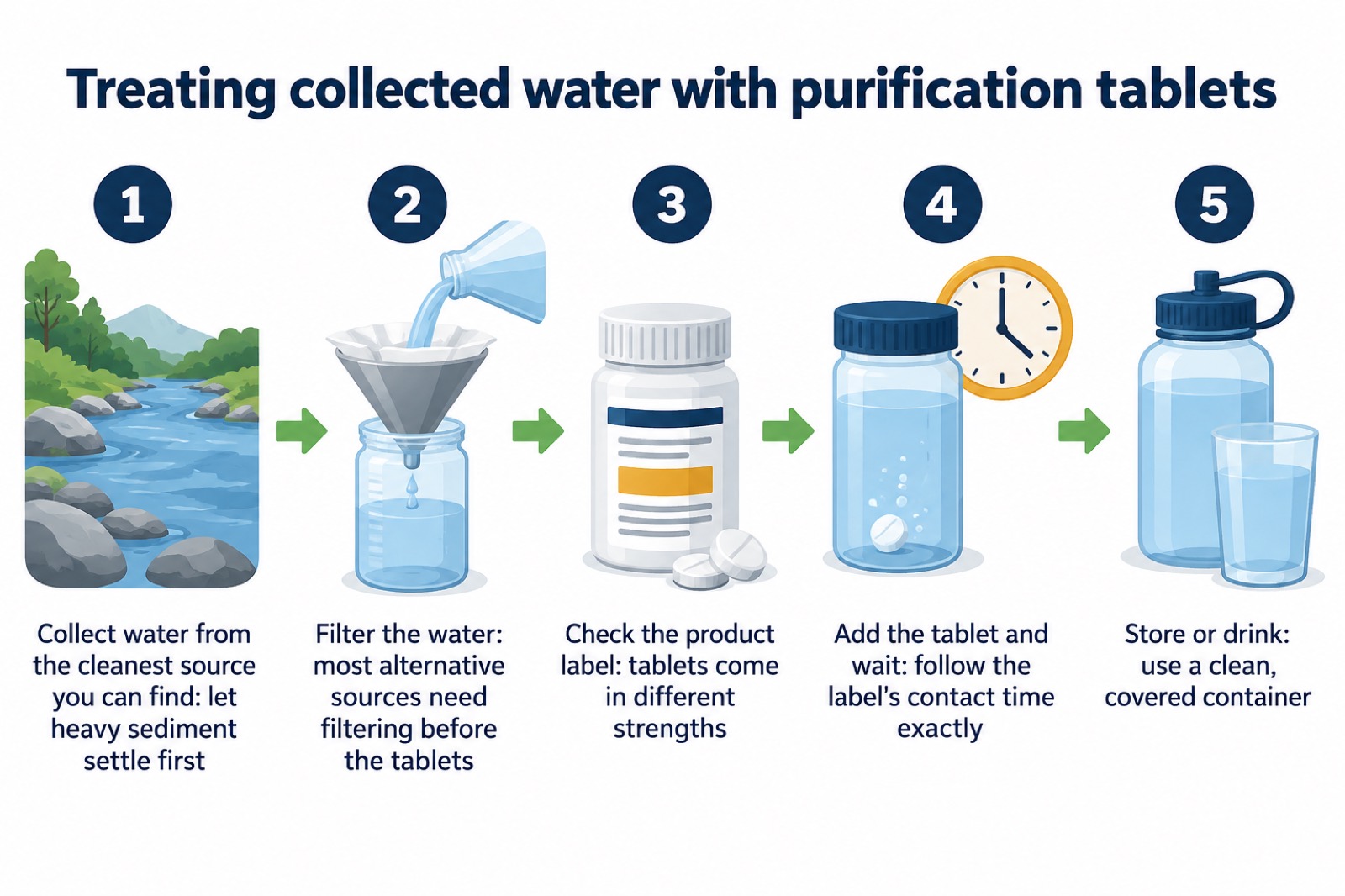
For the filtering step you have several options, each covered in detail elsewhere on this site: gravity filters, hand pump filters, and filter bottles and straws for one person. If you have nothing else, letting water stand so sediment sinks, then pouring the clearer water off the top through a clean cloth, is better than nothing, but a proper filter does the job far better. Our comparison of what each filter type removes explains the differences.
One point worth knowing: a filter and a tablet do different jobs and work well together. A hollow-fibre or ceramic filter physically strains out particles and organisms, while the tablet disinfects what is left. If you are deciding between them, our page on tablets or a gravity filter sets out the trade-offs by circumstance.
Always follow the label: tablets come in different strengths
The single most important instruction on this page comes from the government's emergency guidance: "Always follow instructions on the product label as the tablets come in different strengths."2 A tablet dosed for one litre dropped into a full jerrycan will under-treat the water; two tablets where the label says one is not a shortcut to faster disinfection, it is a stronger chemical dose than the product was designed for.
That means keeping the label with the tablets. If you decant tablets into a smaller pot for a car kit or grab bag, keep the original packaging or a note of the dosing and waiting time. Contact time matters as much as dose: the chemical needs time in the water to work, and the label's stated wait is part of the treatment, not an optional extra.
The same label-following discipline applies to the containers you treat water in. Public health guidance for Wales advises using sterilising tablets or fluids, following the manufacturer's instructions, to clean bowls, buckets and other containers before you use them for water or food8. A disinfected supply poured into a dirty bucket picks up whatever was in the bucket. Our pages on containers and jerrycans and storing tap water safely cover choosing and cleaning what you store water in.
Chlorine, chlorine dioxide or silver: how each tablet works
The three common tablet types differ in what they kill, how the water tastes afterwards, and how long they keep. Here is what the makers state for their own products, side by side.
| Tablet type | What it kills | Taste | Pack coverage | Shelf life (unopened) |
|---|---|---|---|---|
| Chlorine (Life Systems) | Bacteria and viruses1 | Chlorine taste; neutralising tablets can remove it1 | 60 tablets treats up to 60 litres1 | Up to 5 years from manufacture1 |
| Chlorine dioxide (Life Systems) | See maker's product page | No noticeable aftertaste, unlike chlorine4 | See maker's product page | Up to 2 years from manufacture4 |
Chlorine tablets are the familiar workhorse. Life Systems states its chlorine tablets kill bacteria and viruses, and that a pack of 60 tablets treats up to 60 litres of water1. They can also be used beyond drinking, which we cover below. Their drawback is the one you would expect from the name: a chlorine taste, which chlorine dioxide tablets avoid, the maker stating they have no noticeable aftertaste4.
Chlorine dioxide is the stronger all-rounder. Life Systems states its chlorine dioxide tablets kill bacteria, viruses and cysts in water, including Giardia and Cryptosporidium4. That cyst claim matters: Cryptosporidium is resistant to chlorine disinfection and has caused real outbreaks in UK supplies, which is why some households specifically want a treatment that addresses it. See our page on Cryptosporidium outbreaks for what to do when a water company flags it. The trade-offs are coverage and life: a pack of 30 tablets treats up to 30 litres, and an unopened tablet lasts up to 2 years from date of manufacture, against 5 years for the chlorine version1. On the plus side, the maker states these tablets have no noticeable aftertaste, unlike chlorine4.
Silver-based tablets work differently again: rather than a fast disinfectant dose, silver ions are used to keep stored water fresh over long periods, which is why they suit keeping a stored supply drinkable rather than treating a bucket of stream water on the day. Katadyn's Micropur range includes silver-based products, and our Katadyn Micropur Classic page covers them in detail. The distinction to hold onto is between purifying water you have just collected and preserving water you have already treated and stored.
If you are weighing tablets against other treatments, the full set of options, boiling, filtering, UV and chemical, is set out in how to make water safe to drink in an emergency.
Using treated water for teeth, fruit and vegetables
Drinking is not the only way contaminated water reaches you. Life Systems states its chlorine tablets can be used to disinfect water for cleaning teeth and washing fruit and vegetables, as well as for treating drinking water1. In an interruption where the supply is suspect, that matters: brushing your teeth with unsafe water is a common route for infection.
When the water is not yours to treat, follow the official advice for the situation. After a flood, government food safety advice is to use preboiled, cooled water to wash fruit and vegetables if they are to be eaten raw9. Under a boil water notice, the restrictions usually cover teeth cleaning and food washing too, so read the notice rather than assuming it only applies to drinking. Anglian Water's boil notice FAQ is explicit that unboiled tap water must not be used for affected purposes while the notice is in force3.
Everyday habits help as well. United Utilities notes that drinking water is treated to remove any pathogens that may be present and disinfected before it leaves the treatment works, and advises making sure taps used for drinking water and food preparation are cleaned regularly10. Argyll and Bute Council's advice for supply loss includes not leaving taps running when cleaning teeth or washing vegetables11, which conserves a limited supply during an interruption. For the wider picture of how much water a household needs, see how much drinking water to store per person.
Getting rid of the chlorine taste and smell
A chlorine taste in treated water is normal, not a warning sign. The Drinking Water Inspectorate describes chlorine as the most common method of disinfecting drinking water, and says normal levels should be kept low enough to not be noticeable, though you may sometimes notice a slight taste or smell12. Scottish Water's regulator, the Drinking Water Quality Regulator for Scotland, says it is not unusual for a slight taste or smell of chlorine to be noticeable in drinking water5.
If the taste bothers you, the fixes are straightforward:
- Use neutralising tablets, which Life Systems says can be used to remove the chlorine taste when using chlorine tablets1
- Choose chlorine dioxide tablets, which the maker states have no noticeable aftertaste4
- Use a domestic water or jug filter; Thames Water says these can remove chlorine from tap water if used as the manufacturer advises13, and Wessex Water similarly says the taste of chlorine can be removed using a water filter14
The DWQR's fridge-jug tip is the simplest of all and needs no extra kit, so it is the one to try first. If you do use a filter, the DWQR cautions that some filters remove chlorine but must be maintained in accordance with manufacturers' instructions to remain safe to use5. Our page on looking after a filter covers that maintenance.
When the smell is stronger: warm water, peak times and summer
Several ordinary things make chlorine more noticeable. Affinity Water says the smell might be more noticeable if the water has warmed up or if it has been standing in your pipes overnight15. Severn Trent says the taste and smell of chlorine can be stronger if you live near a treatment works, at peak water use times such as first thing in the morning and early evening, or in cold water, which holds chlorine longer than warm water16. Southern Water says you may notice a stronger chlorine smell during peak times when people are using more water or if you live near one of its water supply sites17, and Northumbrian Water notes chlorine may taste or smell stronger in cold weather18.
None of this means the water is unsafe. But some tastes and smells that people blame on chlorine have other causes, and a few do need action:
- A TCP, mouthwash or antiseptic taste can come from chlorine reacting with plastic and rubber in your plumbing, Northumbrian Water says18, and the DWI says this taste and smell may be stronger if the water has been boiled or left to stand in a glass12
- If such a taste is noticeable in both hot and cold drinks, Northumbrian Water advises checking your plumbing and fittings and replacing worn or damaged fittings using an approved plumber on the WaterSafe Register19
- A chemical or petrol taste is likely to be from a new kettle, an older kettle breaking down, or your tap washer, especially with hot drinks, according to Severn Trent16
- A fuel or solvent taste or smell, particularly after a known spillage incident, might mean your water supply has been contaminated, Bristol Water warns20
The DWI's rule for when to act: if you notice a particularly bad or strong smell or taste which means you cannot drink the water, or you notice a smell or taste for the first time, contact your water company immediately21. Our page on why your tap water tastes or smells different goes through the common causes in more detail.
Where chlorine must be kept away: fish tanks and ponds
The instruction is consistent across the water companies. Dŵr Cymru says it is important to always remove chlorine from water before it is used for keeping fish, done by adding the recommended amount of dechlorinator prior to adding the water to a tank or pond23. The same advice appears in Welsh on its site: add a dechlorinating substance following the product instructions before the water goes into the tank or pond22.
This applies with extra force during an emergency, when you may be tempted to top up a pond or aquarium from a treated supply. Water disinfected with purification tablets contains chlorine at levels designed for human drinking water, not for fish. Dechlorinate first, following the dechlorinator's own instructions, and only then add the water. If you keep animals, our pets and animals in an emergency guide covers the rest of their needs during a supply interruption.
Babies, bottle feeding and sterilising
Babies need special care during any water interruption, and the rules are stricter than for the rest of the household. Anglian Water's boil notice FAQ is explicit: unboiled tap water must not be used to make up baby feeds, cooled boiled water should always be used, and tap water mixed with sterilising tablets should not be used3.
The distinction that trips people up is between water for sterilising and water for feeding. The Breastfeeding Network explains that any bottled water you use for sterilising does not have to be safe for formula preparation, as your baby will not be drinking the water, so the levels of sodium or sulphate in it do not matter24. For making up formula, the government's emergency guidance says to check the label of still bottled water to ensure it does not have more than 200 mg per litre of sodium or 250 mg per litre of sulphate2. Bristol Water adds that bottled water provided by water companies must comply with the Water Supply (Water Quality) Regulations, so it can be used in the same way as tap water for all purposes, including preparing baby formula, and that shop-bought brands vary, so check the label for sodium (Na) and sulphate (SO₄) content25.
For sterilising equipment itself, chlorine in tablet form is already a familiar product in homes with babies: the DWQR notes chlorine is commonly used in various brands of sterilisers for baby feeding bottles, and in higher concentrations to disinfect swimming pool water5. Public health guidance for Wales advises using sterilising tablets or fluids, following the manufacturer's instructions, to clean bowls, buckets and other containers8. Our dedicated page on babies and formula feeds covers the full process step by step.
Is chlorine in drinking water actually safe?
Yes, and the reassurance comes from the official bodies that regulate the supply. nidirect, the Northern Ireland government service, describes chlorine as a very effective disinfectant which has been used to treat drinking water for over 100 years and is harmless when used in very small amounts26. The DWQR for Scotland says chlorine has been proven to be the simplest and most effective means of disinfecting water, that it is harmless when used in the very small amounts found in drinking water, and that the amount added is tightly controlled5. Affinity Water notes chlorine has been used to treat drinking water for over 100 years and that it checks chlorine levels continually from its treatment works right through to taps15.
The reason chlorine is there at all is legal as well as practical. The Drinking Water Inspectorate states it is a regulatory requirement in England and Wales for companies to disinfect their water and hold a residual chlorine concentration within the network of pipes27. Wessex Water puts it plainly: chlorine is added to water to disinfect it and make it safe to drink, and disinfection is a legal requirement14. Northumbrian Water adds that it adds a small amount of chlorine to maintain disinfection as the water travels through the network to your tap19, and Dŵr Cymru explains that very small amounts of chlorine stay in the water as it leaves the treatment works to preserve quality to the tap23.
So a slight chlorine taste in tap water, or in water you have treated with chlorine tablets at the labelled dose, is the disinfectant doing its job. Life Systems says chlorine is often in tap water and is safe to drink for all members of the family, while recommending you seek medical assistance and consult your GP with any concern1. If you want the fuller picture of everyday tap water safety, see is tap water safe to drink?.
Where to buy purification tablets in the UK
The government's emergency guidance states that water purification tablets are widely available online, as well as from pharmacies and outdoor and camping retailers2. That availability is one of their practical advantages as a household store: you do not need a specialist supplier, and a pack bought now from a pharmacy or camping shop will sit ready for years, within the shelf life the maker states1.
When you buy, check three things on the pack: the type of tablet, so you know what it kills; the expiry or manufacture date, because unopened chlorine tablets last up to 5 years and chlorine dioxide up to 2 years from manufacture1; and that the dosing instructions are printed on the packaging you will actually keep. If you are buying online, the maker's own product pages carry the specification, and retailers list the same products with their details. Our page on how long purification tablets last covers storage and expiry in more detail.
For the wider store these tablets sit in, the supply interruption checklist and the home drinking supply storage checklist set out everything a UK household should have ready, and the water in an emergency guide is the place to start.
Sources (27)
- Chlorine Water Purification Tablets, Life Systems
- Water supply interruptions or outages, Prepare (UK government campaign)
- Boil water notice FAQs, July 2023, Anglian Water, 2023-07
- Chlorine Dioxide Water Purification Tablets, Life Systems
- Drinking water quality FAQs: chlorine, Drinking Water Quality Regulator for Scotland
- Katadyn Micropur MP1 Water Purifier Tablets, 20 Tab, Katadyn
- Katadyn SteriPEN Ultra UV Water Purifier, Katadyn
- Weather and health, Public Health Wales, 2026-07-16
- Food safety after a flood: consumer advice, GOV.UK, 2018-01-09
- Bacteria in water, United Utilities
- Loss of supply: private water supply users, Argyll and Bute Council
- Taste and odour in drinking water, Drinking Water Inspectorate, 2024-08-13
- Different smell or taste, Thames Water
- Tastes and smells, Wessex Water
- Tastes and odours, Affinity Water
- My water tastes or smells unusual, Severn Trent Water
- My water looks, smells or tastes unusual, Southern Water
- Tastes and smells, Northumbrian Water
- Taste and smells, Northumbrian Water
- Taste and smell, Bristol Water
- TCP or medicinal taste and odour, Drinking Water Inspectorate
- Water quality in the home (Welsh), Dŵr Cymru Welsh Water
- Water quality in the home, Dŵr Cymru Welsh Water
- Feeding your baby in an emergency situation, The Breastfeeding Network
- Bottled water, Bristol Water
- Dealing with drinking water problems, nidirect (Northern Ireland government)
- Chlorine, Drinking Water Inspectorate, 2024-08-13
 Supply Interruption Checklist
 Boil Notice Checklist
 Drinking Supply Checklist
 How Much Water to Store
 Storing Tap Water Safely
 Containers and Jerrycans
 Household Storage Tanks
 Water Already in Your Pipes
 Making Water Safe to Drink
 Boiling Water to Kill Germs
 Emergency Filter Types
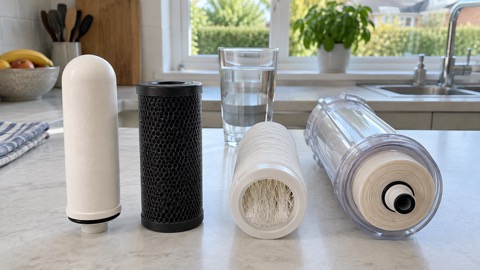 What Water Filters Remove
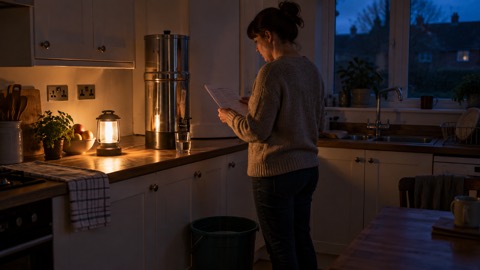 Gravity Filters Explained
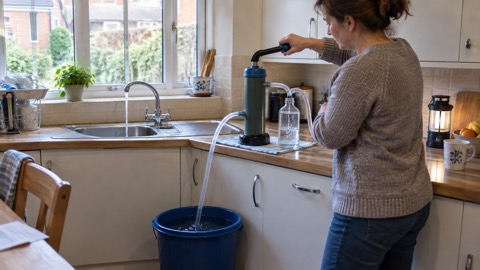 Hand Pump Filters
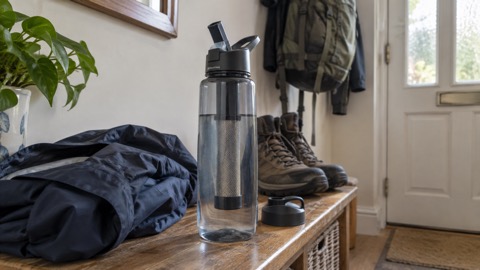 Filter Bottles and Straw Filters