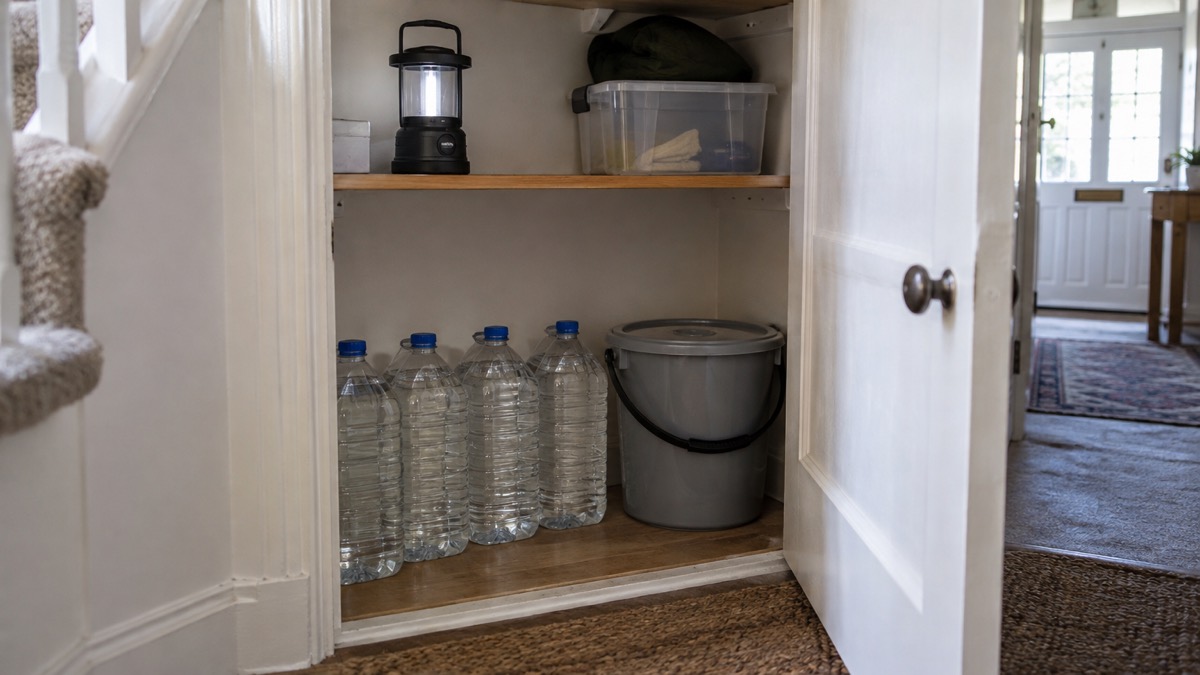
Storing tap water for an emergency is simple, but the safety of what you store depends on one thing above all: chlorine. Water companies in England and Wales are required by regulation to disinfect drinking water and hold a residual chlorine concentration within the network of pipes, so the disinfectant is still working when the water reaches your tap1. Once you fill a container and put it away, that chlorine slowly fades, and with it the protection that keeps the water safe to drink.
The practical consequence is a short shelf life. Official guidance from the Drinking Water Quality Regulator for Scotland is blunt: you should throw away any unused water after 24 hours2. Stored tap water is therefore something you rotate, not something you fill once and forget. Alongside it, keep bottled water for three days, at 3 litres per person per day for drinking, with more for cooking and washing3, and enough household supplies overall to meet your needs for at least 72 hours4.
This page explains how to fill, store and rotate tap water; how to deal with the chlorine taste; and what to do about stagnant water in tanks and pipes when you come home after time away.
Why chlorine is in your tap water, and why it fades
Chlorine is added to the water to disinfect it and keep it safe to drink2. In England and Wales this is not optional: it is a regulatory requirement for water companies to disinfect their water and hold a residual chlorine concentration within the network of pipes1. The residual is what protects the water on its journey from the treatment works to your kitchen tap, and it is the reason water drawn fresh from the mains is safe to store for a short period.
That protection is temporary. Chlorine is a volatile chemical: it disperses when water stands, which is exactly why official advice to remove a chlorine taste is to leave a covered jug in the fridge for a few hours6. The same process happens, more slowly, in a sealed container in a cupboard. As the chlorine fades, the water loses its residual disinfectant, and official guidance treats water that has stood without it as something to discard after 24 hours rather than keep2.
This is also why the container matters less than the rotation. A clean, sealed container keeps out new contamination, but it cannot hold the chlorine in indefinitely: chlorine dissipates over time, which is why the level in your tap water already falls the further your home is from the treatment works3. Treat stored tap water as a short-term buffer: something you fill when a storm, a freeze or planned work on the mains is forecast, and use or replace within a day.
How long stored tap water keeps: 24 hours once the chlorine has gone
The rule is simple: "You should throw away any unused water after 24 hours."2 That applies to water that has stood long enough for the chlorine to disperse, whether in a jug, a bottle or a larger container. After that point, the water has no residual disinfectant protecting it, and the advice is not to drink it.
In practice, this shapes how you use a tap water store:
- Fill containers when you have warning: before a storm, during planned work on the mains, or when a frozen pipe threatens the supply. Bournemouth Water advises filling bottles or containers from the tap in advance for cooking, drinking and pets, ideally on the morning of the interruption7.
- Use stored tap water first, within the 24 hour window, and fall back on bottled water after it.
- Empty, clean and dry containers before refilling, rather than topping up old water with new.
For anything beyond a day, the household plan is bottled water: 3 litres per person per day for drinking, for 3 days, with more needed for cooking and washing3. Birmingham City Council frames the same figure as keeping enough supplies to meet your household's needs for at least 72 hours4. If you want to understand the full calculation, see how much drinking water to store per person.
How much chlorine is in your tap water
The numbers here are small, and that is deliberate. The World Health Organisation has set a health-based guideline maximum value of 5 mg/l for chlorine as a residual disinfectant in drinking water1. Levels in tap water in England and Wales are well below this guideline: most water companies aim to keep the level below 1 mg/l, and typical residual levels, in the form of free or combined chlorine, are 0.5 mg/l or less1.
| Measure | Level | Who says it |
|---|---|---|
| WHO health-based guideline maximum | 5 mg/l chlorine as residual disinfectant1 | World Health Organisation, via the DWI |
| Typical water company target | below 1 mg/l1 | Drinking Water Inspectorate |
| Typical residual at the tap | 0.5 mg/l or less, free or combined chlorine1 | Drinking Water Inspectorate |
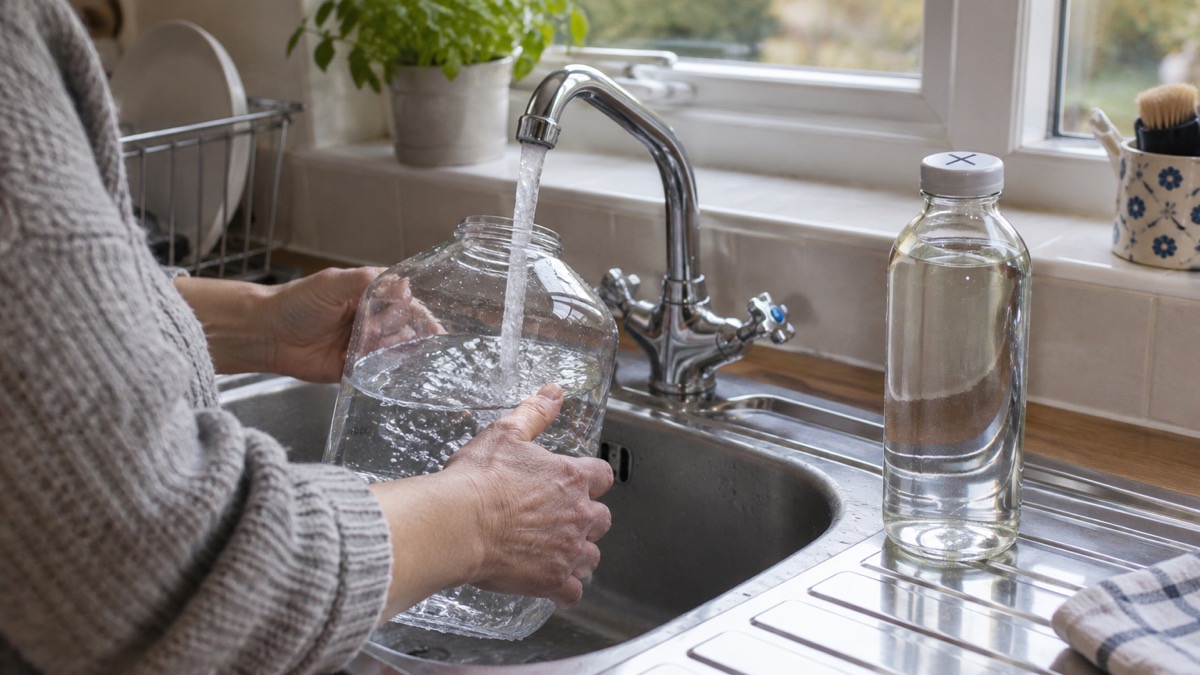
Combined chlorine includes chloramine, which some companies use because it lasts longer in the pipe network. Either form is doing the same job: keeping the water disinfected between the treatment works and your glass. The levels are far below any health-based limit, so the chlorine in UK tap water is a taste question, not a safety question, and the answer to the taste is standing or boiling, not filtering it out of your emergency store.
Getting rid of a chlorine taste before you store or drink
If the taste puts you off drinking tap water, or off giving it to children, there are two officially recommended fixes, and both are free.
The first is patience. nidirect guidance for Northern Ireland says chlorine taste and odours should dissipate if the water is left to stand in the fridge for a few hours6. The same advice is given in household terms: "A simple, safe way to overcome this smell or taste is to place a covered jug of water in the fridge before drinking."2 The cover matters, because water left uncovered in a fridge can pick up flavours and contamination from food around it.
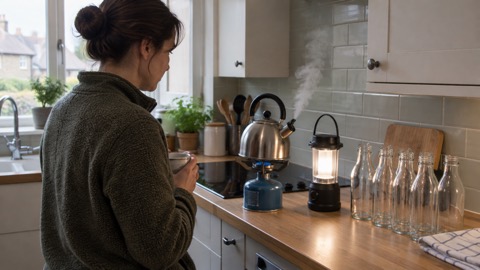
The second is boiling. Boiling the water will also remove chlorine6. If you boil water to drink, Public Health Wales advises: "Boil the water and let it to cool before using, keep it in a container with a cover or a lid while it is cooling (uncovered water could become contaminated and make you ill)."8 The same rule applies to water boiled in an emergency because the supply may be contaminated: the Drinking Water Inspectorate's flooding advice is to boil all intended water and let it cool to avoid scalding, or use bottled water, while waiting for confirmation about whether the main supply has been affected9. Shropshire Council gives the same instruction for private supplies affected by flooding: bring the water to the boil and leave it to cool before drinking, using it for food preparation or giving it to pets10.
One habit worth adopting before any emergency: keep drinking water in the fridge instead of running the tap until it becomes cold, as Cornwall Council advises11. A covered jug in the fridge is a small, daily version of your emergency store, and it is water you rotate naturally because you drink it.
Why the chlorine taste varies from home to home
Two houses on the same street can taste the same water very differently, and there are two reasons.
The first is the supply itself. Residual chlorine levels vary across the network as water travels different distances from the treatment works, so the water at the end of a long main can taste different to water near the works. Levels also change day to day as companies adjust dosing.
The second is your own plumbing and kettle. The Drinking Water Inspectorate explains that chemical reactions can occur between chlorine and chemicals in kettles, rubber or plastic components within your domestic plumbing, and these reactions can produce a distinctive TCP or medicinal taste or odour12. This taste is not the chlorine itself, and it is not a sign the water is unsafe, but it is unpleasant.
There is a simple diagnostic. One water company suggests checking which tap the problem started with, and trying another tap in the house to see whether the taste or smell is present there too13. If the taste appears at every tap, it is likely the supply; if it only appears at one, the cause is probably the tap, its fittings or something connected to it. A new kettle, or one descaled and rinsed well, often cures a TCP taste that appears only in hot drinks. For the full range of causes, see why your tap water tastes or smells different.
Stagnant water in tanks, cisterns and pipes
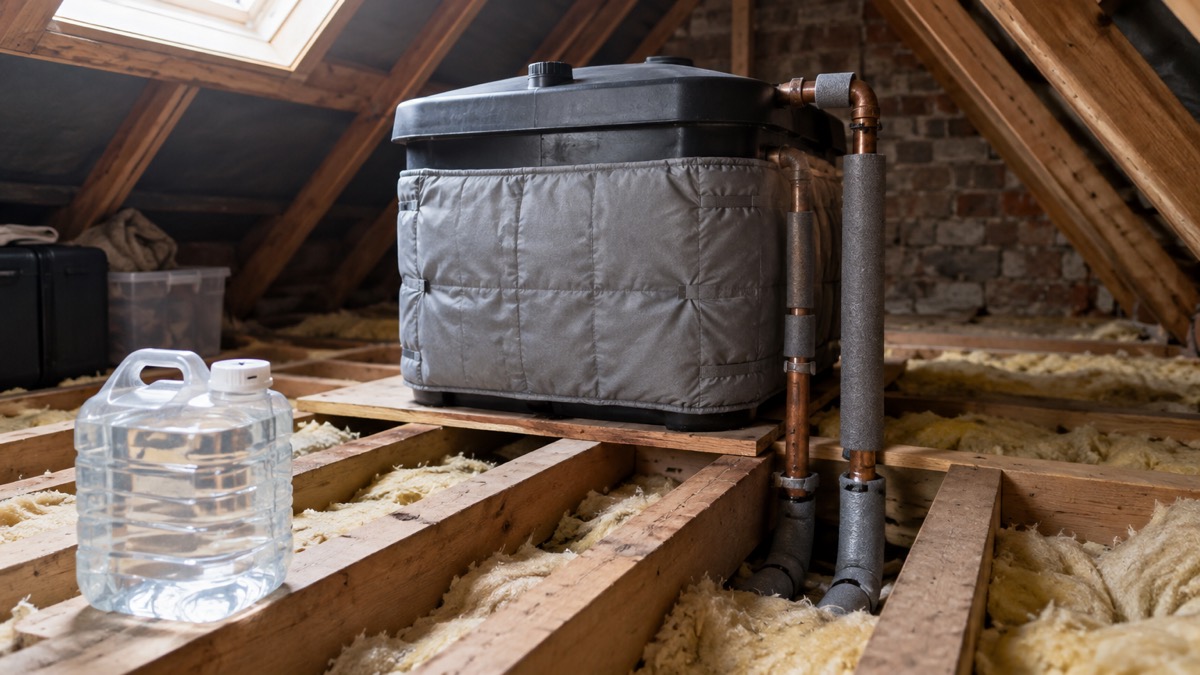
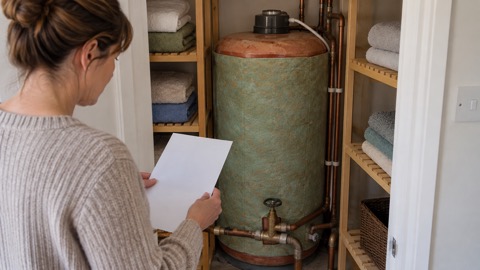
Not all the water in your home is drinking water, and it matters which you store. The Drinking Water Inspectorate's guidance on storage tanks and cisterns is clear: "Ideally you should only use a tap connected to the mains water supply for drinking, food preparation or teeth cleaning."5 In most homes that means the cold kitchen tap. Water that has sat in a loft cistern, a hot water cylinder or long runs of pipe has stood still, warmed and cooled, and it is not the water to fill your containers from.
Stagnant water is a genuine hazard, not just a taste problem. Public Health Wales notes that microbial hazards include Legionella, a bacteria that can grow in water systems14. Legionella thrives where water stands at warm temperatures, which is why the design and maintenance of storage systems matter:
- A storage tank should not be too large, so the water in it is frequently replenished with fresh water; the DWI says 250 litres is quite sufficient for most homes5.
- On private supply networks, inlets and outlets to tanks should be sited at opposite ends to reduce the possibility of stagnant areas of water and short circuiting15.
- When a private supply system is commissioned, it should be disinfected by filling it with a 20 mg/L solution of chlorine, leaving it to stand for several hours, preferably overnight, then draining and rinsing thoroughly with treated water16.
- In public buildings, workplaces, health care premises and social housing, all water tanks are checked and cleaned as part of the arrangements that must be in place for legionella control purposes5.
For an ordinary household, the practical points are these: fill drinking containers from the cold mains tap, not from a bathroom tap fed by a tank; keep the loft cistern lid on and the tank in good order; and if you have a private supply with a storage tank, have it cleaned and disinfected properly rather than letting water sit for months. Legionella also has routes into the home beyond the water system: NHS inform advises wearing gloves while gardening, especially when handling compost, because Legionella bacteria can be found in compost, and washing your hands afterwards17. See how to stay safe from Legionella at home for the detail, and household storage tanks for drinking supplies if you are considering a tank.
Coming home after time away: flush the taps
Water that has stood in your pipes while the house was empty is in the same position as water stored in a container, only without the sealed container. The chlorine has faded, the water has sat at room temperature, and the advice is to flush it through before you use it.
The standard instruction, repeated across official guidance, is to run the taps. Argyll and Bute Council, writing for private supply users after floods and storms, advises that once the supply is restored you should flush all associated taps for a few minutes, or longer depending on the length of pipework, to remove contaminated water from the plumbing lines18. Belfast City Council gives the same advice for mains supplies after flooding: wash taps and let them run for a few minutes before use, because mains tap water should not be contaminated after flooding19.
Where taps have been submerged in floodwater, the cleaning step comes first. Northumberland County Council advises that any taps submerged in contaminated floodwater should be cleaned using a bleach solution and run for 30 seconds before the water is used20.
A routine for returning home:
- Run each tap in turn, starting with the one you drink from, for a few minutes, longer if the pipework runs are long18.
- Wash the tap itself before using it, especially after flooding19.
- Clean any tap that was submerged in floodwater with a bleach solution, then run it for 30 seconds20.
- Fill your drinking containers only after the water is running fresh from the cold mains tap.
The same logic applies in reverse when the supply is about to go off. The Met Office's WeatherReady advice is to capture some tap water for drinking and flushing while your water supply is switched off21, and Wiltshire and Swindon Prepared notes that after you turn off the inside stop valve it may take a few minutes for the water to stop running from your taps, because water is left in the pipes22. That water in the pipes is worth catching. See what to do if water tastes odd after a holiday and usable supplies already in your pipes, cistern and cylinder.
When the supply is off or unsafe: storing, boiling and notices
The moments when you most need stored water are the moments the supply fails or becomes unsafe, and the advice converges on a few actions.
Before the supply goes off, whether for planned work on the mains or because a pipe has frozen, capture water from your taps21. If the burst is on a pipe from the storage tank, nidirect advises turning off the stop valve in the storage tank and turning on all hot taps to drain the system23.
While the supply is off or under suspicion, treat the water. The Drinking Water Inspectorate's flooding advice is to boil all intended water and let it cool, or use bottled water, while waiting for confirmation about whether the main supply has been affected9. If no other water is available and you must use bottled water with sodium above 200 mg/litre, official guidance is to use it for as short a time as possible24.
Notices do happen, and they can last. When your water company issues a "do not drink" or "do not use" notice, follow it exactly and use bottled water for drinking, cooking and pets until the company lifts it. See do not drink and do not use notices and bottled supplies, tankers and bowsers from your water company.
The wider context makes this worth doing now. England's drought in October 2026 left national reservoir storage at 54% of capacity, around 21% below the long-term average for the time of year, in the week ending 13 October 202625. Dry years raise the odds of supply restrictions and hosepipe bans, and a household that already stores water, keeps its kettle full and keeps a freshly filled bottle of water handy as part of its routine26 is ready either way.
Keeping the habit going
Rotation is the whole skill of storing tap water, and it works best as routine rather than as a project. Keep a filled kettle so you can always make a hot drink, and keep a freshly filled bottle of water handy as part of your routine26. Fix dripping taps and leaks, as both Scottish and Argyll and Bute Council guidance recommends27, because a dripping tap wastes the very supply you are trying to hold. In hot weather, drink plenty of water28 and keep drinking water in the fridge rather than running the tap cold11.
Then, when a storm is named or the water company writes about planned work, fill your containers from the cold mains tap, label them with the date, use them within 24 hours2, and rely on your bottled store beyond that3. The home drinking supply storage checklist and the supply interruption checklist pull all of this into one list, and containers and jerrycans for drinking supplies covers what to fill.
Sources (28)
- Chlorine in drinking water, Drinking Water Inspectorate, 2024-08-13
- Chlorine: drinking water quality FAQs, Drinking Water Quality Regulator for Scotland, 2026-10-28
- Be Ready Checklist, Be Ready Campaign, 2026
- Are you ready?, Birmingham City Council, 2026-05-06
- Water storage tanks and cisterns, Drinking Water Inspectorate, 2026-06-09
- Dealing with drinking water problems, nidirect, 2026-10-06
- Snow and ice in Cornwall, Cornwall Council, 2025-10-01
- Weather and health, Public Health Wales, 2026-07-16
- Flooding, Drinking Water Inspectorate, 2026-10-28
- Flooding advice for properties using a private water supply, Shropshire Council, 2026-10-29
- Private water supplies, Cornwall Council, 2026-10-29
- TCP or medicinal taste and odour, Drinking Water Inspectorate, 2024-08-13
- Taste and odour in drinking water, Drinking Water Inspectorate, 2026
- Water and health, Public Health Wales, 2026-10-15
- Protecting your private water supply, Drinking Water Inspectorate, 2026-10-28
- Water storage: private supply networks, Drinking Water Inspectorate, 2025-11-05
- Summer health campaign, NHS inform, 2026-08-06
- Private water supplies after floods or storms, Argyll and Bute Council, 2026
- Flooding advice, Belfast City Council, 2026-10-29
- Information about specific safety concerns, Northumberland County Council, 2026-05-21
- WeatherReady weather hacks, Met Office, 2026-10-25
- Know your water supply, Wiltshire and Swindon Prepared, 2026-10-25
- Steps to reduce risk of burst pipes, nidirect, 2025-10-23
- Keeping children safe during a flood, nidirect, 2025-12-09
- Dry weather and drought in England: 9 to 15 October 2026, UK Government, 2026
- Failure of water infrastructure or loss of drinking water, Wiltshire and Swindon Prepared, 2026-10-25
- Loss of supply: private water supply users, Argyll and Bute Council, 2026
- Stay safe as temperatures rise this week, Wiltshire and Swindon Prepared, 2026-10-25
 Supply Interruption Checklist
 Boil Notice Checklist
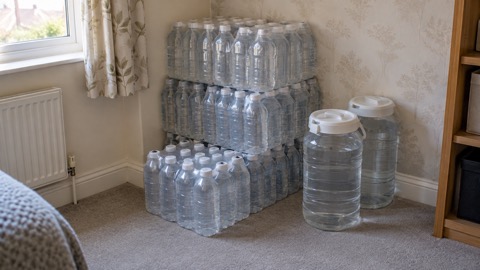 Drinking Supply Checklist
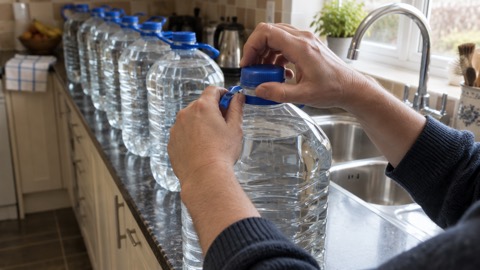 How Much Water to Store
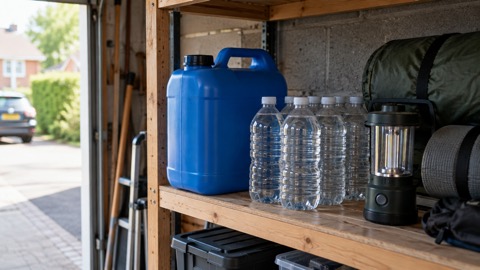 Containers and Jerrycans
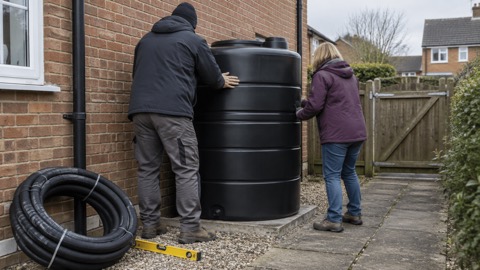 Household Storage Tanks
 Water Already in Your Pipes
 Making Water Safe to Drink
 Boiling Water to Kill Germs
 Purification Tablets
 Emergency Filter Types
 What Water Filters Remove
 Gravity Filters Explained
 Hand Pump Filters
 Filter Bottles and Straw Filters