Legionnaires' disease is a potentially fatal form of pneumonia caused by Legionella bacteria, which can grow in water systems1. You catch it by breathing in contaminated water droplets, not by being near someone who is ill, and it mostly affects people who are already vulnerable because of age, illness, a weakened immune system or smoking1. Public Health Wales describes Legionella simply as "a bacteria that can grow in water systems"2, and it is the systems that hold, warm or spray water that matter most.
For an ordinary household, the headline is reassuring. Somerset Council's water safety guidance states plainly that "the risk of legionella within your home is very low, but following these simple precautions will help keep you stay safe"3. Most UK homes take water straight from the mains, use it daily and never hold it warm and still for long enough to become a problem. The precautions that do matter are running unused taps and showers, preferring mains-fed taps for drinking, and taking particular care with anything that stores or sprays water, such as a hot tub.
This page explains what the disease is, where Legionella can grow in and around a home, the simple habits that keep your water safe, who is most at risk, which symptoms mean you need urgent help, and what happens in the outbreaks that occasionally make the news. It sits alongside our wider guidance on health emergencies and on infectious disease outbreaks near you.
What Legionnaires' disease is, and how you catch it
Legionnaires' disease is a lung infection. Northumberland Council's health and safety guidance describes it as "a potentially fatal form of pneumonia which can affect anyone, but mostly affects those vulnerable because of age, illness, immunosuppression, smoking etc"1. The cause is Legionella, which Public Health Wales lists among the microbial hazards of water, describing it as "a bacteria that can grow in water systems"2.
The route of infection is breathing in fine droplets of contaminated water. This is different from the diseases most households know. The government's Prepare campaign explains that many infectious diseases "can be spread from person to person directly (for example through physical contact with an infected person or through droplets in the air)"10. Legionnaires' disease is not one of them: the droplets that carry Legionella come from a water system, not from a sick person's cough. That single fact shapes everything on this page. You cannot catch it from a colleague, a child or a fellow passenger, and isolating a patient does nothing to stop it. What matters instead is the water source that produced the droplets, which is why outbreak investigations focus on buildings and their plumbing rather than on tracing contacts.
Because the bacteria grow in water systems, the conditions that allow growth are the real hazard: water that sits still, water that is kept warm rather than properly hot or properly cold, and water that is broken into a fine spray that can reach deep into the lungs. Showers, spa pools, cooling systems and misting equipment all create sprays. The Health and Safety Executive (HSE) has issued a safety notice covering "the proper management of the risks from legionella in a wide range of systems, such as hot and cold water systems in buildings, spa pools and a range of industrial processes that use water for cooling, washing, misting etc"4.
The risk in an ordinary home is very low
It is worth saying this clearly, because the word "outbreak" in news reports can make a home feel like a hazard. It is not. Somerset Council's guidance for council and social housing residents states that "the risk of legionella within your home is very low, but following these simple precautions will help keep you stay safe"3. The precautions are simple household habits, not specialist equipment.
The reason most homes are safe is the way UK water is supplied. The Drinking Water Inspectorate (DWI), which regulates drinking water quality in England and Wales, advises that "ideally you should only use a tap connected to the mains water supply for drinking, food preparation or teeth cleaning"11. In most homes the kitchen cold tap is mains-fed, and mains water arrives fresh, treated and moving, which leaves little opportunity for bacteria to multiply. The same DWI guidance notes that "in public buildings, workplaces, health care premises and social housing all water tanks will be checked and cleaned as part of the arrangements that must be in place for legionella control purposes"11. Your home does not have that regime of checks, but it also does not usually have the large, complex stored-water systems that need it.
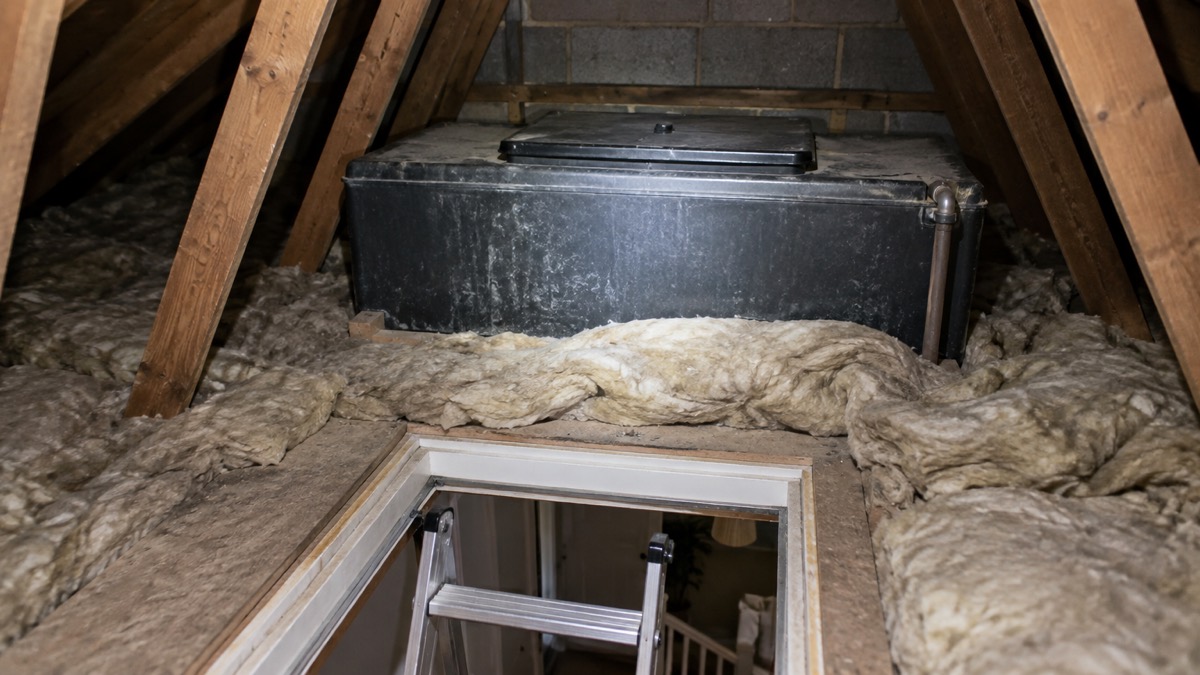
Where homes do differ is in age and plumbing. Older properties, and some flats, may have cold water storage tanks feeding the bathroom cold taps. If your home has a tank, the water in it is stored rather than fresh from the mains, and that is the situation where the DWI's advice about preferring a mains tap for drinking and teeth cleaning matters most11. If you are unsure which taps are mains-fed, your water company can tell you, and a qualified plumber can check.
Where Legionella grows: showers, unused taps, hot tubs and more
Legionella needs water that is still, warm and able to reach the air as a spray. Around a home, that points to a short list of places.
| Where | Why it can matter | What to do |
|---|---|---|
| Showers | They break water into a fine spray you breathe in | Run them before use if unused; clean and descale the head regularly |
| Rarely used taps | Water sits still in the pipe and fittings | Run the tap before drinking or brushing teeth |
| Cold water storage tanks | Water is stored rather than mains-fed | Prefer a mains tap for drinking; ask about checks if in social housing |
| Hot tubs and spa pools | Warm water, held and then sprayed into the air | Clean and maintain exactly as instructed; empty if you cannot maintain it |
| Compost and potting soil | Legionella bacteria can be found in compost | Wear gloves when gardening, consider a mask for dusty work, wash hands afterwards |
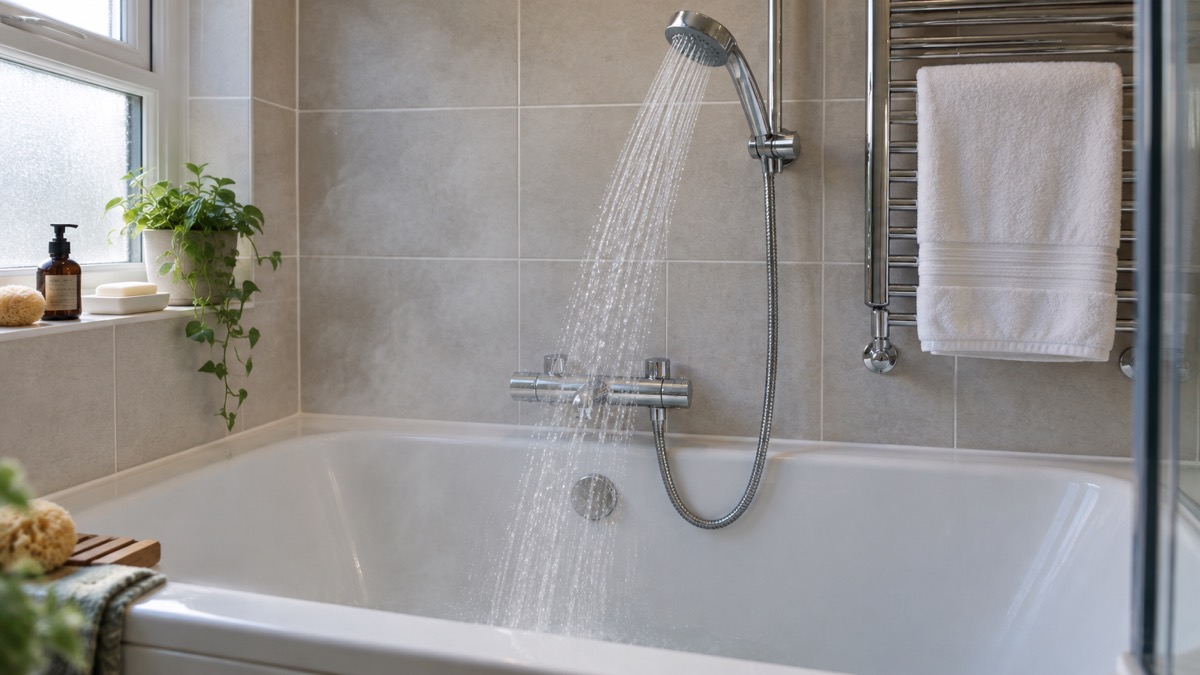
The shower point deserves a moment, because "legionella shower" is a common search. A shower is only a risk when the water feeding it has been allowed to stagnate or the system is poorly maintained. A shower used every day in a mains-fed, well-maintained home is not a meaningful hazard. A shower in a holiday home opened for the first week in months, or one fed from a neglected tank, is the case where running it thoroughly before you step under it makes sense.
Hot tubs are the one domestic item named directly in official guidance. The HSE safety notice on legionella in water systems covers spa pools among the systems it addresses, and states that "leisure centres with spa pools and care homes are among the businesses being urged to do more to protect workers and members of the public from legionella risks"4. A domestic hot tub works the same way as a commercial one: it holds warm water and jets it into the air as a breathable spray. If you own one, follow the maker's maintenance instructions to the letter, keep the treatment regime going whenever it is filled, and drain and clean it rather than letting it sit half-maintained.
One place people do not expect is the garden. NHS inform's summer health campaign advises: "Wear gloves while gardening, especially when handling compost, because Legionella bacteria can be found in compost; consider wearing a mask for dusty work and wash hands afterwards"12. Opening bags of compost away from your face, wearing gloves and washing your hands afterwards covers it.
Air conditioning deserves a plain answer too. The HSE notice refers to industrial processes that use water for cooling, washing and misting4. Domestic air conditioning units of the kind used in UK homes do not use a water spray in the way those systems do. The systems implicated in legionella risk are the large evaporative cooling towers and similar plant found on commercial and industrial sites, which is why the HSE notice is aimed at duty holders in workplaces and public buildings rather than households4.
Keeping your home water safe: flushing, cleaning and maintenance
The precautions that keep household water safe are few and cheap. Somerset Council frames them as exactly that: simple precautions that follow from a very low underlying risk3.
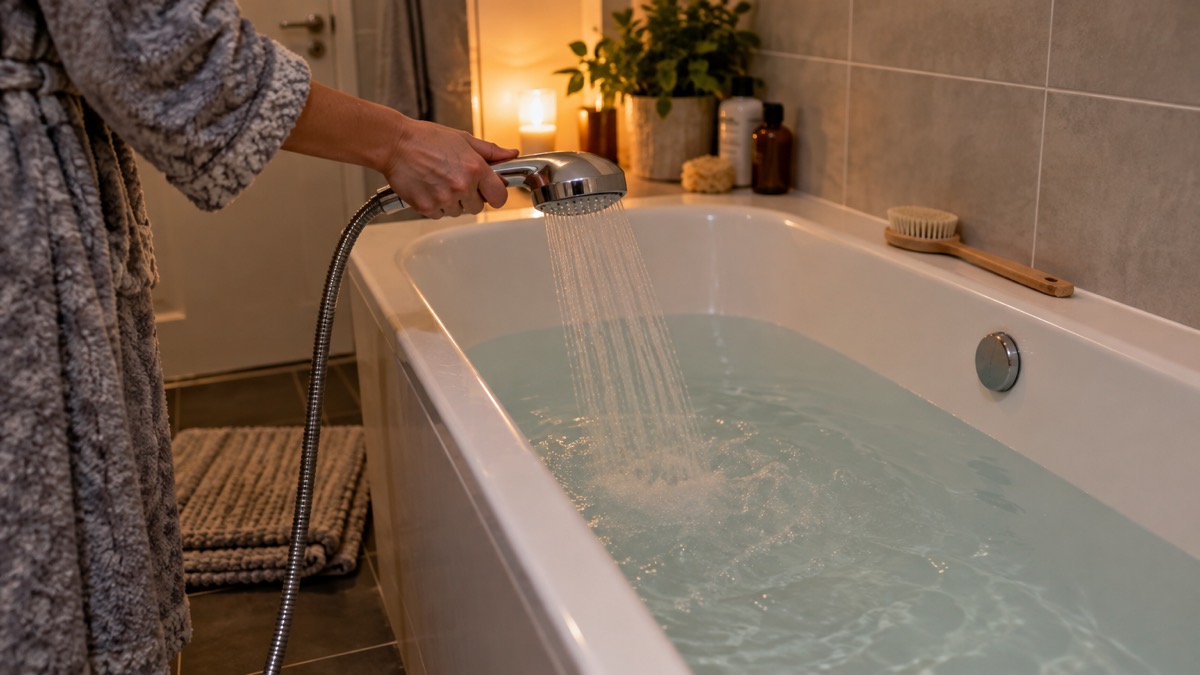
Run unused outlets. Any tap, shower or other outlet that has not been used for a while should be run before you use it for drinking, cooking or brushing your teeth. This is the single most useful habit, and it matters most after a holiday, in a second home, or for a spare bathroom used once a month. Start with the cold tap, then the hot, and let each run long enough to pull fresh water through from the supply.
Prefer the mains tap for drinking. The DWI advises that ideally only a tap connected to the mains supply should be used for drinking, food preparation or teeth cleaning11. In most homes that is the kitchen cold tap.
Clean and descale showers and spray fittings. Limescale and debris in a shower head give bacteria somewhere to grow, and the head is where water becomes a spray. Regular cleaning of the head, following the maker's instructions for the fitting, keeps this in check.
Look after anything that stores or sprays water. That means hot tubs above all, cleaned and treated exactly as the maker instructs, and any cold water storage tank, which in social housing and similar settings is checked and cleaned under the arrangements that must be in place for legionella control11.
Use a qualified plumber for plumbing work. The DWI's guidance on lead pipework advises employing a qualified plumber, for example one accredited through the WaterSafe scheme, and notifying your water company when arranging replacement13. The reason goes beyond lead: alterations that leave long runs of pipe with no outlet, or dead legs where water cannot move, create exactly the stagnant conditions to avoid.
Deal with floods properly. After a flood, Devon Council's recovery leaflet advises that "all clothes, bedding and soft toys should be washed at 60 o C to kill germs"14, a reminder that temperature and hygiene are the tools that deal with waterborne contamination generally. A burst pipe and repair can leave parts of the system standing unused afterwards, so run outlets again once repairs are done.
Who is most at risk
Legionnaires' disease can affect anyone, but it is not an equal-opportunity illness. Northumberland Council's guidance is specific: it "mostly affects those vulnerable because of age, illness, immunosuppression, smoking etc"1. The government's Prepare campaign gives the general shape of at-risk groups for infectious diseases: "People who have a weakened immune system (immunosuppressed) or other underlying health conditions; older adults; babies and young children; pregnant people"10.
Other official guidance on waterborne and infectious hazards points the same way. The Food Standards Agency's safety notice on Listeria lists those more vulnerable to infection as "those over 65 years of age, pregnant women and their unborn babies, babies less than one month old and people with weakened immune systems"15. The government's heat guidance includes "people taking certain medications" among those at higher risk16, and Guy's and St Thomas' heatwave advice names "underlying health conditions, but particularly heart, breathing or mobility problems, dementia, diabetes, an" kidney disease17. These lists are not about Legionnaires' disease specifically, but they describe the same pattern of vulnerability that matters here: age, chronic illness and a weakened immune system.
Smoking is the one factor on the list that many households can act on. It appears in the official description of who Legionnaires' disease mostly affects1, alongside age, illness and immunosuppression. If you smoke, or someone in your home does, that is a reason to be a little more careful with the precautions on this page, and a reason not to brush off a fever and cough.
If you look after someone in one of these groups, our page on people at higher risk in an outbreak goes into protecting vulnerable relatives in more detail.
Symptoms: what to watch for and when to act
Legionnaires' disease is a pneumonia1, which means the illness centres on fever and the lungs. NHS inform's guidance on sepsis, the body's extreme response to infection, lists early symptoms that apply to any serious infection in older children and adults: "a high temperature (fever) or low body temperature chills and shivering a fast hea" rtbeat and fast breathing9. A fever with chills, aches and a cough that is not settling should always prompt you to seek medical advice, and promptly if the person is in one of the at-risk groups above. Our page on when to call 111 and when to call 999 can help you choose.
Some symptoms mean do not wait. NHS inform lists the severe symptoms of sepsis as including "feeling dizzy or faint a change in mental state, like confusion or disorientation diarrhoea nausea an" d vomiting, slurred speech, severe muscle pain, severe breathlessness, less urine production than normal, cold, clammy and pale or mottled skin, and loss of consciousness9. The NHS 111 Wales sepsis guidance is equally direct about confusion: "acting confused, slurred speech or not making sense" is a symptom that means urgent help is needed8.
Confusion can also appear in other heat- and infection-related emergencies: heatstroke symptoms include "confusion, lack of coordination, fast heartbeat, fast breathing or shortness of breath, hot skin that is not sweating, s" eizures17. Whatever the underlying cause, a sudden change in someone's mental state alongside fever or breathing trouble is a reason to get emergency help, not to wait.
Treatment and recovery
Legionnaires' disease needs hospital treatment in most cases, and the treatment is antibiotics. The pattern of antibiotic treatment is set out clearly in NHS inform's sepsis guidance, which describes how serious infections are handled: "If sepsis is suspected, broad-spectrum antibiotics are given first" and "Ideally, antibiotic treatment should start within an hour of diagnosis"9. NHS 111 Wales puts the hospital standard plainly: "You should get antibiotics within 1 hour of arriving at hospital"8. That speed is why the warning symptoms above matter: the sooner treatment starts, the better the outlook.
The course of treatment then steps down. NHS inform states: "Intravenous antibiotics are usually replaced by tablets after 2 to 4 days. You may have to take them for 7 to 10 days or longer, depending on the severity of your condition."9 Recovery from a serious pneumonia takes longer than the antibiotics do, and the official advice on recovering from a severe illness is not to hurry it. NHS 111 Wales advises: "do not try to rush your recovery, give yourself time", along with asking your work about changes to your hours or conditions while recovering, gentle exercises to build strength, regular sleep, hand washing to prevent further infections, and eating little and often if your appetite is small8.
When to return to work depends on your job. Somerset Council's food poisoning guidance states that "if you do not work with food then as a general guide most people can return to work 24 hours after the symptoms have sto" pped, while "people who prepare food as part of their work must inform their employers of their illness and should not return to wo" rk within 48 hours of the last symptom18. For Legionnaires' disease specifically, follow the advice of the team treating you, because a severe pneumonia is not the same as a short stomach bug. Our page on how long to stay off work or school after illness covers the general rules.
One instruction from the recovery guidance applies to any antibiotics: "take antibiotics correctly, follow the instructions and take all your prescribed antibiotics, even if you feel better"8. Stopping early because you feel improved is the common mistake.
It does not spread from person to person
This is worth stating firmly, because it changes what a household does when someone is ill. Legionnaires' disease is caught from a water source, not from a patient. Compare the diseases that do pass between people: Derbyshire Council notes that "flu is a virus that spreads easily from person to person"5; Food Standards Scotland explains that norovirus "is easily spread from person-to-person and outbreaks are common in settings such as care homes, schools, nurse" ries, hotels and cruise ships6; and Public Health Wales warns that meningococcal bacteria "can pass from person to person through close contact"7. Legionella is not in that category. Nobody in the household needs to isolate, and there is no benefit in keeping away from the patient beyond ordinary hygiene.
What a household should do instead is think about the water. If a case is diagnosed, the investigation will look for the source, because that is the only way further cases are prevented. That work is done by public health teams and environmental health officers, not by you, but it is why you may be asked about where the person has been: showers used, hot tubs visited, buildings entered. Answering those questions fully matters more than any cleaning you could do at home.
Our pages on stopping infections spreading at home and looking after someone ill at home cover the general care side, and the ordinary hygiene that protects a household from the infections that do spread.
Outbreaks, landlords and workplaces
Most Legionnaires' disease cases in the news come from a building, not a home, and the responsibility for preventing them sits with the people who run those buildings. Northumberland Council's guidance is explicit that "duty holders must comply with legislation to manage, maintain and treat water systems properly, including appropriate water treatment and cleaning regimes"1. The HSE safety notice names the settings under scrutiny: "leisure centres with spa pools and care homes are among the businesses being urged to do more to protect workers and mem" bers of the public from legionella risks4. The DWI adds that in public buildings, workplaces, health care premises and social housing, water tanks are checked and cleaned as part of the mandatory legionella control arrangements11.
If you rent your home, that framework is your protection. Somerset Council's water safety guidance for council and social housing residents shows what a landlord's advice should look like, including the reassurance that the home risk is very low and the precautions are simple3. If you rent privately and are concerned, ask your landlord what arrangements are in place for the water system, particularly if the property has a storage tank or a hot tub, or has stood empty between tenancies.
During an outbreak, public health teams identify the source, and the cases stop once it is found and treated. Households in the affected area should follow the outbreak advice issued locally, which our page on the UK Health Security Agency explains how to find and read. If you or someone in your household develops the symptoms above during an outbreak, say where you have been when you seek help, because that information is what allows investigators to connect cases to a source.
Sources (18)
- Information about specific safety concerns, Northumberland Council, 2026-05-21
- Water and health, Public Health Wales, 2026-10-15
- Water safety, Somerset Council, 2026-10-28
- Management of the risks from legionella within water systems safety alert, Health and Safety Executive, 2026
- Flu, Derbyshire County Council, 2026-10-29
- Foodborne viruses, Food Standards Scotland, 2026-10-25
- Meningitis and meningococcal disease, Public Health Wales, 2026-10-15
- Sepsis, NHS 111 Wales, 2026-01-12
- Sepsis, NHS inform Scotland, 2026-09-28
- Health and infectious disease outbreaks, Prepare Campaign (UK Government), 2026-10-12
- Water storage tanks and cisterns, Drinking Water Inspectorate, 2026-06-09
- Summer health campaign, NHS inform Scotland, 2026-08-06
- Lead in drinking water, Drinking Water Inspectorate, 2026-05-01
- Flood recovery information, Devon County Council, 2026-01-29
- Food safety alert: Listeria monocytogenes, Food Standards Agency, 2026-06-24
- Beat the heat: keep cool at home checklist, UK Government, 2026-07-21
- Heatwave advice, Guy's and St Thomas' NHS Foundation Trust, 2026-06
- Food poisoning, Somerset Council, 2026-07-09
 Medicine Cabinet Checklist
 Sick at Home Supplies Kit
 Caring for Someone Ill at Home
 Pandemics and UK Household Plans
 Outbreaks Near You
 UK Health Security Agency
 Staying Home When Ill
 Stopping Infections at Home
 Caring for a Sick Person at Home
 Keeping Prescription Medicine
 Medicine Shortages Explained
 Storing Medicines Safely
 Urgent Care and A&E
 Vaccines Against Outbreaks
 Flu Symptoms and Getting Help