
Most people who catch flu or COVID-19 recover at home. But respiratory viruses like these spread easily, and they can put the most vulnerable people in our communities at risk of serious illness1. If someone in your family is older, pregnant, very young, or has a weakened immune system or a long-term condition, the steps you take around them matter more than the steps you take for yourself.
The good news is that the actions that protect a vulnerable relative are ordinary and practical: get vaccinated when eligible, wash hands, keep ill people away until they are no longer infectious, ventilate rooms, and know exactly when to ring 111 or 999. This page sets out who is at higher risk from flu and COVID-19, what to do before and during illness in your household, and where wider support exists for older and disabled people and their carers. There are no COVID-19 restrictions in the UK, so everything here is advice rather than law2.
Who is at higher risk from flu and COVID-19
The groups at higher risk overlap heavily between the two viruses, but they are not identical, and it is worth knowing both lists if you are protecting a relative.
For COVID-19, people more likely to become seriously ill include older adults, those with some long-term conditions, and those who are pregnant, especially after 28 weeks3. UK government guidance adds detail: people at higher risk from COVID-19 and other respiratory infections include older people, those who are pregnant, those who are unvaccinated, people of any age whose immune system means they are at higher risk of serious illness, and people of any age with certain long-term conditions6. The NHS also offers treatments to people with COVID-19 who are at highest risk of becoming seriously ill, which is a separate category from simply being at higher risk10.
For flu, those more likely to become seriously ill include children under 6 months old, people aged over 65, pregnant women, and those with certain underlying health conditions4. The Met Office adds that flu can be more serious for pregnant women, very young children, and older people11. People with Chronic Obstructive Pulmonary Disease (COPD) sit in both camps: they are more at risk of ill-health and hospitalisation during periods of cold weather and more susceptible to illness from high levels of circulating respiratory infections, including flu11.
One risk worth naming plainly: if you get flu and COVID-19 infection at the same time, you are more likely to become seriously ill12. That is a strong reason for a vulnerable relative to take up both vaccines, not just one.
There is reassurance for parents in the same guidance. The risk of becoming seriously unwell from COVID-19 and other respiratory infections is very low for most children and young people6. Babies and young children are nonetheless listed as an at-risk group during winter illness and cold weather13, so a baby with a fever still needs prompt attention, as covered below.
Get the flu vaccine if you are advised to
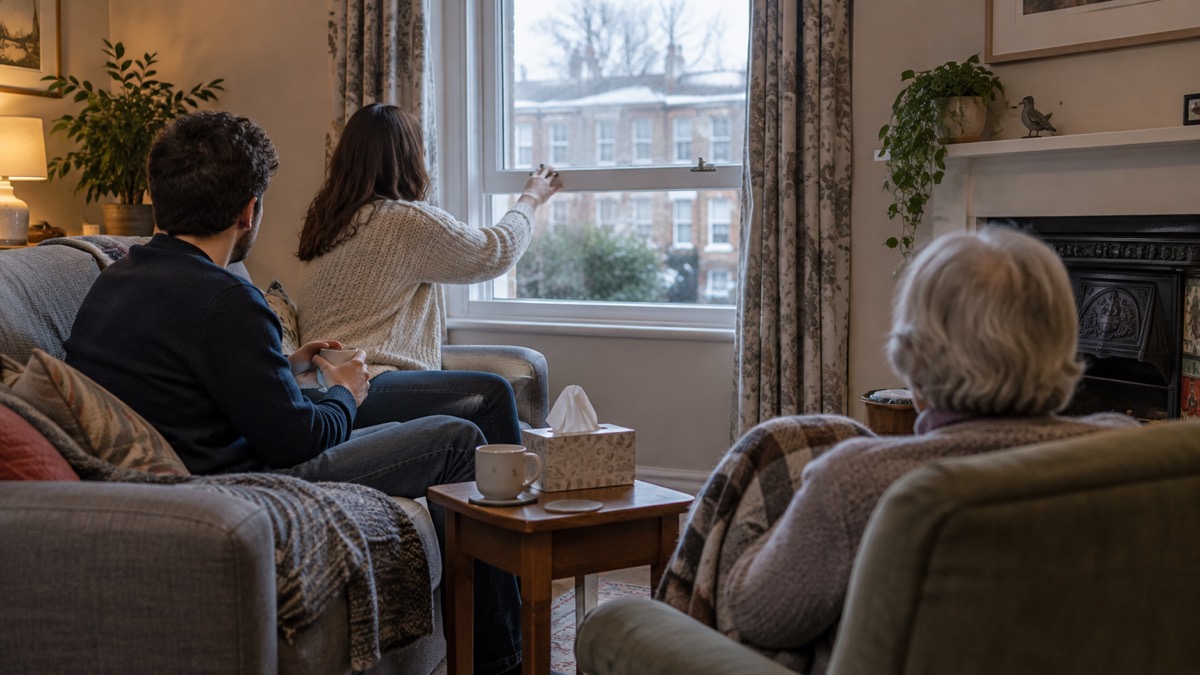
The single most effective thing a higher-risk person can do is take the vaccines they are offered. It is important to get the flu vaccine if you are advised to14. The flu vaccine is offered on the NHS every year in autumn or early winter to some adults and children at higher risk of getting seriously ill from flu5. It helps to reduce the chance of catching and passing on flu, and it also reduces the risk of becoming seriously ill and needing care in hospital14.
The same logic applies to COVID-19. People who are most at risk of severe illness from COVID-19 will be offered an autumn COVID-19 vaccine12, and if you are at increased risk of severe illness you may be offered a free seasonal COVID-19 vaccine3. Getting your flu vaccine and COVID-19 vaccine every year, if you are eligible, tops up your protection and reduces your risk of getting severe symptoms15.
Vaccination also protects the people around a vulnerable relative, not just the relative. The children's flu vaccine, alongside helping to protect children themselves, also helps stop them passing flu onto elderly family such as grandparents, who are likely to be more vulnerable16. If grandchildren visit an older relative regularly, having the children vaccinated is a practical layer of protection.
If you are unsure whether your relative is eligible, see who can get a free flu vaccine and who can get a COVID-19 vaccine now, and read the wider background on vaccines that protect against outbreaks.
Keeping the virus away from a vulnerable relative
Everyday hygiene is the barrier between a circulating virus and a person who would become seriously ill from it. Practising good hand and respiratory hygiene helps to prevent the spread of viruses like flu and COVID-19, as well as the winter vomiting bug17.
The core actions, from official guidance, are:
- Wash your hands often with warm water and soap3
- Cover your mouth and nose with a tissue when you cough or sneeze, or cough into the bend of your elbow, not into your hand5
- Bin used tissues as quickly as possible5
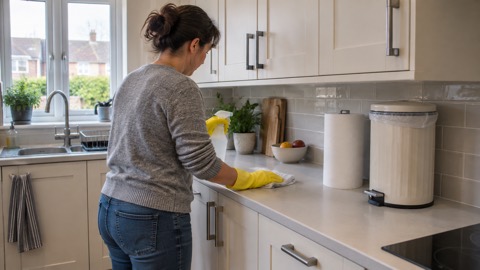
- Regularly clean surfaces that are touched often3
- Wear a face covering in crowded places or close contact3
- Let fresh air in when having visitors3
Flu is spread through coughing and sneezing and can live on hands and surfaces for 24 hours4, which is why the cleaning and hand washing matter as much as the covering of coughs. COVID-19 spreads very easily through close contact with people who have the virus18: droplets containing the virus are breathed in, or picked up from surfaces when someone then touches their eyes, nose or mouth3. Our page on stopping infections spreading at home goes through the practical detail.
If someone in your household has symptoms, the advice is to stay away from people at increased risk of becoming more unwell from respiratory infections, if possible, and not to visit hospitals or care homes19. Where someone with symptoms does need to come into the home of a vulnerable person, advise them in advance so they can take precautions such as wearing a face covering, keeping their distance and washing their hands regularly6.
You can also be infected with a respiratory virus and not have any symptoms but still pass an infection onto others20. This is the reason the hygiene habits above are worth keeping up even when everyone feels well, especially before visiting or hosting someone at higher risk.
Beyond infection control, check on elderly or vulnerable relatives, friends and neighbours and help out where possible to ensure they are safe and well this winter21. Neighbours and relatives who are older, very young or have long-term health conditions are at particular risk from the cold15, so looking out for others by checking in on older neighbours or relatives, especially those who live alone or who have serious illness, helps make sure they are safe, warm and well22.
How long someone stays infectious: flu 5 days, COVID-19 up to 10
Timing matters when you are deciding whether it is safe for someone to be near a vulnerable relative.
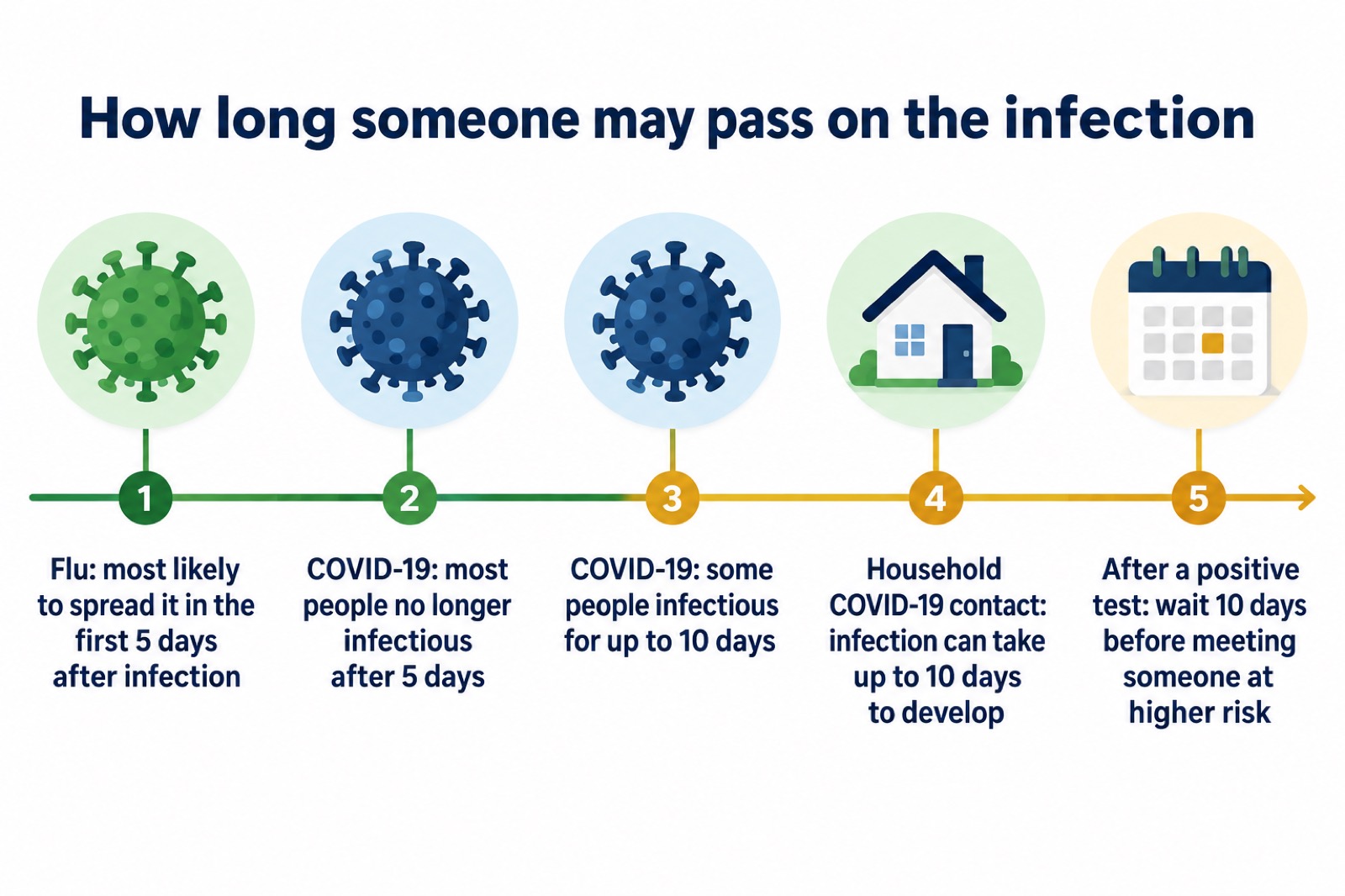
With flu, you are more likely to give it to others in the first 5 days after getting infected5, and you can spread flu even if you do not have symptoms4. Five days from the start of symptoms is therefore the period of greatest caution.
With COVID-19, most people will no longer be infectious to others after 5 days, but some people may be infectious for up to 10 days from the start of their infection6. The NHS puts it the same way: many people will no longer be infectious to others after 5 days, but you can be infectious for up to 10 days18. If the person who was ill is due to meet someone at higher risk, the NHS advises trying to wait 10 days after the day of a positive test before meeting anyone who is more likely to get seriously ill from viruses8.
Household contacts need care too. If you are a household or overnight contact of someone who has had a positive COVID-19 test result, it can take up to 10 days for infection to develop, so avoid contact with people at higher risk, limit close contact with others outside the household, wear a well-fitting face covering, and wash your hands frequently6.
For children the rules differ. Children and young people under 18 who test positive are advised to try to stay at home and avoid contact with other people for 3 days after the day the test was taken, because children and young people tend to be infectious for less time than adults8. Our page on how long to stay at home after a positive COVID test covers the detail.
Flu or a cold: how each one behaves
Deciding whether a visitor has "just a cold" or flu is a real judgement call when a vulnerable relative is involved, and the two illnesses behave differently enough to tell apart.
| How it feels | Flu | A cold |
|---|---|---|
| How it starts | Appears quickly, within a few hours5 | Appears gradually over 1 to 2 days5 |
| Where it affects you | More than just your nose and throat5 | Mainly your nose and throat5 |
| How unwell you feel | Exhausted and too unwell to carry on as normal5 | Unwell, but well enough to do normal activities5 |
| Severity | Tends to be more severe5 | Tends to be milder5 |
Flu symptoms usually include fever, chills, headaches and aching muscles, and you can often get a cough and sore throat at the same time11. Flu symptoms hit you suddenly and sometimes severely11. In children the symptoms are similar, but they can also get pain in their ear, sore eyes, swollen glands and appear less active5.
The practical point for a household with a vulnerable member: someone who is exhausted and suddenly unwell should be treated as possibly having flu and kept away from the higher-risk person, whatever the eventual diagnosis. Someone with a gradual snuffle who is otherwise carrying on as normal is a different situation, though hand washing still applies because flu can spread without symptoms4. If you are unsure, our page on whether it is a cold, flu or COVID-19 helps you weigh it up.
Caring for someone at home with flu or COVID-19
Most people with flu or COVID-19 can be cared for at home, and flu often gets better on its own, though it can make some people seriously ill4. If you have COVID-19 you should try to stay at home2, and the same principle applies to flu.
While caring for someone, keep up the hygiene measures that protect both of you: wash hands often with warm water and soap, cover the mouth and nose when coughing or sneezing and encourage children to do this, clean touched surfaces regularly, and let fresh air in3. The NHS points to GermDefence, a website that can help you identify simple ways to protect yourself and others in your household from COVID-19 and other viruses; people who use it are less likely to catch flu and other infections and are less likely to spread them at home6.
Practical comfort measures from NHS advice:
- Rest: you may need to stay in bed for a few days if you have flu9
- For a cough, try having a teaspoon of honey, but do not give honey to babies under 12 months23
- Do not lie on your back if you have a cough; lie on your side or sit upright instead23
- Do not use a fan to cool the room, as it may spread the virus23
- If you feel breathless, try to stay calm, as getting anxious can make it worse23
- Give paracetamol or ibuprofen to a child if they are distressed or uncomfortable, checking the packaging or leaflet, or speaking to a pharmacist or GP if unsure9
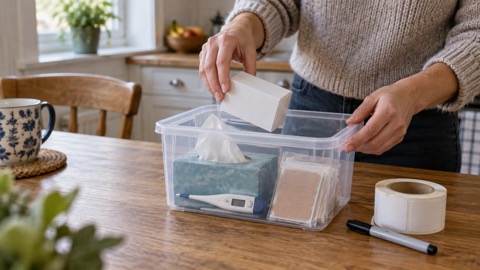
If the person you are caring for is eligible for COVID-19 treatments, keep rapid lateral flow tests at home and test as soon as symptoms develop, even if they are mild10. Free COVID-19 tests are still available for individuals at high risk of becoming seriously ill3: they are available free on the NHS to people who are eligible for COVID-19 treatment8, who will normally have been sent a pack of tests and can request replacements if they need them7. Most people cannot get free COVID-19 tests2. Our checklist for caring for someone ill at home and the guide to looking after someone who is ill give you the fuller kit list.
When to call 111, and when to call 999 or go to A&E
Knowing where the line sits between "manage at home" and "get help now" is the most important thing to have straight before anyone in the household falls ill.
Ask for an urgent GP appointment or get help from NHS 111 if you are worried about symptoms, if symptoms are getting worse or not getting better, if there are other signs of illness such as a rash, loss of appetite or feeling weak, or if there is a high temperature lasting 5 days or more that is not coming down with paracetamol23. You can call 111 or get help from 111 online24. Our page on NHS 111 explains what it can help with.
For anything that is not life-threatening, NHS 111 online can point you to the right service: depending on what you need, you might be advised to go to an urgent treatment centre, see an evening and weekend GP, book a callback from a nurse, get urgent specialist support for dental or mental health problems, contact your own GP surgery, see a pharmacist for help with a minor illness, or look after yourself safely at home24. A pharmacist is often the fastest route for flu advice and remedies. See when to call 111 and when to call 999 and which urgent service to use for the full comparison.
Visiting a relative in a care home or hospice
Visiting rules in high-risk settings have relaxed considerably, but a few still apply and they matter most when the person you are visiting is frail.
Most visitors to adult social care settings, the NHS, hospices, prisons or places of detention will no longer require a test7. Tests will continue to be provided to a small number of visitors to care homes and hospices who will be providing personal care7. If you are one of those visitors, the setting should arrange the tests for you.
If you have symptoms, do not visit if you can avoid it: official advice is to stay away from people at increased risk of becoming more unwell from respiratory infections, if possible, and not to visit hospitals or care homes19. Visits by people with symptoms may still be allowed in exceptional circumstances, such as end of life visits; contact someone responsible at the setting before visiting in these circumstances7. Our page on when to avoid visiting hospitals and care homes covers the judgement in more detail.
Before any visit during winter, the ordinary precautions still serve the person you are visiting: wash your hands, wear a face covering if you will be in close contact, and let fresh air in where you can3. If you have had a positive COVID-19 test yourself, wait 10 days after the day of the test before meeting anyone more likely to get seriously ill from viruses8.
Wider support for older and disabled people and carers
Protection during winter is not only about viruses. Cold weather itself raises the risk of serious illness for the same groups, and there is an official system behind the support available.
The UK Health Security Agency and its Centre for Climate and Health Security publish guidance for a range of professionals on how to protect the population groups most at risk from the health impacts of cold weather25. It asks social care managers to ensure staff have identified everyone vulnerable to cold weather, with assessment at least annually, and it may include developing and maintaining a register of the most vulnerable individuals25. Voluntary and community organisations are asked to promote vaccination for COVID-19 and flu among beneficiaries who are eligible13.
What this means for your family is that help exists and is meant to be asked for:
- Social care managers are advised to protect clients and staff by promoting COVID-19 and flu vaccination for them25
- People identified as being at risk from a cold home can be referred to local services, for example housing services, who may be able to help improve living conditions26
- Fire and rescue services offer safe and well visits, identifying who is more vulnerable to fire and may benefit most from a visit27
People living in deprived circumstances are among the groups at higher risk from cold weather in England, alongside older people aged 65 and over, people with long-term health conditions, and people who live alone and may be unable to care for themselves25. Our section on extra help in an emergency sets out the full range of support for older, disabled and medically dependent households, including the Priority Services Register and carer support.
A healthy lifestyle is a great defence against flu and other illnesses28, so keeping warm, eating well and staying active remain part of protecting a vulnerable relative, not just vaccination and hygiene.
What shielding was, and what replaced it
Many people remember "shielding" from the pandemic years and wonder whether it could return. Shielding was a programme whose objective was to minimise mortality and severe illness among those who were clinically extremely vulnerable (CEV), by providing them with public health guidance and support to stay at home and avoid all non-essential contact29. Through the shielding programme, CEV people could get support accessing food, medicine and basic care29.
The programme had its difficulties: a National Audit Office report records challenges extracting data from different IT systems, and the understandable need for GPs and trusts to review the list of vulnerable people from their clinical perspective29. It was a wartime measure, not a permanent system.
There are no COVID-19 restrictions in the UK today2. What replaced shielding is the approach on this page: annual vaccination for those eligible, treatments for those at highest risk, and everyday precautions by the people around them. For the wider picture of how the UK plans for pandemics, see pandemics: how the UK plans and what households should do.
Sources (29)
- Together we'll keep Wales safe, Welsh Government, 2026
- Coronavirus (COVID-19), GOV.UK, 2026
- Coronavirus (COVID-19), Derbyshire County Council, 2026
- Flu, Derbyshire County Council, 2026
- Flu, NHS, 2026
- People with symptoms of a respiratory infection including COVID-19, GOV.UK, 2022
- Getting a test, Suffolk County Council, 2026
- COVID-19 rapid lateral flow test, NHS, 2025
- Flu symptoms: what to do, London Ambulance Service NHS Trust, 2026
- Stay Well This Winter 2025, NHS England, 2025
- Flu: seasonal advice, Met Office, 2026
- Staying well in winter, Derbyshire County Council, 2026
- Cold Health Alert action card for the voluntary and community sector, GOV.UK, 2025
- Flu, Derbyshire County Council, 2026
- Cold weather advice, West Midlands Ambulance Service NHS Foundation Trust, 2026
- Why it is important to get a flu vaccine, Wiltshire and Swindon Prepared, 2023
- Your Health Guide Winter 2025, NHS West of Scotland Innovation Hub, 2025
- How to avoid catching and spreading COVID-19, NHS, 2023
- Coronavirus (COVID-19), NHS inform Scotland, 2026
- Living with Covid, Nottinghamshire County Council, 2026
- Stay well this winter, Nottinghamshire County Council, 2026
- Staying well in winter, Derbyshire County Council, 2026
- COVID-19 symptoms and what to do, NHS, 2026
- Self care, NHS Cornwall and Isles of Scilly Integrated Care Board, 2024
- Supporting vulnerable people before and during cold weather: for adult social care managers, GOV.UK, 2025
- Supporting vulnerable people before and during cold weather: for healthcare professionals, GOV.UK, 2025
- Home safety, Surrey County Council, 2026
- Protecting your family: pandemic, Essex Prepared, 2026
- Protecting and supporting the vulnerable during lockdown, National Audit Office, 2021
 Medicine Cabinet Checklist
 Sick at Home Supplies Kit
 Caring for Someone Ill at Home
 Pandemics and UK Household Plans
 Outbreaks Near You
 UK Health Security Agency
 Staying Home When Ill
 Stopping Infections at Home
 Caring for a Sick Person at Home
 Keeping Prescription Medicine
 Medicine Shortages Explained
 Storing Medicines Safely
 Urgent Care and A&E
 Vaccines Against Outbreaks
 Flu Symptoms and Getting Help