A pandemic is one of the most significant risks the UK plans for. The London Risk Register, drawing on the UK Health Security Agency's assessment, rates the risk as VERY HIGH, with a likelihood of 4 and an impact of 5 on a 1 to 5 scale, and states that the emergency stage of a pandemic in the UK will last at least 9 months and potentially significantly longer1. Unlike a storm or a power cut, a pandemic is not a matter of days: it is a long disruption in which shops stay open but supply chains, deliveries and household incomes come under strain, and in which you may be asked to stay at home for weeks at a time.
What that means for food is the lesson of Covid-19. Food insecurity among UK adults more than doubled after lockdown in March 2020, rising from 7.63 per cent in 2018 to 16.2 per cent2. Governments in all four nations set up food parcels, delivery schemes and funds, and then withdrew them as guidance changed. The practical response for an ordinary household is to hold a store of food and water that does not need electricity, and to know where help comes from if the store runs short.
What a pandemic means for a household
A pandemic is the global outbreak of a disease that spreads widely and affects a large number of people across multiple countries and continents7. It can occur at any time and happens when a new virus spreads easily from person to person8. Pandemics are rare, but as the Covid-19 experience showed, they can have devastating and wide reaching impacts9.
For a household, three effects matter most. First, the disease itself: a pandemic can vary in its severity and impact, causing anything from mild symptoms through to severe health issues8. The London Risk Register's planning assumption includes a case fatality ratio of 2.5 per cent for a reasonable worst case scenario1. Second, the disruption to services: pandemics can affect millions of people around the world, causing global disruption and impacting on the provision of services, utilities, production and transportation of goods8. Food is moved by people, and when people are sick, isolating or told to stay home, the movement of food slows. Third, the social disruption: school closures, quarantines and restrictions on movement can have long-term impacts on mental health and societal cohesion7, and pandemics can cause significant economic losses due to business closures, disruption of supply chains, and workforce absenteeism7. A household that loses income loses the ability to buy food even when the shelves are full.
The UK National Risk Register identifies pandemics as one of the most significant risks to national security7. That is why the government's own household planning materials treat a pandemic as a scenario worth preparing for, and why the food advice below is drawn from those materials.
How long the disruption lasts: at least 9 months
The single most important number on this page is the duration. The London Risk Register states that the emergency stage of the pandemic in the UK will last at least 9 months and potentially significantly longer1. This is not a storm that passes in a weekend. It is a sustained period in which waves of infection come and go, guidance changes repeatedly, and support schemes are set up and then withdrawn.
That duration changes what a food store means. A three-day store, which is the minimum in official guidance across the UK3, covers the immediate shock: the days when a household is isolating, when a delivery fails, or when a local shortage clears. A ten-day store, which the "Are You Ready" booklet recommends as emergency reserves including essential medications, food and water4, covers a fortnight of illness in the household or a longer gap in supply. Neither covers nine months, and neither is meant to. The purpose of a household store in a pandemic is to bridge the gaps between the systems that keep working: shops, deliveries, council support and charity help all continued through Covid-19, but none of them worked smoothly for everyone at every moment.
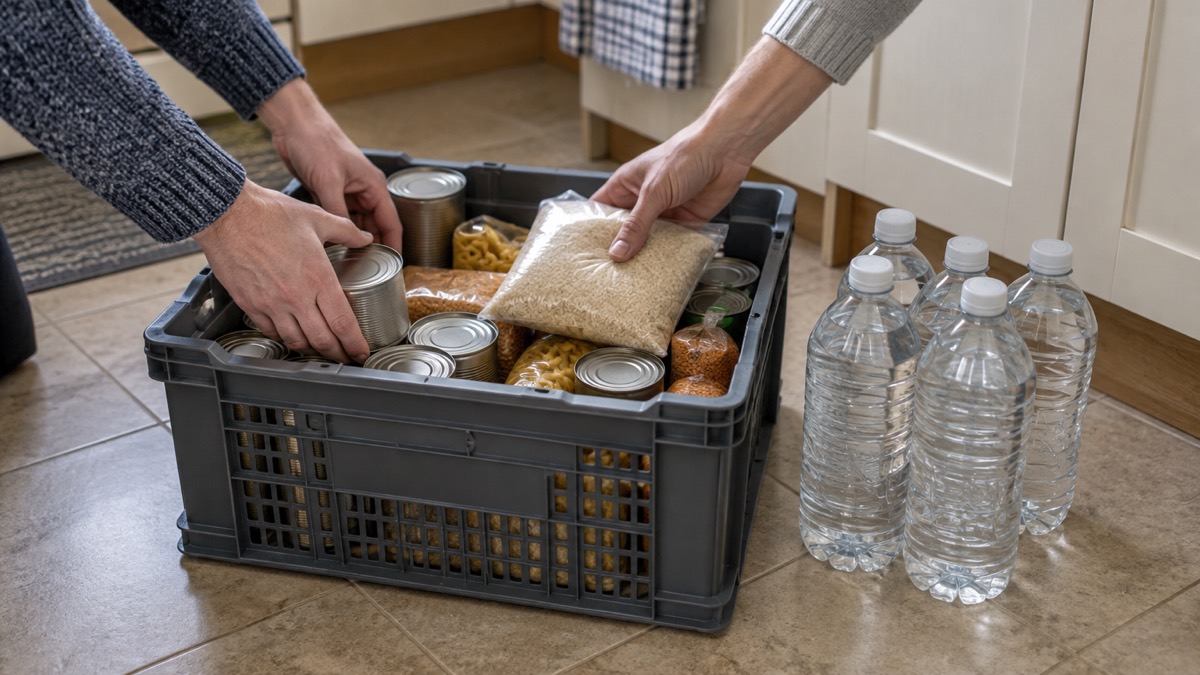
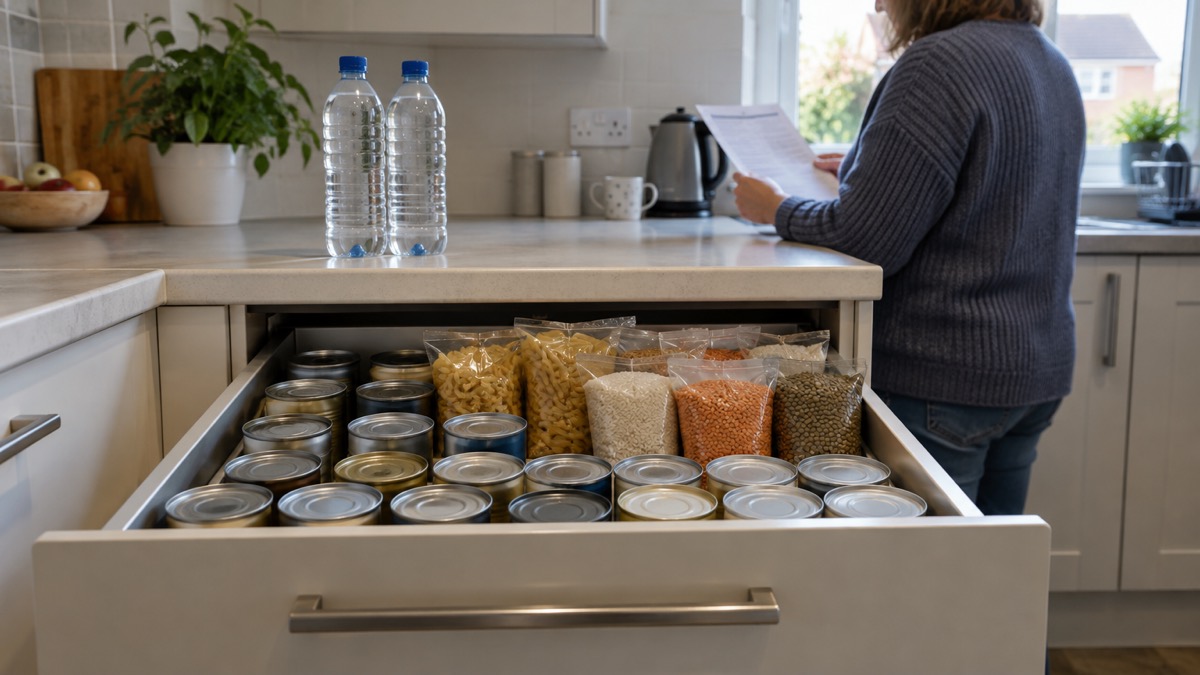
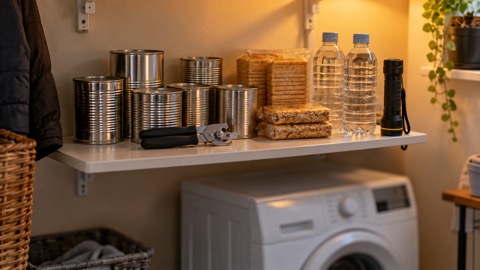
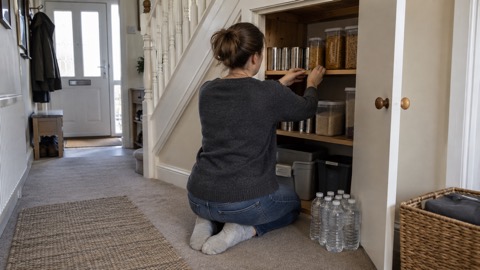
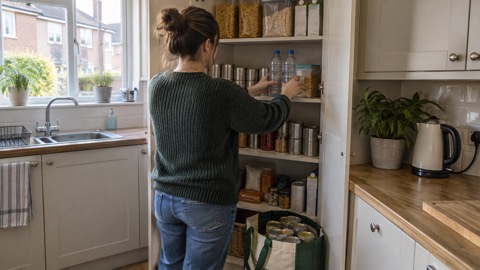
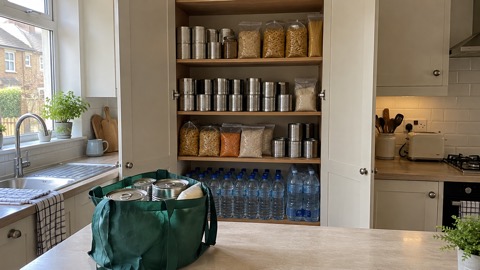
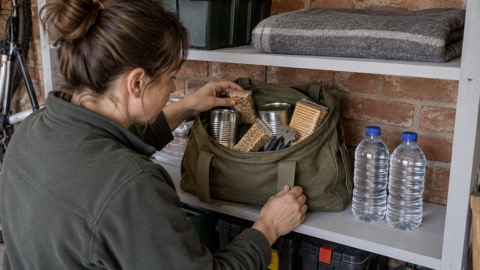
So the practical approach is a store you can eat from and replenish, not a one-off bulk purchase. Buy food you would usually eat, with a long shelf life that does not need refrigeration or cooking, such as tinned meat, fish or vegetables, dried fruit and nuts11. Rotate it so nothing goes off, and keep the water alongside it: at least 3 days' worth of bottled water, 3 litres per person per day5. Our guides on how much emergency food to store per person, what to keep in an emergency store cupboard and rotating your store cover this in detail.
Keep food and water at home: the amounts official guidance gives
Official household guidance across the four nations is consistent on the minimum. Keep at least three days' supply of food, bottled water and other essentials, including medicines, and tinned and dry foods which store safely without need for electricity3. The Scottish emergency kit advice says the same: 3 days' supply of bottled water and food that does not need cooking and will not go off10. The national Be Ready household plan asks for non-perishable food to last at least 3 days that does not require cooking or refrigerating, for example tinned meat, fruit or vegetables, plus a tin opener6.
| What to store | How much | Who says it |
|---|---|---|
| Food, bottled water, essentials, medicines | At least 3 days' supply, tinned and dry foods that store without electricity | Argyll and Bute Council3 |
| Bottled water and food needing no cooking | 3 days' supply | Ready Scotland10 |
| Non-perishable food needing no cooking or refrigeration | At least 3 days, plus a tin opener | Be Ready household plan6 |
| Bottled water | 3 days' worth, 3 litres per person per day | Be Ready power cut guidance5 |
| Emergency reserves: medications, food, water | Up to 10 days | Are You Ready booklet4 |
| Pet food and water | At least 3 days' supply, in waterproof containers | Birmingham Prepared12 |
Two additions matter in a pandemic specifically. The power cut guidance also says to include ready-made baby formula and pet food if needed5, and Birmingham's preparedness advice asks for at least 3 days' supply of pet food and water, stored in waterproof containers, if advised to stay indoors12. If you are told to shield or isolate, a pet that cannot be fed is a problem that forces you out of the house. For more on building the store itself, see starting a store cupboard supply step by step and the emergency store cupboard checklist.
What Covid-19 showed about food supplies
Covid-19 was the first full test of the UK food system in a pandemic, and the findings are mixed. On the reassuring side, the drinking water supply held: the Drinking Water Inspectorate states that all evidence from the spread of the virus shows that the drinking water supply is not a route for transmission of the virus13. Water did not need to be stockpiled for fear of contamination, only for the ordinary reasons of supply interruption.
On the worrying side, food insecurity rose sharply. Food insecurity among UK adults rose from 7.63 per cent in 2018 to 16.2 per cent after lockdown in March 2020, and the British Red Cross's July 2020 report on access to food in emergencies set out lessons on food insecurity, financial support, information barriers and legal responsibility for food provision2. In Scotland, Food Standards Scotland's Covid-19 Consumer Tracker found in May 2020 that 25 per cent of people were either very worried or somewhat worried about their household not being able to afford food in the next month14. Households with children were under particular strain: 13 per cent of households with children had arranged for food to be delivered to their house through a food charity or food bank in the last month, significantly higher than the total of households at 6 per cent14.
The tracker also shows how behaviour shifted. In Scotland in May 2020, 24 per cent of people had purchased food from a local supplier more than before lockdown, while 15 per cent had bought from a takeaway more often and 38 per cent less often14. Some of the change was positive: 39 per cent of people had thrown away less food in the last month14. Local suppliers became a genuine fallback when supermarket delivery slots were scarce.
Behind the household experience sits a structural finding. In September 2026 the National Audit Office reported that the Department for Environment, Food and Rural Affairs has largely relied on the private sector to manage food supply disruptions, and that its actions have not been sufficient to ensure resilience of the food supply chain to major disruptive events15. The lesson for a household is measured preparation rather than alarm: the system held during Covid-19, but it is not guaranteed to hold in every future scenario, and a personal store plus knowledge of local support is the buffer. Our page on how the UK supply chain copes with disruption explains the mechanics.
Food deliveries and parcels for people shielding at home
When people were advised to shield in 2020, each UK nation arranged food differently, and knowing the shape of that help matters for the next pandemic.
In England, the government ran a food box scheme for people shielding, delivering boxes of essential food to those who could not access food any other way. The scheme ended from 31 July 2020, because shielding guidance had changed2. That ending is the key lesson: support schemes are temporary and are withdrawn as guidance changes, sometimes with little notice to the households relying on them.
Each nation ran its own support for people shielding at home. In Wales, direct food deliveries were funded from April 2020 to reach around 80,000 people who were shielding2. In Scotland, the Scottish Government announced a Food Fund in April 2020 to support people who would otherwise be unable to access food during the pandemic2. In Northern Ireland, a Covid-19 Food Parcel Service ran from 6 April to 26 June 2020 and was later extended to 31 July2.
| Nation | Scheme | When |
|---|---|---|
| England | Government food box scheme for shielded people, ended 31 July 2020 | 20202 |
| Wales | Direct food deliveries to around 80,000 shielded people | April 20202 |
| Scotland | Food Fund for people unable to access food | April 20202 |
| Northern Ireland | Covid-19 Food Parcel Service, 6 April to 26 June, extended to 31 July | 20202 |
Alongside the government schemes, community groups delivered food parcels at scale, and the health trusts gave them rules to follow. The Southern Health and Social Care Trust's Cook it! Team published guidance in April 2020 for community groups preparing and delivering food parcels to vulnerable individuals16. If you are shielding or isolating and cannot get food, the routes to try are: your council's support helpline, supermarket delivery services, local community groups, and family and neighbours. If you receive a food parcel and you or someone in your household has allergies, tell whoever is delivering it; the Northern Ireland Ambulance Service's general advice is to inform the service of any allergies so that help can be given safely17.
Help with food if you are isolating or short of money
The pandemic showed that the hardest problem is not supply but access: people who could not leave the house, or who lost income, could not get food even when it was on the shelves. Food insecurity among UK adults more than doubled after lockdown in March 20202, and in Scotland 25 per cent of people were worried about their household not being able to afford food in the next month by May 202014.
The first place to turn is your council. Cumberland Council's support helpline, for example, offers urgent help finding food and essential items, or support if you are struggling to cope with your current situation18. Most councils ran similar helplines during Covid-19 and would do so again. To get help from a food bank you need to be referred with a voucher18, and the referral usually comes through the council, a support service or a professional who knows your situation. Our page on how to get a food bank voucher referral walks through the process, and getting emergency food help sets out the wider options.
If money is the problem rather than access, say so when you contact the helpline: the Red Cross report found that financial support was one of the routes that reduced food insecurity during Covid-192. If you have children, check whether you qualify for the Healthy Start scheme, and if anyone in the house has a medical diet or a baby, plan for that in advance on our page about babies, young children and medical diets in an emergency.
One further habit from the pandemic is worth keeping: check on neighbours. The Scottish tracker's finding that 24 per cent of people bought more from local suppliers14 reflects the same reality, that informal local networks carried much of the work of getting food to people who could not go out. Our community resilience guide covers how to set that up before it is needed.
Outbreaks, food safety and medicine supply
A pandemic is one of a family of infectious disease risks that households face. The Are You Ready booklet lists pandemic influenza, covid-19, norovirus (sickness and diarrhoea), measles and tuberculosis among the infectious diseases to be aware of4. Several of these spread through food and hands, which is why kitchen hygiene matters as much as the store itself.
Foodborne illness is common at the best of times: Northumberland Council notes that the number of cases of food-borne illness has increased dramatically during the past few years, particularly during the summer months19. The incubation period, the time taken from eating the food to feeling unwell, varies with each type of organism and in some cases can be up to 10 to 15 days after consumption of the food20, and symptoms may last for only a day or continue for one or two weeks21. In a pandemic, an avoidable bout of food poisoning is a bout of illness you do not need, and a trip you should not make. See food poisoning: symptoms, who is at risk and when to get help for the warning signs.
Medicines are the other supply line that matters. The government works with medicine suppliers and the NHS to manage national supply issues where there is a shortage of a medicine across the whole country, and to ensure that shortages have as little impact on patients as possible22. Medicine suppliers are legally required to report any medicine shortages to the government in good time22. For your household, the practical step is to keep essential medications in your emergency reserves, as the official guidance on stores asks3, and to order repeat prescriptions in good time rather than waiting until the last day. Our health emergencies guide covers outbreaks and medicine supplies in full.
Food recalls continue during any emergency, and Food Standards Scotland works closely with local authorities and the food industry to publish alerts to consumers when food products are recalled23. Check stored food against current alerts before using it, especially food bought some time ago.
Hygiene habits that cut the spread at home
The most effective measure in the pandemic was also the simplest. Handwashing is the single most effective way to stop the spread of infection21. Surrey's emergency planning advice is to practise good hygiene habits, always washing your hands thoroughly and coughing or sneezing into disposable tissues9, and the Are You Ready booklet stresses maintaining good basic hygiene, washing hands frequently with soap and water to reduce the spread of the virus from hands to face or other people4.
In the kitchen, the rules are specific:
- Wash hands thoroughly before, during and after preparing food24
- Keep raw and ready-to-eat foods separate to avoid cross-contamination, and keep chilled foods cold, with the fridge set to 5°C or below25
- Always clean surfaces, utensils, plates and hands thoroughly after they have touched raw or thawing meat to stop bacteria spreading around the kitchen26
- Eat leftovers within 2 days26
- Defrost food in the fridge overnight, because when food is stored above fridge temperatures bacteria can grow and multiply, known as the Danger Zone26
- Ensure that anyone with diarrhoea, vomiting or nausea does not prepare food, and keep food either piping hot or refrigerated until it is served21
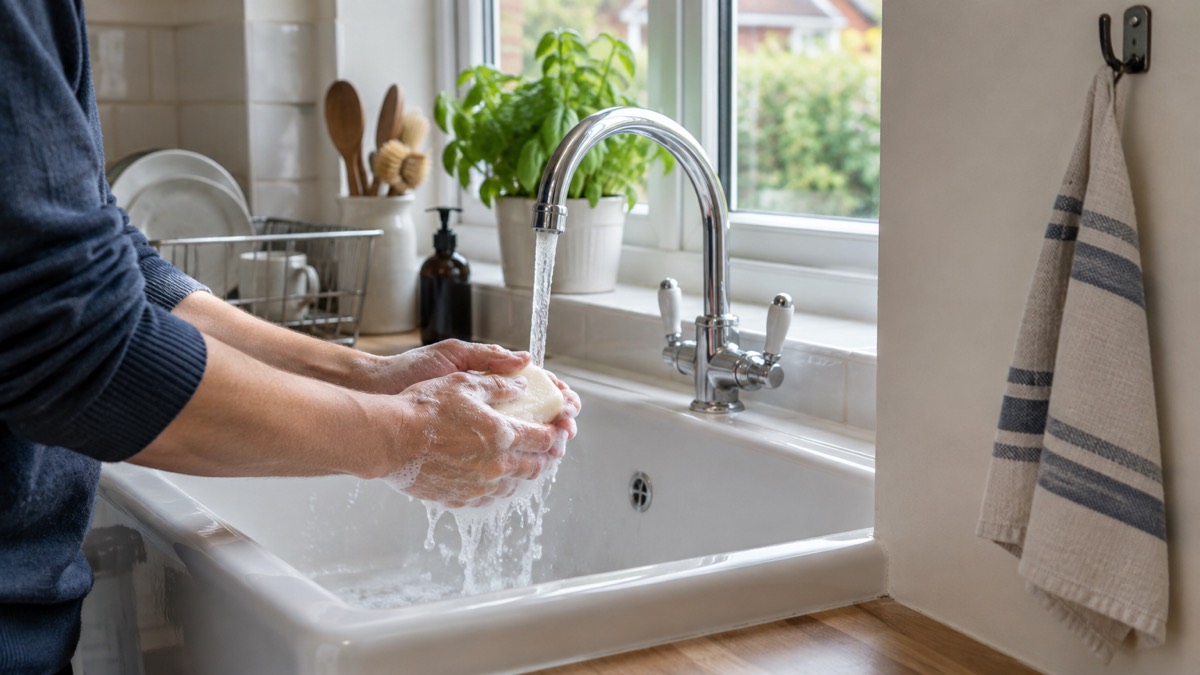
If someone in the house does become ill, the advice from Cornwall and Northumberland councils is to treat the household as a small outbreak zone. Wash your hands after contact with the sick person and before handling food; do not share towels or face cloths with the sick person; and disinfect door and toilet handles, taps and the toilet seat after use27. Cornwall adds further steps: drink plenty of fluids, avoid preparing food for others, avoid sharing bathwater, put the toilet lid down when flushing and ventilate the house27. Good food hygiene standards in the home are vital to prevent foodborne illness20, and in a pandemic they protect both the household and the people who would otherwise have to help you.
If you preserve your own food to build the store, follow the same discipline. The official home preservation advice is to use reputable instructions and follow them exactly, including temperatures and processing times, to use suitable containers, to check jars, lids and containers for damage and discard damaged ones, to sterilise containers when instructed, and to label and date preserved foods and use them within the recommended shelf life24. Our page on preserving at home safely gives the detail.
"Handwashing is the single most effective way to stop the spread of infection."
Where to get help: the Red Cross, councils and support lines
When the household store runs short, or when an emergency hits alongside the pandemic, several routes of help exist.
The Red Cross offers emergency help with things like accommodation, clothing and food, as well as help dealing with insurance companies, and you can contact it through the get help pages at redcross.org.uk29. Its emergency response support service is designed to meet the needs of people who have suffered damage to their home following a fire, flood or similar incident, and its volunteers can provide emotional support and care for those affected while the emergency services manage the incident30. The service is funded by voluntary donations to the British Red Cross31.
The Fire and Emergency Support Service, run in partnership between fire and rescue services and the British Red Cross, uses a specially adapted vehicle equipped with a hot shower, clothing, a mobile telephone, baby food, a camera for clients to take photographs for insurance purposes and a small kitchen31. The team are volunteers who give their time freely, responding to incidents 24 hours a day, 365 days a year32. If you want to be on the other side of that help, the eligibility asks are simple: be caring and keen to help others in need, enjoy meeting people from different backgrounds, understand the needs of people who are distressed, and be reasonably fit and healthy31. You can find more information on volunteering in emergencies on the British Red Cross website32.
For food specifically, the order to try is:
- Your council's support helpline, for urgent help finding food and essential items18
- A food bank, through a referral with a voucher18
- Local community groups and neighbours, who carried much of the load in 20202
- The Red Cross, for emergency help including food29
If you or someone in your household needs extra help because of age, disability or medical dependence, see our extra help in an emergency guide, and register with your supplier's priority services in advance.
Sources (32)
- London Risk Register v14 public version, Greater London Authority, January 2025
- Access to food in emergencies: learning from Covid-19, British Red Cross, July 2020
- Winter weather: be prepared, Argyll and Bute Council, 2026
- Are You Ready booklet, Culham Parish Council, September 2025
- Power cuts: be informed about hazards, Be Ready campaign, 21 October 2026
- Be Ready Household Emergency Plan, Be Ready campaign, 2026
- Pandemic: ongoing risks, Essex Prepared, 29 October 2026
- Infectious disease and pandemics, West Yorkshire Prepared, 29 October 2026
- Prepare for emergencies: risks, Surrey County Council, 28 October 2026
- Prepare: emergency kit, Ready Scotland, 29 October 2026
- Be Ready Checklist, Be Ready campaign, 2026
- Are you ready, Birmingham City Council, 5 June 2026
- Covid-19 and drinking water, Drinking Water Inspectorate, 17 December 2024
- Covid-19 Consumer Tracker Wave 1, Food Standards Scotland, May 2020
- Resilience of the food supply chain to disruptions, National Audit Office, 4 September 2026
- Guidance for those preparing and delivering food parcels in the community, Southern Health and Social Care Trust, April 2020
- What to do before help arrives, Northern Ireland Ambulance Service, 29 October 2026
- Emergency food, essential items and support, Cumberland Council, 2026
- Food poisoning advice, Northumberland Council, 11 August 2026
- Food poisoning, Belfast City Council, 29 October 2026
- Food poisoning and waterborne infections, Shropshire Council, 29 October 2026
- Advice for patients during a medicines shortage, Specialist Pharmacy Service, November 2025
- Why food is recalled, Food Standards Scotland, 25 October 2026
- Consumer advice for food preservation at home, UK Government, 26 October 2026
- Foodborne viruses, Food Standards Scotland, 25 October 2026
- Chilling: food safety in the kitchen, Food Standards Scotland, 25 October 2026
- Infectious diseases, Cornwall Council, 29 October 2026
- Infectious diseases control, Northumberland Council, 28 October 2026
- Financial help after a fire, UK Government, 29 October 2026
- Steps after a fire, North Yorkshire Fire and Rescue Service, 17 June 2026
- Fire emergency support service, Warwickshire County Council, 29 October 2026
- Fire and Emergency Support Services volunteering, Northern Ireland Fire and Rescue Service, 3 April 2026
 Long-Term Storage Kit Checklist
 Store Cupboard Checklist
 30-Day Household Checklist
 How Much Emergency Food to Store
 What to Store in an Emergency
 Starting a Store Cupboard
 Shelf Life and Date Labels
 Rotating Your Food Store
 Long-Term Storage Conditions
 Meals Without Power
 Self-Heating Meals
 Tinned Food Guide
 Rice, Pasta and Pulses Storage
 Freeze-Dried Meals
 Emergency Ration Packs