Food poisoning in the UK is caused by a small number of bacteria and viruses, and each behaves differently: some make you ill within hours, some take weeks, and one of them can still grow in a properly working fridge. Knowing which germ is which tells you which foods need the most care, how quickly symptoms appear, and what to do to stop it spreading to the rest of the household.
The pattern is consistent across official advice. Campylobacter is the most common cause of food poisoning in the UK, usually from undercooked chicken1. Salmonella is second, typically from undercooked meat and poultry, untreated milk and raw or undercooked eggs, with symptoms developing in about 12 to 48 hours2. Listeria is unusual because it multiplies at refrigeration temperatures, which is why soft cheeses, pâtés and smoked fish need particular care2. E. coli O157 is rarer but can cause kidney failure in children2. And foodborne viruses, led by norovirus and hepatitis A, make up an estimated 18% of the UK's food poisoning cases5.
More than half a million cases of food poisoning occur every year in the UK6. Most healthy people recover after a short period of illness7, but the very young, the very old, pregnant women and anyone with a weakened immune system can become seriously ill8. This page sets out each organism, the foods it is linked with, and the kitchen habits that stop it.
The bacteria and viruses behind UK food poisoning
Food poisoning is an illness that occurs after eating or drinking anything that is contaminated12. Many different sorts of bacteria can cause foodborne illness, and when food is kept warm, bacteria can grow rapidly and reach dangerous levels within hours13. Some bacteria can divide in two every 20 to 30 minutes, so that one germ produces up to 16 million others within 8 hours14. Contamination can happen at any stage of the food production, delivery, storage or consumption chain, from pollution in water, soil or air, and from unsafe food storage and processing15.
Food poisoning usually begins within 1 to 2 days of eating contaminated food, but it can start a few hours later or several weeks later1. In some cases it can be 10 to 15 days after eating the food9. Symptoms may last for only a day or continue for one or two weeks12. Common symptoms include nausea, diarrhoea which may contain blood or mucus, lack of energy and weakness, loss of appetite, fever of 38C or above, aching muscles and chills1.
The table below shows the main organisms, how quickly each makes you ill and the foods each is linked with. The sections that follow take them one at a time.
| Organism | Time to symptoms | Main food sources |
|---|---|---|
| Campylobacter | 2 to 10 days, usually 2 to 5 days | Undercooked chicken and other meats, raw milk, contaminated water2 |
| Salmonella | About 12 to 48 hours | Undercooked meat and poultry, untreated milk, raw or undercooked eggs2 |
| Staphylococcus aureus | 1 to 6 hours | Food handled by someone with poor hand hygiene2 |
| Listeria | Varies | Unpasteurised soft cheeses, meat pâtés, cold-smoked and cured fish2 |
| E. coli O157 | Varies | Undercooked minced beef and beef burgers, unpasteurised milk, contact with farm animals2 |
| Bacillus cereus | Varies | Rice, cereals, spices10 |
| Clostridium perfringens | 8 to 24 hours | Cold meats and food kept warm for too long14 |
| Hepatitis A (virus) | Around 4 weeks | Raw fruit and vegetables, berries, salad, undercooked shellfish5 |
Two points from official guidance are worth holding onto throughout. First, with some bacteria, chemicals (toxins) are produced which are not destroyed by cooking, and a food does not have to look, smell or taste off to be dangerous14. Second, germs passed on by other people, pets or farm animals cause more than half the cases, transferred via hands and surfaces, the air if someone is vomiting, or the toilet14. Food poisoning is not only about food.
Campylobacter: the most common cause, usually from undercooked chicken
Campylobacter is the most common cause of food poisoning1 and the most common food poisoning bacteria in the United Kingdom12. It is also the most common cause of acute diarrhoea in adults2. It is found in the gut of animals and birds, and the commonest meat source is poultry; contaminated shellfish and mushrooms and infected pets are fairly common sources too14.
The main sources are undercooked chicken and other meats, handling pets, cross-contamination to other foods, raw milk and contaminated water2. Symptoms include stomach cramps and severe diarrhoea but rarely vomiting. They can begin 2 to 10 days after eating contaminated food but usually within 2 to 5 days2; NHS Borders guidance puts the usual window at 2 to 7 days14.
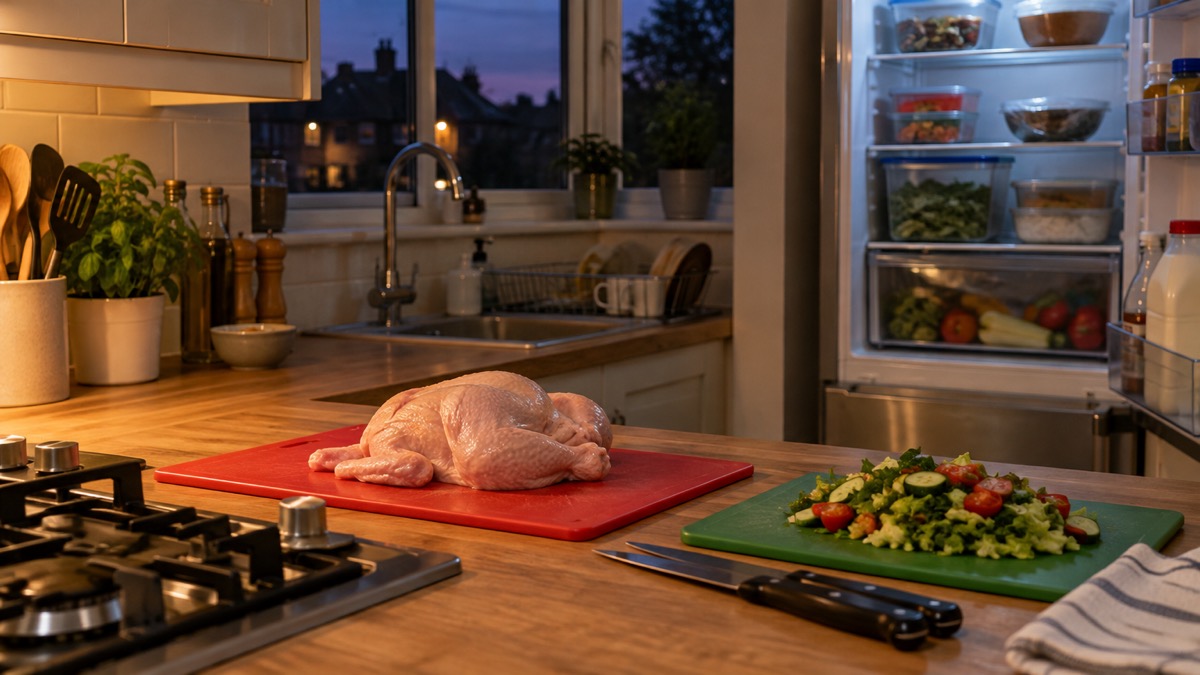
Prevention is straightforward. Thorough cooking kills food poisoning bacteria, so make sure food, especially meat, is cooked right through and piping hot in the middle12. Because campylobacter spreads so easily from raw chicken to anything else it touches, keep raw meat in a sealed container at the bottom of the fridge, never wash raw meat, and use different chopping boards, plates and utensils for raw and cooked food, or wash them thoroughly between uses16. Our page on handling raw meat, poultry and eggs safely covers this in detail.
Salmonella: symptoms within 12 to 36 hours from poultry, eggs and raw milk
Salmonella is the second most common form of food poisoning2. Its main sources are undercooked meat and poultry, untreated milk and raw or undercooked eggs2. Raw meat (processed and unprocessed), undercooked poultry, eggs and unpasteurised milk are the most commonly reported foods causing salmonellosis17.
Symptoms include stomach pain, fever, diarrhoea and vomiting, and it usually takes about 12 to 48 hours for the illness to develop2. NHS Borders guidance gives a narrower window of 12 to 36 hours, with pain, diarrhoea, fever and vomiting which can last for 6 days or more14. The illness is more severe in the young and elderly2, and symptoms typically resolve themselves within a few days17.
Salmonella can be spread from person to person as well as from food, so anyone affected should follow good hygiene practices, such as washing hands thoroughly after using the bathroom and avoiding handling food for others where possible, if you have symptoms18. A number of cases of Salmonella Enteritidis linked to poultry products have involved the consumption of eggs produced in Poland and used in meals in restaurants and cafes18. Cooking food at the right temperature and for the correct length of time will generally ensure that any harmful bacteria are killed18.
Eggs carry their own date rule. After this date, the quality of the egg will decline and if any salmonella bacteria are present, they could multiply to high levels and could make you ill19. Our page on shelf life, use by and best before dates explains what the dates mean.
If you have symptoms, stay away from work, school or nursery until you have stopped having symptoms for at least 48 hours to avoid passing it on to others11. Follow good hygiene practices: wash hands thoroughly after using the bathroom and avoid handling food for others where possible17.
Staphylococcus aureus: violent vomiting within 2 to 6 hours
Staphylococcus aureus is different from the others on this page because the bacteria come from people, not primarily from food or animals. It is found on humans, particularly in the nose, throat, skin and ears, and is transferred to food through poor hygiene practices2. NHS Borders guidance adds that it is found on the skin, hair and mucous membranes, and in wounds, sores or septic spots, and can be passed to food by poor handling14.
The illness comes on fast. Symptoms include stomach pains and vomiting, 1 to 6 hours after eating, and it usually takes 12 to 24 hours for symptoms to subside2. NHS Borders guidance describes violent vomiting and diarrhoea within 2 to 6 hours14. The two documents give slightly different onset windows, so treat anything from 1 to 6 hours as consistent with this organism.
The prevention message is about hands and wounds. Anyone with diarrhoea, vomiting or nausea should not prepare food12, and people with septic spots or wounds on their hands should keep them out of the kitchen or covered14. Hand washing with anti-bacterial soap, and keeping work surfaces and utensils clean and disinfecting them with anti-bacterial spray, are the recommended measures12.
Listeria grows in the fridge, so soft cheeses and pâtés need care
Listeria is the organism that breaks the usual rule that chilling food stops bacteria. Prevention of food poisoning from listeria is more difficult than for other organisms because it can multiply rapidly at refrigeration temperatures2. It occasionally affects milk and dairy products, soft cheeses, pâtés, meat products and vegetables, and can grow at refrigerator temperatures14.
The main sources are unpasteurised soft cheeses, such as Brie and Camembert, and meat pâtés2. Cold-smoked fish, such as smoked salmon or trout, and cured fish such as gravlax, have not undergone a full cooking step during production and therefore present a high risk of listeria infection, including sushi prepared using them3.
In healthy people, listeria causes a mild flu-like illness, but it can cause septicaemia and meningitis in the young and elderly, and stillbirth, miscarriage or meningitis in the new-born baby2. Because of this:
- People who are pregnant or have a weakened immune system are advised to avoid eating ready-to-eat cold-smoked or cured fish products3.
- Older adults should be aware of the risk and eat foods by the use-by dates, ensure the product is kept refrigerated below 5°C, and consider safer alternatives3.
The practical rules are about your fridge and your dates. Keep chilled ready-to-eat foods cold, make sure your fridge is working properly and is set to 5°C or below3. If foods are not stored correctly, for example at the correct fridge temperature, or are eaten after the use-by date, then listeria may grow and cause illness3. Store low-risk foods, such as chilled beverages, in the warmer areas of the fridge to reduce food safety risks and food waste20. Our page on fridge and freezer temperatures and thermometers covers how to check.
E. coli O157 can cause kidney failure
E. coli O157 is less common than campylobacter or salmonella but far more dangerous when it strikes. Some strains, such as E. coli O157, can cause severe illness, kidney failure and death14. The Public Health Agency for Northern Ireland describes it as the most important VTEC strain to cause illness in the UK4.
The main sources are undercooked beef burgers and minced beef, contaminated cooked meats, unpasteurised milk, and contact with farm animals2. People can become infected by eating contaminated food; by contact with infected animals directly or through animal faeces at farms, petting farms and campsites; by contact with other people who have the illness through inadequate hand hygiene; by drinking water from inadequately treated water supplies; and by swimming or playing in contaminated water such as ponds or streams4.
Symptoms include severe bloody diarrhoea, and the infection can lead to serious kidney damage in children2. Symptoms can range from mild gastroenteritis to severe bloody diarrhoea, mostly without fever4. In serious cases the infection leads to two conditions known as haemolytic uraemic syndrome (HUS) and thrombotic thrombocytopaenic purpura (TTP) that affect the blood, kidneys and in severe cases the central nervous system4.
The prevention advice from the Public Health Agency is simple and applies to everyone: wash your hands after using the toilet and before eating or preparing food4. Hand washing matters especially after farm visits and animal contact, and minced beef should be cooked right through, since the outside of a burger is not the only surface that carries bacteria once meat has been ground.
Bacillus cereus and Clostridium perfringens: spores that survive cooking
These two organisms share a trick: they form spores that ordinary cooking does not kill, so a dish that was properly cooked can still make you ill if it is then kept warm or cooled slowly.
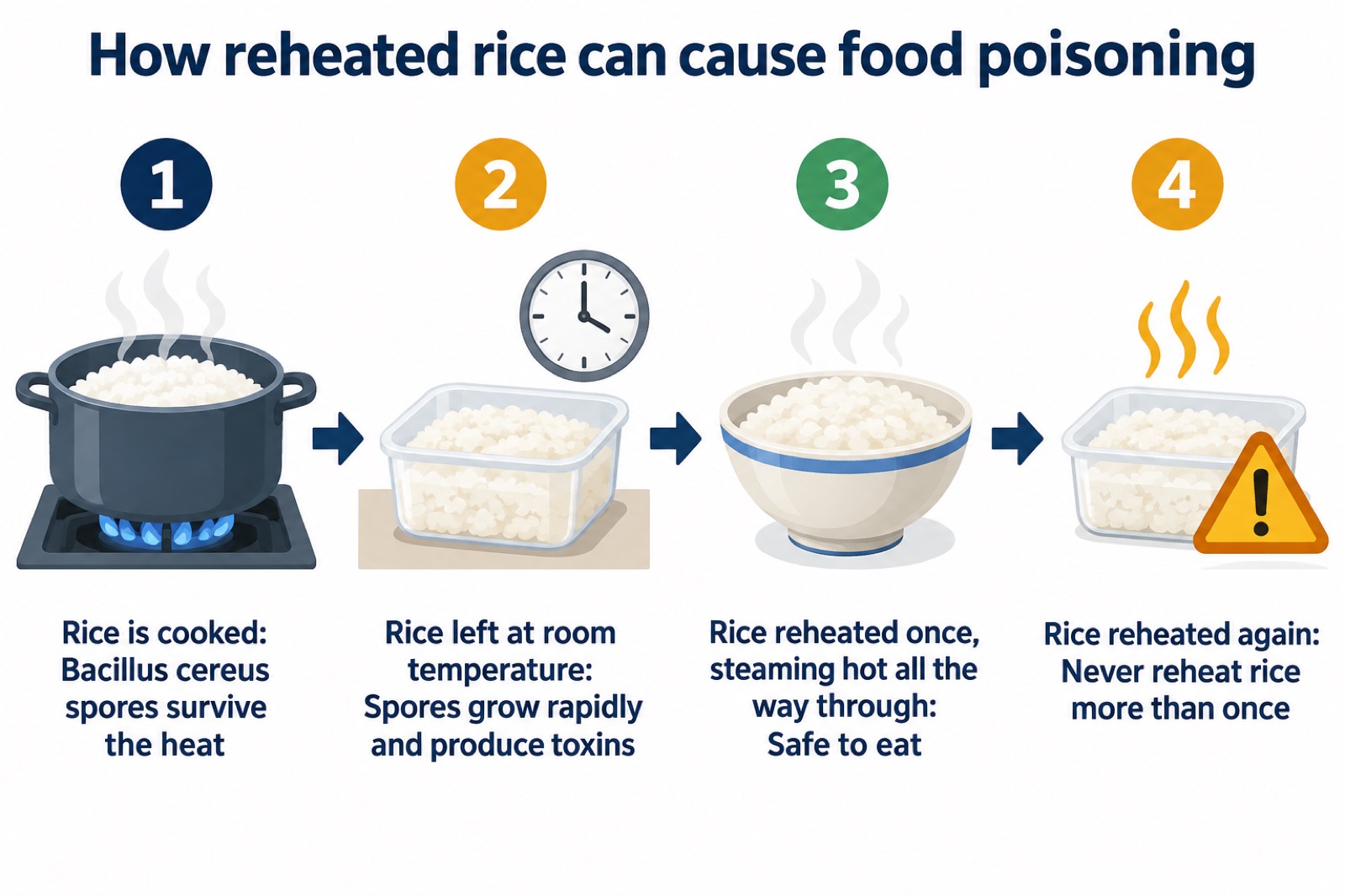
Uncooked rice can contain spores of a bacterium called Bacillus cereus, which can cause food poisoning and whose spores can survive being cooked10. Bacillus cereus is common in soil; foods such as rice, cereals and spices often contain this organism, as can spoiled milk and cream from cattle with teat infections14. It produces spores that survive heat processing and grows rapidly at room temperature, producing toxins both in the food and after ingestion14.
This is the basis of the rice rule. When reheating cooked rice, make sure it is steaming hot all the way through, and never reheat rice more than once10. You should only ever reheat food once, and this applies to all leftovers, not just rice16. Cool leftovers quickly, keep them in the fridge, and see our page on how long you can keep leftovers in the fridge.
Clostridium perfringens works the same way. Its spores can survive in most conditions, including cooking, so the organism is found in some cold meats14. It grows slowly below 15°C and produces a toxin, and it causes abdominal pain, diarrhoea and nausea between 8 and 24 hours after infection14. The classic setting is food cooked in bulk and left standing warm: hence the advice not to prepare food too far in advance, and to keep food either piping hot or refrigerated until it is served12.
Hepatitis A: a food-borne virus with symptoms about 4 weeks later
Not everything that causes food poisoning is a bacterium. There are three viruses of primary concern in food safety: norovirus, hepatitis A and hepatitis E5. Foodborne viruses make up an estimated 18% of the UK's food poisoning cases5. Some viruses can survive and remain infectious in foods and the environment for long periods of time, and can survive harsh conditions5.
Hepatitis A is an infection of the liver caused by the hepatitis A virus, also known as HAV5. It is spread by the faeces of an infected person5. You can get hepatitis A infection from eating food prepared by someone with the infection who has not washed their hands properly; drinking contaminated water; eating contaminated food such as raw fruit and vegetables, including berries and salad, or undercooked shellfish; and close contact with someone who has hepatitis A5. The virus is found in stools of infected people and in shellfish spoiled by sewage14.
Symptoms develop around 4 weeks after becoming infected but will usually pass within a couple of months5. Symptoms can include feeling tired and generally unwell, joint and muscle pain, a high temperature, loss of appetite, feeling or being sick, pain in the upper-right part of your tummy, yellowing of the skin and eyes (jaundice), dark urine and pale stools, and itchy skin5. It causes a range of illness from mild symptoms including nausea, vomiting and fever through to hepatitis, meaning liver inflammation and jaundice, and rarely liver failure5.
Two features make hepatitis A hard to contain. Someone with it is most infectious from around 2 weeks before their symptoms appear until about a week after the symptoms first appear5, so they can spread it before they know they are ill. And the long incubation means the food that carried it was eaten a month earlier. If you have hepatitis A, stay off school or work, especially if you are a food handler, until at least a week after the symptoms first started5. Infection is followed by lifelong immunity, and most people make a full recovery within a couple of months5.
Stopping the spread at home
Most of the prevention advice comes down to what NHS Inform calls the four C's of food safety at home: cleaning, cooking, chilling and avoiding cross-contamination16. Each is a habit, not a one-off.
Cleaning. Wash your hands thoroughly using soap and warm water before preparing food5. Wash worktops, utensils and chopping boards with warm, soapy water before and after food preparation to prevent bacteria from spreading16. Always clean surfaces, utensils, plates and hands thoroughly after they have touched raw or thawing meat to stop bacteria spreading around the kitchen20. Do not prepare food directly on work surfaces if they are chipped or cracked, and discard chipped or cracked crockery, because bacteria can grow in the cracks and make you ill18.
Cooking. Make sure food is cooked throughout to kill harmful bacteria16. Thorough cooking kills food poisoning bacteria, so make sure food, especially meat, is cooked right through and piping hot in the middle, and do not reheat food more than once12. Remember that with some bacteria, toxins are produced which are not destroyed by cooking, and a food does not have to look, smell or taste off to be dangerous14.
Chilling. Make sure foods are stored at the correct temperature to prevent growth of harmful bacteria16. Defrost food in the fridge overnight to keep it out of the Danger Zone20. Keep your fridge at 5°C or below3.
Cross-contamination. Keep raw meat and unwashed vegetables separate from ready-to-eat foods during storage and preparation; use different chopping boards, plates and utensils for raw and cooked food or wash them thoroughly between uses; keep raw meat in a sealed container at the bottom of the fridge; never wash raw meat, because washing does not get rid of harmful bacteria but thorough cooking will kill any bacteria present; and use separate shopping bags for raw and ready-to-eat foods16.
Always wash fruit and vegetables before you eat them to remove any surface dirt or bacteria; peeling or cooking can also remove these germs16. To avoid splashing bacteria around the kitchen, rub raw vegetables in a bowl of fresh water rather than washing them under a running tap16. Public health advice on cryptosporidiosis gives the same instruction: always wash and/or peel fruits and vegetables before eating them21. If your water supply is contaminated, use preboiled, cooled water to wash fruit and vegetables that are to be eaten raw18, and after a flood, flood water is dirty and can contain harmful bacteria, viruses or chemicals from silt and sewage that can cause illness, so thoroughly clean all surfaces, equipment, crockery, cutlery and utensils in hot, soapy water22. Our page on food after a flood covers what to keep and what to throw away.
When someone in the house is ill
When vomiting and diarrhoea strike, they are often caused by a stomach bug and should stop in a few days23. Food poisoning due to eating food that has not been prepared or stored properly can be treated at home24. To stop it spreading within the household:
- Wash your hands after contact with the sick person, and before handling food2
- Do not share towels or face cloths2
- Disinfect the toilet handles and seat2
- Drink plenty of fluids2
- Avoid preparing food for others2
- Avoid sharing bathwater2
- Put the toilet lid down when flushing and ventilate the house2
For cleaning up after sickness or diarrhoea, Northumberland Council advises scooping up loose materials using an improvised scraper or paper towel, rinsing down a WC bowl rather than a food-prep sink, washing with warm soapy water, and cleaning all equipment used with dilute bleach, one egg cup in a small bucket of warm water9. Anyone with diarrhoea, vomiting or nausea should not prepare food12, and food handlers in particular must inform their employers of their illness and should not return to work within 48 hours of the last symptom7. Our page on how long to stay off work or school with food poisoning gives the full rules.
Who needs to take the most care
Young children, the elderly, pregnant women and those with a pre-existing illness can quickly become very ill when infected9. The very young, people who already have a weakened immune system, and the elderly are particularly vulnerable12, and the same groups are named again in Somerset and Northumberland guidance7. If you are in one of these groups, or cooking for someone who is, take extra caution: wash hands, surfaces and utensils often; be cautious with high-risk foods like deli meats and smoked fish; make sure food is steaming hot; and do not consume expired or spoiled food, checking use-by dates25.
If you think a food you bought made you ill, you can report it: food poisoning caused by bacteria or a parasite is normally diagnosed once a patient has provided a faecal sample to their doctor or at a hospital, which is then tested at a laboratory12. Our page on reporting food poisoning or a food problem to your council explains the steps, and our page on food poisoning symptoms, who is at risk and when to get help covers when to seek medical advice.
Sources (25)
- Food poisoning, NHS Inform
- Infectious diseases: causes and sources, Cornwall Council
- Listeria, Food Standards Scotland
- E. coli O157, Public Health Agency Northern Ireland
- Foodborne viruses, Food Standards Scotland
- Boost your resilience: 30 ways, London Resilience Partnership
- Food poisoning, Somerset Council
- Food poisoning advice, Northumberland Council
- Infectious diseases control, Northumberland Council
- Food storage, Food Standards Scotland
- Salmonella warning on eggs imported from Ukraine, Food Standards Scotland
- Food poisoning and waterborne infections, Shropshire Council
- Food poisoning, Belfast City Council
- Food poisoning guidance, NHS Borders
- Health protection: foodborne disease, Cornwall Council
- Preparing and cooking food safely, NHS Inform
- Salmonella linked to poultry products imported from Poland, Food Standards Scotland
- Food safety after a flood: consumer advice, GOV.UK
- Use by and best before dates, Food Standards Scotland
- Chilling, Food Standards Scotland
- Cryptosporidium: public advice, GOV.UK
- Flooding: food safety advice, Food Standards Scotland
- Vomiting, North West Ambulance Service
- Poisoning, NHS
- Food safety in a power cut: advice for consumers, GOV.UK
 Long-Term Storage Kit Checklist
 Store Cupboard Checklist
 30-Day Household Checklist
 How Much Emergency Food to Store
 What to Store in an Emergency
 Starting a Store Cupboard
 Shelf Life and Date Labels
 Rotating Your Food Store
 Long-Term Storage Conditions
 Meals Without Power
 Self-Heating Meals
 Tinned Food Guide
 Rice, Pasta and Pulses Storage
 Freeze-Dried Meals
 Emergency Ration Packs