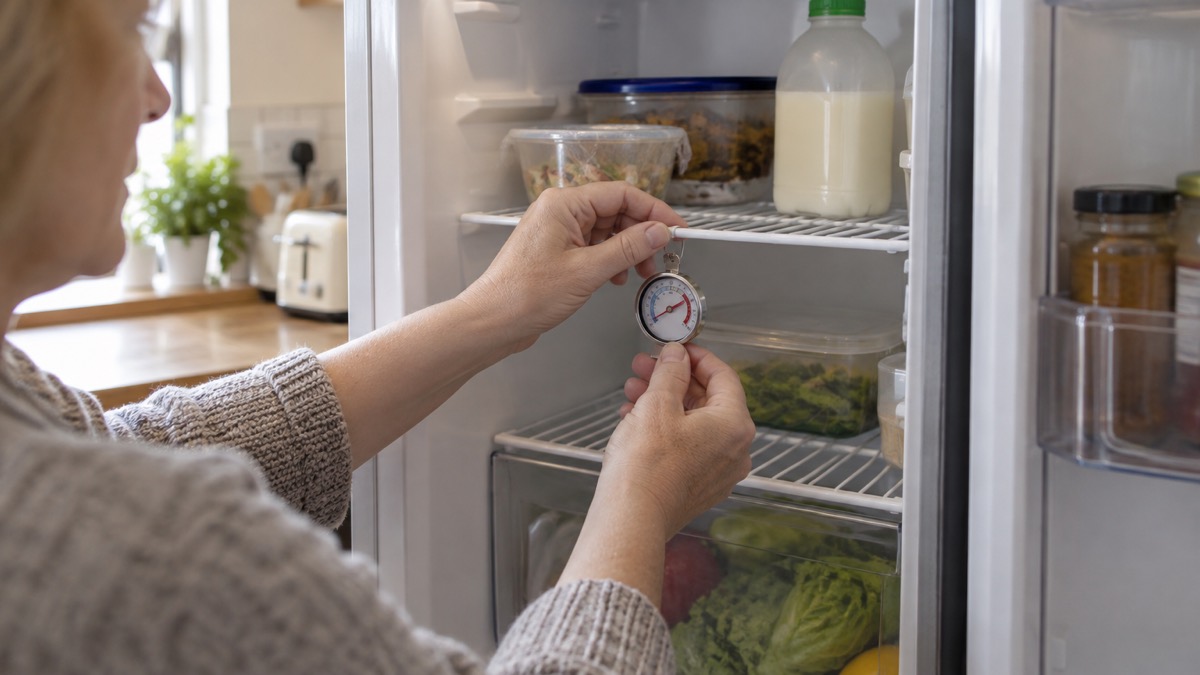
Keep your fridge at 5°C or below, and your freezer at around -18°C. That is the short answer to "what temperature should my fridge be", and it comes from food safety guidance that applies across the UK1. The fuller recommended range for a domestic fridge is between 0°C and 5°C3, and the reason for checking it with a thermometer rather than trusting the dial is simple: over half of fridges monitored in a citizen science project run by Food Standards Scotland, 55.4%, had an average temperature of between 5°C and 11°C1. In other words, most people's fridges are warmer than they think.
The stakes are real but manageable. Above fridge temperatures, bacteria can grow and multiply, a range food safety bodies call the "Danger Zone"1. Keeping the fridge cold enough slows that growth, which is why the difference between 4°C and 8°C matters more than it sounds. During a power cut the rules change slightly: chilled food stays safe below 8°C, and a fridge with its door shut should hold a safe temperature for up to four hours2.
This page covers the everyday temperatures, how to check them with a fridge thermometer, what to do during and after a power cut, and which foods and people need the most care.
Keep your fridge at 5°C or below
Food Standards Scotland's advice is to keep chilled foods cold, with the fridge set to 5°C or below6, and NHS inform in Scotland gives the same figure, recommending you keep your fridge at the right temperature, between 0°C and 5°C3. Environmental health guidance from Northumberland Council states the same rule plainly: the fridge should work at 5°C or lower, and the freezer at -18°C or lower7. Cornwall Council's infectious disease guidance adds that a refrigerator must operate at 8°C or lower, with 5°C or lower recommended where possible8. The 8°C figure is a legal-style ceiling for chilled food; the 5°C target is what you should actually aim for at home.
The reason for the target is bacterial growth. Chilling food properly is one of the four main ways to prevent food poisoning, alongside cooking, cleaning and avoiding cross-contamination, because it stops harmful bacteria multiplying3. Freezing pauses bacterial growth rather than killing the bacteria: Food Standards Scotland warns that "freezing food doesn't kill some harmful bacteria in food. Bacterial growth can be 'paused' at these low temperatures but can start to grow again at higher temperatures"1. A freezer at around -18°C keeps that pause firmly in place.
Two practical points help a fridge hold its temperature. First, leave it switched on: Mid and West Wales Fire and Rescue Service notes that essential electrical items such as your fridge and freezer are designed to be left on 24/7 to store food at the right temperature9. Second, where the appliance sits matters. North Wales Fire and Rescue Service advises: "Don't place a fridge or freezer near cookers, radiators, or in direct sunlight, as it will have to work harder to maintain the required internal temperature"10. A fridge working harder is a fridge running warmer inside, and it uses more electricity to do it.
Checking the temperature with a fridge thermometer
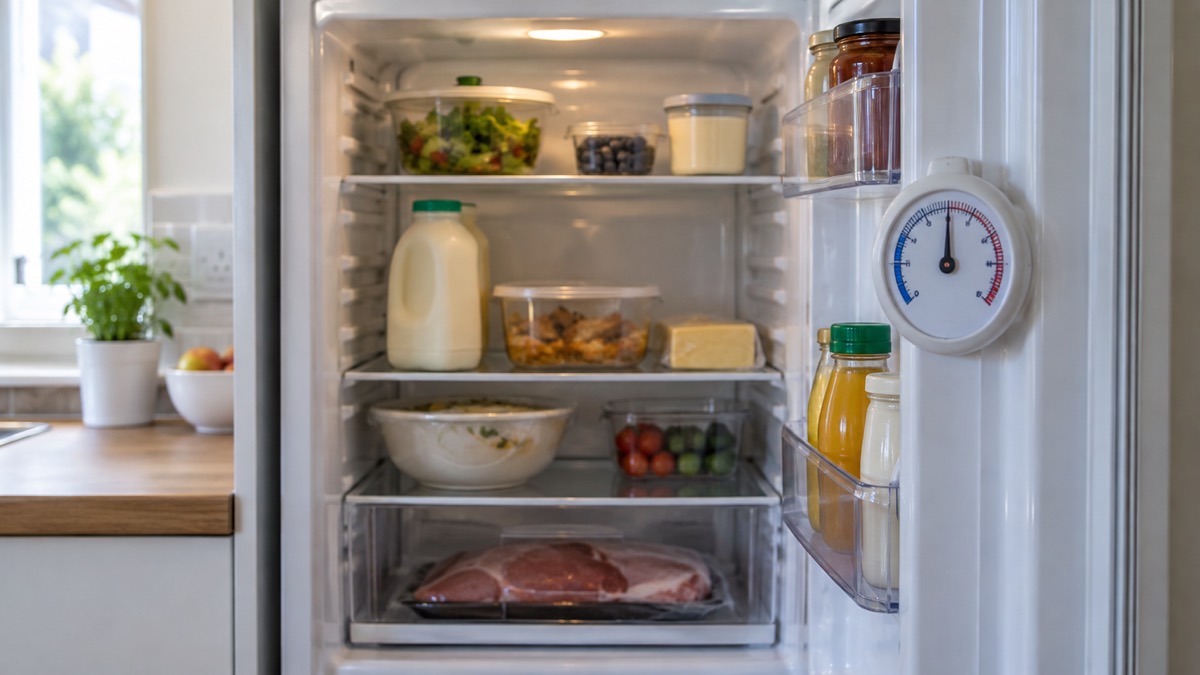
The dial on the front of your fridge is a setting, not a measurement. It tells the appliance how hard to work, not what the temperature actually is inside, and the two can drift apart over time, after a door seal ages, or when the kitchen gets warm in summer or cold in winter. That is why the official advice is to "keep your fridge between 0°C and 5°C, and regularly check the temperature with a thermometer"1.
A fridge thermometer is a small dial or digital thermometer that sits inside the fridge and reads the air or shelf temperature directly. Food Standards Scotland's power cut guidance makes the same point for emergencies: "Using a fridge thermometer is a simple way to monitor the temperature inside your fridge"2. During a power cut, when you cannot see anything on the appliance's own display, a thermometer already inside the fridge is the only way to know whether food has stayed below 8°C.
To check your fridge properly:
- Place the thermometer in the main compartment, ideally on a middle shelf, and close the door.
- Leave it for several hours without opening the door, so it settles to the true running temperature.
- Read it without holding the door open long.
- Adjust the thermostat if it reads above 5°C or below 0°C, and recheck after several hours.
- Repeat the check regularly, and use the thermometer to monitor the fridge during a power cut1.
If the reading is below 0°C, the fridge is too cold rather than too warm. Fresh foods such as milk, salad and vegetables can partially freeze, which damages them. The aim is a steady temperature inside the 0°C to 5°C band, not the coldest the appliance can manage.
During a power cut: fridge food can stay below 8°C
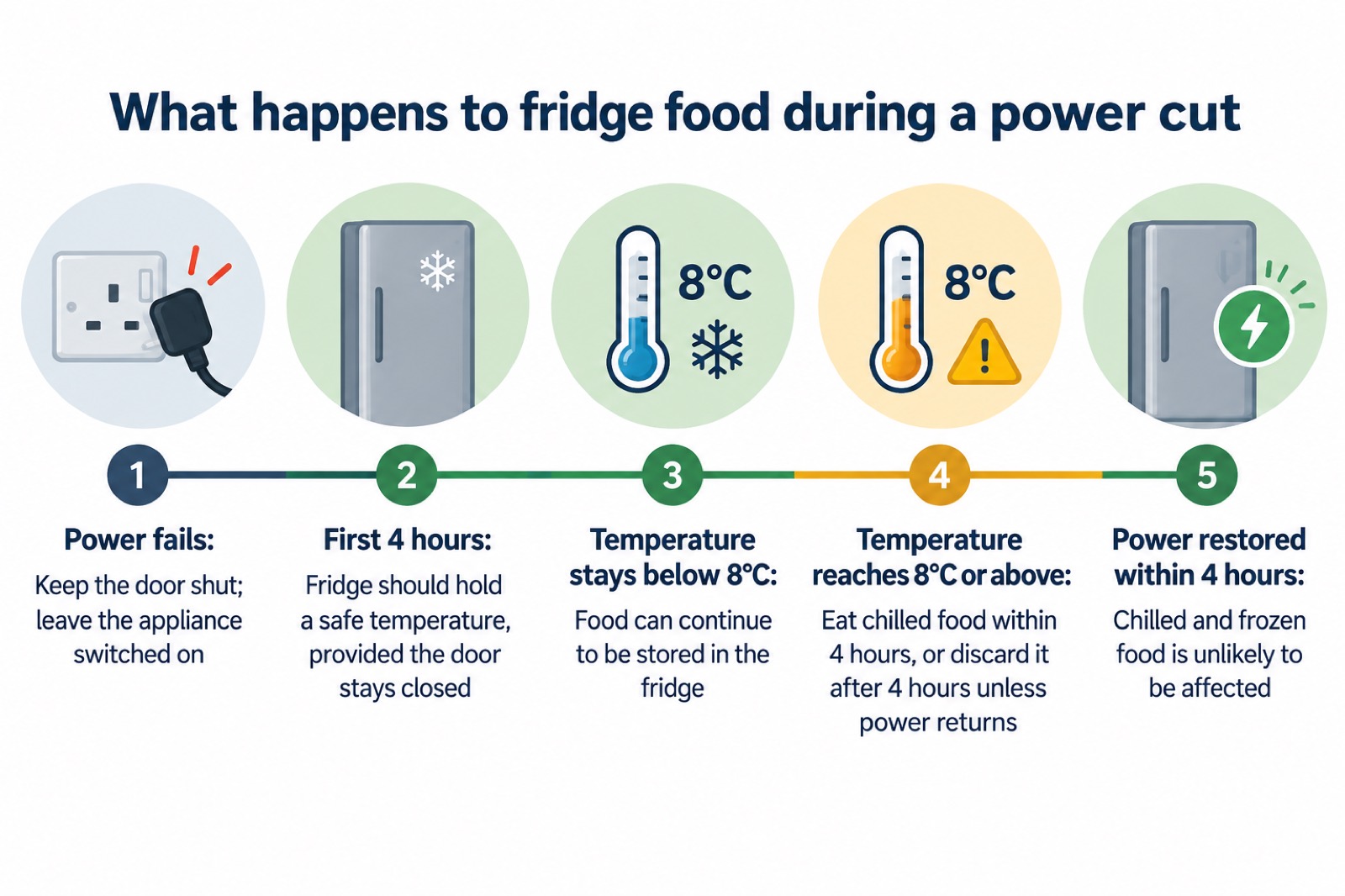
The rules during a power cut are slightly different from everyday rules, and this is where the 8°C figure comes in. Food Standards Scotland's normal advice is to keep the fridge at 5°C or lower, but it states: "during a power cut, it should be safe to store your food in the fridge as long as it doesn't rise to 8°C"2. The Food Standards Agency's consumer guidance for power cuts says the same: in normal circumstances fridges should be at 5°C or below, but in power cuts food can be stored in fridges at temperatures under 8°C4.
How long that lasts depends on the door. "Your fridge should keep your food at a safe temperature for up to four hours" during a power cut, provided the door is kept closed as much as possible2. The Food Standards Agency gives the same figure: your fridge should stay cold for up to 4 hours4. A community resilience booklet reports that some food can last up to 8 hours if the fridge and freezer are kept closed13, but the four-hour figure is the one to plan around, because it is the official consumer advice and it comes with the condition of keeping the door shut.
What to do when the power goes off:
- Keep fridge and freezer doors closed as much as possible2.
- Leave the fridge and freezer switched on with the door shut, so they resume cooling the moment power returns14.
- Check the fridge thermometer if you have one, to see whether the temperature stays below 8°C2.
- Drape a blanket over the closed fridge and freezer: local resilience guidance advises keeping them closed with a blanket over, as they will stay cold for hours15.
- Do not open the fridge for any longer than is necessary; fridges will normally stay cold for many hours16.
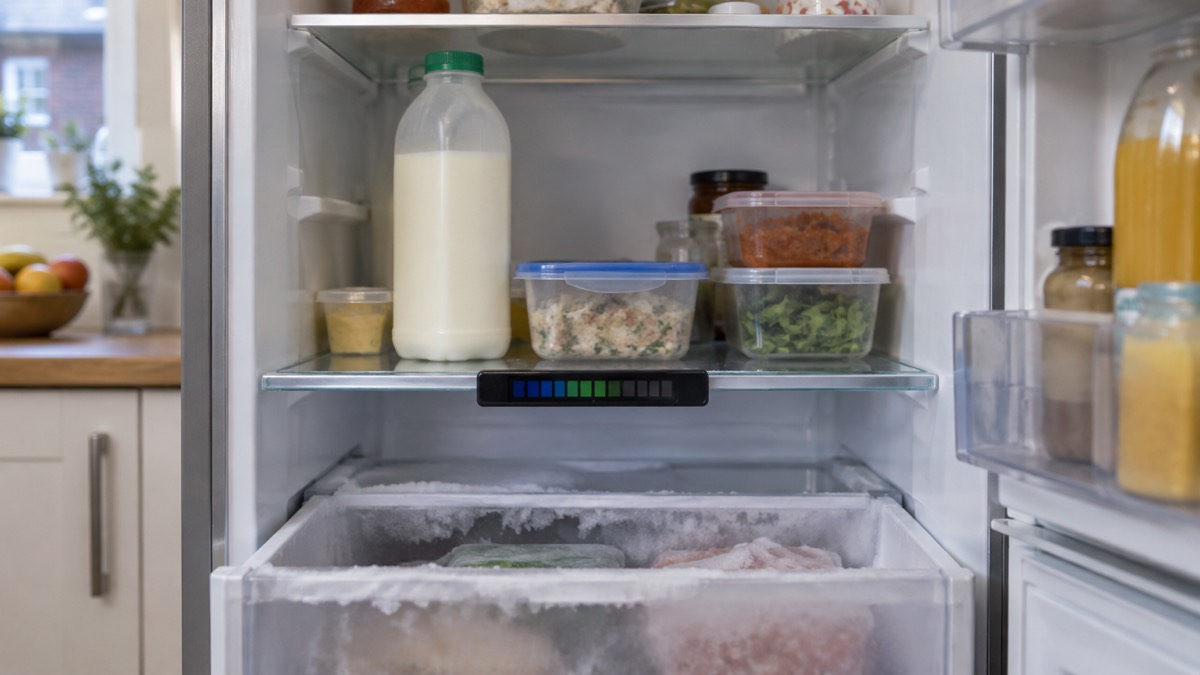
If the power outage lasts less than 4 hours, the Food Standards Agency advises it is unlikely to affect the safety of food in chilled or frozen storage4. For longer cuts, the thermometer tells you which rule applies. If the temperature has risen to 8°C or more, eat food that normally needs to be refrigerated within four hours2. The Food Standards Agency is firmer still: "If the fridge temperature has reached 8°C or above, these foods should be discarded after 4 hours (unless the power is restored within 4 hours)"4.
If the weather outside is cold, below 8°C, you can store chilled food outside in clean dry conditions, out of direct sunlight, protected from animals, in a sealed box to prevent contamination and tampering4. Food Standards Scotland gives the same advice: chilled foods can be safely stored outside if it is 8°C or lower, in a sealed container, out of direct sunlight, in clean dry conditions and protected from animals2. A cool box can do the same job indoors; see cool boxes and cool bags for how they work. For the wider picture of living through a cut, see power cuts: a household guide.
Why a few degrees matter: Listeria grows in the cold
Most food poisoning bacteria behave the way you would expect: cold slows them down, and they multiply rapidly in the Danger Zone above fridge temperatures1. Listeria monocytogenes is the exception that makes the 5°C target worth defending. Food Standards Scotland explains that if foods are not stored correctly, at the correct fridge temperature, or are eaten after the use-by date, then listeria may grow and cause illness5. Cornwall Council's guidance is blunter about why this bug is harder to control than others: prevention of food poisoning from Listeria is more difficult than other organisms as it can multiply rapidly at refrigeration temperatures8. NHS Borders' food poisoning guidance makes the same point: Listeria can grow at refrigerator temperatures17.
This is why a fridge running a little too warm is not "nearly right". It is a fridge in which Listeria can multiply on ready-to-eat food that will never be cooked again before you eat it. The advice that follows is to keep chilled ready-to-eat foods cold, making sure your fridge is working properly and is set to 5°C or below5, and to respect use-by dates, since eating food after them has the same effect as storing it too warm.
The illness itself is worth understanding. Symptoms caused by Listeria monocytogenes can be similar to flu and include high temperature, muscle ache or pain, chills, feeling or being sick and diarrhoea, according to a Food Standards Agency safety notice18. In healthy people it is usually a mild flu-like illness, but it can cause septicaemia and meningitis in the young and elderly, and stillbirth, miscarriage or meningitis in the new-born baby8. One detail makes it hard to trace: Food Standards Scotland notes it can take up to 70 days to show any symptoms of illness5. Food you ate two months ago can be the cause of illness this week. More detail on the illness itself is on food poisoning: symptoms and when to get help and the bacteria behind it.
Foods most at risk when the fridge warms up
Not everything in the kitchen is affected equally. The foods that matter are the ones that need refrigeration: NHS inform lists cooked dishes and foods labelled with a "use by" or "keep refrigerated" label, including dairy produce such as milk, cheese and butter, raw and cooked meat, eggs, fresh fruit and vegetables, and ready meals3. These are the foods covered by the four-hour and 8°C rules during a power cut.
Within that group, some foods carry a particular Listeria risk. Cornwall Council's guidance names the main sources: "Sources include: unpasteurised soft cheeses (such as Brie and Camembert) and meat pates"8. NHS Borders adds that Listeria occasionally affects milk and dairy products, soft cheeses, pates, meat products and vegetables17. These are mostly ready-to-eat chilled foods, which is exactly the problem: there is no cooking step between the fridge and your mouth to kill anything that has grown.
| Food | Why it matters | What to do |
|---|---|---|
| Unpasteurised soft cheeses (Brie, Camembert) | Named Listeria sources8 | Keep below 5°C; eat by the use-by date; discard under the power cut rules if above 8°C |
| Meat pâté | Named Listeria source8 | Keep below 5°C; eat by the use-by date |
| Cooked meats and ready meals | Ready-to-eat, no cooking step left5 | Keep below 5°C; four-hour rule above 8°C4 |
| Cold-smoked and cured fish | Listeria risk in ready-to-eat fish5 | Higher-risk groups should avoid it; see below |
| Milk, butter, fresh vegetables | Need refrigeration3 | Four-hour rule above 8°C4 |
| Raw meat and poultry | Needs the fridge, and must sit below other food | Keep at the base of the fridge, below everything else7 |
Placement inside the fridge matters as well as temperature. Environmental health guidance is consistent: always keep raw and defrosting meat at the base of the refrigerator, below everything else, and store raw meat and ready-to-eat food separately7. Food Standards Scotland adds that defrosting meat, fish and poultry should be kept covered or in a sealed container on the bottom shelf so it cannot drip onto other food1. Defrosting in the fridge overnight also keeps food out of the Danger Zone1. See handling raw meat, poultry and eggs safely for the full routine.
Cooked leftovers follow their own clock. Cornwall Council advises you cool food immediately after cooking and never allow it to be at room temperature for more than 4 hours, storing leftovers in the refrigerator as soon as they have cooled8. Food Standards Scotland says to cool cooked meat as quickly as possible and then put it in the fridge or freezer19. NHS inform adds that cooked meat, fish and poultry can be frozen once they have been cooled, and should only be refrozen once after cooking3. How long leftovers keep once refrigerated is covered in how long you can keep leftovers in the fridge.
Food that does not need the fridge is unaffected by any of this. The Food Standards Agency's power cut guidance states that food normally stored at ambient temperature will continue to be safe to eat, and some foods such as tinned foods are safe to eat without heating through; it advises eating these after perishable foods requiring chilled storage4. That is a good argument for keeping a store cupboard as a fallback, and for knowing what disappears from shops first in an emergency.
Who is most at risk from Listeria
A Food Standards Agency safety notice lists the people more vulnerable to listeria infections: those over 65 years of age, pregnant women and their unborn babies, babies less than one month old, and people with weakened immune systems18. For these groups, the consequences run from severe illness to meningitis, miscarriage or stillbirth8, so the everyday fridge rules carry more weight.
Food Standards Scotland gives specific advice for two of these groups. People who are pregnant or have a weakened immune system are advised to avoid eating ready-to-eat cold-smoked or cured fish products, because they are more likely to suffer severe symptoms from listeria infection5. For older adults, the risk of serious illness from listeriosis increases with age, so they should be aware of the risk, eat foods by the use-by dates, ensure the product is kept refrigerated below 5°C, and consider safer alternatives5. Those safer alternatives include cooked smoked fish, tinned or canned smoked fish, and thoroughly cooked fish fillets purchased fresh or frozen5.
If someone in your household falls into one of these groups, the practical steps are the same ones this page has already covered, applied more strictly:
- Check the fridge temperature with a thermometer and keep it at 5°C or below5.
- Keep chilled ready-to-eat foods cold and eat them by their use-by dates5.
- Avoid ready-to-eat cold-smoked or cured fish if pregnant or immunocompromised; choose cooked or tinned smoked fish instead5.
- Be cautious with unpasteurised soft cheeses and meat pâtés, the named Listeria sources8.
- During a power cut, apply the 8°C and four-hour rules without exception4.
Sources (19)
- Chilling food safely, Food Standards Scotland, 2026
- Food safety in power cuts, Food Standards Scotland, 2026
- Preparing and cooking food safely, NHS inform, 2025
- Food safety in a power cut: advice for consumers, Food Standards Agency, 2023
- Listeria, Food Standards Scotland, 2026
- Foodborne viruses, Food Standards Scotland, 2026
- Infectious diseases control, Northumberland County Council, 2026
- Infectious diseases: food safety guidance, Cornwall Council, 2026
- Cooking safely, Mid and West Wales Fire and Rescue Service, 2026
- Looking after the electrics, North Wales Fire and Rescue Service, 2026
- Beat the heat: staying safe in hot weather - GOV.UK, UK Health Security Agency (GOV.UK)
- 12 tips to prepare for a power cut, Horsted Keynes Parish Council, 2026
- Be ready, stay safe, act now, Sussex Resilience Forum, 2025
- Strong winds and heavy rain warning advice, nidirect, 2026
- Winter safety campaign 2024-2025, West Midlands Local Resilience Forum, 2024
- Are You Ready booklet, Culham Parish Council, 2025
- Food poisoning, NHS Borders, 2014
- Listeria safety notice, Food Standards Agency, 2026
- Food storage, Food Standards Scotland, 2026
 Long-Term Storage Kit Checklist
 Store Cupboard Checklist
 30-Day Household Checklist
 How Much Emergency Food to Store
 What to Store in an Emergency
 Starting a Store Cupboard
 Shelf Life and Date Labels
 Rotating Your Food Store
 Long-Term Storage Conditions
 Meals Without Power
 Self-Heating Meals
 Tinned Food Guide
 Rice, Pasta and Pulses Storage
 Freeze-Dried Meals
 Emergency Ration Packs