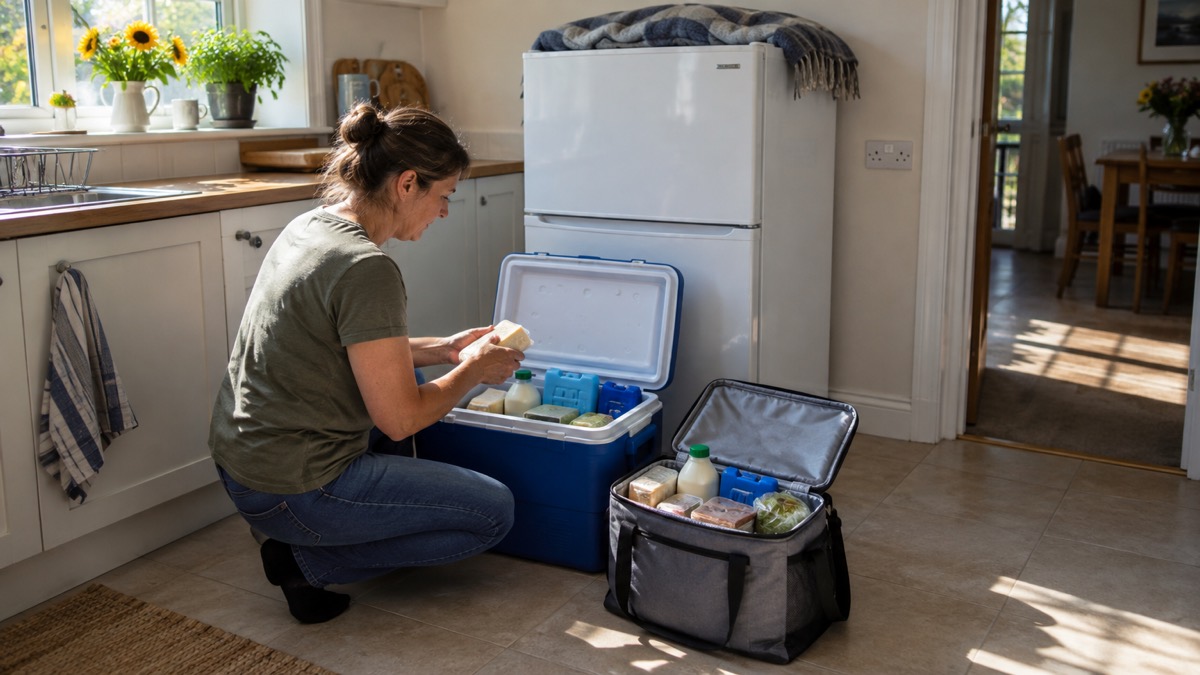
When the power goes off, your fridge and freezer are already cool boxes. Keeping their doors closed as much as possible is the single most important thing you can do, and a blanket laid over them helps them stay cold for many hours1. UK Government food safety guidance adds the deadline that matters most: food from a fridge should be thrown away if the electricity has been off for more than 4 hours2, and Public Health Wales advises turning off big appliances and not opening your freezer until the power returns3.
A cool box or cool bag is what you reach for once those hours start running out, or when you need to move chilled food, baby milk or medicines somewhere else. It does not make cold, it only holds the cold you put into it, so how long it works depends almost entirely on how you pack it. This page sets out what to do in the first minutes of a power cut, how to have a cool box ready before one, how passive boxes, cool bags and 12V electric coolboxes differ, and which foods to save first.
What to do in the first minutes of a power cut
Before you touch a cool box, protect the cold you already have. The Met Office advises keeping fridges and freezers closed, with a blanket over them, because they will stay cold for many hours5. Greater Manchester's resilience team gives the same instruction: keep fridge and freezer doors closed, as this will ensure they stay cold for several hours7. Wigan Council adds the wider household drill: protect the food in your fridge or freezer by keeping the door closed, switch off appliances that could pose a hazard, leave a light on in one room so you know when the power returns, and check on vulnerable neighbours8.
Only open the fridge when you have a plan for what you are taking out. Every opening lets warm air in and shortens the safe window. If you do open it, move the most perishable items straight into a prepared cool box rather than making several trips.
- Keep the fridge and freezer doors shut, and lay a blanket over them5.
- Switch off electrical appliances that should not be left unattended, and leave one light on so you know when power is restored9.
- Work through food in the safe order: chilled fridge foods first, then defrosted frozen food that does not need cooking, then room-temperature perishable food such as bread, then tinned, bottled and dried food1.
- If the cut is localised, consider staying with friends or relatives until your power is back on10.
If you get advance notice of a planned cut, use it. West Yorkshire Prepared's power cut advice includes filling a flask with hot water and making up a hot water bottle, keeping a mobile phone charged, and writing down important phone numbers10. That same notice is your moment to move ice packs from the freezer to the cool box and to pre-chill it.
Getting a cool box ready before a power cut
A cool box is only useful in an emergency if three things are true: you own one, you can find it in the dark, and it has cold mass ready to go. Preparation is mostly about those three.
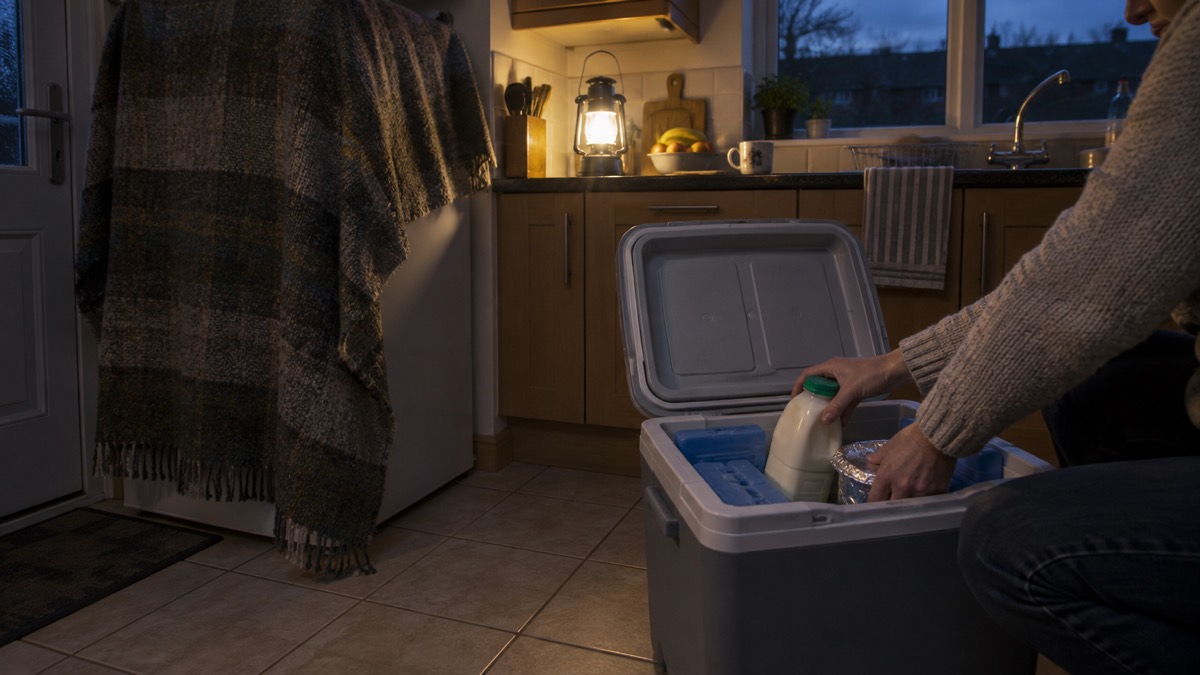
Start with the box itself. A passive cool box (an insulated box with a lid, no electronics) needs nothing more than storage space. Keep it with its ice packs inside it, so the whole thing is one item to grab. Keep a torch and spare batteries with your kit, along with a wind-up or battery-powered radio, a power bank or solar charger, warm clothes and blankets, and non-perishable food, which is the emergency kit West Yorkshire Prepared recommends for power cuts10. The Met Office's snow safety advice adds candles and matches or lighters, torches and batteries, and a mobile phone power pack as the core of power cut preparation11.
Next, keep ice ready. Ice packs live in the freezer between emergencies, where they do double duty as thermal mass helping the freezer stay cold, and come out the moment you need them. If you have space, keep a few sealed bottles of water frozen too. NHS inform advises always storing frozen foods in airtight containers or freezer bags because cold air dries them out12, and sealed bottles of water frozen the same way work as ice packs that end as cold drinking water.
Finally, keep information to hand. The Met Office's WeatherReady campaign suggests storing key information such as the power cut helpline number, 105, on your phone6, and the Royal Borough of Windsor and Maidenhead's home emergency plan lists 105 as the number to call for power cuts13. If you know a power cut is planned, you can also turn the fridge or freezer temperature settings down a couple of hours before the power is due to be switched off, so everything starts out colder12.
For the wider picture of what to hold in the house, see our emergency food guide and the emergency store cupboard checklist.
Cool box or cool bag: how each one keeps food cold
Neither a cool box nor a cool bag makes anything cold. Both are insulation: they slow the flow of heat from the warm room into your cold food and ice. That is why the official food safety question is never "how good is the box" but "how long has the food been above 8°C", because Food Standards Scotland's rule is that chilled foods need to be kept below 8°C to stay safe1.
A rigid passive cool box suits a household that expects to hold a meaningful amount of chilled food for several hours, or to move it by car. Its thick walls and tight lid hold cold mass well, and it doubles as the picnic and barbecue box. Food Standards Scotland's everyday advice is to use a cool bag or cool box when eating outside at a barbecue or picnic15, so the same item serves both ordinary life and emergencies.
A soft cool bag suits a smaller amount, a shorter time, or carrying on foot. It packs away flat, weighs little and fits in a rucksack or a grab bag, and it is the same tool many households already use to keep food cold when eating outside at a barbecue or picnic. For a short power cut, it can hold the few chilled items you expect to use first.
| Passive cool box | Cool bag | 12V electric coolbox | |
|---|---|---|---|
| How it works | Insulation plus ice packs | Insulation plus ice packs | Draws power to cool below ambient |
| Needs power | No | No | Yes, a 12V supply |
| What it holds | A full fridge's perishables for hours | Small amounts, carrying on foot, grab bags | Long journeys, or cuts where you have backup power |
| Between emergencies | Stores flat items inside, no upkeep | Rolls or folds flat | Needs a socket or battery to be useful at all |
The comparison of passive cool box or 12V electric coolbox goes into that choice in more detail. Whichever you choose, the food safety rules are identical, because the 8°C limit and the 4-hour fridge deadline come from the food's needs, not the container's1.
One option costs nothing: if the weather is cold, below 8°C outside, UK Government guidance says you can store food outside in clean dry conditions, out of direct sunlight, protected from animals, in a sealed box to prevent contamination and tampering2. A cool box placed in a cold, shaded spot uses the weather as its freezer. Check the outdoor temperature with a thermometer rather than guessing, and bring the box back in if the weather turns.
Ice packs and ice: filling a cool box so it stays cold longer
How long a cool box keeps food cold is decided by three things: how much cold mass you put in, how full the box is, and how often you open it. The same logic the Met Office applies to your fridge applies to the box: closed and covered stays cold for many hours5.
Pack for cold, not for space. A box that is mostly air loses its cold quickly, because air swaps with the room every time you lift the lid. Fill gaps with ice packs, frozen sealed bottles, or sealed containers of food. Food Standards Scotland advises keeping cupboard and pantry foods in sealed bags or containers to keep them fresh and stop anything falling into them16, and sealed packing matters even more inside a melting cool box, where meltwater and raw meat juices can contaminate everything they touch.
- Use enough ice packs to surround the food, not just sit on top of it.
- Keep raw meat and fish sealed and at the bottom, so nothing drips onto ready-to-eat food.
- Pre-chill the box and everything going into it before packing, if you have warning.
- Open it as rarely as you would open the fridge during a cut.
- Keep a blanket or towel handy to throw over the box, mirroring the Met Office's fridge advice5.
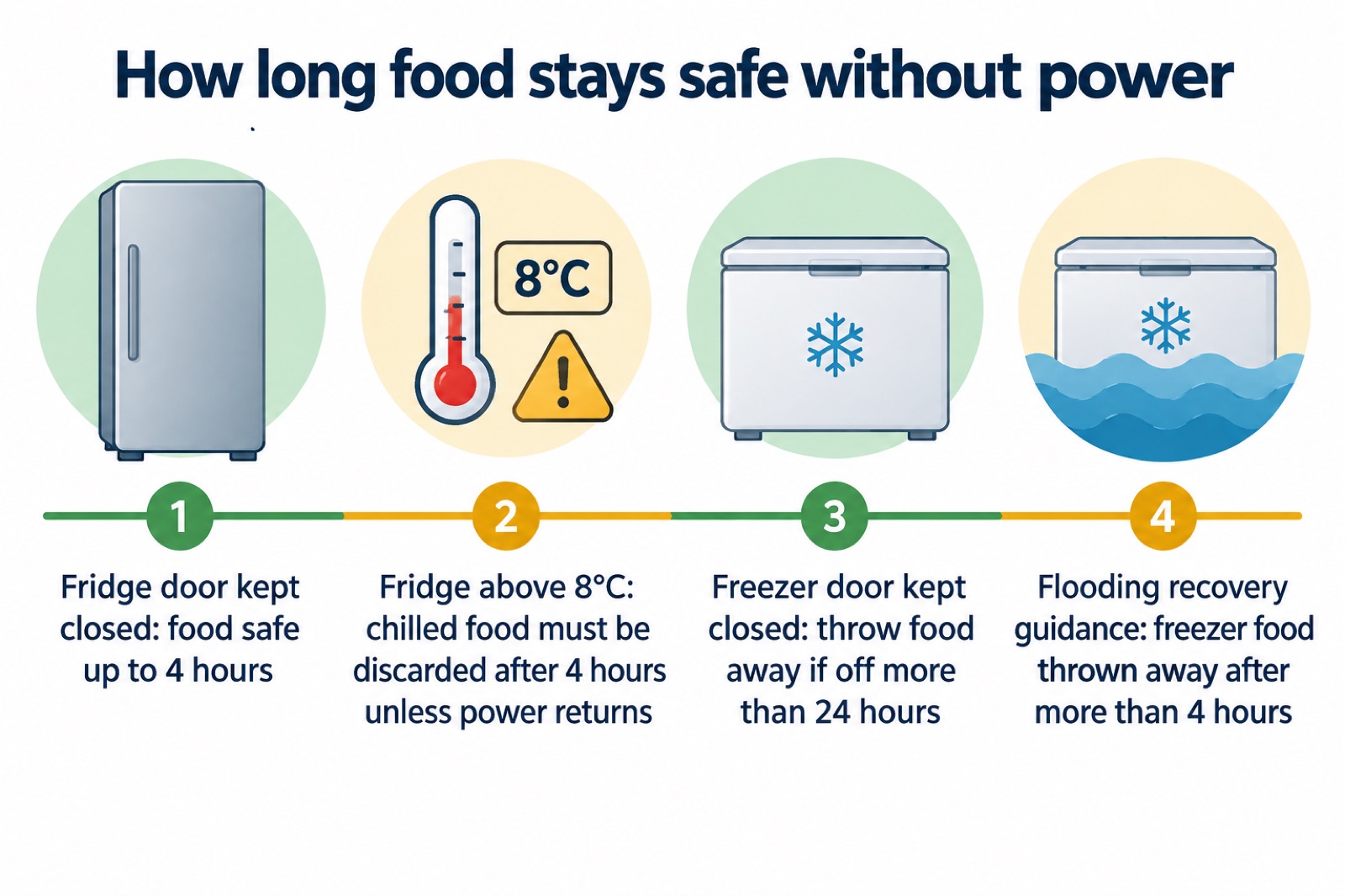
Note the disagreement on freezers. Gov.uk's after-flood page says to throw away food from a freezer if the electricity has been off for more than 24 hours4, while the flooding and health guidance for frontline responders says that if a freezer has not been working for more than 4 hours the food inside should be thrown away17. The flooding guidance adds two useful rules: throw away any ice cream that has gone soft, and meat and fish still below 8°C can be refrozen or cooked and eaten17. Our page on fridge and freezer temperatures and thermometers explains how to check the 8°C limit with a thermometer.
Running a 12V coolbox from a battery or power station
A 12V electric coolbox is a different animal from a passive one. It contains a cooling unit powered from a 12V socket, so it can hold a temperature below the surrounding air for as long as it has power, rather than for as long as your ice lasts. That makes it attractive in a long power cut, but it also makes it a load on whatever battery is feeding it, and the pack of official guidance available gives no figure for how long any given car battery or power station will run one. Treat battery drain as a real limit, not a detail.
In a car, the practical risk is flattening the starting battery. If you use a 12V coolbox while parked, run the engine periodically rather than leaving the coolbox to draw all night, and keep jump leads in the vehicle. The Met Office's winter vehicle preparation list includes jump leads alongside an ice scraper and de-icer, a reflective warning triangle, sunglasses, an in-car phone charger and a portable battery charger, and a blanket18.
At home, a 12V coolbox only helps if you have backup power to run it, which means a power station or battery setup. That is a bigger decision than a cool box, and it belongs with the rest of your backup power planning. If someone in the household relies on mains power for medical or assistive equipment, Ready Scotland's list of equipment that may stop working in a power cut, including ventilators, oxygen concentrators and feeding pumps19, is a reminder to budget your battery for the things that matter most before you spend it on keeping food cold.
A sensible arrangement for a long cut is a hybrid: a 12V coolbox running while power lasts, and a passive box with ice packs as the fallback for when the battery has to be conserved or runs down. The passive box never fails for lack of electricity.
Keeping a cool bag dry: water resistance and IP ratings
If your emergency plan involves a flood risk, or simply carrying chilled food through serious weather, a cool bag's water resistance matters. Meltwater inside is one thing; river water or standing floodwater outside is another, and floodwater is treated as contaminated in official recovery guidance4.
Water resistance is described by IP ratings, and the maker OverBoard publishes figures for its own products that show how the scale works. OverBoard states that its soft-sided cooler bags and backpacks are 100% waterproof thanks to welded seams and a roll-top sealing system, and that once sealed correctly they will protect contents from rain, splashes and even quick submersion23. The main compartment of its Coolers Dry Bags is rated IP66, designed for quick submersion, and will protect contents if the bag is briefly dropped in water23. The weatherproof zip pocket on the same bags is rated IP65: foul weather and spray proof, meaning it can handle rain, splashes and spray, but it is not submersible, and water may enter the zip pocket if the bag is fully submerged23.
| Rating | What the maker says it handles | What it will not do |
|---|---|---|
| Roll-top sealed soft cooler bags | Rain, splashes, quick submersion once sealed correctly23 | Nothing stated; sealing must be done correctly |
| IP66 main compartment | Brief drops into water, quick submersion23 | Extended submersion |
| IP65 zip pocket | Rain, splashes and spray23 | Not submersible; water may enter if fully submerged23 |
The lesson generalises: check what the maker actually claims for the specific compartment, not just the product name, because one bag can carry two different ratings. If your area floods, our page on where to keep an emergency store if your area floods covers the wider storage question, and food after a flood covers what survives contact with floodwater.
Food that must go back in the fridge, or be thrown away
When the power comes back, the cool box job ends with a sorting job. The rules are blunt, and they come from food safety authorities rather than from any box maker.
For the fridge: UK Government guidance is that if the fridge has not been working for up to 4 hours but the door has remained closed, the food inside will be safe; if more than 4 hours, throw the food away17. Gov.uk's after-flood page states the same deadline, throwing away food from a fridge if the electricity has been off for more than 4 hours4. Chilled foods that have reached 8°C or above should be discarded after 4 hours unless power is restored within that window2. Food that is still cold and below 8°C goes back into the fridge, which should now be working again.
For the freezer, the same principle applies with one clear rule: Public Health Wales advises that if the food has defrosted by the time the power is back on, you should throw it away3. The flooding guidance offers a partial reprieve: meat and fish still below 8°C can be refrozen or cooked and eaten, though any ice cream that has gone soft should be thrown away17. Our page on refreezing defrosted meat covers that in detail.
Lancashire's heatwave guidance adds a catch-all that covers the cool box itself: after a power cut, dispose of any food in the fridge or freezer that may have become wet or warm24. Anything from your cool box that sat in meltwater, or that you cannot confirm stayed below 8°C, falls under the same logic. When in doubt, throw it out; the cost of replacing a packet of ham is not worth a bout of food poisoning.
Looking after the box afterwards
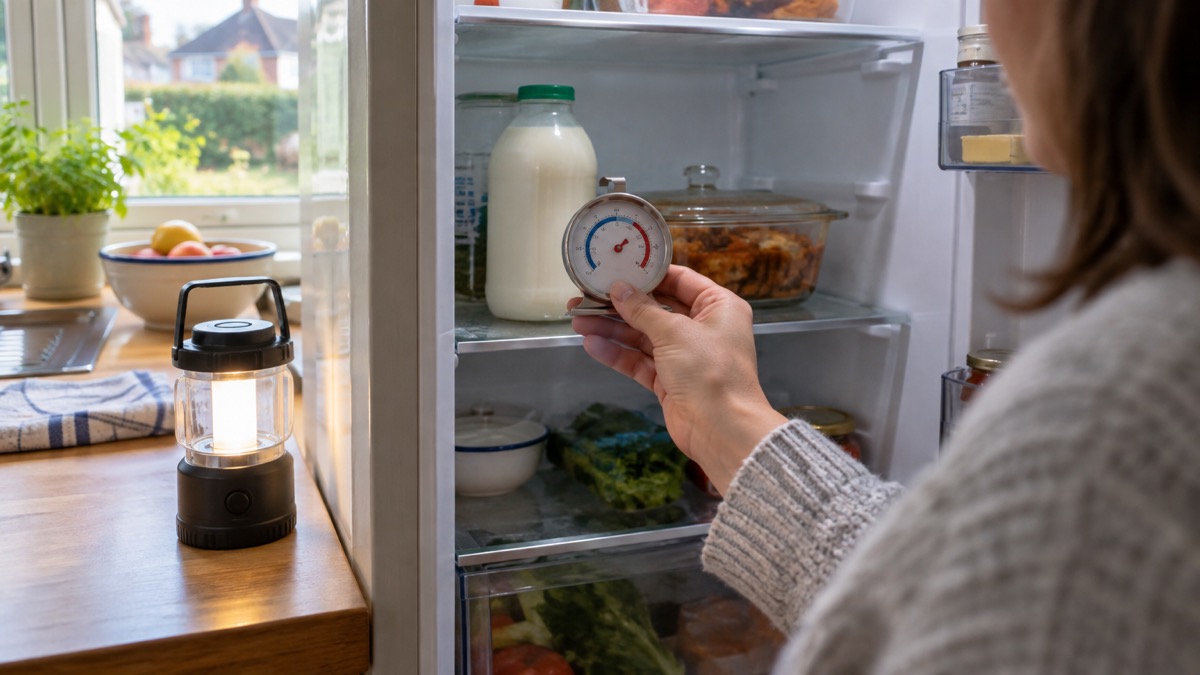
Cleaning and storage are the unglamorous end of cool box ownership, and they decide whether the box is pleasant and safe to use next time. Empty it as soon as the emergency is over, wipe it out and let it dry fully with the lid open, so mould and smells do not set in. Store it ready for the next use rather than leaving it packed with the remains of the last one.
For a 12V electric coolbox, official guidance on electrical appliances applies. Armagh City, Banbridge and Craigavon Borough Council's advice on heaters is to check the cord and plug for wear, fraying or damage, to clean dust and lint from vents and grilles regularly, and to unplug and let the appliance cool before cleaning25. The same habits suit any mains or 12V cooling appliance. If it has been wet, the rule from Greater Manchester and the London Resilience Partnership stands: off at the fuse box, dry out, professional check before it goes back on20.
Between emergencies, store the box clean and dry with the ice packs inside it, somewhere you can reach easily in the dark. Keep tinned and dried foods in a dry place where the temperature is fairly cool, Denbighshire's emergency supplies guidance advises, with boxed food in tightly closed plastic or metal containers to protect it from pests26. And keep the power cut helpline, 105, stored on your phone6, because the moment you need it is not the moment to search for it.
For everything that surrounds the cool box, our guides to power cuts, meals without power and how much emergency food to store per person carry the plan forward.
Sources (26)
- Power cuts, Food Standards Scotland, Food Standards Scotland, 2026-10-25
- Food safety in a power cut: advice for consumers, Gov.uk, UK Government, 2023-07-26
- Weather and health, Public Health Wales, Public Health Wales, 2026-07-16
- After a flood, Gov.uk, UK Government, 2026-10-25
- What to do in a power cut, Met Office, Met Office, 2026-10-25
- Top tips to be WeatherReady, Met Office, Met Office, 2026-10-25
- Loss of essential services, Greater Manchester Combined Authority, Greater Manchester Combined Authority, 2026-10-29
- Power cuts, Wigan Council, Wigan Council, 2026-10-29
- Met Office WeatherReady tips for snow and ice, Met Office, Met Office, 2025-11-19
- Power cuts, West Yorkshire Prepared, West Yorkshire Prepared, 2026-10-29
- Stay safe in snow, Met Office, Met Office, 2026-10-25
- Preparing and cooking food safely, NHS inform, NHS inform, 2025-02-21
- Emergency home emergency plan, Royal Borough of Windsor and Maidenhead, Royal Borough of Windsor and Maidenhead, 2026-01
- Accessible UK warnings, Met Office, Met Office, 2026-10-24
- Chilling, Food Standards Scotland, Food Standards Scotland, 2026-10-25
- Food storage, Food Standards Scotland, Food Standards Scotland, 2026-10-25
- How to recover from flooding, Gov.uk, UK Government, 2023-12-19
- Prepare your vehicle for winter weather, Met Office, Met Office, 2026-10-25
- Disabled people and carers, Ready Scotland, Ready Scotland, 2026-10-25
- Prepare yourself, Greater Manchester Combined Authority, Greater Manchester Combined Authority, 2026-10-29
- Preparing yourself for emergencies, London Resilience Partnership, London Resilience Partnership, 2026-10-25
- Lighting safety, Cleveland Fire and Rescue Service, Cleveland Fire and Rescue Service, 2022-11-12
- OverBoard Coolers Dry Bags, OverBoard, OverBoard, 2026-10-28
- Heatwave, Lancashire Prepared, Lancashire Prepared, 2026-10-29
- Safe use of heaters and generators, Armagh City, Banbridge and Craigavon Borough Council, Armagh City, Banbridge and Craigavon Borough Council, 2026-10-29
- Emergency supplies kit, Denbighshire County Council, Denbighshire County Council, 2026-08-27
 Long-Term Storage Kit Checklist
 Store Cupboard Checklist
 30-Day Household Checklist
 How Much Emergency Food to Store
 What to Store in an Emergency
 Starting a Store Cupboard
 Shelf Life and Date Labels
 Rotating Your Food Store
 Long-Term Storage Conditions
 Meals Without Power
 Self-Heating Meals
 Tinned Food Guide
 Rice, Pasta and Pulses Storage
 Freeze-Dried Meals
 Emergency Ration Packs