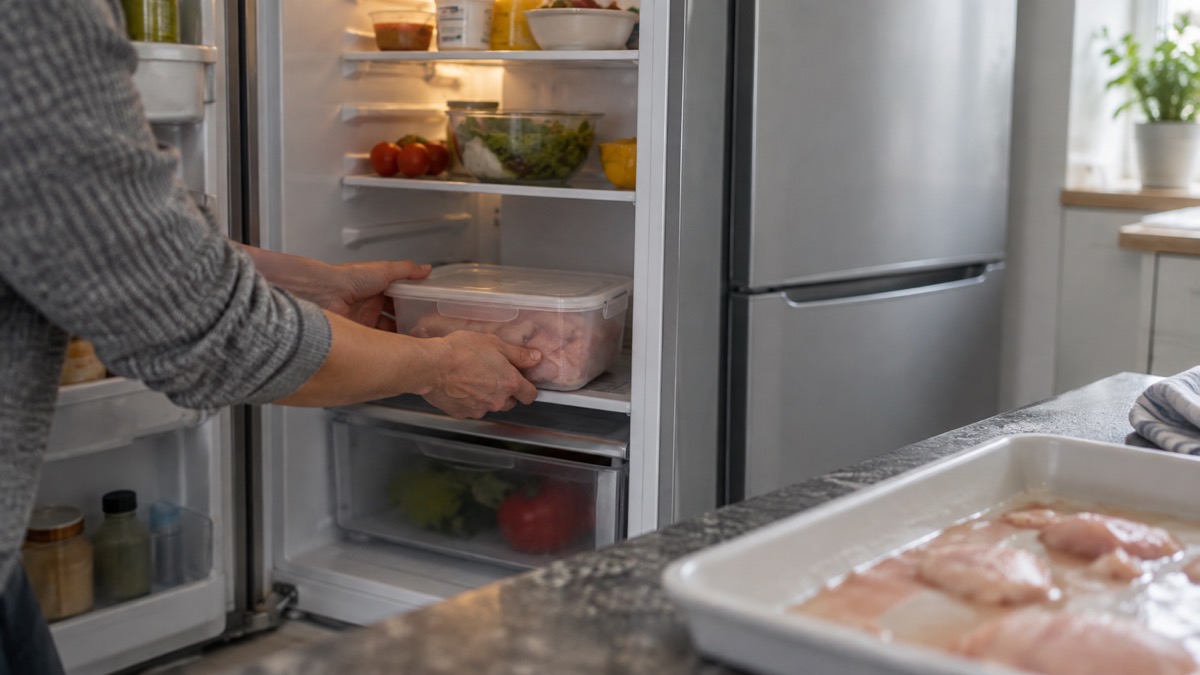
If you have taken meat out of the freezer to defrost and your plans have changed, or your freezer has thawed during a power cut, the short answer is no: raw meat, fish and poultry cannot be frozen again after they have been defrosted1. The same applies to defrosted fish. Putting it back in the freezer does not undo the thaw, and freezing does not kill the harmful bacteria that may have started to grow as it warmed.
What you can do is cook it. Once meat, fish or poultry has been cooked and cooled, it can be frozen, but only once after cooking1. After that, reheat it only once, and if a dish has been cooked, frozen and then defrosted, reheat and eat it within 24 hours1.
The practical rule for a household is simple: if raw meat has defrosted, cook it now or throw it away. If you cook it, cool it quickly, then freeze it in portions you can reheat one at a time. The rest of this page sets out how to defrost meat safely in the first place, what to do with freezer food after a power cut, and when defrosted meat should go in the bin.
Raw meat that has defrosted should not go back in the freezer
The reason is not that the freezer damages the meat. It is that freezing does not kill some harmful bacteria in food. Bacterial growth can be paused at low temperatures, but it can start to grow again at higher temperatures2. While meat defrosts, it passes through the warmer range where bacteria multiply, and refreezing does not reverse that.
Food Standards Scotland is direct about it: raw meat, fish and poultry cannot be frozen again after they have been defrosted1. The same advice appears in fire service guidance for households recovering after a fire, which tells people not to refreeze thawed food4. Food Standards Scotland's flooding advice repeats it: do not refreeze food that has thawed while the power was cut5.
There is a second reason to be careful with defrosting meat: the liquid that comes out of it. Watch out for liquid coming out of defrosting raw meat, because it could spread bacteria to other foods6. Keep defrosting meat in a sealed container at the bottom of the fridge so any liquid is contained, and clean surfaces, utensils, plates and hands thoroughly after they have touched raw or thawing meat2.
If you are weighing up whether to cook or bin a piece of meat, remember that you cannot tell whether food is safe by looking at it or smelling it. The dates and temperatures are the guide, not your nose.
Cook it first, then you can freeze it again
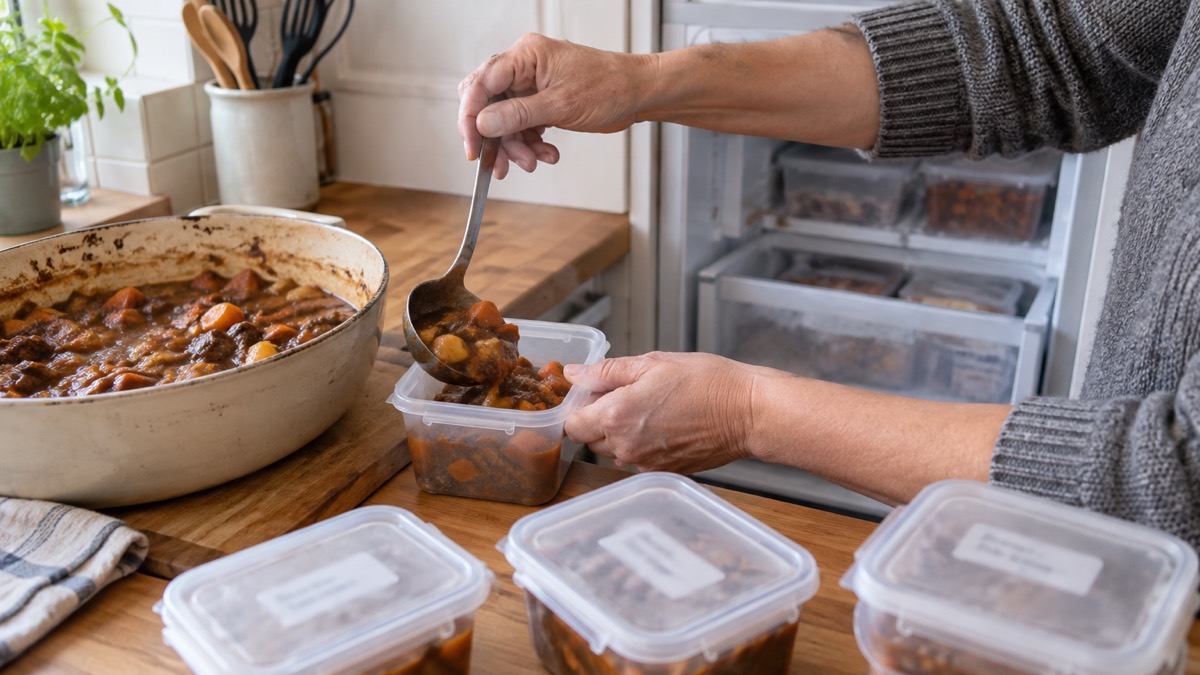
Cooking is the way to rescue defrosted meat. Cooked meat, fish and poultry can be frozen as long as they have been cooled, and you should only refreeze these foods once after cooking1. Cool cooked meat as quickly as possible and then put it in the fridge or freezer7.
The rules that go with it:
- Freeze once after cooking. You can freeze food again once cooked, but you will only be able to reheat it once after that2.
- Reheat once only. You should only ever reheat food once1. Food Standards Scotland's salmonella advice puts it the same way for cooked and frozen meat: only reheat it once8.
- Reheat and eat within 24 hours if the food has been cooked, frozen and then defrosted1.
- Freeze in smaller portions, which makes it easier to reheat only what you need2.
A practical example: mince defrosted during a power cut can be cooked into a chilli or a bolognese, cooled quickly, frozen in single portions, then reheated once and eaten. What it cannot do is go back in the freezer raw, or be reheated twice.
Defrosting meat safely in the fridge
The safest place to defrost meat is the fridge. Defrost food in the fridge so that it does not get too warm2. Defrost it in a sealed container at the bottom of the fridge, to prevent it from becoming too warm or any liquid contaminating other foods1.
Local authority food safety teams give the same instruction in slightly different words. Keep raw and defrosting meat at the base of the refrigerator, below everything else9. Store raw meat in sealed containers at the bottom of the fridge, use different boards for raw and ready to eat foods, and keep raw and ready to eat foods apart10. Cornwall Council adds that you should prepare and store raw meat and ready-to-eat food separately11.
| Method | When it suits | What to watch |
|---|---|---|
| In the fridge, sealed container, bottom shelf | The default for planned meals | Allow time; use within 1 to 2 days of defrosting2 |
| Microwave on the defrost setting | Only if you intend to cook it as soon as it is defrosted1 | Cook immediately afterwards |
| Room temperature | Not advised | Meat warms unevenly and bacteria can multiply |
Defrost meat thoroughly before cooking, ideally in your fridge1. Partly defrosted food may not cook evenly, which means harmful bacteria may survive1. That matters most with thick joints and whole birds, where the outside can be cooked while the centre is still cold.
If you are cooking outdoors, NHS Inform's summer health campaign advises cooking food in the oven before finishing it on the barbecue, to ensure it is cooked all the way through12. Defrost any frozen meat fully in the fridge before cooking13.
What to do with freezer food after a power cut
When the power goes, the first thing to do is nothing: keep the freezer door closed to help preserve your food14. Try to limit opening your fridge or freezer so food stays cold for longer15. National Grid's household guidance says the same: keep your freezer closed to make sure that the food stays cold16.
How long food keeps varies between network operators' guidance. Northern Ireland Networks says food should keep for between 4-6 hours in the fridge and 15-24 hours in the freezer if you can avoid opening it3. Energy Networks, the industry body, says food should keep for up to 4 hours in the fridge and between 24-48 hours in the freezer depending on how full it is17. The two figures differ; treat the shorter as your planning figure.
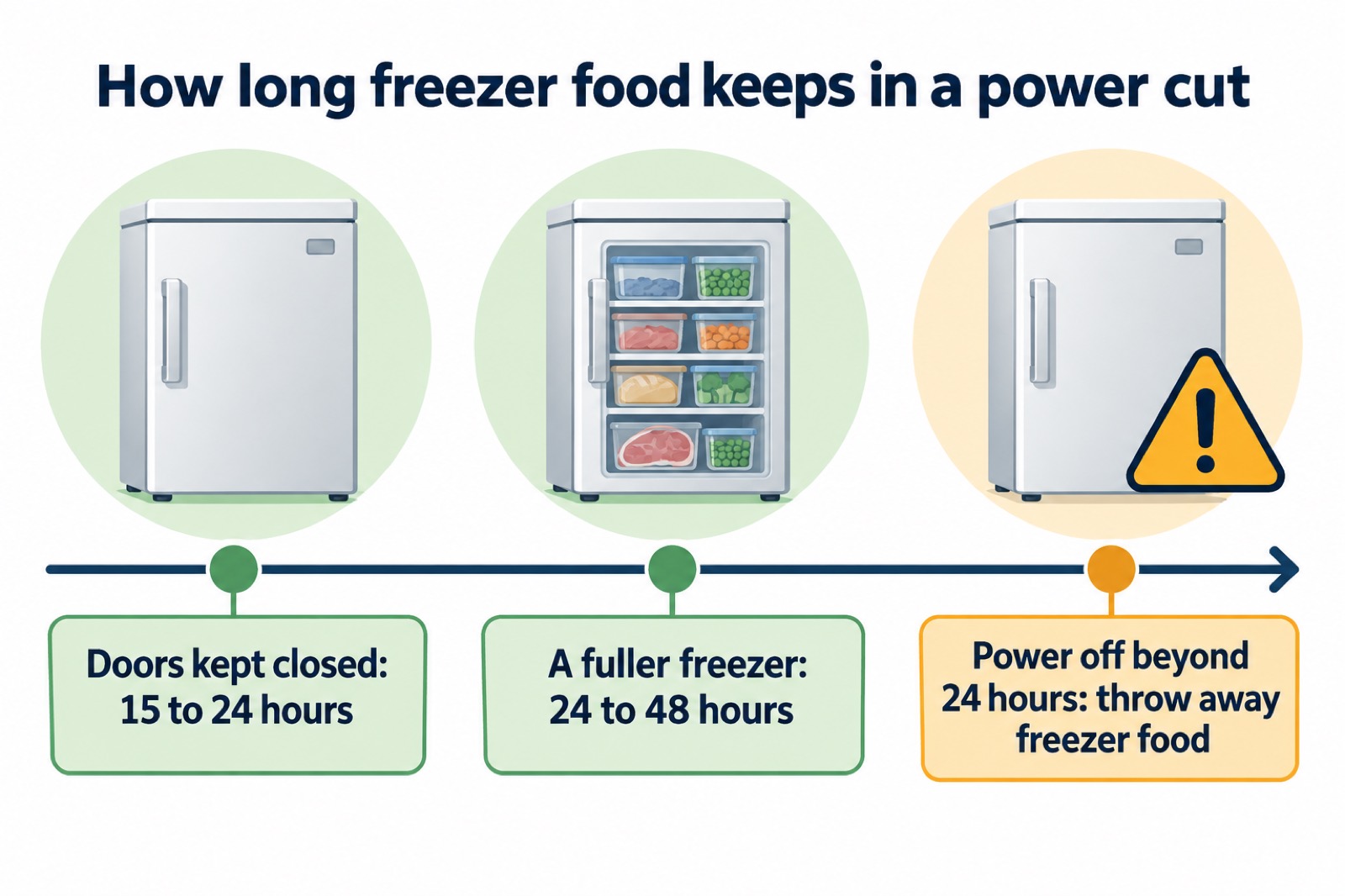
If the food has defrosted by the time the power is back on, you should throw it away19. The government's after-flood guidance is to throw away food from a freezer if the electricity has been off for more than 24 hours18.
Some foods should go whatever else you decide. Discard any food you would eat when it is frozen, such as ice cream, if it has started to defrost, and do not refreeze these foods6. If meat, fish or foods containing them have started to get soft, throw them away too3. Runnymede Borough Council gives the same advice for meat, fish and dairy, and for food you would eat frozen20.
If you have warning of a planned power cut, Scottish and Southern Electricity Networks advises turning the freezer to its maximum setting for 24 hours beforehand, then returning it to a setting that keeps it at -18°C21. It also says to discard defrosted ice cream and soft meat or fish, and not to refreeze defrosted foods21.
To reduce waste, use food in a set order: foods that need refrigeration first, then defrosted frozen food that does not need cooking, then room-temperature perishable food such as bread, then tinned, bottled and dried food22. Food Standards Scotland gives the same order22.
When to throw defrosted meat away
Throw it away if it has been left warm, if it has been out of the fridge too long, or if you simply cannot be sure. Which? advises throwing out meat, fish and dairy products if they have been above 4°C for more than a couple of hours23. Government guidance for food businesses after a power cut says that if frozen food has risen above 8°C for more than four hours it should be thrown away24. That is business guidance, but the principle is the same at home: time and temperature decide, not appearance.
After a flood, the rules are stricter. Discard any food which has been in contact with sewage or floodwater, including tins which may have been contaminated, and discard frozen or chilled food which has been at ambient temperature for a few hours25. Dispose of any frozen food that has been at room temperature for a few hours26. Do not be tempted to try to salvage damaged food25.
A short checklist for defrosted meat:
- Raw and defrosted: cook it now or bin it. Do not refreeze1.
- Soft, warm or leaking: bin it3.
- Above 4°C for more than a couple of hours: bin it23.
- Touched floodwater or sewage: bin it, including the container25.
- Past its use-by date: do not eat it7.
If you are in any doubt, dispose of the food if it appears to have defrosted27. That is the advice from Scottish and Southern Electricity Networks for planned cuts, and it is a sensible default for any thaw.
For more on keeping food safe when the power fails, see Food After a Flood: What to Keep and What to Throw Away and Fridge and Freezer Temperatures and Thermometers. If you are restocking after a loss, Handling Raw Meat, Poultry and Eggs Safely covers the basics, and Food Poisoning: Symptoms, Who Is at Risk and When to Get Help explains what to look out for.
Sources (27)
- Preparing and cooking food safely, NHS Inform, 2025-02-21
- Chilling, Food Standards Scotland, 2026-10-25
- Emergency power cuts, Northern Ireland Networks, 2026-10-25
- After an incident: fire, Devon and Somerset Fire and Rescue Service, 2026
- Flooding, Food Standards Scotland, 2026-10-25
- Repeat power cuts, Scottish and Southern Electricity Networks, 2026-10-25
- Food storage, Food Standards Scotland, 2026-10-25
- Salmonella linked to poultry products imported from Poland, Food Standards Scotland, 2023-12-06
- Food poisoning advice, Northumberland County Council, 2026-08-11
- Food poisoning and waterborne infections, Shropshire Council, 2026-10-29
- Infectious diseases, Cornwall Council, 2026-10-29
- Summer health, NHS Inform, 2026-08-06
- Stay safe this summer, Cornwall Council, 2026-08-07
- Power cuts help, Northern Ireland Networks, 2026-10-29
- What to do in a power cut, Northern Powergrid, 2026-10-25
- Preparing for a power cut, National Grid, 2026
- Power cut, Energy Networks, 2026-10-25
- After a flood, GOV.UK, 2026-10-25
- Weather and health, Public Health Wales, 2026-10-29
- Flooding, Runnymede Borough Council, 2026-10-26
- Planned outage, Scottish and Southern Electricity Networks, 2026-10-29
- Power cuts, Food Standards Scotland, 2026-10-25
- What to do in a power cut, Which?, 2026-06-04
- Information about specific safety concerns, Northumberland County Council, 2026-05-21
- Cleaning up after a flood: health advice, North Warwickshire Borough Council, 2024
- How to recover from flooding, GOV.UK, 2026-10-29
- Planned power cuts, Scottish and Southern Electricity Networks, 2026-10-25
 Long-Term Storage Kit Checklist
 Store Cupboard Checklist
 30-Day Household Checklist
 Baby Formula in a Power Cut
 Leftovers in the Fridge
 Reducing Botulism Risk
 Sterilising Jars
 Spotting Spoiled Preserved Food
 Boiling Water in Glass Jars
 Mylar Bag Food Shelf Life
 Mylar Bag Sizes
 Are Mylar Bags Food Safe
 Oxygen Absorber Activation
 Silica Gel With Stored Food
 Freeze-Dried Meal Shelf Life