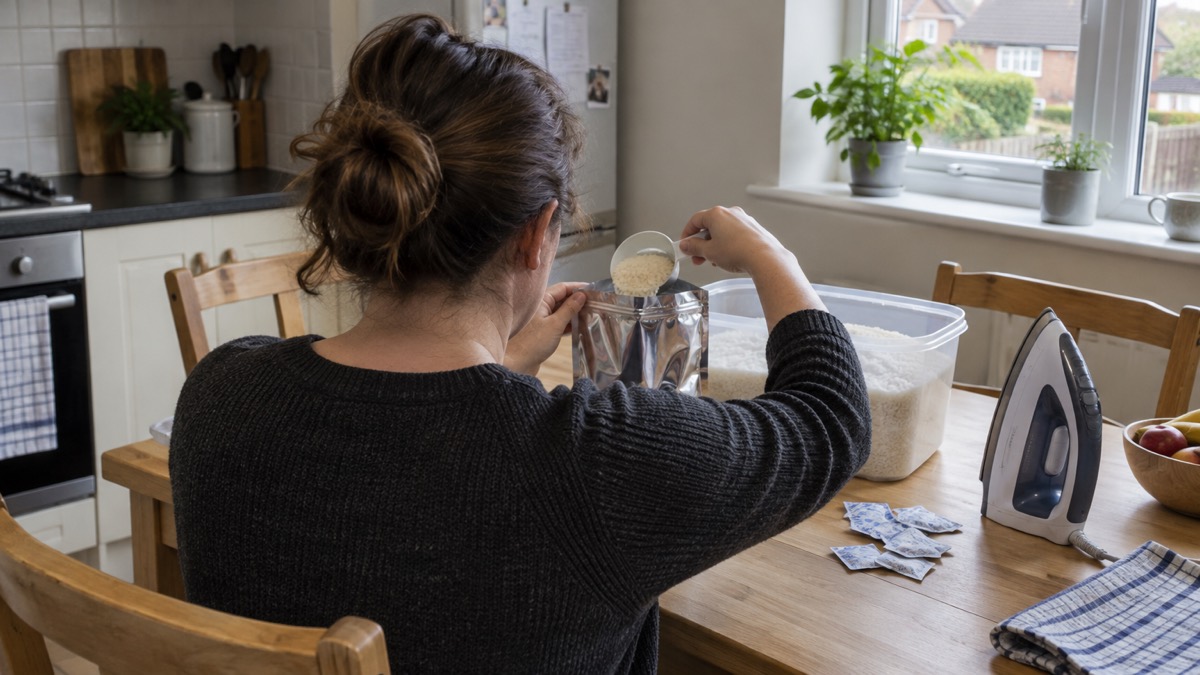
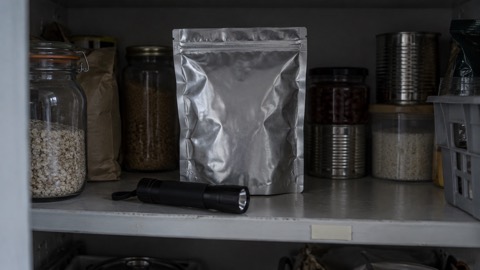
Mylar bags sold for storing food are labelled food grade and safe for food storage, and that label is the thing to look for before you buy. The bags in the range sold for this purpose are described as protecting their contents against oxygen, heat, pests, light and moisture, which is why they suit dry staples such as rice, pasta, flour and pulses1. They come in sizes from a small pouch up to a large bag, and most are both zip-lock and heat sealable, so you can choose a reusable closure or a permanent seal2.
The safety question has two parts. First, is the material safe to put food in? The seller states plainly that its bags are food grade and safe for food storage, and that is the claim to check on any bag you buy4. Second, will the food keep? That depends on what you put in, how dry it is, how well you seal it and where you store it. A bag is a barrier, not a preservative: it holds off oxygen, light and pests, but it cannot rescue damp food or a poor seal.
For an ordinary household, the practical answer is to buy bags labelled food grade, match the size to the food, seal them properly and store them cool and dry. Always check the food's own label for how it should be stored, as Food Standards Scotland advises5. If you are building a store from scratch, the wider guide to Mylar bags and oxygen absorbers for dry stores sets the method out in full.
What "food grade" on a Mylar bag tells you
"Food grade" is a claim about the material: that it is made to be in contact with food and is safe for that use. On the bags sold for home food storage, the seller states it directly, describing each size as "Food grade, safe for food storage"4. The same phrase appears across the range, from the smallest pouch to the largest bag, so you are not trading safety for size3.
It is worth knowing what the claim does not tell you. It does not tell you the bag is airtight once sealed, that it is thick enough for sharp pasta, or that it will keep food for any particular time. Those depend on the closure, the film and how you store it. The seller's own description of what the bags do is the useful companion to the food grade label: they protect against oxygen, heat, pests, light and moisture1.
Other food-contact products use the same kind of claim, which helps you judge it. A maker of a collapsible canister describes it as food grade for storing and transporting food or supplies6. A water bag maker says a food grade coating on the inside ensures safe transport of water7. A cooler bag maker says its bags are safe for storing food and drinks with no additional liners needed8. In each case the phrase means the material is intended for food contact, and it is the maker or seller making the claim.
For a UK household, the sensible approach is to buy from a seller that states food grade clearly, keep the packaging or listing until you have used the first bag, and treat the claim as the starting point rather than the whole story. If a listing does not say food grade, do not assume it.
Sizes: matching the bag to what you are storing
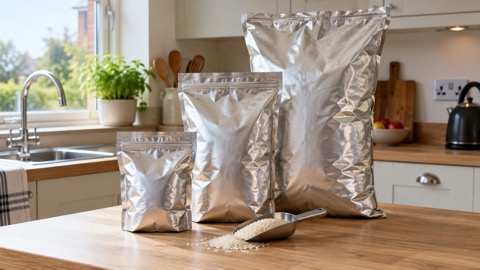
The range runs from small pouches to very large bags, and the right choice is the one that holds the amount you will actually use. A bag that is far too big leaves air space and wastes an oxygen absorber; one that is too small means opening several bags for a single meal.
| Type | Suits |
|---|---|
| Pouch | Herbs, spices, salt, sugar, flavourings, baby milk formula, tea, coffee, powdered milk, seeds9 |
| Ziplock bag | Small amounts of dry foodstuffs10 |
| Stand-up ziplock | Powders, herbs, spices and liquids, standing on a shelf3 |
| Ziplock bag | Small amounts of rice, pasta, cereals, oats, grains, nuts, pulses, dehydrated meat and vegetables11 |
| Ziplock bag | Small amounts of rice and pasta, cereals, oats and grains, nuts and pulses, dehydrated meat and vegetables2 |
| Heavy duty bag | Medium amounts of heavy, bulky or irregular foods: rice, pasta, noodles, beans, pulses, seeds, dehydrated meat and vegetables4 |
| Stand-up ziplock | Powders, supplements, herbs, spices and liquids12 |
| Ziplock heavy duty | Food storage, with the same protection against oxygen, heat, pests, light and moisture13 |
| Heavy duty bag | Medium amounts of heavy, bulky or irregular dry foods14 |
| Large bag | Large amounts of dry foods: cereals and grains, pasta, rice, flour, noodles, beans and legumes, any dry foodstuff1 |
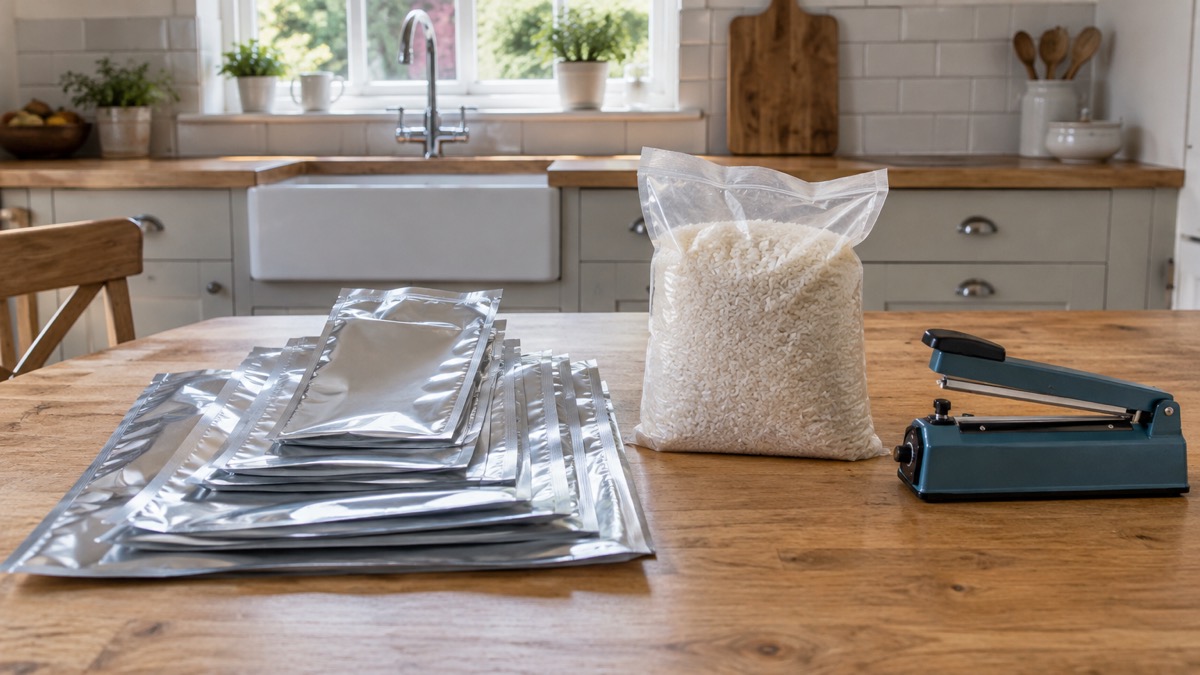
The largest bag is genuinely large. One buyer reported filling it with 10kg of rice and finding plenty of space for more1. That is a customer's experience rather than a specification, but it gives a sense of scale: if you are storing a few kilos at a time, a medium heavy duty bag is likely to be more manageable. The large bag is sold in pack sizes of 10, 50, 100 and 350, so it is aimed at bulk storage1. The small pouch comes in pack sizes from 1 up to 2,000, which suits someone buying a few for spices or a group buying in bulk9.
If you are unsure which size fits a given weight of rice, pasta or beans, the guide to what size Mylar bag you need for rice, pasta and beans works through the common amounts.
Storing dried food in Mylar bags with oxygen absorbers
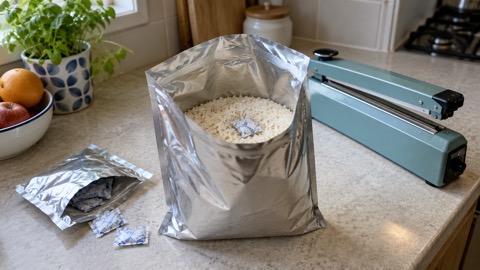
The method is simple: dry food, a food grade bag, an oxygen absorber, a good seal and a cool, dark, dry place. The seller states that foods sealed in Mylar bags with oxygen absorbers can last for decades, and that inorganic products such as paper and plastic last even longer15. That is the seller's claim for its own bags, and it depends on the food being dry and the seal being sound.
A bundle sold for the purpose pairs a heavy duty bag with oxygen absorbers, and one buyer reported using the bags for 3kg of pasta and finding them easy to handle and seal16. That is a customer's experience, not a guarantee, but it shows the size working for a common household amount.
- Choose a bag sized to the amount of food you are packing4.
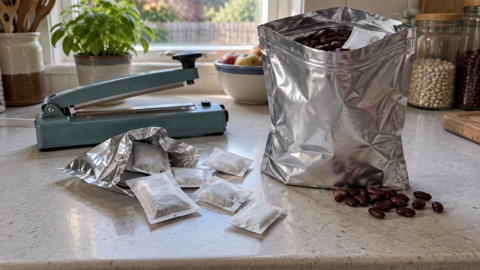
- Make sure the food is thoroughly dry. Mylar bags are for dry foodstuffs, not fresh or moist food1.
- Add an oxygen absorber sized to the bag and the amount of food, following the seller's bundle guidance where one is supplied16.
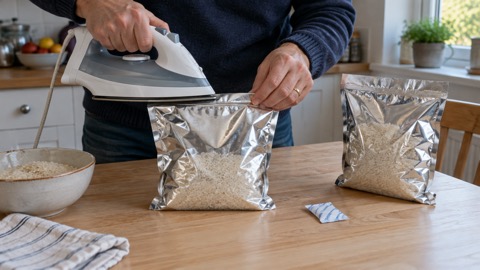
- Press out excess air, then seal. Heat seal for long storage, or close the zip for a bag you will reopen2.
- Label the bag with the contents and the date, and store it cool, dark and dry1.
The protection the bag gives is against oxygen, heat, pests, light and moisture1. That list explains why the storage place matters as much as the bag: a sealed bag in a hot shed still sits in heat, and a bag on a damp floor still sits in moisture. Keep the store cool and dry, and off the floor if your area floods. The guide to keeping a long-term store cool, dry and free of pests covers the conditions in detail.
Ziplock or heat-sealed: choosing a closure
Most bags in the range are both zip-lock and heat sealable, so the choice is not either-or2. The zip is a reusable closure for a bag you open often; the heat seal is a permanent closure for a bag you are putting away. For long storage, heat seal the bag above the zip, so you can still open it with the zip once the top is cut off.
| Closure | Best for | What to watch |
|---|---|---|
| Zip-lock only | Bags you open regularly, such as a working bag of rice or pasta2 | Keep the resealing strip clear of food and debris for a good seal3 |
| Heat seal | Long storage, where the bag will not be opened for months2 | Check the seam is continuous; seal again above it if in doubt |
| Both | Long storage with a reusable top once opened2 | Heat seal above the zip, not through it |
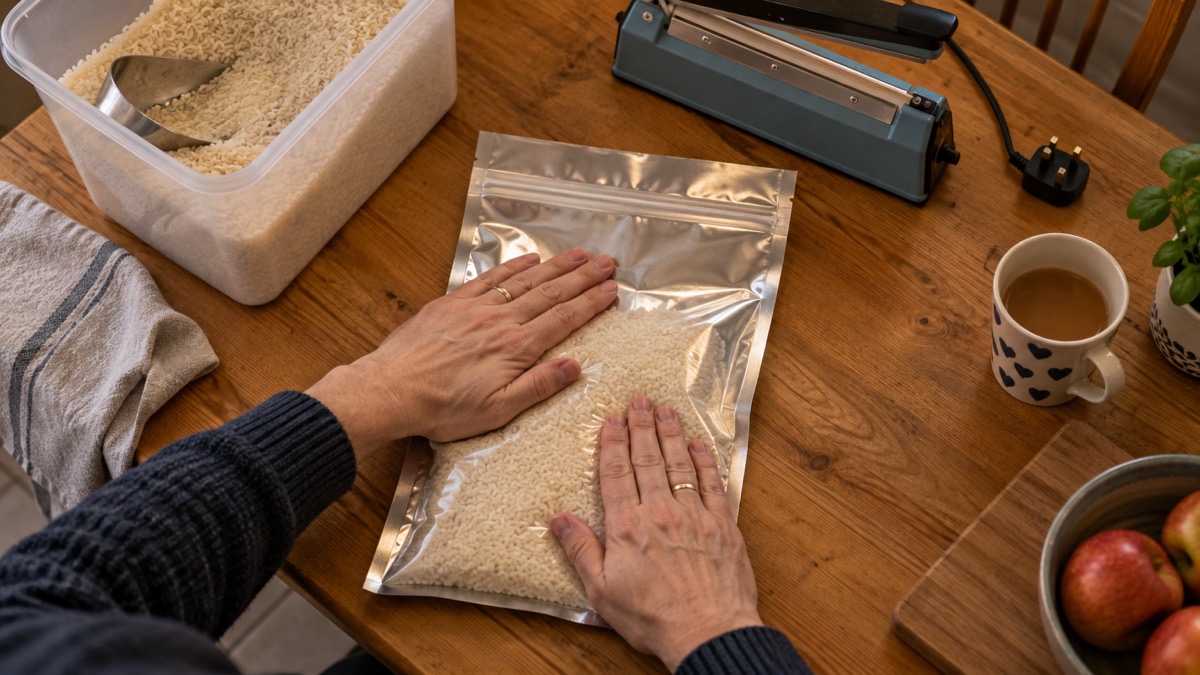
The seller's instruction for its stand-up bag is specific: if you only use part of the contents, ensure the resealing strip is clear of any food or debris to ensure a good seal when reusing it3. That applies to any zip bag. A crumb trapped in the strip lets air in, and air is what the bag is meant to keep out.
If you do not have a heat sealer, you can still use the zip, and there are other ways to close a bag. The guide to how to seal Mylar bags without a heat sealer sets out the options. Whichever closure you use, check it before the bag goes into store.
Heavy duty bags and stand-up pouches: what each is for
"Heavy duty" is the seller's description of a thicker bag in its range, not a regulated standard. The heavy duty bags are listed as food grade and safe for food storage, and the seller describes its largest heavy duty bag as the largest, thickest and most durable Mylar bag available worldwide17. Treat that as the seller's claim for its own product. The practical point is that a thicker film resists punctures from sharp pasta edges, seeds and dehydrated pieces better than a thin one, which is why heavy duty bags are recommended for heavy, bulky or irregular shaped foods4.
Stand-up pouches are a different shape rather than a different material. They are food grade and safe for food storage, and they stand upright on a shelf, which suits powders, supplements, herbs, spices and liquids12. They have a zip-lock and heat-sealable closure3. They are less suited to filling with bulky rice or pasta because the base is narrow, so use them for the small, awkward items and flat bags for the bulk.
| Bag type | Shape | Suits | Who it suits |
|---|---|---|---|
| Flat ziplock bag | Flat, non-gusseted2 | Small amounts of dry staples2 | A household starting a store with a few kilos |
| Heavy duty flat bag | Flat, thicker film4 | Medium amounts of heavy, bulky or irregular foods4 | A household storing rice, pasta, beans and pulses in bulk |
| Stand-up pouch | Stands upright12 | Powders, herbs, spices, liquids12 | A household storing small, awkward items on a shelf |
| Large bag | Very large flat bag1 | Large amounts of dry foods1 | A household or group storing in bulk |
If you are weighing bags against another container, the comparison of Mylar bags or glass jars for dry food sets the two side by side. A glass jar with an airtight lid, such as a push-top jar with a silicone gasket, is a reusable option for a working supply, while a Mylar bag is a single-use barrier for long storage18.
Which foods suit Mylar bags, and which do not
Mylar bags suit dry food. The seller's lists of uses are consistent across sizes: rice, pasta, noodles, flour, cereals, oats, grains, beans, pulses, seeds, dehydrated meat and vegetables, herbs, spices, salt, sugar, flavourings, tea, coffee and powdered milk1. The small pouch adds baby milk formula to its list9.
What they do not suit is anything moist, fresh or cooked. The bags are described as protecting against moisture, not as preserving wet food, and the seller's uses are all dry foodstuffs1. Always check the food's own label for how it should be stored, as Food Standards Scotland advises5. If you are storing baby formula, follow the maker's instructions on the tin for making it up and keeping it.
For the wider question of what belongs in a store cupboard, the guide to what to keep in an emergency store cupboard and the guide to rice, pasta, oats and pulses for long-term storage cover the staples in detail. If you are storing for a specific diet, the guide to emergency food for medical, religious and allergy diets explains what to check.
Checking a seal before the bag goes into store
A seal you have not checked is a guess. Check every bag before it goes on the shelf, and check again when you open it.
- Look at the seam. A heat seal should be continuous and flat, with no gaps or wrinkles.
- Press the zip. Run a finger along the resealing strip to clear any food or debris, as the seller instructs3.
- Squeeze the bag gently. A sound seal holds the air you press out; a failing one lets it back in.
- Seal again if in doubt. A second seam above the first costs little and removes the doubt.
- Label and date. Write the contents and the packing date on the bag so you use the oldest first.
If a bag fails, move the contents to a fresh bag rather than taping or clipping it. The guide to how long food lasts in Mylar bags with oxygen absorbers explains what affects keeping time, and the guide to rotating your store: first in, first out explains how to use the oldest bags first.
Sources (18)
- Large Mylar Bag 48cm x 74cm, Mylar Shop, 2026-10-12
- Mylar Ziplock Bag 24cm x 34cm, Mylar Shop, 2026-09-14
- Mylar Standup Ziplock Bag 12cm x 20cm, Mylar Shop, 2026-09-14
- Heavy Duty Mylar Bag 25cm x 35cm, Mylar Shop, 2026-10-18
- Food storage, Food Standards Scotland, 2026-10-25
- Collapsible Canister 10 l food grade, Katadyn, 2026-10-28
- Water-Bag, ORTLIEB, 2026-10-28
- Slide Seal System, OverBoard, 2026-10-28
- Mylar Pouch 7.5cm x 10cm, Mylar Shop, 2026-10-23
- Mylar Ziplock Bag 10cm x 15cm, Mylar Shop, 2026-10-23
- Mylar Ziplock Bag 20cm x 25cm, Mylar Shop, 2026-10-01
- Mylar Standup Ziplock Bag 25cm x 35cm, Mylar Shop, 2026-09-14
- Mylar Ziplock Heavy Duty Bag 25cm x 40cm, Mylar Shop, 2026-10-24
- Heavy Duty Mylar Bag 35cm x 50cm, Mylar Shop, 2026-09-14
- Mylar Shop, Mylar Shop, 2025-08-11
- 35cm x 50cm HD Mylar Bag Oxygen Absorber Bundle, Mylar Shop, 2025-10-07
- Large Heavy Duty Mylar Bag 48cm x 74cm, Mylar Shop, 2026-10-12
- Kilner Universal Push Top Storage Jar 2 Litre, Kilner, 2026-10-28
 Long-Term Storage Kit Checklist
 Store Cupboard Checklist
 30-Day Household Checklist
 Baby Formula in a Power Cut
 Refreezing Defrosted Meat
 Leftovers in the Fridge
 Reducing Botulism Risk
 Sterilising Jars
 Spotting Spoiled Preserved Food
 Boiling Water in Glass Jars
 Mylar Bag Food Shelf Life
 Mylar Bag Sizes
 Oxygen Absorber Activation
 Silica Gel With Stored Food
 Freeze-Dried Meal Shelf Life