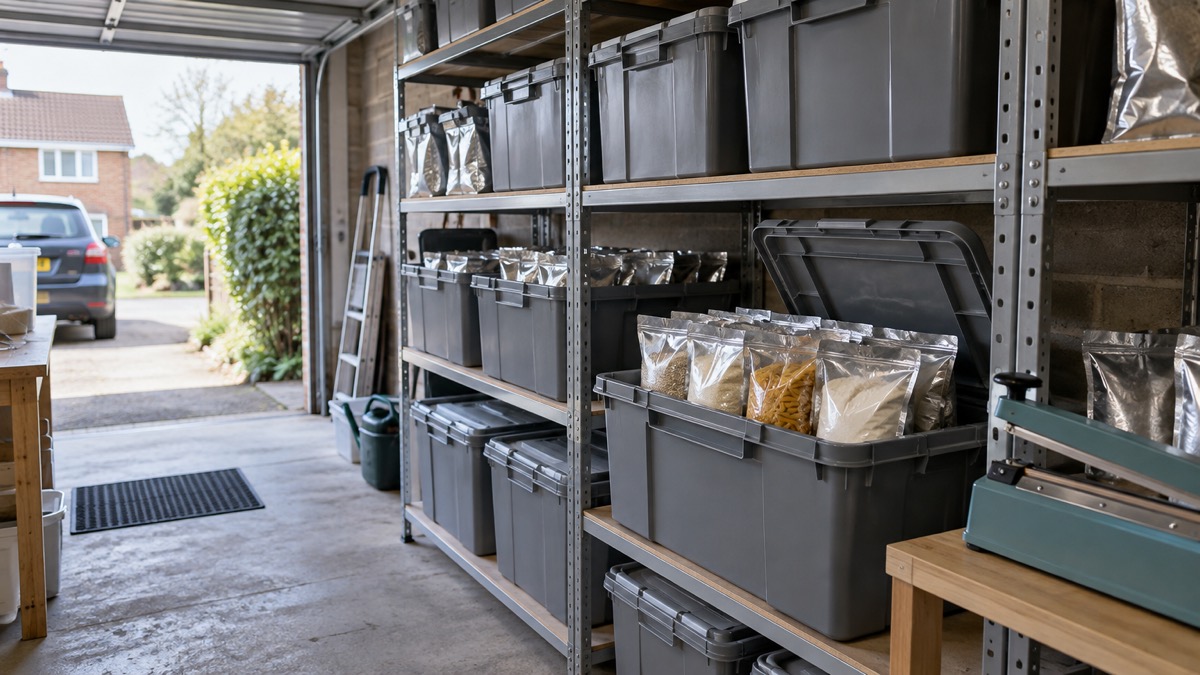
If you are deciding how to keep rice, pasta, flour, oats and pulses for the long term, the choice comes down to two containers. Mylar bags are foil-like pouches that the distributor says protect against oxygen, heat, pests, light and moisture, and that can be sealed with oxygen absorbers inside a rigid tub1. Glass jars, such as the Kilner range made in England, are rigid, reusable and open and close in seconds, with airtight lids on the push-top and twist-top models3.
The practical answer for most households is to use both, for different jobs. Bags take the bulk you want to leave undisturbed: the largest bag measures 48cm x 74cm externally and holds about 22 litres1. Jars take the foods you open often, from a 110ml jar for spices up to a 4 litre jar for flour and ingredients5. Both approaches share the same rule from Food Standards Scotland: keep dry cupboard foods in sealed bags or containers, which keeps food fresh and stops anything falling into it6.
What decides it is how much you are storing, how long you want it to last, and how often you will open it. Foods sealed in Mylar bags with oxygen absorbers can last for decades, according to the distributor2. Glass gives you visibility and easy access but no oxygen-free environment unless you add absorbers and a good seal. The sections below set out what each does, what goes in each, and how to seal and store them safely.
How each one stores dry food
A Mylar bag works by keeping the contents away from air, light and moisture, and by letting you remove the oxygen inside it. The distributor states that its bags protect against oxygen, heat, pests, light and moisture8. That protection is what allows the long storage life: foods sealed in Mylar bags with oxygen absorbers can last for decades, and the distributor adds that inorganic products like paper and plastic last even longer2. The bag itself is flexible, so it moulds around awkward shapes and takes up little space when empty.
A glass jar works differently. It is rigid, so it holds its shape and stacks, and it is see-through, so you can see what is inside without opening it. The Kilner Universal jars have a push-top glass lid with a silicone gasket that the maker says provides a secure and airtight seal, keeping dry food fresh3. The maker also states that glass is made from natural ingredients, so no harmful chemicals or toxins can leak into the food4. Twist-top and clip-top jars close with a metal or glass lid and a rubber or silicone seal9.
The trade-offs are straightforward. Glass is heavy and can break, and a broken jar means lost food and possible injury from shards. The fire service advises that food in glass jars should be discarded if the jar is cracked and has been subjected to heat11. Mylar is light and does not shatter, but it can be punctured by sharp pasta edges or a careless knife, and once opened for use it needs resealing. Neither material sterilises the food inside: both simply slow down what spoils it.
What goes in a Mylar bag
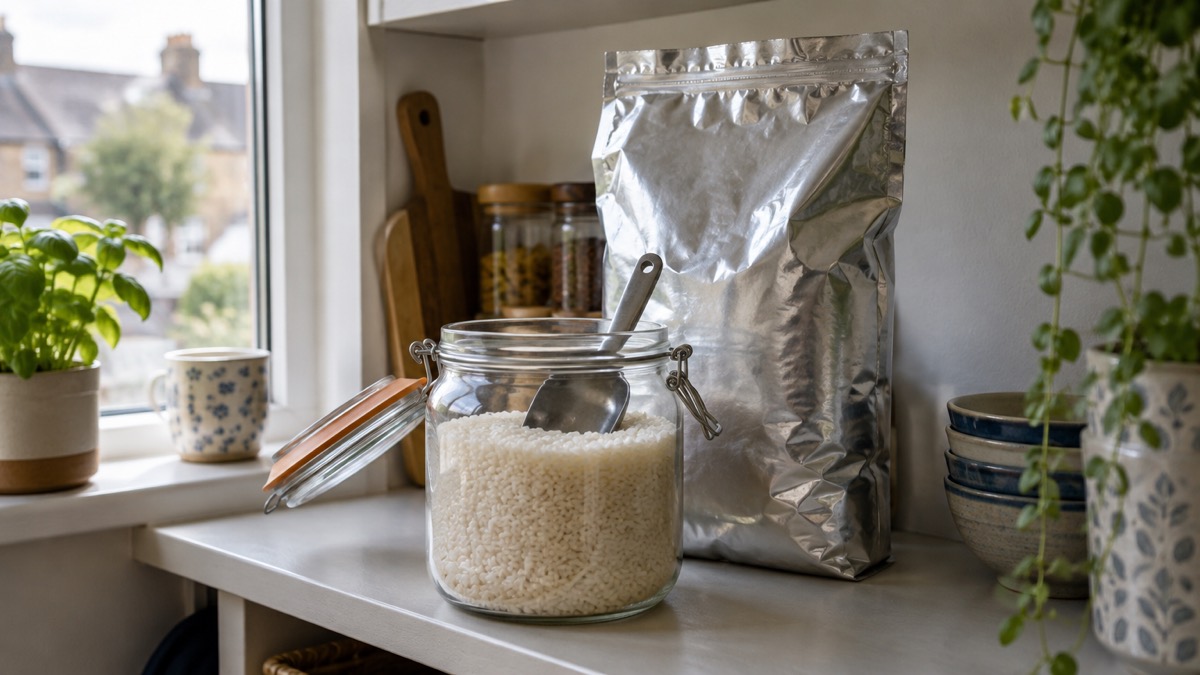
Mylar bags suit dry staples. The distributor lists the potential uses of its large bag as storage of large amounts of dry foods, including cereals and grains, pasta, rice, flour, noodles, beans and legumes, and says it suits any dry foodstuff1. The ziplock bag is intended for small amounts of dry foodstuffs, including rice and pasta, cereals, oats and grains, nuts and pulses, and dehydrated meat and vegetables8. The heavy duty bag is aimed at medium amounts, particularly heavy, bulky or irregular shaped foods, including rice, pasta, noodles, beans, pulses, seeds and dehydrated meat and vegetables2.
That list matches what official and independent guidance says to keep. The NHS in Norfolk and Suffolk advises keeping a supply of long-lasting cupboard essentials such as tinned vegetables, beans, pulses, soup and pasta12. Which? suggests complex carbohydrates including dried rice, oats, pasta, crackers and wholegrain cereals13. Carers UK lists long-life pasta, rice, lentils, chickpeas, butter beans, oats, whole-grain crackers, oatcakes and crispbreads among the items worth stocking14. Public Health guidance for food parcels adds that when buying starchy foods such as cereals, bread, pasta and rice, you should try to include wholegrain and wholemeal versions15.
A few foods need care. Nuts and pulses are on the distributor's list for the ziplock and heavy duty bags8, but nuts are oily and turn rancid over time, so keep them cool and check them before use. Dehydrated meat and vegetables are also listed8, but they must be properly dried before storage. Very small quantities, such as herbs, spices, salt, sugar, tea, coffee and powdered milk, suit the small pouch7. Do not put moist, fresh or cooked food into a Mylar bag for long storage: the bag traps moisture as effectively as it keeps it out.
Bag sizes, from a small pouch to a 48cm x 74cm bag
Mylar bags come in a range of sizes, and the right one depends on what you are storing and how much. The table below sets out the sizes the distributor lists, with what each is intended for.
| Bag | Intended use |
|---|---|
| Mylar pouch | Herbs, spices, salt, sugar, flavourings, tea and coffee, powdered milk, seeds7 |
| Ziplock bag | Small amounts of rice, pasta, cereals, oats, grains, nuts, pulses, dehydrated meat and vegetables8 |
| Heavy duty bag | Medium amounts, especially heavy, bulky or irregular foods2 |
| Large bag | Large amounts of cereals, grains, pasta, rice, flour, noodles, beans and legumes1 |
The large bag is the one most households underestimate. Its external dimensions are 48cm x 74cm, its internal dimensions are 45.5cm x 72cm, and its volume is about 22 litres, or 5 gallons1. One buyer reported that the bags are massive and that 10kg of rice left plenty of space for probably more1. That is a useful guide: a single large bag will take a substantial quantity of rice or flour, so plan where it will live before you fill it.
Pack sizes vary too. The large bag comes in packs of 10, 50, 100 and 3501. The ziplock bag comes in packs of 1, 10, 50, 100, 500 and 1,2008. Buying a small pack first lets you test your sealing method before committing to a large one. For a closer look at matching bag size to contents, see What Size Mylar Bag You Need for Rice, Pasta and Beans.
Heavy duty and stand-up bags for bulky or awkward foods
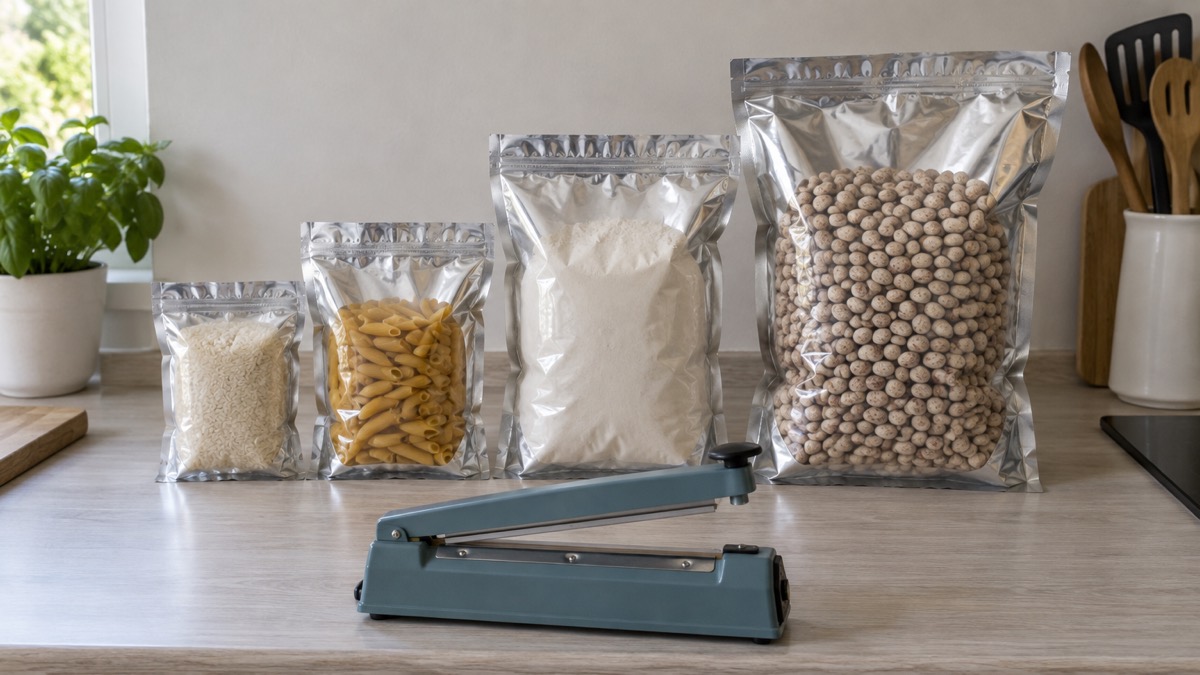
Not every dry food sits neatly in a flat bag. Pasta shapes, large beans, sealed packs of noodles and irregular dehydrated pieces all leave gaps and sharp corners, and a thin bag can rub or puncture against them. The distributor's heavy duty bag is aimed at exactly this: medium amounts of dry foodstuffs, particularly heavy, bulky or irregular shaped foods, including rice, pasta, noodles, beans, pulses, seeds and dehydrated meat and vegetables2. The heavier film resists punctures better than a standard bag.
The ziplock bag is described as a flat bag, non-gusseted, and as both zip-lock and heat sealable8. A flat bag is fine for flat contents but bulges when overfilled, which strains the seal. The heavy duty bag is listed for rice and pasta, cereals, oats and grains, nuts and pulses, and dehydrated meat and vegetables, as well as for electronics, tools and vehicle components2. That last use is a reminder that the same material protects anything from moisture, not just food.
For bulky items, fill the bag loosely, press out the air, and leave a flat margin at the top for the seal. Do not force sharp pasta into a bag so that it presses against the film. If you are storing a mix of shapes, put the awkward items in a smaller bag first and then into a larger one. The distributor recommends its 2000cc oxygen absorbers and 100g silica gel desiccants for use with the large bag1, and its 300cc absorbers for medium bags8. For the full method, see Mylar Bags and Oxygen Absorbers for Dry Stores.
Sealing Mylar bags with oxygen absorbers inside a bucket
Sealing is where a Mylar store succeeds or fails. The distributor says its bags can be easily sealed with a normal clothes iron, ceramic hair-straighteners, or a vacuum sealer or impulse sealer machine2. The principle is the same with each: fold the top of the bag flat, apply heat along a straight line, and hold until the two layers fuse. A vacuum sealer or impulse sealer gives the most consistent result; an iron or hair straighteners work if you keep the line straight and do not scorch the film.
Oxygen absorbers go in before sealing. The distributor lists 300cc absorbers as the perfect size for medium Mylar bags8, 2000cc absorbers for the large bag1, and 20cc absorbers for the small pouch7. Put the absorber in with the dry food, press or expel as much air as you can, and seal immediately. The absorber then removes the remaining oxygen, which is what gives the long storage life the distributor describes2.
A bucket or tub is the outer layer. It keeps the bag from being punctured, holds it upright while you fill it, and keeps pests away. The large bag's 22 litre volume1 means it needs a container at least that big; smaller bags suit smaller tubs. Fold the top of the bag over the rim of the tub while filling, so the seal area stays clean, then seal and lower the bag in. For households that want to seal without buying a machine, see How to Seal Mylar Bags Without a Heat Sealer.
Kilner jars: a glass jar made in England for over 180 years
Kilner is a familiar name in British kitchens. The maker states that the original Kilner Jar was invented by John Kilner and Co. in England and is as much loved and successful now as it was over 180 years ago16. The range today covers small twist-top jars, clip-top preserving jars and large push-top storage jars, and several models are made in England using 30% recycled glass from kerbside collection services17.
The sizes matter more than the name. The table below sets out the main Kilner jars and what each is for.
| Jar | Capacity | Best for |
|---|---|---|
| Hexagonal twist top | 110ml | Herbs, spices and strong flavoured dips5 |
| Round twist top | 228ml | Small dry stores, reusable time and time again17 |
| Round twist top | 370ml | Jams, jellies, marmalades, chutneys, dried herbs and spices9 |
| Preserve jar | 1 litre | Pickling vegetables, preserving whole fruits and chunky chutneys18 |
| Clip top square (set of 3) | 1 litre | Pickling vegetables, chunky chutneys, coffee beans and breadcrumbs16 |
| Universal push top | 2 litre | Kitchen storage of dry ingredients4 |
| Clip top square | 2 litre | Pickling large vegetables and preserving whole fruits10 |
| Universal push top | 4 litre | Countertop biscuits, sweets and dried food ingredients3 |
The push-top jars have a glass lid with a silicone gasket that the maker says gives a secure and airtight seal, keeping dry food fresh3. The clip-top jars are described as robust and durable for everyday use10. The twist-top jars are made in England and reusable time and time again17. For a closer look at one model, see Kilner Clip Top Jar.
Glass has one clear advantage over a bag: you can see the contents and open the jar in seconds. That makes jars the better choice for the foods you use regularly, such as rice, pasta, flour, coffee and breadcrumbs16. It also has a clear disadvantage: weight and breakage. Store jars on a low, stable shelf, not high above a hard floor, and keep them out of the way of anything that might knock them.
Choosing by how much you store and how long
The decision comes down to three questions: how much you are storing, how long you want it to last, and how often you will open it. The table below sets out the choice by circumstance.
| Your situation | Sensible choice |
|---|---|
| A few kilos of rice, pasta and flour used within months | Glass jars, opened and refilled often3 |
| Bulk staples you want to leave for years | Mylar bags with oxygen absorbers, inside a tub1 |
| Small amounts of herbs, spices, tea and coffee | Small jars or the small pouch5 |
| Awkward shapes such as large pasta or beans | Heavy duty Mylar bag2 |
| A mix of everyday and long-term stores | Jars for daily use, bags for the reserve6 |
For a household building a store from scratch, the practical pattern is to keep the next few weeks of dry food in jars where you can see and reach it, and to put the reserve in sealed bags. Food Standards Scotland's advice to keep dry foods in sealed bags or containers applies to both6. The distributor's claim that foods sealed in Mylar with oxygen absorbers can last for decades2 is the reason to use bags for the reserve; the maker's airtight seals on the jars3 are the reason to use glass for the everyday.
How much to store is a separate question, covered in How Much Emergency Food to Store per Person. For the wider picture on dry staples, see Rice, Pasta, Oats and Pulses for Long-Term Storage, and for keeping the store in good condition, see Keeping a Long-Term Store Cool, Dry and Free of Pests.
Where the store should live, and what to check
Both containers need the same conditions: cool, dark and dry. A cupboard away from the oven, radiator and direct sunlight suits jars and bags alike. Keep bags inside their tub so pests cannot reach them and so the bag is not punctured by anything shifting on the shelf. Label every container with what it holds and the date it was packed, so you can rotate the oldest first.
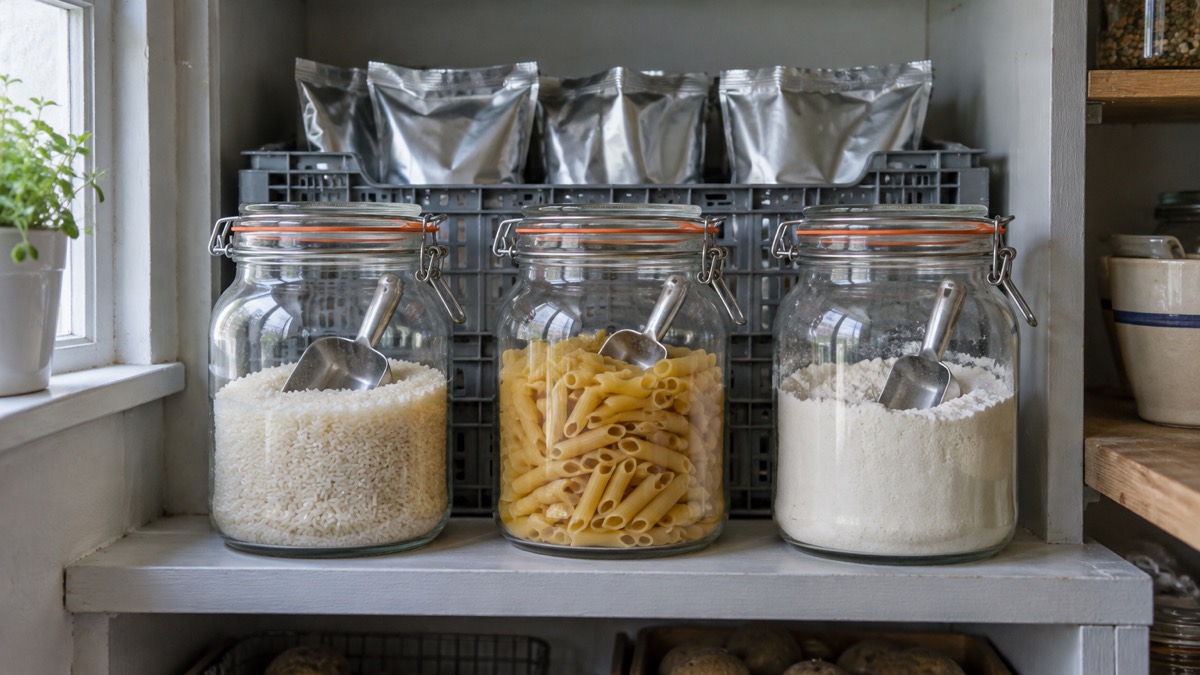
Check the store regularly. Look for condensation inside a bag or jar, which means moisture has got in. Look for pests, damaged seals and cracked glass. The fire service's advice that food in glass jars should be discarded if the jar is cracked and has been subjected to heat11 is a reminder that damaged containers are not worth the risk. For bags, a puncture or a failed seal means the protection is gone; rebag the contents or use them first.
If your area floods, keep the store above the likely water line. Food in water-resistant packaging such as sealed pouches can be kept if it is not damaged, but the outside needs cleaning and sanitising first19. For more on this, see Where to Keep an Emergency Store If Your Area Floods. For the wider household kit, see Emergency Kit: What a UK Household Should Keep Ready.
Sources (19)
- Large Mylar Bag 48cm x 74cm, Mylar Shop, 2026-10-12
- Mylar Shop, Mylar Shop, 2025-08-11
- Kilner Universal Push Top Storage Jar 4 Litre, Kilner, 2026-10-28
- Kilner Universal Push Top Storage Jar 2 Litre, Kilner, 2026-10-28
- Kilner Hexagonal Twist Top Jar 110ml, Kilner, 2026-10-28
- Food storage, Food Standards Scotland, 2026-10-25
- Mylar Pouch 7.5cm x 10cm, Mylar Shop, 2026-10-23
- Mylar Ziplock Bag 20cm x 25cm, Mylar Shop, 2026-10-01
- Kilner Round Twist Top Jar 370ml, Kilner, 2026-10-28
- Kilner Clip Top Square Jar 2 Litre, Kilner, 2026-10-28
- After a fire: the clean up, Cheshire Fire and Rescue Service, 2023-06-22
- Stay warm and nourished, NHS Norfolk and Suffolk ICB, 2026-10-16
- Emergency kit packing list, Which?, 2026-09-30
- Being prepared for the unexpected, Carers UK, 2026-10-25
- Guidance for those preparing and delivering food parcels, Armagh City, Banbridge and Craigavon Borough Council, 2020-04
- Kilner Set of 3 Clip Top Square Jar 1 Litre, Kilner, 2026-10-29
- Kilner Round Twist Top Jar 228ml, Kilner, 2026-10-28
- Kilner Preserve Jar 1 Litre, Kilner, 2026-10-29
- Food safety after a flood, GOV.UK, 2018-01-09
 Freeze-Dried vs Dehydrated Food
 Tinned vs Freeze-Dried Food