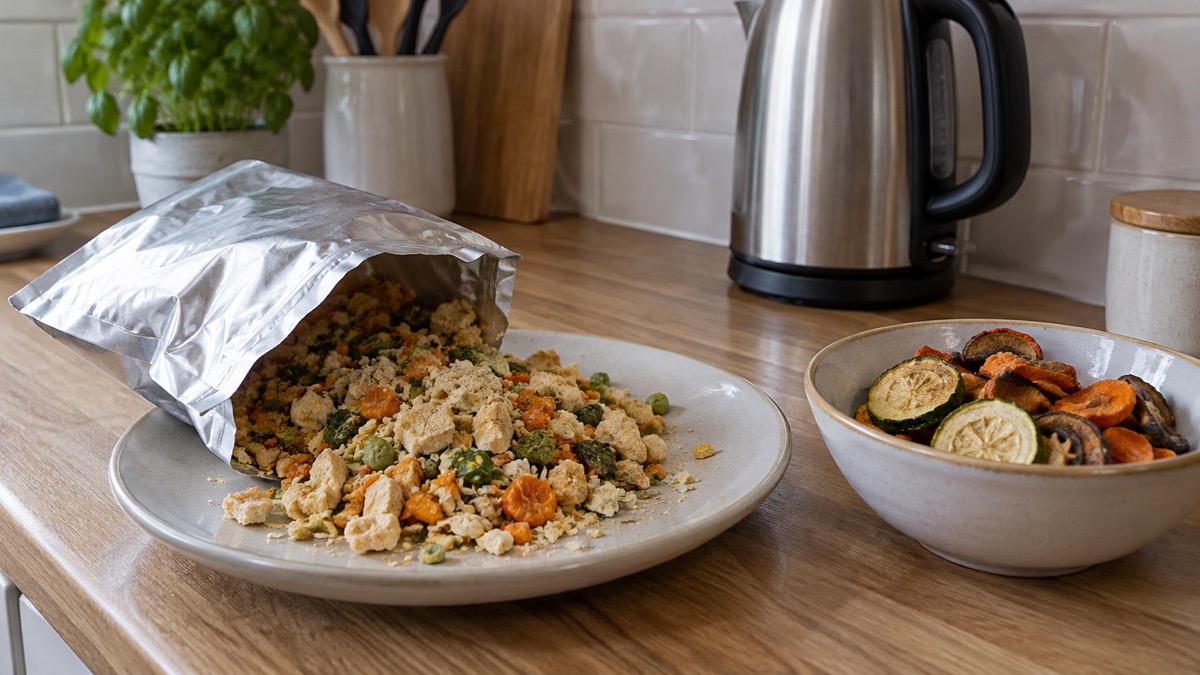
Freeze-dried and dehydrated food are both made by taking the water out of food so it keeps without a fridge, but they get there in different ways and that changes what you store. Freeze-dried food is light and rehydrates quickly, which suits a grab bag or a store you may have to carry. Dehydrated food is heavier and often needs more water and time to soften, but it is familiar, widely sold and easy to use at home.
For an ordinary UK household, the practical answer is to keep both kinds alongside tinned food. Official guidance suggests at least three days' supply of food and bottled water, including tinned and dry foods that store safely without electricity1. The Be Ready checklist puts it at non-perishable food for 3 days2, and Scotland's emergency kit guidance says the same3. Dried and freeze-dried foods fit that brief because they need no refrigeration and no cooking to store.
What decides which you buy is how you will use it. If the plan is to stay at home through a power cut, dehydrated staples and tinned food do the job. If you may have to leave in a hurry or carry food in a bag, the lighter freeze-dried option earns its place. The sections below set out how each is made, what it weighs, what it takes to prepare, how to store it and how to choose.
How freeze-dried and dehydrated food are made
Both methods work on the same principle: remove the water that bacteria and moulds need to grow, so the food stays safe and keeps far longer than fresh food. Official guidance is clear that chilling, freezing and defrosting food properly helps stop harmful bacteria from growing7, and drying does the same job by a different route. The difference is in how the water leaves.
Freeze-dried food is frozen first, then the water is drawn off as vapour while the food stays frozen. The structure of the food is largely left intact, which is why it rehydrates quickly and keeps its shape. Dehydrated food is dried with gentle heat and moving air, which drives the water out more slowly. It is the older, simpler method and the one most of us meet in dried fruit, dried herbs and dried staples.
Neither method is a licence to relax about safety. Official guidance warns that preserved foods which have not been prepared correctly may not look, smell or taste unusual, and says plainly: do not rely on appearance, smell or taste to decide whether food is safe to eat8. That applies to bought preserved food as much as to anything you make at home. Buy from reputable sellers, follow the label, and treat any pack that is damaged or past its date with suspicion.
For a household store, the method matters less than the result: a dry, shelf-stable food that needs no fridge. What follows from the method is weight, preparation and how the food behaves in the bag and in the bowl.
Freeze-dried food weighs a lot less than dehydrated food
The single biggest practical difference for an emergency store is weight. Because freeze-dried food keeps its structure and has almost all its water removed, a meal weighs very little and takes up little space. Dehydrated food has also had its water removed, but it is denser and heavier for the same amount of food, and it often needs more water to come back.
That matters most when you have to carry it. Official guidance for a grab bag lists bottled water, medicines, a torch, radio and batteries, copies of important documents and a change of clothes9, and flood guidance adds medication, a first aid kit, warm waterproof clothing and baby care items10. Food is part of that bag, and every gram counts when you are carrying water as well. Freeze-dried meals suit a bag you may have to carry; dehydrated staples suit a cupboard you expect to stay put.
| What you are comparing | Freeze-dried food | Dehydrated food |
|---|---|---|
| Weight for the same meal | Weighs a lot less, as much as 90% of the weight removed1 | Heavier and denser |
| Space in a bag | Compact | Takes more room |
| Water to prepare | Usually quick to rehydrate | Often needs more water and time |
| Best use | Grab bag, travelling, quick meals | Home store, everyday cooking |
| Shelf life | Approximately 25 to 30 years1 | About 15 to 20 years1 |
Neither is wrong. The point is to match the food to the job. A store that never leaves the house can lean on dehydrated staples and tinned food; a bag that might leave with you should lean on the lightest option you will actually eat.
Preparing each type: water and time needed
Both kinds need water to become a meal, and that water has to come from your store. This is the part households most often underestimate. Official guidance suggests at least three days' supply of bottled water alongside food1, and emergency kit lists include water for drinking and sanitation5. If you plan to rehydrate meals, store more water than you would for drinking alone.
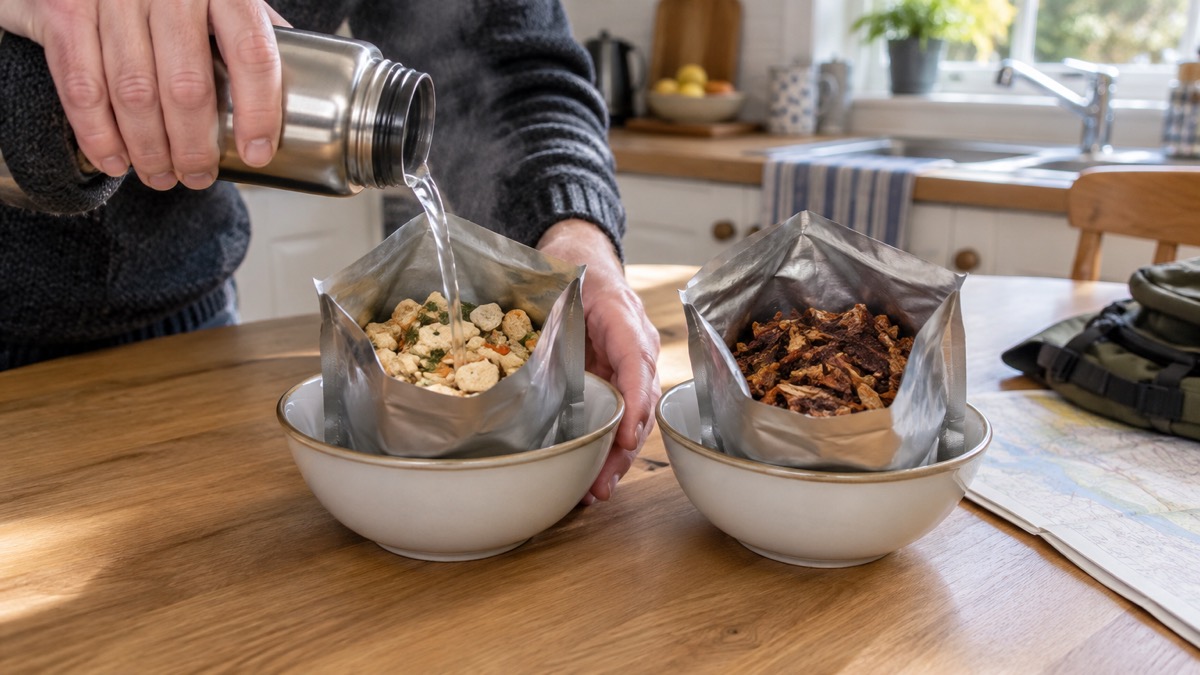
Freeze-dried meals usually rehydrate quickly with hot or cold water, following the maker's instructions on the pack. Dehydrated foods often need longer soaking and sometimes cooking to soften. The exact amount and time depend on the food, so the packet is the authority. What you can plan for is the supply: keep bottled water set aside for the kitchen as well as for drinking.
If you are boiling water to make a hot meal, remember that boiling water for drinking is a separate step. Official guidance for private water supplies says water needs only to be brought to the boil, and can then be stored in a covered container in the fridge for up to 48 hours11. That is a useful guide for treating water you are unsure of, though it applies to private supplies rather than to sealed bottled water.
Keep drinking water to hand whatever you eat. NHS guidance says to drink fluids regularly, that water or diluted sugar-free squash are good choices, and to drink enough during the day that your pee is a pale colour12. Hot weather advice adds that water and diluted squash or lower fat milks are good choices, and to limit fruit juice, smoothies and sugary soft drinks13. A dry meal without enough to drink is uncomfortable and, in heat, unwise.
Shelf life and storage in a UK home
Both freeze-dried and dehydrated food keep for a long time, but the date on the pack is what counts. Official guidance notes that best-before dates appear on a wide range of foods, which can include frozen, dried and tinned foods such as canned tomatoes, bread and cereal6. Check the date when you buy and rotate your store so older packs are used first.
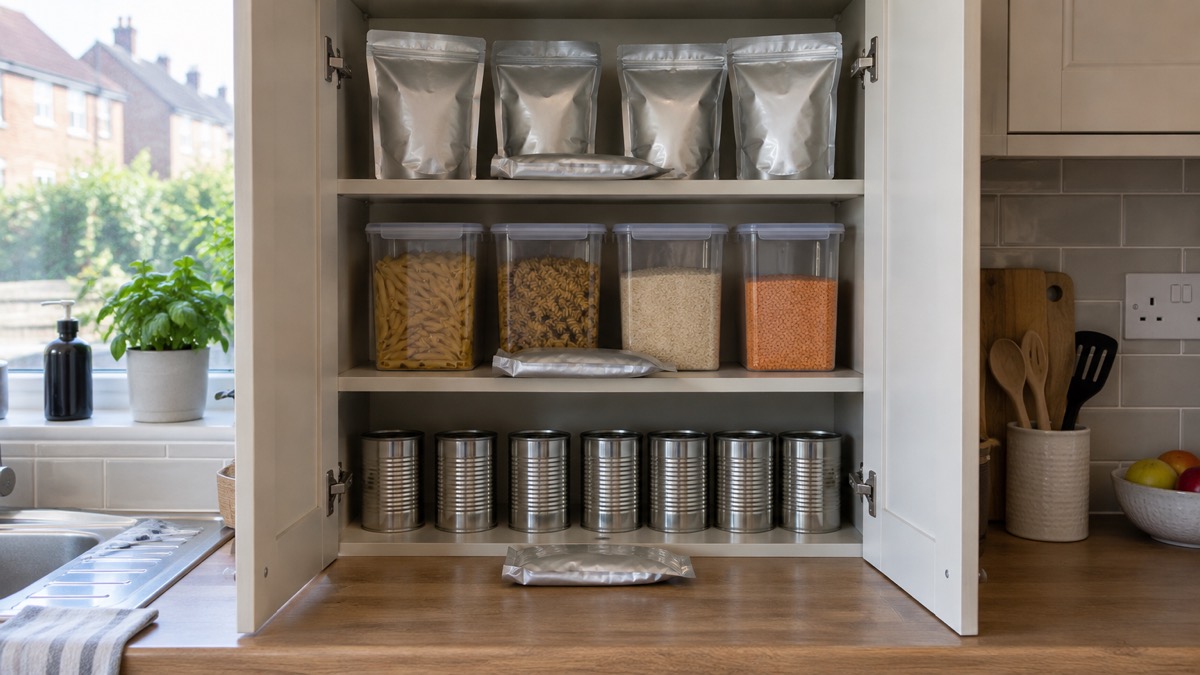
Storage is simple but not careless. Official guidance says to keep the storage area dry and not too warm, and that some foods may need the fridge once opened, so follow the label's storage instructions14. Damp is the enemy of dried food: it can let mould take hold and it spoils the texture. Keep packs sealed, off the floor and away from pests.
A power cut is the test most stores face. Your fridge should keep food at a safe temperature for up to four hours with the doors kept closed15, and food in a full freezer should stay frozen for up to 48 hours, or 24 hours if it is half full16. Dried and freeze-dried foods sit outside that clock entirely, which is their great advantage: they are unaffected by a power cut as long as they stay dry.
For a fuller picture of dates and rotation, see Shelf Life, Use By and Best Before Dates Explained and Rotating Your Store: First In, First Out. If your area floods, Where to Keep an Emergency Store If Your Area Floods covers siting it safely.
Taste, texture and nutrition compared
Taste is personal, but the texture difference is real. Freeze-dried food tends to come back close to its original texture because its structure survived the process. Dehydrated food can be chewier or softer, and some items need longer soaking to lose their toughness. Neither is a reason to avoid one; it is a reason to try a pack before you build a store around it.
On nutrition, the sensible approach is variety. Official guidance for staying warm and well says to include plenty of fruit and vegetables, whether fresh, frozen, tinned or dried19. That is the standard to aim for in an emergency store: a mix of sources, not a single type. Dried fruit and nuts are listed among long shelf life foods that need no refrigeration or cooking, and guidance suggests buying food you would usually eat2.
There is a quality caveat worth knowing. Official guidance notes that extreme cold can affect the quality of foods with a high water content, such as fresh fruit and salad vegetables20. That is about freezing rather than drying, but it makes the same point: how a food is preserved changes how it turns out. Dried and freeze-dried foods are no different, and the pack you enjoy fresh is the one to stock.
Do not judge safety by taste. As above, preserved foods that have not been prepared correctly may not look, smell or taste unusual, so do not rely on appearance, smell or taste to decide whether food is safe8. If a pack is damaged, past its date or has been stored damp, treat it as suspect whatever it smells like.
Which suits your household's emergency store
The honest answer is that most households should keep some of each, chosen by how they will use it. Official guidance points to food with a long shelf life that needs no refrigeration or cooking, such as tinned meat, fish or vegetables, dried fruit and nuts, and advises buying food you would usually eat2. It also says to avoid fresh or perishable food and keep longer lasting products such as tinned food for emergencies4.
Use this to decide:
- If you expect to stay at home: dehydrated staples, tinned food and dried fruit and nuts cover the three-day minimum and are easy to rotate into everyday meals2.
- If you may have to leave quickly: freeze-dried meals are the lighter choice for a grab bag you may carry21.
- If you have limited water storage: favour foods you can eat without rehydrating, such as tinned ready-to-eat food, and keep bottled water for drinking22.
- If you cook without power: choose ready-to-eat tinned food that needs no cooking, and include a tin opener22.
- If you have babies or pets: add ready-made baby formula and pet food to the store22.
Whichever you choose, build the store around the three-day minimum and rotate it. For the wider picture, see Emergency Food: A Household Guide to Stores, Safety and Meals Without Power, How Much Emergency Food to Store per Person and What to Keep in an Emergency Store Cupboard. If you are choosing between formats, Tinned or Freeze-Dried Meals sets them side by side, and Freeze-Dried Meals: What They Are and How to Choose goes deeper on that type. For drying at home, see Drying Food at Home With a Dehydrator or Oven.
Sources (22)
- Be prepared at home and in your community, Argyll and Bute Council, 2026
- Be Ready checklist, GOV.UK, 2026
- Emergency kit, Ready Scotland, 2026-10-22
- What is a national power outage, Wiltshire and Swindon Prepared, 2026-10-25
- Get help and advice in an emergency, Lincolnshire County Council, 2026-10-29
- Use-by and best-before dates, Food Standards Scotland, 2026-10-25
- How to chill, freeze and defrost food safely, GOV.UK, 2017-12-18
- Consumer advice for food preservation at home, GOV.UK, 2026-10-26
- 10 things you should do now to prepare for winter, Met Office, 2026-10-25
- Flooding, Prepare, 2026-10-12
- Private water supplies, Argyll and Bute Council, 2026
- Dehydration, NHS, 2026-05-01
- Beat the heat: staying safe in hot weather, GOV.UK, 2026-07-21
- Food storage, Food Standards Scotland, 2026-10-25
- Food safety in a power cut, Food Standards Scotland, 2026-10-25
- Food safety in a power cut: advice for consumers, GOV.UK, 2023-07-26
- Food safety in the kitchen: flooding, Food Standards Scotland, 2026-10-25
- Food safety after a flood: consumer advice, GOV.UK, 2018-01-09
- Stay warm and nourished, NHS Norfolk and Suffolk ICB, 2026-10-16
- Preparing and cooking food safely | NHS inform, NHS inform
- Benefits of Freeze-Dried Food - Expedition Foods, Expedition Foods
- Loss of essential services, Greater Manchester Combined Authority, 2026-10-29
 Mylar Bags vs Glass Jars
 Tinned vs Freeze-Dried Food