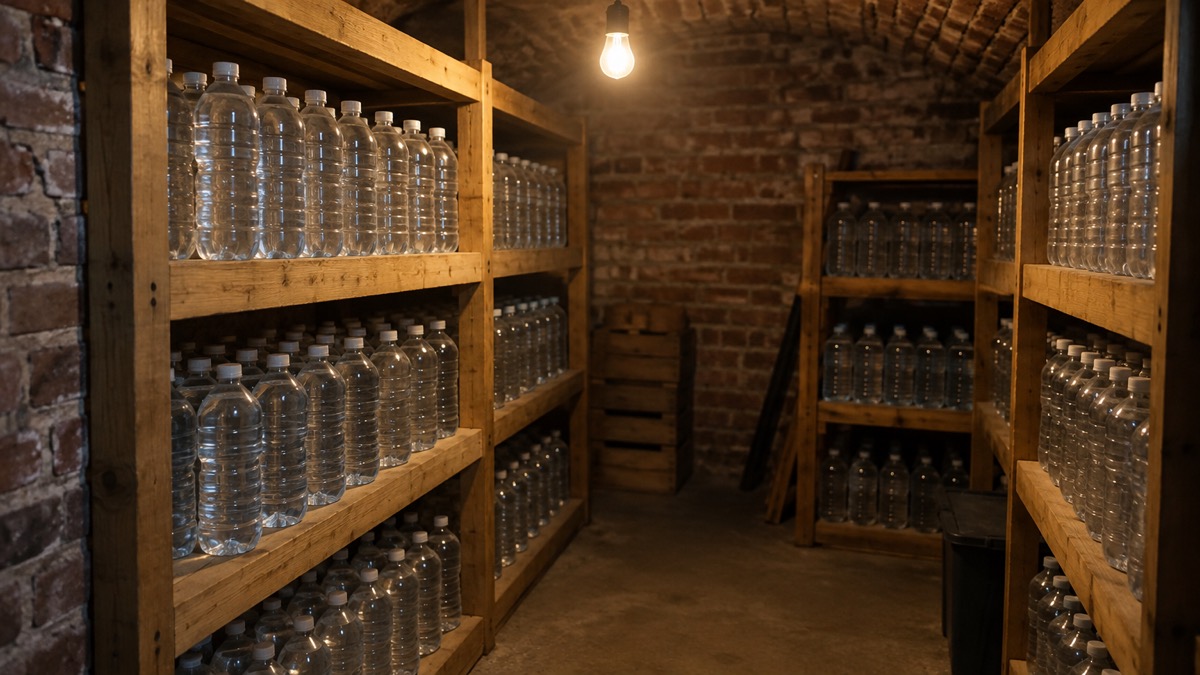
Bottled water is the simplest drinking reserve a household can keep, and the rules for looking after it are short. Keep it somewhere cool, shaded and out of direct sunlight, away from heat sources, and rotate it so nothing sits past its date. The amount most official guidance settles on is at least 3 days' worth at 3 litres per person per day, for drinking alone1.
That figure is a floor, not a target. Cooking, washing and any pets need more, and some official guidance puts the survival minimum at 2.5 to 3 litres per person per day, with 10 litres per person per day giving a more comfortable margin for basic cooking and hygiene3. A council flood pack gives a different measure again: one gallon, or eight pints, per person per day, split four pints for drinking and four for food preparation and sanitation4.
Where you put the bottles matters as much as how many you keep. Heat and light are what shorten a store's life, and the same principle official guidance applies to water in storage tanks, that it should be insulated, out of sunlight and away from heat so it stays as cold as practicable, applies to the bottles in your cupboard5. Get the position right and the rest is rotation.
Keep it cool, shaded and out of direct sunlight
The single most useful thing you can do for a bottled water store is choose its position carefully. Official guidance on domestic cold water storage is explicit that tanks should be insulated, not exposed to sunlight and not located near any source of heat, so that stored water is kept as cold as practicable5. Bottles are not tanks, but the reasoning is the same: warmth and light are what degrade both the water and the plastic around it.
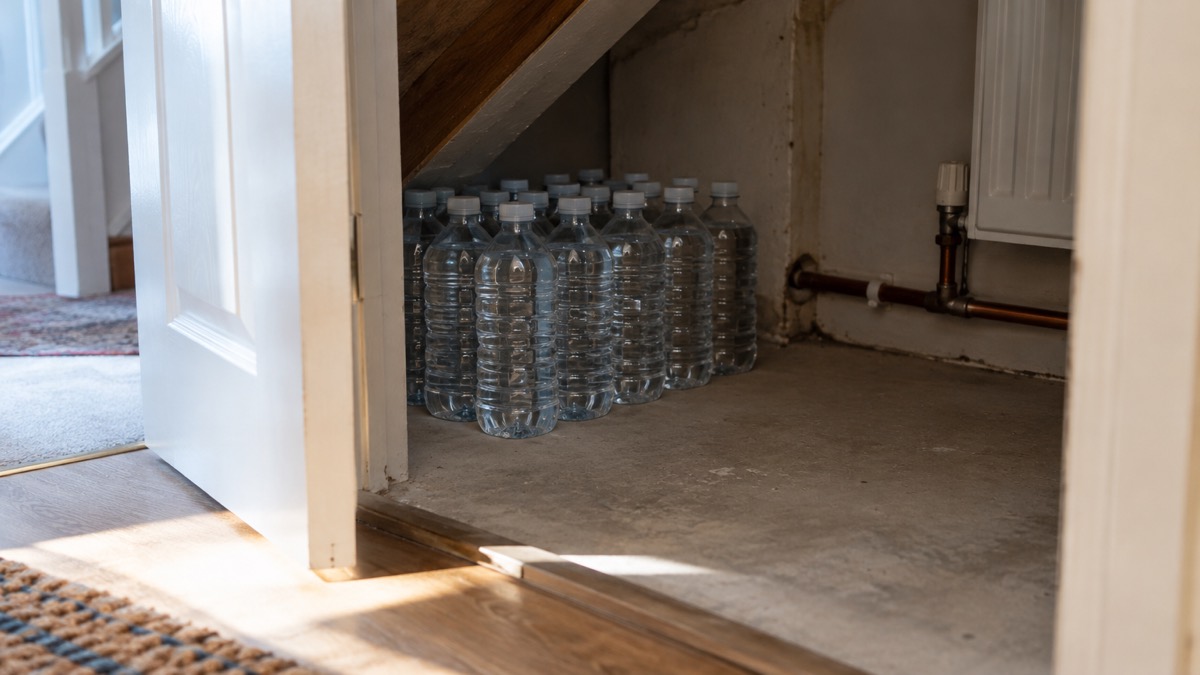
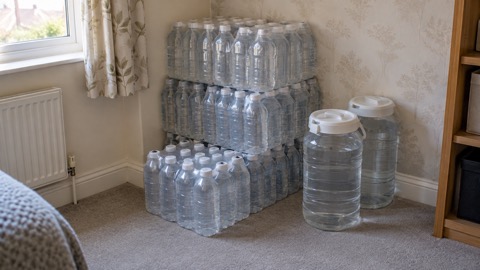
In practice that means a cupboard in a cool room, a lower shelf away from a radiator or boiler, or the back of a larder. A garage or shed is the obvious place for bulk and the wrong place for drinking water, because both swing between hot and cold through the year. If you have no alternative, keep bottles off the floor, out of any window light, and check them more often.
The same principle runs through official advice on storing other household liquids. The Health and Safety Executive's guidance on storing petrol says to keep it out of direct sunlight9, and fire service guidance on bio-ethanol says to store it in a cool, dry place away from direct sunlight and naked flames10. Water is far less hazardous, but the storage logic is identical.
A few practical points follow from this:
- Keep bottles in their original containers, so the label and any date stay with them.
- Stand them on a shelf or rack rather than a concrete floor, which can be cold and damp.
- Keep the store away from anything that could leak onto it, such as cleaning products or fuel.
- Check the store each time you do a normal shop, and pull the oldest bottles to the front.
How much to keep, and how to rotate it
Official guidance converges on a three day figure. National power cut advice says to keep at least 3 days' worth of bottled water at 3 litres per person per day1, and the same figure appears in the Be Ready checklist and in power cut guidance for households2. A household emergency plan template recommends a minimum of 2.5 to 3 litres of drinking water per person per day12, and Scottish guidance for a household emergency pack gives 2.5 litres per person per day13.
| Source | Figure | What it covers |
|---|---|---|
| National power cut advice | 3 days at 3 litres per person per day | Drinking water1 |
| Be Ready checklist | 3 days at 3 litres per person per day | Drinking only; more for cooking and washing2 |
| Greater Manchester guidance | 2.5 to 3 litres minimum; 10 litres for comfort | Survival, then basic cooking and hygiene3 |
| Council flood pack | One gallon (eight pints) per person per day | Four pints drinking, four pints food and sanitation4 |
| Scottish household pack | 2.5 litres per person per day | Drinking water13 |
The differences are about what is being counted, not a disagreement about safety. Three litres a day is a drinking figure; ten litres a day is a comfort figure that also covers basic cooking and washing3. Work out your own number from the people in the house, then add for anyone who needs more: additional water might be needed to make up baby formula, for medical devices and for pets3.
Rotation is what keeps a store usable. Official guidance for emergency kits says bottled water should be changed regularly as noted on best before dates7, and national power cut advice says to hold a small amount of bottled water and make sure it is not past its expiry date14. The easy habit is to buy a little more than you need each shop and drink the oldest bottles first, so the store turns over without anyone having to remember a date.
Once a bottle is opened, it belongs in the fridge
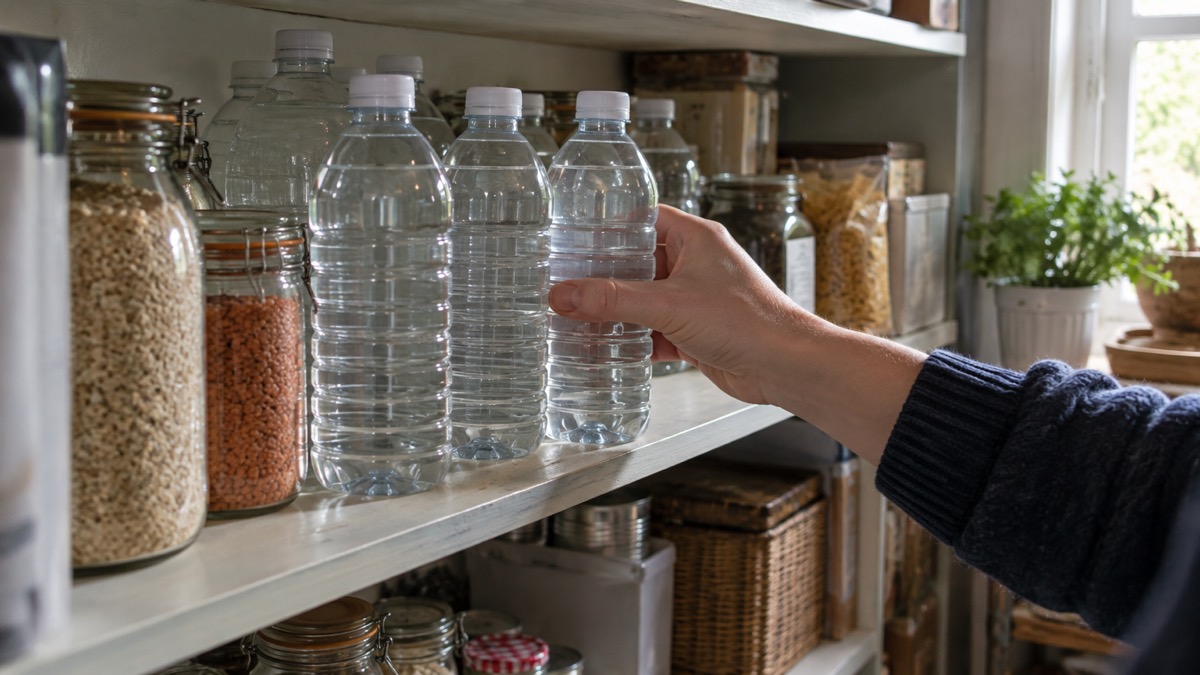
An opened bottle is a different proposition from a sealed one. Keep it in the fridge and use it soon, rather than leaving it on a worktop to warm through. The same principle official food guidance applies to opened food applies here: storage instructions on the label should be followed to keep it safe, and the example given is "store in a refrigerator"6.
If you decant water, or open a large container to fill smaller ones, treat the opened container as short life. Food safety guidance for opened tins is a useful model: put the contents into a clean bowl or container in the fridge once opened, and do not store them in the opened can15. The point is that the original container stops being a good keeper once the seal is broken.
There is a related question about hot water, which comes up in a power cut. Official guidance suggests boiling some water and keeping it in a thermos flask, so you can make hot drinks or fill a hot water bottle if it gets cold16, and independent guidance recommends a vacuum flask for storing hot water17. If you use a hot water bottle, the NHS advises replacing it every two years, never filling it with boiling water, and always using a protective cover to prevent burns18.
Where not to store bottled water
Most of the mistakes with bottled water are about position and container rather than the water itself. The main ones:
- In direct sunlight. Heat and light are what degrade a store, and official guidance on stored water is to keep it out of sunlight and away from heat sources5.
- Next to a heat source. A boiler cupboard, an airing cupboard over a cylinder or a spot beside a radiator all work against you5.
- In a garage or shed through the year. These spaces swing between hot and cold, and are also where fuel and chemicals tend to live.
- In glass or decomposing containers. Official flood guidance says to store water in plastic containers such as soft drink bottles, and to avoid containers that will decompose or break, such as milk cartons or glass bottles4.
- In unmarked bottles. NHS poisoning guidance is clear: do not store cleaning liquids in unmarked containers or bottles, and keep them in the container they came in to avoid confusion19. The same discipline protects your water store: nothing unlabelled goes on the same shelf.
- On the floor of a space that floods. Keep the store off the floor in a cellar or low cupboard, so that water on the ground cannot reach it.
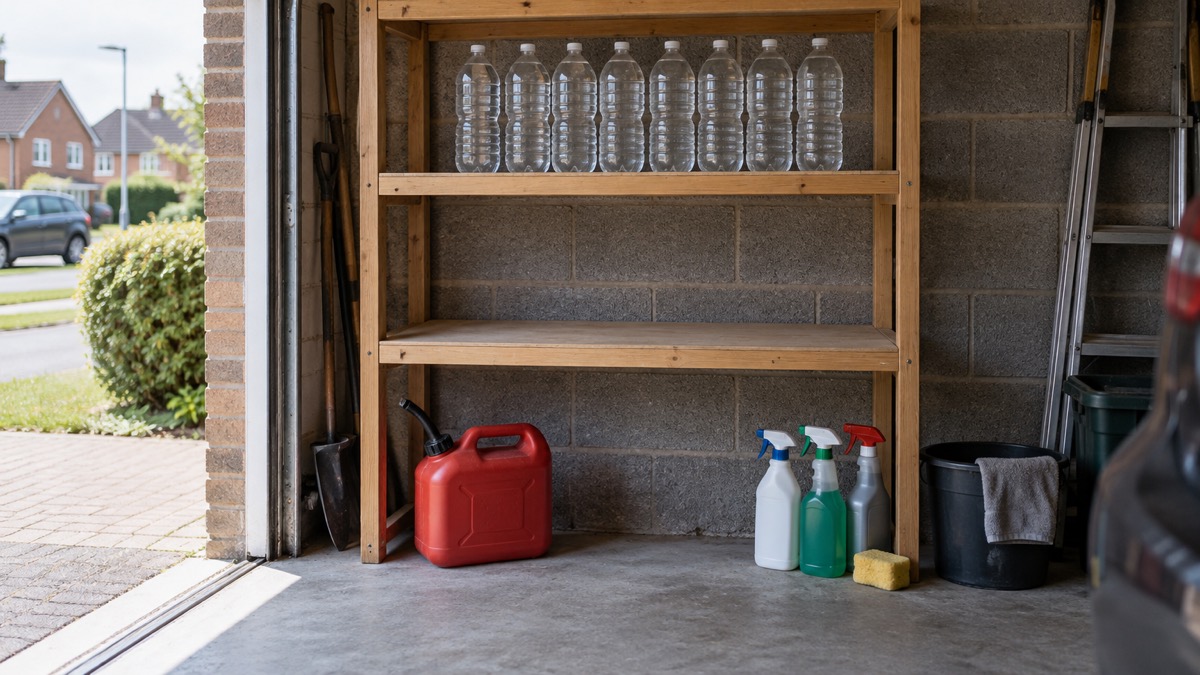
There is a fire safety angle too. Glass bottles left lying around in parks and open spaces are a wildfire risk in dry weather, and fire services ask people not to leave them and to take litter home if bins are full21. At home the risk is smaller, but broken glass near a store is worth avoiding, which is another reason plastic is the better container4.
When a water supply interruption makes stored water matter
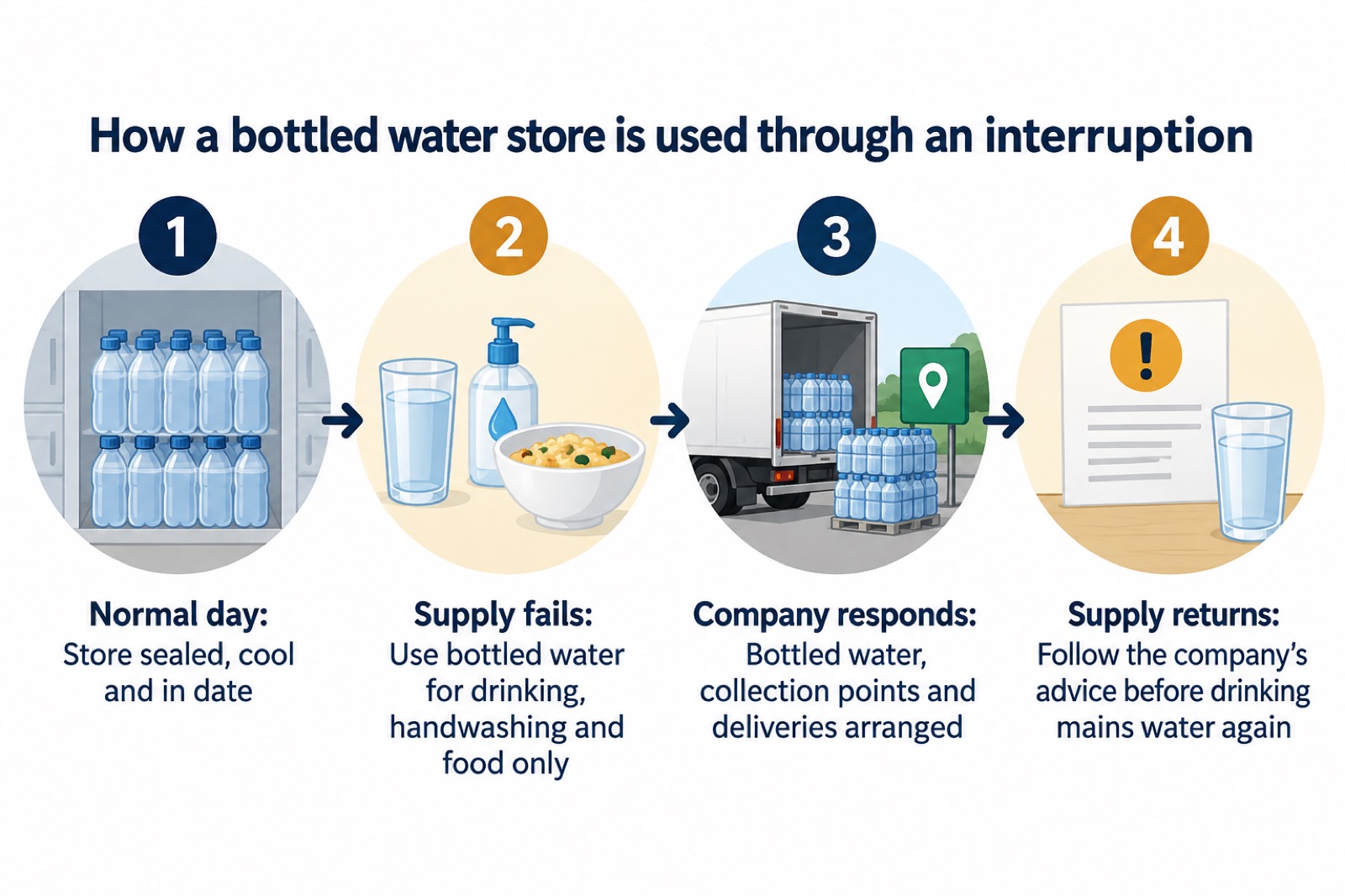
A bottled store earns its place when the mains supply stops, whether through a burst main, planned work, contamination or a wider incident. Official guidance for water supply interruptions is to use bottled water solely for drinking, washing your hands and food preparation while there is no mains supply22. That is a narrower use than most people expect, and it is why the store needs to be sized for drinking first.
Flooding is the classic case. Fire and rescue guidance says to store some drinking water in bottles in case the public supply becomes contaminated by floodwater or sewage23. During flood clean-up, if you are experiencing water disruption, use bottled water to wash your hands24. For infants in areas where drinking water is interrupted or contaminated, official guidance is to use tanker or bottled water for formula milk25, and in rare circumstances such as when drinking water is unavailable or has been contaminated, you can use still bottled water to make up formula feeds1.
A wider loss of supply is also planned for. Guidance on a national power outage says it is good to hold a small amount of bottled water in your home, but to make sure it is not past its expiry date14. Private supply owners have their own version of the problem: a storage tank or reservoir should hold enough to cover peak demand and the maximum period of interruption, but not so much that water sits static for lengthy periods26, and after floods or storms the supply should be checked from abstraction point to taps for damage, with filters changed more frequently and storage tanks cleaned27.
Getting help if you cannot collect water yourself
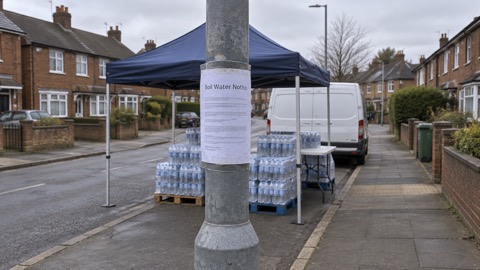
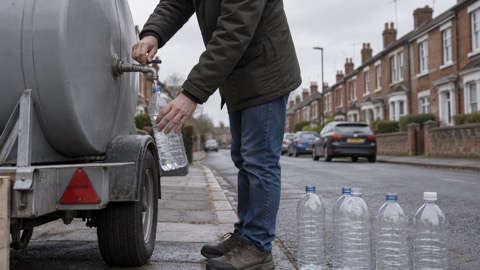
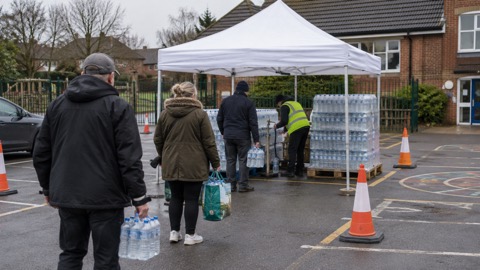
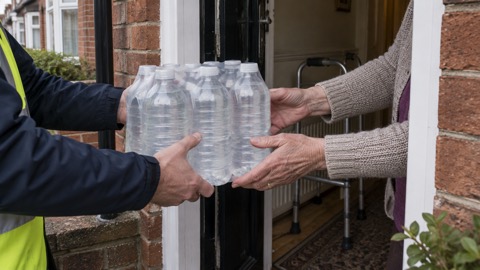
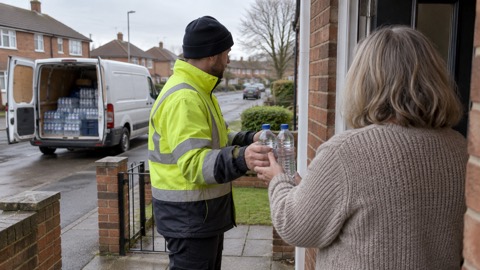
Water companies do not leave households to manage alone. Official guidance sets out what they hold and arrange: bottled water held for customers during planned interruptions and incident response, bottled water available for collection from stockpiles and for doorstep delivery, static tanks and mobile bowsers for major incidents, emergency tankers to fill them, and other options including standpipes, over-ground mains and emergency drought orders8. A local water supply disruption plan describes the same thing from the household's side: providers keep households in supply or make alternative arrangements such as water distribution points, where people go to a designated local area to collect bottled water28.
If you cannot get to a collection point, say so early. Ask your water company about doorstep delivery, and tell them in advance if anyone in the house is vulnerable, so alternative arrangements can be made. The Priority Services Register is the route most suppliers use for this, and it is worth joining before anything goes wrong rather than during an incident.
Neighbours matter too. Official guidance for supply interruptions says to check whether others, particularly any members of your community who might need extra support, are also without water, and to offer assistance such as collecting bottled water24. A street where one household has a car and another has a mobility problem can solve its own collection problem with a short conversation.
For households with a private supply, the arrangements are different. A private supply may be a small covered reservoir or a storage tank, for instance in the roof space, from which water flows under gravity to the taps29, and its purpose is to provide a reserve of drinking water for fluctuations in demand, planned maintenance or problems26. After a flood or storm, check the supply from the abstraction point to the taps for damage, change filters more frequently because of suspended solids, clean storage, intermediate and loft tanks, and check collection points for dislodgement or blockage27.
Sources (29)
- Power cuts, Prepare (Cabinet Office), 2026-10-21
- Be Ready for Emergencies, Be Ready (Cabinet Office), 2026-10-21
- Loss of essential services, Greater Manchester Combined Authority, 2026-10-29
- Create a flood pack, City of Bradford Metropolitan District Council, 2026-10-29
- Water storage tanks and cisterns, Drinking Water Inspectorate, 2026-06-09
- Use-by and best before dates, Food Standards Scotland, 2026-10-25
- Preparing for an emergency, Nottinghamshire County Council, 2026-10-29
- Power, gas and water: what if they fail, Surrey County Council, 2025-12-29
- Staying safe, Health and Safety Executive, 2026
- Storing fuel, Devon and Somerset Fire and Rescue Service, 2026
- Be Ready checklist, Be Ready (Cabinet Office), 2026-10-21
- Household emergency plan, Worcestershire County Council, 2026
- Prepare for emergencies, Dumfries and Galloway Council, 2026
- What is a national power outage, Wiltshire and Swindon Prepared, 2026-10-25
- Food storage, Food Standards Scotland, 2026-10-25
- 12 tips to prepare for a power cut, Horsted Keynes Parish Council, 2026
- What to do in a power cut, Northern Powergrid, 2026-10-26
- Burns prevention and tips, Mid and South Essex NHS, 2026-10-25
- Poisoning, NHS South Yorkshire, 2026-10-29
- Safety for medicines and poisons, NHS West Yorkshire, 2026-10-29
- Grass and wildfires, London Fire Brigade, 2026-10-25
- Water supply interruptions or outages, Be Ready (Cabinet Office), 2026-10-12
- Flooding and health: safely cleaning your home, Wiltshire and Swindon Prepared, 2026-10-25
- Water supply interruptions or outages, Prepare (Cabinet Office), 2026-10-12
- Keeping children safe during a flood, nidirect, 2025-12-09
- Water storage, Drinking Water Inspectorate, 2025-11-05
- Private water supplies after floods or storms, Argyll and Bute Council, 2026
- Failure of water infrastructure or loss of drinking water, Wiltshire and Swindon Prepared, 2026-10-25
- Emergency planning for carers, Cornwall Council, 2026-01-14
 Supply Interruption Checklist
 Boil Notice Checklist
 Drinking Supply Checklist
 Boil Water Notice Advice
 When Supply Is Restored
 Check for an Outage
 Report No Water or Burst Pipe
 Bottled Water Stations
 Bottled Water Delivery Help
 Flushing the Toilet in an Outage
 Washing Without Running Water
 Combi Boiler When Water Is Off
 Water Company Incident Alerts
 Checking a Water Company Caller
 Brown or Discoloured Tap Water