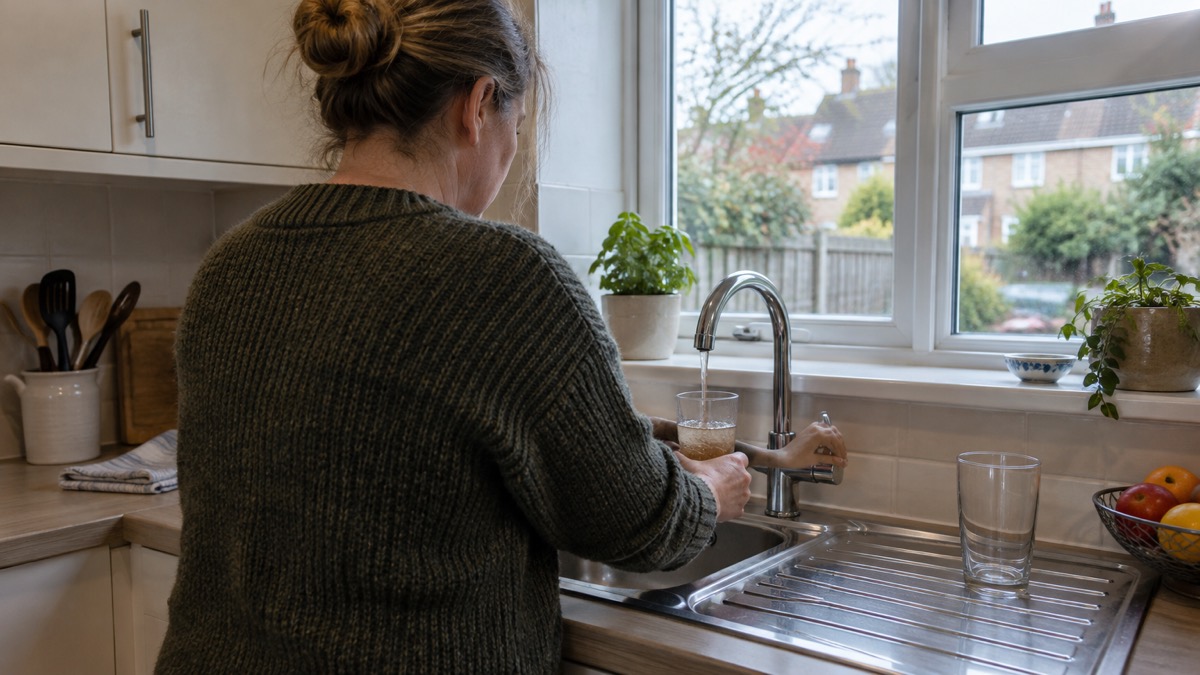
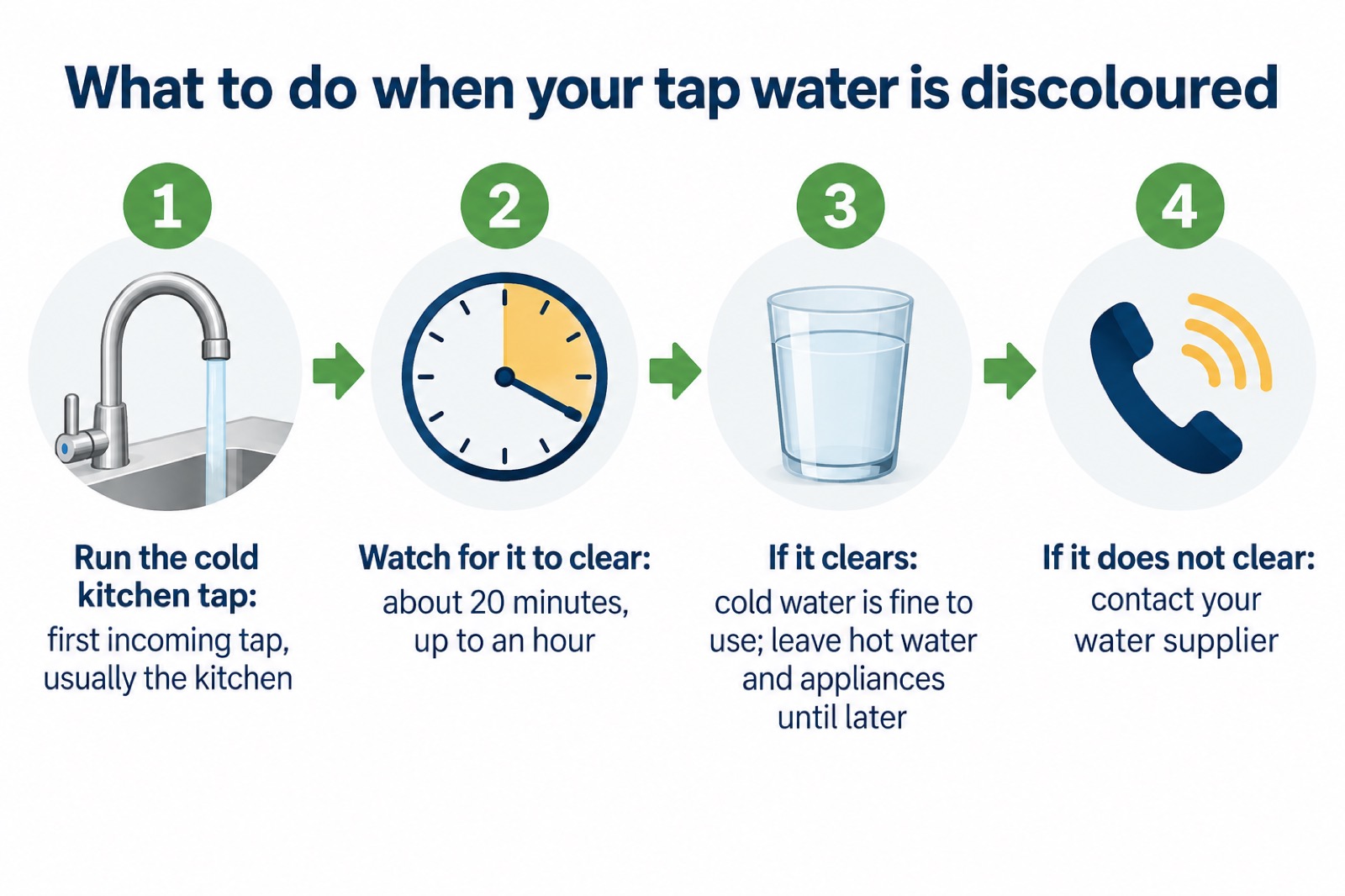
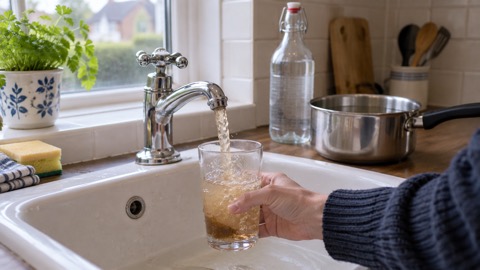
If your tap water has turned yellow, orange or brown, the first thing to do is run the cold kitchen tap. In most cases discoloured water is not harmful, and it can be cleared by running the first incoming cold water tap, usually in the kitchen, at a trickle until it clears1. Most water companies say the same: run the cold tap nearest your stop tap, normally the kitchen tap, and the water should clear.
How long it takes varies. One water company says it usually takes about 20 minutes, but could take up to an hour2. Another advises running the cold kitchen tap at a steady flow, not a trickle and not full blast, for 20 minutes or until the water runs clear3. If it has not cleared after that, stop and contact your supplier.
The colour matters. Yellow, orange and brown water is usually sediment, mostly iron particles, stirred up in the main, and the levels of iron and manganese found in it are unlikely to be harmful to your health4. Blue, green or pink water is different: do not drink it or use it for cooking until you have sought advice from your water supplier1.
Run the cold kitchen tap until it clears
The standard fix is the same across the industry: flush the cold tap closest to where the water enters your home. WaterSafe says to run the first incoming cold water tap, usually in the kitchen, at a trickle until it clears1. United Utilities gives the same instruction for bits in the water, and suggests collecting the flushed water to use on your plants7. Severn Trent describes it as a pencil-thin stream from the tap nearest your stop tap for 20 minutes8.
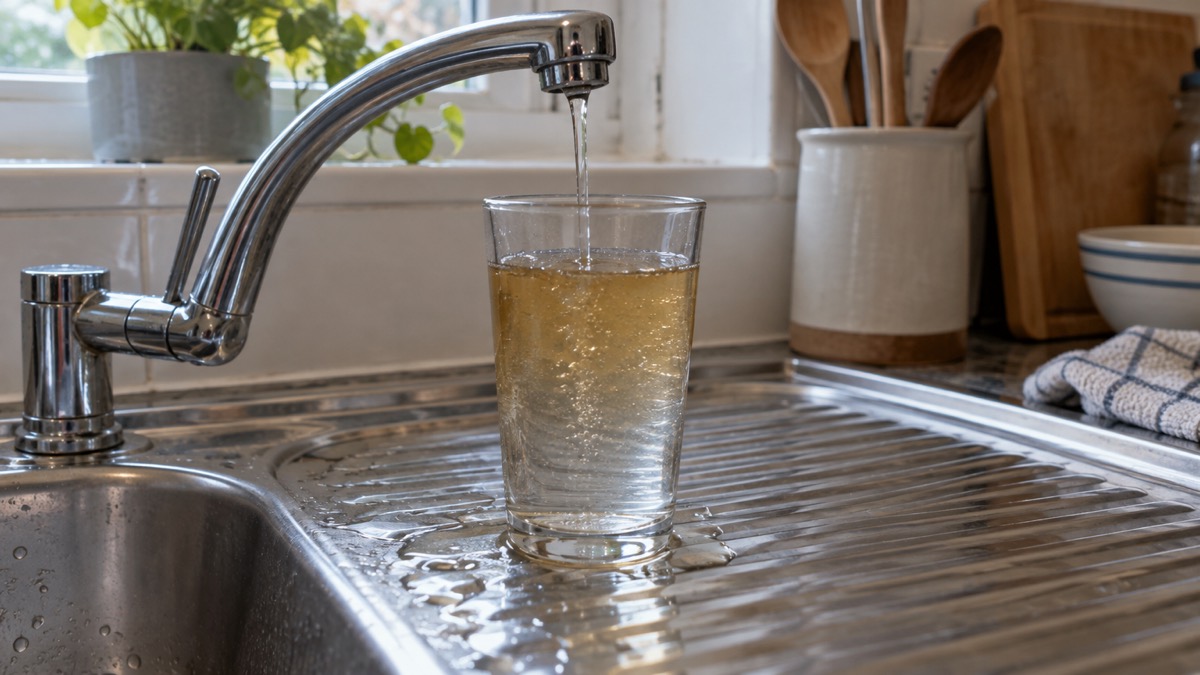
Not every company asks for a trickle. Cambridge Water, during its mains renewal programme, asks households to run the cold kitchen tap at steady flow, not a trickle and not full blast, for 20 minutes or until the water runs clear9. South Staffs Water gives the same steady-flow instruction3. Affinity Water, during mains cleaning, simply says run the cold kitchen tap until it runs clear10, and after an incident says running your cold kitchen tap until it runs clear will help11.
The differences are small and the principle is the same: use the cold tap nearest the stop valve, let it run, and watch for the water to clear. A trickle is gentler and uses less water; a steady flow clears the line faster. Either way, do not run every tap in the house, and do not run the hot tap.
Yellow, orange or brown water is usually not harmful
Brown or orange water is normally rust sediment in the main that has been disturbed after an incident, and it can usually be cleared by flushing the cold kitchen tap12. Affinity Water says brown water is usually caused by iron in the water supply, from iron sediment being disturbed, deterioration of storage tanks, or corrosion of service pipes13. Bristol Water puts it the same way: a yellow, brown or orange colour is normally caused by disturbance of sediment, mostly iron particles, in the water main14.
On safety, the message is consistent. WaterSafe says in most cases discoloured water is not harmful1. Dŵr Cymru says that although it does not look nice, the levels of iron and manganese found in discoloured tap water are unlikely to be harmful to your health4. South Staffs Water says discoloured water is not harmful in most cases and does not usually last long3. Water Regs UK describes yellow discolouration as generally harmless15.
That does not mean drink it while it is brown. Bristol Water advises waiting until the water runs clear before drinking and cooking, because discoloured water will not look or taste very nice14. The Drinking Water Inspectorate is firmer: if your tap water is suddenly discoloured, you should not assume that it is safe to drink until you have sought advice from your water supplier16.
"If your tap water is suddenly discoloured, you should not assume that it is safe to drink until you have sought advice from your water supplier."
The cause is often visible in the street. A burst water main on Rochdale Road in Oldham produced discoloured tap water, and the company explained that this can happen when natural sediments in the pipes are disturbed17. Northumbrian Water describes sediment causing discoloured water as easily removed by flushing water mains and running taps18. If you want to know whether work is going on nearby, see planned work on the mains.
Blue, green or pink water: stop and seek advice
A bright colour is a different problem from brown. WaterSafe says if your water is blue, pink, green or any other colour not described, do not drink it or use it for cooking until advice is sought from the water supplier1. United Utilities says the same for blue, pink, green or any other unusual bright colour19. Bristol Water says it is not advisable to drink water that has an unusual, bright colour14. Southern Water asks customers with blue, green or any other coloured water to stop using it until it has been tested20.
The usual cause is copper. Bristol Water explains that very rarely, a bright blue or green discolouration is caused by high levels of copper from household pipes, after new pipework is installed or a pipe is repaired or altered, and that running the tap should clear the discoloured water and reduce the level of copper14. Affinity Water adds that most household pipes are copper, and in buildings with new plumbing small amounts can dissolve into the water; blue water can also come from toilet blocks in cisterns without suitable backflow protection13.
So the action is: stop using the water for drinking and cooking, run the cold tap to flush the pipe, and if the colour persists or you are unsure, contact your supplier. There is more detail on this in blue, green or pink tap water.
What not to do while the water is discoloured
The list of things to avoid is short and practical, and it is where most households go wrong.
- Do not run the hot water tap. Yorkshire Water and United Utilities both say not to run the hot water tap or use dishwashers, washing machines or any appliances fed by your hot water supply while your tap water is discoloured5.
- Do not do laundry. Bristol Water suggests not doing any laundry or using your hot water while the water is discoloured14. Affinity Water warns that using your washing machine while the water is discoloured could cause staining to your clothes6.
- Do not use the dishwasher. South Staffs Water warns that particles may cause a blockage3.
- Do not assume it is safe. The Drinking Water Inspectorate says not to assume suddenly discoloured water is safe to drink until you have sought advice from your supplier16.
- Do not use tap water after a flood if the supply looks or smells wrong. Official flood recovery guidance says do not use tap water if you think there are issues with the supply, such as an odour or discolouration, and to use bottled water if you do not have mains water available22.
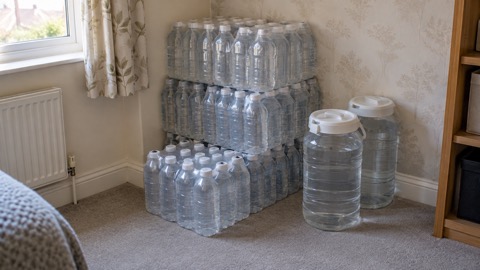
If you are storing water for an interruption, do it from a clear-running cold tap, not while the supply is discoloured. Our guides to storing tap water safely and how much drinking water to store per person cover quantities and containers.
When to contact your water supplier
Contact your supplier if the water has not cleared after flushing, if the colour is blue, green or pink, or if you are simply unsure. WaterSafe directs customers to their water supplier for more information1. The Drinking Water Inspectorate says to call your water company if you notice a change in quality such as discolouration or a change in taste or smell, or if you are unsure23. WaterSafe adds that if you have any concerns, contact your local water company24.
After a flood, the fire and rescue service advises contacting your water company if tap water is discoloured or tastes bad25. After an outage, the government's Be Ready guidance says to try running the cold tap nearest your stopcock, usually under the kitchen sink, for a while to see if it clears, and to contact your water provider if problems continue26.
Dŵr Cymru says that if discolouration, air or particles persist at the kitchen tap after running the tap, contact them, as they may need to come and flush the system or carry out investigations27. Affinity Water asks customers to check its alerts page if the water does not improve after five minutes, and to contact the company if concerned or if the problem is ongoing13.
| Situation | What to do |
|---|---|
| Yellow, orange or brown, clears after flushing | No action needed; use the cold water normally1 |
| Has not cleared after about 20 minutes to an hour | Contact your water supplier1 |
| Blue, green or pink | Stop drinking and cooking with it; contact your supplier1 |
| Discoloured after a flood | Contact your water company25 |
| Discoloured after an outage | Flush the cold tap near the stopcock; contact your provider if it continues26 |
| Private supply changes colour | Stop drinking it and seek advice from your local authority28 |
If it is your own plumbing, or a private supply
Not every discolouration comes from the mains. WaterSafe lists the causes as naturally occurring substances, disturbance of mains deposits, corrosion of service pipes and internal plumbing issues1. Bristol Water offers a simple test: if your neighbour's water is clear, or if only your hot water is affected, it is likely to be a plumbing problem14. In that case the fix is in your own pipework, and a plumber may be needed.
Private supplies, such as wells, boreholes and springs, carry their own risks. If you rely on a private supply and the water changes colour, stop drinking it and seek advice from your local authority. Our guide to private supplies explains how they are regulated.
In Northern Ireland, Northern Ireland Water says the discolouration will be short-lived and running the tap for a while should help clear it from the system29. Discoloured drinking water should be reported to Northern Ireland Water, and while such water is normally harmless it should still be reported30. If you are on a private supply in Northern Ireland, nidirect sets out how to deal with drinking water problems30.
In Wales, Dŵr Cymru is the contact for persistent discolouration at the kitchen tap27. In Scotland, the arrangements differ and your supplier is the first point of contact; the general principle of flushing the cold kitchen tap and seeking advice applies.
Sources (30)
- Why is my water discoloured?, WaterSafe
- My water smells strange, South East Water
- Appearance of your water, South Staffs Water
- Drinking water quality, Dŵr Cymru
- My water is dark brown or black, Yorkshire Water
- How to guides: discoloured water, Affinity Water
- Bits in your water, United Utilities
- Your water supply, Severn Trent
- Planned work, Cambridge Water
- Mains cleaning, Affinity Water
- Incident support, Affinity Water
- Discoloured water, South West Water
- Water quality: appearance, Affinity Water
- Water appearance, Bristol Water
- Why is my water yellow?, Water Regs UK
- Brown, black or orange water, Drinking Water Inspectorate
- Oldham incident, United Utilities
- Getting water to your home, Northumbrian Water, January 2024
- White water, United Utilities
- My water looks, smells or tastes unusual, Southern Water
- My water has bits in it, Yorkshire Water
- Flood recovery leaflet, Nottinghamshire Local Resilience Forum
- Flooding, Drinking Water Inspectorate
- Water quality FAQs, WaterSafe
- Flooding advice, Mid and West Wales Fire and Rescue Service
- Water supply interruptions or outages, Be Ready
- Water appearance, Dŵr Cymru
- Water safety plan approach to improving the safety of a private supply, Drinking Water Inspectorate
- Water mains rehabilitation project, Northern Ireland Water
- Dealing with drinking water problems, nidirect
 Supply Interruption Checklist
 Boil Notice Checklist
 Drinking Supply Checklist
 Boil Water Notice Advice
 When Supply Is Restored
 Check for an Outage
 Report No Water or Burst Pipe
 Bottled Water Stations
 Bottled Water Delivery Help
 Flushing the Toilet in an Outage
 Washing Without Running Water
 Combi Boiler When Water Is Off
 Water Company Incident Alerts
 Checking a Water Company Caller
 Cloudy or Milky Tap Water