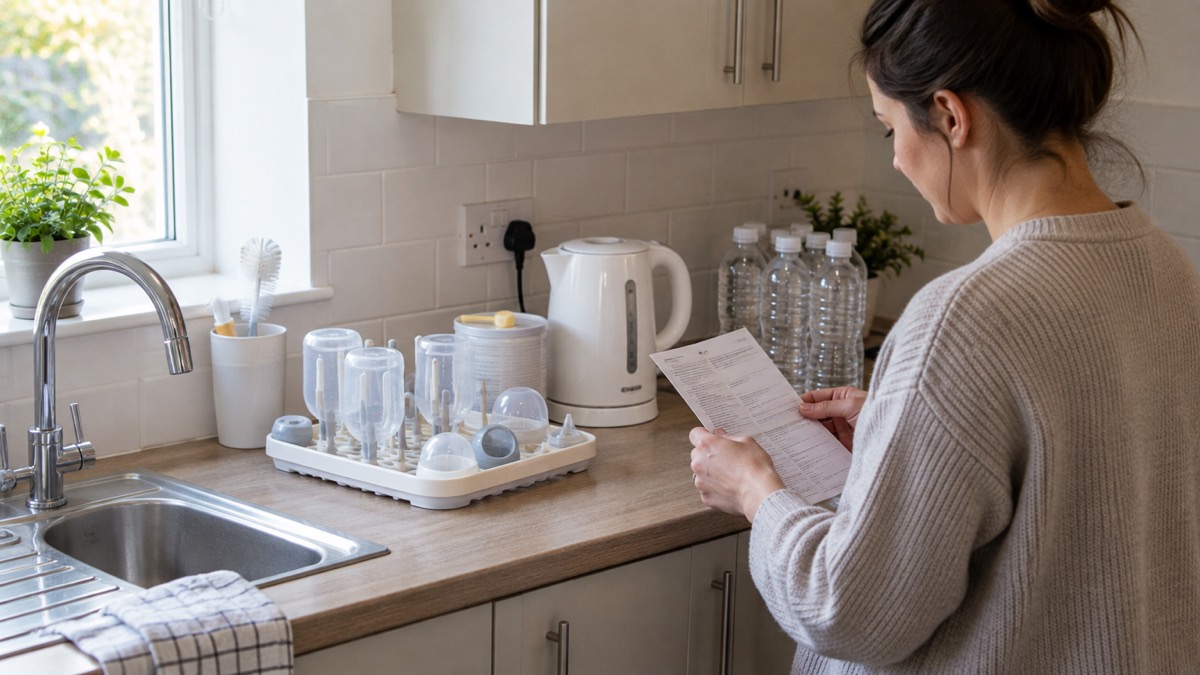
If your tap water is under a boil water notice, or your supply has been cut off, you can still make up formula safely: boil the water, let it cool for no more than 30 minutes, and it will still be at least 70°C, the temperature needed to make up a feed1. Powdered infant formula is not sterile and should only be prepared with freshly boiled water3. If you cannot boil water at all, ready-to-feed liquid formula is the safest option4.
The decisions you face come in a clear order. First, check what your water company has actually told you to do, because a boil notice is about the water, not the formula. Second, work out whether you can boil water: on the hob, on a camping stove outdoors, or with a kettle once power returns. Third, if you cannot boil, switch to ready-made formula rather than improvising with cold water. Bottled water has a specific role, with limits on sodium and sulphate, and this page sets out exactly when it is and is not suitable.
Making up formula during a boil water notice
A boil water notice means the water in your tap might contain bacteria, viruses or parasites which could be harmful to your health, so the water company is instructing consumers in the affected area to boil it before use1. For formula, that instruction fits with what you should be doing anyway: powdered formula is not sterile and should only be prepared using freshly boiled water3.
The method matters. Boil the water and leave it to cool in the kettle for no more than 30 minutes; after that time it will still be at a temperature of at least 70°C, which is what you need to make up the feed safely2. The Drinking Water Inspectorate, which regulates drinking water quality in England and Wales, advises boiling until the water reaches a rolling boil, then removing it from the heat and allowing it to cool naturally1. Follow the formula manufacturer's instructions for the quantities, and use the feed immediately once it is made.
If you use a baby formula preparation machine, check it carefully during a notice: the nidirect guidance for Northern Ireland is to make sure the water is at least 70°C2. Preparation machines are convenient, but the safety requirement is the same as for a kettle, and during a boil notice it is worth verifying rather than assuming.
Boiled tap water under a notice is normally fine for formula, because the boiling deals with the contamination the notice is about. The exception is when your water company tells you not to use the water at all, or the water has an odour or discolouration. Public health guidance on recovering from flooding is clear on this point: do not use tap water with an odour or discolouration to prepare baby formula, and never, under any circumstance, give unboiled tap or tank water, as these sources might be contaminated8. In that situation, move to bottled water that has been boiled and cooled, or to ready-made formula8.
"They should not, under any circumstance, give unboiled tap or tank water as these sources might be contaminated"
For more on the notice itself, see What to Do If You Get a Boil Water Notice and How to Make Water Safe to Drink in an Emergency.
Bottled water and formula: only when tap water is not available
Bottled water is not usually recommended for making up formula milk feeds. The reason, set out in official guidance, is that it is not sterile and may contain too much salt (sodium) or sulphate9. In rare circumstances, such as when drinking water is unavailable or has been contaminated, you can use still bottled water to make up formula feeds3.
When you do, two checks and one step apply:
- Check the label to ensure it does not have more than 200 mg per litre (mg/L) of sodium or 250 mg/L of sulphate3. The government's drought guidance gives the same limits: less than 200 milligrams per litre of sodium (Na) and no more than 250 mg per litre of sulphate (SO4)11.
- Boil it anyway. Bottled water is not sterile, so it should be boiled to sterilise it and allowed to cool for no more than 30 minutes before making up the feed3. The drought guidance recommends boiling for 1 minute and letting it cool down11.
- Use still water only. Sparkling or carbonated water is not suitable for formula.
Public Health Wales gives the same routine: bottled water should be boiled, covered and left to cool for up to half an hour, then follow the manufacturer's instructions to make up the feed, and the prepared feed should be used immediately12. Herefordshire Council's flood guidance adds that the preferred option where the supply is affected is bowser or bottled water, brought to a rolling boil and cooled, and that unboiled water should not be used13.
The key point is that bottled water is a substitute for the water, not a shortcut past boiling. It buys you a clean starting supply when the tap is off or contaminated, but it still goes into the kettle or pan first.
How to boil and cool water safely with a baby in the house
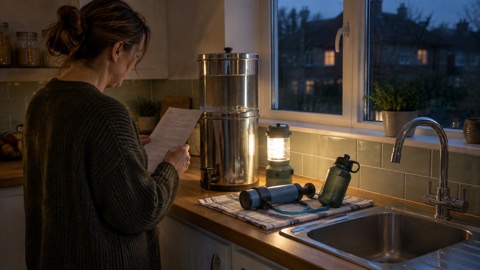
Boiling water for feeds during an outage means handling pans and kettles in a house that may be darker than usual, possibly with a baby in your arms. The Drinking Water Inspectorate asks households to be cautious, because boiling water can cause scalds1.
Plan the sequence before you start. Boil the water, cover it, and set a timer for 30 minutes so you know when it is at the right temperature rather than guessing3. Make up the feed following the manufacturer's instructions and use it immediately12. If you are using a camping stove or barbecue because the power is off, use it outdoors only, and never bring it inside.
Two further rules from official guidance matter for households with a baby:
- Feeds are not for storing. It is always safer to make up a fresh feed, and when this is not possible, feeds should never be stored for longer than 24 hours14.
- A flask buys you time. The nidirect storm guidance for Northern Ireland advises households with a baby to prepare a flask of hot water to heat bottles and baby food14. A filled vacuum flask keeps water hot enough to make up a feed for hours after the kettle goes off, which is one of the most useful things you can do in the first minutes of a power cut.
For keeping a baby hydrated when water is scarce, the NHS advises carrying on breastfeeding or using formula, giving small amounts more often than usual, and giving small sips of extra water if the baby is on formula or solid foods. For babies under 6 months, boil the water first and let it cool, and give regular small sips of rehydration solution where that is advised16. Bottle-fed babies aged 0 to 6 months can be given a little cooled boiled water in addition to their usual milk feeds17.
Ready-made formula as a backup when you cannot boil water
If you are not able to boil water to prepare baby formula safely, try to use ready-to-use baby formula5. This is the consistent advice across official sources: Food Standards Scotland states plainly that you need to boil water to prepare infant formula safely, and if you cannot boil water, use ready-to-use infant formula10. The UK government's food safety in a power cut guidance says the same18.
Ready-made formula, sometimes labelled ready-to-feed, is sterile in the carton or bottle, so it needs no boiled water and no sterilised bottle in the moment: you pour it and give it. That makes it the safest option during an emergency, as you may not be able to boil water or sterilise bottles4. The government's preparedness campaign and the Be Ready checklist both single it out: ready-made or ready-to-feed formula is best, as you may not be able to boil water to make up powdered formula safely19.
There is one situation where official guidance goes further. If you have no gas or electricity to allow boiling, the nidirect flood guidance permits using unboiled bottled water (table, spring or mineral water) to make a baby feed, but you must give the feed to the baby immediately2. Runnymede Borough Council's flooding aftercare advice matches this: if boiling is not possible and ready-to-feed liquid formula is not available, bottled water can be used without boiling, but the prepared feed should be used immediately21. Treat this as a last resort in that order: boil first, ready-made second, unboiled bottled water only when neither is possible.
Supplies to pack for babies in your emergency kit
Every emergency kit list in official guidance treats baby supplies as a category of their own. The core items, drawn from the government's preparedness campaign, the Be Ready checklist and local authority lists across the UK, are:
- Ready-made or ready-to-feed formula, because you may not be able to boil water to make up powdered formula safely19
- Bottles and teats, including spares, since washing and sterilising may be difficult4
- Nappies, wipes and nappy sacks20
- A change of clothing for the baby, and waterproof clothing and boots for you25
- Baby food and snacks if the baby has started solids26
- Toys, books and activities, which local authority kit lists include specifically for children24
- Essential medicines the baby or family needs28
- A flask, to hold hot water for heating bottles and baby food14
- Extra bottled water, because additional water might be needed to make up baby formula5
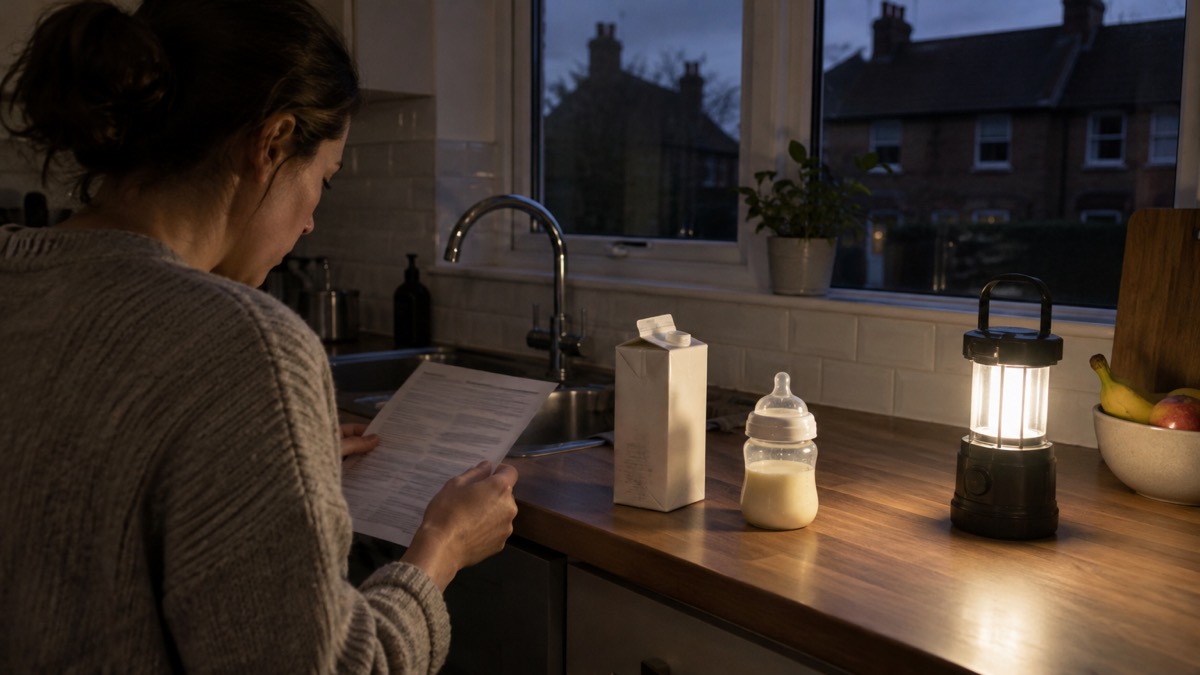
The Household Emergency Plan published alongside the Be Ready campaign puts it simply: keep baby products such as nappies, wipes and ready-made formula22. Lincolnshire's emergency advice lists infant formula milk and disposable nappies and nappy sacks, and also suggests water purification tablets as part of a wider kit23. Essex's grab bag guidance for families adds flood protection and drink for children alongside formula and nappies26.
Work out how much you need for three days without shopping, and add a margin. Ready-made formula cartons have a long shelf life unopened, which is what makes them practical to keep at the back of a cupboard. Check dates when you change the clocks or at the same time as you rotate your water store.
For the full household list, see Emergency Kit: What a UK Household Should Keep Ready and the Supply Interruption Checklist.
How much water to store for a household with a baby
The standard figure across official guidance is 3 litres per person per day for drinking, for at least 3 days6. The Be Ready checklist notes that this covers drinking only, and more would be needed for other tasks such as cooking and washing7. Birmingham City Council's preparedness guidance gives the same 3 litres per person per day for cooking and washing29.
Some local guidance goes further. Greater Manchester's resilience guidance recommends a minimum of 2.5 to 3 litres of drinking water per person per day for survival, and 10 litres per person per day to make you more comfortable by also providing for basic cooking and hygiene needs5. Denbighshire's emergency supplies guidance says to store at least 2.5 litres per person per day to cover sanitary purposes and possibly cooking30.
| Guidance | Drinking water per person per day | Notes |
|---|---|---|
| Prepare campaign (England) | 3 litres | At least 3 days' worth6 |
| Be Ready checklist | 3 litres | Drinking only; more for cooking and washing7 |
| Greater Manchester Combined Authority | 2.5 to 3 litres | 10 litres per person per day covers basic cooking and hygiene too5 |
| Birmingham City Council | 3 litres | For cooking and washing29 |
| Denbighshire County Council | 2.5 litres | Covers sanitary purposes and possibly cooking30 |
For a household with a baby, the important addition is that the standard per-person figure does not account for feeds. Greater Manchester's guidance states that additional water might be needed to make up baby formula, for medical devices and for pets5, and North Hertfordshire's emergency planning advice says the same25. A formula-fed baby's feeds come out of your store, so count the baby as a full person and add extra beyond that. A baby who has six feeds a day, each made up with more water than powder, can use a meaningful share of a family's 3-day store.
Bottled water in your store should be replaced every six months30. Keep it sealed and rotate it into everyday use. For the detail on containers, quantities and rotation, see How Much Drinking Water to Store per Person, How to Store Bottled Water and Storing Tap Water Safely at Home.
Why boil water notices are issued and how you will be told
Boil water notices are usually issued because of weather emergencies or engineering works1. What the notice means is that the water in your tap might contain bacteria, viruses or parasites which could be harmful to your health1. The water company issues the notice to the consumers in the affected area, instructing them to boil their water before use1.
You will normally hear through your water company's own channels, and you can check the company's website and incident line for the affected streets. On rare occasions the systems can fail1, so treat any change in the water's appearance, taste or smell as a reason to check and report, using How to Check If There Is an Outage in Your Area and How Will My Water Company Contact Me in an Incident?. If the water is discoloured or smells odd, see Brown or Discoloured Tap Water and Why Does My Tap Water Taste or Smell Different? before using it for anything.
Private supplies: wells, boreholes and springs
Around one in ten UK households takes its water from a private supply rather than the mains. For a private supply, the notice comes from your local authority, not a water company1. Local authorities can formalise boil water advice in a Regulation 18 Notice, which instructs users of the supply to boil water before consumption31.
The Drinking Water Inspectorate's case studies show how this works in practice. In one case from 2017, a sample from a Regulation 9 supply serving nine properties and a coffee shop indicated faecal contamination, and the local authority served a Regulation 18 Notice instructing users to boil water before consumption; after the supply was shock chlorinated, further samples were free from microbiological parameters and the authority revoked the Notice31. In another, slurry spread on the opposite hill slope contaminated one spring within hours in September 2012, and the owner issued boil water advice to all the properties32.
Notices can also restrict use rather than simply requiring boiling. In a case at a salad growing nursery, the Notice specified short-term restrictions covering drinking, cleaning teeth, food preparation including ice cubes and salads, cooking, preparing babies' feeds, washing open wounds and disinfecting feeding equipment, with notices physically displayed where consumers would see them33. If you are on a private supply and receive any restriction, assume it covers feed preparation and sterilising unless the authority says otherwise, and see Private Supplies: Wells, Boreholes and Springs.
Nitrate and infants on private supplies
Nitrate deserves a specific mention because the risk falls on infants. In November 2017, a local authority wrote to consumers on a private supply at a salad growing nursery advising of the risk of elevated nitrate levels to infants, and that visitors should be warned not to make babies' feed with the water33. If your private supply has tested high for nitrate, or has never been tested, ask your local authority before using it for formula, and use boiled bottled water or ready-made formula in the meantime.
Getting bottled water when the supply is off
When the supply is off rather than unsafe, the help available changes. Households with young children may be eligible for their water supplier's Priority Services Register, which lets the company know you need additional support, including when there is an interruption to your supply9. Vulnerable consumers registered with their water company can receive extra help and support, for example the delivery of bottled water11.
If you believe you are registered but have not received support during an incident, contact your water company as soon as possible4. The government's water supply interruption guidance also suggests asking anyone you provide care for whether they are registered, which matters if grandparents or others help with the baby4.
For formula-fed infants where drinking water is interrupted or contaminated, official flood guidance is to use tanker or bottled water2. Water companies set up bottled water collection points and tankers during major interruptions; see Where Are Bottled Water Stations Set Up?, How to Get Bottled Water Delivered If You Are Vulnerable and Bottled Supplies, Tankers and Bowsers From Your Water Company. Remember that water from a bowser or tanker is drinking water but is not sterile: for formula, it still needs boiling and cooling for no more than 30 minutes, exactly as tap water does13.
One further point for households in older properties: NHS inform advises that where lead pipes are a concern, you should only use the cold tap water for drinking, cooking and making infant formula34. Run the cold tap briefly before drawing water for a feed, and never use water from the hot tap or from a storage tank for formula.
Sources (34)
- Receiving a boil water notice, Drinking Water Inspectorate, 2024-05-16
- Keeping children safe during a flood, nidirect (Northern Ireland government), 2025-12-09
- Power cuts: advice for households, Prepare campaign (UK government), 2026-10-21
- Water supply interruptions or outages, Prepare campaign (UK government), 2026-10-12
- Loss of essential services, Greater Manchester Combined Authority, 2026-10-29
- Power cuts: be informed about hazards, Be Ready campaign, 2026-10-21
- Be Ready checklist, Be Ready campaign, 2026-10-21
- How to recover from flooding, UK Health Security Agency, 2023-12-19
- Water supply interruptions or outages, Be Ready campaign, 2026-10-12
- Food safety in the kitchen: power cuts, Food Standards Scotland, 2026-10-25
- Public health impact of drought: advice for the public, UK government, 2022-07-28
- Weather and health, Public Health Wales, 2026-07-16
- Staying safe in a flood, Herefordshire Council, 2026-10-29
- Strong winds and heavy rain warning: information and advice, nidirect (Northern Ireland government), 2026-01-27
- Strong winds weather warning: information and advice, nidirect (Northern Ireland government), 2026-10-24
- Dehydration, NHS, 2026-05-01
- Safety in the sun, NHS, 2024-09-27
- Food safety in a power cut: advice for consumers, UK government, 2023-07-26
- Get prepared for emergencies, Prepare campaign (UK government), 2026-10-21
- Be Ready for emergencies, Be Ready campaign, 2026-10-21
- Flooding aftercare, Runnymede Borough Council, 2026-10-26
- Household Emergency Plan, Be Ready campaign, 2026
- Get help and advice in an emergency, Lincolnshire County Council, 2026-10-29
- Emergency pack, Lancashire Resilience Forum, 2026-10-29
- Preparing for emergencies, North Hertfordshire District Council, 2015-01-12
- Step 1: preparation, Essex Prepared, 2026-10-29
- Protect yourself and your family, Dorset Prepared, 2026-04-21
- Preparing for a flood, nidirect (Northern Ireland government), 2025-09-11
- Are you ready?, Birmingham City Council, 2026-05-06
- Emergency supplies kit, Denbighshire County Council, 2020
- Faecal contamination of a supply (case study 2017/05), Drinking Water Inspectorate, 2022-07-11
- Water safety plan approach to improving the safety of a private supply (case study 2013/19), Drinking Water Inspectorate, 2022-07-11
- Change of supply for long-term remediation (case study), Drinking Water Inspectorate, 2018
- Lead poisoning, NHS inform Scotland, 2026-09-07
 Supply Interruption Checklist
 Boil Notice Checklist
 Drinking Supply Checklist
 How Much Water to Store
 Storing Tap Water Safely
 Containers and Jerrycans
 Household Storage Tanks
 Water Already in Your Pipes
 Making Water Safe to Drink
 Boiling Water to Kill Germs
 Purification Tablets
 Emergency Filter Types
 What Water Filters Remove
 Gravity Filters Explained
 Hand Pump Filters