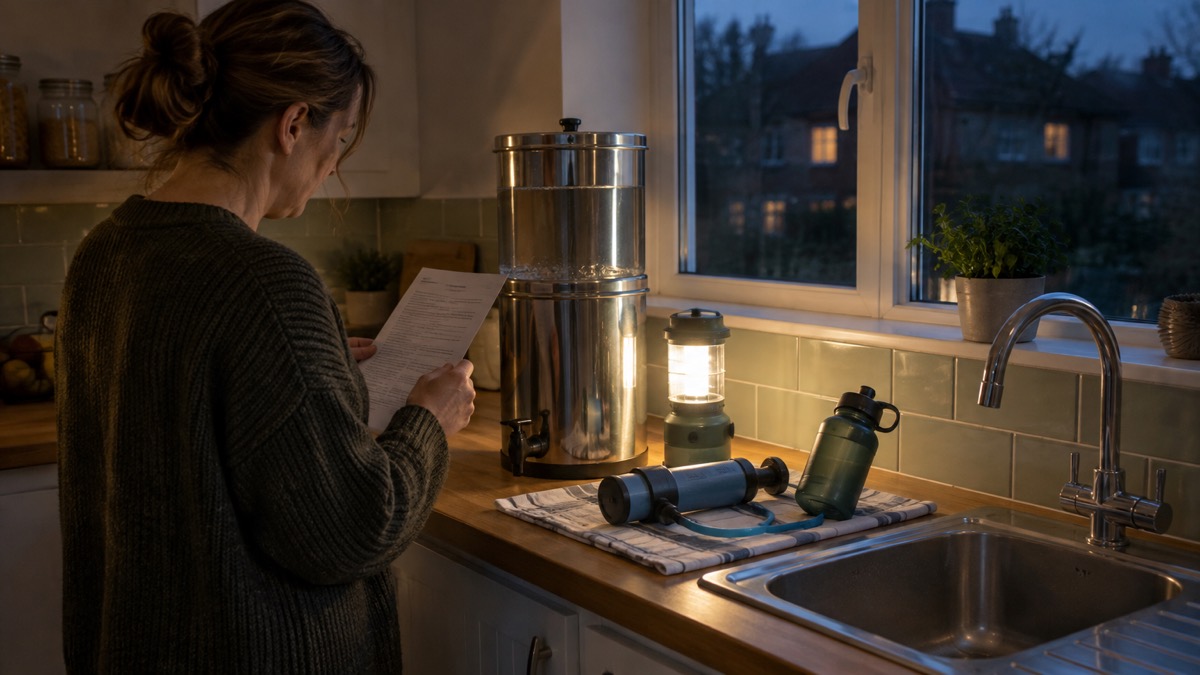
UK tap water is treated to the highest standards, and a household filter is a personal choice rather than a necessity1. In most flooding circumstances the mains supply is unaffected and remains safe to drink2. So the honest starting point for an emergency water filter for home use is this: you do not need one for everyday water, and you should not let a filter replace the advice of your water company when something goes wrong. If there is a problem with your mains water, your local water company will tell you what to do3.
What a filter is for is the gap between a safe mains supply and an interrupted or suspect one. The mains water supply to your home can be disrupted during and after power cuts4, and while there is no mains water the official advice is to use alternative supplies, such as bottled water, solely for drinking, washing your hands and food preparation5. Water companies may not always be able to provide an emergency supply in bowsers or bottles, for example if they are dealing with their own emergency such as a burst main6. A filter you already own, understand and have kept clean extends what you can safely drink from, and it does so without electricity or plumbing, which is exactly what an outage takes away.
This page sets out the four kinds of filter a household might hold, gravity, pump, bottle and straw, what each is for, how to set up and look after them, and where their limits lie. It sits alongside our wider guide to water in an emergency, including how much drinking water to store per person and how to make water safe to drink.
When a filter stops being optional
For most households, most of the time, a filter does nothing for safety. Welsh Water is blunt about whether a filter is needed: "No, because the water is treated to the highest standards"1. The Drinking Water Inspectorate, which regulates mains supplies in England and Wales, adds that slight changes in water quality from source changes are no cause for concern, because supplies are regularly tested against drinking water standards10. A change in taste after a switch of source is a nuisance, not a danger.
The picture changes in three situations. The first is an interruption: with no mains water, you move to alternative supplies, and official guidance says to use them solely for drinking, washing your hands and food preparation5. The second is a contamination or boil notice, where your water company tells you not to drink untreated tap water; see our page on what to do if you get a boil water notice. The third is a private supply: if your water comes from a borehole, well, spring, river or loch rather than the mains, the responsibility for treating it is yours, and after floods or storms the usual treatment processes may not be adequate, particularly if the water is coloured or cloudy, in which case it may need to be filtered and boiled before use11.
That third group should take filters most seriously. Scottish Borders Council warns that a small domestic private supply may never have been sampled unless a problem is suspected12, and the Drinking Water Inspectorate warns that without a risk assessment or test results the quality of water from a supply serving a single dwelling may be unknown, potentially below the regulatory standard, and a risk to human health13. If you are on a private supply, read our guide to private supplies: wells, boreholes and springs.
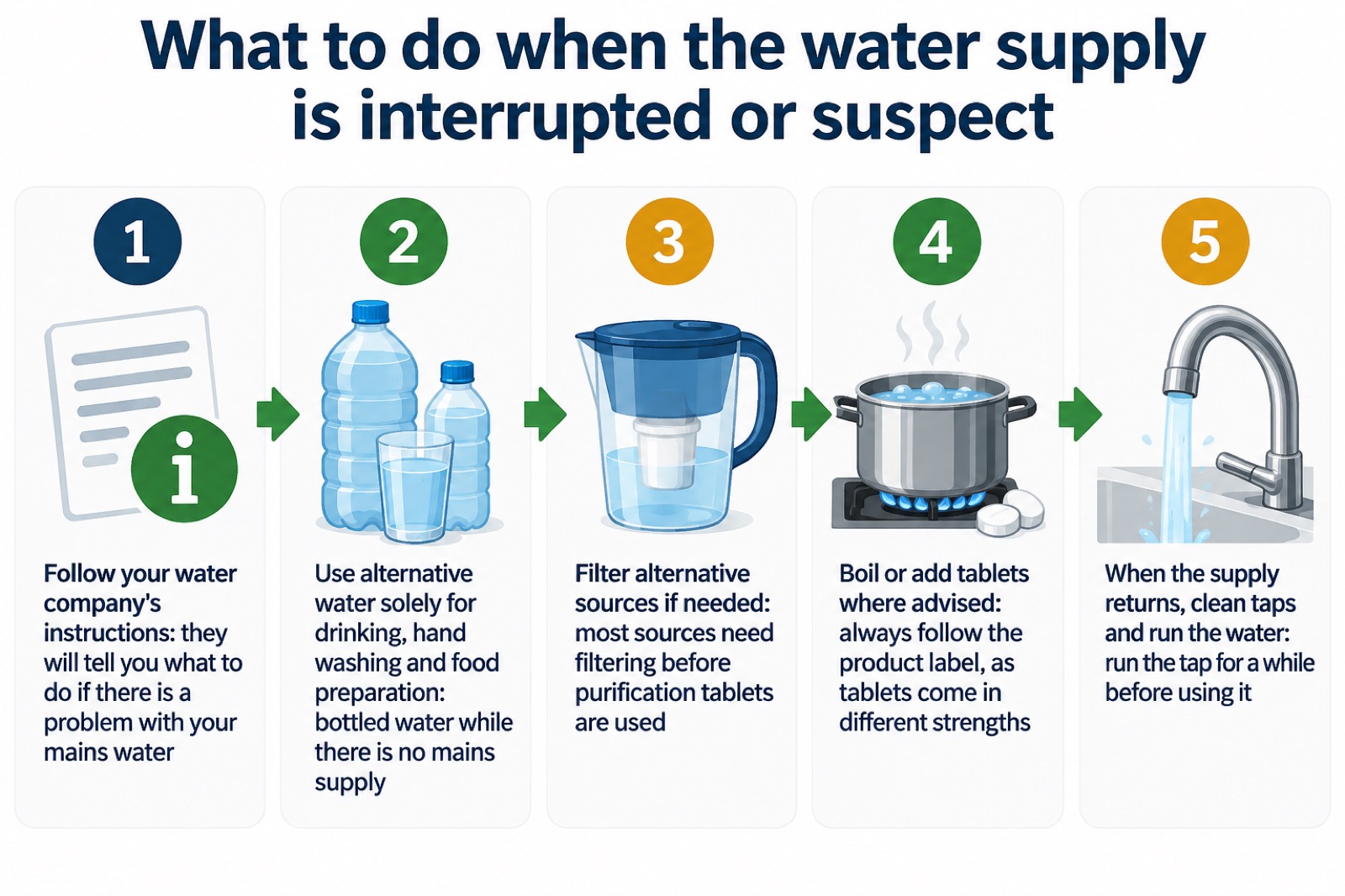
One more caution belongs here. A filter is a treatment step, not a guarantee. If water is coloured or cloudy after contamination of the source, official Scottish guidance says it may need to be filtered and boiled11, and the same guidance supports boiling or adding purification tablets to alternative sources, always following the product label, with most alternative sources needing to be filtered before tablets are used14. Filtering and boiling or tablets are complementary, not rivals: see purification tablets or a gravity filter? and boiling to kill germs.
The four types side by side
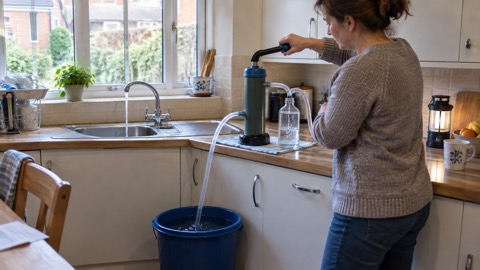
Emergency filters divide by how water moves through them. A gravity system drips water from an upper chamber through filter elements into a lower chamber, using nothing but the weight of the water7. A pump filter pushes water through a cartridge by hand, so you work for each litre but can draw from almost any container or stream. A bottle filter is a drinking bottle with a filter in the cap or straw, so you filter as you sip. A straw filter is the smallest of all: you drink directly through the filter from the source. Makers of portable filters describe the straw type as working "without the need for electricity, chemicals, or extensive training"8.
| Type | How water moves | Power or plumbing needed | Best suited to | Where to read more |
|---|---|---|---|---|
| Gravity system | Drips from upper to lower chamber under its own weight7 | No electricity, no plumbing7 | A household needing drinking water for several people over hours or days | Gravity filters and ceramic candles explained |
| Pump filter | Hand-pumped through a cartridge | None | Treating collected water in buckets or from streams, one litre at a time | Hand pump filters for treating collected water |
| Bottle filter | Sipped through a filter in the bottle | None | One person on the move, refilling from taps or containers | Filter bottles and straw filters for one person |
| Straw filter | Drunk directly through the filter | None | One person, single drinks, lightest to carry | Filter bottles and straw filters for one person |
The choice comes down to volume and mobility. A household sheltering at home wants a gravity system, because it holds and treats water in useful quantities without anyone pumping. A household that may need to move, or a single person, wants something that fits in a bag. Households on private supplies may want a pump or gravity system as part of everyday treatment rather than emergency kit.
Gravity systems: the one that keeps working through cuts
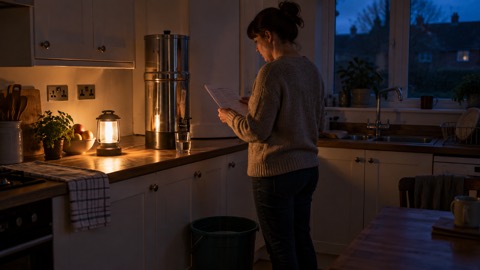
A gravity-fed system works by using gravity to pull water from an upper chamber through specialist filters into a lower chamber7. Because gravity does all the work, it needs no electricity and no plumbing, and makers state plainly that these systems work during water or power outages7. That is the whole case for a gravity filter as emergency kit: the two things an outage removes are mains pressure and mains power, and a gravity system depends on neither.
Doulton, whose British Berkefeld range is a well known example in the UK, says its gravity systems suit two to six people at home, in a caravan or camping, for dealing with contaminants and taste8. A gravity system needs no electricity and no plumbing, and it works during water or power outages, which is what makes it useful in an emergency7. All water that reaches the bottom chamber is filtered water7, so the lower chamber doubles as a safe store: you fill the top, leave it, and draw clean water from the tap below.
Two honest trade-offs come with that independence. The first is speed: gravity filtration is slower than a plumbed-in system precisely because gravity does all the work7. The second is labour: manual refilling is required7, and the system takes up counter top space and needs manual intervention15. Neither is a reason to avoid the type; both are reasons to size it and place it sensibly, which we come to below.
If you are weighing a gravity system against the under-sink filter you may already have, our comparison page gravity filter or under-sink filter? works through the differences. The short version: an under-sink filter needs mains pressure and a working pipe to do anything at all, so it is not emergency kit.
Setting one up: chambers, elements and the first flushes
Setting up a gravity system is deliberately simple, and the maker's own instructions describe it in a few steps. You install the filter elements inside the top chamber, place that over the bottom chamber, and for the first few uses you flush the water through and discard it7. That first-flush step matters: it clears manufacturing residues and fine particles from the new elements before you drink anything.
- Install the filter elements inside the top chamber, following the maker's instructions for how many elements your system takes7.
- Place the top chamber over the bottom chamber, seated properly so nothing can bypass the elements7.
- Fill the top chamber with the best water you have available and let it drip through.
- For the first few uses, flush the water through and discard it rather than drinking it7.
- After flushing, fill the top chamber and treat everything in the bottom chamber as filtered water7.
- Keep the top chamber topped up as you draw water from below, since manual refilling is required7.
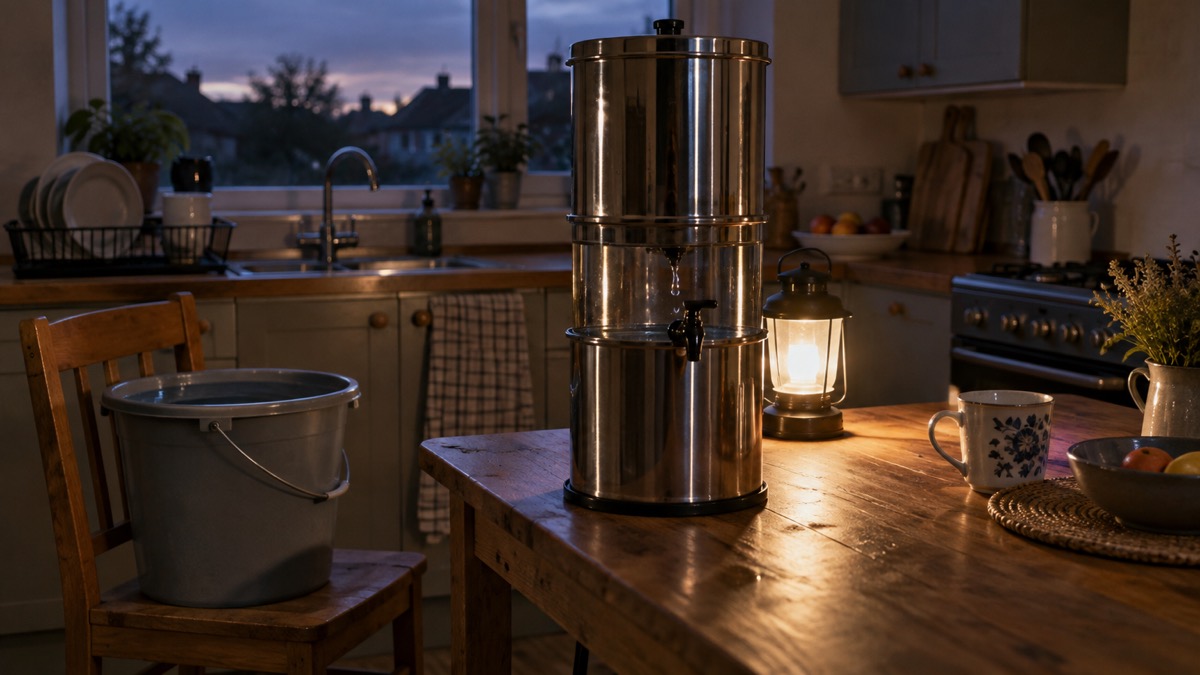
Where you place it is part of the setup. Makers note that a gravity system can be moved around and taken with you on house moves or holidays15, and that you have the flexibility to place it where needed and keep the water topped up15. Put it somewhere stable, at a height you can lift a full top chamber onto, and where the tap on the bottom chamber has room for a jug or glass beneath it. If your household's numbers vary through the day, that flexibility is one of the type's real advantages: you top up when demand rises rather than being fixed to a plumbed unit's output.
One placement caution: keep the system out of the way of cooking splashes and general kitchen traffic. The bottom chamber is your drinking water store, and the tap and lid are the parts hands touch most. Clean hands before drawing water, and keep the lid on between uses.
Speed and space: the limits to plan around
Gravity's independence has a price, and it is worth knowing it before you buy rather than after. The maker's own list of the type's drawbacks is short but real: a slower filtration rate due to gravity doing all the work, manual refilling required, and a system that takes up counter top space and needs manual intervention7. None of these is a safety problem; all of them shape how you use it.
The practical answer to slowness is to filter ahead of need. Because the bottom chamber is a store of filtered water7, a gravity system works like a slow battery: you fill the top chamber when you think of it, and clean water accumulates below. Households that wait until they are thirsty will find the drip rate frustrating; households that keep the top chamber topped up never notice it. Scottish guidance on filter candles makes the same point from the maintenance side: one sign that a candle needs cleaning is simply that the water starts to percolate more slowly9.
Space is the other limit. A gravity system lives on your worktop, not in a cupboard, because it needs headroom above the top chamber for filling and the bottom chamber's tap needs clearance below. Measure before choosing. Against that, the maker notes the systems are portable and can be used in any location7, so the space is not permanently committed: the same unit can move to a caravan, a holiday let or another room.
For households that need larger volumes faster, the alternatives are a bigger gravity system topped up more often, or a hand pump filter for bulk treating collected water, which trades effort for speed. What you cannot do is make gravity quicker by wishing: the physics is the feature.
Bottle and straw filters: filtering as you drink
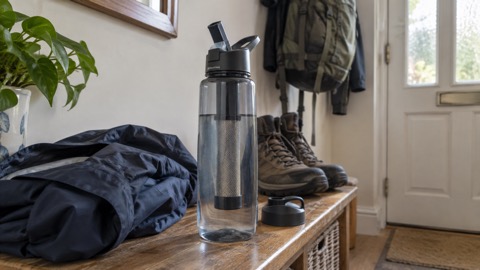
At the opposite end of the scale from a countertop gravity system are the filters you drink through. A bottle filter is a bottle with a filter built in, so every sip passes through it; a straw filter is thinner still, and you drink directly through it from a container or source. The maker describes this class as working "without the need for electricity, chemicals, or extensive training"8, which is a fair summary of their appeal: nothing to set up, nothing to pump, nothing to carry beyond the filter itself.
Their limit is volume. A bottle or straw filters one person's drinks, one at a time; it does not fill a kettle, a saucepan for cooking, or a washing bowl. For a household, that makes them a supplement rather than a substitute: a gravity system or stored bottled water covers cooking and hand washing, while a bottle filter covers the person who has to travel, walk to a bowser or refill from a public tap. Our page on filter bottles and straw filters for one person covers the detail.
Two safety points apply to any filter used away from the mains. First, most alternative water sources will need to be filtered before purification tablets are used, and tablets come in different strengths, so always follow the instructions on the product label14. Second, a filter that improves taste is not the same as one that makes water safe: for what different filter media actually remove, see ceramic, carbon, hollow-fibre and RO: what each removes and filter claims and certification. If you are drinking from streams or rivers rather than stored water, read drinking from streams, rivers and other sources safely first.
What is actually inside: mesh, carbon and ceramic
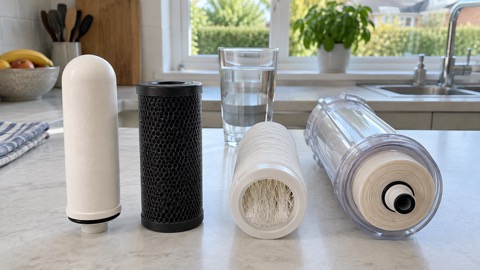
The word "filter" covers several very different materials, and knowing which is which stops you expecting the wrong thing from your kit. The coarsest layer is simple mesh or a screen, which catches visible particles and sediment. Finer than that, ceramic filter candles, the elements used in gravity systems, force water through a fired ceramic wall whose pores are small enough to hold back much of what you cannot see. Different again, activated carbon absorbs dissolved substances rather than particles.
Carbon's role is specific and worth understanding, because it is the most commonly misunderstood. United Utilities explains that "a water filtration device containing carbon will absorb chlorine and other naturally occurring substances", and that such devices are not necessary, though some customers like to use them, provided they follow the manufacturer's maintenance instructions16. Doulton's own guidance describes an activated carbon filter as being for "basic water polishing"15. In other words, carbon is about taste and odour, and chlorine removal, not about making unsafe water safe.
That has a direct safety consequence, and it is the reason the maintenance section below is not optional reading. A filter that is not maintained loses the protection it was bought for: damage reduces effectiveness and can allow impurities to leach back and harmful bacteria to grow9. Follow the manufacturer's maintenance instructions for whatever filter you choose, and treat any cartridge that has sat unused or uncleaned with suspicion rather than confidence.
For private supplies, the filter stack can be longer. Scottish guidance on filter candles notes that pre-filters can be added, including ion exchange resin to remove heavy metals such as lead or to help soften the water9. Households on private supplies should match the stack to what their water actually contains, which starts with testing it, not with buying every cartridge on the shelf.
Choosing a size for your household
Sizing a filter is about matching capacity to use, and the maker's own selection guidance says exactly that: select the right capacity, meaning filter lifespan and size based on household water use15. For emergency purposes, "household water use" means drinking water and water for food preparation, not washing or flushing, since official guidance during an interruption is to use alternative supplies solely for drinking, washing your hands and food preparation5. Work out how much drinking water your household needs from our guide to how much drinking water to store per person, then choose a system whose chambers and elements can deliver it with sensible topping up.
Doulton positions its British Berkefeld gravity range for two to six people for home, caravan or camping use, addressing contaminants and taste8. That range is a useful anchor: a two-person household and a six-person household can both be served by the same type of system, differing in chamber size and how often the top chamber is refilled. The maker also notes that for households with varying numbers of users, a gravity system works well because you can place it where needed and keep the water topped up accordingly15.
Scottish guidance adds a cost angle that is easy to miss at purchase: consider how much water you use before choosing a filter, because the wrong type may need more cleaning and more frequent replacement, adding to overall cost9. A system that is too small for your household will be cleaned and refilled constantly; one that is comfortably sized will run longer between interventions. Buy for the household you actually are, including visitors.
For people who may need to leave home at short notice, keep some of the kit in a waterproof bag, as Ready Scotland advises for emergency kit generally, for example if your home is at risk of flooding17. A straw or bottle filter belongs in that grab bag; a countertop gravity system does not, which is a fair argument for holding both types if budget allows.
Keeping it clean, and knowing when to replace it
A filter that is not maintained is worse than no filter, because it can become the problem. The Drinking Water Quality Regulator for Scotland's guidance on filter candles is the clearest official statement of this: "if they are not cleaned frequently and replaced when required, the water quality is reduced. Any cracks or damage to the [filter]" reduce effectiveness and can lead to impurities leaching back and harmful bacterial growth9. The same guidance sets the routine: filter candles should be cleaned and inspected every few weeks, or when the water starts to percolate more slowly9.
The hygiene rules around that routine matter as much as the routine itself. Because filters can collect microbes, wash your hands after cleaning or replacing a filter, and if someone in the household is immunocompromised, they should get someone else to replace filters if possible9. Handle elements by the edges where you can, and clean them with clean hands over a clean sink, not over the bottom chamber.
- Clean and inspect candles every few weeks, or when percolation slows9
- Replace any filter that is cracked or damaged, since damage reduces effectiveness and can allow impurities to leach back and harmful bacteria to grow9
- Wash your hands after cleaning or replacing a filter, as filters can collect microbes9
- Follow the manufacturer's maintenance instructions for your filter, since an unmaintained filter loses the protection it was bought for9
- Keep spares of equipment that needs regular replacement, as Argyll and Bute Council recommends for private supplies18
- After a flood or storm affecting a private supply, replace filters, and check any UV disinfection system's quartz sleeve and bulb11
For households on private supplies, replacement is part of everyday running, not emergency housekeeping. Argyll and Bute Council recommends keeping spares of equipment that needs regular replacement, such as UV bulbs and filters18, and after floods or storms its guidance is to replace filters and ensure any UV system's quartz sleeve is clean and its bulb operational and renewed within the previous year or as the manufacturer's handbook requires11. The Drinking Water Inspectorate's advice to private supply holders is the same in principle: cartridge filters need to be cleaned or replaced according to the manufacturer's instructions19.
Our page looking after a filter: priming, cleaning, cartridges and frost goes through the practical detail, including what frost can do to a ceramic candle in a caravan or outbuilding over winter.
Where filters sit in the wider plan
A filter is one layer, and not the first. The foundation is stored water: official emergency kit guidance across the UK includes water for drinking and sanitation20, drinkable water in plastic bottles for pets20, and water purification tablets20. Alongside water, a household kit holds essentials such as spare keys for your windows, car and house21, essential medicines22, and sanitary items and toiletries23. Our supply interruption checklist and emergency kit guide pull those together.
The second layer is knowing what to do when the supply fails: check for an outage, report no water, and follow your water company's instructions, which is the body that will tell you what to do if there is a problem with your mains water3. When bottled water, tankers or bowsers are provided, our page on bottled supplies, tankers and bowsers from your water company explains how they reach you, and how to get bottled water delivered if you are vulnerable covers the extra help available.
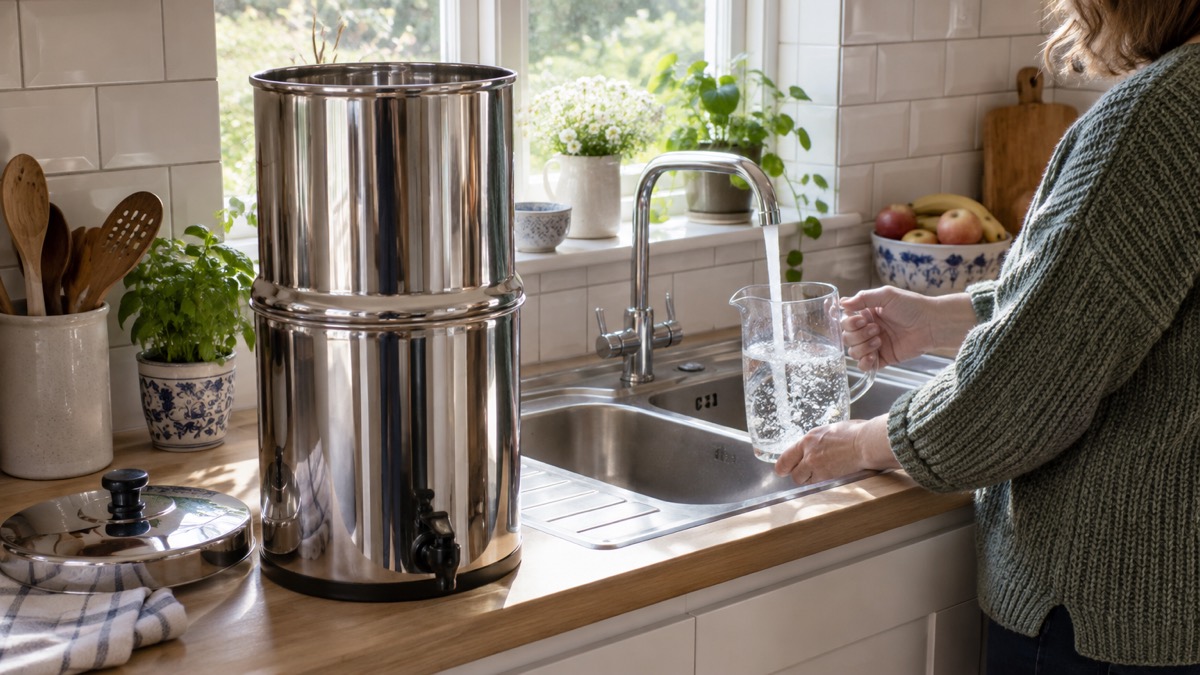
The third layer is treatment on demand: boiling, tablets and the filters on this page. When the supply returns, run your taps before using the water. London Fire Brigade's after-a-flood advice is to give your taps a good clean and run the water for a while before using24, and the Drinking Water Inspectorate suggests running the original tap for a few minutes before tasting again, which may clear the problem through flushing25. Welsh Water applies the same logic to filters: run your cold tap for a minute or two before using a jug filter, and allow the tap to run long enough to remove standing water from the pipework before filling any container1. Scottish flood guidance goes further for private supplies: remove any screens, filters, flow regulators and aerators, clean the reusable parts with hot water and a detergent suitable for food contact items, apply a mild disinfectant suitable for food contact or drinking water disinfection, rinse, reassemble, and run the tap for a few minutes before use11.
Sources (25)
- Water quality in the home, Dŵr Cymru Welsh Water, 2026
- Flooding and drinking water, Drinking Water Inspectorate, 2026
- Weather and health, Public Health Wales, 2026
- Power cuts: be informed about hazards, Prepare Campaign, 2026
- Water supply interruptions or outages, Prepare Campaign, 2026
- Managing insufficiency of private water supplies, Drinking Water Inspectorate, 2025
- Countertop water filter systems, Doulton, 2026
- Portable water filters, Doulton, 2026
- Water filter candles: technical guidance, Drinking Water Quality Regulator for Scotland, 2026
- Taste and odour in drinking water, Drinking Water Inspectorate, 2024
- Private water supplies after floods or storms, Argyll and Bute Council, 2026
- Private water supplies, Scottish Borders Council, 2026
- Buying a dwelling with a private water supply, Drinking Water Inspectorate, 2026
- Water supply interruptions or outages, Be Ready Campaign, 2026
- How do I choose a water filter, Doulton, 2026
- Chlorine in your water, United Utilities, 2026
- Prepare an emergency kit, Ready Scotland, 2026
- Private water supplies, Argyll and Bute Council, 2026
- Protecting your private water supply, Drinking Water Inspectorate, 2026
- Get help and advice in an emergency, Lincolnshire County Council, 2026
- Planning for an emergency kit, Wiltshire Council, 2026
- Preparing for a flood, nidirect, 2025
- Preparing for an emergency, Nottinghamshire County Council, 2026
- After a flood: flooding advice, London Fire Brigade, 2026
- TCP or medicinal taste and odour, Drinking Water Inspectorate, 2026
 Supply Interruption Checklist
 Boil Notice Checklist
 Drinking Supply Checklist
 How Much Water to Store
 Storing Tap Water Safely
 Containers and Jerrycans
 Household Storage Tanks
 Water Already in Your Pipes
 Making Water Safe to Drink
 Boiling Water to Kill Germs
 Purification Tablets
 What Water Filters Remove
 Gravity Filters Explained
 Hand Pump Filters
 Filter Bottles and Straw Filters