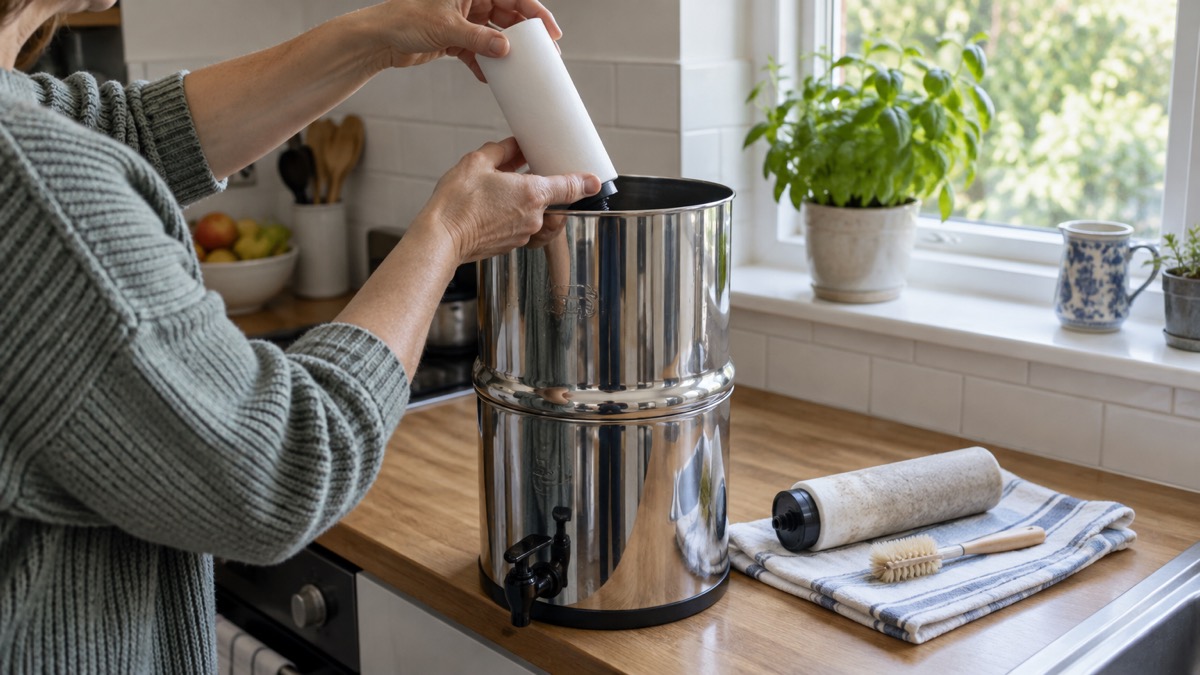
A water filter only keeps water safe if you look after it. The three habits that matter most are simple: check the filter for damage before you use it, run water through it for about 5 minutes after it has stood unused, and clean a ceramic candle every few weeks with clean warm water and a soft brush, never with soap or detergent1. Beyond that, watch for the signs that a cartridge is reaching the end of its life: the flow rate drops and the filter becomes harder to pump, at which point the maker advises replacing the cartridge2. Once primed, a cartridge can be used continuously for up to 3 months or until it becomes blocked, whichever occurs first2.
This page covers the care of the filters most UK households keep for emergencies or use on a private supply: gravity filters with ceramic candles, and cartridge filters such as bottle and hollow-fibre purifiers. The makers' own guidance tells you how to spot a cartridge nearing the end of its life: the flow rate reduces and pumping becomes harder, and the cartridge should then be replaced2. If you are choosing a filter in the first place, start with our guides to emergency filters and gravity filters and ceramic candles.
Before every use: check for damage, then flush for 5 minutes
Whenever a filter has been stood unused, whether for a fortnight or a whole winter, the routine is the same. First check the filter for damage: look over the candle or cartridge and its casing for cracks, chips or splits. Then run water through the filter for about 5 minutes before you collect any water to drink1. This is the advice of the Drinking Water Quality Regulator for Scotland (DWQR), and it applies to any filter that has been out of action for a period of time.
The reason for both steps is the same. A filter that has stood still can grow bacteria within its pores and casing, and the first water through it carries that residue with it. Flushing clears it. Damage matters even more: cracks or damage to a candle reduce its effectiveness and can lead to impurities leaching back into the filtered water and harmful bacterial growth1. A cracked candle can let water bypass the filtering material entirely, so water that looks clear has simply not been filtered.
The same principle applies to whole properties. Dŵr Cymru Welsh Water advises that if a property has been unoccupied for a while, you should flush the water through the system to remove stagnant water from the pipework, and contact the water company if there is an unusual taste, odour or appearance afterwards5. So if you are returning to a holiday home or a house that has been empty, flush the plumbing as well as the filter. Our page on what to do if water tastes odd after a holiday covers this in more detail.
Cleaning a ceramic candle: every few weeks, with water and a soft brush
A water filter candle is a type of water purification system that removes impurities from water. The candle is made of porous materials such as cotton, paper or ceramic, and its pores allow water to pass through while trapping impurities such as dirt and bacteria1. Over time those trapped particles build up on the outside of the candle and the flow slows. That is the signal to clean.
The DWQR recommends that candles are cleaned and inspected every few weeks, or when the water starts to percolate more slowly1. The method is straightforward:
- Unscrew the filter candle from its plastic casing1.
- Put on rubber gloves1.
- Clean the candle with clean warm water and a soft brush or damp cloth1.
- Inspect it for cracks or damage as you clean1.
- Wash your hands after you finish, as filters can collect microbes1.
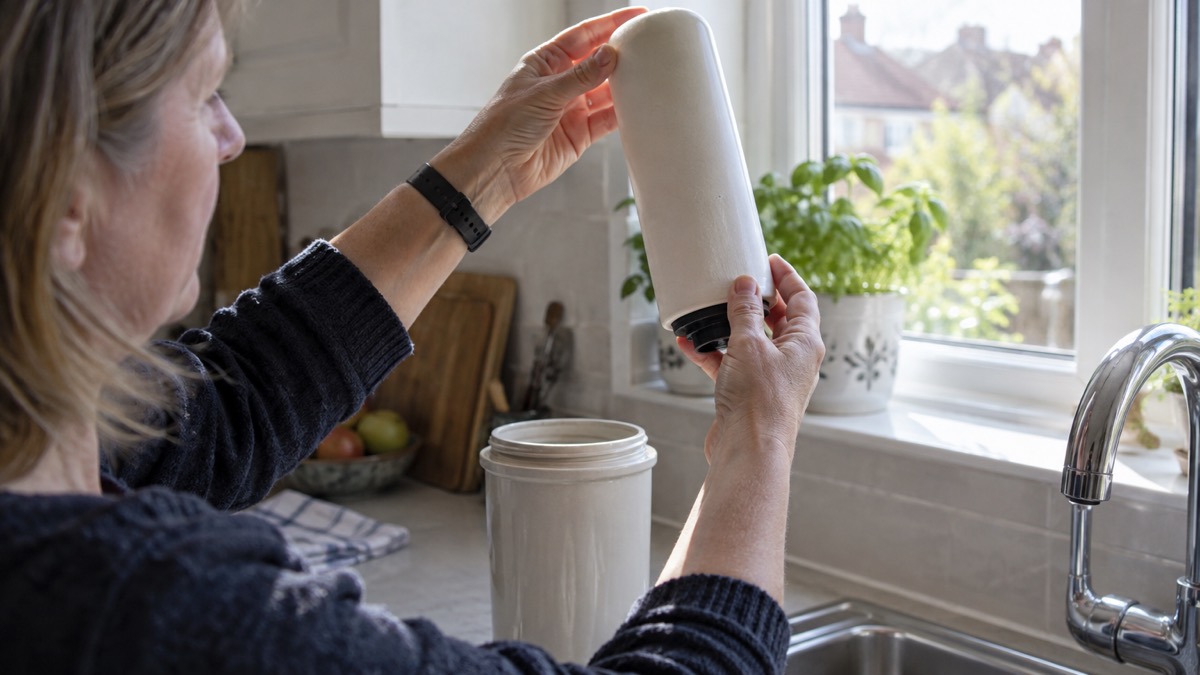
What you are doing is removing the layer of trapped sediment from the surface, which opens the pores back up. You are not cleaning deep inside the candle, and you do not need to: the dirt is caught on the outside, which is why gentle brushing works. With proper care a candle can last for many months1, though it will still need replacing eventually, as covered below.
Cleaning also gives you a natural inspection point. Because you are handling the candle every few weeks, you will notice a crack, a chip or a worn patch early, before it can affect your water. Make cleaning part of the routine rather than something you do only when the flow has slowed to a trickle.
Never use soap, detergent or bleach on a filter
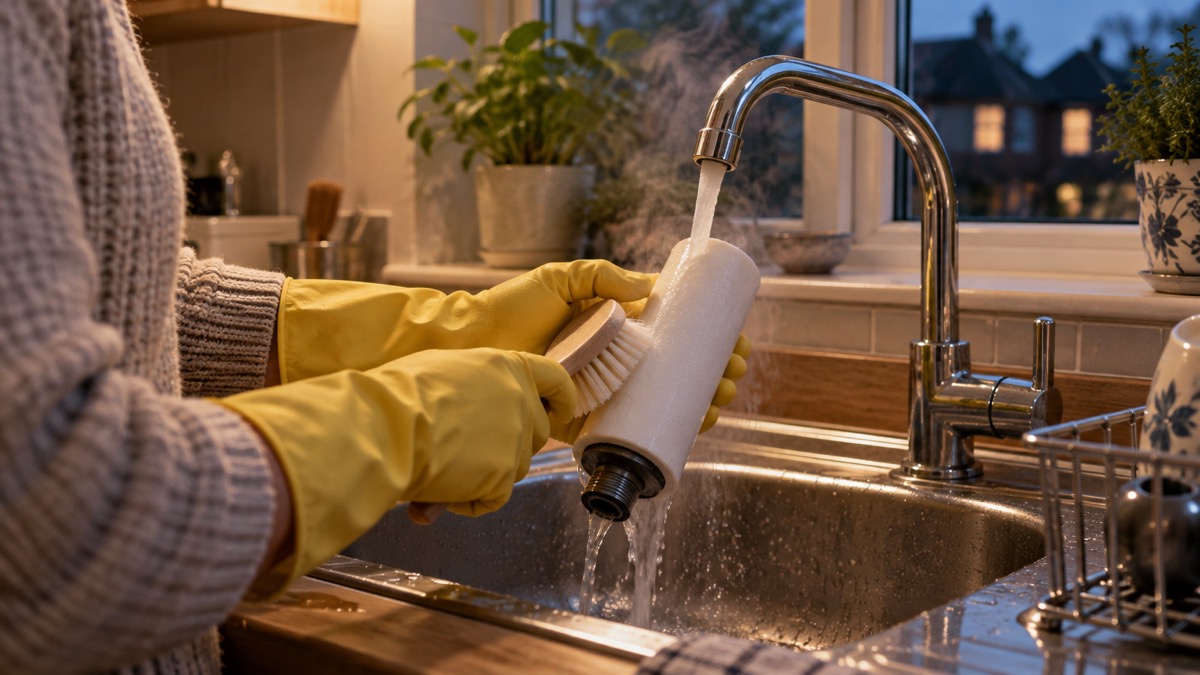
This is the rule people most often get wrong, and it applies to every type of filter element. The DWQR states plainly that it is not recommended to use soap or detergent to clean filter candles1. LifeSystems gives the same instruction for its Soft Flask cartridge: do not wash the cartridge with soap, detergent, bleach or other cleaning products, do not place it in a dishwasher, and do not backwash it2.
The reason is that filter materials are absorbent and porous. Soap and detergent residues soak into the pores and are very difficult to rinse out, so they end up in the next water you drink. Worse, some cleaning products can break down the filtering material itself or the seals around it. A filter cleaned with detergent is not a cleaner filter; it is a contaminated one.
There is a distinction worth knowing, though, and it applies to jug filters in particular. Dŵr Cymru Welsh Water advises washing your filter jug with hot soapy water on a regular basis, but not the filter itself5. The housing, the jug and the spigot can and should be washed normally, because they do not filter the water. Only the element, the candle or cartridge, must never touch soap. Wash the container, rinse it well, and handle the element with clean warm water only.
Keeping hands, tools and the household safe
Filters sit at the point where dirty water becomes drinking water, so hygiene around them matters. The DWQR recommends that you wash your hands after cleaning or replacing a filter, because filters can collect microbes1. Wear rubber gloves while handling the candle, as noted above, and wash your hands again once the job is done.
For households on a private supply, the Drinking Water Inspectorate advises following good hygiene practices when working on the system, including hand washing and disinfection of tools6. If you are swapping a candle in a system that treats water from a well, borehole or spring, disinfect the spanner or brush you use as well as washing your hands. Our guide to private supplies covers the wider responsibilities.
One group needs to take particular care. The DWQR recommends that immunocompromised people should get someone else to replace filters if possible1. If someone in your household is undergoing treatment that weakens the immune system, or has a condition that does, let another adult handle the filter work. The trapped microbes in a used candle are exactly what a weakened immune system should not meet.
Filtered water itself needs care once it is made. Dŵr Cymru advises storing filtered water in the fridge and using it within 24 hours of filtering, and not letting filtered water stand for any length of time in direct sunlight5. Filtering removes the chlorine that keeps mains water stable in storage, so treat filtered water as a fresh product, not a stored one. Our pages on storing tap water safely and how long you can keep boiled water in the fridge set out the storage rules for other kinds of water.
Replacing candles: about every 6 months depending on use
Cleaning extends a candle's life, but it does not extend it forever. Rough guidance from the DWQR suggests that candles should be replaced every 6 months depending on usage1. A filter used daily on a silty private supply will need new candles sooner than one used occasionally during emergencies. The regulator's guidance pairs the 6-month figure with the cleaning routine: a candle that is cleaned frequently and replaced when required keeps the water quality up, while one that is not lets it fall1.
A medical device example shows how standard the interval is: the NHS Leeds Teaching Hospitals manual for Lumis 100/150 machines instructs users to change the filter every 6 months, with an on-screen reminder to prompt it7. Treat 6 months as your planning figure for any ceramic candle, and check your maker's instructions for the specific product.
Because candles are a regular-replacement item, keep spares. Argyll and Bute Council, whose area has many private supplies, recommends keeping a spare of those pieces of equipment that need to be replaced regularly, such as UV bulbs and filters8. A spare candle stored sealed means a slow flow or a cracked candle is a five-minute fix rather than the end of your filtered water. Cornwall Council likewise advises households on private supplies to make sure filters and UV treatment systems are serviced and maintained9.
| What | Interval | Notes |
|---|---|---|
| Clean and inspect a candle | Every few weeks, or when flow slows | Warm water, soft brush, gloves1 |
| Replace a candle | About every 6 months | Sooner with heavy use or silty water1 |
| Flush after non-use | About 5 minutes | Check for damage first1 |
| Use filtered water | Within 24 hours of filtering | Store in the fridge, out of sunlight5 |
Cartridge life: 10 years sealed, 2 years once opened
Cartridge filters, the sealed elements used in bottle filters and purifiers, have a different life pattern from ceramic candles. LifeSystems states that an unopened cartridge has a shelf life of up to 10 years when stored correctly in its original sealed packaging2. Once opened and put into use, the same maker's guidance treats the cartridge as a consumable with a much shorter working life: replace it three months after first use, or after it has treated 250 litres, whichever comes first2.
That makes cartridges an excellent thing to buy ahead and store, and a poor thing to install and forget. A sealed spare in a drawer is good for up to a decade; a cartridge fitted to a bottle that lives in a rucksack is on a three-month clock from the day it first gets wet. If you keep a filter bottle for emergencies, note the date you first use it, and treat the cartridge as expired three months later even if it has barely been used.
The full list of reasons to replace a Soft Flask cartridge, from the maker, is worth keeping to hand. Replace the cartridge when any of the following applies: three months have passed since it was first used; it has treated 250 litres; water no longer passes through; the flow is unacceptably slow; the cartridge may have frozen or been damaged; it has been exposed to water hotter than 50°C; or you are uncertain whether it has been stored or handled safely2. The last two matter more than people expect, and the freezing one is covered below.
How do you know a cartridge has had it?
The most reliable sign is the flow. LifeSystems explains that the flow gradually slows as the cartridge collects sediment and other contaminants, more quickly with cloudy or silty water, and advises checking the installation and twist valve before concluding the cartridge is at fault2. If the flow stays unacceptably slow after you have ruled out installation problems, replace the cartridge. Do not backwash it, force water through at high pressure, or clean it with soap or chemicals2.
LifeSaver, whose ultrafiltration products work on a similar principle, gives the same signal for its UF Cartridge: eventually nearly all the pores will be blocked and the flow rate will slow down to a rate which is unacceptable to you, and that is the point to replace it3. The maker also offers a reassurance worth quoting: the water is equally safe from the first litre to the last3. A slowing cartridge is not failing to filter; it is filtering more slowly. You choose when the pace becomes unacceptable, and until then the water is as safe as it was on day one.
That said, do not push a cartridge past its other limits. The three-month and 250-litre figures, freezing, damage and heat exposure all end a cartridge's life regardless of how well it still flows2. And if water stops passing through altogether, the cartridge is finished; forcing it is both futile and against the maker's instructions2.
"Eventually nearly all the pores will be blocked and the flow rate will slow down to a rate which is unacceptable to you."
Silt and dirty water shorten a cartridge's life
The water you put in determines how long the cartridge lasts. LifeSystems advises that very cloudy or silty water reduces flow and shortens cartridge life, and recommends two simple steps: where possible, allow sediment to settle and collect the clearer water from the top, or pass the source water through a clean cloth before filling2. Either step takes the worst of the suspended particles out before they reach the cartridge, so the cartridge spends its life on the contaminants it is actually built to trap.
Note the maker's caveat: pre-filtered water must still pass through the purifier cartridge2. Settling and straining through cloth removes visible silt, but it does not remove bacteria or viruses, so it is a way of protecting the cartridge, not a substitute for it. Our guide to how to make water safe to drink sets out the full treatment chain, and what each filter type removes explains why the cartridge stage cannot be skipped.
The same logic applies to whole treatment systems on private supplies. Scottish Borders Council advises that water treatment systems need regular maintenance following the manufacturer's instructions, and that the maintenance frequency will need to be increased during prolonged periods of heavy rainfall, when source water carries more sediment10. Keep a record of all maintenance carried out on the system, as the council recommends10, so you can see whether heavy weather is accelerating your candle or cartridge consumption.
Frost: the filter killer to plan for
Freezing does not just pause a filter, it can end it. When water freezes inside a ceramic candle or a hollow-fibre cartridge, the ice expands and cracks the filtering material, often invisibly. That is why LifeSystems lists a cartridge that may have frozen as a reason to replace it outright, alongside visible damage2. A cartridge that has been through a hard frost in a shed, a car boot or an unheated outbuilding should be treated as finished even if it looks intact, because you cannot see the internal damage.
Protect filters from freezing the way you protect pipework. Argyll and Bute Council's winter readiness advice is to protect water pipes from freezing and know how to find the stop valve for your water supply11. Bring filter candles, spare cartridges and filled filter housings indoors during cold spells: a cupboard under the stairs is safer than a garage. If a filter must stay in an unheated space, drain it down first so there is no water in it to freeze.
After any flood or storm, treat your filters as suspect. Argyll and Bute Council advises private supply users to replace any filters after floods or storms, and to check that UV disinfection systems have a clean quartz sleeve and an operational bulb renewed within the previous year or as the manufacturer's handbook requires12. The council also advises removing any screens, filters, flow regulators and aerators from taps, cleaning reusable parts with hot water and a detergent suitable for food contact items, applying a mild disinfectant suitable for food contact or drinking water disinfection, rinsing, reassembling and running the tap for a few minutes before use12. Note the distinction: tap aerators and screens can be cleaned with detergent because they do not filter, but filter elements themselves are replaced, not washed.
Storing a filter long term
Long-term storage needs a little planning, and the maker's instructions differ by product. For LifeSaver ultrafiltration products, the maker advises storing the product with a small amount of clean water inside and changing this water every couple of months to keep the membranes hydrated; if they dry out, the UF Cartridge will need replacing3. So a LifeSaver bottle or jerrycan stored empty for a year may arrive at the emergency with a dead cartridge. Store it wet, on a two-month water-change routine, or accept that the cartridge is a spare-in-waiting rather than a working one.
For sealed spares, follow the packaging rule: an unopened cartridge keeps for up to 10 years when stored correctly in its original sealed packaging2. Keep spares in their sealed wrappers, in a dry place indoors, away from frost and away from direct sunlight. Once opened, work to the maker's life limits rather than trying to store a part-used cartridge.
Whatever you store, the return-to-service routine from the top of this page applies: check for damage, then run water through for about 5 minutes before you drink1. Storage, however careful, is a period of non-use, and the flush is what makes the first litre as good as the rest.
Filters that need no electricity
One reason gravity filters suit emergency use is that they need no power. Ceramic candle filters do not require electricity to run, because the water is filtered under gravity1. You pour water into the upper chamber and it drips through the candles into the lower one, with nothing to plug in and nothing that stops in a power cut. During a storm or an outage that has also interrupted your supply, a gravity filter plus a stored reserve of water keeps working when a UV system, which does need power, does not.
If your household relies on UV treatment on a private supply, the maintenance burden is different. Scottish Borders Council advises that UV treatment should be regularly checked to ensure it is operating correctly, and the pre-filter replaced as required, dependent on the quality of the source water10. After floods or storms, check the quartz sleeve is clean and the bulb has been renewed within the previous year12. A UV system with a tired bulb or a clogged pre-filter gives the appearance of treatment without the substance, so diarise the checks.
A final note on chlorine-removing filters. The Drinking Water Quality Regulator for Scotland notes that a number of domestic water filters will remove chlorine, and that consumers who choose to use them must maintain them in accordance with manufacturers' instructions to remain safe to use13. Removing chlorine is fine for taste, but chlorine is what keeps stored water safe, so filtered water goes back to the 24-hour fridge rule5. For comparison of the main types, see gravity filters and ceramic candles, filter bottles and straws and what each filter type removes.
Sources (13)
- Water filter candles: technical guidance to treatment, Drinking Water Quality Regulator for Scotland, 2026
- Water Filter Purifier Soft Flask FAQs, LifeSystems, 2026
- LifeSaver product information and FAQs, LifeSaver, 2026
- Water Filter Purifier Cartridge | Lifesystems, Life Systems
- Water quality in the home, Dŵr Cymru Welsh Water, 2026
- Protecting your private water supply, Drinking Water Inspectorate, 2026
- Lumis 100/150 user manual, Leeds Teaching Hospitals NHS Trust, 2024
- Private water supplies in Argyll and Bute, Argyll and Bute Council, 2026
- Private water supplies in Cornwall, Cornwall Council, 2026
- Private water supplies: treatment and maintenance, Scottish Borders Council, 2026
- Winter weather: be prepared, Argyll and Bute Council, 2026
- Private water supplies after floods or storms, Argyll and Bute Council, 2026
- Chlorine in drinking water: FAQs, Drinking Water Quality Regulator for Scotland, 2026
 Supply Interruption Checklist
 Boil Notice Checklist
 Drinking Supply Checklist
 How Much Water to Store
 Storing Tap Water Safely
 Containers and Jerrycans
 Household Storage Tanks
 Water Already in Your Pipes
 Making Water Safe to Drink
 Boiling Water to Kill Germs
 Purification Tablets
 Emergency Filter Types
 What Water Filters Remove
 Gravity Filters Explained
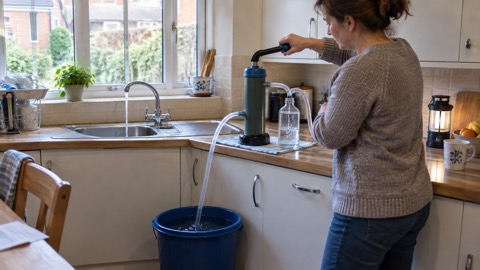 Hand Pump Filters