
Lifesystems is a UK maker of outdoor and expedition equipment: water treatment, first aid kits, survival shelters and the small personal kit that hill walkers, climbers and expedition participants carry when they are beyond easy help. Its products are built for people who may be a long way from a tap, a chemist or a rescue team, which is exactly the situation a household can find itself in during a flood, a power cut or a storm that closes roads for a day or two.
For an ordinary household, the useful parts of the Lifesystems range are the ones that overlap with a home emergency kit: a water filter purifier bottle that treats up to 600 litres of water1, a survival bag that keeps one person warm and dry in the worst weather, and first aid and personal kit in packable form. One of its products, the Water Filter Purifier Bottle, carries the DofE Recommended Kit mark1, meaning it has been recommended for Duke of Edinburgh's Award expeditions, where participants carry everything they need for several days.
This page covers what Lifesystems makes for UK households in each area of emergency preparedness, how an expedition kit list turns into a household emergency kit, and where to find support, warranty and safety information for its products.
What Lifesystems makes for UK households
Lifesystems designs kit for the outdoors, and most of it falls into four groups that map directly onto the sections of a household emergency kit: water treatment, first aid, survival shelter and warmth, and the small tools and lighting that fill out a grab bag. The company's own product pages describe each item's purpose and specifications, and the Water Filter Purifier Bottle page is a good example of the level of detail available: capacity, filter life, cleaning and replaceable parts are all stated by the maker1.
The through-line for households is weight and packability. Expedition kit has to be carried, so it is designed to do its job in a small, light package. That matters at home too, because the kit you keep for emergencies is most useful if it fits in one bag you can grab on the way out of the door. Councils across the UK advise exactly this: keep a bag of items you might need in an emergency, whether in your home, your car, or simply as a list of where to find the items2.
What follows is a short guide to each kit type, what the Lifesystems approach offers, and where to read more on this site about that part of a household emergency kit.
Water treatment: the Lifesystems Water Filter Purifier Bottle
The Lifesystems Water Filter Purifier Bottle is a drinking bottle with a built-in filter and purifier, so you fill it from a source and drink through the filter. The maker states it has a 1000ml capacity and comes complete with the filter included1. The filter cartridge is long-lasting and treats up to 600 litres of water before it needs replacing, and the bottle is easy to clean with replaceable parts1.
| Specification | Value (maker's figures) |
|---|---|
| Product type | Water filter purifier bottle1 |
| Capacity | 1000ml1 |
| Filter life | Treats up to 600 litres of water1 |
| Filter included | Yes, comes complete with the filter1 |
| Maintenance | Easy to clean, with replaceable parts1 |
| Filter life indicator | Built-in, with a Life Indicator Ring for recording the date of the next filter change1 |
| Endorsement | DofE Recommended Kit1 |
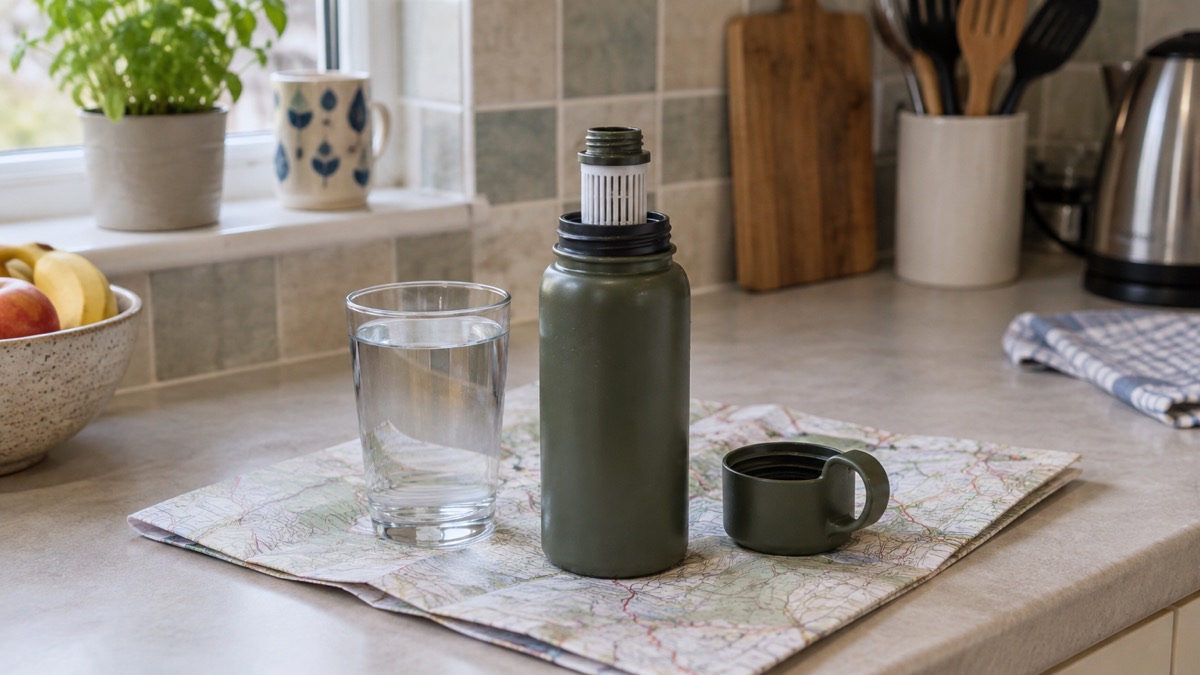
Two features matter for household use. First, the 600-litre filter life means one cartridge covers a great deal of drinking water for one person, which is why the product appears on expedition kit lists where participants cannot carry the water they need. Second, the Life Indicator Ring exists because a filter that has passed its useful life looks exactly the same as a new one: the ring is where you record the date of the next filter change, so check it as part of your routine kit checks1.
For a household, a filter bottle is a back-up to stored water, not a replacement for it. In a flood or a supply interruption you may have access to water that is not safe to drink as it stands, and a filter purifier bottle gives you a way to treat it. Read more about how much water to store and how to treat it in our guide to water in an emergency.
Survival shelter: the Lifesystems Survival Bag
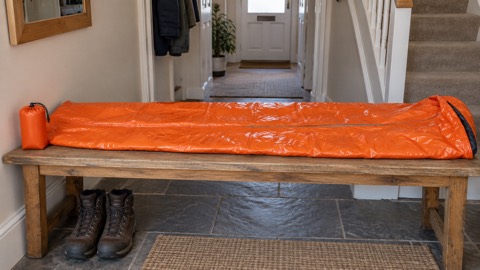
The Lifesystems Survival Bag is the company's basic emergency shelter: a bag a person can climb into to stay warm and dry when caught out in bad conditions or waiting for help. In expedition and mountain use it is the item you hope never to need and carry anyway, because exposure to wind and rain can become dangerous quickly.
At home, a survival bag earns its place in two situations. The first is evacuation: if you have to leave your house in a hurry in winter, during a flood or a gas incident, a survival bag in the car or the grab kit means one more layer between you and the weather while you wait or travel. The second is heating failure: if your boiler stops working in a cold snap and you are trying to keep one room warm, an emergency shelter bag is one more way to hold body heat overnight, particularly for an older or less mobile person who cannot easily add activity to stay warm.
Councils that publish emergency kit advice include items for warmth and shelter alongside the rest of the kit, and the principle is the same whether the item is a blanket or a survival bag: it has to be there before you need it. See our emergency kit guide for the full household list, and our guide to heating and cooking without mains power or gas for keeping warm during an outage.
First aid and personal kit
First aid and personal care items belong in any household emergency kit, and this is where an outdoor maker's range is most directly useful, because personal first aid kits designed to be carried on the hill are compact enough to live in a grab bag or a car's glovebox permanently. Lifesystems publishes kit lists and expedition resources with the Duke of Edinburgh's Award, available to download, share or print, which set out the essential equipment for time away from home4. The same maker has partnered with the British Mountaineering Council to support climbers, hill walkers and mountaineers through improved safety awareness, education and access to trusted outdoor safety equipment4.
The household version needs more than the expedition version in some respects and less in others. Less in that you are near your bathroom cabinet and your medicine supplies; more in that a home emergency kit has to serve everyone under one roof rather than one person walking a route. The Duke of Edinburgh's Award kit lists published by Lifesystems and Lifeventure are a workable starting pattern: they are written for people carrying everything they need, so anything they include is light and compact enough for a household grab bag5. Adapt the list to your own household rather than copying it exactly.
A first aid kit is only half of the preparation, the other half is knowing what to do with it. Our first aid at home guide covers the basics, and the health emergencies guide covers medicine supplies during outbreaks and disruptions.
Lighting, power and the small tools
The rest of an expedition kit list translates almost unchanged into the household list. North Hertfordshire District Council's emergency kit basics include a portable power bank, a first aid kit and manual, hand sanitiser and wet wipes, a battery or dynamo powered torch, matches in a waterproof container, spare batteries, a notepad and pencil, a whistle, tools to turn off utility supplies, local maps, rubbish bags with plastic ties, a dust mask, plastic sheeting and duct tape6. That list could sit in a rucksack on a Duke of Edinburgh's Award expedition or in a cupboard under the stairs, and it would be equally sensible in both places.
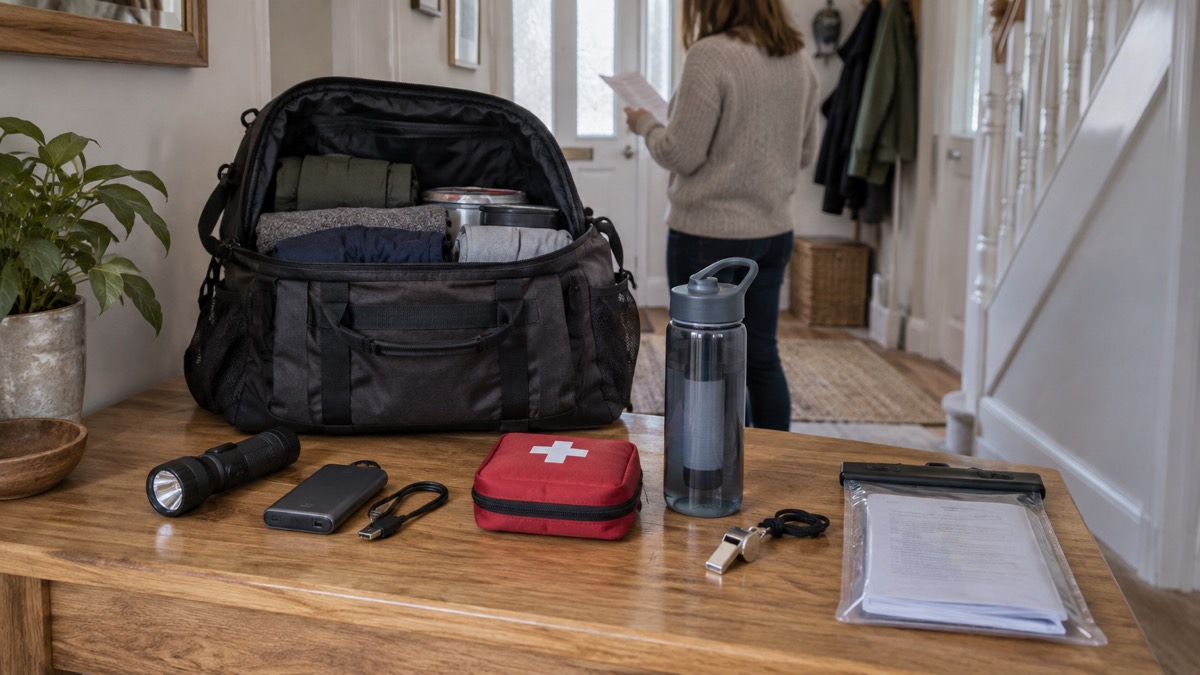
Two items deserve particular attention at home. The torch and spare batteries, or a dynamo torch that needs no batteries at all, matter because a power cut at night is the most common emergency a UK household actually faces; our guides to emergency lighting and power cuts cover the options. The tools to turn off utility supplies matter because knowing where your stopcock and gas isolation valve are, and having the tool to hand, turns a burst pipe or a gas smell from a crisis into a job you can start on yourself; see home emergencies.
If you keep a power bank in the kit, treat it as the lithium-ion battery it is. South Wales Fire and Rescue Service notes that rechargeable lithium-ion batteries are found in a wide range of household devices, from mobile phones and tablets to vacuum cleaners and ear pods7, and its guidance on safe charging and storage applies to power banks kept in an emergency kit as much as to anything else. Check the bank's charge as part of your routine kit checks.
*A household grab bag holds the same categories as an expedition kit: first aid, water, light, warmth, tools and information.
Turning an expedition kit list into a household emergency kit
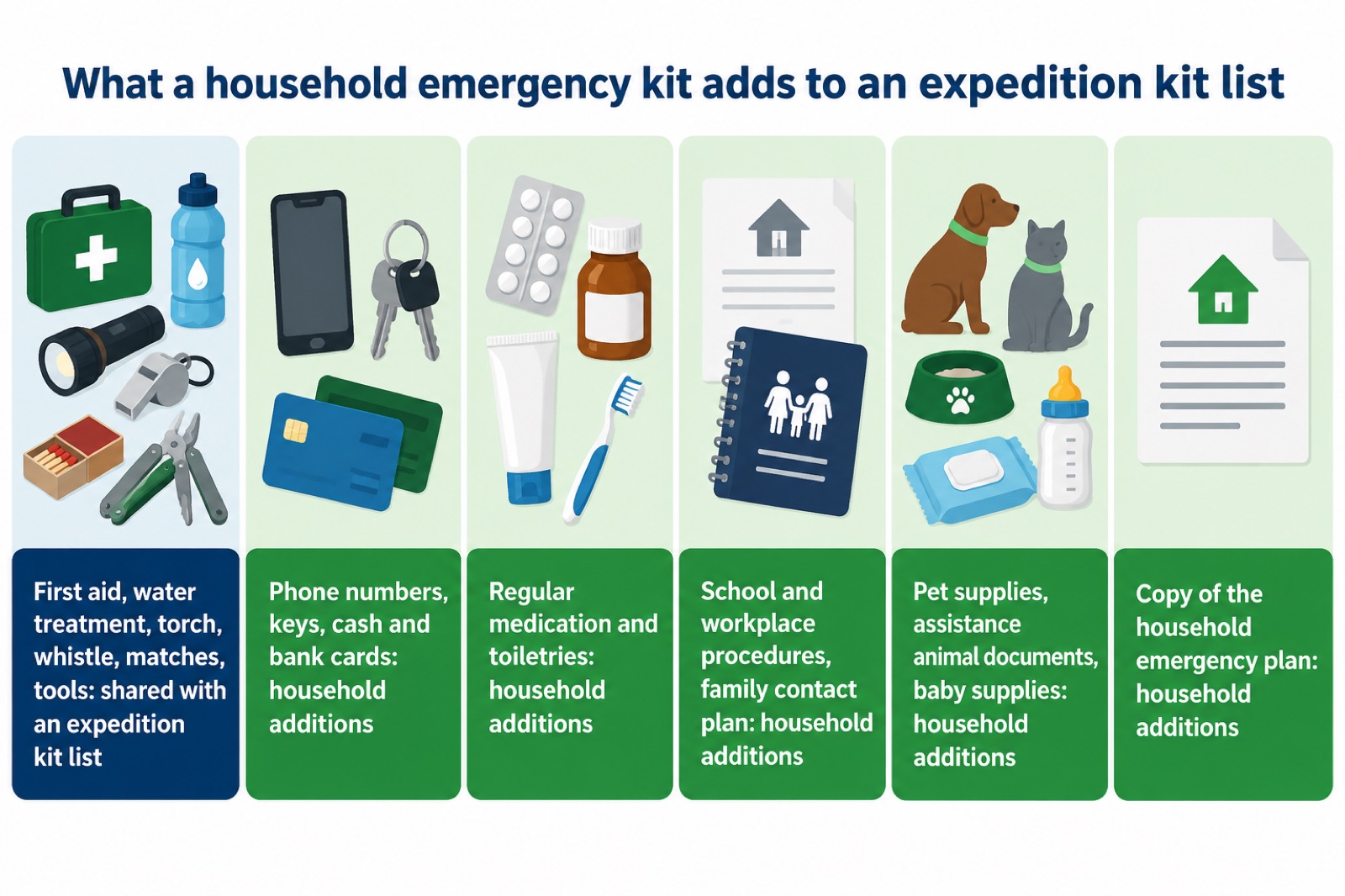
An expedition kit list and a household emergency kit list overlap heavily, because both answer the same question: what do I need to get through a period without normal services? The difference is what you add for home. Where the expedition list stops at personal kit, the household list adds documents, contact information and the specific needs of the people and animals in the house.
Anglesey's guidance gives the fullest household version: a list of useful phone numbers, house and car keys, toiletries and regular medication, a wind-up or battery radio with spare batteries, a first aid kit, emergency procedures for children's school and workplace, a family contact plan, a mobile phone and charger, cash and bank cards, and bottled water and ready-to-eat food5. Read that against the expedition basics in the section above and the pattern is clear: the outdoor list is the core, and the household additions are the things a hill walker does not need because they are at home, until home itself is the problem.
Three additions matter most, and all three come from official guidance:
- People and pets. Ready Scotland's household emergency kit advice includes pet supplies and any documents or supplies for assistance animals, and baby supplies such as nappies and ready-made infant formula8. An expedition list never has these; a household list must.
- A smaller personal kit. North Hertfordshire advises preparing a household emergency kit and a smaller personal kit, for example in a backpack, for use should you need to be evacuated, and making sure everyone knows where the kits are kept6. This is the grab bag, and it is the closest thing at home to a rucksack packed for an expedition.
- The plan itself. Dumfries and Galloway Council advises including a copy of your Household Emergency Lifesaving Plan in the household emergency pack9. Worcestershire's guidance on a Household Emergency Plan lists medication lists and medical needs, school pick-up arrangements and pet considerations, an essential items checklist and a simple grab bag10. The kit and the plan belong together.
If you are starting from nothing, begin with the getting started guide, then build the kit itself from the emergency kit guide. Households that need extra help, because of age, disability or medical dependence, should also read extra help in an emergency, and anyone with pets or assistance animals should read our guide to pets and animals in an emergency.
Support, warranty and safety notices
For support on a Lifesystems product, start with the maker's own product page. The Water Filter Purifier Bottle page, for example, states that the bottle is easy to clean with replaceable parts and comes complete with the filter included, and describes the Life Indicator Ring for recording the date of the next filter change1. Follow the maker's own instructions for its own products on cleaning, part replacement and filter changes, and record the date when you change a filter so the next check is a matter of reading the ring rather than guessing.
For safety notices and recalls, two checks are worth making on any safety-critical product, whoever makes it. The first is the mark: Peterborough Trading Standards advises making sure a life vest has a CE or UKCA mark and buying from a reputable retailer3, and the same principle of checking for the conformity mark and buying from a reputable seller applies across safety equipment. The second is the recall list: the Office for Product Safety and Standards has issued product recalls on 21 different life vests3, which shows both that recalls of safety equipment do happen and that there is an official system for finding them. Check for recalls before you rely on any item whose failure could matter, and re-check when you do your routine kit reviews.
Keep track of the items that expire or wear out. The Lifesystems Water Filter Purifier Soft Flask has a built-in filter life indicator that helps you track when the filter needs replacing, and the Water Filter Purifier Bottle has a Life Indicator Ring for recording the date of the next filter change6. For anything electrical in the kit, register it with the manufacturer so you will be informed of any safety recalls6. A kit whose dates and registrations are kept up to date is a kit that works when it is needed.
Sources (10)
- Lifesystems Water Filter Purifier Bottle product page, Lifesystems, 2026
- Preparing for an emergency, Nottinghamshire City Council, 2026
- Product safety campaigns, Peterborough City Council Trading Standards, 2026
- Planning for an emergency kit, Wiltshire Council, 2026
- Preparing for an emergency: what you need to know, Isle of Anglesey County Council, 2020
- Preparing for emergencies, North Hertfordshire District Council, 2015
- Lithium-ion batteries, South Wales Fire and Rescue Service, 2026
- Emergency kit, Ready Scotland, 2026
- Prepare for emergencies, Dumfries and Galloway Council, 2026
- Worcestershire Prepared, Worcestershire County Council, 2026
 Lifesystems Survival Bag