Lomo is a UK maker whose kit sits in the waterproof and emergency end of the outdoor market: dry bags, foil blankets and related equipment that ordinary households can use to keep things dry, keep warm and carry essentials when they have to leave home quickly or get through a disruption. Its products are the sort of thing UK emergency guidance actually asks households to own. Official preparedness advice tells you to put documents in a waterproof wallet, pack warm waterproof clothing and sturdy footwear in a grab bag, and keep a foil blanket or similar among your emergency supplies1.
The product this page can describe in verified detail is the Lomo Emergency Foil Blanket Silver 200 Pack. The maker states it is a versatile accessory for first aid, emergency and survival situations, that it protects the user from wind and helps retain body heat, and that it is suited to treating or preventing hypothermia2. It comes as a pack of 200 blankets, each folded to 7.5cm x 11.5cm, and carries barcode 50606697764442. Around that core, this page sets out what Lomo-type kit does for a household, how to choose it, how to use and care for it safely, and where to turn for support, returns and recall information.
What Lomo makes for UK households
Lomo's range is aimed at keeping people and their belongings dry and protected outdoors, which is exactly the gap most households have when an emergency hits. UK flooding guidance asks households to pack documents in a waterproof wallet, warm waterproof clothing, sturdy footwear such as wellies or waterproof boots, water and snacks into a grab bag stored where it can easily be reached1. Cold weather guidance asks people to wear warm waterproof clothing and shoes with a good grip5. A maker of dry bags and foil blankets supplies the pieces that satisfy those instructions.
The verified Lomo product in this area is the Emergency Foil Blanket Silver 200 Pack. The maker describes it as "a very versatile accessory that can be used for first aid, emergency and survival situations"2. In a household context that means three jobs: keeping one in the first aid kit for shock or hypothermia, keeping some in the grab bag and the car for emergencies away from home, and having a bulk pack to draw on for a whole family or to split between home, car and work bags.
For the wider emergency kit, a foil blanket is one item among many. Official guidance on grab bags lists wind-up torches, bottled water, non-perishable food, spare medication, first aid kits, spare clothes and blankets6, and our emergency kit guide sets out the full list for a UK household. Lomo's contribution is the waterproof carrying and the warmth retention; the torches, radios, food and water come from elsewhere, and the section guides linked throughout this page cover each of those in turn.
Dry bags: keeping documents and kit dry
The single most valuable thing a dry bag does for a prepping household is protect the documents you need after a flood or fire. Flood grab bag guidance from Harborough District Council is explicit: pack "Documents (passport, driving licence, insurance documents) in a waterproof wallet"1. The Met Office's winter preparation advice says the same in plainer terms: put together a grab bag with "copies of important documents" among the essentials7. A dry bag is that waterproof wallet, scaled up to hold a folder of documents, a phone, a charger and medication at once.
What to keep dry, in order of importance:
- Passport, driving licence, insurance documents and any other papers you would need to prove identity and claim after an emergency1
- A written list of key contacts and information, which official guidance recommends packing because a dead phone cannot look anything up6
- Phone, chargers and power banks1
- Prescribed medication and repeat prescriptions1
- Spare glasses and hearing aid batteries1
Dry bags also earn their place after the event, not just before it. If documents or photographs do get wet, North Yorkshire Fire and Rescue Service advises that "single sheets or photographs can be dried using a hand-held hair dryer. Take care not to scorch the surface. Afterwards," press them flat between the pages of a heavy book8. Prevention is still better than rescue: a document that never touched the water needs no drying. Our flooding guide covers the wider preparations for flood-prone households.
One practical habit worth adopting alongside the dry bag: keep towels in the car. Wiltshire and Swindon Prepared notes that "you might get caught out in the rain or need to dry off any pets, therefore a towel again has multiple uses"9. Drying people, pets and kit after a wet evacuation is a real job, and a dry bag plus a towel covers most of it.
Emergency grab bags: what a Lomo bag can carry
A grab bag is the kit you grab when you are told to leave home quickly, or when your power and water are disrupted and you need everything in one place. Central Bedfordshire Council's guidance is simple on the container: "A grab bag should be kept in either a box or waterproof bag that can be accessed quickly"10. A waterproof bag with a proper closure is the better choice for a UK household because the two scenarios most likely to force you from home, flooding and storms, both involve water.
What goes in it, drawn from official grab bag lists:
- Documents: passport, driving licence, insurance documents, in a waterproof wallet or dry bag inside the grab bag1
- Communications: phone and charger or power banks, torch (wind-up or battery) and spare batteries, wind-up or battery radio1
- Money and keys: emergency cash and bank cards, spare house keys, spare car keys1
- Health: prescribed medication and repeat prescriptions, first aid kit, spare glasses, hearing aid batteries1
- Warmth and weather: warm waterproof clothing, sturdy footwear such as wellies, blankets or foil blankets, spare clothes1
- Food and water: bottled water, snacks and non-perishable food1
- Toiletries and hygiene: wipes, hand sanitiser, toilet items1
- Children's items: nappies and wipes, baby food, milk and bottles, spare clothes, comfort items such as a toy or book1
- Pets: a lead or carrier for every animal, pet medications, pet food, vaccination certificates, litter or bedding, toys11
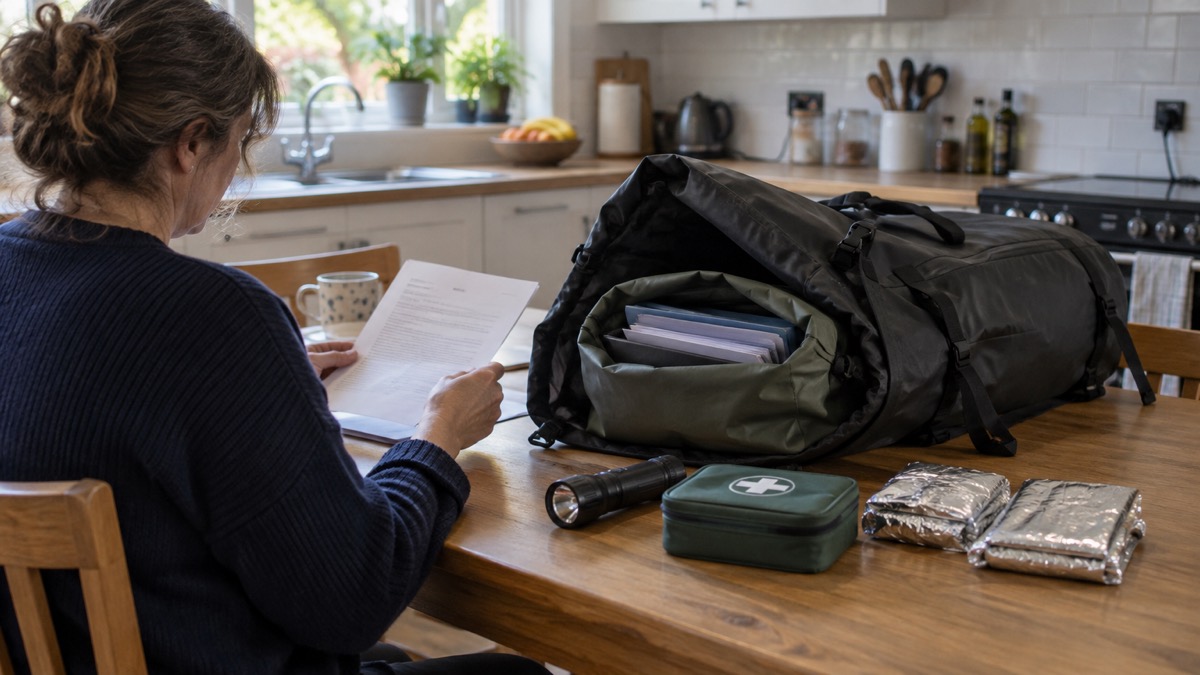
The bag's contents will vary depending on your needs, as Essex Prepared notes when it lists medication, glasses, phone numbers, keys, money and a first aid kit among the essentials12. Store the packed bag somewhere you can easily get to, which is the instruction the government's flooding advice gives alongside its own contents list4. A waterproof grab bag kept by the door, with documents in an inner dry bag, satisfies both instructions at once.
For households that want to go further, Hillingdon's household emergency plan checklist adds a copy of the plan itself, cash in small bills, a pen and notepad, a map and a whistle to the standard list13, and Lancashire's emergency pack guidance adds rubbish bags, toilet paper and sunscreen13. Our getting started page walks through building a household plan around the bag.
Clothing and footwear for wet and cold conditions
Waterproof clothing and proper footwear appear on official grab bag lists because cold and wet conditions are the default state of a UK emergency in winter. Read Scotland's cold weather advice and the instruction is consistent: "wear warm waterproof clothing and shoes with a good grip" when clearing pavements, and "wear a hat and gloves and shoes with a good grip to avoid slips and falls" when outside5. The North Yorkshire Local Resilience Forum's community risk register gives the same instruction for severe weather: "In cold temperatures, make sure you are wearing layers of clothing and shoes with good grip"14.
For a household putting a grab bag together, that translates into three things to pack or keep ready:
- Warm, waterproof clothing, packed as layers rather than one heavy garment14
- Sturdy footwear: wellies or waterproof boots, which the flood grab bag guidance names directly1
- A hat, gloves and spare clothing, which appears on both the flood grab bag list1 and the wildfire grab bag advice from Hampshire and Isle of Wight Fire and Rescue Service15
The footwear point matters more than it looks. Flood water and snow both turn pavements and stairs into slip hazards, and the injuries that follow can be as limiting as the emergency itself. Shoes with a good grip are named in Scottish5, North Yorkshire14 and Met Office winter guidance7 for exactly that reason. Our storms and snow guide covers the wider preparations for cold weather events.
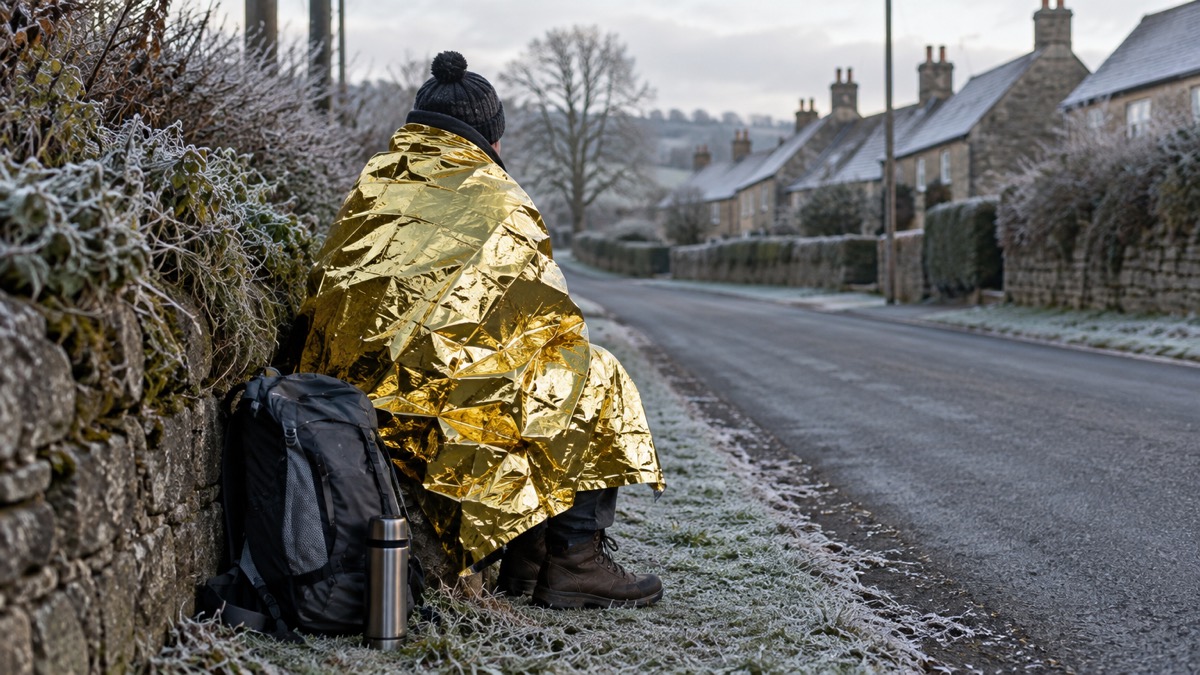
A foil blanket is the backstop when clothing is not enough. The maker states the Lomo Emergency Foil Blanket "protects the user from the wind and helps retain some of their body heat. This is great for treating or preventing hypothermia"2. That makes it a first aid item as much as a comfort item, and it belongs in the first aid kit as well as the grab bag. Our first aid guide covers the rest of what a household kit should hold.
Camping and outdoor kit for a power cut or evacuation
Outdoor kit doubles as emergency kit more directly than most households expect. The North Yorkshire community risk register, planning for utilities disruption, advises households to "Be prepared for an outage with a grab bag in your home containing a wind-up torch and radio, supplies of tinned and dried food and drinking water"14. That is a camping kit list wearing different clothes: the same stoves, lighting, food stores and water carriers that serve a campsite serve a power cut or an evacuation.
The split of jobs looks like this:
| Job in an emergency | Outdoor kit that does it | Covered in depth at |
|---|---|---|
| Seeing and working in the dark | Wind-up torch, lantern, spare batteries14 | Emergency lighting |
| Eating without mains power | Tinned and dried food supplies14 | Emergency food |
| Drinking water when supply fails | Bottled water and carriers14 | Water in an emergency |
| Staying informed | Wind-up or battery radio6 | Staying informed |
| Keeping phones working | Power banks and chargers1 | Backup power |
| Warmth and cooking | Blankets, foil blankets, outdoor cooking kit2 | Heating and cooking |
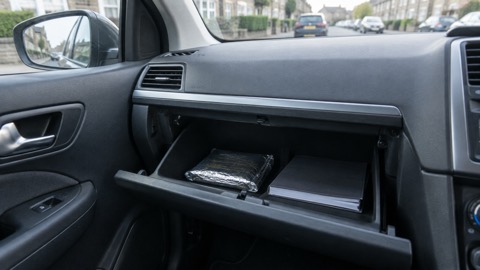
The foil blanket's place in this table is the warmth row. Its folded size of 7.5cm x 11.5cm2 means a handful of them from a 200 pack2 can live in the car's glovebox, the rucksack's side pocket and the kitchen drawer without any of them being noticed until needed. For a power cut specifically, our power cuts guide sets out the fuller response, and the self-reliance page covers longer disruptions.
Choosing the right size and specification
For the verified Lomo product, the specification is straightforward and worth setting out side by side:
| Specification | Lomo Emergency Foil Blanket Silver 200 Pack |
|---|---|
| Product type | Emergency foil blanket2 |
| Pack size | 200 blankets2 |
| Folded dimensions | 7.5cm x 11.5cm2 |
| Stated use | First aid, emergency and survival situations2 |
| Stated protection | Wind protection and body heat retention, for treating or preventing hypothermia2 |
| Barcode | 50606697764442 |
The choice a household faces is really about quantity and distribution. A 200 pack2 is sized for splitting across locations and for households that want spares for first aid training, community groups or a car kit for every driver. A single blanket is the unit that matters in an emergency, so the question is how many places you want one to hand.
For waterproof kit generally, learn to read the rating rather than the word on the label. The maker of one power product rated IP67 describes it as "submersible to 1 meter for up to 30 minutes"16, which is what that rating means: protection against dust and against brief immersion at shallow depth. A bag rated for spray and rain is a different product from one rated for immersion, and a household packing documents against floodwater wants to know which it is buying. The maker's own product page states the level of protection for each item, so read the specific claim there. Where a maker and a retailer list different specifications, the maker's figure is the one to trust, and it is worth saying the retailer lists another.
Safe use, care and storage
A foil blanket is one of the safest items in an emergency kit, but it is used on people who may be cold, wet or unwell, so use it as intended. The maker's stated purpose is wind protection and body heat retention for treating or preventing hypothermia2, which means wrapping the person, shiny side where the maker's instructions direct, and getting proper medical help for anyone you suspect has hypothermia. A blanket retains heat; it does not generate it, and it is not a substitute for shelter, dry clothing and medical assessment.
Storage of emergency kit follows a few consistent official rules, whatever the item:
- Store the grab bag and its contents somewhere you can get to quickly4
- Keep any chemical products in their original containers, follow the storage instructions on the label, keep them out of the reach of young children or locked away, never store them near food, and keep them away from pots, pans and cooking utensils17
- Store medicines safely out of reach of children, preferably in a locked cupboard, in their original packaging with the product information and instructions for use17
- Store creams and similar items in a cool, dry place away from direct sunlight or any source of heat, and clean their containers regularly to prevent a build-up of residue18
Dry bags themselves need little care, but check them before you rely on them. A closure that has been folded the same way for years can develop a weak line, and a bag that has been stored crushed may not seal cleanly. A quick test, filling the bag with air, sealing it and pressing on it, tells you whether the closure still holds. Do this when you repack the grab bag, which should be often enough that medication and food inside stay in date.
Cleaning kit after floodwater
If your Lomo kit, or any kit, has been in floodwater, treat the water as contaminated. The government's flooding and health advice is direct about protective equipment: "When cleaning up a home affected by floodwater, the use of rubber boots, protective overalls or waterproof apron, and waterproof gloves" is advised4. Hand hygiene comes with it: "Thoroughly wash your hands with warm water and soap after each cleaning session and contact with flood water. If you hav[e]" open cuts or sores, clean them and use waterproof plasters4.
The cleaning sequence for surfaces, from Lancaster City Council's guidance, is to "Clean down any dirt sticking to walls and furnishing, preferably with a hose, rinse several times before removing all th[e]" residue, then wipe down all surfaces with bleach with adequate ventilation, and rinse19. The same guidance says to "Make liberal use of disinfectants when cleaning up" and to "Contact your local environmental health department for further advice"19.
For kit itself, the practical rules are:
- Wash your hands regularly with warm, soapy water, rinse and dry thoroughly after contact with floodwater, sewage or any item that has been in the water; the government's flooding advice calls this "the most important way of removing harmful bugs and any chemicals found in flood water"4
- Dry items naturally in open areas during dry weather; Derbyshire's guidance notes sunlight is effective at killing micro-organisms, and heating and good ventilation help the drying process20
- Discard anything that cannot be safely cleaned, and place discarded items in rubbish bags and within hard bins21
- Dry out reusable items raised off the ground, which Somerset and Scottish Borders guidance gives for sandbags and gel bags as the way to help prevent mould forming22
A dry bag that has kept floodwater out needs only the outside cleaned. One that has been immersed with water inside should be emptied, cleaned and dried fully before it is trusted with documents again. Our flooding guide covers the full clean-up and return-home process.
Support and warranty
For any Lomo product, the maker's own website, lomo.co.uk, is the route for support: it publishes the product pages with the specifications and the company's contact details. When you contact support about a fault, give the product name and the barcode where the item carries one. The Emergency Foil Blanket Silver 200 Pack carries barcode 50606697764442, and a barcode is the quickest way for any company to identify the exact product and batch you are asking about.
On warranty terms, the position to take with any safety-related product is to check what the maker states before you buy, because terms vary. As an illustration of the kind of term worth looking for, independent guidance on carbon monoxide alarms describes one model's "Five-year warranty, alarm reports can be downloaded to a smartphone, hush/test button, LED indicators"24. A stated warranty period, and a stated way to test the product works, are both things a household should expect to find written down. Where a maker publishes no warranty term for an item, ask before buying, and keep the purchase record so you can prove when you bought it.
For faults that are not safety issues, contact the seller you bought from: the maker if you bought direct, or the retailer if you bought through a shop. Describe the fault plainly, give the product name and barcode, and say what you want done. For safety issues, the recall route in the next section comes first.
Safety notices and recalls
The place to check for recalls of any product sold in the UK is the government's product safety pages. London Fire Brigade's electrical safety guidance notes that "The Office for Product Safety and Standards issue recalls & alert notices on their website"3. Those notices name the product, the batches affected and what owners should do.
Recent examples show how the system works and what a notice contains:
| Recall | What it covered | What the notice said to do |
|---|---|---|
| POM power banks sold by TK Maxx, 2026 | Power banks sold in TK Maxx and Homesense stores during December 2025 and May 202625 | Follow the recall notice on the government's product safety pages25 |
| MSR camping cooking pots, 2024 | PocketRocket Stove Kit, barcode 40818095676, and Trail Lite Duo Cook Set, barcode 4081806897723 | Follow the recall notice on the government's product safety pages23 |
| MOMA porridge pots and sachets, 2026 | All products with a best before date between 24/04/2026 and 12/03/202722 | MOMA Foods recalled the products, with point of sale notices displayed in all retail stores selling them and on the company's website22 |
The MOMA notice shows the pattern: the recall names the company action, the date range affected and where notices will appear22. The MSR notice shows that outdoor and camping kit is recalled the same way as food, with barcodes identifying the affected items23. The way to check the current position for any Lomo product is the Office for Product Safety and Standards pages on GOV.UK3.
If a product you own is recalled, stop using it and follow the notice. Recalled items are handled through the recall process rather than an ordinary return, and the notice tells you whether to return the item, destroy it or await a repair or replacement. Check the pages when you buy any new emergency kit, and again if you hear of a safety concern, because notices are updated as investigations develop.
Sources (25)
- 10 things you should do now to prepare for winter, Met Office, 2026
- Lomo Emergency Foil Blanket Silver 200 Pack, Lomo, 2026
- Product recall: MSR R Trail Lite and Reactor R camping cooking pots, Office for Product Safety and Standards, 2024
- Be Prepared, Lancaster City Council, 2026
- Cold, snow and ice, Scottish Government, 2026
- Emergency, Basingstoke and Deane Borough Council, 2026
- Emergency kits and grab bags, Central Bedfordshire Council, 2026
- Cleaning up, Derbyshire County Council, 2026
- Reduce the risk of wildfire damage to your property, Hampshire and Isle of Wight Fire and Rescue Service, 2026
- Looking after your pets in an emergency, Medway Council, 2026
- Community Risk Register 2025, North Yorkshire Local Resilience Forum, 2025
- Step 1: Preparation, Essex Prepared, 2026
- Emergency pack, Lancashire Prepared, 2026
- Steps after a fire, North Yorkshire Fire and Rescue Service, 2026
- Household emergency plan, London Borough of Hillingdon, 2025
- Chemical safety in the home, nidirect, 2026
- Fire safety: using medication and medical equipment, Warwickshire County Council, 2026
- Carbon monoxide symptoms, Which?, 2026
- Electrical items, London Fire Brigade, 2026
- Flooding advice, Scottish Borders Council, 2026
- Flooding and safely cleaning your home, Wiltshire and Swindon Prepared, 2026
- Product recall: POM power banks sold by TK Maxx, Office for Product Safety and Standards, 2026
- MOMA Foods recalls various porridge pots and sachets, Food Standards Scotland, 2026
- Out and about, Wiltshire and Swindon Prepared, 2026
- Range 400, BioLite, 2026
 Emergency Foil Blanket