

ESR makes power banks and charging accessories, and for a household getting ready for an emergency the useful part is simple: a charged power bank keeps a phone, and sometimes a medical device, running when the mains go off. The government's household emergency plan lists a portable power bank to charge your phone and medical devices, if compatible, among the things to keep ready1. A small power bank, charged regularly, can help power your mobile phone in a power cut2.
There is one thing to check before you rely on ESR kit. On 26 November 2025 the Office for Product Safety and Standards published a recall of ESR HaloLock Wireless Power Banks sold via Amazon, in models 2G520, 2G505B and 2G512B, because the lithium-ion batteries can overheat during use and enter thermal runaway, causing a fire3. The notice advises owners to stop using the product immediately and visit the ESR website for more details3. If you own one of those models, check it against the recall now, before the next power cut rather than during one.
Everything else on this page follows from those two facts: what ESR kit does for a household, how to charge and store it so it is safe and ready, how to check for recalls and register a product, and where to go if something fails.
What ESR makes for UK households
ESR's kit for emergency preparation is charging kit: power banks that store power for a phone, and the chargers and cables that top them up. That is a narrow but genuinely useful role. In a power cut the mains is gone, and a phone is how a household gets information, checks on relatives and calls for help. Official advice for power cuts puts a power bank or solar charger alongside a torch, a battery or wind-up radio, warm clothes and non-perishable food7. A grab bag for leaving home in a hurry should carry a portable power bank for charging your mobile phone8.
The HaloLock Wireless Power Bank is the ESR product covered on this site, and it has its own page: HaloLock Wireless Power Bank. Read that page for the product itself, and read it alongside the recall notice described below, because the recall covers three HaloLock models.
It helps to be clear about what a power bank is not. It does not run a fridge, a heater or a boiler, and it does not feed power into your home's wiring. For anything beyond phones and small devices, the place to start is the guide to backup power at home, which sets out the options by what they can actually run. A power bank is the smallest, simplest layer of that: enough to keep one or two phones alive through an evening without power, and small enough to carry if you have to leave.
Where it fits in a household plan is in the emergency kit: charged, checked and stored with the torch and radio, so that when the lights go out nobody is hunting through drawers for a cable. The wider getting started guide sets out how to build that kit up over time.
Power banks for keeping phones running
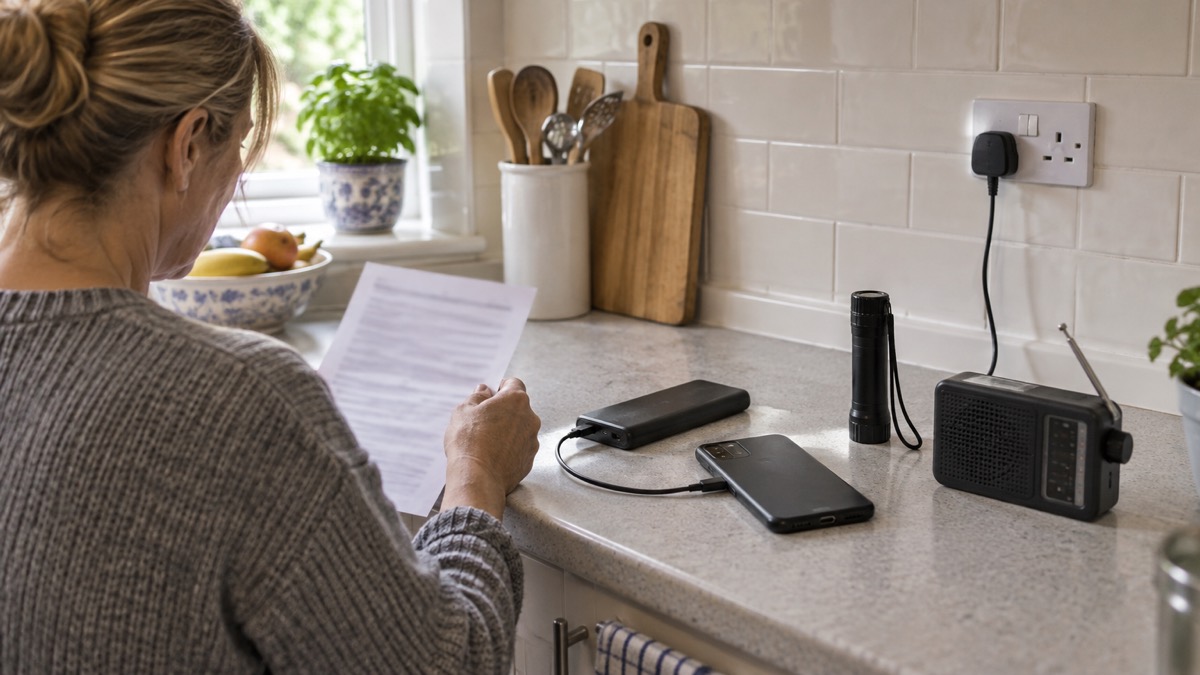
A power bank is the piece of ESR kit most households will want, and the reason is in the official advice: keep a portable power bank to charge your phone and medical devices, if compatible1. The same advice appears in local emergency planning: have a fully charged power bank available in case you need to charge your phone, tablet or other devices9, and keep a small power bank charged regularly so it can power your mobile phone in a power cut2.
What that means in practice is a routine, not a purchase. A power bank left in a drawer for a year is flat when you need it. The habit that works is to charge it on a schedule, check the charge level, and put it back in the kit. Treat it as part of the same round as testing smoke alarms and checking the torch batteries.
How long a power bank lasts depends on its capacity and on what you ask it to do, and the figures for a particular model belong on that model's page rather than here. What can be said generally is that phones are the priority: charge the phone, keep it topped up, and use it sparingly so the power bank's charge stretches further. If someone in the household depends on a medical device, check with the device's maker whether it can be charged from a power bank at all, because the government's advice is explicit that compatibility has to be checked1. The extra help guide covers households with medical dependencies in more detail.
For the wider picture of staying contactable when networks and power are disrupted, see staying informed and in touch.
Chargers and cables for use at home
The chargers and cables are the part of the kit people forget, and they decide whether the power bank is any use. Official emergency planning advice lists a charged portable power bank and charging cables together, as one item10. A power bank with no cable for your phone is a brick.
Two habits keep this side of the kit working:
- Keep the right cable with the power bank. Store it in the kit, not in a drawer with a tangle of others, so it is there when the power goes.
- Use the charger the maker supplied or recommends. Official fire safety advice for rechargeable devices is to use the charger provided by the manufacturer, or one specifically recommended for the device11. Using the wrong charger can overload a battery and increase the risk of overheating and fire12.
That second point is the one that matters most for safety. Fire and rescue services are consistent about it: connecting the wrong charger to a battery can pose serious fire risks, because not all batteries and chargers are safe when used together13. Make sure your battery and charger meet UK safety standards12. For ESR kit, that means the charger and cable that came with the product, or ones the maker specifies for it.
A household plan should also account for the fact that charging opportunities may be scarce. If you have one power bank and three phones, decide in advance which phone gets charged first, and keep charging cables for each device in the kit. The emergency kit guide sets out how to build and check the whole kit, and the lighting guide covers the torch and lantern side of it.
Safe charging and storage
Lithium-ion batteries are safe when they are undamaged and charged properly, and dangerous when they are not. Fire and rescue services across the UK give the same core advice, and it applies to a power bank as much as to a larger battery.
The practical rules for a power bank at home:
- Charge it where you can see it and where smoke alarms are working. Fire services advise charging batteries in a safe place from a socket that is RCD protected, in an area with working smoke alarms4.
- Keep it out of escape routes and bedrooms. Never charge or store batteries in hallways, near exits, on escape routes or where people sleep18.
- Keep it cool and dry. Avoid excessively hot, cold or damp areas, especially for charging20, and do not charge or store in direct sunlight or in hot locations17.
- Let it warm up before charging in winter. If a battery has been left in freezing conditions, allow it to warm up slowly indoors before using or charging it21. Charging a battery when it is extremely cold can damage it21.
- Check it regularly. Look for swelling, leaks or strange smells, and stop using it immediately if you find any22.
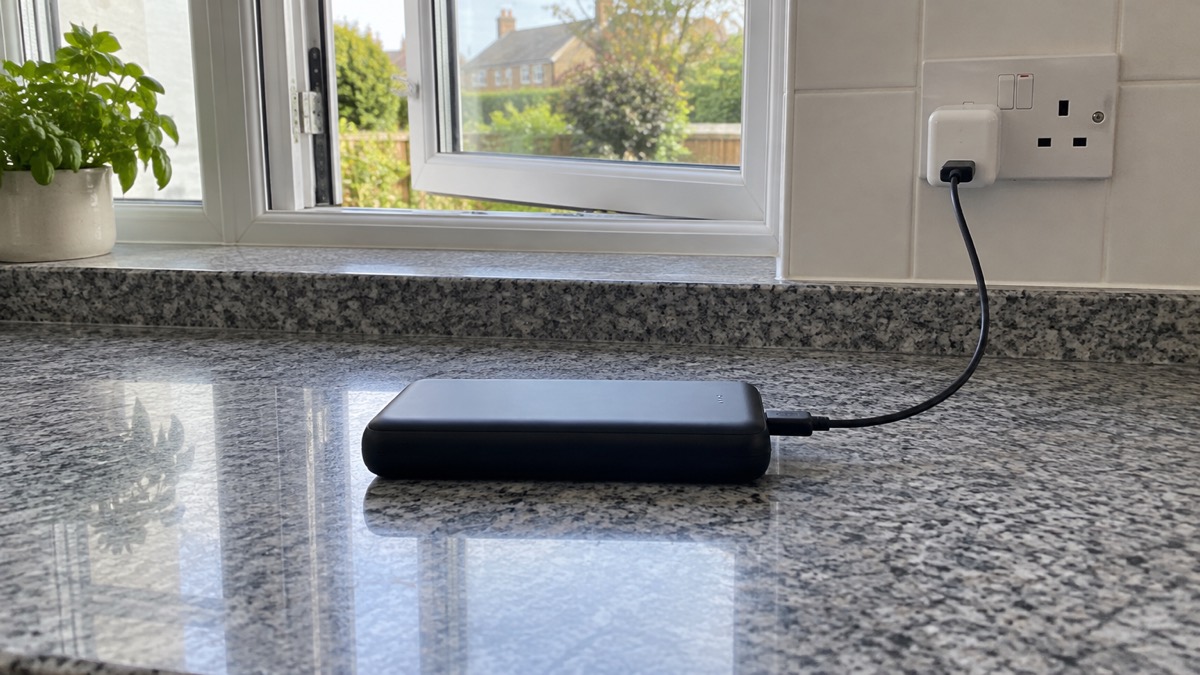
Cold also affects performance: cold temperatures can reduce the range a battery gives, slow charging and make it lose charge more quickly, because the chemical reactions inside slow down21. A power bank kept in a cold shed over winter will not perform as it should, so bring it indoors before you need it.
Using ESR kit during a power cut
When the power goes, the power bank becomes the household's link to the outside world. Official advice for power cuts is to have a torch and spare batteries, a wind-up or battery radio for local news, a power bank or solar charger, warm clothes and blankets, and non-perishable food7. The power bank's job in that list is the phone.
A sensible order of use:
- Check the power bank is charged and bring it to where the household is gathered, with the cable for the phone that matters most.
- Charge the phone, not everything. Top up the phone, then unplug. Leaving devices charging drains the bank for no benefit.
- Use the phone sparingly. Short calls and messages, low screen brightness, and airplane mode where signal is poor all stretch the charge.
- Keep the bank out of the cold if the heating is off in winter, and away from candles and flames.
- Recharge the bank as soon as mains power returns, so it is ready for the next time.
The power cuts guide covers the wider household response, and backup power at home explains what larger kit can and cannot do. For households that need to keep a phone running for medical reasons, the extra help guide sets out the support available.
Checking safety notices and recalls
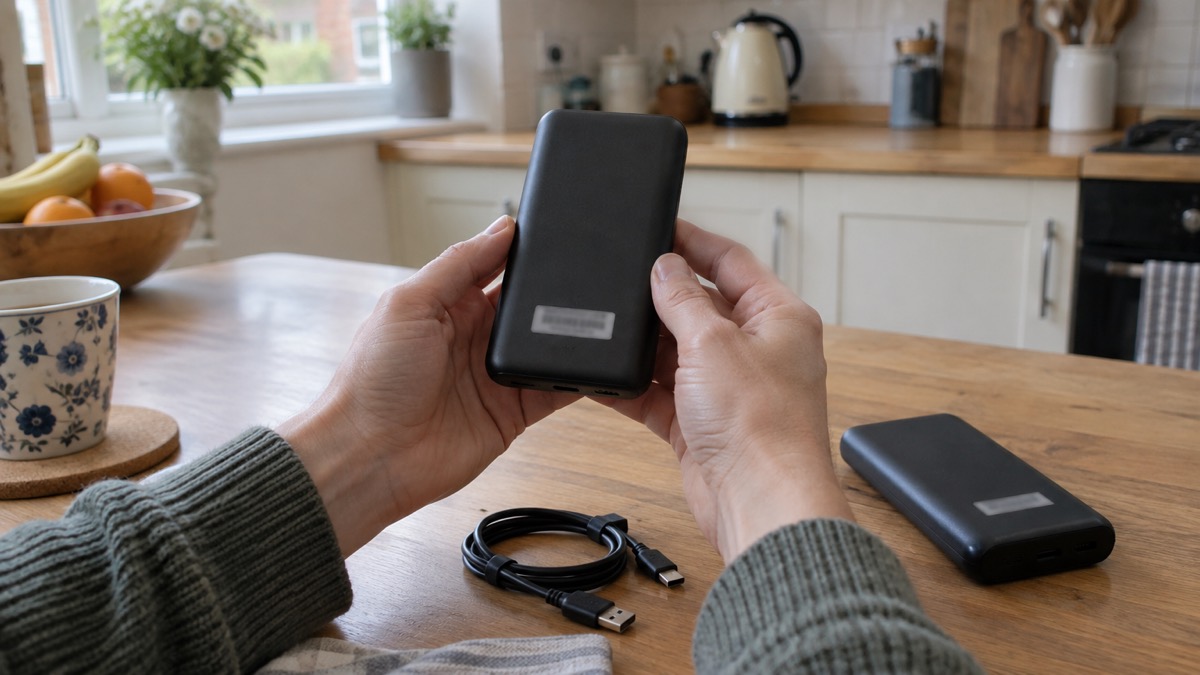
This is the section to read if you own ESR kit, because there is a live recall. On 26 November 2025 the Office for Product Safety and Standards notified a recall of ESR HaloLock Wireless Power Banks sold via Amazon, in various colours, models 2G520, 2G505B and 2G512B, under notification number 2511-02173. The affected products were sold in the UK between October 2023 and August 20243. The cause given is that the lithium-ion batteries can overheat during use, causing the power bank to enter thermal runaway, causing a fire3.
"We advise owners to stop using this product immediately and visit the ESR website for more details"
The affected barcodes listed in the notice are 4894240179031, 4894240168479, 4894240168462, 4894240132579, 4894240179024, 4894240132586, 4894240201022, 4894240201015, 4894240201657, 4894240201039 and 48942401325553. Check the barcode on your own unit against that list.
Beyond this recall, the routine is the same for any electrical product:
- Check for recalls before you buy and after. Check any products you have bought are not subject to a product recall, using Electrical Safety First's website or the government website5.
- Look for the mark. Check the product is marked with a CE or UKCA mark to ensure it complies with UK product safety standards25.
- Register the product with the maker. Registering lets the manufacturer contact you quickly if an important safety alert or product recall is issued26. You will typically need the model name or number, serial number and purchase date27.
- Report unsafe products. Report unsafe products to the Citizens Advice Consumer Service13.
Warranty and support for UK buyers
Products sold to UK consumers must meet UK safety laws, and buyers should check that the seller provides information about how they comply4. That is the baseline for any ESR purchase: buy from a seller who can show the product meets UK standards, keep the receipt, and keep the packaging until you are sure the product is right.
Registration is the practical step that protects a UK buyer. Fire and rescue services advise registering products with the manufacturer to validate warranties and to be informed of safety recalls18. For ESR kit, that means finding the product registration page on the maker's website and entering the model number, serial number and purchase date26. Keep a note of those details somewhere you can find them, because they are also what you need for a warranty claim and for checking a recall.
If a product fails or you are worried about it:
- Stop using it if there is any sign of damage, swelling, leaking or a strange smell22.
- Contact the retailer where you bought it, which is one of the routes official advice gives for reporting a recall issue26.
- Report the defect to the manufacturer, and dispose of the product appropriately25.
- Report unsafe products to the Citizens Advice Consumer Service13.
The home emergencies guide covers what to do if a battery fire does start at home, and the first aid guide covers burns.
Where to get help if a product fails
If an ESR product fails, the first question is whether it is a safety matter. A swollen, leaking or overheating power bank is: stop using it, stop charging it, and take it directly to a household waste recycling centre, without putting it in your pocket, bag or household bin6. Damaged batteries can catch fire without warning20, so do not leave it somewhere it could be crushed or punctured.
For disposal of anything with a battery in it:
- Take batteries and items containing batteries to household waste recycling centres or recycling points23.
- Use official recycling points, such as collection boxes in shops and supermarkets, or check with your local authority16.
- Never put old batteries or electrical items in household bins, including the recycling bin23. Punctured or crushed batteries can cause fires in bin lorries, recycling and waste centres14.
- If the battery cannot be removed, treat the whole item as electrical waste and take it to a household waste recycling centre or return it to a retailer when buying a replacement15.
For a product that has failed but is not dangerous, the routes are the retailer, the manufacturer and, for unsafe products, the Citizens Advice Consumer Service13. Keep the model number, serial number and purchase date to hand, as you would for a registration27.
If a fire has involved a battery, get everyone out and call 999, then follow the fire service's advice on what to do after a fire before re-entering. The home emergencies guide sets out the steps.
Sources (27)
- Be Ready: Household Emergency Plan, UK Government, 2026
- Be more resilient in 30 simple ways in 30 days, Scottish Borders Council, 2026
- Product recall: ESR HaloLock Wireless Power Banks sold via Amazon (2511-0217), GOV.UK, 26 November 2025
- Buy safe, be safe: avoid e-bike and e-scooter fires, GOV.UK, 24 October 2024
- E-bikes, Cheshire Fire and Rescue Service, 30 September 2026
- Battery safety, Tower Hamlets Council, 29 October 2026
- Power cuts, West Yorkshire Prepared, 2026
- Reduce the risk of wildfire damage to your property, Hampshire Fire and Rescue Service, 2026
- 12 tips to prepare for a power cut, Horsted Keynes Parish Council, 2026
- Be prepared for emergencies, North Devon Council, 29 October 2026
- Fire safety tips: smoking, vaping and using e-cigarettes, Warwickshire County Council, 29 October 2026
- How to charge e-bikes and e-scooters safely, London Fire Brigade, 25 October 2026
- Product safety campaigns, Peterborough City Council, 29 October 2026
- E-bikes and e-scooters, South Wales Fire and Rescue Service, 29 July 2026
- Lithium battery fire safety, Tandridge District Council, 26 October 2026
- Battery safety, West Yorkshire Fire and Rescue Service, 29 October 2026
- ChargeSafe: safety tips for e-bikes and e-scooters, North Yorkshire Fire and Rescue Service, 12 November 2024
- E-bikes, e-scooters and mobility scooters, Greater Manchester Fire and Rescue Service, 29 October 2026
- E-bikes and e-scooters, Greater Manchester Fire and Rescue Service, 29 October 2026
- Battery safety for e-scooter users, GOV.UK, 1 February 2024
- Heat, cold and rain: how weather conditions affect e-bikes and e-scooters, London Fire Brigade, 25 October 2026
- Battery safety, Greater Manchester Fire and Rescue Service, 29 October 2026
- Be battery aware, Greater Manchester Fire and Rescue Service, 29 October 2026
- E-bike and e-scooters, Scottish Fire and Rescue Service, 25 October 2026
- Battery fires, Devon and Somerset Fire and Rescue Service, 2026
- Registering your e-bike or e-scooter for safety alerts and product recalls, London Fire Brigade, 25 October 2026
- Electrical safety, Scottish Fire and Rescue Service, 27 February 2025
 HaloLock Wireless Power Bank