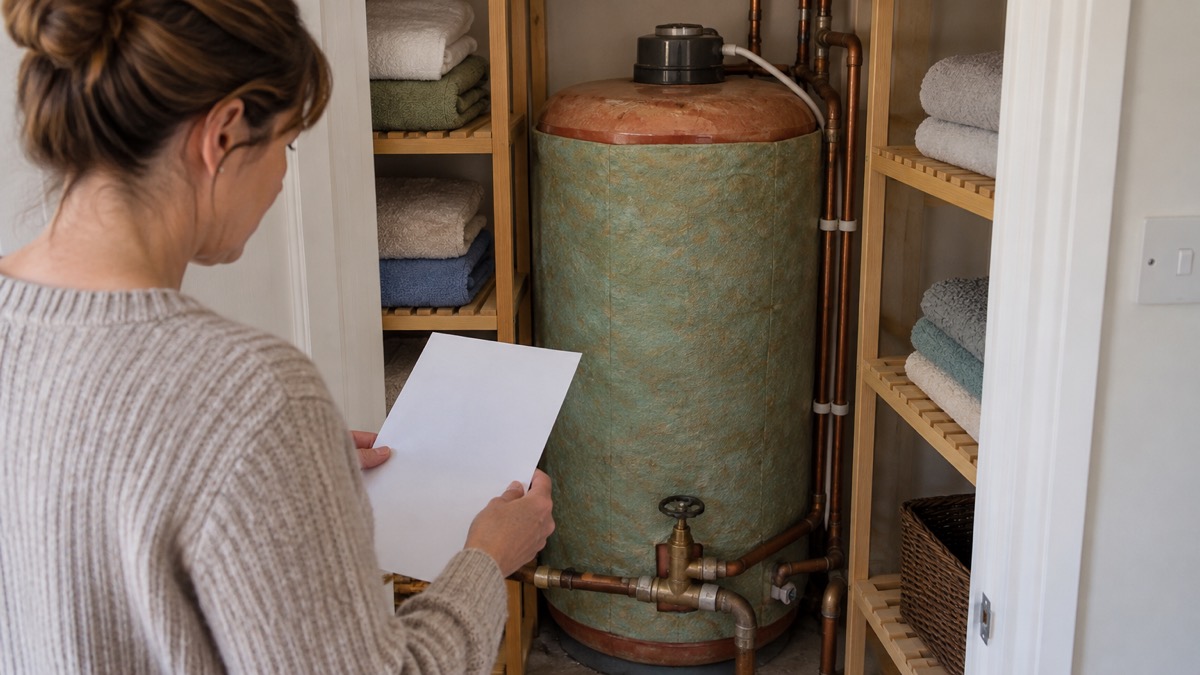
When the mains supply fails, your house is not empty of water. A typical home with a loft cold tank holds around 250 litres in that tank alone1, plus whatever sits in the hot water cylinder, the toilet cisterns and the pipework itself. In an outage, that stored water will keep toilets flushing and hands washed for a short period, and knowing how to reach it, and what it is fit for, buys you time2.
The rule that governs everything else is simple: only water from a mains-fed tap, or sealed bottled water, should go in your mouth. The Drinking Water Inspectorate advises that you should only use a tap connected to the mains supply for drinking, food preparation or teeth cleaning1, and official guidance is blunt that bottled water is the safest way to prepare for water outages3. Everything else in the house is a washing and flushing reserve, not a drinking reserve.
Drinking water comes from the mains-fed tap only
In most homes the mains water supply enters at the cold kitchen or utility room tap, and that tap, often the kitchen cold tap, is the one to rely on for anything you swallow7. NHS inform in Scotland advises using only cold tap water for drinking, cooking and making infant formula8. The reason is that this tap is usually fed directly from the street main, so the water in it has not sat in a container in your house picking up dust, warmth or whatever lives in the roof space.
Every other outlet may be fed differently. Bathroom cold taps, toilet cisterns and often the hot water cylinder are commonly fed from the cold storage tank in the loft, so the water from them has been stored open to the air before it reaches you. If you are diagnosing a supply problem, try the cold kitchen tap first: if water comes out of that tap but not elsewhere, the fault is in your internal plumbing rather than the mains7.
After a flood, the mains supply itself is usually fine. Belfast City Council advises that mains tap water should not be contaminated after flooding, and that you should wash the taps and let them run for a few minutes before use9. The Drinking Water Inspectorate agrees that in most flooding circumstances the main supply is unaffected and so is safe to drink10. The risk after a flood is at the tap and in the pipework, not in the street main, which is why flushing matters so much once supply returns.
Your cold water tank: around 250 litres, but not for drinking
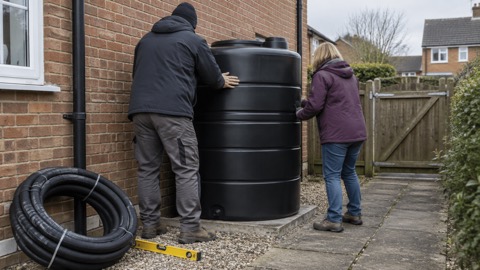
The loft cold tank is the biggest reserve in a traditional home. The Drinking Water Inspectorate notes that a tank should not be too large, so the water in it is frequently replenished with fresh water, and that 250 litres is quite sufficient for most homes1. Wiltshire and Swindon Prepared makes the same point from the household side: some houses have a cold-water tank in the loft which allows some water for a short period in an outage, and you should use it only for critical purposes2.
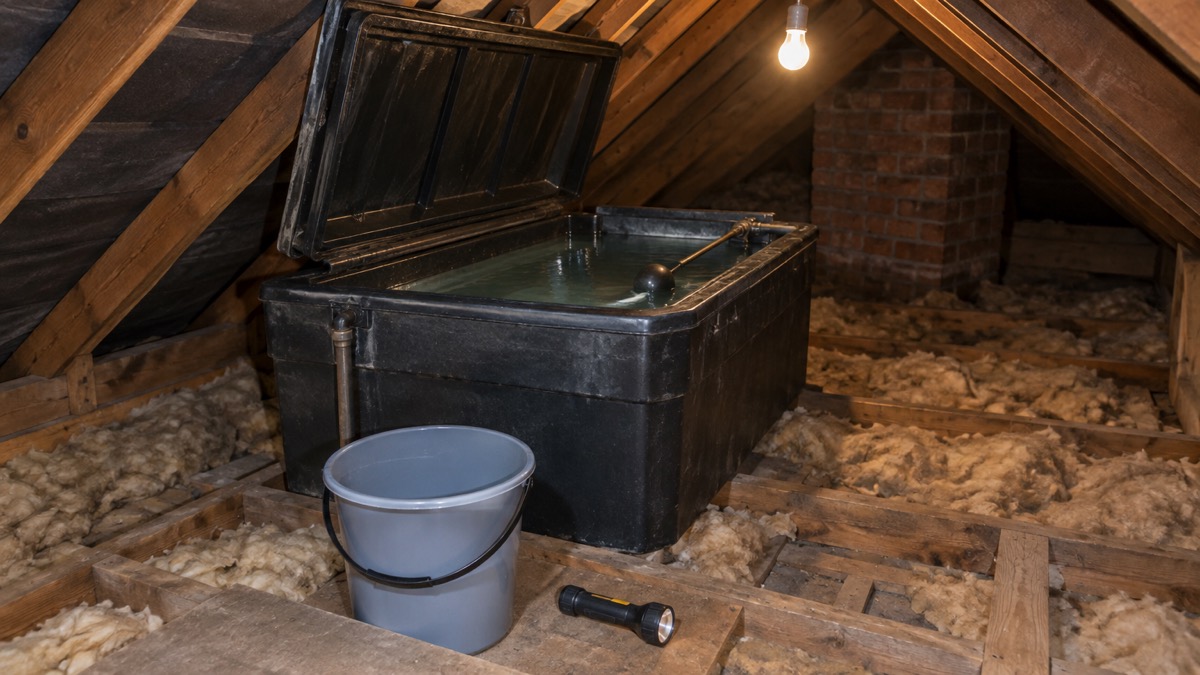
What "critical purposes" means in practice is flushing toilets, washing hands and bodies, and cleaning. A 250 litre tank used carefully for those jobs will carry a household for a short period, but it is not a drinking supply, and it will run down faster than most people expect once everyone starts drawing from it. Treat it as a bridge to bottled water or to a water company bowser, not as a substitute for either.
Two safety points about the tank itself. First, older tanks: traditionally tanks were made of galvanised iron, and these rust over time, leading to bits in the water or a brown or yellowish tinge or a metallic taste1. If your tank is galvanised iron, be even more cautious about using its contents, and consider having it inspected or replaced. Second, the Health and Safety Executive has issued a safety alert about a rare but potentially serious scalding risk from domestic hot water systems which include a fixed all-electric or part-electric immersion heater in conjunction with a plastic cold water storage cistern in the roof space11. If that describes your system, treat the hot outlets with particular care.
If you are unsure how to clean your storage tank or cistern, you can contact your local water company for advice or use a WaterSafe registered plumber who can carry out the task for you1. For more on tanks as a deliberate store rather than an incidental one, see household storage tanks for drinking supplies.
The toilet cistern and the hot cylinder
The toilet cistern is a small open tank, typically holding several litres, and it is useful in an outage for one thing above all: flushing the toilet12. Because the water sits open to the air in the pan and cistern, treat it as water that has been standing, and none of it belongs in a drinking glass. If the cistern is clean and chemical-free, its water can top up a bucket for hand washing, but keep anything you swallow to bottled or freshly boiled water.
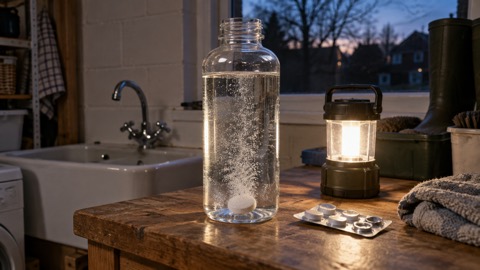
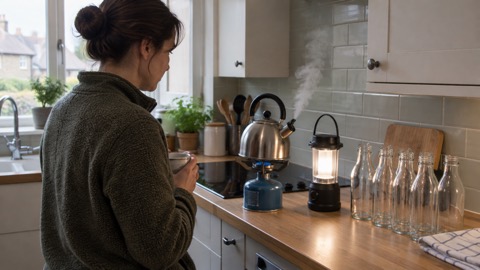
The hot water cylinder holds a useful volume of warm water, and in a vented system it is refilled from the same loft tank, so it shares that tank's drawbacks and adds one of its own: warmth. Warm stored water is a more comfortable home for bacteria than cold stored water, which is why cylinder water is for washing and cleaning only. If you are forced to drink it in a genuine emergency, boil it first and follow the advice on how to make water safe to drink.
Water that has sat still goes stale within a day
Tap water arrives with a small residual of chlorine that keeps it safe in the pipe. That protection does not last once the water is standing in a container. The Drinking Water Quality Regulator for Scotland advises that you should throw away any unused water after 24 hours4. After a day, the chlorine has gone, and anything that gets into the water has a chance to grow.
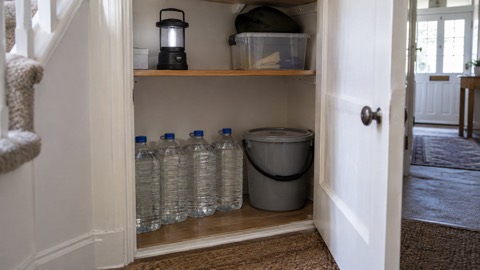
This is why the loft tank, the cistern and any jug or bucket of drawn water all sit on the wrong side of the line, and why refilling bottles from the tap for long-term storage does not work. It also explains a taste point people notice at the tap: chlorine taste and odours should dissipate if the water is left to stand in the fridge for a few hours, and boiling the water will also remove chlorine13. Standing water loses its chlorine to the air, which is pleasant for taste and bad for safety, in that order.
Where a stored system has to be disinfected properly, the professional method is a strong one: the Drinking Water Inspectorate describes commissioning a private supply storage system by filling it with a 20 mg/L solution of chlorine and leaving it to stand for several hours, preferably overnight, then draining it off and rinsing it thoroughly using treated water14. That is a job for a plumber or water company, not a household mixing job, but it shows how seriously stored systems need cleaning once they have been left standing.
Empty homes and low use
The same staleness problem arrives without any outage at all when a home is empty or water use is very low. Water that sits in tanks and long pipe runs for weeks loses its chlorine and can pick up tastes, colours and contamination from the fittings it sits in. If you return from a long absence and the water tastes odd, run the taps thoroughly before using it for drinking, and see the advice on what to do if water tastes odd after a holiday.
Low supplies raise the same issue on private sources. Natural Resources Wales notes that when there is a lack of rainfall over a long period, groundwater levels can become exceptionally low and there may be impacts on supplies15. Households on private supplies are advised that if water levels are very low they should take action to seek an alternative supply of water, speaking to neighbours, ensuring containers used to transfer water are cleaned and disinfected to prevent contamination, and finding out if there is a nearby mains supply to connect to15. The Drinking Water Inspectorate also warns that water companies may not always be able to provide an emergency supply of water in bowsers or in bottles, for example if they have their own ongoing emergency such as a burst main16. Do not assume help will arrive at a set time: services could be lost for a few hours, days or weeks depending on the severity of the incident6.
Flushing taps and outlets when the water comes back
When supply returns, or after any period where water has stood in the pipes, flush every outlet before using it. Belfast City Council's advice after flooding is to wash taps and let them run for a few minutes before use9. Run each tap in turn, the kitchen cold first, then the others, and let the water carry away whatever has been sitting in the pipe run.
Flushing uses more water than people expect, which is worth knowing both ways. Official drought guidance notes that running taps while you brush your teeth, shave or wash your hands can waste up to 6 litres of water per minute12. In a flush after an outage that flow is doing a job, but it is also draining any reserve you hold, so flush outlets one at a time and catch the first run-off in a bucket for toilet flushing rather than letting it all go down the drain.
How do you tell fresh water has come through? The clearest signs are that the flow is strong and steady at the mains-fed kitchen tap, the water runs clear without cloudiness or colour, and any odd taste fades as the standing water is displaced. Cloudy water that clears from the bottom up in a glass is usually trapped air rather than a contaminant, and there is separate guidance on why tap water is cloudy or milky and on brown or discoloured tap water. If the water smells of petrol or oil, or is blue, green or pink, stop using it and contact your water company.
After a flood, the clean-up sequence matters for the water system as much as for the house. nidirect advises getting an electrician to check your electrical appliances and a Gas Safe-registered engineer to inspect the gas supply17. Surrey County Council advises that before you can properly move back into your home you need to make sure all standing water has been removed, particularly from the under floor area, using a pump or buckets followed by a wet/dry vacuum, then shovelling out mud and hosing out or using a garden sprayer18. If you need to pump flood water into public sewers, check with your water company first19.
Legionella, warmth and why temperature matters
Standing water is not just unappetising, it can be genuinely risky when it stands warm. The Health and Safety Executive publishes a safety notice that draws attention to key aspects of the proper management of the risks from legionella in a wide range of systems, such as hot and cold water systems in buildings, spa pools and a range of industrial processes that use water for cooling, washing and misting11. Legionella bacteria grow in warm, stagnant water and are dispersed in fine droplets, which is why showers and spray taps are the outlets to be careful with after water has stood.
The practical household response is to avoid breathing in spray from water that has stood. After a long outage or an absence, run the shower first with the door open and the showerhead pointed away from you, or remove the showerhead and run water down the drain, before anyone takes a shower. There is fuller guidance on how to stay safe from legionella at home.
Temperature is the other lever, and it works through your heating rather than your plumbing. Ready Scotland advises trying to heat your home to a temperature that is comfortable for you, and if you can, at least 18°C in the rooms you regularly use20. When drying out a flooded home, nidirect advises that you can use your central heating once the system has been checked by a qualified engineer, and that for best results the temperature should be set at 20 to 22 degrees centigrade17. Surrey County Council gives the same range: if you have gas or oil central heating and it has been checked by an engineer, turn it on and keep the thermostat between 20°C to 22°C for steady drying18. A home kept warm through a cold-weather outage also protects its pipework, which brings in the next section.
Draining a tank-fed system safely
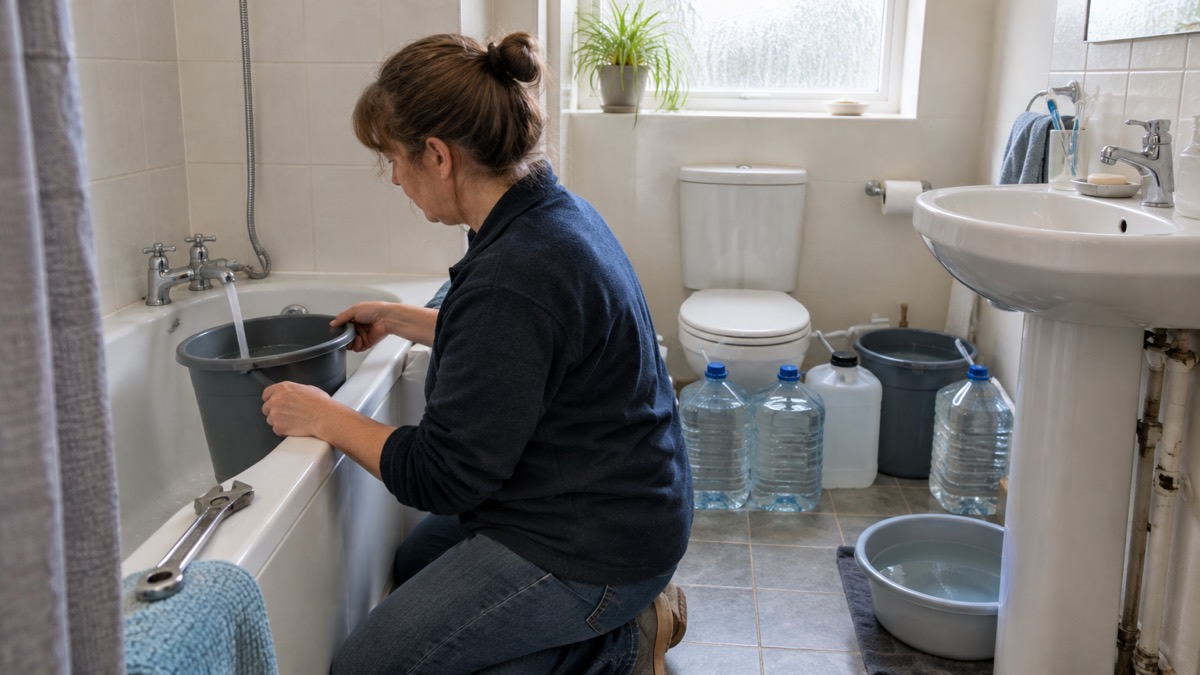
If a pipe freezes or bursts, your first move is to stop the flow at the stop tap, and only then think about saving what is left in the system. Capturing the water is the heart of using your pipework as a reserve. The pipes and tank between them hold tens of litres, and draining them through the taps into containers, rather than letting them empty through the burst, is how you capture it.
Do this in order:
- Turn off the water at the stopcock. Natural Resources Wales notes the water stopcock is usually under a kitchen sink or where the pipe enters the home21.
- Open all the taps, starting with the lowest outlet in the house, which is where the system drains from.
- Catch the water in clean buckets and covered containers as it runs.
- Label what you have saved and what it is fit for: flushing and washing, not drinking.
- Contact your water company, which is who Cumberland Council advises you should contact if pipes burst22.
If water is coming into your home, London Fire Brigade advises that you will also need to turn off your gas supply, turn off your water supply and turn off your electricity supply, if possible and safe to do so23. Natural Resources Wales gives the same sequence and adds where the controls usually are: the gas valve is usually next to the gas meter, the electricity main is usually a red switch on the fuse box, and the water stopcock is usually under a kitchen sink or where the pipe enters the home21.
Homes with a combination boiler need a note of their own. A combi heats water on demand straight from the mains, with no loft tank and no hot cylinder, so there is very little stored water in the house to drain or use. When the mains stops in a combi home, the pipework holds only a few litres, which makes a bottled store more important, not less. There is specific guidance on whether you can use a combi boiler when the water is off.
Burst pipes in a freeze
Sometimes water pipes can burst in very cold weather, and if this happens you should contact your water company22. A burst is often not obvious at once: the pipe freezes and splits, and the leak appears only when the thaw lets water flow again, which is why damage so often shows up during the warm-up after a cold snap.
Before cold weather, Ready Scotland advises you to make a household emergency kit and make an emergency plan20. For the water side of that, the practical steps are to know where your stopcock is and check that it turns, and to insulate exposed pipework in lofts, garages and outside, where freezing temperatures are most likely to reach it. During the freeze, keeping the home as warm as possible, even if you are out, protects the pipes as well as the people.
If the worst happens, follow the draining sequence above: stopcock off, taps open, water saved, water company contacted24. For reporting a problem, see how to report no water or a burst pipe, and for the wider picture, home emergencies: fire, carbon monoxide, gas leaks and burst pipes.
Do not drink notices: what they mean and what to do
A do not drink notice is the formal version of everything this page says about stored water, applied to the mains itself. It is issued when the water company cannot guarantee the supply is safe to swallow, for example when stagnant water has entered the main. In October 2025, a valve recorded incorrectly on the network system in Llanrumney, Cardiff, was opened and let stagnant water into the main, causing discolouration and unusual tastes; do not drink advice covered 20 properties and lasted until 29 October 2025. It happens, and it is lifted only when testing says the water is safe.
While a notice is in force, or while there is no mains supply at all, official guidance is to use alternative water supplies such as bottled water solely for drinking, washing your hands and food preparation3. That word "solely" is doing real work: no cooking with it, no teeth cleaning, no ice, no drinks made with the affected tap water, and no infant formula except with bottled water as directed.
"Whilst there is no mains water supply, use alternative water supplies such as bottled water solely for drinking, washing your hands and food preparation."
The same discipline applies to flood water, which the West Midlands Ambulance Service NHS Foundation Trust says to avoid at all costs25. Flood water carries sewage, chemicals and debris, and it is neither a washing supply nor a drinking supply. There is fuller guidance on do not drink and do not use notices and on what to do if you get a boil water notice.
Flats and larger buildings
Everything on this page is written for a house, and most of it transfers to a flat, but larger buildings add a layer of risk. Shared storage tanks are bigger, pipe runs are longer, and if occupancy is low, the water in them turns over slowly. Standing water of that kind creates the right environment for bacteriological growth, most commonly legionella colonisation, so the water system in a larger building needs active management, not just passive storage.
If you live in a block, find out who is responsible for the water system and how the tanks are maintained. Follow any notice issued for the building rather than judging the water by how it looks at your own tap, because your tap may be a long way from the tank. And if the building has a do not drink notice, apply it to every outlet in your flat, including the kitchen tap, since all of them draw from the same shared supply.
Bottled water in your home emergency plan
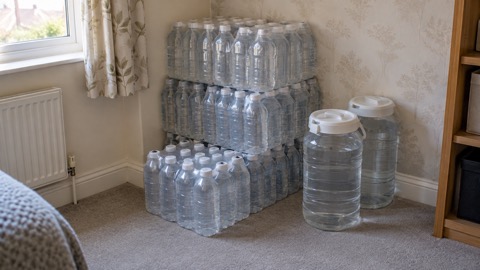
Stored water in the house is a reserve you happen to have. Bottled water is the reserve you choose, and it is the one official guidance points to first: bottled water is the safest way to prepare for water outages3.
How much? The figures from official guidance line up closely:
| Source of advice | Amount to store |
|---|---|
| Be Ready checklist (UK government) | Bottled water for 3 days, 3 litres per person per day for drinking, more for cooking and washing5 |
| Worcestershire Council household emergency plan | A minimum of 2.5 to 3 litres of drinking water per person per day, bottled26 |
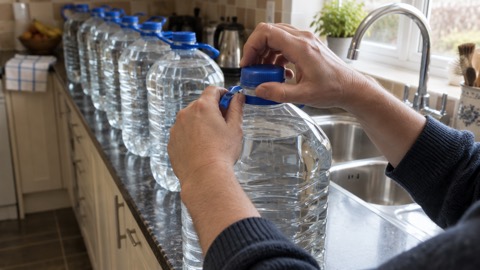
The difference between the survival figure and the comfort figure is the difference between drinking and living. Two and a half to three litres per person per day keeps a person alive and hydrated27; ten litres per person per day also provides for basic cooking and hygiene needs27. For a three-day store, as the Be Ready checklist recommends5, plan for the higher figure if you can store it, and remember that the loft tank and cylinder can cover some of the washing load, which stretches the bottled supply further.
Pets need their own line in the plan. Wiltshire and Swindon Prepared advises a couple of bottles of water and a bowl to keep it in for pets28, and the Be Ready checklist includes pet food and bottled water5. Greater Manchester Combined Authority advises considering what supplies you and your household might need during an emergency lasting a few days, such as a power cut or a water failure, including medication and bottled water29.
Water companies do plan for outages. Surrey County Council describes the arrangements: bottled water held for customers during planned interruptions and incident response, bottled water available for collection from stockpiles and for doorstep delivery, static tanks and mobile bowsers for major incidents, emergency tankers to fill them, and other options including standpipes, over-ground mains and emergency drought orders30. But the Drinking Water Inspectorate's warning stands: companies may not always be able to provide an emergency supply, for example if they have their own ongoing emergency such as a burst main16. Your bottled store is what covers the gap. For more, see bottled supplies, tankers and bowsers from your water company and how much drinking water to store per person.
A simple water plan for your home
Pulling it together, a household water plan needs only a few decisions made in advance, and Ready Scotland's advice to make a household emergency kit and an emergency plan before an emergency applies to water as much as to anything else20.
- Know your system. Identify your mains-fed tap (usually the kitchen cold tap), find your stopcock and check it turns, and note whether you have a loft tank, a hot cylinder, a combi boiler or a shared building supply.
- Store bottled water. Three litres per person per day for drinking, for three days, plus a couple of bottles and a bowl for pets5.
- Write the plan down. Worcestershire Council's interactive household emergency plan is one template for recording what you would do26, and Dumfries and Galloway Council advises keeping a copy of your Household Emergency Lifesaving Plan with your kit31.
- Plan for the water system itself. Water safety specialists recommend establishing a control or water safety plan tailored to your water system, so you know in advance what to flush and clean when supply returns32.
- Expect to flush. When supply returns, a small system with toilets and a kitchen fed by a combination boiler may need no more than a thorough, safe flush of all parts of the system and cleaning and descaling of the outlets32.
- Know when the water is fresh again. Run cold outlets until the temperature drops to within a degree or two of the incoming supply, and check hot outlets stay above 50°C for a minute or so before use32.
For the wider kit this sits inside, see emergency kit: what a UK household should keep ready and getting started: preparing your household for an emergency, and for the full water picture, water in an emergency: a household guide.
Sources (32)
- Water storage tanks and cisterns, Drinking Water Inspectorate, 2026-06-09
- Failure of water infrastructure or loss of drinking water, Wiltshire and Swindon Local Resilience Forum, 2026-10-25
- Water supply interruptions or outages, Prepare (UK government campaign), 2026-10-12
- Chlorine in drinking water FAQs, Drinking Water Quality Regulator for Scotland, 2026-10-28
- Be Ready checklist, Be Ready (UK government campaign), 2026
- Loss of gas and water, Essex Prepared, 2026-10-29
- Utilities failure, London Borough of Richmond upon Thames, 2026-05-22
- Lead poisoning, NHS inform Scotland, 2026-09-07
- Flooding advice, Belfast City Council, 2026-10-29
- Flooding and drinking water, Drinking Water Inspectorate, 2026-10-28
- Management of the risks from legionella within water systems safety notice, Health and Safety Executive, 2026
- Droughts, Prepare (UK government campaign), 2026-10-19
- Dealing with drinking water problems, nidirect (Northern Ireland government), 2026-10-06
- Water storage in private supply networks, Drinking Water Inspectorate, 2025-11-05
- Drought planning and management, Natural Resources Wales, 2026-10-29
- Managing insufficiency of private water supplies, Drinking Water Inspectorate, 2025-12-15
- After a flood: clearing up, nidirect (Northern Ireland government), 2026-05-06
- Flooding: after, Surrey County Council, 2026-09-23
- Help during a flood, GOV.UK, 2026-10-25
- Cold, snow and ice, Ready Scotland, 2026-03-25
- Preparing for a flood, Natural Resources Wales, 2026-10-29
- Severe weather advice, Cumberland Council, 2026
- Flood water is coming into my home, London Fire Brigade, 2026-10-25
- Frozen or burst pipes, Met Office, 2026-10-26
- Staying safe in flooding, West Midlands Ambulance Service NHS Foundation Trust, 2026-05-20
- Household emergency plan (interactive), Worcestershire County Council, 2026-05
- Be prepared for emergencies, North Devon Council, 2026-10-29
- Your pets, Wiltshire and Swindon Local Resilience Forum, 2026-10-25
- Prepare yourself, Greater Manchester Combined Authority, 2026-10-29
- Power, gas and water: what if they fail, Surrey County Council, 2026
- Prepare for emergencies, Dumfries and Galloway Council, 2026
- Loss of supply for private water supply users, Argyll and Bute Council, 2026
 Supply Interruption Checklist
 Boil Notice Checklist
 Drinking Supply Checklist
 How Much Water to Store
 Storing Tap Water Safely
 Containers and Jerrycans
 Household Storage Tanks
 Making Water Safe to Drink
 Boiling Water to Kill Germs
 Purification Tablets
 Emergency Filter Types
 What Water Filters Remove
 Gravity Filters Explained
 Hand Pump Filters
 Filter Bottles and Straw Filters