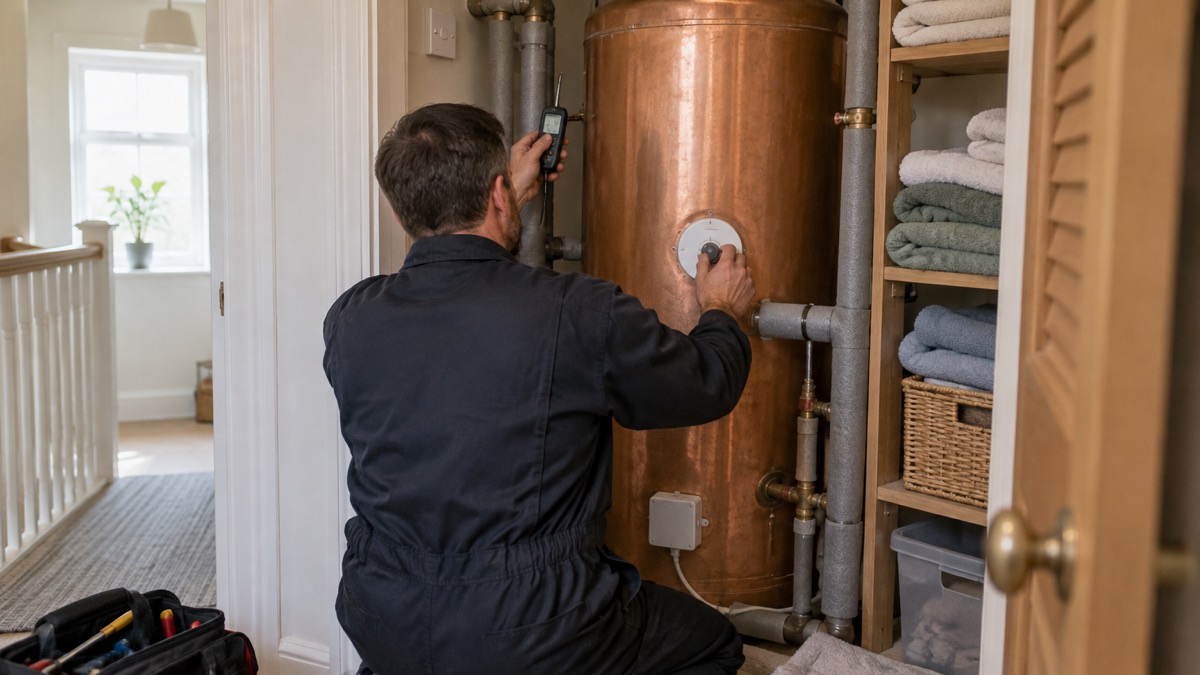
Legionella is a bacterium that can grow in water systems, and Legionnaires' disease is the severe form of pneumonia it causes when small droplets of contaminated water are breathed in1. For an ordinary household the risk is very low: Somerset Council's public health team puts it plainly, saying the risk of legionella within your home is very low, but that following simple precautions helps keep you safe1. The precautions are not complicated. Run taps and showers that have stood unused, keep hot water hot and cold water cold, and clean the outlets where water sits and sprays.
The reason home risk stays low is that most of us use our water constantly, so it never sits long enough in the warm, stagnant conditions the bacteria favour. Problems tend to appear after a break: a holiday, a spare room nobody uses, a shower in a guest bathroom, a tank or a hosepipe left full over winter. Legionnaires' disease is caught by inhaling contaminated droplets, not by drinking water, which is why showers, spa pools and spray outlets matter more than a glass from the tap2.
This page sets out what to do now, what to check and clean, who is most at risk, and when to seek help. If your supply has been interrupted or you are returning to a property that has been empty, the wider guidance on what to do when your supply comes back on and on water after a holiday sits alongside this page.
What Legionella is and how it reaches your taps
Legionella bacteria are naturally present in rivers, ponds and other water sources, so they are part of the environment rather than something that only appears when plumbing fails2. They become a household concern when water sits in a system at a temperature that lets them multiply, and when that water is then turned into a fine spray that someone breathes in. Legionnaires' disease is a severe form of pneumonia caused by inhaling small droplets of water contaminated with Legionella bacteria2.
That route of infection shapes everything else on this page. Drinking a glass of water containing the bacteria is not the main concern; breathing the mist from a shower, a spa pool or a spray tap is. The Health and Safety Executive's safety notice on managing legionella risks covers hot and cold water systems in buildings, spa pools and industrial processes that use water for cooling, washing and misting, which is a reminder that the risk is about systems and spray, not about the water itself being poisonous to swallow5.
In the home, the practical levers are temperature and stagnation. WaterSafe, the independent plumbing assurance scheme, advises maintaining hot water above 60°C and cold water below 20°C wherever possible to limit bacterial growth3. It also says that flushing water systems, cleaning taps and showerheads and maintaining correct water temperatures can significantly reduce the risk of Legionella establishing in your water systems3. Those three actions, flush, clean and keep the temperatures right, are the core of household prevention.
Run taps and showers that have not been used for a week or more
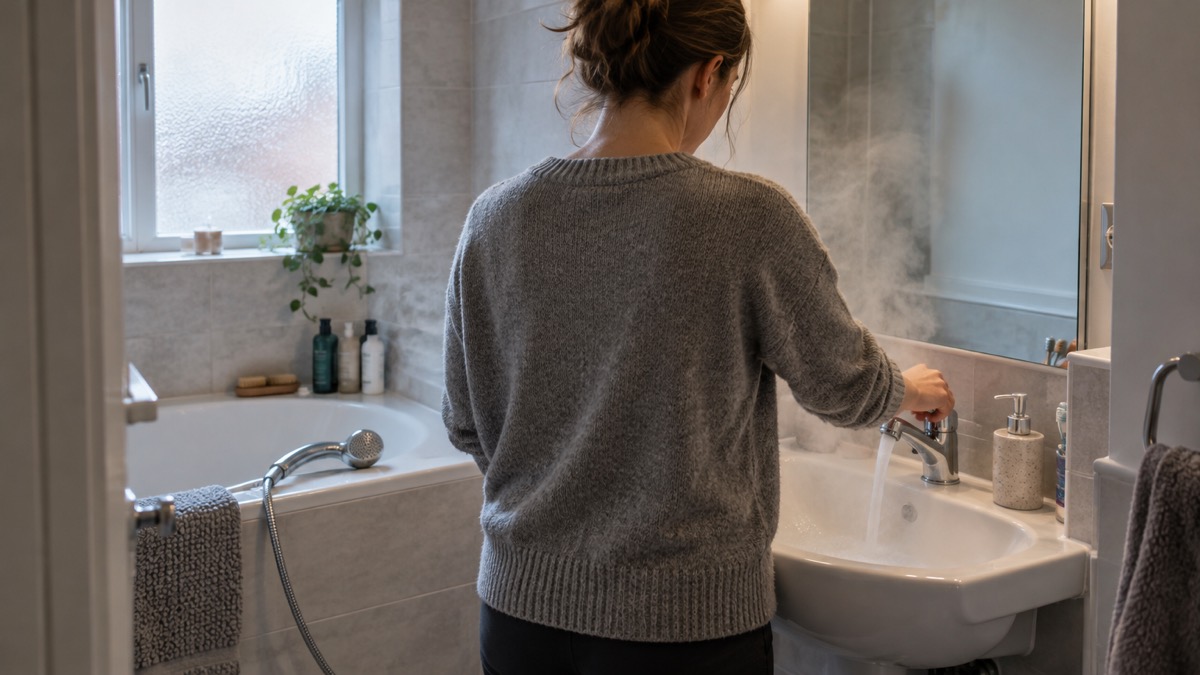
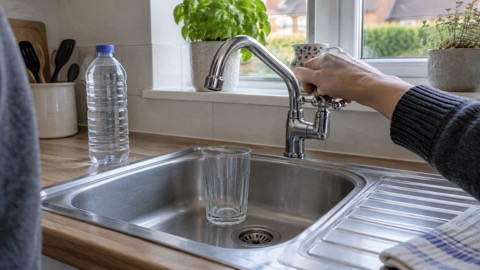
If a tap, shower or outside tap has not been used for a week or more, run it before you use it normally. WaterSafe's guidance on reducing lead in water makes the same point for any tap that has stood: run the tap to remove water that has been standing in the pipes for long periods, for example overnight, or if no one has run the taps for several hours4. The principle applies to every outlet in the house, not just the kitchen tap, and it is the single most useful habit after a holiday or when a spare bathroom goes unused.
Do it in a sensible order. Run the hot taps first, then the cold, and let each run for a few minutes so that fresh water is drawn through the pipework and any standing water is cleared. Flush the toilet as well, since the cistern holds water too. If you have an outside tap or a garden hose, run that briefly before you use it for anything, and never drink from it.
The same logic applies when you return to a property that has been flooded or left empty. Derbyshire County Council's advice for people returning home after flooding is to contact your local water company if you notice a change in drinking water quality, such as a change in the colour, taste or smell of tap water6. That is a sensible check after any long absence, not only a flood.
Keep hot water hot and cold water cold
Temperature is the lever you can actually control. WaterSafe's advice is to maintain hot water above 60°C and cold water below 20°C wherever possible to limit bacterial growth3. In a well-run home that usually happens by itself: the cylinder thermostat and the boiler do the work, and cold water arrives from the mains below 20°C. The problems come when a cylinder is turned down to save energy, when a cold tank sits in a warm loft, or when a hot water system is switched off for a long period.
Insulation helps hold those temperatures. If you are adjusting a cylinder thermostat, keep the stored water hot rather than lukewarm.
| What to check | Target | Why it matters |
|---|---|---|
| Hot water cylinder or tank | Above 60°C wherever possible3 | Limits bacterial growth in stored hot water |
| Cold water tank or supply | Below 20°C wherever possible3 | Warm cold water is the ideal growing range |
| Cylinder and pipe insulation | Fitted7 | Keeps stored water hot and pipes from cooling |
| Taps and showers after a break | Run before use4 | Clears standing water from the pipework |
If you have a cold water tank in the loft, check that it is covered and insulated, and that it is not sitting next to a hot pipe or a warm chimney. The Drinking Water Inspectorate explains that in public buildings, workplaces, healthcare premises and social housing all water tanks will be checked and cleaned as part of the arrangements that must be in place for legionella control purposes8. In a private home that job falls to you, and the household storage tanks page covers the practical side of keeping a tank clean and covered.
Water tanks, showerheads and hoses that need regular cleaning
The outlets and vessels where water sits are where limescale, mould and algae build up, and those deposits give bacteria somewhere to live. WaterSafe advises cleaning and disinfecting showerheads, taps and hosepipes periodically to prevent limescale, mould or algae from building up, and keeping all tap outlets free from debris3. A showerhead that has never been descaled is the classic example: it sprays a fine mist, and it is the part of the system closest to your lungs.
A simple routine keeps on top of it:
- Showerheads: remove and clean periodically, then disinfect, and refit3.
- Taps: clean and disinfect the outlet and keep it free of debris3.
- Hosepipes: clean and disinfect periodically to prevent limescale, mould or algae building up3.
- Tanks and cisterns: keep covered and check for debris; in public buildings, workplaces, health care premises and social housing, water tanks are checked and cleaned as part of the arrangements that must be in place for legionella control8.
- After flooding: clean all affected hard surfaces, including walls, floors and furniture, with hot soapy water and ordinary household cleaning products, and allow to dry thoroughly, which also helps destroy germs left behind9.
"Clean and disinfect showerheads, taps, and hosepipes periodically to prevent limescale, mould, or algae from building up, and keep all tap outlets free from debris"
If your home has a private supply, such as a well, borehole or spring, the routine matters more because there is no water company treatment upstream. Cornwall Council's guidance on private water supplies is the place to start, and the private supplies page explains what a household needs to do.
Who is most at risk from Legionnaires' disease
Legionnaires' disease can affect anyone, but the risk of infection is higher for certain groups: people over 45, smokers, heavy drinkers, and individuals with weakened immune systems or chronic illnesses such as diabetes, heart, lung or kidney disease2. The Health and Safety Executive describes it as a potentially fatal form of pneumonia which can affect anyone, but mostly affects those vulnerable because of age, illness, immunosuppression or smoking10. That is why workplaces and public buildings have legal duties to manage their water systems, while a household's job is the simpler routine above.
For a household, the practical point is to know who in the home is in a higher-risk group and to make sure the flushing and cleaning still happen when they cannot do it themselves. If someone in the home is shielding, has a long-term condition or is older, ask another household member to run the shower and clean the showerhead, and keep the bathroom ventilated while it is done.
The same groups often need extra help when the supply itself is interrupted. The government's Be Ready guidance lists people who use more water due to a medical condition, babies and young children, older adults and people with long-term health conditions among those who may be most at risk11. If that describes your household, the extra help section explains the Priority Services Register and other support.
Symptoms to watch for and when to call NHS 111
Legionnaires' disease starts like a severe chest infection, and it is worth knowing the signs if you have been exposed to a misty outlet that has not been cleaned. The early symptoms to watch for are a flu-like illness with fever, cough, breathlessness, chest pain, confusion, and sometimes sickness or diarrhoea. Because it is a form of pneumonia, it can worsen quickly, and early treatment matters.
Seek help from a GP or contact NHS 111 if someone is feeling unwell and shows symptoms of breathlessness, chest pain, confusion, intense thirst, weakness, dizziness, or cramps which get worse or do not go away12. If you or anyone in your family gets symptoms such as sickness, diarrhoea or tummy cramps, or becomes ill after swallowing contaminated water, speak with your GP, call NHS 111 or visit the NHS 111 website for advice13. In Wales, the equivalent route is NHS Wales 111, which the Welsh health service advises calling for a child with a rash, vomiting, headache or other symptoms after accidental swallowing or contact14.
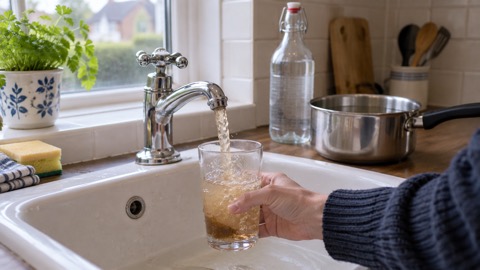
If your water has been discoloured, cloudy or smelly, check with your water supply company before drinking it or using it for baby formula or brushing teeth, as it may be contaminated17. In Northern Ireland, call NI Water on 0345 744 0088 if you notice a change in water quality, such as a change of taste or smell or discoloured water18.
Stored water, hot tubs and garden supplies
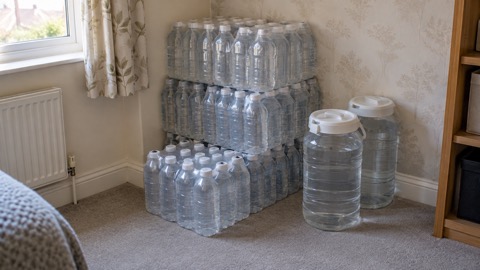
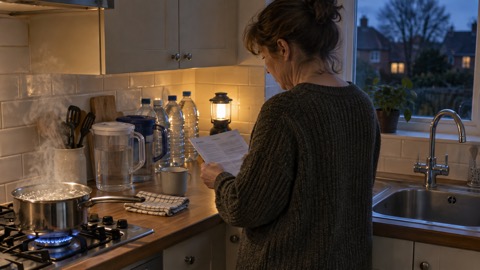
Stored emergency water is for drinking and cooking, not for showers, so it does not create the droplets that cause infection. The official Be Ready checklist suggests bottled water for 3 days, at 3 litres per person per day for drinking, with more needed for other tasks such as cooking and washing19. The Scottish Government's Prepare guidance gives 2.5 litres of bottled water per person for each day20. Either way, keep stored water covered and cool, and if you boil water to make it safe, keep it in a container with a cover or a lid while it is cooling, because uncovered water could become contaminated and make you ill21. The how much to store and storing tap water pages go into the detail.
Hot tubs and spa pools are the opposite case: they make warm mist, and they need proper treatment. Public health guidance recommends that leisure water facilities such as swimming pools, spa pools and hot tubs meet the requirements of the Pool Water Treatment Advisory Group22. If you have your own hot tub, follow the maker's water treatment instructions and do not let the water sit untreated between uses.
Garden supplies need care too. Water butts and hosepipes hold standing water that can grow bacteria, so never drink from them and do not use a garden hose to fill paddling pools or wash food. In a drought, the government advises using a watering can instead of a hosepipe and installing a water butt if you can to capture rain23, which is a good reason to have one but not a reason to drink from it.
Sources (23)
- Water safety, Somerset Council, 2026
- What is Legionnaires' disease?, WaterSafe, 2026
- How can I prevent Legionnaires' disease in my home or business?, WaterSafe, 2026
- What can I do to reduce lead in my water?, WaterSafe, 2026
- Safety alerts, Health and Safety Executive, 2026
- Cleaning up and returning home after flooding, Derbyshire County Council, 2026
- Keeping your home warm in winter, Met Office, 2026
- Water storage tanks and cisterns, Drinking Water Inspectorate, 2026
- Flooding and health - Public Health Wales, Public Health Wales
- Information about specific safety concerns, Northumberland County Council, 2026
- Water supply interruptions or outages - Be Ready, Be Ready (beready.campaign.gov.uk)
- Severe weather planning, Derbyshire County Council, 2026
- Further support after a flood, Nottinghamshire County Council, 2026
- Poisoning and accidental swallowing, Aneurin Bevan University Health Board, 2026
- Dehydration, NHS, 2026
- Recognising sepsis, NHS, 2026
- Prepare yourself, Greater Manchester Combined Authority, 2026
- Flooding advice, Belfast City Council, 2026
- Be Ready checklist, UK Government, 2026
- Prepare for emergencies, Dumfries and Galloway Council, 2026
- Weather and health, Public Health Wales, 2026
- Private water supplies, Cornwall Council, 2026
- Droughts, UK Government, 2026
 Supply Interruption Checklist
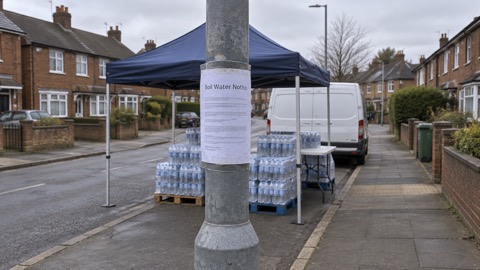 Boil Notice Checklist
 Drinking Supply Checklist
 Boil Water Notice Advice
 When Supply Is Restored
 Check for an Outage
 Report No Water or Burst Pipe
 Bottled Water Stations
 Bottled Water Delivery Help
 Flushing the Toilet in an Outage
 Washing Without Running Water
 Combi Boiler When Water Is Off
 Water Company Incident Alerts
 Checking a Water Company Caller
 Brown or Discoloured Tap Water