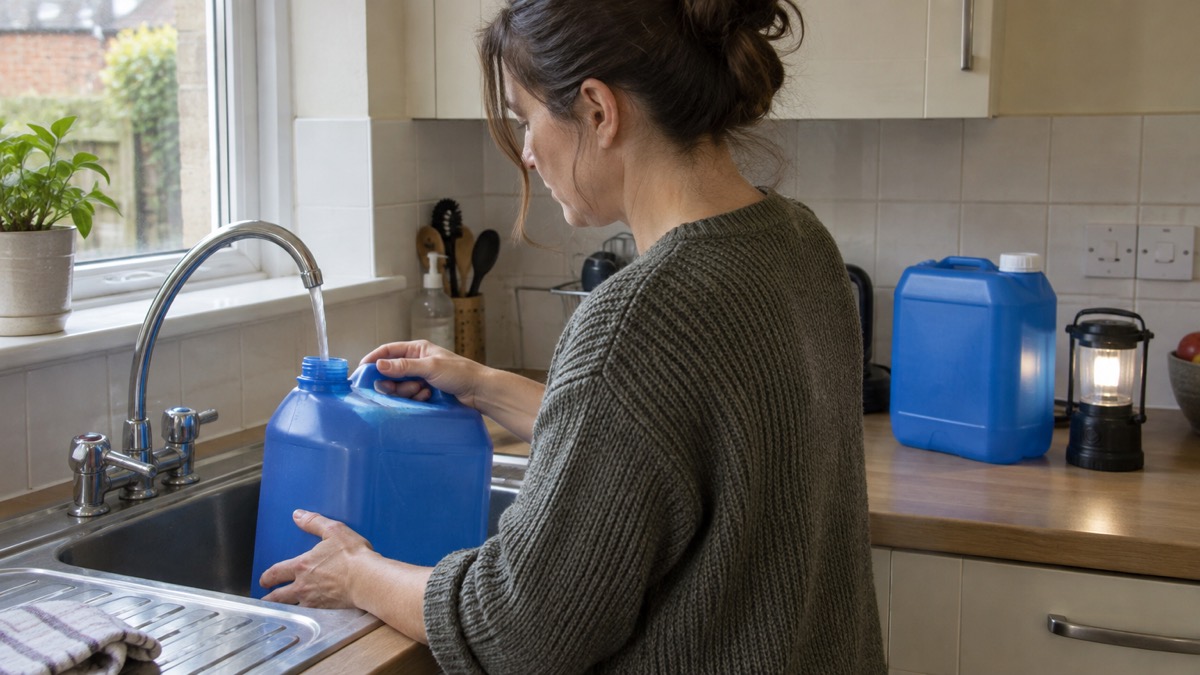
Water supply interruptions happen for many reasons, from scheduled maintenance to a burst water main, and most are over quickly with minimal impact1. Occasionally they last longer, and a burst main can leave a street or a whole area without water for days1. The single most useful thing you can do now is to know who supplies your water, keep a modest store of drinking water, and know where your stopcock is.
This checklist sets out what to have ready before the tap runs dry, what to do while the supply is off, and how to tell an interruption apart from a do not drink notice or a hosepipe ban. It is written for an ordinary household with no prepping background. Work through it once, put the few things it asks for in a cupboard, and you will be ready for the next incident.
Water supply interruption checklist
Work through this list once and keep the items together. Each line says why it matters.
Burst mains and supply incidents can cut water for days
Interruptions to water supply occur for many reasons, ranging from scheduled maintenance to burst water mains1. Pipe bursts and contamination, infrastructure failures or pollution incidents can all disrupt supply12. A burst main is the classic case: it can lead to a loss of supply with little warning, and the repair and refill can take time2.
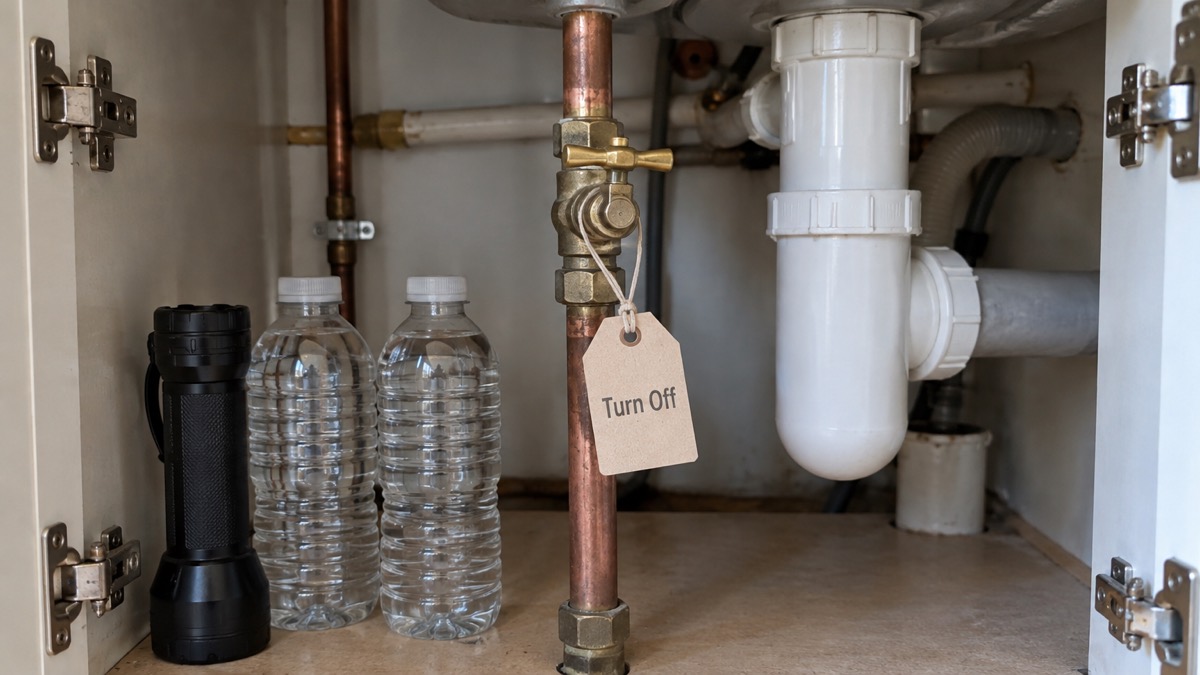
Most events are over quickly with minimal impact, but longer water supply outages occasionally happen1. It is worth planning for the longer case rather than the shorter one. Official advice is to plan for situations where your electricity, gas or water supply is cut off13. That means a store of water, a way to keep in touch, and a plan for anyone in the house who depends on water for medical or care needs.
Water and power failures often arrive together. Mains water supply to your home could also be disrupted during and after power cuts, because pumps and treatment works need electricity11. If the lights go out, do not assume the taps will keep running.
The risk is not evenly spread. Older pipework is being replaced in some areas, and companies do plan for it. But the practical point for a household is the same everywhere in the UK: know your supplier, keep some water, and know how to turn the supply off if a pipe bursts inside your home.
Water stations: where bottled water is handed out during an interruption
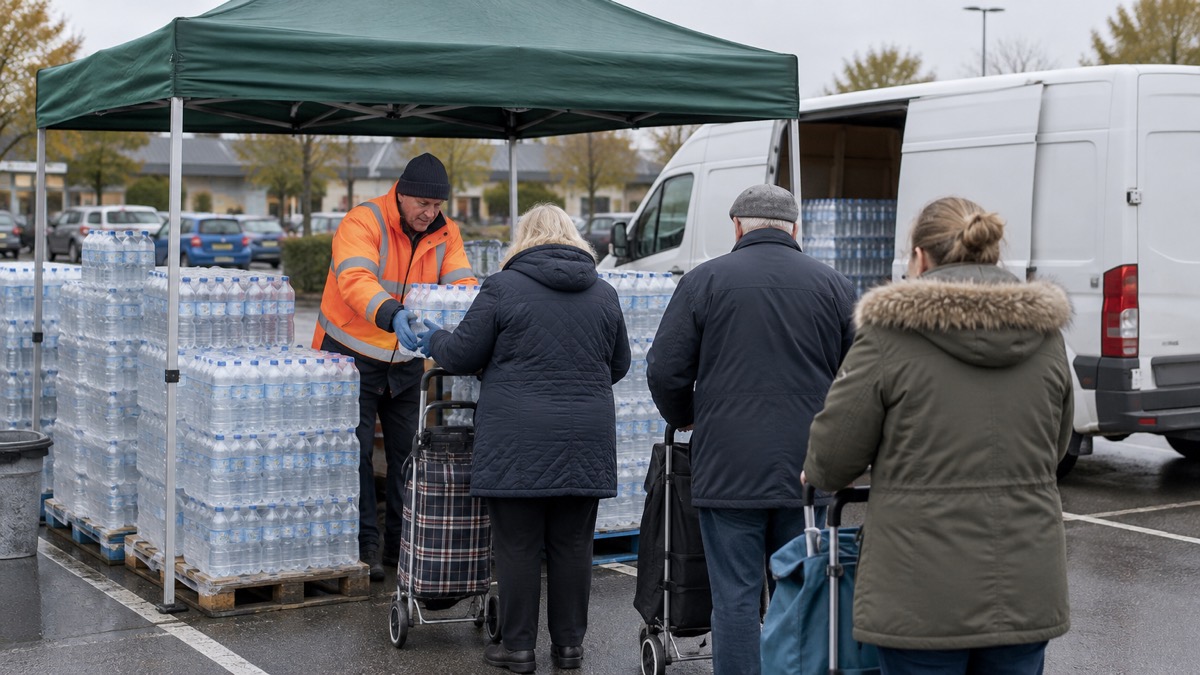
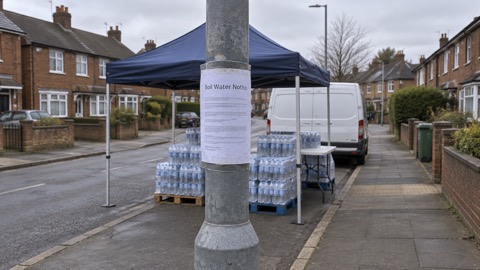
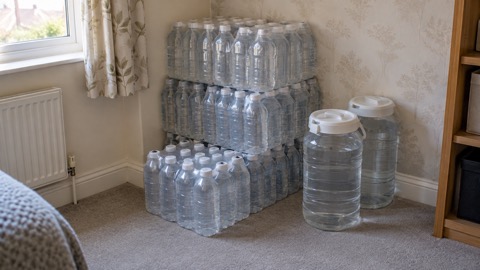
When a supply interruption is serious, water providers keep households in supply where they can, or make alternative arrangements such as water distribution points where people collect bottled water at a designated local area3. These are usually called bottled water stations.
The pattern is well established. During a supply interruption in Flintshire, three bottled water stations were established over the course of the incident, in addition to community hubs set up to provide alternative water14. After a burst main at Purton and Royal Wootton Bassett, Thames Water set up bottled water stations where individuals could collect water, and delivered bottled water to properties on the Priority Services Register6.
So there are two routes to bottled water:
- Collect it yourself from a bottled water station or community hub, whose location your water company will publish3.
- Have it delivered if you are on the Priority Services Register, which water companies use to identify households that need extra help6.
If you are collecting for someone else, check first whether they are also without water and offer to pick up bottled water for them1. If you need to report a water emergency, give as accurate a location as possible15.
Do not drink notices and hosepipe bans: how they differ from an interruption
An interruption means the water is not there. A notice means the water is there but you must not use it in the usual way. A hosepipe ban means the water is fine but scarce. These are three different situations, and they call for different responses.
Water suppliers send three kinds of water notice for different circumstances: "Boil tap water before use" for drinking and food preparation, "Do not drink your tap water", and "Do not use your tap water"7. These are safety instructions issued because of contamination or a treatment failure. Follow them exactly, and see do not drink and do not use notices for what each one means in practice.
A temporary use ban, often called a hosepipe ban, is different again. Water companies may choose to enforce temporary usage bans, or hosepipe bans, to help conserve water8. If a hosepipe ban is in place where you live, you cannot use a hosepipe connected to your mains water supply for things like watering your garden, filling a paddling pool or washing your car8. It is a restriction on how you use water, not a warning about its safety.
| Situation | What it means | What to do |
|---|---|---|
| Supply interruption | No water, low pressure or intermittent supply1 | Use stored water, check your supplier by postcode, collect from a station if needed1 |
| Boil notice | Water must be boiled before drinking or food preparation7 | Boil and cool water before use |
| Do not drink notice | Tap water is not safe to drink7 | Use bottled or stored water for drinking |
| Do not use notice | Tap water is not safe for any use7 | Avoid all use, including washing |
| Hosepipe ban | Water is safe but scarce8 | Stop using a hosepipe for the listed activities |
Finding your water supplier and checking an incident in your postcode
It is good to know who supplies your water and which company you would need to contact if something goes wrong16. You can add your postcode and find this out using the supplier lookup signposted by your council's emergency planning pages16. Write the name and number down and keep it with your other emergency contacts.
Once you know your supplier, checking an incident is straightforward. Take a look at your local water company's website, where you can search on your postcode and see if there is anything going on in your area3. Your water company is the source to check if an interruption happens1. In an emergency, your supplier should keep you informed about service disruptions17.
If the problem continues after an outage, contact your water provider directly1. Ofwat provides information on what communication you should expect to receive from your water company in the case of an interruption to water supply1. Water companies should also tell you if they are going to turn off your water5.
For households that need extra help, the Priority Services Register is the route. Water companies use it to tell you if they are going to turn off your water, and to deliver bottled water during an incident5. Ask your supplier to add you if anyone in the household is older, disabled, medically dependent or has young children. See extra help in an emergency for the wider picture.
Lead in drinking water and when the supply comes back
Two quieter risks deserve a place on the checklist: lead in older pipework, and what happens when the water returns.
Lead can dissolve into water while it stands in the pipe18. The concentration depends on how long the water has stood, the condition of the pipework, the water temperature and the water hardness, and more lead dissolves during the summer and autumn months18. The problem arises when drinking water comes into contact with lead supply pipes, lead tanks, lead solder joints on copper pipes, or inferior quality brass fittings and taps, particularly over longer periods such as overnight, weekends and holidays19. In Scotland, the Drinking Water Quality Regulator publishes advice on lead, and councils encourage households to establish whether lead is present and to take steps to replace lead pipes, with precautionary measures in the short term19. If you are concerned, run the tap before drinking and ask your supplier about testing.
When the supply comes back, do not assume everything is normal. During a national power outage, water may not come back on for a day or even longer21. Check your supplier's updates for your postcode before you rely on the tap again, and follow any notice that comes with the restoration. If the water runs discoloured at first, let it clear before use, and see what to do when your supply comes back on for the full sequence.
Keeping the kit ready
A checklist is only useful if the items are there when you need them. Review your store twice a year, when you change the clocks or before winter. Check that your stored water is in date, that your stopcock still turns, and that your supplier's number is still correct.
Keep the physical items together in one place: water, a container, a torch, a radio and your written contacts. Keep the knowledge in your head and on a label by the stopcock, so that anyone in the household can act if you are out4.
Finally, think about who else might need help. Checking on a neighbour during an interruption costs nothing and can make the difference for someone who cannot carry water1. For the wider picture, see water in an emergency: a household guide and emergency kit: what a UK household should keep ready.
Sources (21)
- Water supply interruptions or outages, UK Government Prepare campaign, 2026-10-12
- Loss of utilities, East Cambridgeshire District Council, 2026
- Failure of water infrastructure or loss of drinking water, Wiltshire and Swindon Prepared, 2026-10-25
- Steps to reduce the risk of burst pipes, nidirect, 2025-10-23
- Priority Services Register, Surrey County Council, 2026-10-28
- Spotlight on Thames Water: prioritising support for those who need it most, Wiltshire and Swindon Prepared, 2026-10-25
- How to recover from flooding, UK Government, 2023-12-19
- Droughts, UK Government Prepare campaign, 2026-10-19
- Preparing for flooding, Surrey County Council, 2026-10-28
- 2965-WYP-Flooding-Checklist-A4.pdf, West Yorkshire Prepared
- Power cuts, UK Government Prepare campaign, 2026-10-21
- Utility failure, Essex Prepared, 2026-10-29
- Are you ready?, Birmingham City Council, 2026-05-06
- Written statement: water supply interruption Flintshire, Welsh Government, 2025-08-27
- Water, Surrey County Council, 2026-10-29
- Know your water supply, Wiltshire and Swindon Prepared, 2026-10-25
- Energy, power supply and utilities, nidirect, 2025-10-23
- Lead in drinking water, Drinking Water Inspectorate, 2026-05-01
- Lead in drinking water, Drinking Water Quality Regulator for Scotland, 2026-10-28
- Public health and housing, Argyll and Bute Council, 2026
- What is a national power outage, Wiltshire and Swindon Prepared, 2026-10-25
 Boil Notice Checklist
 Drinking Supply Checklist
 30-Day Household Checklist