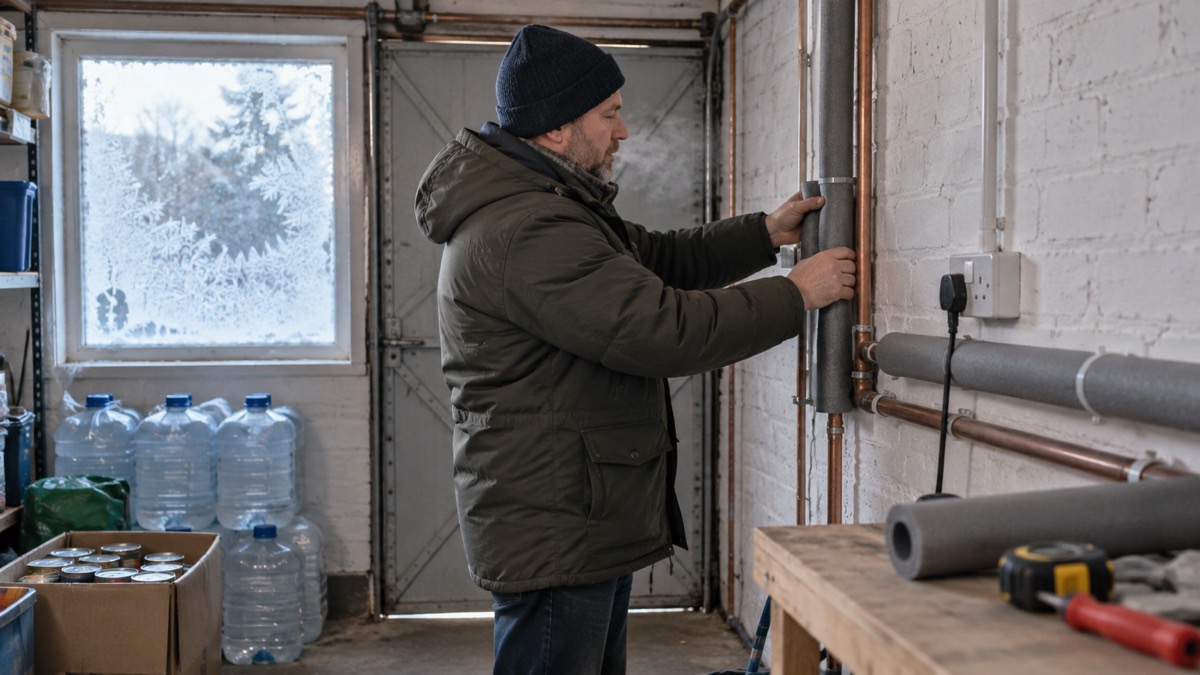
Cold weather damages homes in predictable ways: pipes freeze and burst, heating fails, and snow or floods cut households off from shops and help. The preparation that prevents most of this is short and cheap. Find your stop tap, usually under the kitchen sink, and check it works every six months1. Put together a household kit with at least three days of water and food2. Those actions cover the majority of what winter can do to an ordinary UK home.
The Met Office's winter advice puts it plainly: if you have a burst or frozen pipe, "the number one step you can take to prevent damage to your home" is knowing how to find and operate your stop tap3. Everything else on this page supports that. This guide walks through the jobs in the order they matter: the stop tap first, then the pipes, then the kit, then the extra steps if you live rurally or in a flood-risk area. If a pipe has already burst, go straight to home emergencies for what to do in the moment.
Find your stop tap and check it works
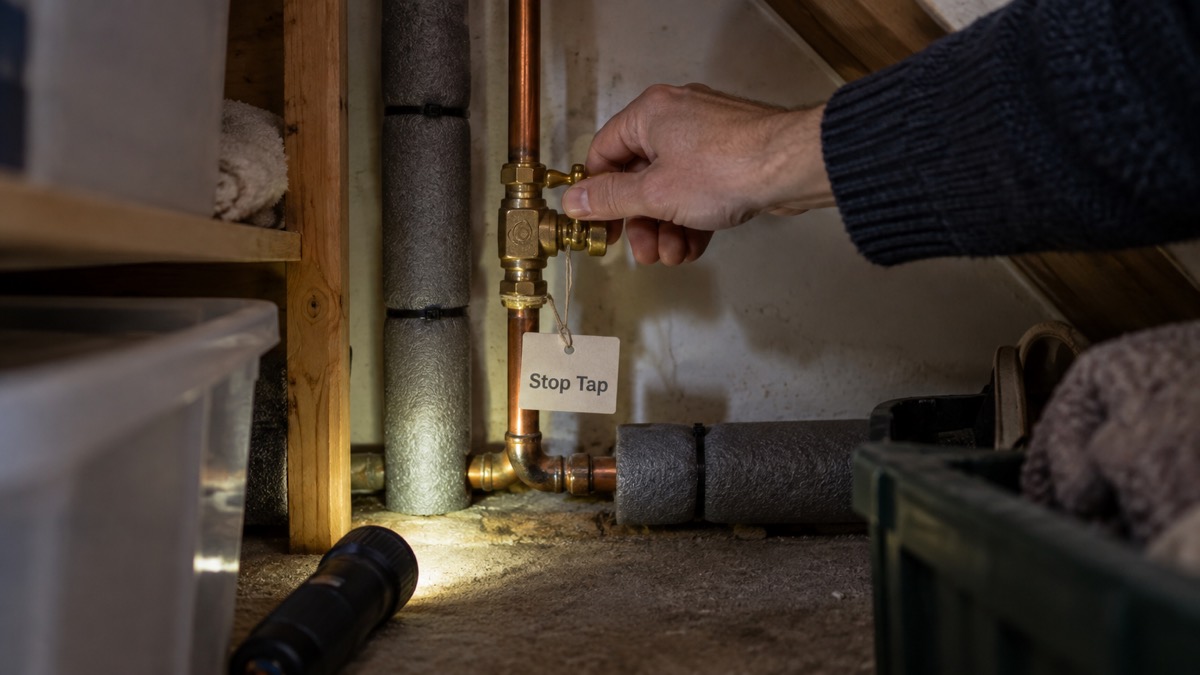
The stop tap, also called a stopcock or stop valve, is the valve that shuts off the mains water coming into your home6. It is usually located under the kitchen sink, but it can also be found in downstairs bathrooms, kitchen cupboards, garages, cellars and under the stairs1. If a pipe bursts anywhere in the house, turning this one tap stops the flow of water into the property, which is why every piece of official winter advice starts here.
Knowing where it is is only half the job. The Met Office advises you to check it is working every six months1, and North Wales Fire and Rescue Service adds that you should check regularly that you can turn it off easily in an emergency7. Stop taps that sit unused for years seize in the open position, and a tap you cannot turn is no use at all. Turn it off and on again a couple of times, and if it is stiff, do not force it: work it gently, and if it will not move, arrange for a plumber to free it before the cold weather arrives.
Two habits make the stop tap useful for the whole household, not just for you. First, tell everyone in the home where it is, including older children and anyone who might be in the house alone. Second, label it. Surrey's flood preparation advice is to know and label all mains supplies, gas, water and electricity, and to include instructions beside each one on which way to turn8. In a burst, with water coming through a ceiling, nobody wants to be guessing which way is off. While you are at it, check for an additional stop tap or valve near any water storage tank, which some homes with loft tanks have9.
Where pipes freeze first
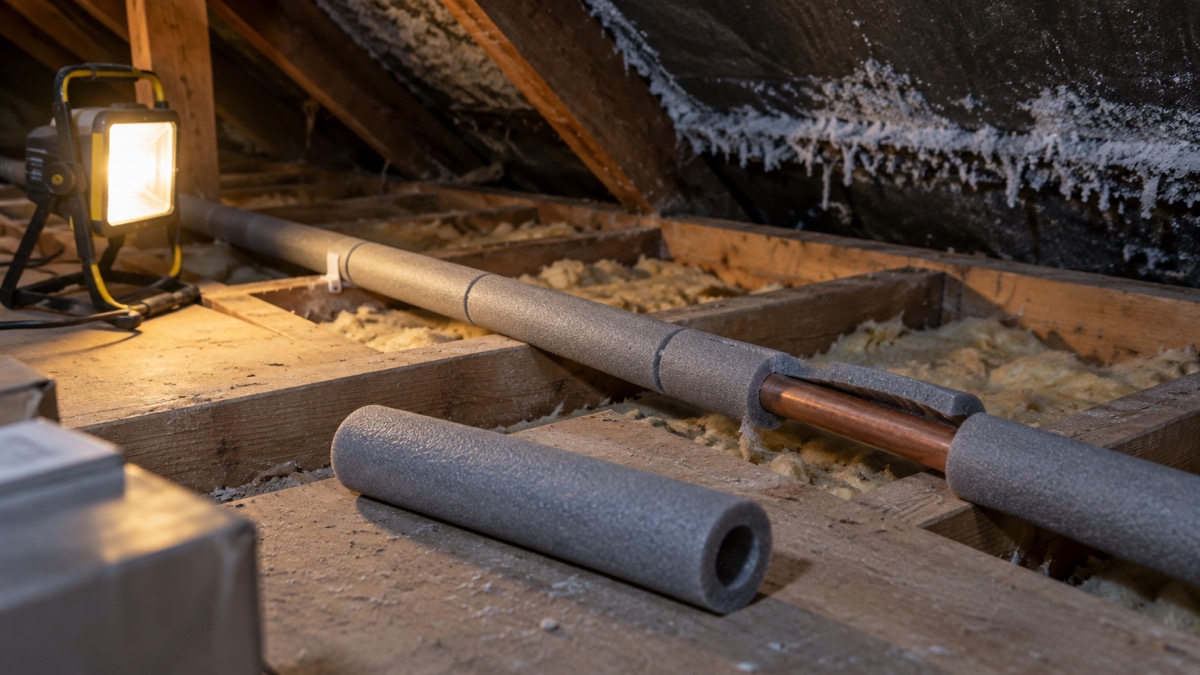
Pipes freeze where the cold reaches them, and that is rarely in the warm middle of the house. Wessex Water's guidance on thawing frozen pipes says to look in garages, outbuildings, attics and basements, starting with the pipes that are easiest to reach and most likely to freeze10. The West Mercia local risk guidance makes the same point from the other direction: pipes can be exposed to freezing temperatures if they are in a part of your home that is not heated9.
That gives you a short list of places to check before winter:
- The loft or roof space. Pipes in cold places like lofts are among the most likely to freeze, so check the ones there are insulated1.
- The garage and outbuildings. Rarely heated, often draughty, and frequently home to long pipe runs10.
- Basements and cellars. Basements are among the places to check for frozen pipes, alongside garages, outbuildings and attics10.
- Outside walls. Pipes in unheated areas such as lofts, garages or outside walls are at particular risk when temperatures fall9.
- Outside areas. Pipes and taps that are outdoors are among the most likely to freeze5.
If your loft is very cold, Cornwall Fire and Rescue Service suggests leaving the loft trap door open in severe cold, so some warmth from the house reaches the pipes and tank above11. It is a small step, but it costs nothing and it works precisely because lofts are the coldest inhabited-adjacent space in most homes. For a loft tank specifically, see how to insulate a cold water tank in the loft.
Pipe lagging: what it does and where to fit it
Lagging is the foam or mineral wool sleeve that wraps around a pipe to slow the loss of heat from the water inside it. Water that stays warmer takes longer to freeze, and in most UK cold snaps that margin is the difference between a pipe that survives and a pipe that bursts. The Met Office's advice on protecting your property from winter weather makes the wider case: "Good quality lagging protects from freezing, but it will also help insulate your hot water system and save you money"12. So lagging is not only burst prevention; it reduces the work your boiler does to keep hot water hot.
You can buy lagging from DIY stores13, and it is one of the simpler home jobs: the foam type splits along its length and slides over the pipe, and joints are taped. Check all pipes inside your home and any bare pipes outside your home are lagged and protected before the cold weather comes13.
If your pipes are in poor condition, lagging will not fix them: changes in pressure can strain the pipework and cause it to burst, so protect pipes during cold weather and contact a plumber if you spot damaged pipework11. That repair is worth doing before winter, because a freeze stresses exactly those weak points first. More on heating failures in gas and heating failures.
Outdoor pipes need waterproof lagging
Outdoor pipes face a problem indoor pipes do not: rain and damp. Standard foam lagging absorbs water, and wet lagging conducts heat away from the pipe faster than no lagging at all, which is why outdoor runs need waterproof lagging. United Utilities' advice, carried in Cumberland Council's winter readiness pages, is to insulate water pipes with lagging in cold places like the loft, garage and outside areas5. For an outside tap, the cleanest solution is to isolate it for the winter so no water sits in the pipe at all: see how to isolate an outside tap for winter.
If a pipe bursts: turning off the water
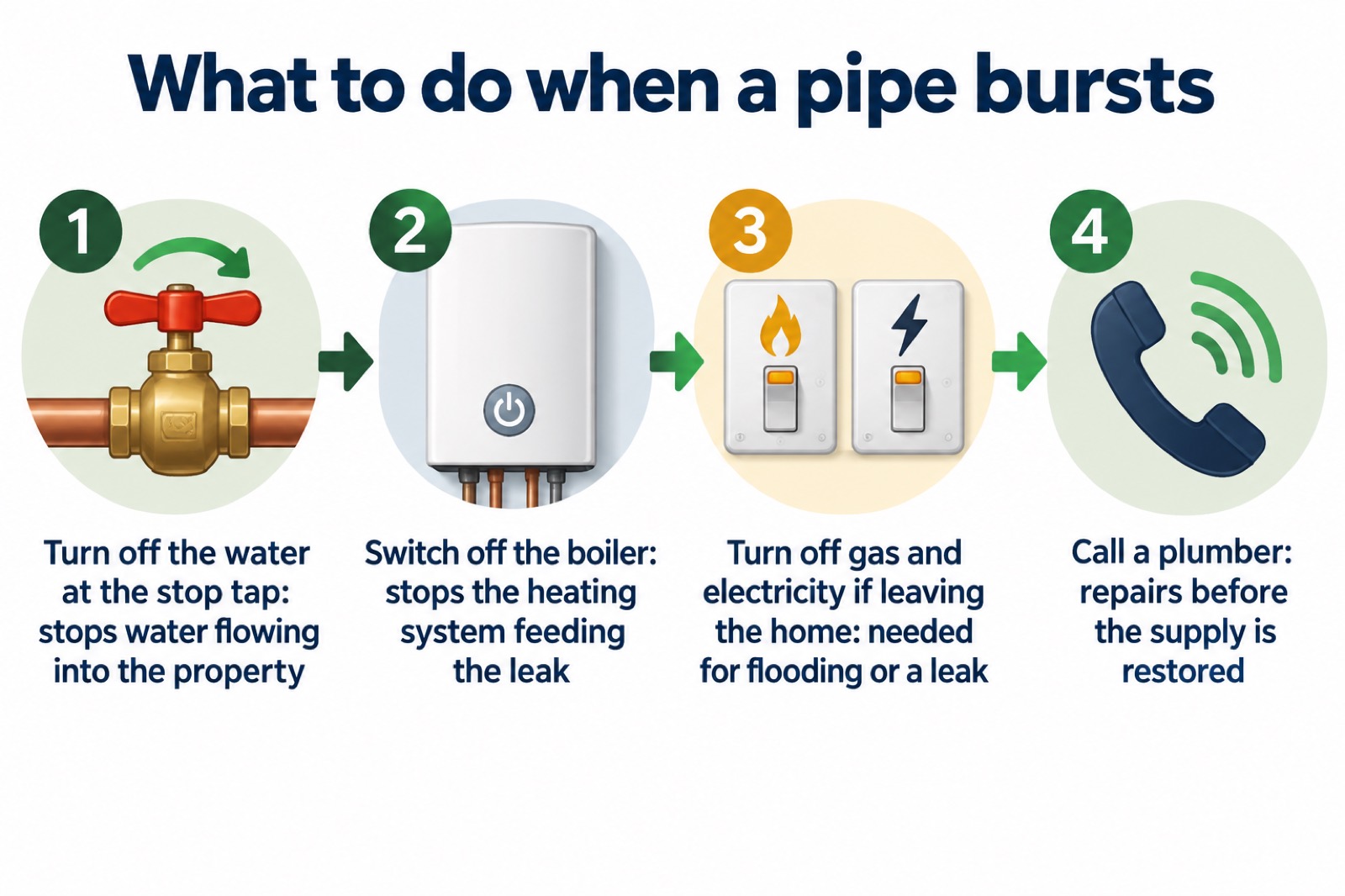
The moment a pipe bursts, the sequence is short. Turn off the water supply coming into your property at the stop tap, and switch off your boiler1. Those two steps stop the inflow and stop the heating system pumping water into the leak. Cornwall Fire and Rescue Service adds a preparation step that pays off here: store some water for personal and toilet needs for when you have to switch the mains water off11. A burst pipe can leave the water off for hours while repairs are made, and a filled container or two in advance makes that bearable.
The same shut-off knowledge applies to gas and electricity. Official preparedness advice across the UK is consistent: know how to turn off water, gas and electricity in your home14, because you will need to turn these off if you have to leave your home due to flooding or a leak4. The practical way to learn this is to do it once, while everything is calm: find each shut-off, turn it, confirm it works, and label it with the direction to turn8.
For a frozen pipe that has not burst, the approach is different: Wessex Water's first step is to turn off the internal stop tap to stop pressure building up inside the pipe, then thaw the pipe gently, and once it has thawed, remove the towels and check for cracks or leaks before turning the water supply back on10. The full step-by-step, including how to thaw a pipe safely, is on home emergencies.
Who is responsible for which pipes
The division is straightforward. Ofwat, the water regulator for England and Wales, states that as a customer "you are responsible for the supply pipe to your home. This is the pipe that runs from the boundary of your property into your home"16. The water company is responsible for the mains network up to your boundary. In practice that means the pipe under your garden, under your drive and inside your walls, including all the indoor pipework, is yours to maintain, lag and repair. If a pipe bursts inside that boundary, the repair bill and the plumber's call-out are household matters, which is a further reason the cheap prevention on this page is worth doing.
Make a household emergency kit before the cold weather
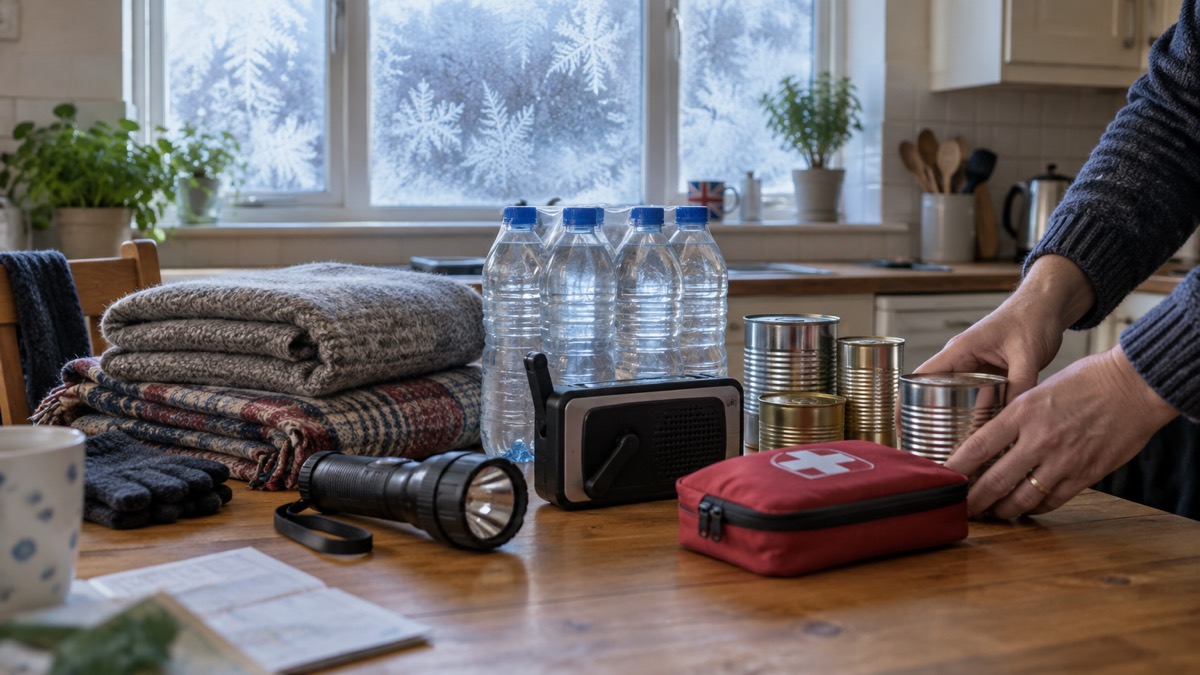
Winter emergencies at home are usually interruptions: the power goes, the water goes, or the road becomes impassable for a day or two. A household kit means those interruptions are uncomfortable rather than dangerous. The UK government's Be Ready campaign sets out the core contents, and local guidance across England, Scotland, Wales and Northern Ireland agrees on the essentials4.
What the kit contains, drawn from official checklists:
- Torches and spare batteries, plus a battery or wind-up radio for news and weather4
- First aid kit and any essential medicines, with enough of your regular medication to last through a period of disruption18
- Warm clothing, blankets and sleeping bags, because homes can become cold very quickly when the heating goes off4
- Bottled water and food that does not need cooking and will not go off17
- Sanitary items and toiletries17
- A written list of emergency contact numbers18
- Spare keys and important documents, including your insurance policy, in a waterproof bag19
Keep the kit in one place that everyone in the household knows, and where you can reach it in the dark. Check it once a year: replace expired medicines, test the torch batteries, and swap any food approaching its date. The full contents list, including what to keep in the car for wintry weather such as a shovel, jump leads, warm clothes and an in-car phone charger, is on emergency kit, and the case for each item is developed on water, food and lighting.
The contact list
Write down, on paper, contact details for work, your doctor, schools, your water supplier, electricity network operator, gas supplier, telephone and internet provider, home insurance company, home breakdown services and an emergency friend outside the household18. In a burst or a power cut, your mobile may be flat or out of signal, and the numbers you need are never the ones you know by heart. If you live in a flood-risk area, add your insurer's claims line and the Floodline number to the same list19.
How much to store: at least 3 days of water and food
The consistent figure across official guidance is three days. Argyll and Bute Council's severe weather advice is to keep at least three days' supply of food, bottled water and other essentials, including medicines, and tinned and dry foods which store safely without need for electricity20. Pembrokeshire's emergency planning advice puts the same goal in plain terms: prepare to survive in your home on your own, without outside help, for at least three days21. A home emergency kit should hold 3 days' supply of bottled water and food that does not need cooking and will not go off2.
For water, the Be Ready campaign gives the working figure: 3 litres per person per day for drinking, and more would be needed for other tasks such as cooking and washing4. Store at least three days' worth of bottled water on that basis, before any extra for cooking, washing or flushing. Store more if you can, and remember Cornwall's advice to keep some water set aside for personal and toilet needs for when the mains has to be switched off11.
| What to store | How much | Notes |
|---|---|---|
| Drinking water | 3 litres per person per day, for 3 days4 | More needed for cooking and washing4 |
| Food | At least a 3 day supply of non-perishable food2 | Tinned and dry foods that store safely without electricity20 |
| Medicines | Enough essential medication for the stored period18 | Include prescriptions you rely on |
| Heating fuel | An adequate store for your house22 | Keep fuel supplier contacts close at hand, but do not rely on them reaching you22 |
Some local guidance goes further. The community resilience booklet used in parts of England advises enough emergency reserves in your house for up to ten days, including essential medications, food and water18. Three days is the minimum that official campaigns ask of every household; ten days is the level some communities aim for where disruption is known to last longer. If you want to build up gradually, start at three days and add to the store each shop.
If you heat with oil, LPG or solid fuel, Lancaster's severe weather guidance adds a specific point: ensure you have an adequate storage of heating fuel for your house, keep contact details for fuel suppliers close at hand, but do not rely on them being able to reach you22. A snowed-in lane stops a fuel delivery just as it stops a shopping trip.
If you live rurally or in a flood-risk area
Rural households face the same risks with longer consequences. The Scottish emergency kit guidance is direct about it: rural areas are more likely to be cut off from the shops during snow17. That argues for a larger store, more heating fuel, and a plan that assumes no deliveries and no travel for several days. Pembrokeshire's advice for remote areas covers the rest of the picture: sufficient heating fuel and alternative heating equipment, with fuel for it, in case the electricity supply is cut off; ventilation maintained when using kerosene heaters to avoid a build-up of toxic fumes; fire extinguishers to hand, with everyone knowing how to use them; and regular checks on vulnerable family and friends21.
For flood-risk households, the preparation is a step further: be ready to leave at short notice if required17. Cornwall Fire and Rescue Service's flood advice is to make a flood kit containing a torch, battery radio, emergency numbers, rubber gloves and your insurance policy, kept in a safe place, and to keep a list of useful numbers including your insurance company and Floodline19. When a flood warning arrives, Natural Resources Wales sets out the sequence: get your flood kit, prepare to move people and pets to a safe place, move important items upstairs, move or weigh down large or loose items outside, put flood gates in place, turn off gas, electricity and water, and move your car to higher ground23.
Remember to make provisions for domestic animals22, and do not underestimate flood damage: check that your insurance covers flood, make a family flood plan, and do not wait, because floods can occur very quickly19. During a storm, only call for immediate help if there is a risk to life, and do not travel in heavy rainstorms unless absolutely necessary19. The full sequence of what to do before, during and after a flood is on flooding.
Staying warm and well while you wait
Preparation is not only about pipes and stores. Derbyshire Fire and Rescue Service's cold weather advice covers the human side: look after yourself by eating hot meals, drinking hot drinks, wearing lots of thin layers, and stocking up on food and medication in bad weather24. The Be Ready campaign makes the same point about the home cooling: homes can become cold very quickly when the heating goes off, so keep blankets, sleeping bags and warm clothing in your kit4. If the heating fails for longer than a few hours, the guidance on heating and cooking without mains power and on staying well in cold weather take over from this page.
Watch out for signs of frostbite and hypothermia and get medical help immediately if symptoms are detected, and regularly check up on vulnerable family and friends, particularly older neighbours21. Cornwall's flood advice carries a reminder that applies to any cold, wet emergency: people have suffered hypothermia after their homes became flooded with cold rainwater, even in summer19. Households that need extra support, including older, disabled and medically dependent people, can register for priority services, explained on extra help in an emergency.
A winter checklist for the whole home
Pulling the page together, here is the order of work, roughly by effort and payoff:
- Find the stop tap and check it works. It is usually under the kitchen sink, and it is closed by turning it clockwise8.
- Check for a second stop tap near any loft tank, and know which one controls what9.
- Lag the pipes in the garage, loft and outside the home to prevent them freezing or bursting5.
- Use waterproof lagging outdoors, or isolate the outside tap for winter5.
- Have the boiler serviced, and ensure all pipes in your roof space or loft are insulated18.
- Clear gutters and check the roof as part of the Met Office's wider property protection advice12.
- Build the household kit: torch, radio, first aid, blankets, water, food, medicines, toiletries, contact list, spare keys and documents4.
- Store 3 litres of drinking water per person per day for at least 3 days, plus non-perishable food4.
- Stock heating fuel if you are not on mains gas, and keep supplier numbers written down22.
- If you are in a flood-risk area, make a flood kit and a family flood plan, and be ready to leave at short notice17.
Each of these jobs is small on its own. Done together, before the first hard frost, they remove most of the ways a cold snap turns into an insurance claim or a night in a hotel. For the wider picture of storms, snow and ice, including weather warnings and travel, start at storms, snow and ice, and for the general case of preparing your household for any emergency, see getting started.
Sources (24)
- Frozen or burst pipes, Met Office, 2026
- Create a flood pack, Bradford Council, 2026
- WeatherReady weather hacks, Met Office, 2026
- Be Ready for emergencies, UK government Be Ready campaign, 2026
- Snow, ice and winter ready advice, Cumberland Council, 2026
- 10 things you should do now to prepare for winter, Met Office, 2026
- Ice and burst pipes, North Wales Fire and Rescue Service, 2026
- Preparing for flooding, Surrey County Council, 2026
- West Mercia Risk Register, West Mercia, 2025
- Thawing frozen pipes, Wessex Water, 2026
- Snow and ice in Cornwall, Cornwall Fire and Rescue Service, 2025
- Protecting your property from winter weather, Met Office, 2026
- AW172 Wrap up Lft V5.indd, Anglian Water
- Preparing for an emergency, Nottinghamshire County Council, 2026
- Emergency advice for residents, Warwickshire County Council, 2026
- Households: your water supply, Ofwat, 2026
- Emergency kit, Ready Scotland, 2026
- Are You Ready? community resilience booklet, Culham Parish Council, 2025
- Flooding: keeping safe, Cornwall Fire and Rescue Service, 2026
- Be prepared at home and in your community, Argyll and Bute Council, 2026
- Severe weather, Pembrokeshire County Council, 2026
- Be prepared for severe weather, Lancaster City Council, 2026
- What to do in a flood, Natural Resources Wales, 2026
- Cold weather, Derbyshire Fire and Rescue Service, 2026
 Car Checks Before Winter
 Flood Warning Checklist
 First Steps After a Flood
 Beast from the East 2018
 Driving in Snow and Ice
 Which Roads Are Gritted
 Staying Well in Cold Weather
 Walking on Ice Safely