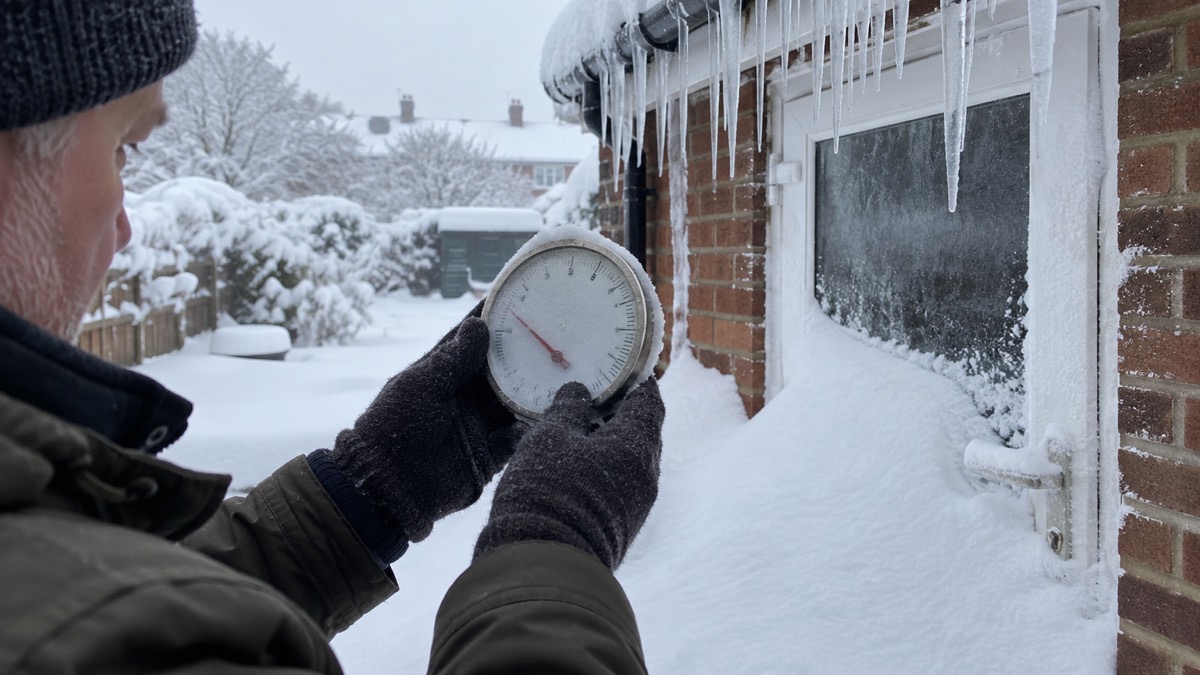
The Beast from the East was the name given to the period of severe cold and snow that gripped the UK from late February to early March 20181. A bitter easterly wind dragged air from Siberia across the country, dropping temperatures 8 to 12°C below average in places on 1 March, and combining with Storm Emma to bring heavy snow to the south west2. The Met Office issued two Red Warnings for snow, the highest level of warning it gives, and almost all areas experienced some lying snow2.
The event is remembered for its travel chaos, its closed schools and its frozen water network, but its most serious consequences came quietly, in people's homes. On 28 February a man died after falling into a frozen lake in a London park2. Then, as the weather warmed, the rapid thaw brought a second emergency: water companies across England and Wales later described the weather that produced it as severe, though not unprecedented, and fewer than 3% of all customers were affected2.
This page explains what happened, day by day and system by system, and what an ordinary household should take from it. The lesson of 2018 is not that severe cold cannot be forecast, because it was. It is that the effects of a long cold spell, on roads, schools, water supplies and health, arrive together and last longer than the snow itself.
What the Beast from the East was
The Beast from the East was not a single storm but a spell of severe winter weather, driven by a cold easterly airflow that set in over the UK at the end of February 2018. Ofwat, the water regulator, describes it simply as "the name given to the period of cold weather in late February and early March 2018"1. The National Risk Register records that "the UK experienced a spell of severe winter weather with very low temperatures and significant snowfall" across much of the country3.
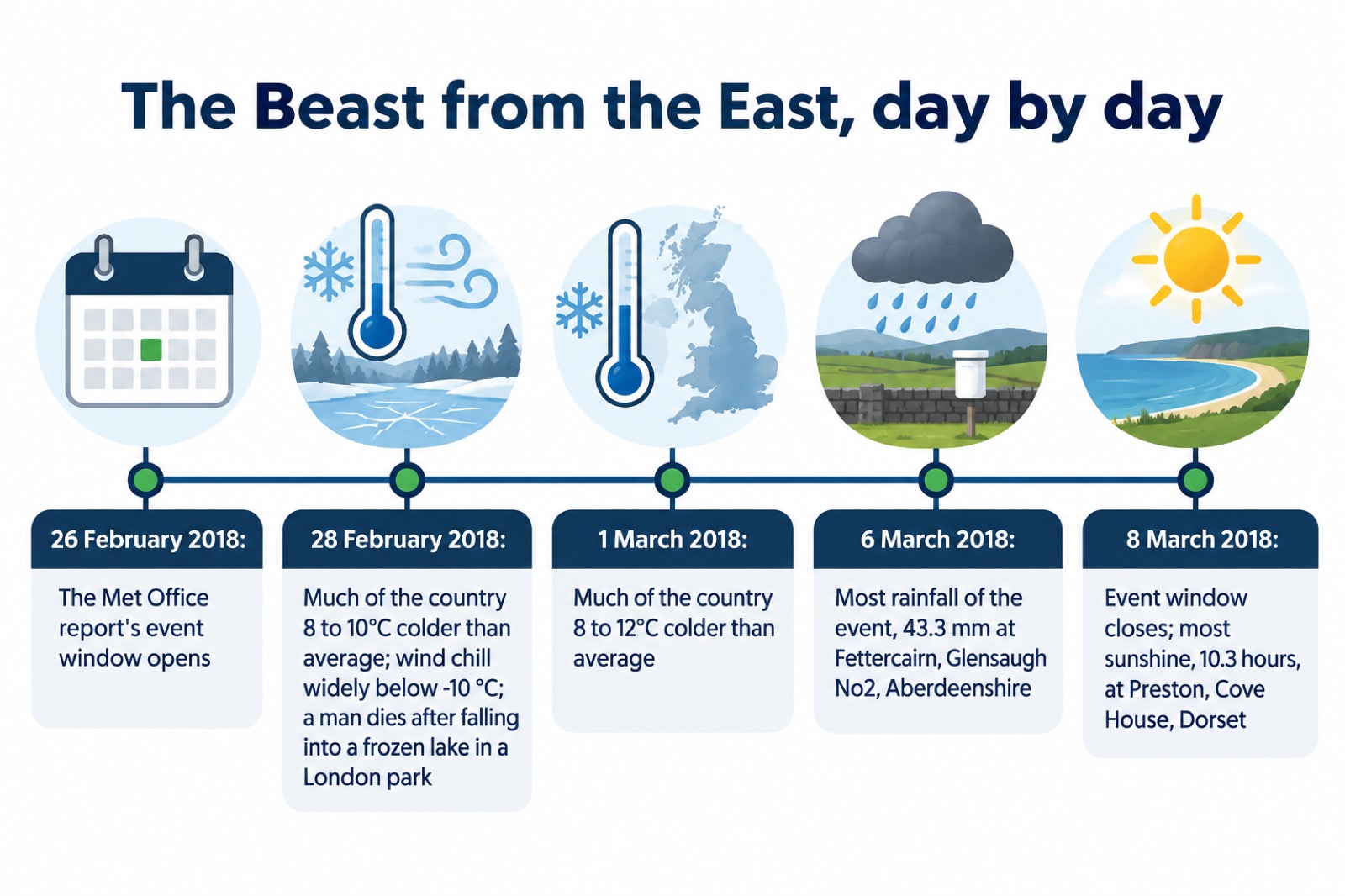
The Met Office's report on the event covers 26 February to 8 March 20182. Other accounts give different dates: NEA's reporting dates the event from 22 February to 3 March 20184. The disagreement is real and worth knowing about, because it reflects what the event was: a prolonged cold spell with no sharp beginning and end, rather than a named storm with a defined track. The worst conditions clustered around 28 February and 1 March, when the cold easterly flow met Atlantic air pushing in from the south west around Storm Emma, a named storm that arrived from the direction of France and Iberia and threw heavy snow back over the UK's south west on its northern flank.
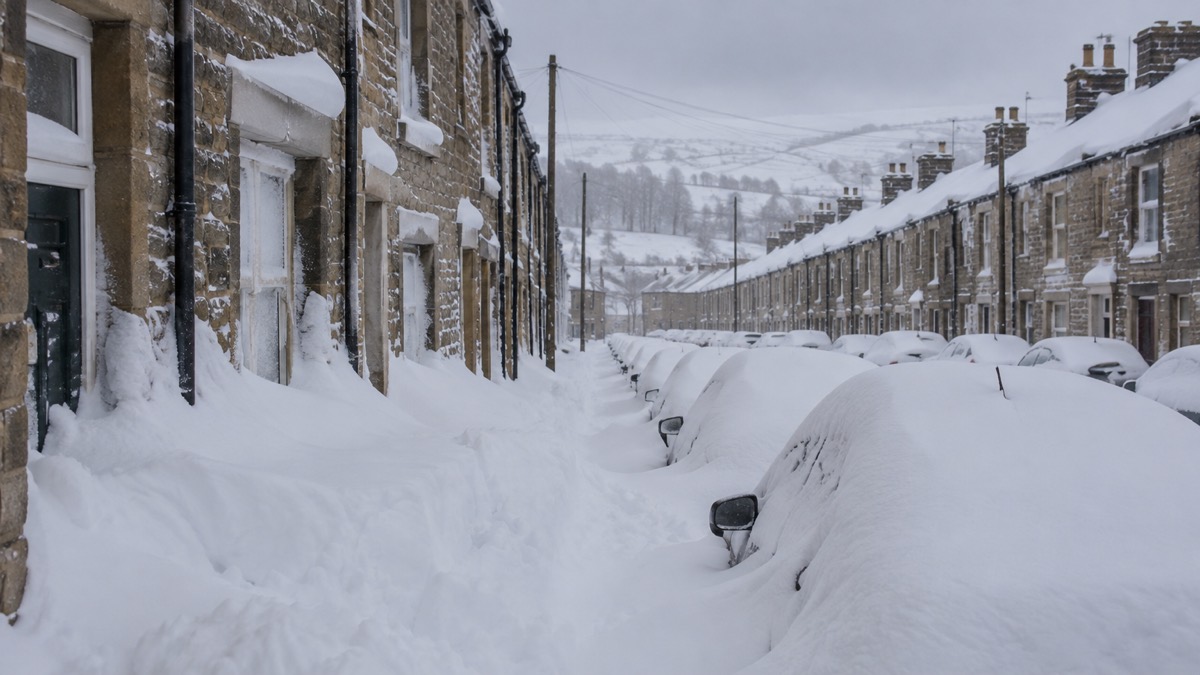
That meeting of air masses is what made the event so disruptive. The east of the UK had deep, dry snow driven by wind; the south west had heavy, wet snowfall as Storm Emma's moisture ran into the cold air. Almost all areas across the UK experienced some lying snow, with the greatest accumulations in the north and east2.
How cold it got, and what wind chill added
The raw temperatures were striking enough. Much of the country was 8 to 10°C colder than average for the time of year on 28 February, and 8 to 12°C colder than average on 1 March2. The lowest minimum temperature recorded during the event was around -14°C, at Faversham in Kent on 28 February3, and places across the country stayed well below freezing, day and night, for days on end.
What made it dangerous to be outdoors was the wind. The Met Office records that "the freezing temperatures combined with a strong east wind, particularly on 28 February and 1 March, resulted in a wind-chill widely below -10 °C"2. Wind chill is the effect of wind stripping heat from exposed skin: at those values, frostbite becomes possible on exposed skin, and the risk to anyone stranded outdoors, waiting for a bus or walking to school, rises sharply.
For perspective, the Beast from the East did not approach the UK's record lows. The coldest temperature ever recorded in England was -26.1C at Edgmond, near Newport in Shropshire, in the winter of 19825. More recently, December 2024 saw a UK lowest minimum of -11.2°C at Tyndrum No 3 in Perthshire, with a grass minimum of -14.3°C at the same site6. What set 2018 apart was not the depth of the cold but its reach and duration: severe wind chill and lying snow across almost the whole country, including places like Cornwall and the south coast that rarely see either, sustained for well over a week.
| Measure | Value | Where and when |
|---|---|---|
| Temperature anomaly, 28 February 2018 | 8 to 10°C colder than average | Much of the country2 |
| Temperature anomaly, 1 March 2018 | 8 to 12°C colder than average | Much of the country2 |
| Wind chill | Widely below -10 °C | 28 February and 1 March 20182 |
| Most rainfall | 43.3 mm | Fettercairn, Glensaugh No 2, Aberdeenshire, 6 March 20182 |
| Most sunshine | 10.3 hours | Preston, Cove House, Dorset, 8 March 20182 |
Two Red Warnings for snow, and what a Red Warning asks of you
The Met Office issued two Red Warnings for snow during the event, and almost all areas across the UK experienced some lying snow, with the greatest accumulations in the north and east2. A Red Warning is the highest level of the UK's severe weather warning system, and it carries a specific instruction.
"Dangerous weather is expected and, if you haven't already done so, you should take action now to keep yourself and others safe from the impact of the severe weather."
Traffic Scotland's guidance spells out what that means in practice: with a red warning "it is very likely there will be a risk to life with substantial disruption to travel, you should avoid travelling where possible and follow the advice of the emergency services and local authorities"8. If you want to understand the full warning system, including how amber and yellow differ, see our guide to Met Office weather warnings.
During the Beast from the East, many people who set out on 28 February and 1 March in response to amber warnings found themselves trapped when conditions escalated. The lesson is to treat any snow warning as a prompt to decide, that day, whether journeys in the following 48 hours are truly necessary.
Roads, railways and airports stopped moving
The transport impacts were the most visible face of the event. Dorset's local resilience forum notes that in storms and severe weather "buses, railways and planes cannot run their services", and low temperatures and heavy snow bring "road and travel disruption"9. During the Beast from the East that played out across the whole country at once: hundreds of flights cancelled, trains suspended or running emergency timetables, and major routes closed by snow and abandoned vehicles.
The road network simply could not keep up. National Highways, formerly the Highways Agency, provides traffic reports for its network of 4,300 miles of motorways and major A roads across England11, but that network covers only the main strategic routes. Local roads, and the A roads that feed them, depend on council gritters, and in drifting snow even treated roads became impassable as wind refilled them within hours. Devon and Somerset Fire and Rescue Service notes that it attends more road incidents than fires, and that on average 650 people are seriously injured on the roads in its area each year12: in snow, that risk multiplies, which is why the service's standing advice is to stick to the speed limits and never use your mobile phone when driving12.
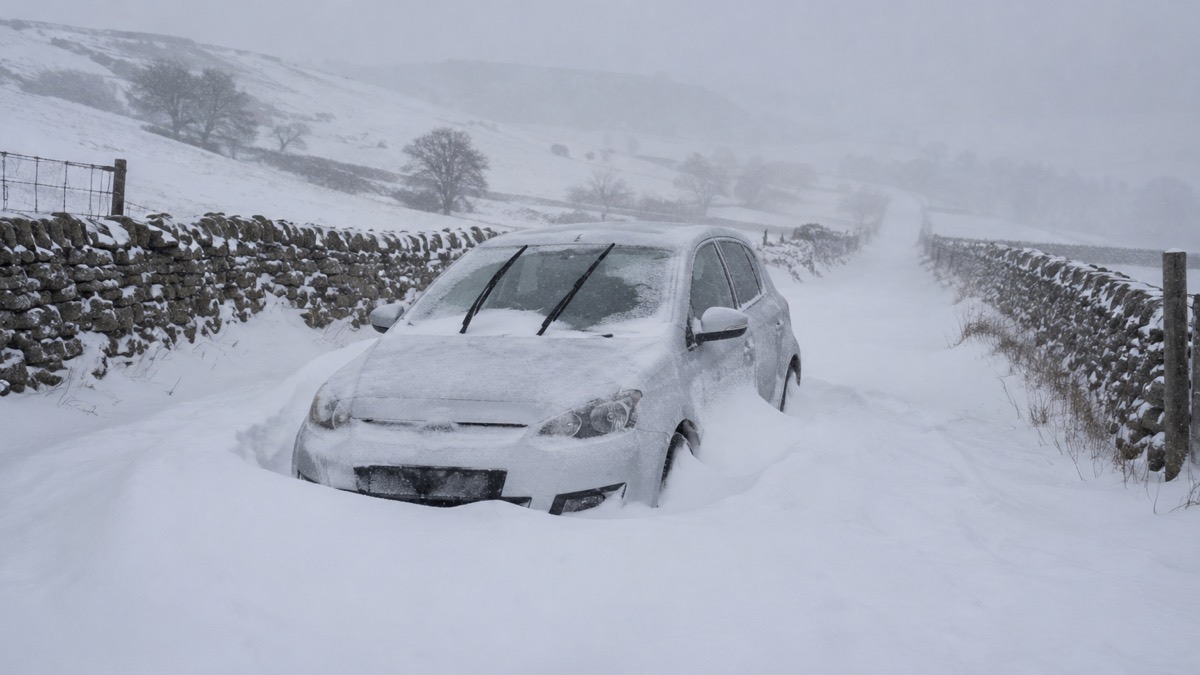
The most serious road consequence of the event was people stranded in vehicles overnight. If that happens to you, Pembrokeshire Council's severe weather advice is specific:
- Pull off the road, turn on your hazard lights and hang a distress flag from the radio aerial or window13
- Remain in your vehicle unless there are buildings nearby you know you can take shelter in13
- Run the engine and heater for about 10 minutes each hour to keep warm, opening a window slightly while the engine runs and periodically clearing snow from the exhaust pipe13
- Move around to maintain body heat but avoid over-exertion, and huddle with passengers13
- Make sure someone stays awake to keep an eye out for rescue teams13
- Drink fluids to avoid dehydration, and do not waste battery power13
The Humber Local Resilience Forum's winter guidance adds the key rule: "Do not leave the vehicle unless you are in sight of a suitable destination. Let help come to you"14. People who leave a stranded car in a blizzard to walk for help are the ones rescuers struggle to find. Our page on what to do if your car gets stuck in snow covers this in full, and driving in snow and ice covers the decisions you make before setting out.
*A stranded vehicle in drifting snow: stay with it, and let help come to you.
Schools closed and isolated communities supplied by helicopter
Thousands of schools closed during the event. In 2018 that consequence arrived on a national scale, with closures across England, Scotland and Wales at the event's peak.
For parents, the practical question is how you find out, and what happens if the school has to act quickly. Lewisham Council's guidance for school emergencies explains that "if the school needs to be evacuated, children will be taken to a safe place nearby and the school will contact you to let you know what to do"15. That is worth knowing in advance: your child's school has arrangements for keeping pupils safe even if you cannot collect them, and it will contact you. Our page on how to find out if your child's school is closed in snow lists the channels councils use.
The event also showed how far emergency support can stretch when communities are cut off. The Met Office's report records that "isolated communities and farms across the North Pennines received supplies by helicopter"2. When snow blocks every road for days, the response does not stop at gritting: the military and emergency services can be asked to deliver food, fuel and medicine by air. Households in remote areas should not plan on that arriving quickly, though. Pembrokeshire Council's advice for remote communities is to hold sufficient heating fuel and alternative heating equipment, with fuel for it, in case the electricity supply is cut off13.
Burst pipes left more than 200,000 people without water
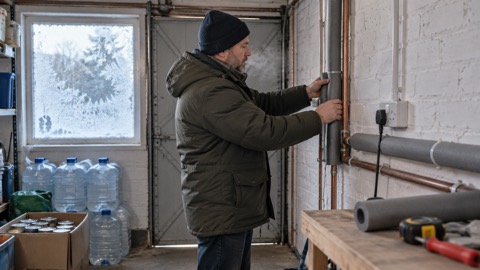
The thaw was a second emergency. Ofwat's report on the event is clear about the mechanism: "The fast change in temperature led to many burst pipes"1. Water freezes inside a pipe, expands, and splits the pipe or its joints; while the blockage holds, no water escapes. When the weather warms rapidly, the ice melts and water pours out through every damaged section at once, across an entire region on the same day.
The scale in 2018 was extraordinary. The documents give two figures, and they disagree because they measure different things: over 200,000 customers in England and Wales were without water for more than four hours, and over 60,000 customers were without supply for more than 12 hours1. Ofwat also notes that fewer than 3% of all customers were affected, which is true and cold comfort if you were among them, and that the weather "was severe but not unprecedented"1. A later freeze-thaw event in December 2022 showed the same pattern: Dŵr Cymru Welsh Water estimated that up to 60% of the water lost during that period was linked to leaks on customer pipelines, meaning pipes on the household's side of the boundary, not the company's mains16.
What to do if a pipe bursts in your home:
- Turn off your stop tap and electricity supply immediately, and contact a plumber for professional advice14
- If the burst is on a pipe from the storage tank, turn off the stop valve in the storage tank, turn on all hot taps to drain the system, and allow the fire to burn out or turn the heating off until a plumber has attended17
- See that taps are turned off properly, so the system does not drain away through an open tap once supply returns17
The single most useful preparation is knowing where your stop tap is and checking that it turns. Find it before winter, not while water is coming through the ceiling. Our guides on home emergencies, insulating a cold water tank in the loft and isolating an outside tap for winter cover the household side of this in detail.
As many as 2,000 deaths: cold homes, heart and lung disease
The gravest toll of the Beast from the East was not on the roads but in people's homes. NEA, the fuel poverty charity, reported in November 2024 on estimates of the event's mortality: based on ONS data, as many as 1,724 extra deaths in England alone, and across the UK "the number may even be as high as 2000"4. Of those, an estimated 690 were attributable to cardiovascular diseases and up to 570 to respiratory diseases, and around 520 vulnerable people may have perished in cold homes during the freezing weather4.
This pattern is not unique to 2018. Official guidance on cold temperatures notes that "there is strong evidence that some of these winter deaths are indeed 'extra' and are related to cold temperatures and living in cold homes as well as infectious diseases such as influenza"5. Cold raises blood pressure and strains the heart, and it worsens breathing conditions; the deaths cluster in the days after the cold arrives, not only during it.
More recent official statistics show the same mechanism at work in milder events. UK Health Security Agency monitoring for England recorded 421 cold-associated deaths in the first cold episode of winter 2024 to 2025, which lasted 2 days, and 738 in the second episode, which lasted 3 days. Over that whole winter, the South East had the highest regional number of cold-associated deaths, at 515, and hospitals saw the highest number of any place of death, at 1,070. A cold spell does not need to be a Beast from the East to kill: even a two-day episode in a normal winter carries a measurable death toll.
Who was most at risk, and what help exists:
- People in cold homes, especially older people and those on low incomes who cannot afford to heat adequately4
- People with cardiovascular and respiratory disease, whose conditions worsen in cold4
- People who depend on electricity or water for heating or medical equipment, for whom supply failures compound the cold18
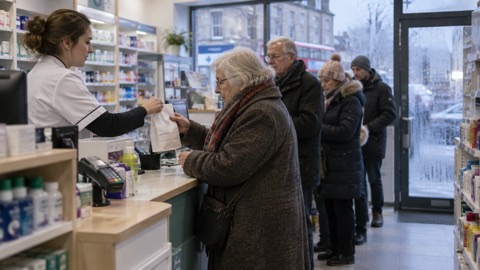
If you or someone you care for is in these groups, join the Priority Services Register with your energy supplier and water company. Surrey County Council's guidance lists what it provides, including "priority help in an emergency" and, from communications providers, "use of emergency SMS (mobile only)"18. Our pages on staying well in cold weather and extra help in an emergency explain how to register and what else it unlocks.
What the Beast from the East shows about getting ready for severe cold
Every impact of 2018 was forecast, and most were survivable with preparation. The households that came through it best were the ones that had acted before the first warning. Advice on preparing homes for severe cold sets out the essentials13:
- Sufficient heating fuel, and alternative heating equipment with fuel for it, in case the electricity supply is cut off
- Ventilation maintained when using kerosene heaters, to avoid a build-up of toxic fumes
- Fire extinguishers to hand, with everyone in the household knowing how to use them
- Local radio or television monitored for weather reports and emergency information
- Regular meals and ample fluids, avoiding caffeine and alcohol
- Several layers of light, loose-fitting clothing with a water repellent outer layer, mittens rather than gloves, and always a hat
- Watching for signs of frostbite and hypothermia, and getting medical help immediately if symptoms appear
- Regularly checking on vulnerable family, friends and neighbours, especially the elderly
Essex Prepared's guidance frames the same point as a list of disruptions to be ready for: power cuts, disruption to gas or water supplies, severe weather, loss of telephone or internet services, being confined indoors, and being stranded or severely delayed on a journey19. The Beast from the East delivered several of these at once, which is the real test of household preparedness. A kit that covers only one failure, a torch for a power cut but no water stored, is not enough.
Two specific measures are worth acting on:
- Know your stop tap and insulate your pipes. Insulation alone is often not enough in very extreme temperatures below freezing, as was witnessed during the Beast from the East16. Lag pipes, insulate the loft tank, and know how to shut the water off.
- Check whether you qualify for a Cold Weather Payment. Between 1 November and 31 March, people claiming certain benefits receive a payment of £25 if the average temperature in their area is recorded as, or forecast to be, zero degrees celsius or below for 7 consecutive days20. A spell like the Beast from the East triggers it in most areas.
For the fuller checklist, see our guides on getting your home ready for cold weather, the emergency kit a UK household should keep, and staying informed in an emergency.
How the Beast from the East compares with other bad winters
The event stands out in living memory, but the historical record puts it in perspective. The winter of 1946 to 1947 was one of the harshest on record, lasting until March 1947: heavy snowfall blocked roads and train tracks, shut down power stations due to lack of fuel causing power cuts, and the eventual thaw led to over 100,000 homes being affected by flooding21. The Beast from the East was shorter and less severe than 1947, but its thaw-driven water emergency echoed the same pattern: the melting is often as damaging as the freeze.
More recent comparisons are closer to home. Storm Arwen in November 2021 combined severe gales with snow, particularly in the north east of England and Scotland: the regulator Ofgem's review found that around 40,000 customers were without supply for more than three days, nearly 4,000 were off supply for over a week, and all customers were restored within 13 days22. The North Yorkshire Community Risk Register records that in Low Row in Swaledale, temperatures plunged below minus six degrees and heavy snowfall left residents without power and roads inaccessible23. Arwen's lesson, like 2018's, is that a single event can leave households without power, heating and water simultaneously for days, not hours. Our page on Storm Arwen covers that event in detail.
The Beast from the East was exceptional in its scale, but the mechanisms that made it deadly, cold homes, strained hearts and lungs, and infrastructure that fails in a fast thaw, are present in every British winter. The same monitoring that counts cold-associated deaths episode by episode shows that shorter, quieter cold spells in an ordinary winter still carry a real health toll, which is why the preparations on this page matter every year, not just in the once-a-generation storms.
Sources (23)
- Thaw report: the water sector's response to the Beast from the East, Ofwat, 19 June 2018
- Beast from the East February March 2018 report, Met Office, March 2018
- National Risk Register, Cabinet Office
- Cold weather warning: fuel poverty and excess deaths, NEA, 17 November 2024
- Cold temperatures risk page, Wiltshire and Swindon Prepared, 31 May 2024
- Monthly weather report, December 2024, Met Office, December 2024
- Weather warnings guide, Wiltshire and Swindon Prepared, 25 October 2026
- Weather warnings, Traffic Scotland, 29 October 2026
- Storms, gales and high waves, Dorset Prepared, 3 April 2024
- Low temperatures and heavy snow, Dorset Prepared, 14 March 2024
- Driving in winter, Northumberland County Council, 17 March 2025
- Top causes of rescues and how to avoid them, Devon and Somerset Fire and Rescue Service, 2026
- Severe weather advice, Pembrokeshire County Council, 29 October 2026
- Winter guidance, Humber Local Resilience Forum, August 2024
- Emergencies at school, Lewisham Council, 14 September 2026
- Freeze-thaw response, December 2022, Ofwat, February 2023
- Steps to reduce the risk of burst pipes, nidirect, 23 October 2025
- Priority Services Register, Surrey County Council, 28 October 2026
- Preparing your family, Essex Prepared, 29 October 2026
- Keeping your home warm in winter, Met Office, 26 October 2026
- Heavy snow risk page, Wiltshire and Swindon Prepared, 25 October 2026
- Review into the networks' response to Storm Arwen, Ofgem, 9 June 2022
- Community Risk Register 2025, North Yorkshire Local Resilience Forum, April 2025
 Car Checks Before Winter
 Flood Warning Checklist
 First Steps After a Flood
 Driving in Snow and Ice
 Which Roads Are Gritted
 Winter Home Preparation
 Staying Well in Cold Weather
 Walking on Ice Safely