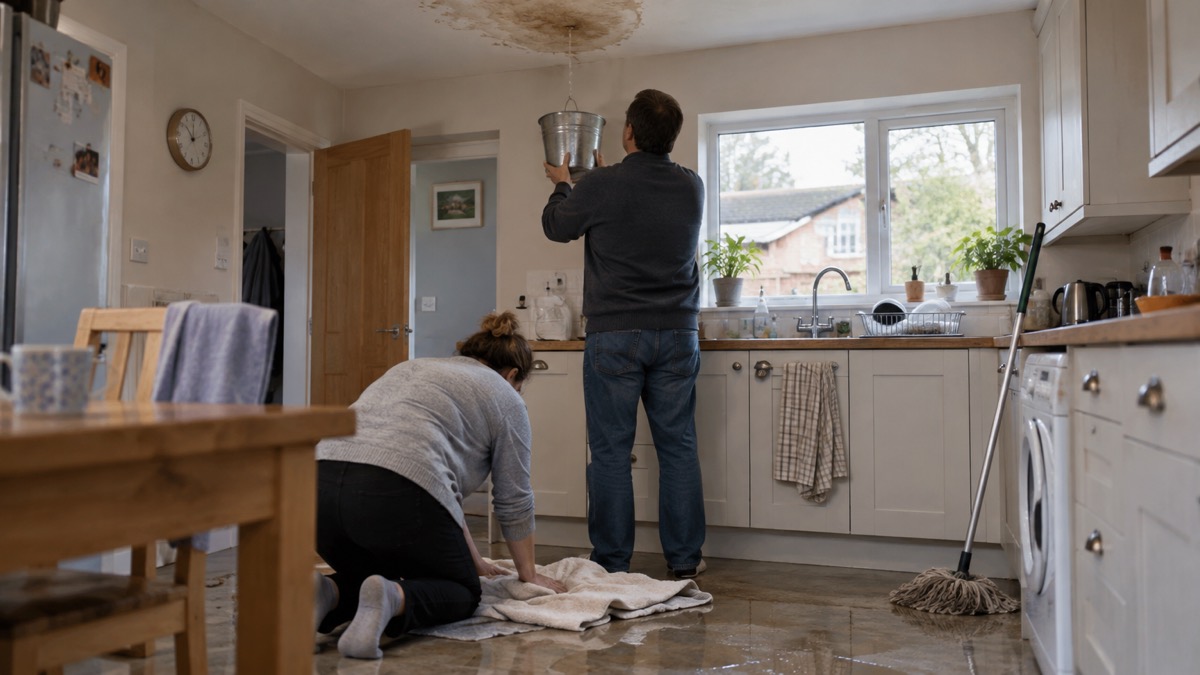
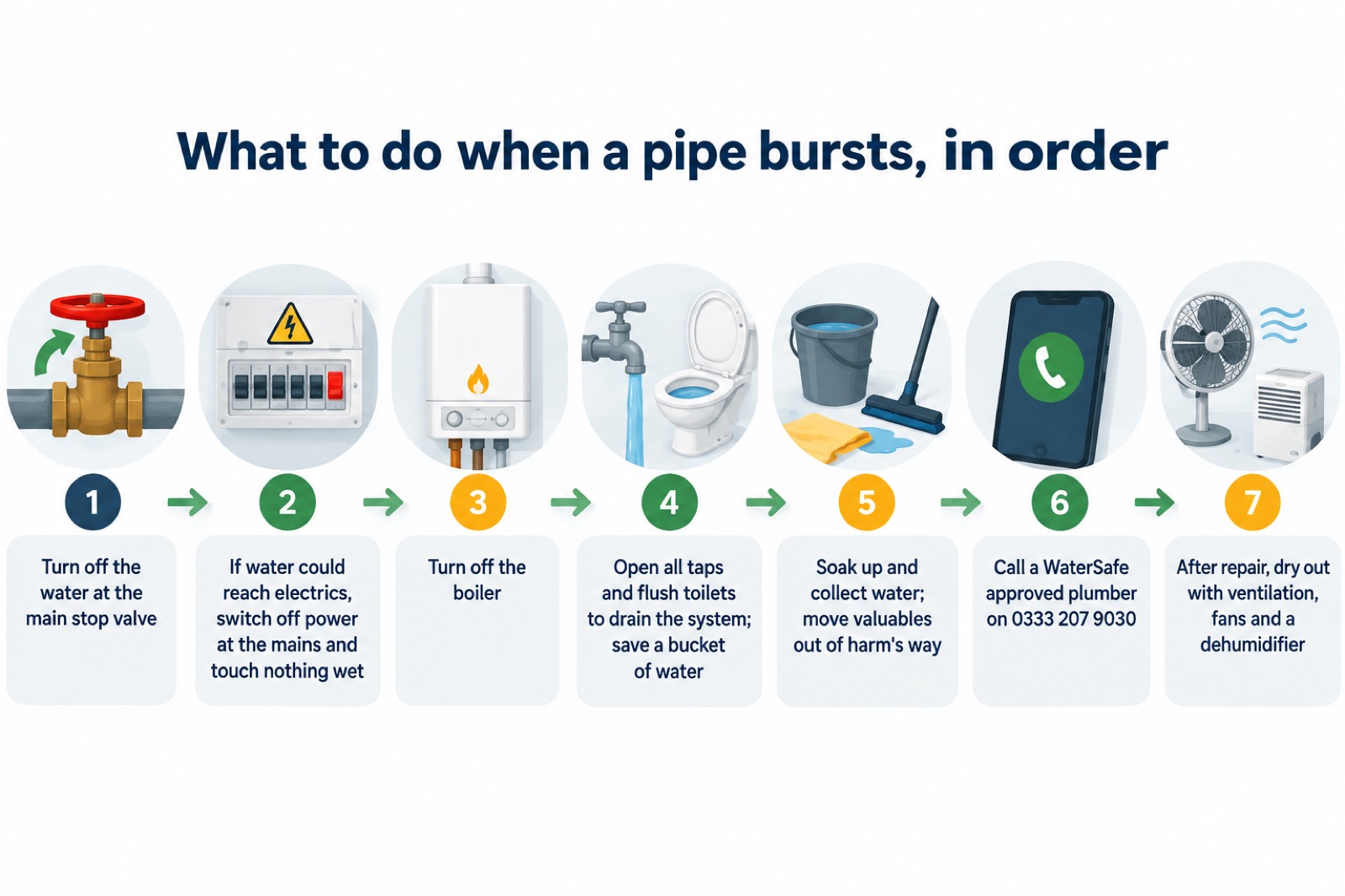
A burst pipe can release a large amount of water into your home very quickly, and the damage grows with every minute it runs. WaterSafe's advice for a burst pipe is to turn off the water supply coming in to your property at the stop tap and switch off your boiler1. If water has leaked near your electrics or into any electrical appliances, switch them off at the mains1. Everything else, draining the pipes, containing the water, calling a plumber, follows after those two.
The first action when a pipe bursts is to turn off the water supply coming in to your property at the stop tap2, so knowing where yours is before anything goes wrong is the one piece of preparation that matters most. If you have never turned yours, find it today and check that it moves, because a seized valve is the one thing that will defeat you when water is coming through the ceiling.
This page walks through what to do from the moment you notice the leak to drying the house out afterwards, including who is responsible for which pipes in each part of the UK, what to do about insurance, and how to stop it happening again. It sits alongside our guides on frozen pipes, stop taps and water leaks on your property.
First, turn off the water at the stop tap
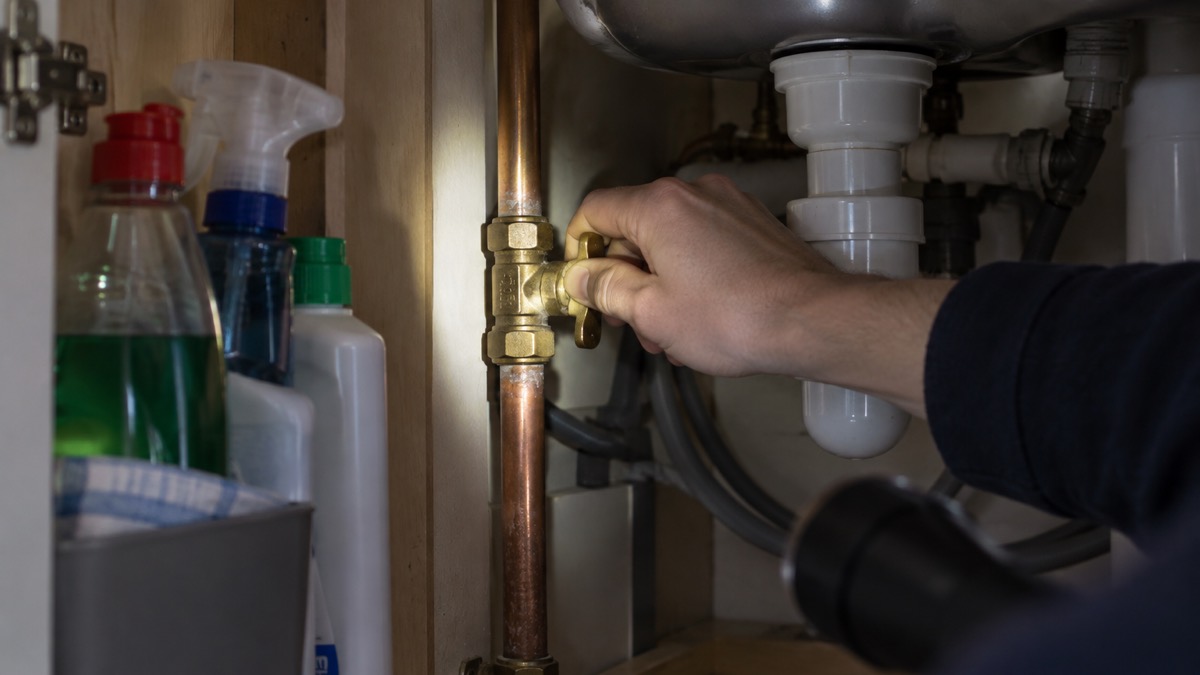
The moment you realise a pipe has burst, go straight to the stop tap and turn it clockwise to shut off the supply. Wessex Water, whose step-by-step guidance is followed in this section, puts this first: find and turn off your internal stop tap as soon as possible to stop the flow of water6. Llangattock Community Council's adverse weather guidance says the same in plain terms: turn off the water supply at the main stop valve3. Every other step depends on this one, because as long as the mains supply is connected, water will keep feeding the split.
The stop tap is normally under the kitchen sink or in the downstairs toilet7. Some homes have a second valve near a water storage tank, often in the loft, and it is worth knowing where that is too, because a burst on a pipe from the tank needs a different response: turn off the stop valve in the storage tank, turn on all the hot taps to drain the system, and allow the fire to burn out or turn the heating off until a plumber has attended8. If you cannot find your stop tap and you are a council or housing association tenant, contact your housing officer9.
If the tap will not turn, do not force it to the point of breaking it. A seized stop tap is a common problem in older homes, and the reason to check yours now rather than during an emergency. Our guide to stop taps covers the inside and outside valves in more detail, including the outside stop tap that your water company controls.
If water reaches your electrics, switch off at the mains
Water and electricity together are a danger to life, so treat this step as equal in urgency to turning off the water. If you think the water could have reached your electrics, turn off your power at the mains6. Portsmouth Water gives the same instruction for appliances as well as wiring: if water has leaked near your electrics or into any electrical appliances, switch them off at the mains10. The Met Office adds the crucial caution: if water has leaked near your electrics, do not touch them, and switch them off at the fuse box1.
The order matters. If the fuse box or mains switch itself is wet, or you would have to stand in water to reach it, do not touch it: seek advice first11. In that situation the safe action is to keep everyone away from the water and from anything electrical in it, and to get advice before going further. The same principle applies after the event: have all electrical circuits fully dried out and checked by an electrical engineer before switching them back on13, and turn off electricity and gas supplies if they have been in contact with water and get them checked before using them again14.
If water is dripping through a ceiling that contains wiring or light fittings, treat that ceiling as live until the power is off. Switch off at the mains before you go near the fittings, and keep children and pets out of the room until the water is off and the electricity is isolated.
Drain the system and save a bucket of water
With the supply off, there is still water in the pipes and the hot water cylinder, and gravity will keep feeding the leak from everything above it. Open all your taps to drain the system as quickly as possible, saving some water in a bucket for flushing toilets and hand washing1. Wessex Water breaks the draining into practical steps: flush your toilets and turn on all your cold taps to drain the water left in your pipes, then turn off all the taps when the water stops running6.
The bucket matters more than it sounds. Once the mains are off, nothing will come out of the taps until the repair is done and the supply is restored, and a household without mains water needs what it can save for flushing and washing. Our guide to water in an emergency covers how much a household needs and how to store it.
Turn off the boiler as well. Portsmouth Water's advice for a burst pipe is to turn off the stopcock and the boiler, open all taps to drain the system quickly, soak up escaping water with thick towels and call a qualified plumber10. A boiler should not be left running while the system is empty, and switching it off protects it as much as it limits the leak.
Contain the water and protect your belongings
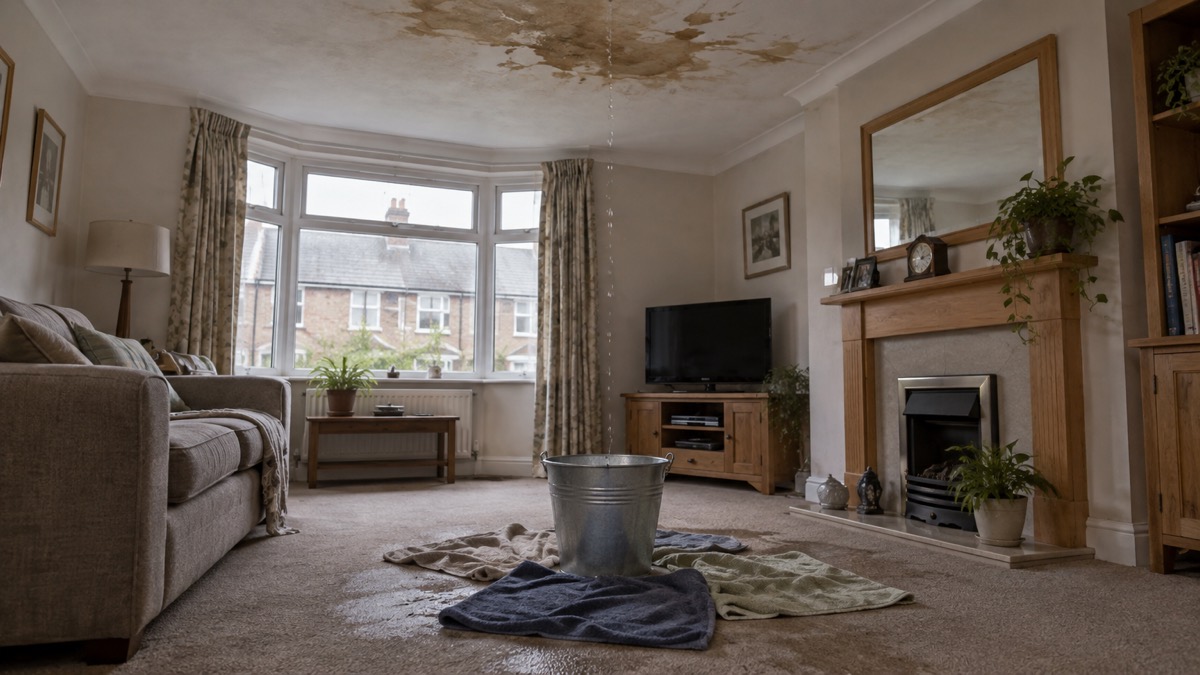
While the system drains, start moving things out of the water's path. Use towels, mops and buckets to soak up and collect the water, and move valuable items out of harm's way6. For major leaks you may need to hire a water pump or contact a professional with specialist drying equipment6. Lift what you can off the floor, especially anything electrical, and move rugs, papers and soft furnishings to a dry room.
If water is spreading towards a doorway or down stairs, towels and cloths can be used to divert and soak it up. The same flood guidance applies to water spreading from a burst pipe: block water entering through doors and windows with pillowcases or plastic bags filled with soil or heavy objects, and block water inlet pipes with towels or cloths15. Cotswold District Council's flood warning advice makes the same points: protect yourself and your family, help others, move family, pets and valuables to a safe place, and turn off gas, electricity and water supplies if it is safe to do so16.
Water leaking through a ceiling deserves particular care. If the ceiling is bulging, keep people away from beneath it, because a saturated ceiling can fail and come down. Move what you can from the room below, and put a bucket under the lowest point. Do not poke or cut the ceiling while the power to that floor is still on.
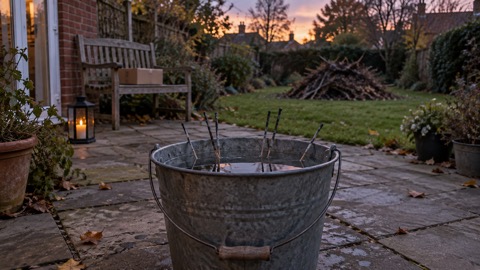
*A bucket catching water from a saturated ceiling, with towels laid to soak up the spread.
Call a WaterSafe approved plumber, not the fire service
Once the water is off and the electrics are safe, call a plumber. The Met Office is specific about who: "Call a WaterSafe approved plumber, who is qualified to work on the plumbing system in your home."1 WaterSafe is a national accreditation scheme to find a qualified, approved plumber near you, backed by all water companies in the UK and the drinking water regulators1. You can find one through the WaterSafe scheme at watersafe.org.uk or by calling 0333 207 903017.
The fire and rescue service is not the right call for a burst pipe. North Wales Fire and Rescue Service states it directly: residents experiencing burst pipes or electrical problems caused by winter weather are advised to isolate the water or electrical supply where possible and contact a local trader to fix the leak, not the fire and rescue service4. The fire service is there for danger to life, and a burst pipe with the supply isolated is a plumbing job.
Have the name and telephone number of your nearest WaterSafe qualified plumber to hand, kept by the boiler or the stop tap1. Searching for a plumber with water coming through the ceiling is far harder than reading a number off a card, and in a widespread event, such as the rapid thaw that followed a sudden freeze in 2022 and caused bursts across the South East, approved plumbers are in heavy demand. If you think you have a blockage in your drains or sewer, WaterSafe also keeps a directory of approved plumbers for that18.
Drying out after the repair
A burst pipe is not over when the plumber leaves. The repair stops the water; drying out is what saves the fabric of the house and prevents mould. Wessex Water's drying advice is to open doors and windows and use fans to create airflow, turn up your thermostat to add heat to the airflow, and use a dehumidifier to remove moisture6.
The same approach appears in official flood recovery guidance, which is written for exactly the problem a burst pipe leaves behind: a wet building. nidirect, the Northern Ireland government service, advises that you can speed up the drying process by keeping the building well ventilated, opening as many windows and doors as possible and using a fan19. North Warwickshire Borough Council's health advice adds that after cleaning, surfaces should be allowed to dry thoroughly, which also helps destroy germs left behind, using fans, air conditioners, heaters and dehumidifiers if available20. Tewkesbury Borough Council's flood recovery leaflet says the same: if possible use fans, industrial heaters and dehumidifiers to aid drying21.
Drying takes longer than most people expect, and the temptation is to close the house up too early. Keep the airflow going, keep the dehumidifier running, and check behind and under anything that was wet. If electricity or gas supplies were in contact with water, have them checked before you use them again14, and have circuits fully dried out and checked by an electrical engineer before switching back on13.
Insurance: tell your insurer and keep the receipts
If you have to arrange emergency repairs, tell your insurer and keep receipts, as you will need these in any claim. That is the advice of the Association of British Insurers, quoted in Belfast City Council's emergency planning guidance5. Mid and West Wales Fire and Rescue Service's after-the-fire booklet makes the same point for any incident that leads to a claim: "Make sure you keep receipts for any work carried out as these may form part of your claim."22
Practically, this means three things. First, tell the insurer before or as soon as you commission work, so they know an emergency repair is under way. Second, keep every receipt: the plumber's invoice, the hire of any water pump, the dehumidifier, anything bought to contain the damage. Third, do not turn the water back on until the pipe has been repaired or replaced by a qualified plumber, and keep that receipt for the insurance company too6.
Photograph the damage before you start clearing up if it is safe to do so. A record of what was wet, and how wet, supports the claim in a way a memory cannot.
Renting: who fixes what, and who to tell
If you rent, tell your landlord straight away. London Fire Brigade's after-a-flood guidance is clear that if you are in social housing or renting privately, you should let your landlord know what has happened so they can take any remedial action needed to keep you safe23. Devon and Somerset Fire and Rescue Service likewise states that it is the landlord's or building owner's responsibility to repair any damage to gas, electricity or water supplies24.
The legal background supports this. Argyll and Bute Council's gas safety guidance requires that pipework, appliances and flues provided for tenants are maintained in a safe condition25. nidirect's guidance on reducing the risk of burst pipes states that in rented accommodation, landlords are responsible for insulating and protecting inside pipework8. Carmarthenshire County Council tells its council tenants to locate the stop tap so they can quickly turn off the water if a pipe bursts, and to contact their housing officer if they cannot find it9.
If you live in a flat and the damage affects shared riser equipment, the pipes and cables that run through the building, report it promptly: any damage to this equipment should be reported to the building owner, landlord, residents committee, housing provider or managing agent as soon as you see it26. Our guide to fire safety in flats covers shared building systems in more detail.
Who is responsible for which pipes
Responsibility for pipes splits at the boundary of your property, and the split matters because it decides who you call and who pays. The rules are broadly similar across the UK, with the water company responsible for its mains and network pipes up to your boundary, and the homeowner responsible for everything inside.
| Where the pipe is | Who is responsible | What to do |
|---|---|---|
| Water main in the road or up to your property boundary | The water company | Report suspected leaks and flooding from the main to your water supplier27 |
| Inside your home (homeowner) | You | Insulate and protect all inside pipework8 |
| Inside your home (rented) | Your landlord | Tell your landlord so they can act23 |
| Pipes up to the boundary (Scotland) | Scottish Water | Scottish Water will fix bursts in these pipes28 |
| Inside your home (Northern Ireland) | You, not NI Water | NI Water is not responsible for burst pipes inside the home but can give some help8 |
In Scotland, Scottish Water states that it is responsible for the pipes that lead up to your property boundary and will fix bursts in them28. In Northern Ireland, nidirect states that NI Water is not responsible for burst pipes inside the home but can give some help8. In England and Wales, Somerset Council advises that if flooding is due to a burst pipe you should contact your water supplier, the company to whom you pay your water rates27. For a suspected leak from a water main and any resulting flooding, St Helens Borough Council names the water company, in its area United Utilities, as the responsible authority to report it to29.
If you are unsure where the boundary falls in your case, our guide to water leaks on your property goes into finding leaks and establishing who repairs them.
Why pipes burst, and how to prevent it
The commonest cause in winter is freezing. When the minus temperatures hit, water within exposed and uninsulated pipework can freeze, and as water expands it can split the pipework1. Stray nails or screws driven into a pipe during DIY can also cause a burst1. Ready Scotland lists frozen or burst pipes among the harms of cold, snow and ice30. A sudden freeze followed by a rapid thaw in 2022 put extra stress on pipes and resulted in bursts, which is why the danger often peaks on the warming day rather than the coldest one.
Freezing is not the only cause. Wessex Water notes that pipes can also burst and leak because of age and wear, poor installation and maintenance, clogs and blockages, excessively high water pressure, and ground movement6. An older pipe that bursts in summer is usually failing for one of these reasons rather than frost.
Prevention is mostly about insulation and knowing your own system:
- Wrap exposed pipes with lagging, especially in parts of the home that are not heated7
- Find your stop tap, normally under the kitchen sink or in the downstairs toilet, and check that it works7
- Check for an additional stop tap or valve near a water storage tank7
- Check that you know where your stop tap is located, in case a pipe bursts31
- Fix dripping taps32
If a pipe is frozen but has not burst, act before it thaws on its own. Portsmouth Water advises turning off the water supply at the stopcock, checking whether the pipe has burst, opening the affected tap and slowly thawing the pipe with hot water bottles or a towel soaked in hot water, starting at the end nearest the tap10. Cornwall Fire and Rescue Service says you can try to thaw the affected pipe using a hair dryer or hot water bottle if it is safe, and is emphatic about the one thing you must not do: "Do not use a naked flame to do this."11 Our frozen pipes page covers this in full.
If a pipe bursts as the thaw arrives, the response is the same as any burst, with one addition from Humber's guidance: turn off your stop tap and electricity supply immediately and contact a plumber for professional advice33.
Getting back to normal
The last step is turning the water back on, and it waits for the plumber. You will need to get the pipe repaired or replaced before you can turn your water supply back on6. When the repair is done, turn the supply on slowly, check the repaired section and the taps downstream of it, and keep the receipt.
Two checks before you settle back in. First, if electricity or gas supplies were in contact with water, get them checked before using them again14. Second, keep drying until the building really is dry, not just dry to the touch: ventilation, fans, heat and a dehumidifier, continued for as long as the fabric needs it6.
For wider preparation, our home emergencies section covers the other sudden events a household faces, and storms, snow and ice covers the weather that causes most burst pipes in the first place.
Sources (33)
- Frozen or burst pipes: seasonal advice, Met Office, 2026-10-26
- WeatherReady: weather hacks, Met Office, 2026-10-26
- Adverse weather events, Llangattock Community Council, 2026-10-25
- Ice and burst pipes: winter safety, North Wales Fire and Rescue Service, 2026-10-29
- Emergency planning and community safety, Belfast City Council, 2026-10-29
- Dealing with burst pipes, Wessex Water, 2026-10-28
- West Mercia Community Risk Register, West Mercia Local Resilience Forum, 2025-01
- Steps to reduce the risk of burst pipes, nidirect (Northern Ireland government), 2025-10-23
- Keeping your home safe, Carmarthenshire County Council, 2026-06-26
- Help for leaks, pressure and pipes, Portsmouth Water, 2026-10-15
- Snow and ice in Cornwall, Cornwall Fire and Rescue Service, 2025-10-01
- may-2021-booklet-before-during-and-after-a-flood-final, Suffolk County Council
- Flooding: keeping safe, Cornwall Fire and Rescue Service, 2026-10-29
- Worcestershire and Warwickshire Community Risk Register, Warwickshire Local Resilience Forum, 2024-03
- What to do in a flood, Natural Resources Wales, 2026-10-29
- Preparing your home for flooding, Cotswold District Council, 2020
- Southern Water household code of practice, Ofwat / Southern Water, 2022-11
- How to prepare for flash flooding, Greater London Authority, 2026-10-25
- After a flood: clearing up, nidirect (Northern Ireland government), 2026-05-06
- Cleaning up after a flood: health advice, North Warwickshire Borough Council, 2024
- After a flood: flood recovery leaflet, Tewkesbury Borough Council, 2023
- After the fire booklet, Mid and West Wales Fire and Rescue Service, 2013-03-11
- After a flood: flooding advice, London Fire Brigade, 2026-10-25
- After an incident: fire, Devon and Somerset Fire and Rescue Service, 2026
- Gas safety, Argyll and Bute Council, 2026
- Fire safety in flats and high-rise buildings, Devon and Somerset Fire and Rescue Service, 2026
- Flooding information and advice: during flooding, Somerset Council, 2026-10-01
- Public water supply: domestic consumers, Drinking Water Quality Regulator for Scotland, 2026-10-28
- Types of flooding and who to contact, St Helens Borough Council, 2026-10-29
- Cold, snow and ice: severe weather response, Ready Scotland, 2026-03-25
- Keep warm in winter, Derbyshire County Council, 2026-10-29
- Hot weather advice, Ready Scotland, 2026-03-24
- Looking Good Rain or Shine: winter guidance, Humber Local Resilience Forum, 2024-08
 Home Fire Safety Checklist
 Bedtime Fire Safety Checks
 Fire Risk Checks for Carers
 What to Do If Fire Starts
 How to Make a Fire Escape Plan
 Fire in a Block of Flats
 Kitchen Fires and Cooking Safety
 Electrical Fires and Sockets
 Smoking, Matches and Lighters
 E-bike Charging Safety
 Hoarding and Fire Risk
 Thatched Properties Fire Risk
 Fireworks and Bonfire Safety
 What to Do After a House Fire
 How Fire Services Respond