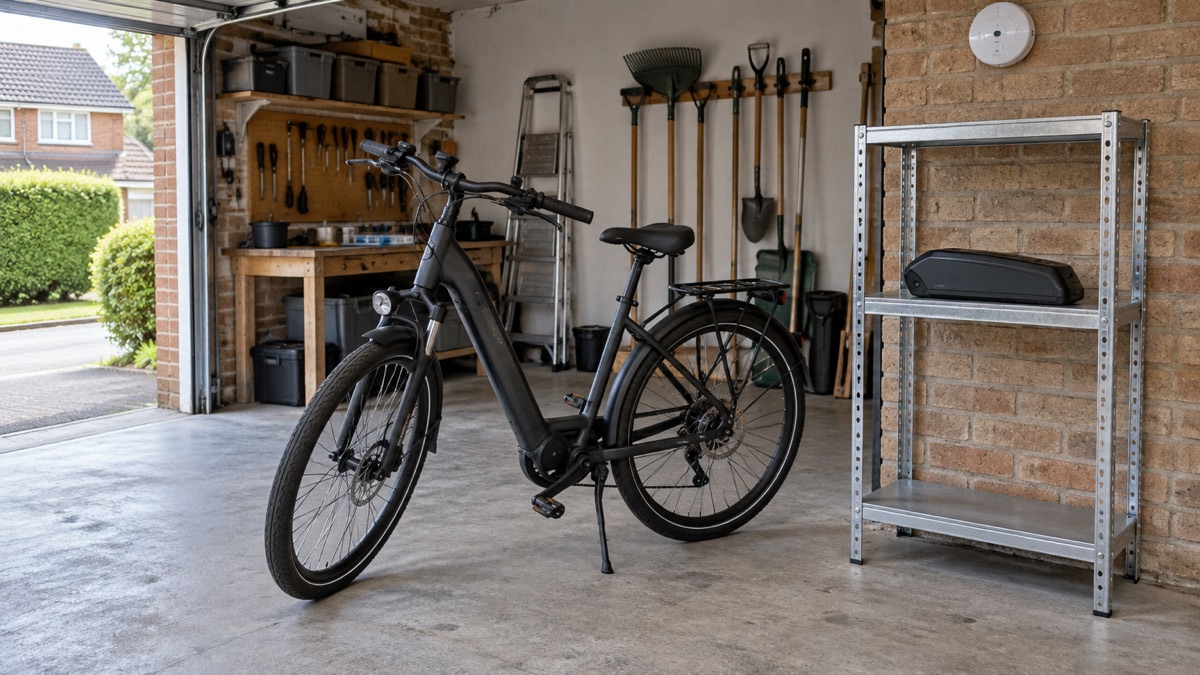
E-bikes and e-scooters run on large rechargeable lithium-ion batteries, and most are charged at home. The Bike Association estimates there are around 550,000 of them in the UK1. Used correctly, with the right charger, they are ordinary household equipment. The problems start when a battery is damaged, substandard, paired with the wrong charger, or left charging unattended: lithium-ion batteries can then overheat, catch fire without warning, and even explode1.
These batteries are not a niche concern. The Bike Association estimates there are around 550,000 e-bikes and e-scooters in the UK, and most run on rechargeable lithium-ion batteries, which are small, lightweight and hold lots of power3. Fire and rescue services, including South Wales Fire and Rescue Service, have raised concerns about the danger of fires that could be caused by e-bikes and e-scooters4. The risk of fire increases if a product is non-compliant, counterfeit, damaged, poorly manufactured, used with an incompatible charger, or modified or repaired with non-compatible parts such as chargers, motor and battery5.
The good news is that the safety rules are simple and consistent across every fire and rescue service: use the manufacturer's own charger, charge only while you are awake and at home, store the machine away from escape routes, and know the warning signs of a failing battery. This page sets out what to do in an emergency, what to check, and how to buy, charge, store and dispose of batteries safely.
If a battery is smoking or on fire: get out, stay out, call 999
If your e-bike, e-scooter or its battery begins to smoke or catches fire, a fire has already started. Every fire and rescue service in the UK gives the same instruction: raise the alarm, get out, stay out and call 999 immediately12. Do not go back inside for anything, and do not stop to unplug the charger or move the bike.
The reason fire services are so firm about this is how these fires behave. When lithium-ion batteries fail they can ignite quickly and produce intense fires that spread rapidly14. South Wales Fire and Rescue Service reports that when these fires occur, they burn very hot and can be difficult for firefighters to extinguish15. The batteries can also produce toxic smoke14, and Oxfordshire County Council's fire and rescue team warns that they can overheat into an intense fire producing toxic gases and large amounts of smoke with little warning16. A household extinguisher or fire blanket is not designed for a fire of this intensity, and the time spent trying to use one is time spent in a room filling with toxic smoke.
If you live in a flat or a multi-occupied building, a fire in a communal hallway or stairwell affects everyone's ability to escape, which is exactly why fire services say never to store or charge these machines there8. Once you are out, tell the 999 operator what is burning: say it is an e-bike or e-scooter lithium-ion battery fire, so the crew arrives expecting a battery fire. If you can do so safely on your way out, close doors behind you to slow the spread of smoke and fire. Then read our guide to what to do if a fire starts in your house and, if you live in a shared building, what to do if there is a fire in your block of flats.
Warning signs a battery is failing
Batteries usually give warning before they fail, and spotting those signs early is the single most useful thing a household can do. London Fire Brigade's warning-signs campaign lists the things to watch for12, and other services add to the list10.
| Warning sign | What you may notice | Who reports it |
|---|---|---|
| Heat | The battery becoming unusually hot | London Fire Brigade10 |
| Swelling or bulging | A battery that appears swollen or misshapen, bulging out of shape, or any lump | London Fire Brigade12, gov.uk e-cycle guidance13 |
| Noise | Hissing or cracking sounds | North Yorkshire Fire and Rescue Service4, gov.uk13 |
| Smell | A strong or unusual smell, which could be toxic | gov.uk e-scooter guidance13 |
| Leaking | Any leak from the device or battery | gov.uk e-cycle guidance13, Warwickshire County Council17 |
| Performance | Significantly reduced performance or range | London Fire Brigade10 |
A battery that appears swollen or misshapen is a strong sign that it is failing12. Gov.uk's e-cycle guidance is equally direct about bulging: "A battery bulging or swelling out of shape is a common sign of it failing. You should stop using it immediately. The same applies if there is any type of lump or leak from the device."13
Make checking the battery part of your routine. Greater Manchester Fire and Rescue Service advises regularly checking for signs of damage like swelling, leaks or strange smells, and stopping use of damaged batteries immediately18. Warwickshire County Council advises regularly inspecting e-bike batteries for signs of overheating or damage such as bulging or leaking, and seeking professional advice if you notice any issues17. A quick look and feel of the battery each time you charge it takes seconds and catches most problems early.
What to do when a battery shows warning signs but is not on fire
If you notice any warning sign, stop using the battery immediately and take action12. The government's battery safety guidance for e-scooter and e-cycle users sets out the steps in order13, and Oxfordshire's fire safety team gives the same first move16.
- Turn off and unplug the charger immediately. If the device is charging, stop charging and unplug it16. Do this at the socket, and do not pick up a battery that is already very hot.
- Move the e-bike, e-scooter or battery outside if you can. The government guidance says to move it carefully away from people, pets and combustible materials, or to a place where the risk would be minimised if the battery were to catch fire13. Only do this if it is safe: a battery that is hissing, crackling or smelling strongly may be close to failure, so if in doubt, get everyone out and call 999.
- Do not use or charge that battery again. A battery showing warning signs should be replaced, not nursed along8.
- Arrange safe disposal. Check safe disposal options, or call the manufacturer or retailer13. Never put the battery in household waste or recycling (see the disposal section below).
- Report it. Once everyone is safe, report the faulty battery to Citizens Advice in England and Wales, or Advice Direct Scotland in Scotland, and to the manufacturer or seller13. London Fire Brigade also advises reporting faulty batteries to your local Trading Standards office12.
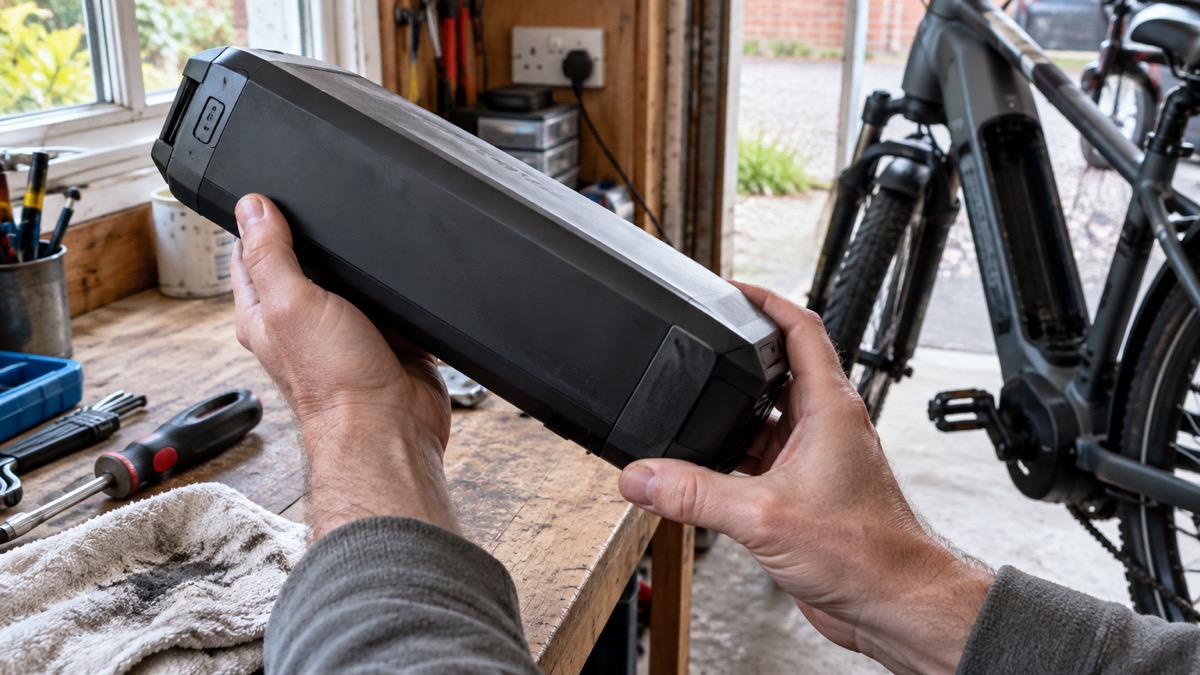
The key judgement is the line between "warning signs" and "fire". If the battery is smoking, a fire has already started: raise the alarm, get out, stay out and call 999 immediately13. Hissing or cracking sounds, strong smells and visible swelling are warning signs that call for the steps above, but treat them urgently, because these batteries can fail suddenly and with little warning16.
Safe charging: the right charger, never overnight or while you are out
Most fires involving e-bikes and e-scooters happen while the battery is charging7. That single fact shapes all the charging advice: charge when you can watch the battery, with the right charger, in the right place.
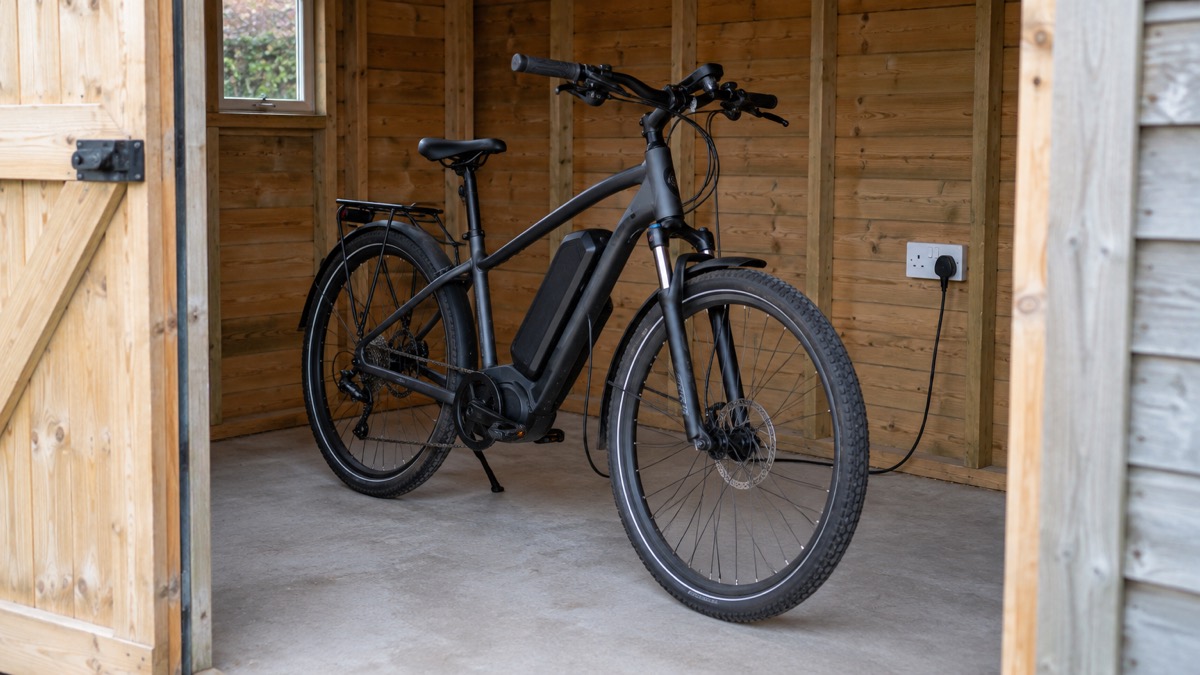
Use the right charger. Always use the charger made for your battery, from the same manufacturer19. London Fire Brigade warns that using the wrong charger can overload the battery and increase the risk of overheating and fire7. If you need a replacement charger or battery, get it from the original manufacturer: Devon and Somerset Fire and Rescue Service warns that fake or substandard chargers can cause fires19. Peterborough City Council's trading standards team reports that fires have predominantly been caused by two things: using a charger or battery not from the same manufacturer, and bike conversions using home kits20.
Charge only while awake and at home. Never leave a battery charging unattended or while you are asleep7. Fire and rescue services across the UK put it the same way: charge batteries whilst you are awake and alert, so if a fire should occur you can respond quickly, and do not leave batteries to charge while you are asleep or away from the home8. Devon and Somerset Fire and Rescue Service explains why overnight is the worst time: fires at night when people are sleeping are particularly dangerous because your reaction time is massively reduced19. Essex County Fire and Rescue Service is just as blunt: never leave your battery to charge when you are out or whilst you sleep3.
Do not cover the battery or charger. Greater Manchester Fire and Rescue Service warns never to cover the battery while charging, as this can cause overheating and start a fire9. The same applies to chargers and battery packs: covering them can lead to overheating or even a fire8.
Do not overcharge. East Sussex County Council advises not overcharging your product, and removing the charger once the battery is fully charged21.
Fit an alarm where you charge. London Fire Brigade advises fitting a smoke alarm in the area where you charge your batteries7, and Devon and Somerset Fire and Rescue Service says to ensure you have working smoke alarms on every floor of your home, including where you charge your batteries19. Our guides to smoke alarms and heat alarms explain the choices.
Charging in hot and cold weather
Temperature affects both safety and performance. Avoid charging batteries in strong sunlight or anywhere there is a high temperature or flammable materials19. In winter, London Fire Brigade advises avoiding leaving your battery outside overnight, but if you keep it indoors, make sure it will not block your escape route if it starts a fire10. If a battery has been left in freezing conditions, allow it to warm up slowly indoors before using or charging it10. Cold temperatures reduce the performance of lithium-ion batteries: expect reduced range, slower charging and the battery losing charge more quickly, because the chemical reactions inside it slow down at lower temperatures10.
Charging after long storage
If a device has not been used for quite some time, be extra careful when you charge it. Humberside Fire and Rescue Service warns that lithium batteries do not like being discharged to a very low voltage22. Check the battery over for swelling, leaks or smells first, charge it while you are awake and at home, and watch it more closely than usual for the first charge.
Where to store an e-bike or e-scooter, and where it must never go
The rule that matters most: never charge or store an e-bike, e-scooter or mobility scooter in hallways, near exits, on escape routes or where people sleep, and keep them away from communal areas9. Greater Manchester Fire and Rescue Service explains why: a fire in those places could block the escape route9. Mid and West Wales Fire and Rescue Service adds that in multi-occupied buildings, a fire on an escape route or in a communal area affects people's ability to escape8, and the Scottish Fire and Rescue Service gives the same advice1.
Where should they go instead?
- A secure outbuilding, shed or garden area is the preferred option where possible, away from flammable materials and escape route exits23.
- A cool, well ventilated area inside the home, away from flammable materials9.
- Somewhere cool but not extreme: store e-bikes, e-scooters and their batteries in a cool place, avoiding excessively hot or cold areas1.
- Away from combustible or flammable materials: as far as possible, do not charge batteries or store your e-bike or e-scooter near them13.
- Never in the hallway or anywhere it could block your escape24.
If you charge or store your e-bike or e-scooter in a garage or kitchen, install detection there, and fire services recommend heat alarms rather than smoke detectors for those areas8. Kitchens and garages have cooking fumes, exhaust fumes and dust that trigger false alarms in smoke detectors, while a heat alarm responds to the rapid temperature rise of a real fire. Our comparison of heat alarms and smoke alarms explains which goes where.
If you live in a flat with no outside space, the calculation is harder, and the escape-route rule matters even more. A bike in the hallway of a flat is the arrangement fire services fear most, because it sits directly on the only way out. Never charge or store an e-bike, e-scooter or mobility scooter in hallways, near exits, on escape routes or where people sleep, and keep it away from communal areas, as this can block escape routes in a fire15. Our fire safety checklist for flats covers the wider picture.
Buying an e-bike, e-scooter, battery or conversion kit safely
Most of the risk in these products is decided at the moment of purchase. Buy e-bikes, e-scooters, chargers and batteries from reputable retailers1, and only from trusted retailers and manufacturers25. Devon and Somerset Fire and Rescue Service advises against buying from market stalls or third-party sellers on online marketplaces, because there is no guarantee the product has been through Product Safety testing19. South Wales Fire and Rescue Service warns that items which do not meet British or European standards pose a huge fire risk, and that many fires involve counterfeit electrical goods15.
East Sussex County Council's trading standards team lists the conditions that increase the risk of fire: products that are non-compliant, counterfeit, damaged, poorly manufactured, used with an incompatible charger, or modified or repaired with non-compatible parts such as chargers, motors and batteries21. Check for the CE or UKCA safety marking to make sure your battery and charger meet safety standards24.
Conversion kits
E-bike conversion kits, which turn an ordinary bike into an electric one, deserve particular care. London Fire Brigade warns that conversion kits can increase the risk of battery fires if they are poorly installed or use incompatible components26. If buying a conversion kit, purchase from a reputable seller and check that it complies with British or European standards, take particular care if buying from online auction or fulfilment platforms, and if buying separate components, check that they are compatible8. Gov.uk's e-cycle guidance is blunt about mixing parts: incompatible battery packs and chargers can cause an extremely high fire risk13.
Second-hand and damaged batteries
Buying second-hand batteries can be particularly risky because they may already be damaged or degraded26. Gov.uk's e-cycle guidance extends the warning to any used pack: "Be cautious about buying used e-cycle battery packs. Whether or not any physical damage is visible, the battery could already have been damaged or abused and pose an increased fire risk."13
Damage is not always visible, and it does not need a crash to happen. Batteries can be damaged by dropping them or by crashing the e-bike or e-scooter, and where the battery is damaged it can overheat and catch fire without warning15. Check your battery regularly for any signs of damage, and if you suspect it is damaged, it should be replaced and should not be used or charged15. In some cases these batteries can fail severely: they can explode or lead to a rapidly developing fire8.
Recalls, registration and alarms: three jobs that take minutes
Check for product recalls
Check whether products you have bought are subject to a product recall, via the Electrical Safety First website or the government website27. Recall notices are issued by the Office for Product Safety and Standards (OPSS), and you can also contact the retailer where you purchased the product28. One live example shows why this matters: the OPSS has issued a warning on dangerous UPP e-bike batteries, repeating an earlier warning to stop using them because they have been linked to multiple serious fires5. Our guide to how to check if an electrical product has been recalled covers the process in detail.
If a recall affects your device or battery, stop using the product immediately, follow the manufacturer's instructions, and arrange repair, replacement or return if required. Do not continue to use a battery or charger that has been identified as unsafe28.
Register with the manufacturer
Registering your e-bike or e-scooter with the manufacturer allows them to contact you quickly if an important safety alert or product recall is issued28. Registration also validates any warranties, which usually cover the battery2. To register, visit the manufacturer's website, find the product registration page, and enter details such as the model number, serial number and purchase date28. If you choose not to register, you can still check for recalls via Electrical Safety First or the UK government website29.
Check your alarms
Make sure you have working smoke alarms on every level of your home22, on every floor including where you charge your batteries19. If you charge or store the machine in a garage or kitchen, fit a heat alarm there rather than a smoke alarm8. Test alarms regularly, and see our guides on how often to test smoke and CO alarms and where to fit smoke alarms.
Disposing of an old battery: never in household waste or recycling
A damaged or end-of-life battery must never go in your household waste or normal recycling. Mid and West Wales Fire and Rescue Service explains what happens if it does: these batteries, when punctured or crushed, can cause fires in bin lorries, recycling centres and waste centres8. The incorrect disposal of lithium-ion batteries in general household and recycling waste can lead to significant waste fires8. Cheshire Fire and Rescue Service's rule is simple: never dispose of batteries in your household or recycling bin11.
Instead:
- Recycle batteries safely at your local tip25.
- Check safe disposal options with your manufacturer or retailer when a battery shows warning signs13.
- Take small lithium-ion batteries (phones, vapes, power tools) to a battery recycling collection point rather than the bin.
A battery that has been damaged, or that has shown warning signs, needs particular care on its way to disposal. Store it somewhere safe away from people and combustibles while you arrange recycling, and never put it loose in a bag or box where it can be crushed8.
Phones, laptops and power banks: the same lithium-ion rules at home
The battery in your e-bike is the same chemistry as the one in your phone. Lithium-ion batteries power everyday items such as phones, laptops, vapes, toys, power tool packs and more30, and the same rules apply at smaller scale. They hold more energy than other batteries, and they must be stored and charged properly to reduce the risk of fire19.
The practical version of those rules for small devices:
- Never leave your mobile phone charging under your pillow22.
- Use the correct charger for the device30.
- Do not charge small devices unattended overnight either: Devon and Somerset Fire and Rescue Service advises it is never a good idea to charge any electrical product overnight, especially ones containing lithium-ion batteries19.
- Be careful with devices that have sat unused: lithium batteries do not like being discharged to a very low voltage22.
- Stop using anything that swells, leaks, smells strange or gets unusually hot, and recycle it properly, never in the bin11.
The stakes are lower with a phone than with an e-bike battery, simply because the battery is smaller, but the failure mode is the same, and the same habits protect both. If you keep power banks or rechargeable torches as part of your household emergency kit, the same rules govern how you store and top them up; see our backup power guide for how these fit into wider preparations.
Sources (30)
- E-bikes and e-scooters, Scottish Fire and Rescue Service
- E-feiciau ac e-sgwteri: diogelwch tân, Mid and West Wales Fire and Rescue Service
- Batteries and charging safety, Essex County Fire and Rescue Service
- Charge Safe campaign, North Yorkshire Fire and Rescue Service
- Battery safety, West Yorkshire Fire and Rescue Service
- What to do if there's a fire caused by an e-bike or e-scooter, London Fire Brigade
- How to charge e-bikes and e-scooters safely, London Fire Brigade
- E-bikes and e-scooters fire safety, Mid and West Wales Fire and Rescue Service
- E-bikes, e-scooters and mobility scooters, Greater Manchester Fire Rescue Service
- Heat, cold and rain: how weather conditions affect e-bikes and e-scooters, London Fire Brigade
- Rechargeable lithium-ion battery safety advice, Cheshire Fire and Rescue Service, 2026
- Spot the warning signs: could your e-bike or e-scooter start a fire?, London Fire Brigade
- Battery safety for e-scooter users, UK Government, 2024
- E-bikes and e-scooters, London Fire Brigade
- E-bikes and e-scooters, South Wales Fire and Rescue Service
- Charging safety, Oxfordshire County Council
- Electrical fire safety, Warwickshire County Council
- Battery safety, Greater Manchester Fire Rescue Service
- Battery fires, Devon and Somerset Fire and Rescue Service
- Product safety campaigns, Peterborough City Council
- Product safety, East Sussex County Council
- Batteries, Humberside Fire and Rescue Service
- Battery safety, Greater Manchester Fire Rescue Service
- E-bike and e-scooter fire safety in the home, Greater Manchester Fire Rescue Service
- E-scooters, e-bikes and batteries campaign, Greater Manchester Fire Rescue Service
- E-bike conversion kits: fire risks and safety advice, London Fire Brigade
- E-bikes, Cheshire Fire and Rescue Service, 2026
- Registering your e-bike or e-scooter for safety alerts and product recalls, London Fire Brigade
- Lithium-ion batteries, Scottish Fire and Rescue Service
- Battery safety, London Borough of Tower Hamlets
 Home Fire Safety Checklist
 Bedtime Fire Safety Checks
 Fire Risk Checks for Carers
 What to Do If Fire Starts
 How to Make a Fire Escape Plan
 Fire in a Block of Flats
 Kitchen Fires and Cooking Safety
 Electrical Fires and Sockets
 Smoking, Matches and Lighters
 Hoarding and Fire Risk
 Thatched Properties Fire Risk
 Fireworks and Bonfire Safety
 What to Do After a House Fire
 How Fire Services Respond
 Alarms for Deaf People