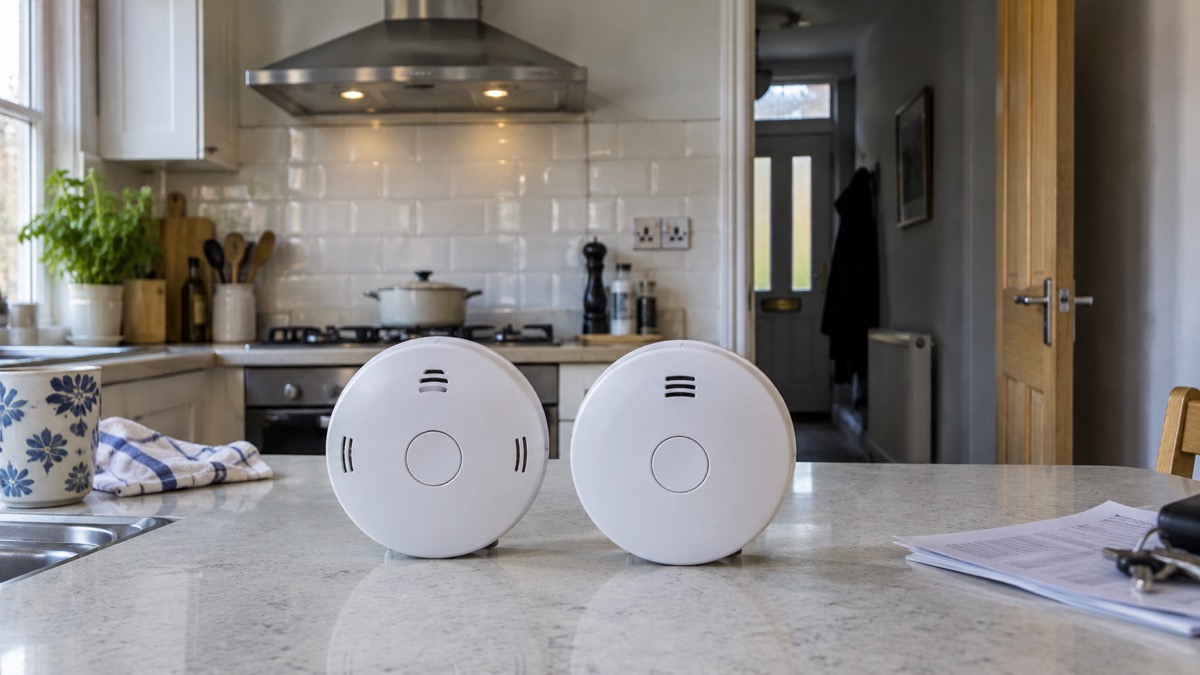
A smoke alarm detects smoke at the earliest stages of a fire, and a heat alarm detects the rise in temperature a fire causes but is insensitive to smoke1. That single difference decides which one belongs in each room. Put a smoke alarm in the kitchen and cooking fumes will set it off until you stop trusting it. Put a heat alarm in the hall and you lose the early warning that gives you time to get out.
The rule most households need is simple: fit a heat alarm in the kitchen, and smoke alarms everywhere else, with at least one working smoke alarm on every floor of your home2. Heat alarms are also the right choice for garages, lofts and boiler rooms, where fumes, smoke or dust would keep a smoke alarm sounding4. Never fit a smoke alarm in a bathroom, because steam will trigger it3.
Scotland goes further. Every home in Scotland must have one heat alarm in the kitchen, one smoke alarm in the living room or the room you use most, and one smoke alarm in every hallway and landing, all ceiling mounted and interlinked5. The standards came in from February 20227. In England, Wales and Northern Ireland the position is guidance rather than a single national standard for every home, though building regulations set requirements for new builds8.
Heat alarm or smoke alarm: what each one detects
The two devices are answering different questions. A smoke alarm is a warning device that detects smoke at the earliest stages of a fire1. A heat alarm is a warning device that detects an increase in temperature from a fire but is insensitive to smoke1. Both are self-contained devices that combine a detector with a warning sound, and when either detects a fire it makes a piercing noise to alert or wake you1.
That difference in what they sense is what makes one suitable for a room and the other unsuitable. Heat alarms are more suitable than smoke alarms for detecting fires in kitchens or other rooms where steam, fumes or moisture could cause nuisance alarms in smoke alarms9. A heat detector activates when there is a change in temperature caused by a fire, unlike a standard smoke alarm which sounds when it detects smoke13.
The trade-off is speed. A smoke alarm responds at the earliest stages of a fire, while a heat alarm waits for enough heat to build up. That is why heat alarms are not a substitute for smoke alarms across the home: they are a way of getting some warning in rooms where a smoke alarm would be a nuisance. The general principle is to fit smoke alarms in the rooms where people sleep and live, and a heat alarm only where smoke or steam makes a smoke alarm impractical.
| Alarm type | What it senses | Best rooms | Avoid in |
|---|---|---|---|
| Smoke alarm | Smoke at the earliest stages of a fire1 | Bedrooms, living rooms, hallways and landings14 | Kitchens and bathrooms3 |
| Heat alarm | A rise in temperature caused by fire, insensitive to smoke1 | Kitchens and garages14 | Rooms where early smoke warning matters most |
| Combined optical smoke and heat | Both, in one unit | Bedrooms, living rooms and hallway, as an alternative to optical smoke alarms14 | Kitchens, where cooking fumes remain a problem |
Fit a heat alarm in the kitchen, not a smoke alarm
Every official source on the subject says the same thing. An alarm installed inside the kitchen must be a heat alarm rather than a smoke alarm3. Smoke alarms are not suitable for kitchens, but heat alarms are: fitting a heat alarm in your kitchen will give you warning of an increase in temperature caused by a fire but will not be set off by cooking fumes9. Do not fit smoke alarms in kitchens or bathrooms where smoke or steam could set them off accidentally; install a heat alarm in the kitchen instead15.
The reason is nuisance alarms. A smoke alarm that sounds every time you fry something gets silenced, covered or ignored, and an alarm you have stopped trusting is worse than no alarm because it gives you false confidence. A heat alarm in the kitchen gives warning of a temperature increase caused by fire without being triggered by cooking fumes9. Fire services across the country repeat the advice: fit a heat alarm in your kitchen area17, and it is better to install a heat alarm in your kitchen rather than a smoke alarm18.
There is one practical exception worth knowing. The Scottish Tolerable Standard guidance notes that BS 5839-6:2019, Clause 12.2(f) states that only heat alarms should be used in kitchens, but an existing smoke alarm in a kitchen need not be replaced until the end of its manufacturer's recommended lifespan19. In other words, if you already have a smoke alarm in the kitchen and it is still within its working life, you are not required to rip it out today, but when it reaches the end of its life it should be replaced with a heat alarm.
Where a smoke alarm must never go
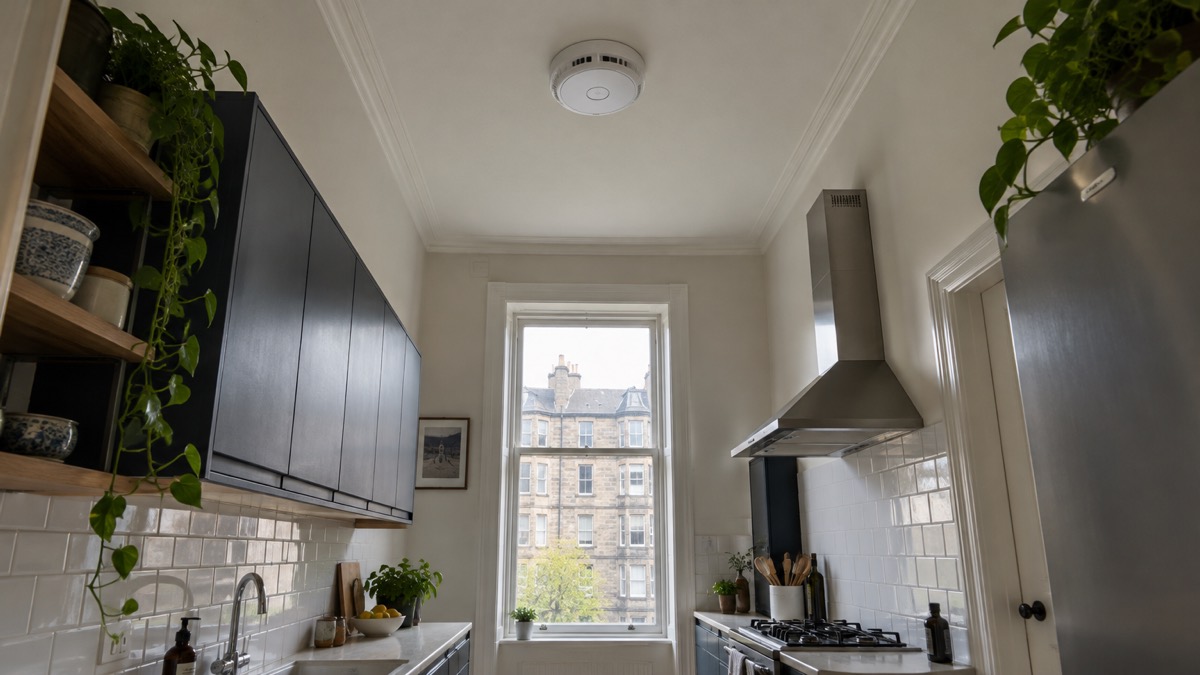
The kitchen and the bathroom are the two rooms where a smoke alarm does not belong. Do not fit an alarm in the bathroom, as steam may trigger the alarm3. Smoke alarms should not be in the kitchen and bathroom as heat and vapour from cooking and bathing can set them off unnecessarily20. No smoke alarms in kitchens: you will need a heat alarm instead16.
There is a second rule that matters more than placement: never take the batteries out of your alarm to use in another electrical item1. An alarm without batteries cannot warn you if a fire starts1. If an alarm keeps sounding because of steam or cooking, the answer is to fit the right type of alarm in the right place, not to disable it. If you are struggling with false alarms, there is separate guidance on how to stop smoke alarm false alarms.
Placement on the ceiling matters too. All smoke and heat alarms should be attached to the ceiling and be interlinked5. Ceiling mounting puts the sensor where smoke and heat collect first, and interlinking means an alarm in the hall wakes you even if the fire starts in the kitchen. For the detail on siting, see where to fit smoke alarms.
Garages, lofts and boiler rooms: rooms that need a heat alarm
The kitchen is not the only room where a smoke alarm struggles. Heat alarms are useful in any room where there are high levels of fumes, smoke or dust, such as garages, lofts and boiler rooms4. Warwickshire Fire and Rescue Service recommends heat alarms for the kitchen and garage14. Heat alarms are also recommended for fitting in smoky or steamy rooms such as kitchens or bathrooms13, though the general advice against alarms in bathrooms still applies where steam is the problem.
These are the rooms where a smoke alarm would be triggered by everyday activity: a car starting in the garage, dust in a loft, or the exhaust from a boiler. A heat alarm gives you warning of a fire in those spaces without the constant false alarms that would lead you to disconnect it.
The same logic applies to anywhere electrical items are stored or charged. Fit smoke or heat alarms in areas where electrical items are stored or charged and test them at least monthly21. That covers the utility room, the garage where a battery charger lives, and the corner where an e-bike is charged. For the charging side of that, see e-bikes and e-scooters: charging and storing them safely.
| Room | Alarm to fit | Why |
|---|---|---|
| Kitchen | Heat alarm3 | Cooking fumes would set a smoke alarm off |
| Garage | Heat alarm4 | Exhaust fumes, dust and smoke from tools |
| Loft | Heat alarm4 | Dust and fumes cause nuisance alarms |
| Boiler room | Heat alarm4 | Fumes from the boiler |
| Bathroom | No alarm3 | Steam triggers alarms |
| Bedroom, living room, hallway | Smoke alarm, or combined optical smoke and heat14 | Earliest warning where people sleep and live |
Scottish homes: one heat alarm in every kitchen
Scotland has the clearest and most demanding rules in the UK, and they apply to all homes in Scotland, not just new builds. Every home must have one heat alarm in the kitchen, one smoke alarm in the living room or the room you use most, and one smoke alarm in every hallway and landing, all mounted on the ceiling and interlinked5. The standards were introduced for all homes from February 20227.
The detail matters if you are checking your own home. If your home has more than one level, you need one smoke alarm on each floor, plus the living room11. If your home is on one level, a flat or bungalow, you need to fit at least two smoke alarms11. You also need one smoke alarm in every circulation space on each storey, such as hallways and landings11. One heat alarm should be installed in every kitchen22.
Open plan layouts have their own rule. If you have an open plan area, for example a combined hall and living room, you only need one alarm, but it should be no more than 7.5 metres from any point in the room; if the area includes a kitchen, then it should be a heat alarm5. Scottish homes with fixed combustion appliances such as boilers and wood burners also need a carbon monoxide alarm7.
Working out which alarm each room needs
Start with the minimum and build from there. Every home should have a minimum of one working smoke alarm per floor, and a heat alarm in the kitchen23. Northern Ireland Fire and Rescue Service gives the same baseline: as a minimum you should have a working smoke alarm on each floor of your house, but consider additional alarms in the most used rooms such as living rooms and bedrooms24. Fit enough alarms to cover all areas where a fire could start10.
For a fuller system, the guidance for carers is a useful model for any household. Smoke alarms should be fitted in all areas where a fire can start: this includes bedrooms and lounges, and a heat alarm should be installed in the kitchen25. If you smoke indoors, fit a smoke alarm in the rooms where you smoke12. If you have a multi-level home, the interlinking matters most, because a fire in the kitchen should wake someone sleeping upstairs.
A simple way to work through a house:
- Put a heat alarm in the kitchen3.
- Put a smoke alarm in the living room and in every hallway and landing5.
- Put a smoke alarm in each bedroom, or at least in the rooms where people sleep25.
- Put a heat alarm in the garage, loft or boiler room if you have one4.
- Link them all so one alarm sets off the rest5.
- Test every alarm weekly, and if an alarm does not sound, buy a new alarm11.
If you are unsure how many alarms your home needs, there is a separate guide to how many smoke alarms a house or flat needs.
Sealed battery or mains wired: how heat and smoke alarms are powered
Both heat and smoke alarms come in battery and mains-powered versions, and the choice affects how much maintenance the household has to do. Where battery powered alarms are selected, alarms with sealed for life batteries rather than alarms with replaceable batteries are the better option26. You can buy alarms fitted with sealed 10 year batteries3, and ten-year sealed battery smoke alarms are described as the best option because they are slightly more expensive but you save on the cost of replacing batteries27.
Mains-powered alarms are wired into the home's electrical supply and have a back-up battery in case of a power cut28. They need to be installed by a qualified electrician28. Hard-wired alarms should be replaced as per the manufacturer's guidelines and tested weekly27. The advantage is that you are not relying on a battery you might forget to change; the disadvantage is the installation cost and the need for an electrician.
| Power type | How it works | Maintenance | Suits |
|---|---|---|---|
| Sealed 10-year battery | Battery sealed inside the alarm3 | Replace the whole alarm at end of life; test weekly11 | Most households, especially where wiring is difficult |
| Replaceable battery | Battery can be changed | Change the battery regularly; test weekly11 | Where sealed units are not available |
| Mains wired with back-up battery | Wired into the home supply, battery backs up in a power cut28 | Test weekly; replace as per maker's guidelines27 | New builds and rewires, where an electrician is already involved |
For households where someone cannot hear a standard alarm, specialised smoke and heat alarms include mains-powered smoke alarms with back-up batteries, and vibrating pads and flashing lights that warn people who cannot hear well, for people with sight, hearing, mobility issues or other special needs29. There is more on this in smoke and CO alarms for deaf and hard of hearing people.
Certification, guarantees and support from alarm makers
Buying an alarm is not like buying a kettle. Make sure any alarms you buy are marked with a current British Standards or European (CE) safety mark, which shows they meet the relevant standard2. Look out for the British Standard Kitemark and Loss Prevention Certification Board (LPCB) symbols, which show the alarm is approved and safe9. Heat alarms should conform to BS 5446-219.
The system category and grade matter if you are installing a full system or buying a new build. Northern Ireland's building regulations require fire alarm systems in new builds to be at least category LD2 and at least grade D2, including a smoke alarm or alarms in every habitable room and a heat alarm in every kitchen8. For the meaning of the categories and grades, see alarm standards: BS 5839-6, BS EN 50291 and system grades.
If your alarms were fitted by a fire and rescue service and are still covered by guarantee, the maker may support you directly. FireAngel can be reached on freephone 0800 141 2561 for support30. FireHawk can be reached on freephone 0800 008 6568, or text 07885 831239 if you are unable to call30. Many services also offer home fire safety visits and will fit alarms free of charge where they are needed; ask your local service, or see how fire and rescue services respond to a call.
Sources (31)
- Smoke and heat alarms, Greater Manchester Fire and Rescue Service, 2026
- Smoke alarms and heat alarms, London Fire Brigade, 2026
- Smoke alarms, Staffordshire Fire and Rescue Service, 2026
- Kitchen safety | Scottish Fire and Rescue Service, Scottish Fire and Rescue Service
- Fire and smoke alarms in Scottish homes, Scottish Government, 2024
- What each home needs, Scottish Government, 2024
- Home fire safety, Scottish Government, 2026
- Fire alarm installation, NICEIC, 2025
- Fire alarms and carbon monoxide detectors, Lincolnshire County Council, 2026
- Avoiding accidental fires at home, nidirect, 2022
- Your guide to fire safety, Scottish Fire and Rescue Service, 2023
- Smoking, Greater Manchester Fire and Rescue Service, 2026
- Equipment, Devon and Somerset Fire and Rescue Service, 2026
- Alarms and sprinklers, Warwickshire County Council, 2026
- Advice for parents and guardians, Devon and Somerset Fire and Rescue Service, 2026
- Why you shouldn't use washing machines and tumble dryers at night, Devon and Somerset Fire and Rescue Service, 2022
- Hanukkah, Greater Manchester Fire and Rescue Service, 2026
- Winter warning as fire fatalities rise this year, Northern Ireland Fire and Rescue Service, 2021
- Tolerable Standard guidance: satisfactory fire and carbon monoxide detection, Scottish Government, 2023
- Dementia fire safety, North Wales Fire and Rescue Service, 2026
- Electrical fire safety leaflet, Greater Manchester Fire and Rescue Service, 2026
- Chimneys, Scottish Fire and Rescue Service, 2026
- Home fire safety advice, Greater Manchester Fire and Rescue Service, 2026
- Following 3 tragic fire deaths in 72 hours, NIFRS calls on community to prioritise fire safety in the home this winter, Northern Ireland Fire and Rescue Service, 2022
- Alarms, London Fire Brigade, 2026
- Housing standards, Cherwell District Council, 2026
- Safe and well booklet, Cheshire Fire and Rescue Service, 2026
- Fire safety in the home, Suffolk County Council, 2021
- Smoke and heat alarms, Scottish Fire and Rescue Service, 2025
- Problem with your smoke or heat alarm, Greater Manchester Fire and Rescue Service, 2026
- Product recall: Aico Ei3014 Heat Detector, London Borough of Bromley, 2025
 Combined vs Separate Alarms
 Sealed or Replaceable Alarms
 Battery or Mains Smoke Alarms
 Wireless or Wired Alarms
 Optical or Ionisation Alarms
 CO2 vs Powder Extinguishers