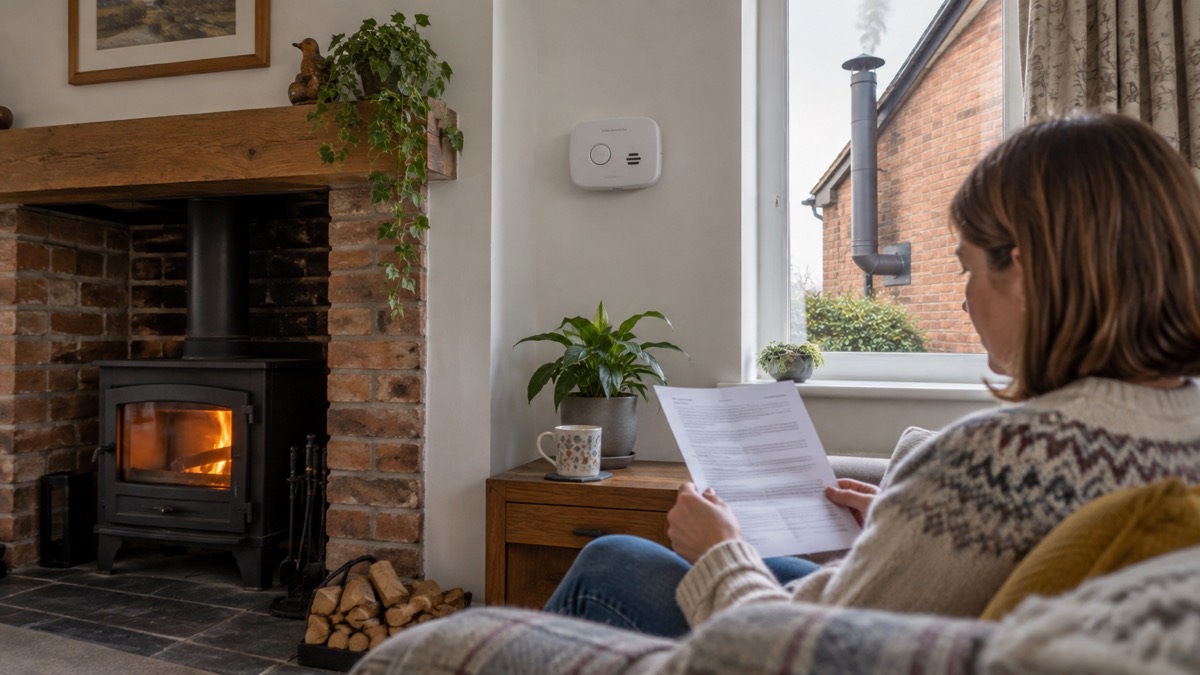
Carbon monoxide has no smell, no taste and no colour, and you cannot tell it is in the room until people start to feel ill. A carbon monoxide alarm is the only device designed to detect it, and its whole purpose is to alert you and give you time to leave the building safely1. If your alarm sounds, or anyone has symptoms, fire and rescue advice is to get out, stay out and call for help: open doors and windows, turn off fuel burning appliances, and call 999 if anyone feels unwell2.
Choosing one is straightforward if you know what to look for. Buy an alarm that complies with British Standard BS EN 50291 and carries a British or European approval mark such as the BSI Kitemark4, fit it in every room with a fuel burning appliance, and replace it when it reaches the end of its life, which for most alarms is between five and seven years, with some lasting as long as 10 years5. This page sets out what a CO alarm does, where it goes, what the law requires in each nation, and how to tell a trustworthy alarm from one that is not.
If your carbon monoxide alarm goes off: get out, ventilate and call for help
Treat every sounding CO alarm as real. Devon and Somerset Fire and Rescue Service is blunt about this: CO alarms rarely beep as a false alarm, so if the detector is beeping you should act fast and get out of the property9. North Wales Fire and Rescue Service advises that if your alarm sounds, or you suspect carbon monoxide poisoning, you should leave the building immediately, call the emergency services if anyone feels unwell, and not re-enter until it has been declared safe2.
The steps, drawn from fire and rescue services and the NHS, are:
- Open all doors and windows to ventilate and try to clear the gas3.
- Stop using and turn off all fuel burning appliances, including any pump or generator3.
- Leave the property, leaving doors and windows open behind you, and do not re-enter until the alarm has stopped and the property is declared safe2.
- If anyone feels unwell, call 999 and ask for an ambulance and the Fire and Rescue Service12.
- If no one is unwell, contact your gas or fuel supplier on their emergency number; for gas, Manchester Fire and Rescue Service advises calling the Gas Emergency Helpline on 0800 111 9993.
If your boiler, heater, stove or fire was producing dangerous levels of carbon monoxide, it will need to be serviced by a professional before you use it again10. Do not simply silence the alarm and carry on: the appliance is the problem, and the alarm is only the messenger. For more detail on symptoms and what to watch for, see our page on carbon monoxide poisoning symptoms and our guide to what to do if your CO alarm sounds.
What a carbon monoxide alarm does, and what it will not do
Carbon monoxide detectors, commonly known as CO alarms, are devices specifically designed to detect the presence of this odourless and invisible gas13. When the gas reaches a dangerous level in the room, the alarm sounds an audible warning, giving you time to leave the building safely1. That is the whole job: it detects the gas and it warns you. It does not remove the gas, shut off the appliance or summon help on its own.
Two limits matter. First, a CO alarm is not a smoke alarm. CO alarms detect carbon monoxide while smoke alarms detect smoke and fire; they are not a substitute for one another and both types should be installed in your house15. If you are fitting alarms from scratch, our pages on smoke alarms and heat alarms cover the other half of the job.
Second, an alarm is never a substitute for looking after the appliances themselves. The Health and Safety Executive for Northern Ireland is explicit:
Suffolk Fire and Rescue Service makes the same point: these alarms may warn you of the presence of carbon monoxide but they are not a replacement for regularly servicing household appliances16. Get your boiler, fire and stove serviced on schedule, keep flues and chimneys clear, and treat the alarm as the last line of defence, not the first.
Which homes need one: every room with a fuel-burning appliance
The rule is simple and it is the same advice from the NHS, fire and rescue services and gas network operators: get one carbon monoxide alarm for each room of your home containing appliances that burn gas, oil, coal or wood6. That covers boilers, cookers, ovens, open fires, wood burners, gas or paraffin heaters and stoves18. If you have a gas boiler in the kitchen and a gas fire, open fire or log burner in the living room, a minimum of two detectors is advisable10.
Some services go further. Warwickshire and Lincolnshire Fire and Rescue Services suggest ensuring the alarm can be heard throughout your home and considering keeping one in the bedroom as well17. Warwickshire also recommends at least one CO alarm in every household, with additional units for each floor, near sleeping areas, and near potential sources such as gas appliances, wood burning stoves or attached garages13.
If your house or flat is entirely powered by electricity, you will not need a carbon monoxide detector, because there is nothing burning fuel to produce the gas15. But if you have a fuel burning boiler, fire or stove, you should have one in every room where fuel is burned15.
| Your home | CO alarm needed? |
|---|---|
| All electric, detached | No15 |
| Gas, oil, LPG or solid fuel appliance | One in every room where fuel is burned15 |
| All electric, but semi-detached or terraced with a fuel burning neighbour | Safety first approach: fit one10 |
| Caravan, campervan or houseboat | Yes, where fuel is burned and where you sleep10 |
The law on CO alarms in England, Scotland, Wales and Northern Ireland
The legal duties differ across the four nations, and they mostly fall on landlords rather than owner occupiers.
In England, all landlords of private residential rental properties are required by law to install a carbon monoxide alarm in any room that contains a solid fuel burning appliance, such as a coal or wood burning fire or stove17. Since the Smoke and Carbon Monoxide Alarm (Amendment) Regulations 2022, relevant landlords in England must also ensure a carbon monoxide alarm is equipped in any room used as living accommodation which contains a fixed combustion appliance, excluding gas cookers22. Landlords must additionally have smoke detectors on each floor of the premises23, and the alarms they choose should be compliant with British Standards BS 502917.
In Northern Ireland, carbon monoxide alarms are a mandatory requirement for all homes where a new fossil fuel appliance is installed, following a change to The Building Regulations (Northern Ireland) 2012 that came into operation on 31 October 20124. This applies to any home having a new fossil fuel appliance fitted, not just rented ones.
In Scotland, the rules on alarms in homes centre on smoke and heat alarms, and Scottish Government guidance on what to buy covers carbon monoxide alarms too: any alarm you buy will have information on how long it lasts, which can be up to 10 years, and if you also need a carbon monoxide alarm and it is battery operated, it must have a sealed battery for the duration of its lifespan24. Scottish Fire and Rescue Service advises that carbon monoxide detectors should be placed in all rooms where there is a carbon fuelled appliance, including boilers, fires, gas or paraffin heaters, stoves or a flue19.
In Wales, as in England and Scotland, the law points in the same direction for homes with fuel burning appliances, though each country's legislation sets its own requirements21. Our page on Wales and Northern Ireland covers the differing arrangements in more detail.
Choosing an alarm: look for BS EN 50291 and the Kitemark
Fire and rescue services and safety bodies give the same buying advice, and it is worth following exactly. Before purchasing a carbon monoxide alarm, always ensure it complies with British Standard EN 50291 and carries a British or European approval mark, such as a CE or Kitemark4. Lincolnshire Fire and Rescue Service says to only buy alarms certified to British Standard EN50291 with the British or European approval mark, such as the Kitemark17, and Bedfordshire Fire and Rescue Service, in guidance from gas network Cadent, says to make sure your CO alarm complies with British Standards BS EN50291-1 and to look for the BSI Kitemark logo5.
The standard is not a formality. BS EN 50291 specifies the requirements and test methods for CO alarms, ensuring their effectiveness and reliability15. An alarm without it has never demonstrated that it will actually detect the gas.
What to check on the box or listing:
- BS EN 50291 (written as BS EN50291-1 for home alarms)5
- A British or European approval mark, such as the BSI Kitemark or CE mark4
- The British Standard mark on the packaging, and purchase from a reputable source15
- The stated lifespan, printed by the maker24
CO alarms are sold in many retail outlets, including DIY and hardware stores, online sellers, supermarkets and trade retail stores, and are made by a wide range of companies4. Before purchasing, always ensure the alarm complies with British Standard EN 50291 and carries a British or European approval mark, such as a Kitemark15. If you are weighing up a combined smoke and CO unit against separate alarms, our comparison page on combined or separate alarms sets out the trade offs, and our page on alarm standards explains what the numbers mean.
Why unbranded alarms cannot be trusted
This is the one area where the independent testing evidence is unequivocal. Which? reports:
"Every unbranded carbon monoxide alarm we've tested has failed to detect the killer gas, and every one is a Don't Buy."
That is not a marginal difference. An alarm that fails to detect the gas gives you a false sense of security while offering no protection at all. Which? advises choosing a carbon monoxide detector from a well known brand that is widely available on the high street or online, and notes that retailers such as Argos, B&Q, Currys, Homebase, John Lewis, Screwfix and Wickes only stock carbon monoxide alarms from well known brands10.
The official record backs this up. A carbon monoxide alarm sold for domestic use has been the subject of a product safety report, which found that the product does not meet the requirements of the General Product Safety Regulations 200525. An alarm can look the part and still be unsafe.
The practical rule: buy from a reputable source, buy a known brand, and check the standard and Kitemark on the packaging before you part with your money. If a listing shows none of those marks, walk away. You can also check whether an electrical product has been recalled on our product recalls page.
Where to fit it: 1 to 3 metres from the appliance
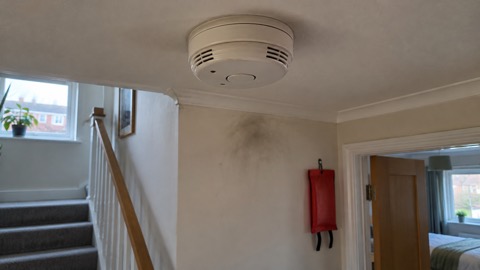
Positioning matters, and the fire and rescue services' advice sheet gives precise figures. The alarm must be 1 to 3 metres away from the appliance: a minimum of 1000mm and a maximum of 3000mm1. Cherwell District Council, setting out the standard used for rented homes, gives the fuller version: alarms should be positioned at head height, either on a wall or shelf, approximately 1 to 3 metres away from a potential source of carbon monoxide7.
The clearances depend on how you mount it:
| Mounting | Rule |
|---|---|
| On the ceiling | Minimum 300mm away from the wall1 |
| On the wall | Minimum 150mm down from the ceiling1 |
| Height | Above the line of any doors or windows in the room1 |
| Distance from appliance | 1 to 3 metres, same room1 |
| Room with a partition | Same side of the partition as the appliance1 |
For bedrooms and rooms remote from the appliance, alarms should be located just below but relatively close to the breathing zone of the occupant, and between the occupant and the appliance1. Manchester Fire and Rescue Service recommends placing a carbon monoxide alarm in rooms where you have a fixed combustion appliance, such as a gas fire, gas boiler, log burner or open fireplace26. Our page on where to put a carbon monoxide alarm goes through room by room placements in more detail.
Where a CO alarm must never go
Poor placement can stop a good alarm doing its job. The advice from several fire and rescue services is consistent:
- Do not place the alarm too close to any appliance that produces a flame5.
- Do not put it in cupboards, behind furniture, or near outside doors, windows or ventilation equipment such as extractor fans5.
- Avoid areas with high humidity or direct sunlight, as these can affect performance15.
- Make sure it is not directly above a source of heat or steam10.
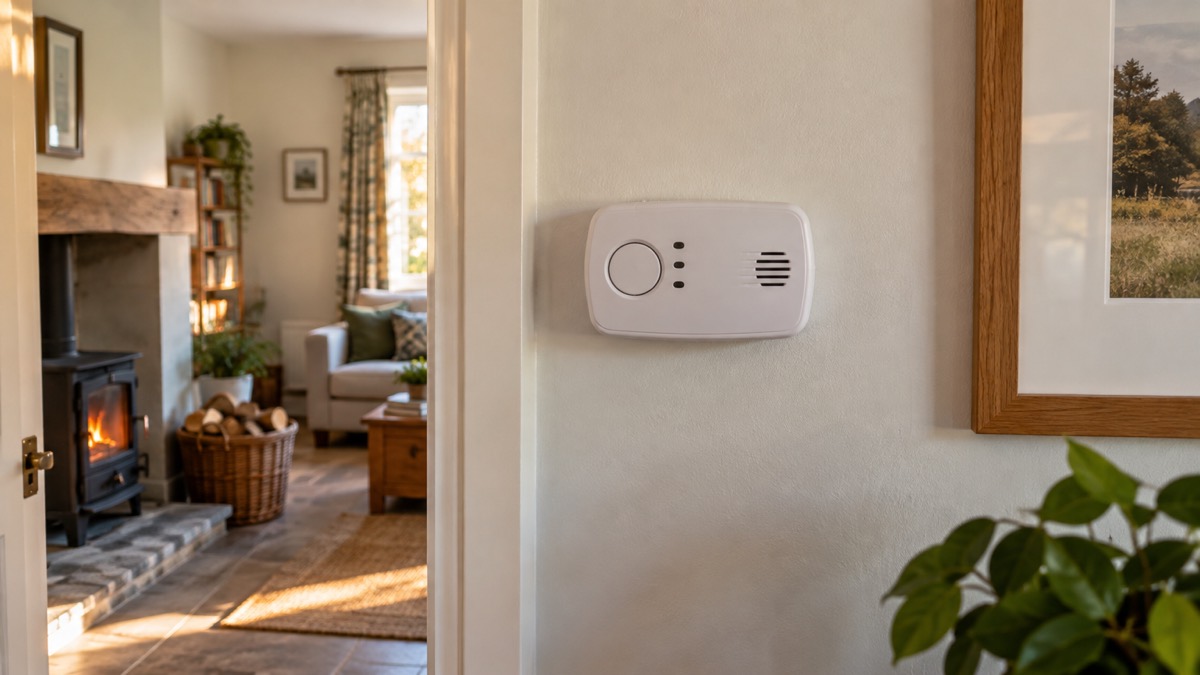
The reasons are practical. An alarm tucked in a cupboard or behind a sofa may not sample the air in the room. An alarm next to a window, door or extractor fan sits in a stream of fresh air that dilutes the carbon monoxide before it reaches the sensor. An alarm above a kettle, hob or shower gets repeated doses of steam and heat that can affect it over time. Fit it in open air at head height, in the same room as the appliance, and it will do what it was tested to do.
Batteries and lifespan: most alarms last 5 to 10 years
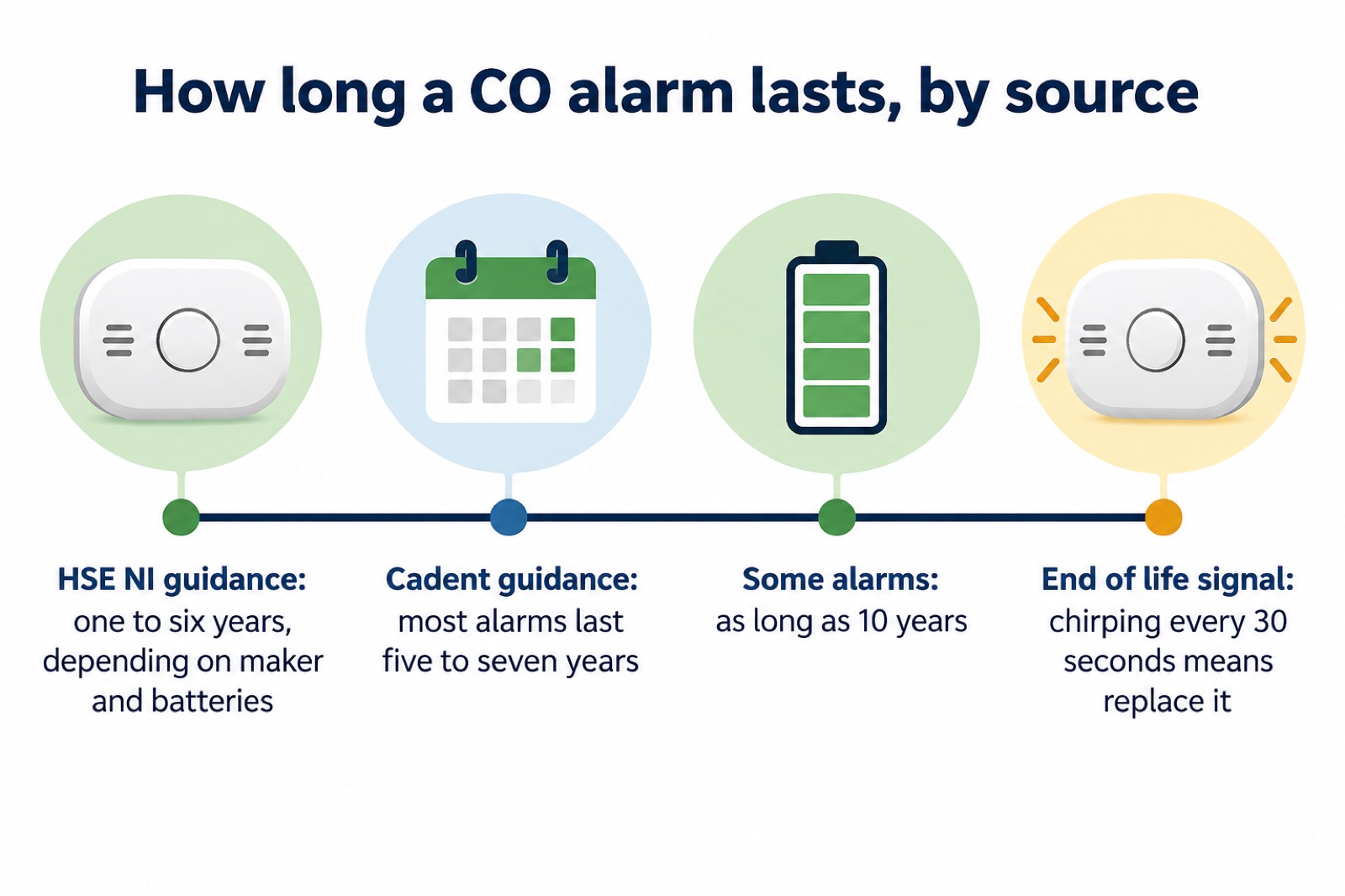
Carbon monoxide alarms do not last forever, and the sensor inside degrades with age. Cadent's guidance, published by Bedfordshire Fire and Rescue Service, states that most alarms will last between five and seven years, with some lasting for as long as 10 years5. Which? agrees that all CO detectors have a set lifetime which can be as long as 10 years10. The Health and Safety Executive for Northern Ireland gives a wider range, warning that particular attention should be given to the lifespan of the unit, which can range from one to six years depending on the manufacturer and the expected life of the batteries; some have replaceable batteries, others are sealed in for the life of the unit4.
Scottish Government guidance adds a requirement worth knowing wherever you live: if a carbon monoxide alarm is battery operated, it must have a sealed battery for the duration of its lifespan24. A sealed battery cannot be removed and used for something else, cannot be fitted flat by mistake, and cannot be quietly disconnected by a frustrated householder silencing a low battery chirp. The trade off is that when the battery or sensor ends its life, the whole unit is replaced.
Any alarm you buy will have information on how long it lasts, which can be up to 10 years24. Write the replacement date on the unit when you fit it, or set a reminder, and see our page on when to replace a smoke, heat or CO alarm. If you are deciding between sealed and replaceable battery designs, our comparison of sealed 10 year or replaceable battery alarms sets out the differences.
What the chirps and beeps mean
Not every sound from a CO alarm is a full alarm, and knowing the difference tells you whether to act immediately or simply fit new batteries. Which? gives the two patterns to learn:
- A chirp or beep every minute, on a detector with replaceable batteries, is your cue to replace the batteries10.
- Chirping every 30 seconds is the sign that your alarm is ready to be replaced: the unit has reached the end of its life10.
A continuous or rapid alarm is the real thing, and the response is the get out, ventilate, call for help sequence at the top of this page2. The danger is treating an end of life chirp as a nuisance and pulling the batteries out entirely, leaving the home with no protection. Replace the batteries or the unit the same day. Our page on why your carbon monoxide alarm is beeping works through every sound pattern, and our guide to testing alarms covers the regular checks that catch a dying unit early.
Special cases: caravans, houseboats, holidays and hearing loss
Caravans, campervans and houseboats. Alarms for a houseboat or caravan need to comply with a different British standard, BS EN 50291-2, because these settings differ from a house17. North Wales Fire and Rescue Service specifies BS EN 50291-2:2010 compliant alarms for boats, campers and caravans1, and Humberside Fire and Rescue Service says to ensure there is a carbon monoxide alarm that is tested to BS EN50291-2 and kitemarked, in place and tested regularly20. On a houseboat, Which? advises that detectors are installed both where the fuel is burned and where you will be sleeping10.
Holidays. UK holiday cottages and hotels should be fitted with carbon monoxide detectors, but a CO alarm is small, light and easy to pack if travelling abroad10.
Deaf and hard of hearing households. A standard CO alarm relies on hearing the sounder. If anyone in your household would not hear it, look at alarms and alerting devices designed for deaf and hard of hearing people, covered on our page about smoke and CO alarms for deaf and hard of hearing people. Some telecare services offer a CO detector that raises an audible alarm within the home and also sends an instant alarm call to a monitoring centre when carbon monoxide levels rise, for example from a blocked flue or chimney or a faulty appliance27.
Interlinking. Carbon monoxide detectors do not need to be interlinked with your fire alarms, according to Scottish Fire and Rescue Service19. If you are planning a linked system for smoke and heat alarms, our page on interlinked alarms explains how linking works and where CO alarms fit in.
Warning signs of a faulty appliance
An alarm tells you carbon monoxide is present, but appliances usually give earlier warnings if you know what to look for. Which? lists the four main signs:
- A lazy yellow or orange flame on the hob
- Dark staining on fuel burning appliances
- Your boiler's pilot light blowing out
- Increased condensation10
Any of these means the appliance is not burning cleanly and may be producing carbon monoxide. Stop using it, ventilate the room, and get it serviced by a professional before lighting it again10. Combine that with the alarm checks above and you have both halves of the protection: the servicing that stops the gas being produced, and the alarm that warns you if it still is. For the wider picture of fire and gas safety at home, see our home emergencies guide.
Sources (27)
- CO alarm advice sheet, North Wales Fire and Rescue Service, 2024
- Carbon monoxide safety at home, North Wales Fire and Rescue Service
- Smoke alarms and carbon monoxide detectors, Surrey County Council, 2026-08-24
- Carbon monoxide alarms, Health and Safety Executive for Northern Ireland, 2026
- Carbon monoxide leaflet, Cadent, published by Bedfordshire Fire and Rescue Service, 2026
- Carbon monoxide poisoning, NHS, 2025-12-16
- Housing standards: smoke and carbon monoxide alarms, Cherwell District Council, 2026-10-29
- Carbon monoxide, Health and Safety Executive for Northern Ireland, 2026
- Carbon monoxide, Devon and Somerset Fire and Rescue Service, 2026
- What to do when a carbon monoxide detector goes off, Which?, 2026-07-14
- Carbon monoxide safety in your home, TâncGC
- Home fire safety, Northern Ireland Fire and Rescue Service, 2026-10-14
- Smoke alarms and CO detectors, Warwickshire County Council, 2026-10-29
- Celebrating safely: Pesach, Manchester Fire and Rescue Service, 2026-10-29
- Safe home heating: CO alarms, Warwickshire County Council, 2026-10-29
- sfrs-carbon-monoxide-factsheet, Suffolk Fire and Rescue Service
- Fire alarms and carbon monoxide detectors, Lincolnshire County Council, 2026-10-29
- Stay warm safely this winter, Devon and Somerset Fire and Rescue Service, 2026
- Carbon monoxide detectors, Scottish Fire and Rescue Service, 2024-04-16
- Caravan, motor home and campervan safety, Humberside Fire and Rescue Service, 2026-10-29
- Carbon monoxide: the silent killer, Wiltshire and Swindon Prepared, 2026-10-25
- Smoke and carbon monoxide alarms, North Yorkshire Fire and Rescue Service, 2026-02-20
- Fire safety in rented accommodation, Cornwall Council, 2026-10-29
- Fire and smoke alarms in Scottish homes: where and what to buy, Scottish Government, 2024-08-14
- Product safety report: carbon monoxide alarm 2112-0591, GOV.UK, 2022-03-27
- Carbon monoxide, Manchester Fire and Rescue Service, 2026-10-29
- Telecare service: what is available, Isle of Anglesey County Council, 2026-10-29
 Home Fire Safety Checklist
 Bedtime Fire Safety Checks
 Fire Risk Checks for Carers
 What to Do If Fire Starts
 How to Make a Fire Escape Plan
 Fire in a Block of Flats
 Kitchen Fires and Cooking Safety
 Electrical Fires and Sockets
 Smoking, Matches and Lighters
 E-bike Charging Safety
 Hoarding and Fire Risk
 Thatched Properties Fire Risk
 Fireworks and Bonfire Safety
 What to Do After a House Fire
 How Fire Services Respond