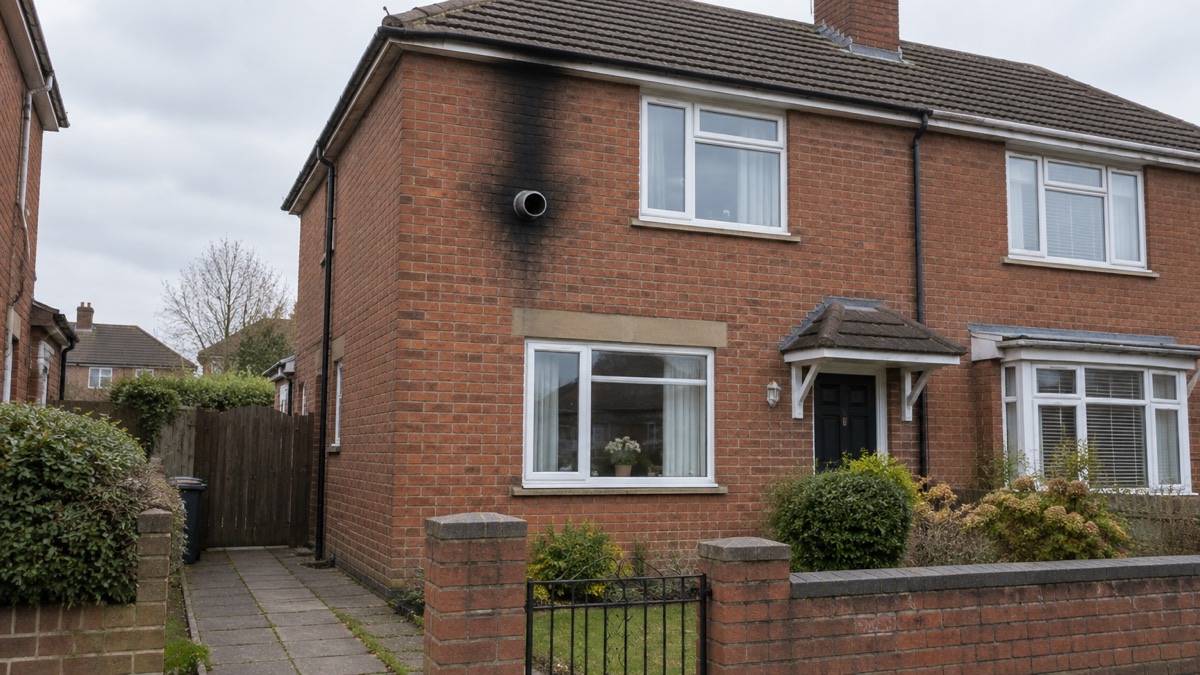
A gas appliance that is going wrong usually tells you before it becomes dangerous. The signs to look for are a lazy yellow or orange flame instead of a crisp blue one, soot or yellow and brown staining on or around the appliance, a pilot light that keeps blowing out, and more condensation in the room than usual1. If you spot any of them, the law is clear: it is illegal for anyone to use a gas appliance if they suspect it is unsafe. Turn the appliance off and do not touch it again until it has been checked by a Gas Safe registered engineer2.
That rule catches many households out. People see a yellow flame on the hob or a black mark above the fire and carry on using it for weeks, thinking it is cosmetic or that it will sort itself out. It will not. Those marks mean the appliance is burning its fuel incompletely, and incomplete combustion is exactly the condition under which carbon monoxide is produced3. Carbon monoxide is odourless and invisible, and you cannot rely on noticing it4.
This page sets out the warning signs in full, what to do the moment you see one, what it means when an engineer disconnects an appliance and attaches a label reading "Danger Do Not Use", and the checks and duties that stop an appliance reaching that state in the first place. If you are dealing with a gas leak right now, open the windows, avoid using electrical switches and contact the emergency gas helpline on 0800 111 999 immediately5; our page on the National Gas Emergency Service explains what happens when you ring.
The warning signs: flame colour, soot, staining and condensation
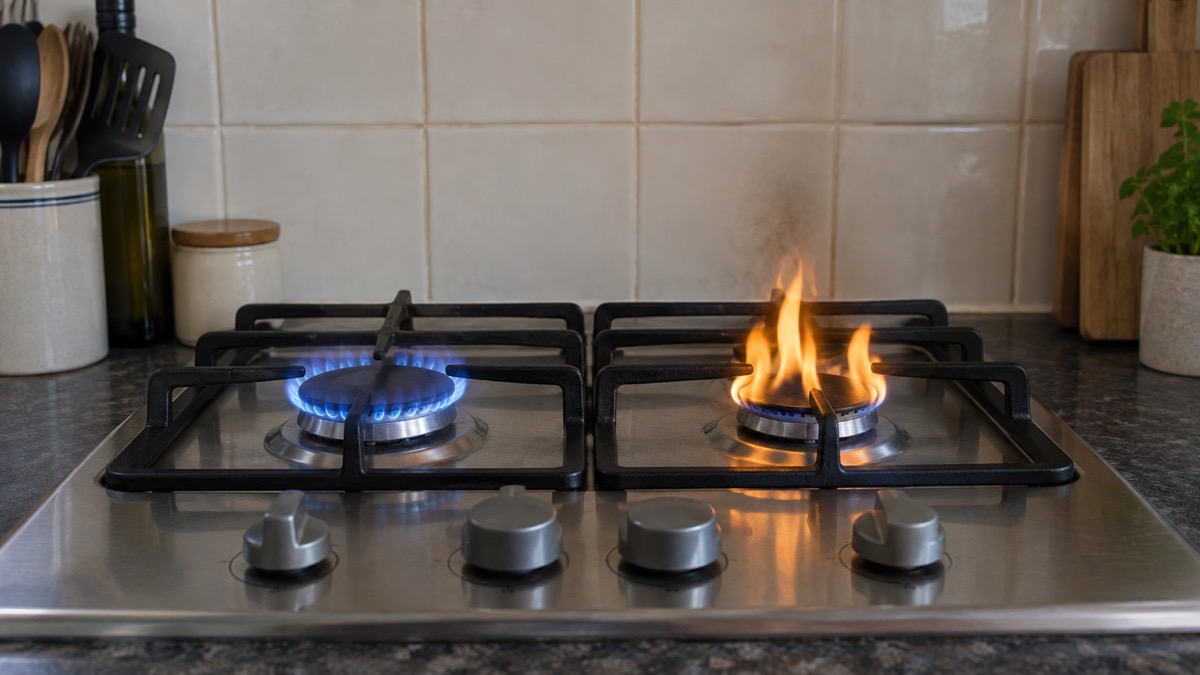
The signs fall into two groups: what you can see on the appliance itself, and what you can see in the room around it. On the appliance, look for yellow instead of blue flames, or flames that are not fully formed; black, sooty marks on the front covers of gas fires; sooty or yellow and brown stains on or around boilers, stoves or fires; and a pilot light that frequently blows out4. In the room, look for increased condensation on windows, and an unfamiliar or burning smell when gas or oil appliances are on4. On a houseboat, also look for smoke escaping into the cabin when a log burner or coal stove is lit4.
The flame colour rule has one exception worth knowing. Flames that look lazy and are yellow or orange rather than blue are a warning sign, except on fuel-effect fires, which are designed to look like a real coal or log fire, and fuel-less appliances6. A decorative fuel-effect gas fire with yellow flames is doing what it was built to do. A yellow flame on a cooker, a boiler or a cabinet heater is not.
Soot and staining matter because of what they represent. Soot or yellow and brown staining around or on an appliance indicates incomplete combustion, and where combustion is incomplete, carbon monoxide may be produced3. The stain is a record of what has been coming out of that appliance, possibly for months. Black marks or stains on or around the appliance, together with lots of condensation in the room, are the signs the fire and rescue service asks households to check for7.
Check the whole set of signs rather than one in isolation. A single pilot light going out once may be a draught; a pilot light that frequently blows out, combined with staining around the fire and condensation on the windows, is a pattern that points to an appliance that is not burning properly4. If you are unsure, treat the appliance as suspect and follow the steps in the next section.
What to do the moment you spot a warning sign
The Health and Safety Executive's instruction is unambiguous, and it applies to every household, owner or tenant:
"It is illegal for anyone to use a gas appliance if they suspect it is unsafe. Turn the appliance off and do not touch it until it has been checked by a Gas Safe registered engineer."2
So the first step is to turn the appliance off at its control and leave it off. Do not relight it, do not run it "just to see", and do not attempt any repair yourself. If you have any concerns about unsafe gas equipment, contact a Gas Safe registered engineer, who can inspect the equipment and make any repairs8. Check your heating and cooking appliances are safe and contact a Gas Safe registered engineer to make sure they are working properly9.
If you think the appliance is spilling carbon monoxide, the steps change, because you are no longer preventing a risk, you are responding to one:
- Open all doors and windows to ventilate the room1.
- Turn off gas appliances and leave the house10.
- Call the National Gas Emergency Service on 0800 111 9991.
- If anyone in the household feels unwell, treat it as a medical emergency.
If you suspect a gas leak rather than carbon monoxide, open windows, avoid using electrical switches, and contact a Gas Safe registered engineer or the emergency gas helpline on 0800 111 999 immediately5. The instruction not to use electrical switches includes light switches: a spark is all a gas leak needs. One further limit: if the gas meter is in the cellar or basement, do not go in to switch it off11. Ventilate what you safely can and let the emergency service handle the rest.
Carbon monoxide: symptoms, alarms and what they do
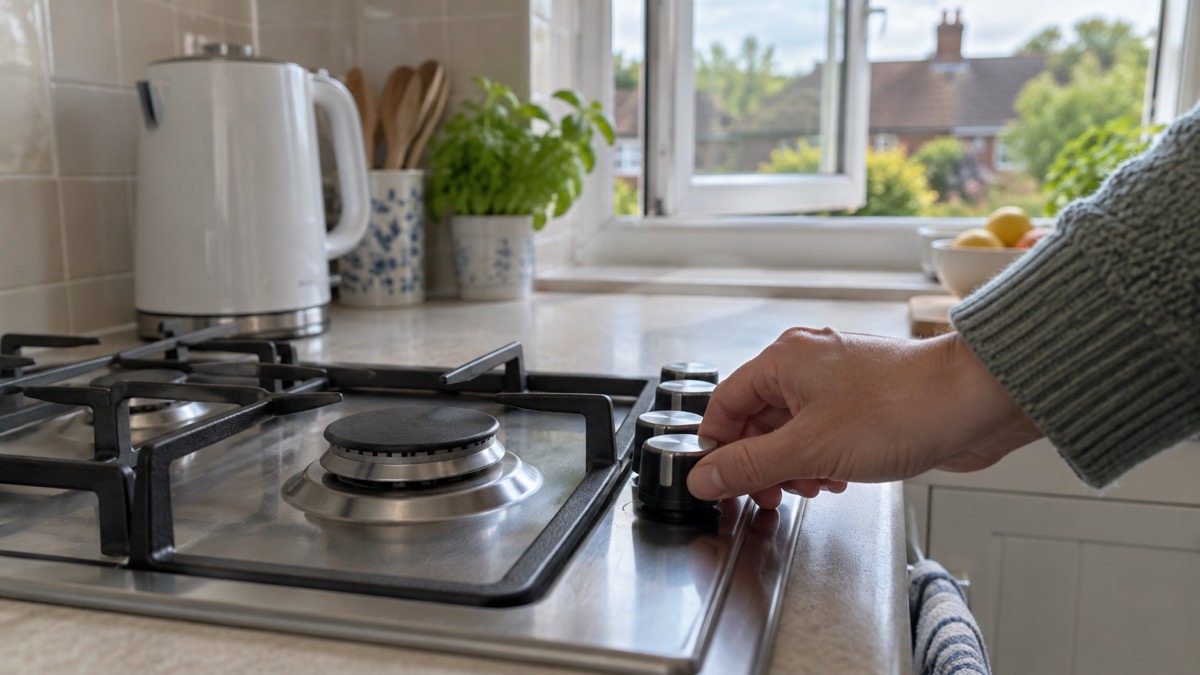
Carbon monoxide is an odourless and invisible gas4. You will not smell it, and you cannot see it, which is why the physical signs on the appliance and the symptoms in your body matter so much. The symptoms of carbon monoxide in the home include headaches, dizziness and nausea12; feeling sick and dizzy is a recognised presentation13. Because those are also the symptoms of many ordinary illnesses, the clue that points to carbon monoxide is that they ease when you leave the house and return when you come back, and that more than one person or pet in the household has them at once.
Know the risk factors that make exposure likely: your appliance was not installed by a Gas Safe registered installer; your appliance is not working correctly; your appliance has not been checked or maintained correctly; there is not enough fresh air in the room; or your chimney or flue gets blocked14. If several of those describe your home, treat any headache-and-nausea cluster in the household as possible carbon monoxide poisoning until an engineer says otherwise.
A carbon monoxide alarm is the backup, not the substitute. Carbon monoxide detectors, commonly known as CO alarms, are devices specifically designed to detect the presence of this odourless and invisible gas15. Make sure you know the symptoms of carbon monoxide poisoning and have a working carbon monoxide alarm, but fitting an alarm should not be used instead of regular checks of appliances16. Test alarms at least once a month15; the fire and rescue service advice is to install a carbon monoxide alarm and test it weekly7. If you have a solid fuel appliance, such as a log burner, make sure you have a working carbon monoxide alarm17.
Some households can get more than a standalone alarm. A telecare carbon monoxide detector raises an audible alarm within the home and provides additional protection by raising an instant alarm call to a monitoring centre when carbon monoxide levels are increased, for example from a blocked flue or chimney or faulty appliances18. If someone in your household already has a lifeline or telecare service, ask the council whether a CO detector can be added. For the wider picture on gas leaks, fire and burst pipes, see our guide to home emergencies.
What "Danger Do Not Use" means when an engineer disconnects an appliance
When a Gas Safe registered engineer inspects an appliance and finds a serious fault, they can switch it off and attach a warning label. Appliances found "at risk" or "immediately dangerous" both carry the same message on the warning label: "Danger Do Not Use"1. The distinction between the two categories matters to the engineer's paperwork, but the instruction to you is identical either way: the appliance is out of service until it is repaired or replaced.
The Health and Safety Executive is direct about what a disconnection means:
"If a gas appliance has been switched off by a Gas Safe registered engineer it is because it was unsafe and should not be used."1
That applies even if the appliance seems to work when you try it. An appliance can light, heat and cook and still be spilling carbon monoxide into the room, because the fault is in how it burns, not in whether it burns. Do not remove the label, do not reconnect the appliance, and do not ask anyone other than a Gas Safe registered engineer to put it right. If you are left without heating or hot water because an appliance has been disconnected, our page on what help there is if your appliance is condemned sets out the support available, and heating and cooking without mains power or gas covers how to keep warm in the meantime.
Only a Gas Safe registered engineer may work on gas appliances
Anyone employed to work on gas appliances in domestic premises must be a Gas Safe registered engineer and competent in that area of gas work1. This is not a trade recommendation, it is the law: only a Gas Safe registered engineer should carry out gas work, and anyone else doing it is breaking the law19. When it comes to gas work you must use a Gas Safe registered engineer for fitting, fixing and servicing appliances20.
Checking the engineer is part of the householder's job. All Gas Safe registered engineers carry ID cards which tell you which appliances they are qualified to work on, and the competencies are clearly marked on the back of the engineer's Gas Safe Register ID card1. Check that the engineer is competent to work in the specific area of gas, which is marked on the back of the card, or check the engineer or business on the Gas Safe Register website21. Not all engineers can work on caravans or non-domestic properties, so check they are appropriately qualified for the work needed19. Our page on finding a Gas Safe registered engineer and checking their card walks through this step by step.
Two traps catch households out. The first is the helpful friend or "gas fitter" who is not registered. A Gas Safe registered engineer must fit and check a gas appliance; a non-registered engineer may not fit it21. The second is asking a registered engineer to sign off someone else's work. It is not acceptable for a Gas Safe registered engineer to knowingly sign off gas work carried out by a person who is not registered, and where this occurs, both the registered and unregistered installer may face prosecution21. Never attempt to install or service appliances yourself: use a reputable, registered engineer to install and service your boiler, cooker, heating system and appliances22.
An annual safety check for every gas appliance
Gas appliances, flues and pipework should be installed, regularly maintained and serviced at least annually by a Gas Safe registered engineer1. The Health and Safety Executive strongly advises that gas appliances and flues are regularly checked for safety at least once every 12 months1. The fire and rescue service puts the same advice in household terms: ensure you have a gas safety check each year for your boiler or appliances23, and have appliances checked every year by a Gas Safe registered engineer10.
A check and a service are related but not identical. Have your gas appliances checked and serviced every year by an engineer registered with the Gas Safe Register24. The check establishes that the appliance is safe; the service keeps it that way by cleaning and adjusting it before faults develop. Our page on appliance safety checks explains how often they are needed and who gets them free, and boiler servicing covers what an engineer actually does during one.
If a date in twelve months is easy to forget, use the reminder service. Give the Gas Safe Register the date your appliances are due to be checked and they will drop you a single email each year to remind you20. Alongside the annual check, the fire and rescue service advises a set of standing habits: have all gas appliances serviced annually by a Gas Safe registered engineer, never attempt DIY on a gas installation, never block air vents, fit a CO alarm in any room with a gas appliance, and know how to turn your gas supply off in an emergency25.
Renting: your landlord's gas safety duties
If you rent, the legal duty to have the appliances checked sits with your landlord. The Gas Safety (Installation and Use) Regulations 1998 deal with landlords' duties to make sure gas appliances, fittings and flues provided for tenants are safe1. Landlords have a responsibility to make sure the gas appliances and flues in rented homes are safety checked every 12 months20, and gas appliances must be checked by a registered Gas Safe engineer every year26. This covers your gas boiler, gas cooker and gas fire20.
Your practical rights as a tenant are these:
- Ask for the record. If you do not have a record that the gas appliances in your rented home have been safety checked, ask your landlord for a copy20. Your landlord must show you safety certificates so you can see when gas and electrical appliances were last checked27.
- Check it was done. Ensure that your landlord has completed the annual Gas Safety check28.
- Report a landlord who fails. Your landlord should arrange an annual gas safety check for any fixed appliances; if they fail to provide this, report them to your local authority23.
Two situations need special care. If you own a gas appliance yourself, the landlord has responsibilities for parts of the associated installation and pipework but not for the actual appliance; approach your landlord and ask for your appliance to be included, at reasonable cost, within the gas safety maintenance and check they arrange with a Gas Safe registered engineer1. If you live in a building with communal appliances, the landlord's arrangements with the building owner must ensure that any communal gas appliances, flues and pipework used by tenants are maintained and checked for safety by the building owner, with evidence of checks available1. Our page on broken boilers in rented homes goes further into what to do when the heating fails in a tenancy.
Vents, flues and chimneys must never be blocked
Never block ventilation1. Avoid blocking air vents, flues or chimneys, to prevent the build-up of potentially harmful gases5. Ensure that gas appliances have proper ventilation5. The reason is simple: a gas appliance draws air to burn and sends waste gases out through the flue. Block either path and the gases that should go up the chimney come back into the room instead.
This is a particular risk in winter, when households tape over vents to stop draughts, or when insulation, storage boxes or bird nests obstruct a flue. A blocked flue or chimney is one of the conditions a telecare CO detector is specifically designed to catch, alongside faulty appliances18. The full advice from the Health and Safety Executive is: never block ventilation; ensure flues are kept clear at all times; and have your appliance regularly maintained and annually serviced by a Gas Safe registered engineer1.
If you have a chimney serving a solid fuel or open-flued gas appliance, have it swept and checked as part of your routine, and treat any smell of burning or smoke in the room as a sign the flue is not clearing4. Between checks, walk round the home occasionally and confirm that vents are open and unobstructed, especially after building work, decorating or a loft insulation top-up.
Rooms you sleep in, and appliances that were never commissioned
Where a gas appliance sits changes the rules. It is advisable that you do not use a gas appliance in a room that you will be sleeping in, unless it has a flame safety device (FSD) fitted or is a sealed unit with an external flue; seek professional advice from a Gas Safe registered engineer to confirm this is the case14. The NHS repeats the same advice for private properties28. The danger is that a fault in an open-flued appliance in a small, closed bedroom can fill that room with carbon monoxide while you sleep, which is the worst possible circumstance for exposure.
There is a historical wrinkle for older homes. If a room contains a restricted appliance and was used as a bedroom prior to 1998, you will need to do a risk assessment to determine if the room can still be used as a bedroom, and if you are unsure, get a Gas Safe registered engineer to check it1. If you have moved into a home where a gas fire sits in what is now a child's room or a guest room, do not assume it is fine because it has always been there.
The same principle of "not ready means not used" applies to newly installed appliances. Never attempt to install or service appliances yourself22: an appliance that has been fitted but not commissioned and checked by a registered engineer has not been proven safe, and inadequately installing new gas appliances is a recognised cause of carbon monoxide3. Badly fitted and poorly maintained gas appliances can cause gas leaks, fires, explosions and carbon monoxide poisoning20. Until the engineer has finished, signed off and demonstrated the appliance, treat it as out of service. If you have just moved in, our checklist of boiler and appliance checks when you move into a home covers what to verify in the first week.
After a flood or a gas leak: getting appliances checked
Water and gas appliances do not mix, and neither does a leak that has been stopped and left behind. After a gas leak has been stopped, any work on appliances such as cookers, boilers or fires has to be carried out by a Gas Safe registered engineer11. If you spot any of the warning signs after a flood, it might be best to get your gas appliances checked by a Gas Safe registered engineer6. Flood water can reach burners, controls and flues even when the appliance looks dry on the outside, so the check is worth arranging before you relight anything.
The sequence to follow is the same as for any suspect appliance: turn it off, leave it off, and book a registered engineer. Do not relight a boiler or fire that has been under water or that was shut off during a leak incident, even if it appears to work, because the fault may be in parts you cannot see. Our pages on getting your supply back on after an outage and flooding cover the wider recovery steps.
Fault codes, electrical warning signs and other things people ask about
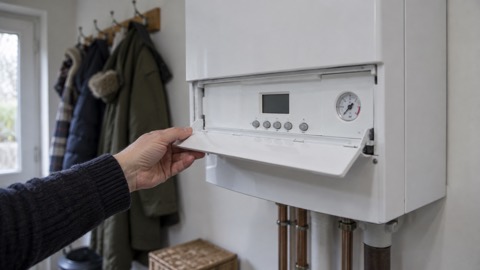
Not every warning sign on a heating appliance is a gas danger, but each has its own correct response. Boiler fault codes and flashing lights are the appliance telling you something is wrong, and by law anyone working on a gas appliance must be a Gas Safe Registered installer qualified to work on that appliance2. Our page on boiler fault codes, flashing lights and lockouts explains what the common codes mean and when a reset is safe.
Electrical appliances give their own warning signs: scorch marks on plugs or sockets, fuses that blow repeatedly, flickering lights, burning smells, or sparks from outlets or appliances. Stop using the appliance immediately, unplug it and have it checked or replace it29. Faulty electrical goods can cause fires30. Never leave pans unattended when cooking30, and never leave any open flame unattended31.
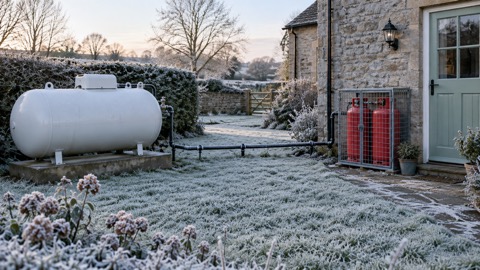
For bottled gas and outdoor heating, the flame rules still apply: a poor, lazy flame on an LPG appliance is the same incomplete-combustion warning as on a mains appliance6, and badly fitted and poorly serviced gas appliances can cause gas leaks, fires, explosions and carbon monoxide poisoning19. Never put your hand in the burning flames or fuel31. If you use cylinders or a bulk tank, see our guide to LPG homes.
Sources (31)
- Gas safety: frequently asked questions, Health and Safety Executive, 2026
- Gas safety: frequently asked questions for owner occupiers, Health and Safety Executive, 2026
- Carbon monoxide: hazardous substances, Health and Safety Executive, 2026
- Carbon monoxide safety, London Fire Brigade, 2026
- Safe home heating, Warwickshire County Council, 2026
- Carbon monoxide leaflet, Bedfordshire Fire and Rescue Service and Cadent, 2026
- Fire safety at home, Surrey County Council Fire and Rescue Service, 2026
- Energy, power supply and utilities, nidirect, 2025
- Keep warm, keep well, NHS, 2022
- Carbon monoxide, Manchester Fire and Rescue Service, 2026
- What you might need in a gas outage, Wiltshire and Swindon Prepared, 2026
- Safe home heating, Warwickshire County Council, 2026
- Carbon monoxide, Dorset and Wiltshire Fire and Rescue Service, 2025
- Sleeping in a room with a gas appliance, coal or log fire, Doncaster and Bassetlaw Teaching Hospitals NHS Foundation Trust, 2026
- Smoke alarms and CO detectors, Warwickshire County Council, 2026
- Weather and health, Public Health Wales, 2026
- How to prevent fire in your home this winter, Cumberland Council, 2026
- Telecare service: what is available, Isle of Anglesey County Council, 2026
- Gas safety, Argyll and Bute Council, 2026
- Gas safety: tenants, Greater London Authority, 2026
- Landlords: gas safety checks and who can carry them out, Health and Safety Executive, 2026
- Carbon monoxide, Devon and Somerset Fire and Rescue Service, 2026
- Stay fire safe, Manchester Fire and Rescue Service, 2026
- Safety: preventing carbon monoxide poisoning, NHS, 2022
- Home fire safety, Northern Ireland Fire and Rescue Service, 2026
- Household fire safety, Somerset Council, 2025
- Shared and rented accommodation, Dorset and Wiltshire Fire and Rescue Service, 2025
- Carbon monoxide, Doncaster and Bassetlaw Teaching Hospitals NHS Foundation Trust, 2026
- Fire prevention, Fire Kills campaign, 2026
- Home fire safety guide, Wirral Community Health and Care NHS Foundation Trust, 2025
- Outdoor heating safety, Scottish Fire and Rescue Service, 2024
 Checks Before Calling Engineer
 Boiler Checks When Moving In
 Power Cut Kit Checklist
 National Gas Emergency Service
 When the Mains Supply Goes Off
 Getting Supply Back After Outage
 Compensation for Supply Cuts
 Planned Pipe Works
 Help During a Long Outage
 Prepayment Meters
 LPG Homes in Winter
 Oil Boiler Breakdowns
 Boiler Breakdown in Cold Weather
 Boiler Fault Codes
 Boiler Pressure Gauge