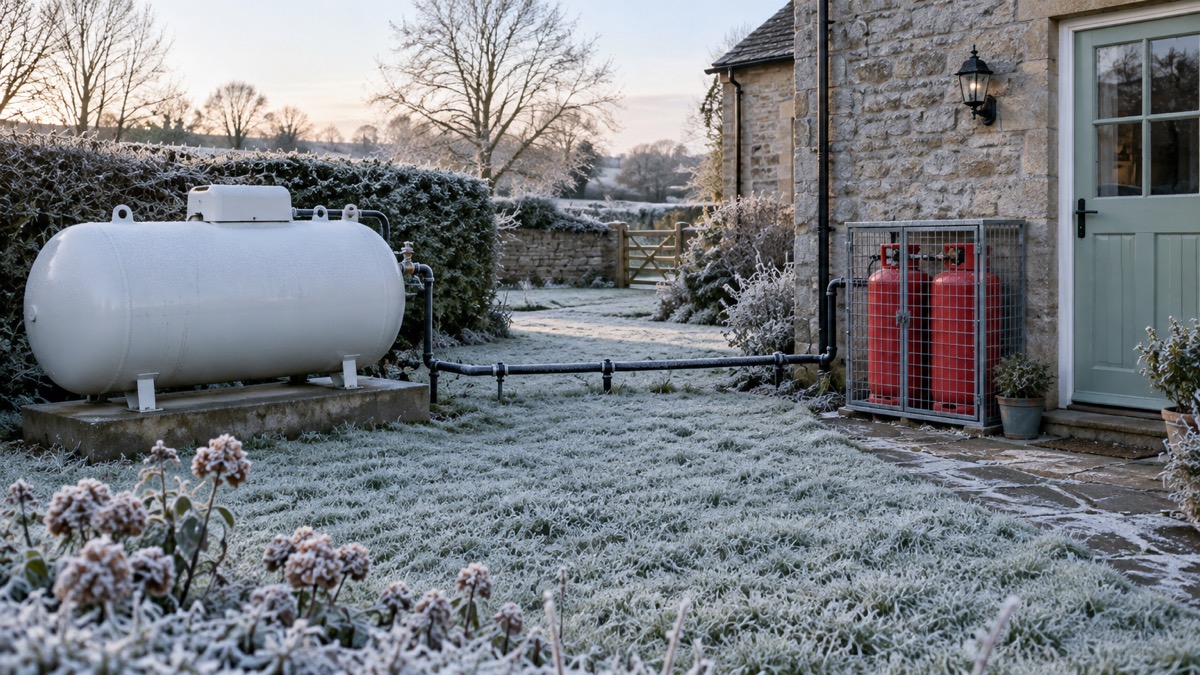
Around 200,000 UK homes off the gas grid are heated by LPG, and for those households a winter supply problem is not an inconvenience, it is the heating, the hot water and often the cooking gone at once. LPG, or Liquefied Petroleum Gas, is butane or propane stored as a liquid under pressure1. It reaches your home either through a bulk tank in the garden with a pipe to the boiler, or in portable cylinders that feed heaters, stoves and patio heaters.
The two things that matter most are simple. First, do not let the tank run low: official winter guidance for off-grid households is to make sure you have a sufficient supply to see you through the winter period2. Second, know what to do if gas escapes: LPG is heavier than air, collects at floor level, and a small leak can produce a large volume of highly flammable gas1. This page sets out how to order ahead, how to check cylinders and heaters, where cylinders must never go, who to ring, and what help exists if you are older, disabled or medically dependent.
Ordering ahead: the supply only fails when the tank runs down
Unlike a mains gas home, an LPG home holds its own fuel. Nothing arrives unless someone orders it, and that is the system's weakness in winter: deliveries slow down exactly when you are burning most. Local resilience guidance for off-grid fuel users is blunt about it, telling households that use heating oil, LPG or solid fuel to "make sure that you have a sufficient supply to see you through the winter period"2.
Order early, before the first cold snap, rather than when the gauge is already low. Fuel disruption can come from several directions at once: scarcity of supply, a technical problem with the fuel supply infrastructure, industrial action, or public protest6. A council community risk register also warns that once a shortage starts, supplies can be depleted further through increased consumer demand, in other words a sharp rise in orders as people try to top up at the same time6. If a shortage is announced, the households who ordered early are the ones who are not queuing.
The risk is not hypothetical. Surrey's community risk register rates the failure of gas supply infrastructure during winter as Very High, noting that a technical failure or accident in winter can leave large numbers of properties without gas7. Extreme weather, including flooding or freezing conditions affecting infrastructure, is listed among the causes of gas supply failures8. For an LPG household, that risk arrives twice over: the wider supply chain can be disrupted, and your own tank can run dry because a lorry could not reach you.
Check your tank's gauge regularly through the autumn and winter, and order on the early side of your supplier's recommended level. If your supplier offers automatic top-ups or telemetry that reports your level to them, ask how it works and confirm it is active before winter. If your supply does run out, see what to do when the supply to your home goes off for the wider steps, and getting your supply back on once a delivery has been made.
Cold weather, snow and what it does to your LPG
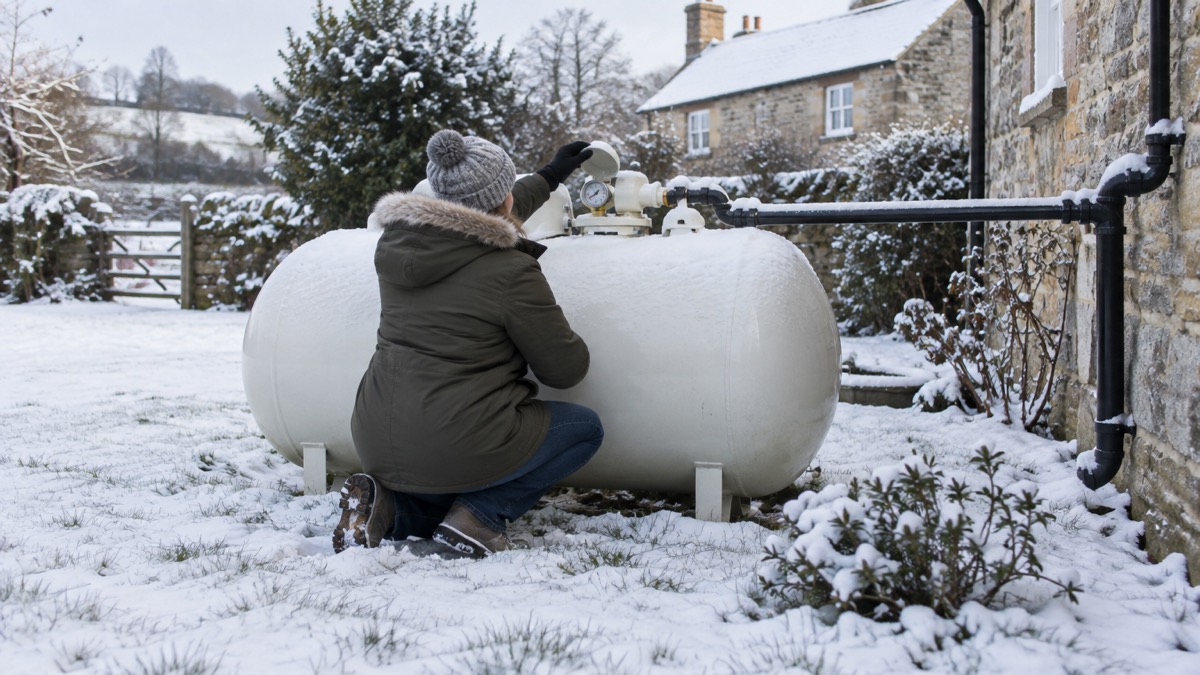
Winter is when LPG systems are under most strain, and not only because you burn more. Cold and snow create a higher risk of carbon monoxide poisoning and utility failure, alongside hypothermia and other cold-weather harms9. Scottish Government guidance on cold, snow and ice warns that these conditions can cause frozen or burst pipes10, and London borough guidance makes the same point: cold weather can freeze pipes, making them more likely to expand and burst11. A burst pipe near your tank or boiler can turn a heating problem into a water problem too.
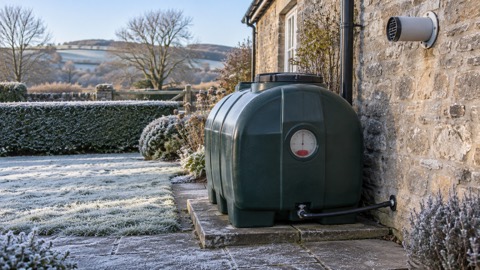
Snow and ice around a bulk tank matter for two reasons. The delivery driver needs clear access to fill the tank, and the tank and its pipework need to be reachable and visible. After heavy snow, clear a path to the tank and clear snow from the tank itself and around its valves before the delivery is due. Keep the area around the tank free of stored items and debris so that any leak or vent can be seen and smelled, and so the driver can work safely.
One winter habit deserves a specific warning. The Health and Safety Executive advises that any facilities using LPG must have adequate ventilation at both high and low level, and that you should check it is not blocked, for example fixed grilles covered by newspaper or rags in cold weather to "stop draughts"12. Blocking ventilation to keep warm is one of the most dangerous things an LPG household can do, because blocked or partially blocked burners can lead to higher carbon monoxide levels and flame failure12. If your boiler room or cylinder housing has grilles, leave them open in all weathers.
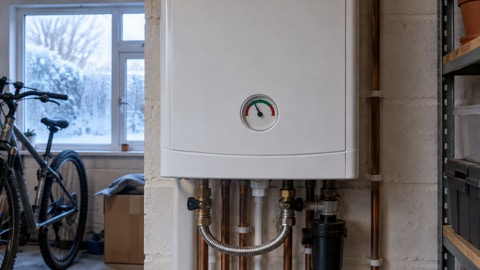
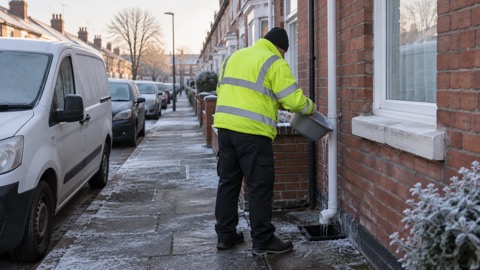
If the boiler itself fails in the cold, the most common winter culprit is a frozen condensate pipe, which you can deal with safely using our guide to frozen condensate pipes, and our boiler breakdowns in cold weather page covers the wider checks before you call an engineer.
If you smell gas: leave first, call second
LPG behaves differently from mains gas when it leaks, and the difference is what makes the official advice so firm. The gas is heavier than air, so it collects near the floor or ground, and it can be ignited at a considerable distance from the source of the leak1. The fire and rescue services put it plainly:
"A small leak can produce a large volume of highly flammable gas."
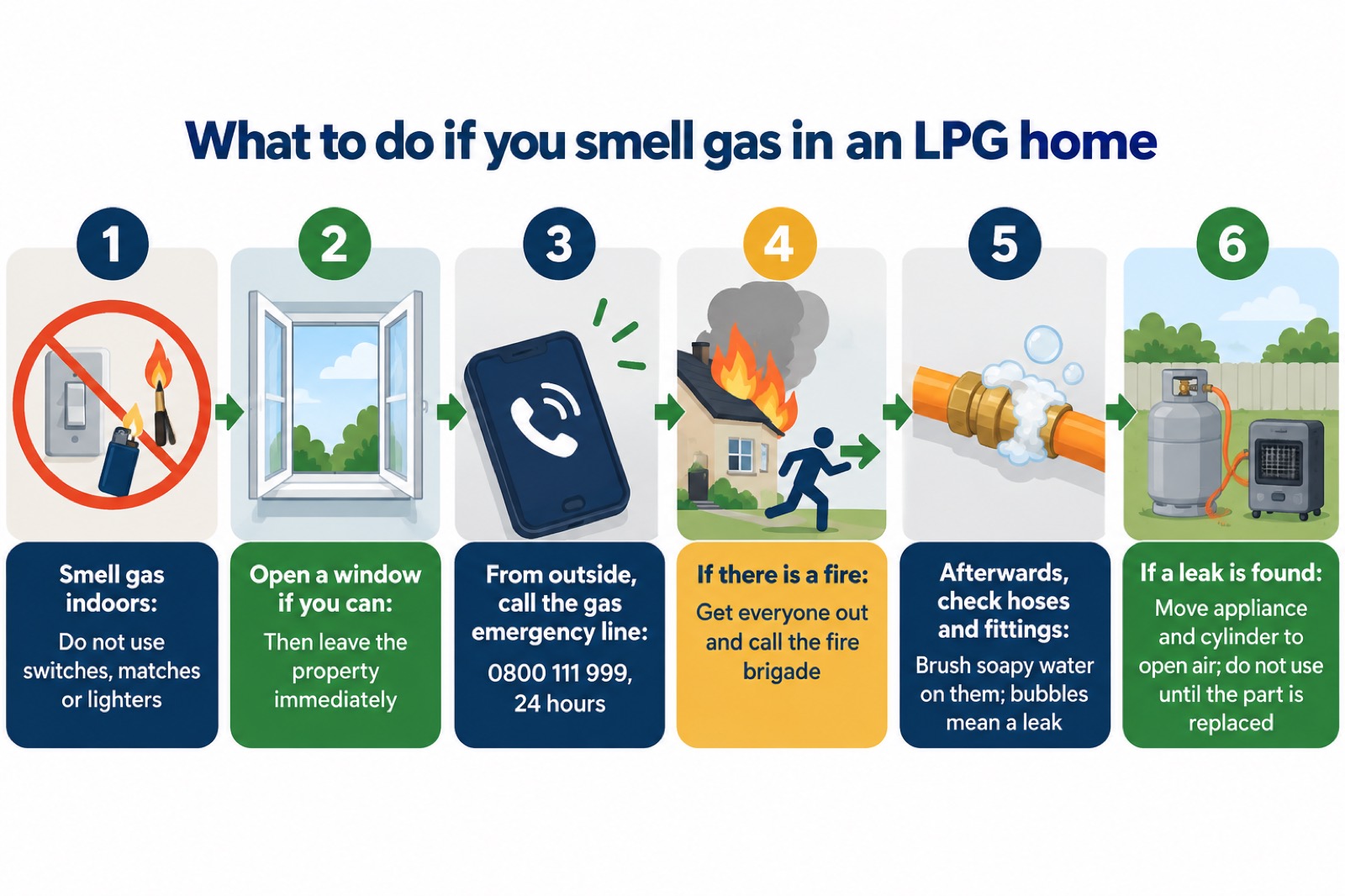
If you smell gas inside your home, open a window if you can and leave the property immediately3. Do not operate light switches, do not use matches or lighters, and do not try to find the leak with a flame. Once you are outside and safely away from the building, call the gas emergency service. If there is a fire, do not fight it yourself: get everyone out and call the fire brigade. LPG fires are a job for firefighters, because the gas collecting at floor level can flash back to the source from a distance1.
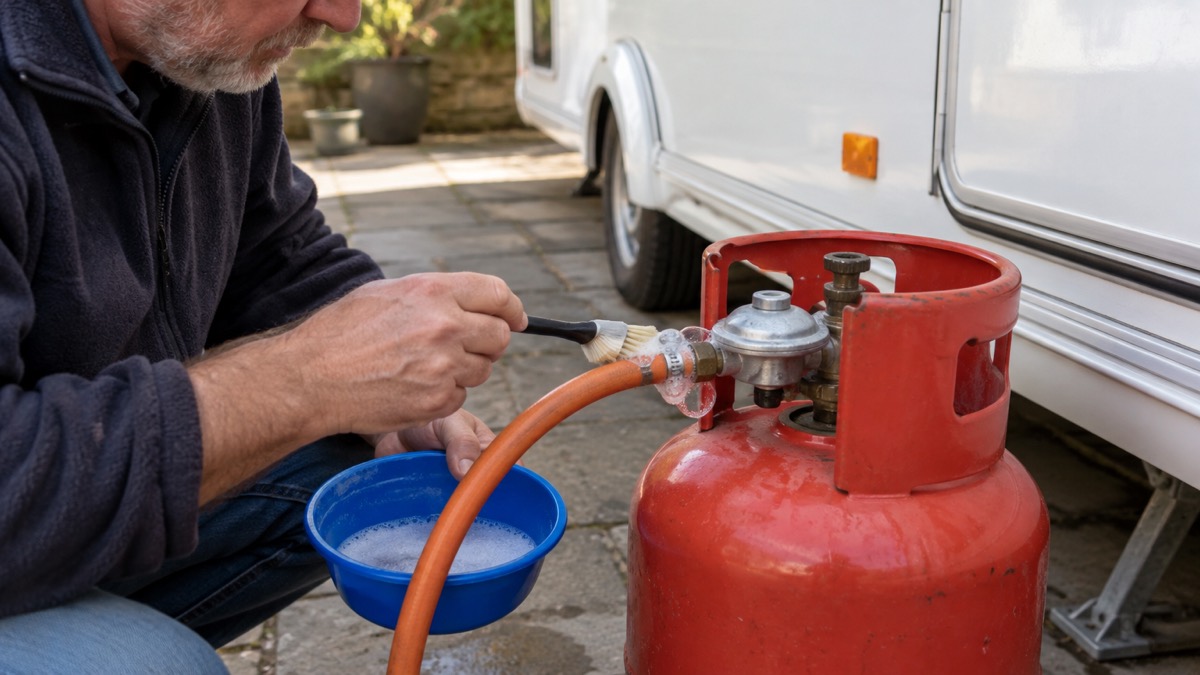
For appliances you use day to day, there is a simple routine check. The fire and rescue service advises you to search for any suspected gas leak by brushing soapy water onto the flexible hose and fittings1. Cheshire Fire and Rescue Service gives the same instruction: check for leaks using soapy water on connections, where bubbles indicate a leak13. If a leak is found, take the heater and cylinder into open air and do not use them until the faulty part has been replaced1. Do this check whenever you change a cylinder, because that is when leaks most often start: the Scottish Fire and Rescue Service notes that accidents from portable gas heaters happen due to gas leaks during appliance assembly or cylinder or cartridge changes14.
Who to call: the emergency numbers, nation by nation
For a gas leak or a gas escape, the number most of the UK rings is the National Gas Emergency Service on 0800 111 99915. Derbyshire Council confirms that suspected gas leaks should be reported on 0800 111 999 out of hours, meaning before 9am or after 5pm Monday to Friday, at weekends and on bank holidays, because it is a 24 hour emergency service for gas escapes4. Basingstoke and Deane Borough Council lists the same number for gas leaks15.
In Northern Ireland the number is different: the Northern Ireland Fire and Rescue Service's home safety guidance says to call the Gas Emergency Service (24hrs) freephone number on 0800 002 001 in the event of a gas leak5.
If you suspect carbon monoxide rather than a leak you can smell, the advice is the same line. NHS 111 Wales says that if you think a gas appliance is leaking carbon monoxide, you should call the free National Gas Helpline immediately on 0800 111 99916, and NHS stop smoking services in Yorkshire repeat the same instruction17. Carbon monoxide has no smell, so an audible carbon monoxide alarm in the same room as any gas appliance is worth having; blocked or partially blocked LPG burners can produce higher carbon monoxide levels and flame failure12.
| Where you are | Who to call | Number | When |
|---|---|---|---|
| England, Scotland, Wales | National Gas Emergency Service | 0800 111 999 | Any suspected gas leak or escape, 24 hours4 |
| England, Scotland, Wales | National Gas Helpline | 0800 111 999 | If you think a gas appliance is leaking carbon monoxide16 |
| Northern Ireland | Gas Emergency Service | 0800 002 001 | Gas leaks, 24 hours5 |
| Anywhere | Fire brigade | 999 | If there is a fire1 |
Our page on the National Gas Emergency Service explains what happens after you ring, and home emergencies covers gas leaks alongside fire, carbon monoxide and burst pipes.
Priority help: registers and delivery priority for vulnerable households
If someone in your home would struggle in a supply failure, there is help worth signing up to before winter, and it comes in two forms: registers that flag you for extra support, and delivery priority within the LPG industry itself.
The Priority Services Register is the main route. Eligibility is set by gas, electricity and water suppliers, and registration lets them know you need additional support, including when there is an interruption to your supply18. The Greater London Authority puts it simply: if you are eligible and your gas, electricity or water supply is cut off, your suppliers will know you need extra support19. Cornwall Council lists who typically qualifies: people with a disability, a long-term health condition, reliance on medical equipment, pregnancy, young children, or pensionable age20. Scottish Borders Council notes you can also join if you temporarily need extra support, for example after an operation or a bereavement21. Contact your supplier directly to join, or see our guide to extra support from networks and suppliers.
In Northern Ireland, Northern Ireland Electricity keeps a critical care register for customers who depend on electricity for medical equipment, and Belfast City Council's emergency planning pages give the registration number as 03457 643 64322.
For bulk LPG specifically, there is industry-level protection. Government guidance on identifying vulnerable people in an emergency records that Liquid Gas UK members operate a customer charter that prioritises deliveries to the most vulnerable customers during supply shortages, ensuring fuel availability to those aged 75 or older and those who are chronically ill or registered disabled, and that bulk LPG members abide by the non-legally binding Vulnerable People's Protocol23. If you are in one of those groups, tell your LPG supplier now, in writing, so you are on their list before any shortage rather than during one. The gas network companies also hold registers of people likely to need particular assistance, such as elderly or disabled customers, to restore their supply, who will be contacted separately in an emergency24.
Cylinders and regulators for portable heaters and stoves
Many LPG homes, and many households that just want backup heat, use portable gas heaters and camping stoves fed from cylinders. Portable gas heaters use Liquefied Petroleum Gas, such as butane or propane13. They are effective, but they demand respect: the Scottish Fire and Rescue Service records that accidents from this heating source happen due to gas leaks during appliance assembly or cylinder or cartridge changes14.
Build a habit around every cylinder change:
- Turn off the appliance and the cylinder valve before disconnecting anything.
- Check the flexible hose and fittings by brushing soapy water over them; bubbles indicate a leak1.
- If you find a leak, take the heater and cylinder into open air and do not use them until the faulty part has been replaced1.
- Keep ventilation clear: the Health and Safety Executive warns that LPG equipment can be particularly vulnerable, and blocked or partially blocked burners can lead to higher carbon monoxide levels and flame failure12.
- Have faulty hoses and regulators replaced rather than repaired.
Regulators, the fitting that controls the pressure from cylinder to appliance, are the part most often implicated in problems. Calor has run a safety programme around OPSO regulators on fixed cylinder installations: from 18 October 2021 its drivers carried out safety checks at every delivery and left a leaflet with customers without an OPSO regulator, and from 31 March 2022 Calor stopped delivering gas to fixed cylinder installations that lack one. If you have a fixed cylinder installation and deliveries have stopped, ask your supplier whether the regulator is the reason.
For cooking and heating without mains gas more broadly, including during an outage, see our guide to heating and cooking without mains power or gas.
Where cylinders must never be stored
Storage is where cylinder safety is most often got wrong, because the wrong places are exactly the convenient ones. The fire and rescue service's instruction is specific: store spare cylinders outside where possible, never store them in basements, near drains, under the stairs or in a cupboard containing electric meters or equipment, and spare cylinders must be stored upright1. The Scottish Fire and Rescue Service gives the same prohibitions14.
The reasons follow from the gas itself. LPG is heavier than air, so a leaking cylinder in a basement or near a drain lets gas collect at the lowest point of the house, where it can be ignited at a considerable distance from the leak1. Under the stairs and in cupboards with electrical equipment combine confined spaces with possible sources of ignition. Upright storage matters because the cylinder holds liquid under pressure, and the valve is designed for the cylinder standing as intended1.
| Storage place | Allowed? | Why |
|---|---|---|
| Outside, upright, in the open | Yes, preferred | Leaks disperse; the valve works as designed1 |
| Basement or cellar | Never | Gas is heavier than air and collects at the lowest point1 |
| Near drains | Never | Escaping gas can pool and travel1 |
| Under the stairs | Never | Confined space inside the home1 |
| Cupboard with electric meters or equipment | Never | Confined space with possible ignition sources1 |
The Flogas Gold butane cylinder recall
If you bought a butane cylinder in November 2024, check it against this recall. On 3 December 2024 the Office for Product Safety and Standards issued a product recall, notification 2411-0181, for the Flogas Gold Butane Gas Cylinder, presenting a risk of fire25. The cylinders were sold between 6 and 22 November 2024 across East Anglia, the East Midlands, the Home Counties and the South East25.
The fault is in the fill, not the cylinder itself. The cylinders were filled with a mixture of butane and propane outside the parameters for commercial butane defined in BS4250, and as the recall notice states, "This will result in a higher vapour pressure within the cylinder than usual"25. The higher pressure is what creates the fire risk26. The recall covers 4.5 kg, 7 kg and 13 kg sizes, was notified by Local Authority Trading Standards, and the cylinders were recalled from end users and withdrawn from the market26.
Ventilation, carbon monoxide and the checks that prevent both
The thread running through every LPG hazard on this page is the same: gas that cannot escape, and gas that cannot burn cleanly. The Health and Safety Executive's advice joins the two. Make sure any facilities using LPG have adequate ventilation at both high and low level, and check it is not blocked, for example fixed grilles covered by newspaper or rags in cold weather to "stop draughts"12. Blocked or partially blocked burners can lead to higher carbon monoxide levels and flame failure, and LPG can leak from damage to hoses12.
Carbon monoxide from a faulty LPG appliance has no smell and no taste, and it kills. NHS 111 Wales advises that if you think a gas appliance is leaking carbon monoxide, you should call the free National Gas Helpline immediately on 0800 111 99916, advice repeated by NHS services in Yorkshire17. Symptoms to act on include headaches, dizziness, nausea and confusion that ease when you leave the house and return when you go back in. If you experience those, get into fresh air, call the helpline, and seek medical help.
Before each winter, run through this short list:
- Order LPG early enough to see the winter through2.
- Clear snow and ice from the tank, its valves and the delivery path.
- Check ventilation grilles at high and low level are unblocked12.
- Check hoses, fittings and connections with soapy water1.
- Confirm your carbon monoxide alarm works and sits near the appliance.
- Make sure spare cylinders are stored outside, upright, and never in a basement, near drains, under the stairs or in a cupboard with electric meters or equipment1.
- If you are eligible, join your supplier's Priority Services Register18, and if you are 75 or older, chronically ill or registered disabled, make sure your bulk LPG supplier knows, so their vulnerable customer charter applies to you23.
For the wider picture of gas and heating failures, including mains gas, oil boilers and long outages, start at our gas and heating failures guide, and for storms and snow that can cut off deliveries, see storms, snow and ice.
Sources (26)
- Portable heaters safety advice, Mid and West Wales Fire and Rescue Service, 2026
- Winter preparedness for off-grid households, Humber Local Resilience Forum, August 2024
- Preparing yourself for emergencies, Greater London Authority, 2026
- Emergency contacts, Derbyshire County Council, 2026
- Home fire safety, Northern Ireland Fire and Rescue Service, October 2026
- Fuel shortage community risk, Darlington Borough Council, 2026
- Community Risk Register 2026, Surrey County Council, 2026
- Utility failure risks, Essex Prepared, 2026
- Winter preparedness, Essex Prepared, 2026
- Cold, snow and ice: respond, Ready Scotland, March 2026
- Utilities failure, London Borough of Richmond upon Thames, May 2026
- Carbon monoxide: hazardous substances, Health and Safety Executive, 2026
- Staying warm: portable heaters, Cheshire Fire and Rescue Service, May 2026
- Heating and gas safety at home, Scottish Fire and Rescue Service, November 2024
- Emergency planning, Basingstoke and Deane Borough Council, 2026
- Carbon monoxide poisoning, NHS 111 Wales, October 2025
- Carbon monoxide information, NHS Yorkshire Smokefree Wakefield, October 2026
- Prepare yourself, Greater Manchester Combined Authority, October 2026
- Keeping warm, healthy and safe in cold weather, Greater London Authority, October 2026
- Storm preparation advice, Cornwall Council, October 2026
- Priority Services Register Scotland, Scottish Borders Council, October 2026
- Emergency planning, Belfast City Council, October 2026
- Identifying and supporting persons who are vulnerable in an emergency, UK Government, April 2025
- Gas supply emergencies, Health and Safety Executive, 2026
- Product recall: Flogas Gold Butane Gas Cylinder (2411-0181), Office for Product Safety and Standards, December 2024
- Flogas Gold Butane Gas Cylinder recall notice, London Borough of Bromley, December 2024
 Checks Before Calling Engineer
 Boiler Checks When Moving In
 Power Cut Kit Checklist
 National Gas Emergency Service
 When the Mains Supply Goes Off
 Getting Supply Back After Outage
 Compensation for Supply Cuts
 Planned Pipe Works
 Help During a Long Outage
 Prepayment Meters
 Oil Boiler Breakdowns
 Boiler Breakdown in Cold Weather
 Boiler Fault Codes
 Boiler Pressure Gauge
 Frozen Condensate Pipes