
Campingaz is a maker of gas camping equipment: stoves, grills, lanterns and the cartridges that feed them. For a UK household, its kit is most useful when the mains fail. Official food safety guidance for Scotland says that during a power cut you can cook food and heat water using a camping stove, barbecue or bottled gas stove, provided you check the manufacturer's instructions for safe use1. That is the promise and the limit in one sentence: the appliance can get a hot meal made, but only on its own terms.
Those terms are strict, and they are the same for every maker's gas appliance. Camping stoves are designed for use outdoors in well-ventilated areas, and fire and rescue services warn that using them indoors poses a fire risk and a risk of carbon monoxide poisoning2. The Campingaz Party Grill 200 manual is just as direct: do not use the appliance in caravans, cars, tents, huts, sheds or any small enclosed areas3. Read this page as a guide to getting the best out of Campingaz kit while staying inside those rules.
The practical shape of it is simple. Choose the appliance that matches how you would cook without power, keep the right cartridges for it, use it outside, store the gas properly, and know how to check for leaks before you light anything. The sections below take each of those in turn, with the product pages for the individual models and the wider guides for the job each one does.
What Campingaz makes for UK households
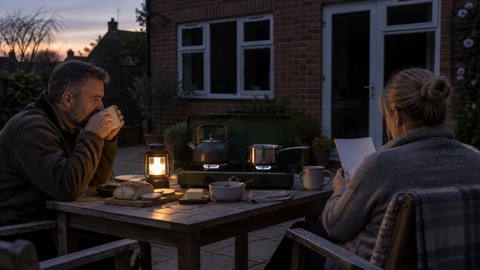
Campingaz sits in the same corner of the market as other gas camping brands: portable appliances that burn bottled gas to cook food or give light. For a household preparing for power cuts, that means three broad families of kit. There are cartridge stoves and grills, such as the Campingaz Party Grill 200 and the larger Campingaz Party Grill 400 CV, which cook on a plate over a burner. There are two-burner units such as the Campingaz Camping Kitchen 2 CV, which suit a household that wants to cook a proper meal rather than heat a pan. And there are gas lanterns, which light a room or a table without mains power.
The Party Grill 200 shows how the maker builds a compact appliance. Its manual lists the components as the lid, cooking plate, pan support, legs, water reservoir and base, and notes that the legs can be placed in the reservoir for compact transportation3. The cooking plate is covered with a high quality non-sticking material which, the maker says, ensures healthy cuisine without adding fat or oil3. Those details matter to a household because they describe a unit that packs down small, wipes clean and can be carried to a campsite or set up in a garden.
Where does this fit against the alternatives? A battery torch is the safer light source in a power cut, and fire and rescue guidance in Scotland says to use battery-operated lights or torches as an alternative light source during a power cut5. A gas lantern is a cooking-adjacent appliance that needs the same outdoor discipline as a stove. The wider guide to heating and cooking without mains power or gas sets gas appliances alongside other options, and the emergency lighting guide covers torches and lanterns together. Campingaz kit earns its place where a household has outdoor space and wants a hot meal, not where it wants light or warmth indoors.
Camping stoves for cooking in a power cut
A gas stove is a cooking tool, and the first thing to settle is what it can and cannot do in a cut. It can boil a pan, heat water for food preparation and cleaning, and cook a meal, which is exactly what the Scottish food safety guidance describes1. It cannot warm a room. Fire and rescue services are explicit: never use barbecues, camping stoves or patio heaters for heat indoors2. A household that buys a stove as a substitute for a radiator has bought the wrong thing.
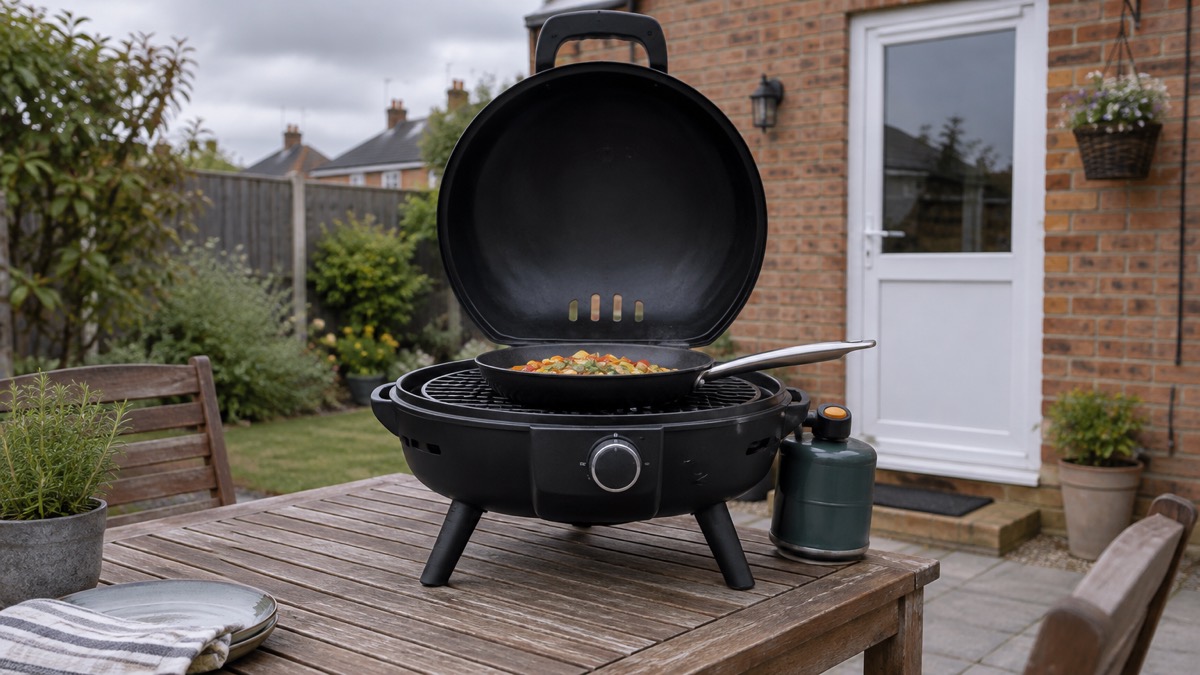
Cooking on a camping stove also takes longer than a kitchen hob, and the food safety guidance warns that because these appliances can take longer than your usual ways of cooking, you need to make sure food is steaming hot and cooked all the way through1. Plan for that. A pan of rice or a stew that would take twenty minutes on gas may take noticeably longer on a small burner, and the run time figures below are measured at maximum flow, so a lower setting stretches them but slows the cooking further. If you have an electric oven and hob, it probably will not work during a power cut, and you could use a camping stove or portable gas stove to boil water or cook food on, used outdoors6.
The two Campingaz product pages set out the models in detail. The Party Grill 200 is the compact cartridge stove and grill; the Party Grill 400 CV is the larger version; the Camping Kitchen 2 CV is the two-burner stove for households that want to cook more than one thing at once. Which suits you depends on how many people you are feeding and whether you want a grill plate or two rings. The section guide to heating and cooking without mains power or gas helps place a stove against other cooking methods.
| Appliance | What it does | Cartridge | Run time at maximum flow |
|---|---|---|---|
| Party Grill 200 | Compact stove and grill with a non-stick cooking plate | CV 470 Plus | 3 hours 15 minutes3 |
| Party Grill 200 | Compact stove and grill with a non-stick cooking plate | CV 300 Plus | 1 hour 45 minutes3 |
| Party Grill 400 CV | Larger cartridge stove and grill | See the product page | Not stated in this manual |
| Camping Kitchen 2 CV | Two-burner stove for cooking a full meal | See the product page | Not stated in this manual |
Gas lanterns for emergency lighting
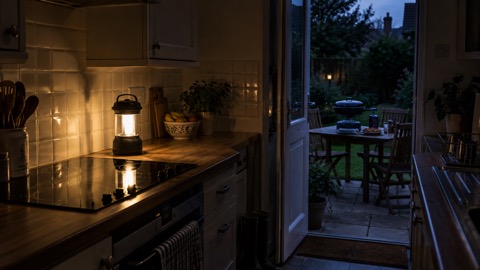
A gas lantern is the other half of the Campingaz offer for a household in a cut, and it carries the same outdoor rule as a stove. Fire and rescue guidance lists lanterns among the fuel-burning devices that must never be used inside a tent, and the same logic applies to a room7. The Northern Ireland Fire and Rescue Service puts the point about flames plainly: never light a candle or have any kind of flame burning apparatus in or near to a tent8. A gas lantern is a flame burning apparatus.
That does not make a lantern useless. It makes it an outdoor light: for a garden, a doorway, a campsite table or a shed with the door open. For lighting inside the house during a cut, the safer answer is a battery torch or battery lantern, and the emergency lighting guide covers those in detail. The power cuts guide sets out the wider routine for a cut, and the essentials it lists include battery candles, torches and batteries, and a mobile phone power pack9.
For comparison, other makers sell lanterns on the same principle. The Primus EasyLight Piezo Lantern is described by its maker as a glass lantern that attaches directly to a gas canister, with piezo ignition, and gas is not included10. That is the shape of the category: a mantle or glass lantern screwed onto a cartridge, lit by a spark, used outdoors. If you keep a gas lantern for emergencies, treat it as a cooking-adjacent appliance, store its cartridges with the stove cartridges, and never bring it inside to read by.
Gas cartridges and cylinders
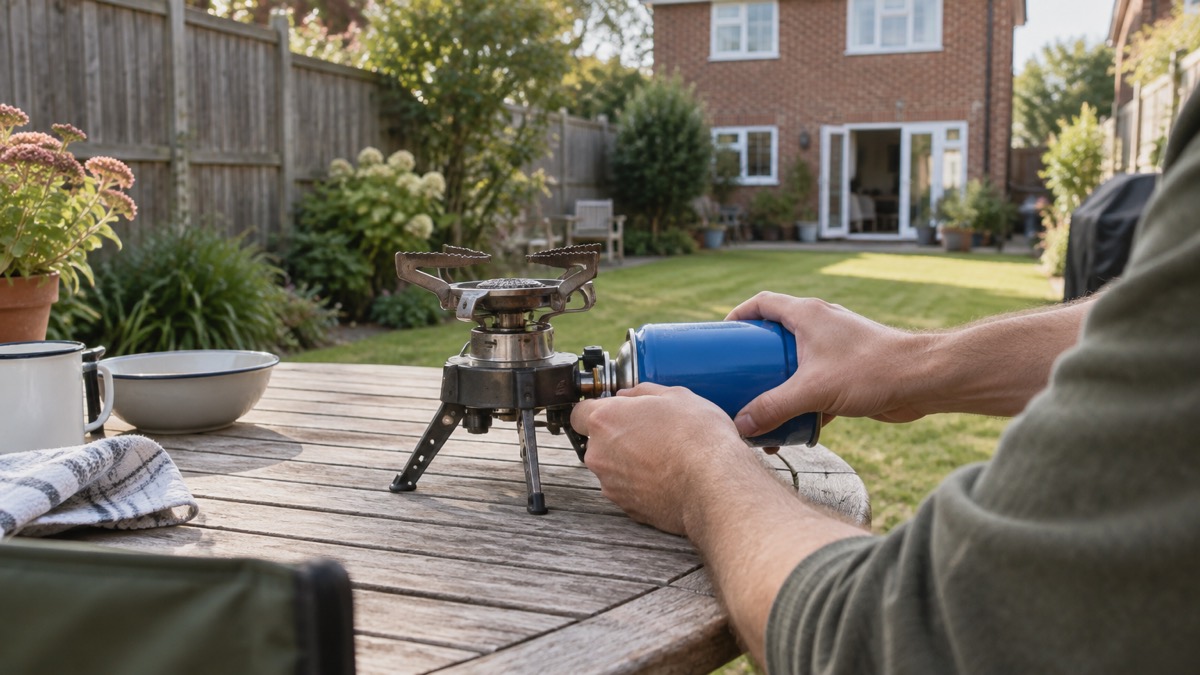
Campingaz appliances run on sealed cartridges, and the maker is specific about which ones. The Party Grill 200 manual states that the appliance must be used exclusively with Campingaz CV 470 PLUS or CV 300 PLUS cartridges, and warns against using other gas cartridges3. The CV 470 Plus and CV 300 Plus are valve-operated butane gas cartridges, which is why they can be detached from the equipment and re-used3. That valve is the feature that makes a part-used cartridge worth keeping rather than discarding.
The run times in the table above come from the same manual and are the figures a household should plan around. At maximum flow a CV 470 Plus gives 3 hours 15 minutes of stove use and a CV 300 Plus gives 1 hour 45 minutes3. A household cooking two meals a day on a single burner will get through a cartridge faster than those numbers suggest, because the figures are for continuous use at full flow. Keep at least one spare cartridge per appliance, stored as below.
Cylinders, the larger refillable bottles, are a different matter. They are not Campingaz cartridges, but the storage and handling rules are the same family of advice, and the pack includes official recalls of gas cylinders and gas appliances from other makers: a Flogas Gold butane gas cylinder11, OEX and Vango folding gas stoves12, and a Wanzhaoda portable gas fire14. Those recalls are not Campingaz products, but they show why you should check any gas appliance against the government's product recall list before relying on it.
Safe use: ventilation and carbon monoxide
Carbon monoxide is the danger that runs through every gas appliance on this page, and it is worth understanding why. Carbon monoxide can build up to levels that can kill very quickly in enclosed spaces, such as tents and awnings7. Fire and rescue services warn that opening tent flaps, doors or windows is insufficient to prevent build-up of carbon monoxide concentrations from fuel-burning devices8. In other words, a cracked window is not a ventilation strategy. The appliance belongs outside.
The precautions are consistent across the UK fire services. Fit a carbon monoxide detector and keep air vents clear8. Ensure there is a smoke and carbon monoxide alarm in place and that they are tested regularly15. Always make sure a caravan or tent is ventilated and never block air vents, to avoid the build-up of poisonous gases such as carbon monoxide10. Consider having a carbon monoxide alarm for a tent16. Before you use any gas appliance, check that it is in good order, undamaged, and that hoses are properly attached and undamaged; if in doubt, get the hoses replaced or do not use it7.
A carbon monoxide alarm is a backstop, not a licence to bring a stove indoors. The government's own product safety report on an unbranded carbon monoxide alarm, sold under ASIN X001FDH8EZ and made in China, is a reminder that alarms themselves can be the subject of a recall17. Buy a recognised alarm, test it, and treat it as the last line of defence behind the outdoor rule.
Where a gas stove or lantern must never go
The list of forbidden places is short and absolute, and it is the same in every nation of the UK. Never take a gas stove, light or heater into a tent, caravan or cabin unless it is a permanent fixture, installed and maintained correctly7. Never use fuel-burning devices inside a caravan, including disposable barbecues, camping stoves, camping heaters, lanterns and charcoal grills18. Do not use stoves or barbecues inside or too close to a caravan4. Do not use barbecues or stoves inside a tent or caravan19. Never light a candle or have any kind of flame burning apparatus in or near a tent8.
The maker's manual agrees with all of it. The Party Grill 200 manual says not to use the appliance in caravans, cars, tents, huts, sheds or any small enclosed areas3. A garage with the door shut is a small enclosed area. A porch with the windows closed is a small enclosed area. A shed is named in the manual. The rule is about the space, not the weather.
| Place | Gas stove or lantern allowed? | Source |
|---|---|---|
| Outdoors, on a stable surface, well ventilated | Yes, following the maker's instructions | 3 |
| Inside a tent or awning | No | 7 |
| Inside a caravan, motorhome or campervan | No | 4 |
| Inside a cabin, hut or shed | No | 3 |
| Indoors for heat during a power cut | No | 2 |
There is one more rule that catches people out during a cut. If you are using a camping stove outdoors, never change gas cartridges indoors or near ignition sources5. The cartridge change is the moment when gas can escape, so it happens outside, away from a flame, a pilot light or a hot hob. Fire and rescue guidance also says to put cooking appliances in a place where they cannot easily be knocked over7, which for a garden stove means a firm, level table rather than a wall or a step.
Storing gas cartridges and cylinders at home
Gas kept at home is a small but real hazard, and the storage rules are about distance and temperature. Store cylinders six metres away from your home, even when empty4. Keep gas bottles outside in a secure, upright position, and turn them off when not in use15. Store them outside, away from direct sunlight and freezing temperatures8. Only change gas cylinders when they are completely empty, and store them away from caravans and vehicles20.
For a household with a cartridge stove rather than a cylinder, the same principles scale down. Keep cartridges out of the house, in a cool outdoor store away from sunlight and frost, and bring in only the one you are about to fit. Change cartridges outdoors or in a well-ventilated space8. Never change a cartridge indoors or near an ignition source5. If you live in a flat with no outdoor store, that is a reason to think carefully about a gas appliance at all, and the backup power guide and emergency kit guide set out alternatives that do not involve stored gas.
Support and warranty in the UK
Campingaz appliances are consumer products, and the ordinary consumer protections apply. Keep your proof of purchase, keep the manual with the appliance, and register the product where the maker offers it. Registering appliances at registermyappliance.org.uk gives free recall alerts if there is a problem with your appliance21. That is a general scheme, not a Campingaz one, but it is the simplest way to hear about a safety notice that affects something in your kitchen or your shed.
For spare parts, the Party Grill 200 manual's component list is the place to start: lid, cooking plate, pan support, legs, water reservoir and base3. Knowing the names of the parts makes a call to a retailer or a service desk much quicker. The manual also notes that the cartridge can be removed even if not empty and re-used on other Campingaz appliances in the CV 470 PLUS and CV 300 PLUS range3, which is useful if you add a second appliance later.
The wider household guides cover the support that sits around any emergency kit. The getting started guide sets out how to build a household plan, and the home emergencies guide covers fire, carbon monoxide, gas leaks and burst pipes. If you need help because of age, disability or a medical dependency, the extra help guide explains the Priority Services Register and other routes to support.
Safety notices and recalls
Before you rely on any gas appliance, check it against the government's product safety alerts, reports and recalls. The pack includes several recalls in this category, none of them Campingaz, but each showing the kind of fault that triggers one. A Flogas Gold butane gas cylinder was recalled in December 202411. OEX and Vango folding gas stoves were recalled in June 202412. A Wanzhaoda portable gas fire sold via Amazon was recalled in 202314. MSR Trail and Reactor camping cooking pots were recalled in March 2024, with the Office for Product Safety and Standards as the notifying body, and affected consumers told to stop using the pots immediately and contact Cascade Designs for a free replacement pot handle or lifter9.
The lesson for a Campingaz owner is procedural. Check the recall list when you buy, check it again each season, and act on a notice the day you see it. A recalled appliance is not a bargain to be kept in the shed. If a notice tells you to stop using something, stop, and follow the remedy the notice gives.
Camping safety guidance adds two habits worth building. Make sure you read the fire safety arrangements at the campsite, and find out what firefighting arrangements are in place for the campsite20. At home, the equivalent is knowing where your outdoor cooking spot is, keeping it clear of litter and rubbish so a fire cannot spread4, and having a fire blanket for the kitchen area22. None of that is Campingaz-specific, and all of it makes a gas appliance safer to live with.
Sources (22)
- Power cuts, Food Standards Scotland, 2026
- Stay warm safely this winter, Devon and Somerset Fire and Rescue Service, 2026
- Campingaz Party Grill 200 manual, Campingaz, 2021
- Caravans and mobile homes, Devon and Somerset Fire and Rescue Service, 2026
- Power cuts, Scottish Fire and Rescue Service, 2026
- Barbecue safety | Humberside Fire, Humberside Fire
- Carbon monoxide dangers if camping, caravanning or boating, nidirect, 2026
- Camping safety, Cheshire Fire and Rescue Service, 2026
- Product recall: MSR Trail and Reactor camping cooking pots, Office for Product Safety and Standards, 2024
- EasyLight Piezo Lantern, Primus, 2026
- Product recall: Flogas Gold butane gas cylinder, Office for Product Safety and Standards, 2024
- Product recall: OEX folding gas stoves, Office for Product Safety and Standards, 2024
- Product recall: Vango folding gas stoves, Office for Product Safety and Standards, 2024
- Product recall: Wanzhaoda portable gas fire, Office for Product Safety and Standards, 2023
- Caravan, motor home, campervan and tent safety, Humberside Fire and Rescue Service, 2026
- Fire and summer safety advice, nidirect, 2026
- Product safety report: carbon monoxide alarm 2112-0591, Office for Product Safety and Standards, 2022
- Cheshire Fire & Rescue Service - Caravan Safety, Cheshire Fire & Rescue Service
- Camping and caravanning safety, Devon and Somerset Fire and Rescue Service, 2026
- Caravans and Camping - North Yorkshire Fire & Rescue Service, North Yorkshire Fire & Rescue Service
- Safe and Well Home Safety booklet, Cheshire Fire and Rescue Service
- Simple steps to stay safe this summer, Northern Ireland Fire and Rescue Service, 2026
 Campingaz Camping Kitchen 2 CV: Two-Burner Stove for Power Cuts
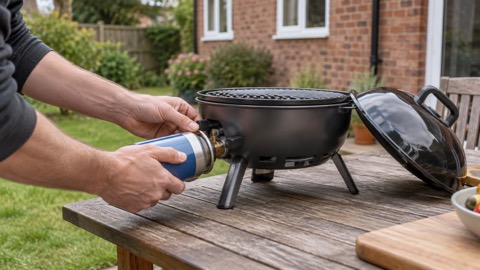 Campingaz Party Grill 200: Compact Gas Stove and Grill
 Campingaz Party Grill 400 CV: Larger Cartridge Stove and Grill