Calor is one of the names most UK households associate with gas bottles: the cylinders that fuel portable heaters, camping stoves, barbecues and, in some homes off the mains gas network, central heating and cooking. If you have arrived here because you can smell gas, act first and read later. Calor gives its own Emergency Service number, 03457 444 999, for gas emergencies involving its bottles and equipment, and if there is a fire you should call 999. For a suspected leak on the mains gas network, the National Gas Emergency Helpline is 0800 111 999, a free 24 hour service1.
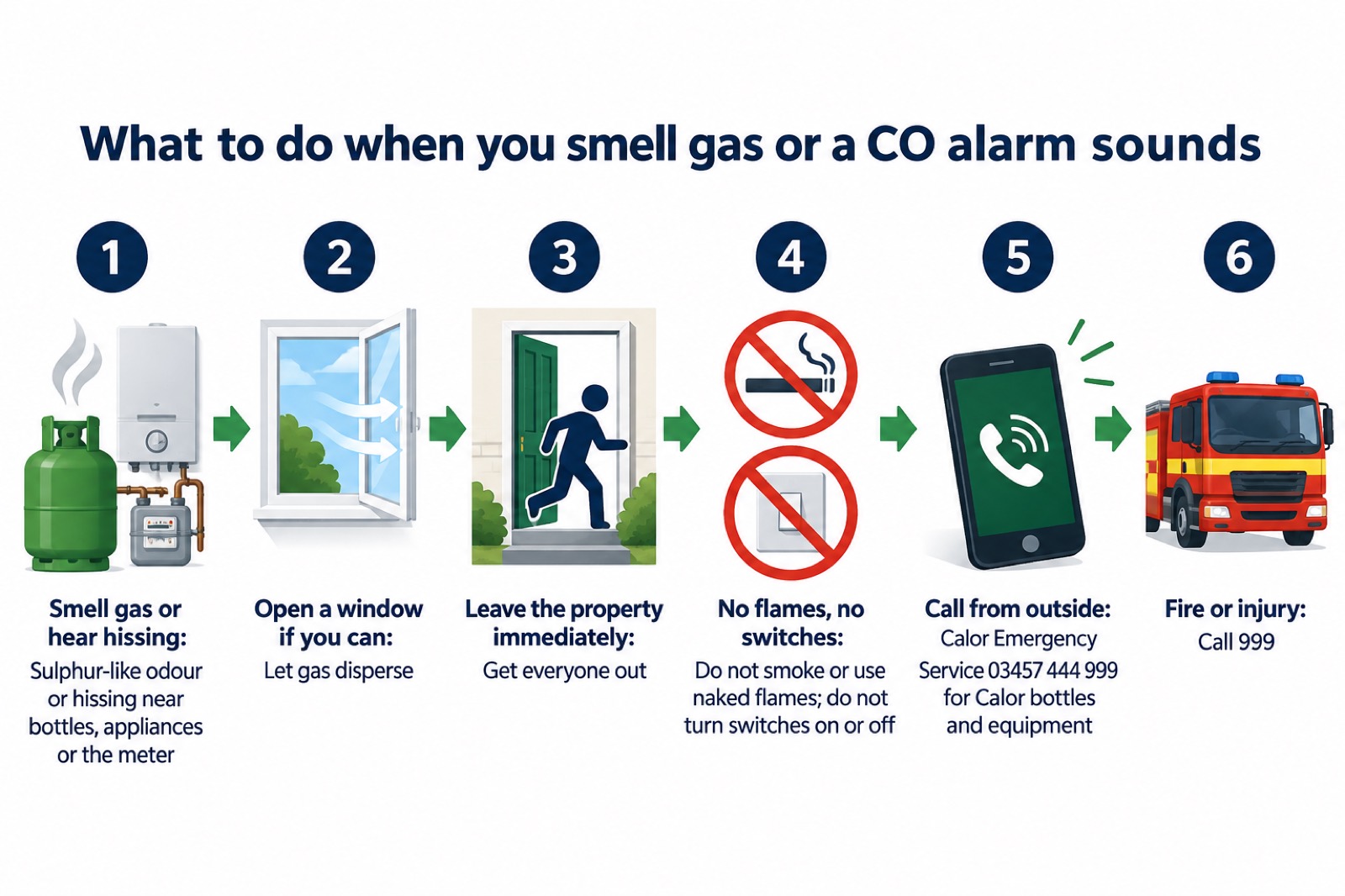
The immediate steps, repeated across official guidance from Greater Manchester, London and other authorities, are the same whatever the source of the gas: open a window if you can, leave the property immediately, and do not smoke or use naked flames until you are sure there is no leaking gas2. Do not turn electrical switches on or off. Then call the emergency number from outside, from a mobile or a neighbour's phone, not from inside the property.
This page sets out what to do in a gas or LPG emergency, when to use which number, how to store and move Calor bottles safely, and how to keep the right contact details ready before anything goes wrong. Calor's own range for households covers LPG cylinders for heating and cooking, portable gas heaters and barbecue gas, and each is covered below with links to the guides that go with it.
What to do first if you smell gas
Work through these steps in order, and do not go back inside until the emergency service tells you it is safe.
- Open a window or door if you can, to let gas disperse2.
- Leave the property immediately. Do not stop to gather belongings6.
- Do not smoke, light a match or use any naked flame until you are sure there is no leaking gas2.
- Do not turn electrical switches on or off, including light switches, because a spark can ignite gas7.
- Turn off the gas supply at the meter if it is safe to do so, but not if the meter is in the cellar, and do not enter the cellar if the smell is coming from there7.
- Call the emergency number from outside: Calor's Emergency Service, 03457 444 999, for gas emergencies involving Calor bottles and equipment8.
- If there is a fire, call 9993.
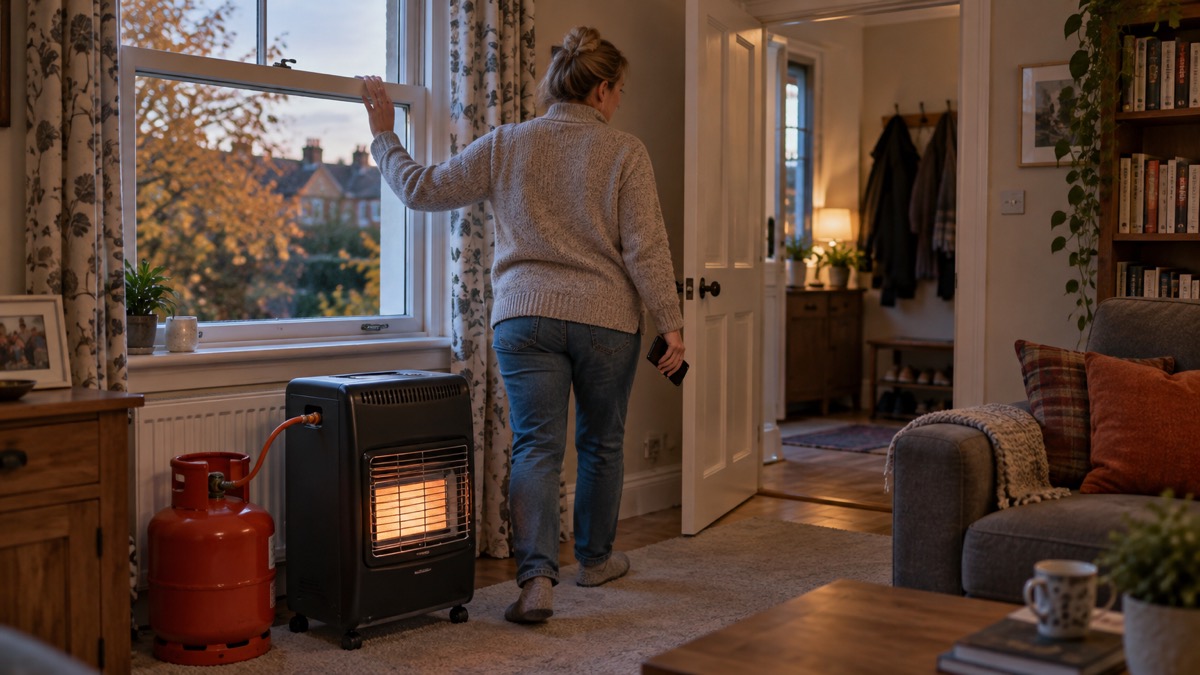
These steps come from official guidance. Greater Manchester's resilience advice is blunt about it: "If you smell gas, open a window if you can and leave the property immediately. Call National Grid (0800 111 999)"2. Surrey County Council's guidance on gas failures adds the detail about the meter and the cellar, and about not touching switches7. The same first instruction, to open a window if you can and leave the property immediately, also appears in the London Resilience Partnership's advice to households9.
Know what you are looking and listening for. Warwickshire Council's home heating safety advice says to "look out for the smell of gas (a distinctive, sulphur-like odour) or hissing sounds near gas appliances or gas meters"9. A hissing sound near a bottle, regulator or hose is a sign of a leak from the LPG side of things, and that is when Calor's own emergency number is the right call. If the smell is around the meter or a mains appliance, 0800 111 999 is the line that dispatches the network engineers.
When to use the Calor emergency number, and when to use another
Calor's Emergency Service number, 03457 444 999, is for gas emergencies involving Calor's own bottles, regulators and connected equipment: a smell of gas around a bottle, a hissing cylinder, a damaged valve, or a heater that is behaving badly. Calor also advises calling 999 if there is a fire. The National Gas Emergency Helpline on 0800 111 999 covers the mains gas network, and it is also the number to call if your carbon monoxide alarm is sounding10.
There is one situation where the guidance is unambiguous regardless of where the gas comes from: a sounding carbon monoxide alarm. Devon and Somerset Fire and Rescue Service instruct: "If your carbon monoxide alarm is sounding, call the Gas Emergency Helpline on 0800 111 999"11. Manchester Fire and Rescue Service's Passover fire safety advice, which covers heavy cooking use of gas, says the same: "If the alarm sounds, get out and call the Gas Emergency Helpline on 0800 111 999"12. Wiltshire and Swindon Prepared adds that it is "very important to call the 24 hour Gas Emergency Number on 0800 111 999 and tell them what has happened" before returning home, even if the suspected source is not a gas appliance13.
The table below sets out which number fits which situation.
| Situation | Who to call | Notes |
|---|---|---|
| Smell of gas or hissing around a Calor bottle, regulator or hose | Calor Emergency Service, 03457 444 999 | Calor's own emergency line for its equipment |
| Smell of gas near the meter or mains appliances | National Gas Emergency Helpline, 0800 111 999 | Free, 24 hours15 |
| Carbon monoxide alarm sounding | Gas Emergency Helpline, 0800 111 999 | Get out first, then call4 |
| Fire involving a gas bottle, heater or pan | 999 | Fire and rescue service3 |
| A burn or scald that is very large or deep, on the face, or caused by a chemical or electricity | 999 or A&E | NHS guidance17 |
| Suspected CO issue or leak, non-urgent questions | HSE Gas Safety Advice Line, 0800 300 363 | Cornwall Council lists this alongside the emergency line5 |
Who to call in an LPG emergency
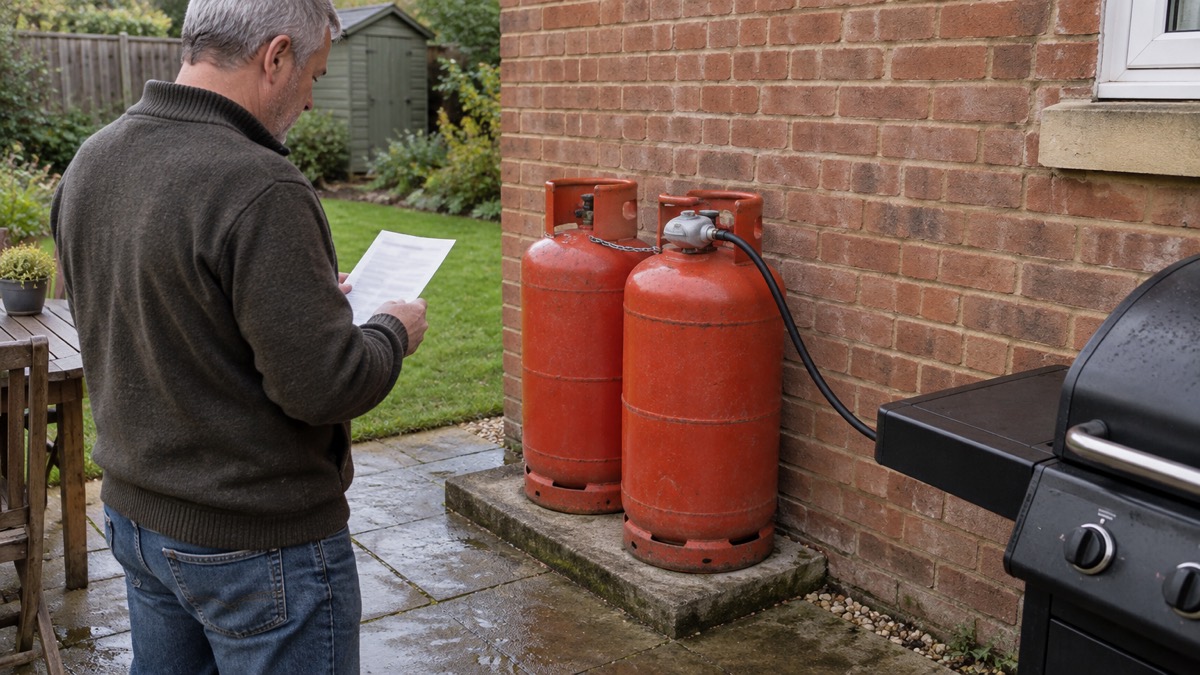
An LPG emergency can escalate beyond gas itself, and the right number changes with what is happening. If a fire has started, whether from a pan, a heater or a bonfire that has spread, the fire and rescue service is the call. Devon and Somerset Fire and Rescue Service say that for heater fires you should "call the fire service (999)"3. Dorset and Wiltshire Fire and Rescue Service give the same number for a pan fire16, and Cheshire Fire and Rescue Service say to call 999 "if the burn spreads and is no longer controlled or is at risk of affecting nearby property"18.
Burns need their own judgement. NHS inform in Scotland and the wider NHS guidance agree that you should phone 999 or go to A&E for a burn or scald that is very large or deep, is on your face, genitals or bottom, or has been caused by an acid or chemical, or by electricity17. The Scottish Ambulance Service lists severe burns or scalds among the reasons to call 99919. If someone has been burned while dealing with a gas bottle or heater, treat the burn and the gas problem as two separate calls: the gas emergency line for the leak, 999 or A&E for the injury.
For non-emergency concerns, there are two further contacts worth knowing. Cornwall Council's carbon monoxide page gives the Health and Safety Executive Gas Safety Advice Line on 0800 300 363 for CO alarm activation or a suspected leak where you want advice rather than an emergency response5. And if you are struggling to keep warm safely, Manchester Fire and Rescue Service point households to the Local Energy Advice Programme on 0800 060 756720. West Yorkshire Police's utilities advice page also lists council contact numbers for housing, roads and environmental concerns, such as Kirklees Council on 01484 414700, which can be the right route if a gas problem has left your home unsafe to occupy21.
Calor's kit for households: gas bottles for heating and cooking
Calor's core product for UK households is the LPG cylinder: a bottle of liquefied petroleum gas that fuels equipment where mains gas does not reach. Households use Calor bottles in three main ways, and each has its own guide on this site.
Portable gas heaters. A Calor-fuelled cabinet heater gives radiant heat in a single room, which makes it useful during a power cut or a heating failure, because it needs no electricity. Devon and Somerset Fire and Rescue Service give the storage rules for portable gas heaters: "store gas cylinders outside and away from direct sunlight and frost. Don't store more gas cylinders than you need"3. Keep the heater itself clear of anything that can burn when it is in use, and never use it to dry clothes over. For how to heat a room safely when the central heating fails, see Heating and Cooking Without Mains Power or Gas.
Cooking and camping stoves. Calor bottles and smaller canisters fuel camping stoves and portable cookers used at home during outages and away from home. The same storage rules apply: cylinders outside, away from sunlight and frost, and only as many as you need3. For planning meals and food safety when the power is off, see Emergency Food and Heating and Cooking Without Mains Power or Gas.
Home LPG supply. Some households off the mains gas network use LPG for central heating, hot water and a gas hob, with larger bottles or a tank outside. These systems behave like mains gas from the household's point of view when something goes wrong: the smell-of-gas steps above apply, and the Gas Emergency Helpline on 0800 111 999 is the number the authorities list8. For what to do when gas or heating fails, see Gas and Heating Failures and Home Emergencies.
Whatever the equipment, official winter health advice is to "contact a Gas Safe registered engineer to make sure they're working properly" before the cold weather arrives22. An annual check of any gas appliance, including LPG ones, is the single best protection against both leaks and carbon monoxide.
Transporting Calor gas bottles: where to get advice
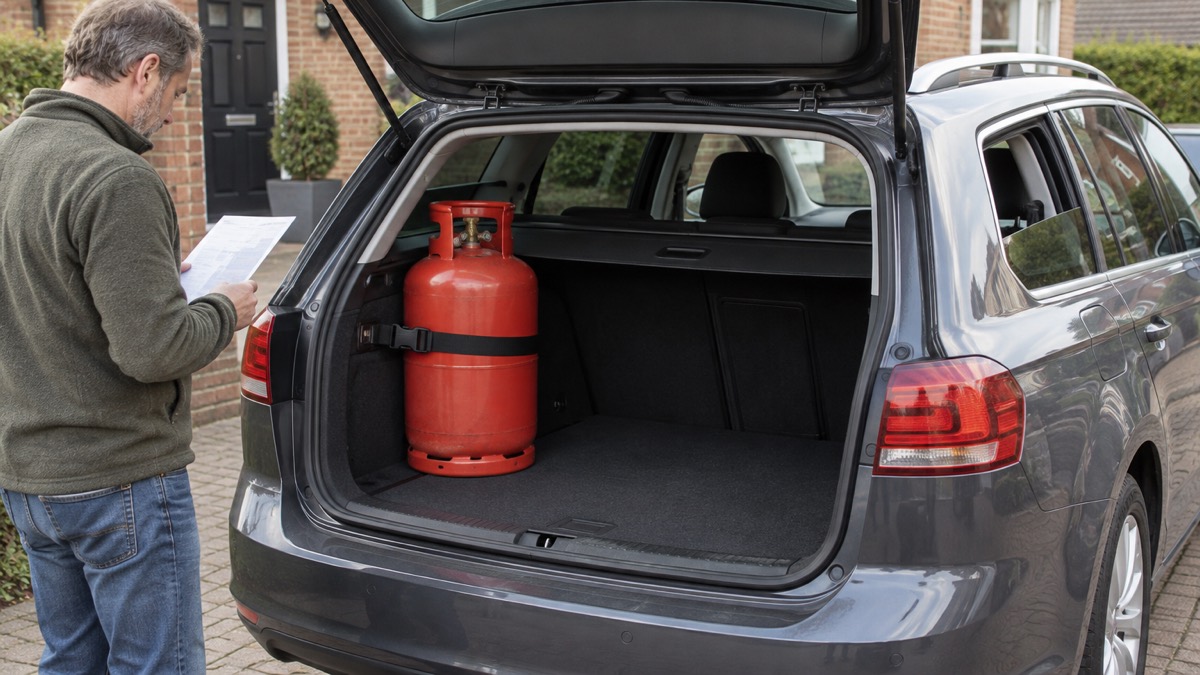
Moving a gas bottle by car is the point where households most often guess instead of asking, and the official guidance is consistent: ask the supplier. North Wales Fire and Rescue Service, in guidance on cylinders in the home, say simply: "Ask your supplier for transport box"23. That advice is written for medical oxygen cylinders, but the principle is the right one for any pressurised gas bottle: the supplier knows its own containers, valves and safe handling, and Calor's technical engineering help desk is the place to ask how its bottles should be carried, secured and ventilated in your particular vehicle.
Before any journey, official travel advice is to "check with your transport operator before you travel for the latest updates and consider alternative routes or times if needed"24. That matters if you are carrying a bottle by public transport, where operators set their own rules on gas cylinders, and it matters on the road too, because a bottle that shifts or overheats in a car is a hazard to you and others. Keep the bottle upright, secured so it cannot roll, and adequately ventilate your vehicle. The fire service's storage advice for gas cylinders is to store them outside and away from direct sunlight and frost3, so treat a car left in strong sun as nowhere to leave a bottle.
What to ask the technical engineering help desk
Calor's technical engineering help desk exists for the questions that are not emergencies but still need a knowledgeable answer. Ring it before you ring anyone else about:
- Connecting a bottle: which regulator fits which bottle, and how the hose and connections should be made and checked.
- Transport: how to carry a bottle in your car safely, and what the supplier recommends for securing it23.
- Storage: how many cylinders to keep, and where; the fire service advice is outside, away from direct sunlight and frost, and no more than you need3.
- Appliance set-up: whether a heater or cooker is suitable for the bottle you have.
- Faults that are not emergencies: a heater that smells faintly when first lit, a valve that is stiff, a bottle that seems to have run out early.
The dividing line between the help desk and the emergency line is simple: if gas is escaping now, it is an emergency. Calor's own guidance for a flame that will not go out after switching off is to leave the appliance alight and contact the Calor gas emergency service number on 03457 444 9998. If the question can wait until the morning without risk, it is a help desk question. If you are unsure, treat it as an emergency.
Keeping Calor's contact details ready for an emergency
The best time to save an emergency number is before you need it, and official guidance is specific about how. The government's travel advice says to "store one or more emergency contact numbers on your mobile phone or keep a written copy in your wallet or purse", using the ICE or Medical ID feature on your phone if it has one24. The Scottish Government's emergency kit advice says the same: "Have one or more emergency contact numbers on your phone or in your bag"25. Anglesey Council's winter advice adds two practical points: keep your mobile charged so you can call for support if needed, and keep key numbers "on the fridge or saved in the contacts on your mobile phone"10.
For a Calor household, write down or save three numbers:
- 03457 444 999, Calor Emergency Service, for gas emergencies involving Calor bottles and equipment
- 0800 111 999, the National Gas Emergency Helpline, free and 24 hours15
- 999, for fire3
A written card matters more than it sounds. A power cut takes out your broadband and, if you rely on a cordless phone, your landline too, and a flat mobile takes out your contacts. A card on the fridge with the three numbers on it, plus the HSE Gas Safety Advice Line on 0800 300 3635, is readable in the dark with a torch, and it is there for neighbours or visitors who need to act on your behalf. If you want to build this into a wider household plan, see Getting Started: Preparing Your Household for an Emergency and Emergency Kit.
Sources (25)
- Plumbing Emergencies: What to Do Before Help Arrives | CIPHE, Chartered Institute of Plumbing and Heating Engineering (CIPHE)
- Prepare yourself for emergencies, Greater Manchester Combined Authority
- Heaters, Devon and Somerset Fire and Rescue Service
- Pesach - Greater Manchester Fire Rescue Service, Greater Manchester Fire Rescue Service
- Carbon monoxide, Cornwall Council
- RoSPA- Child Safety Hub Fire , RoSPA
- Power, gas and water: what if they fail, Surrey County Council
- Emergency plan: gas emergencies, Ready Scotland
- Safe home heating, Warwickshire County Council
- Winter ready, Isle of Anglesey County Council
- Book a home safety visit, Devon and Somerset Fire and Rescue Service
- Celebrating safely: Pesach, Manchester Fire and Rescue Service
- Carbon monoxide: the silent killer, Wiltshire and Swindon Prepared
- Safe and well booklet, Cheshire Fire and Rescue Service
- TVLRF_28pp_print_brochure_V11.indd, Thames Valley Local Resilience Forum
- Kitchen safety, Dorset and Wiltshire Fire and Rescue Service
- Burns and scalds, NHS inform
- Bonfires and burning waste, Cheshire Fire and Rescue Service
- When should you call 999?, Scottish Ambulance Service
- Stay warm safely this winter, Manchester Fire and Rescue Service
- Utilities advice, West Yorkshire Police
- Stay well this winter, NHS Cheshire and Merseyside
- Oxygen at home, North Wales Fire and Rescue Service
- Travel advice, Prepare Campaign
- Emergency kit, Ready Scotland
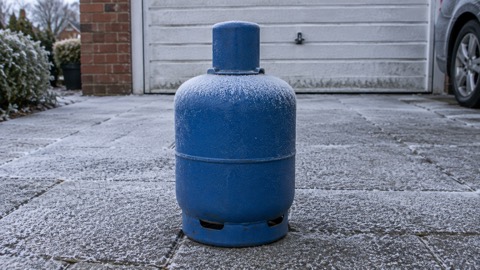 Calor 4.5kg butane cylinderSome units recalled