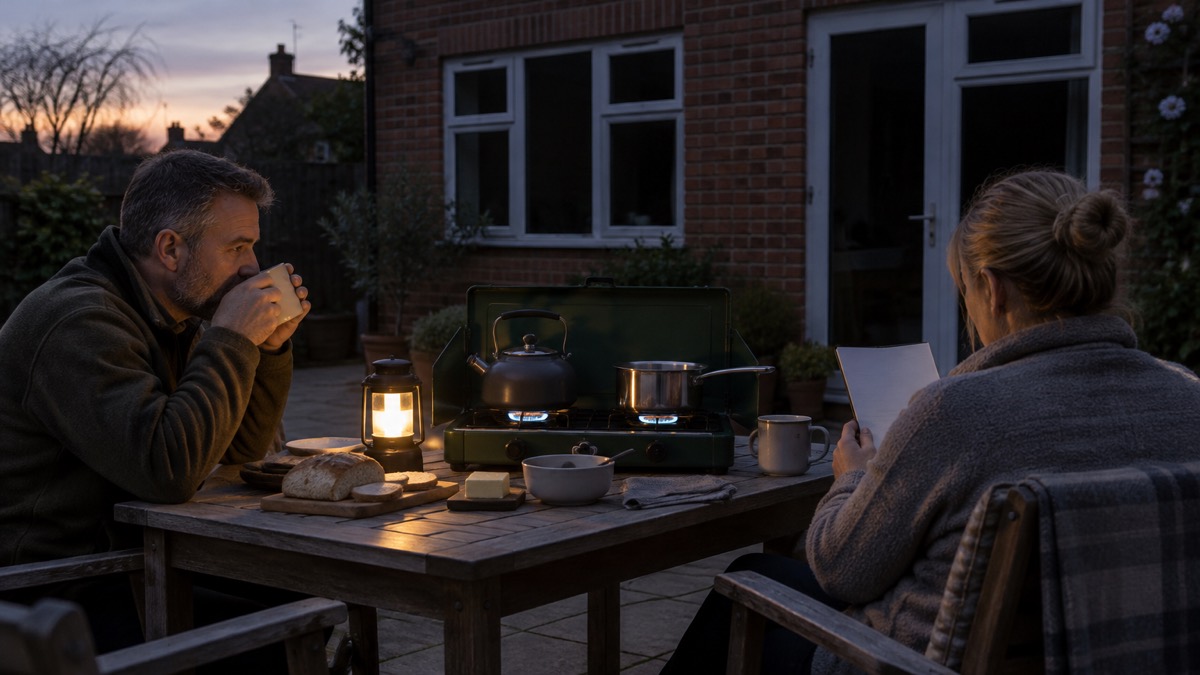
The Campingaz Camping Kitchen 2 CV is a two-burner gas stove that runs on Campingaz CV 470 PLUS cartridges through the hose and regulator supplied with it. For a household facing a power cut, it offers a way to boil a kettle, heat soup or cook a simple meal when the electric hob and oven are dead. The maker's manual gives its rate as 291 g/h (4 kW) with injector N° 70, on a butane direct pressure category1.
The single most important thing to know is that it is an outdoor appliance. The maker states plainly: "Do not use this product in caravans, cars, tents, huts, sheds or any small enclosed areas"1. Fire and rescue services across the UK say the same of camping stoves generally: never use one in an enclosed space, because they are designed for outdoor use only and can produce poisonous carbon monoxide2. That rules out the kitchen worktop, the garage and the shed.
Used outdoors, with the clearances the maker specifies and a leak check after every cartridge change, it is a practical backup cooker for a household that has somewhere safe to put it: a garden, a yard or a well-ventilated patio. This page sets out what it is, what it can do, how to set it up and light it, and how to keep your household safe while using it.
What the Camping Kitchen 2 CV is and who it suits
This is a two-burner camping stove built for outdoor cooking: campsites, picnics, a garden table. In a household emergency it does the job a gas hob does when the electricity is off, but only outside. Which? notes that if you experience blackouts a lot, having a gas fired camping stove tucked away for emergencies could be useful3. The Camping Kitchen 2 CV fits that role for a household with a garden or yard, and does not fit a flat with no outdoor space at all.
It runs on Campingaz CV 470 PLUS cartridges, connected through the hose and regulator that come with the stove. The maker is explicit that the unit must be used exclusively with those cartridges and with the included hose and regulator1. That matters for planning: the stove is only as useful as your stock of the right cartridges, so keep spare cartridges alongside it and store them as the maker directs.
What it can do is cook. Two burners let you heat a pan and a kettle at once, which shortens the time you spend outside in cold weather. What it cannot do is heat a room, dry washing indoors, or stand in for any appliance inside the home. It is a cooker, used outdoors, for the duration of an outage.
Specifications
The maker's manual gives the figures that decide how the stove performs and what it needs around it.
| Specification | Figure |
|---|---|
| Burners | Two |
| Gas rate | 291 g/h (4 kW)1 |
| Injector | N° 701 |
| Gas category | Butane direct pressure1 |
| Fuel | Campingaz CV 470 PLUS cartridges, with the included hose and regulator1 |
| Minimum distance from a wall or flammable object | 20 cm1 |
| Minimum distance from a ceiling | 1 metre1 |
| Pan diameter | 12 cm to 24 cm1 |
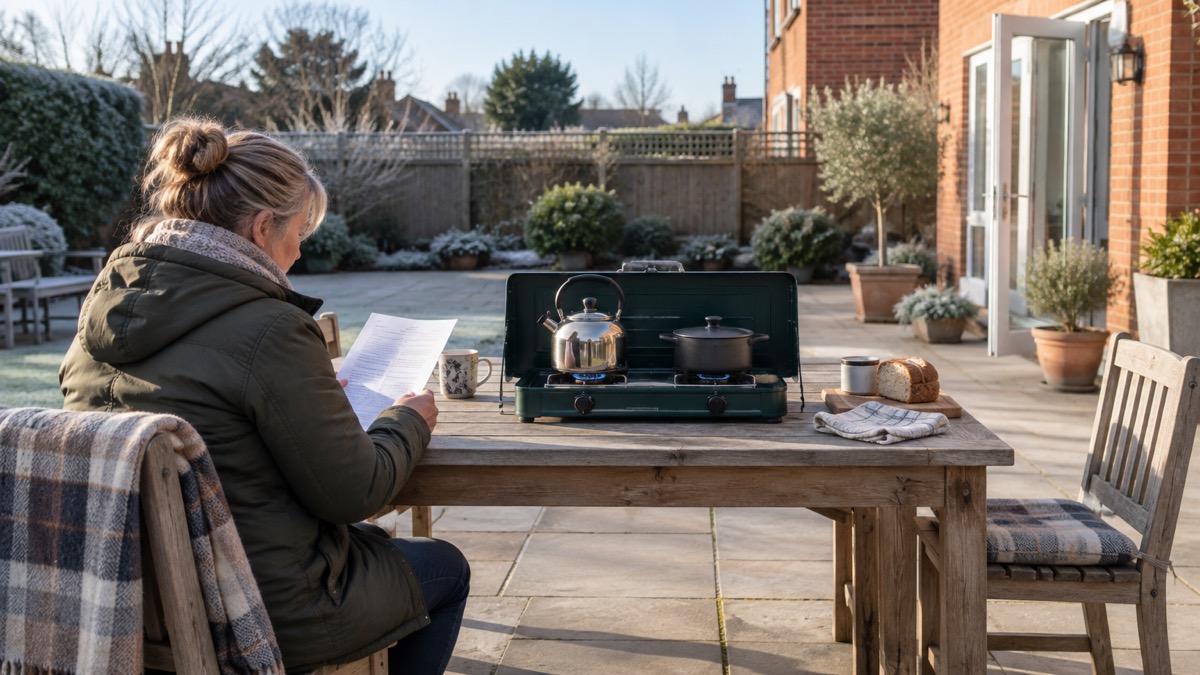
The 4 kW figure describes the burner's output; the 291 g/h figure describes how much gas it draws to deliver it. Together they tell you the stove is a serious cooker rather than a toy, and that a cartridge will not last indefinitely under heavy use. Plan meals that need one pan and a kettle rather than a long roast, and keep spare cartridges so a second or third day of outage does not leave you without fuel.
Outdoors only: never in a tent, caravan, shed or car
Carbon monoxide is the reason for the outdoor-only rule, and it is worth understanding rather than simply obeying. The maker's own manual warns that carbon monoxide is an odourless, clear gas that can cause flu-like symptoms, sickness, illness and possibly death if produced inside enclosed areas without proper ventilation1. You cannot see it, smell it or taste it, so an enclosed space gives you no warning before it builds up.
Fire and rescue services are unanimous. Never use a camping stove, portable barbecue, lit charcoal or generator in an enclosed space, as they are designed for outdoor use only and can produce poisonous carbon monoxide2. Never use fuel-burning devices inside a caravan, including camping stoves4. Never take a gas stove, light or heater into a tent, caravan or cabin unless it is a permanent fixture, installed and maintained correctly5. Fuel-burning equipment should never be used inside a tent, camper or other enclosed shelter6.
The rule extends to the edges of shelters. Never use barbecues inside or near the entrance to your tent or caravan, either for cooking or as a heat source, because the carbon monoxide they produce is lethal7. Always cook outside and well away from your tent, and do not cook near flammable materials or long grass8. If you are cooking in a garden, keep the stove away from fences, shed walls, dry grass and anything else that could catch.
Setting up: 20 cm from walls, 1 metre from any ceiling
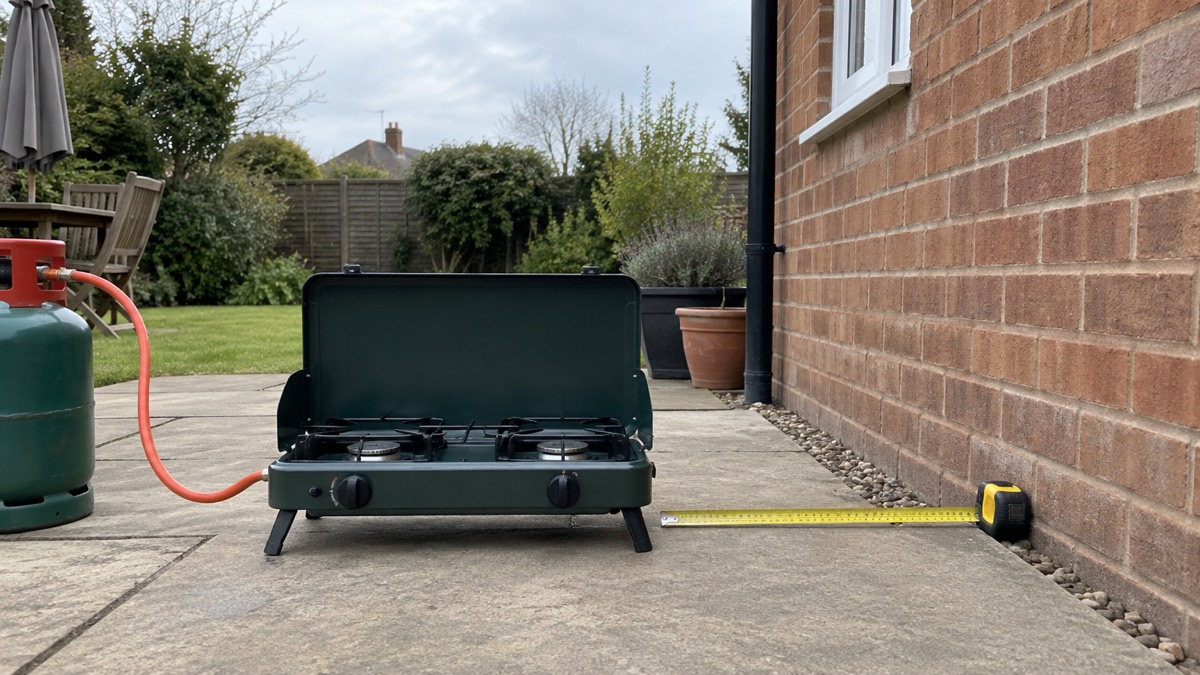
Position decides whether an outdoor stove is safe as well as whether it works. The maker's manual says not to use the stove at a distance closer than 20 cm to a wall or flammable object, nor closer than 1 metre to a ceiling1. Those figures are minimums, not targets: give the stove more room where you can, and never tuck it under a gazebo roof, an awning or a low canopy that brings a ceiling within a metre.
Set it on a steady, level, non-combustible surface where it cannot be knocked over. Keep it out of doorways and away from paths people use, so nobody trips over the hose. The hose itself should run without kinks or tension between the cartridge and the stove.
If you are cooking at a campsite rather than at home, pitch sensibly as well: tents should ideally be pitched at least 6 metres apart from other tents9, and caravans kept six metres apart where possible so a fire cannot spread from one to the next11. Those distances are about fire spreading between units, and they also give you space to cook safely outside your own.
Lighting with a match or lighter, and turning it off
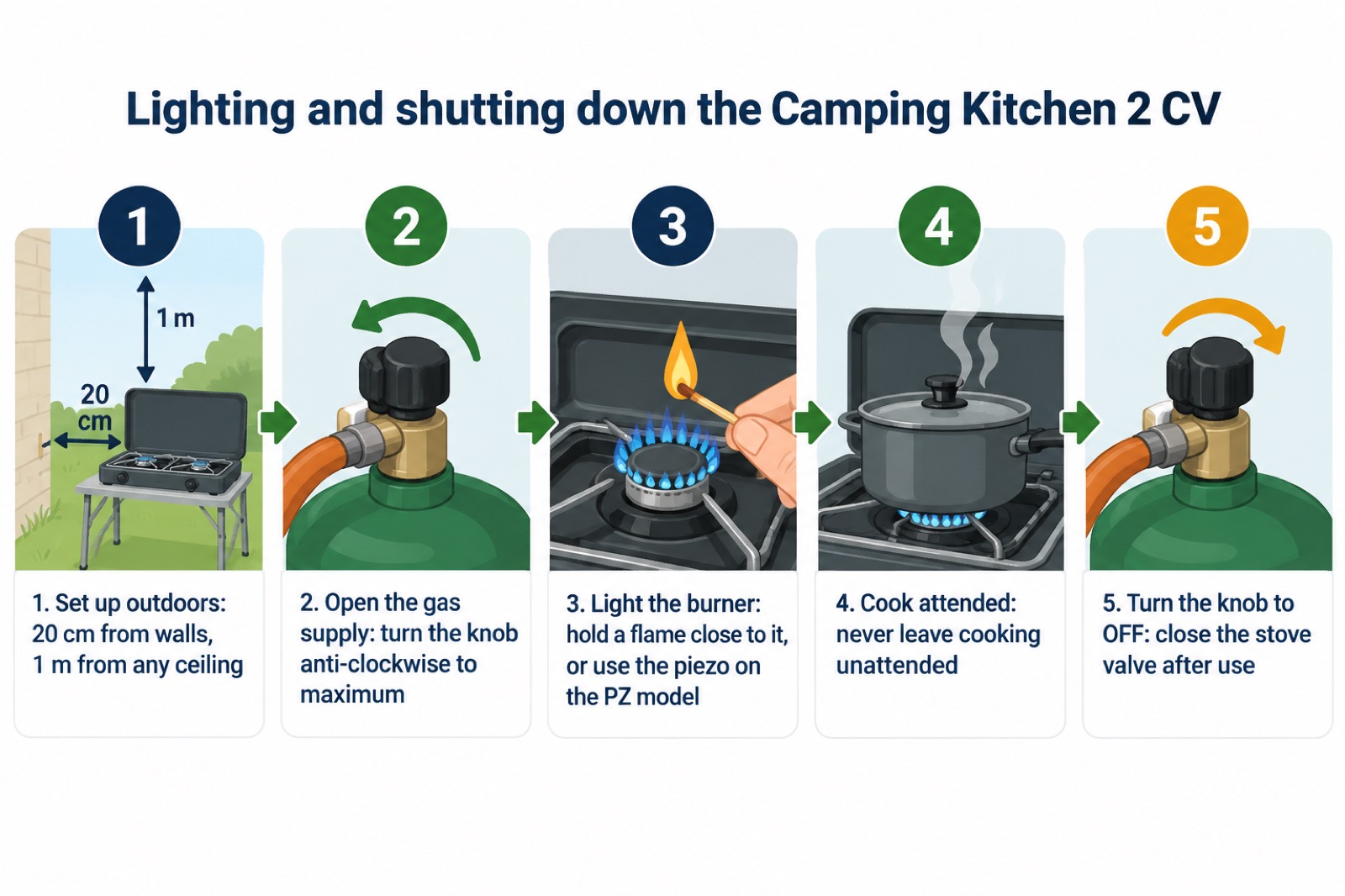
The standard Camping Kitchen 2 CV is lit by hand. Open the gas supply, rotate the knob anti-clockwise to the maximum flow rate position, and hold a flame close to the burner1. A long match or a gas lighter keeps your hand away from the burner as it catches.
The PZ version has a piezo ignition instead. The maker's instruction for that model is specific: when turning it on with the piezo switch, push the piezo switch with your thumb, and do not place other fingers on areas that may be hot1. On the PZ model, wait 2 to 3 seconds and then press the piezo button repeatedly until the burner lights; if it does not light after 3 attempts, turn the knob to off and wait 1 minute before trying again1.
To turn off, close the stove valve by putting the knob in the OFF position1. Do it at the stove first, then deal with the cartridge connection if you are packing up. Never leave cooking unattended12, and never leave a lit stove while you go indoors.
Checking for gas leaks after every cartridge change
A leak check is not a one-off. The maker requires an overall inspection and leaks check at least annually and always after changing the cartridge1. Since a power-cut stove may sit unused for months and then be pressed into service, treat the start of each outage as a reason to check before you cook.
The method matters as much as the frequency. Do not check for leaks using a flame; use a gas leak detecting liquid1. Apply it to the connections between cartridge, regulator, hose and stove, and watch for bubbles, which indicate a leak. A flame test risks igniting the very gas you are trying to find.
If you do suspect a leak, official advice is to turn off all appliances and the main cylinder valve13. In a caravan, open doors and windows and do not smoke or turn on switches or electrical devices until you know everything is clear15. Make sure the gas pipe connection is secure in the first place13.
When the burner won't light or flashes back
A stove that will not light is usually telling you something. The maker lists the likely causes: poor gas supply, a regulator not operating properly, or a pipe, valve, venturi tube or burner hole that is obstructed1. Work through them in that order. Check the cartridge is not empty and is seated correctly, check the regulator, then look for blockages.
Blockages are common after storage. If the stove has not been in use for more than 30 days, check that cobwebs or anything else are not clogging the burner tube openings; this could lead to decreased burner efficiency or dangerous ignition of gas outside the burner1. A quick look down the burner tubes before the first use of the season is worth the minute it takes.
Flashback is the other fault to recognise: ignition under the burner cap rather than at the burner face. In case of flashbacks, switch the product off, allow it to cool down for approximately five minutes, then reignite; if the problem persists, contact your local Campingaz representative1. Do not keep clicking at a stove that is flashing back.
Carbon monoxide: the symptoms to know
Because the stove is used outdoors, the risk to your household is low if you follow the outdoor rule. But knowing the symptoms matters, because carbon monoxide can also come from other fuel-burning appliances, and because a stove brought indoors "just for a minute" is exactly how poisonings happen.
The NHS lists headache, dizziness, feeling sick or being sick, feeling weak, tiredness and confusion, chest and muscle pain, shortness of breath, a hot red face and loss of vision16. Fire services describe the six main symptoms as headaches, dizziness, nausea, breathlessness, collapse and loss of consciousness17, and add drowsiness and vomiting18. The symptoms are similar to flu, food poisoning, viral infections and tiredness, and can easily be mistaken for something less serious20.
If anyone in the household develops these symptoms while a fuel-burning appliance has been in use, treat it as carbon monoxide until proved otherwise. Get out into fresh air, and call 999 if someone is unconscious or seriously unwell.
Cleaning, storage and looking after the stove
Clean the pan supports by pulling them upwards to remove them, then reattach by inserting the legs into the holes on each side of the burners1. Keep cooking appliances clean as a general fire safety habit21, wiping up grease and spills rather than letting them build up around the burners.
Store the equipment and the cartridge in a cool, dry and well-ventilated area, out of reach of children, and never store in a basement or cellar1. That last point matters in a flat or a house with a cellar: the stove and its cartridges do not belong in a sealed underground space.
For the hose, the maker's maintenance advice is to check it regularly and replace it if it shows signs of wear or cracking, contacting your local after sales service1. For wider guidance on cartridges, valve types and cold weather, see Gas Cartridges: Valve Types, Cold Weather and Storage, and for the outdoor-only principle across all stove types, Is It Safe to Use a Camping Stove Indoors?.
Where to get help and further guidance
If you are choosing a backup cooker, the Camping Stoves for a Power Cut guide sets out the types side by side, and the Backup Stove Kit Checklist lists what to keep with one. For the wider picture on outages, see Power Cuts: A Household Guide, and for cooking without mains power generally, Heating and Cooking Without Mains Power or Gas.
If you smell gas or suspect a leak, turn off the appliance and the gas supply and follow the safety advice above. For carbon monoxide concerns, get into fresh air and seek medical help. Households that need extra support during an outage can find it through Extra Help in an Emergency.
Sources (21)
- Camping Kitchen 2 CV instruction manual, Campingaz, 2021
- Power cuts, Devon and Somerset Fire and Rescue Service, 2023-11-30
- What to do in a power cut, Which?, 2026-06-04
- Caravan safety, Lincolnshire County Council, 2026-10-29
- Carbon monoxide: dangers if camping, caravanning or boating, nidirect, 2026-04-02
- Barbecue safety, Humberside Fire and Rescue Service, 2026-10-29
- Camping and caravanning, Devon and Somerset Fire and Rescue Service, 2025-06-20
- Stay safe this summer: essential tips, Northern Ireland Fire and Rescue Service, 2026-06-22
- Camping safety, North Wales Fire and Rescue Service, 2026-10-29
- Camping safety, North Wales Fire and Rescue Service, 2026-10-29
- Gypsies and travellers safety, Devon and Somerset Fire and Rescue Service, 2020-12-01
- Simple steps to keep you safe this summer, Northern Ireland Fire and Rescue Service, 2022-06-24
- Fire safety outdoors, GOV.UK, 2022-05-25
- Caravan fire safety, Mid and West Wales Fire and Rescue Service, 2023
- Caravan safety advice, Mid and West Wales Fire and Rescue Service, 2026-10-29
- Carbon monoxide poisoning, NHS, 2025-12-16
- Carbon monoxide, Greater Manchester Fire and Rescue Service, 2026-10-29
- Carbon monoxide awareness, Staffordshire Fire and Rescue Service, 2026-10-29
- Carbon monoxide, Cornwall Fire and Rescue Service, 2026-10-29
- Carbon monoxide safety, Mid and West Wales Fire and Rescue Service, 2026-10-29
- Watch what you heat, Electrical Safety First, 2026-10-25
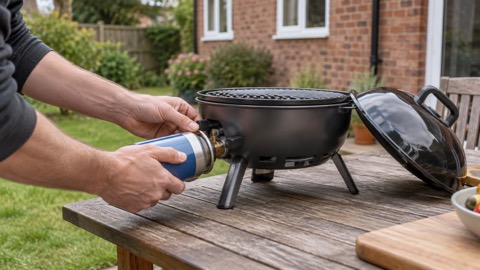 Campingaz Party Grill 200
 Campingaz Party Grill 400 CV
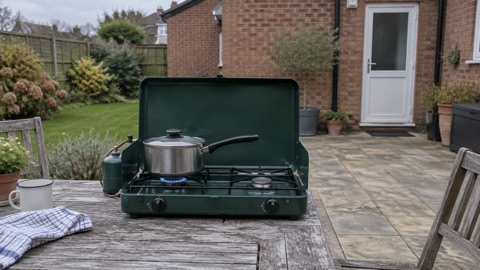 Optimus Gemini II Stove