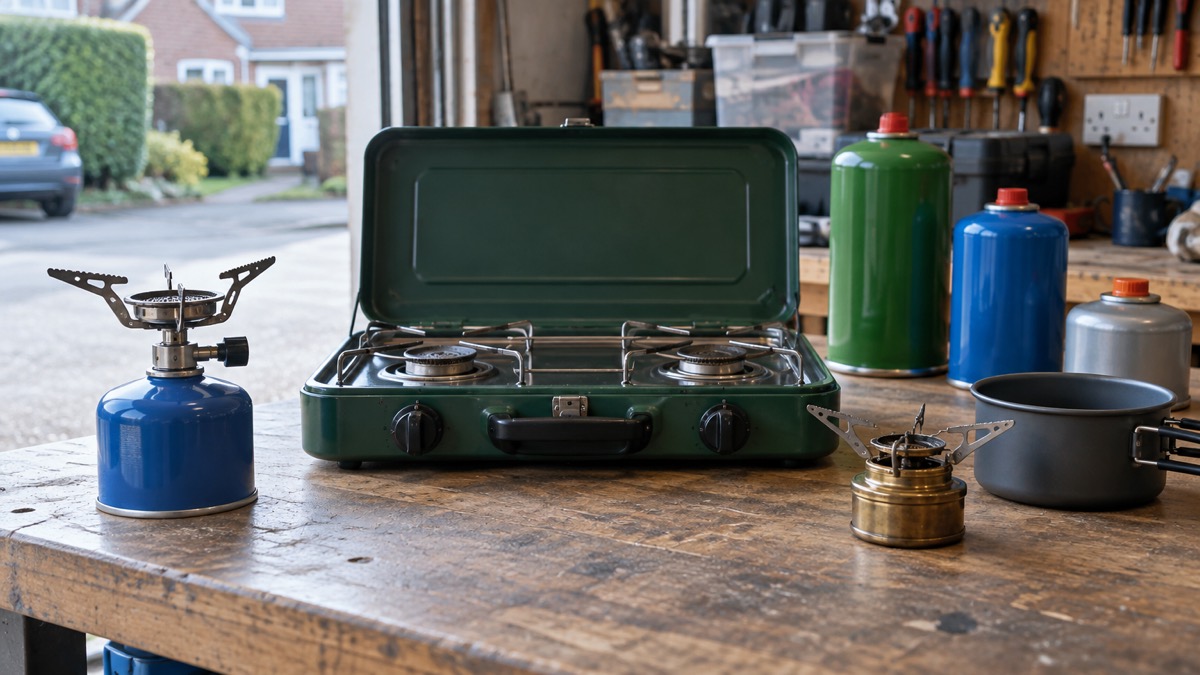
When the electricity goes off, a camping stove is one of the few ways left to heat food and water. Official guidance for consumers confirms you can cook food and heat water for food preparation and cleaning using a camping stove, barbecue or bottled gas stove, provided you check the manufacturer's instructions for safe use, because most are designed for outdoor use only1. That single sentence shapes everything on this page: a camping stove is a real asset in a power cut, but it is an outdoor appliance, and using it as one is what keeps your household safe.
Before you rely on any stove you already own, check it against the product recalls listed below. Several camping stoves and gas cylinders sold in the UK in recent years have been recalled over fire, explosion and burns risks, including folding gas stoves from two brands in 2024 and butane gas cylinders in 2021 and 20242. A stove that has been sitting in a cupboard for years deserves a check of its hose, its connections and its recall status before it is ever lit.
This page covers what each main type of stove does, where you can safely use it, how to set it up, how to store the fuel, and how to look after the stove between emergencies. For the wider picture of cooking and heating without mains power, start with our heating and cooking guide.
Check your stove against these recalls first
Recalls of camping stoves and gas cylinders are not rare, and they matter directly to anyone keeping a stove for emergencies. A stove bought years ago and never used may still be on a recall list, and the faults in these cases are serious: leaking gas, degrading hoses, and handles that fail and spill hot contents.
The Office for Product Safety and Standards recalled MSR Trail Lite and Reactor camping cooking pots in March 2024 because pot handles can come loose or disengage and spill hot contents. The pots were sold individually and as part of sets, and affected consumers were told to immediately stop using them and contact Cascade Designs for a free replacement pot handle and lifter14.
| Product | Date | The problem | What to do |
|---|---|---|---|
| MSR Trail Lite and Reactor cooking pots | March 2024 | Handles can come loose or disengage, spilling hot contents | Stop using immediately; contact Cascade Designs for a free replacement handle14 |
| Optimus Gemini Portable 2-Burner Gas Stove | September 2022 | The gas regulator burr can tear the seal and cause an ignitable gas leak | Stop using and return it for a refund3 |
| Vango folding gas stoves (two models) | June 2024 | The gas hose may degrade over time, leading to a gas leak and possible hose ignition | Recall from end users; stop using4 |
| OEX Folding Novo and Folding Savo gas stoves | June 2024 | The gas hose may degrade over time, leading to a gas leak and possible hose ignition | Recall from end users; stop using5 |
| Flogas Gold Butane Gas Cylinders, 4.5 kg, 7 kg and 13 kg | December 2024 | Filled with a butane and propane mixture outside BS4250 parameters, an over-pressure fire risk | Stop using; return6 |
| Calor 4.5kg Butane cylinders (a limited number) | October 2021 | Can release gas from the valve when open and connected | Stop using; return2 |
Two patterns stand out. First, hose degradation is a recurring fault in folding gas stoves, which is why fire and rescue services tell you to check that hoses are properly attached and undamaged before every use, and to get them replaced or not use the appliance at all if in doubt8. Second, gas cylinders themselves can be faulty, so a recall check applies to your fuel stock as much as to your stove. Check the gov.uk product safety alerts pages for anything you own, and check gas and electrical equipment, including gas bottles, before use, making sure connections are secure and undamaged15.
Camping stoves are made for the outdoors, so plan where you will cook
The starting point, repeated across official guidance, is that most camping stoves, barbecues and bottled gas stoves are designed for outdoor use only, and you should check the manufacturer's instructions for safe use of your particular appliance1. In a power cut this means planning ahead: decide now which spot outside your home you would use, and how you would cook there in the dark or in poor weather.
The reason is carbon monoxide. nidirect, the Northern Ireland government information service, warns never to take a gas stove, light or heater into a tent, caravan or cabin unless it is a permanent fixture, installed and maintained correctly7. Cumbria Fire and Rescue Service gives the same warning and adds the check that matters before every use: make sure the appliance is in good order, undamaged, and that hoses are properly attached and undamaged, and if in doubt, get the hoses replaced or do not use it8. Carbon monoxide has no smell and can build up quickly in any enclosed space, including a kitchen with doors and windows shut against the cold. Our page on whether it is safe to use a camping stove indoors covers this in detail.
Fire and rescue services across the UK apply the same rule to tents and awnings. North Wales Fire and Rescue Service states the general advice plainly:
"General advice is to always cook outside and well away from your tent, no matter how large."
North Wales Fire and Rescue Service16
The same services advise having an escape plan and being prepared to cut your way out of the tent if there is a fire17. If you are cooking under an awning, a gazebo or a caravan canopy, treat it as a tent: the fabric catches fire easily, and the safest cooking position is outside and well away from it. For cooking and warmth in tents and caravans specifically, see our tents and caravans page.
One more point from official food safety guidance: cooking with camping stoves, barbecues or bottled gas stoves can take longer than your usual ways of cooking, so make sure food is steaming hot and cooked all the way through18. A stove that seems slow is usually working normally; the answer is patience and a thermometer-free check that steam is rising and the food is piping hot throughout, not moving the stove somewhere sheltered but enclosed.
If your home has a gas hob, check whether it still works in a power cut before assuming you need the camping stove at all. Official guidance notes that electric and induction cookers will not work during a power cut, but gas cookers may continue to function1. Our page on using a gas hob when the electricity is off explains what to check.
Setting up safely: flat ground, well away from anything that burns
Fire and rescue services give consistent advice on where to site any outdoor flame, and it applies to camping stoves exactly as it does to barbecues. Northern Ireland Fire and Rescue Service says to make sure the site is flat, away from fences, trees and shrubs9. Mid and West Wales Fire and Rescue Service says the same: ensure the stove or barbecue is on a flat site, well away from a shed, trees or shrubs10. Humberside Fire and Rescue Service adds the same flat-site rule for barbecues19.
In practice, for a household using a stove in a power cut, that means:
- Choose a level, stable surface: a patio slab, a driveway or a flat patch of ground, not grass on a slope or a wobbly folding table
- Keep the stove well away from fences, sheds, trees, shrubs, hanging plants and washing lines
- Keep it away from the house wall, bins and anything else that can catch fire, including the tent, awning or gazebo you may be sheltering under
- Keep children and pets at a distance, and keep the fuel cylinders behind you, not beside the flame
Stability matters as much as distance. A single-cartridge burner or a spirit stove has a small footprint, and a pan of boiling water on an uneven surface is a scalding hazard. Cheshire Fire and Rescue Service advises always turning off the gas supply before changing the cylinder20, which is a reminder that the moments of handling, not just cooking, are when things go wrong. Our page on how to change a gas cylinder safely walks through that step by step.
For lighting, follow the maker's instructions for your model. nidirect's advice on gas camping equipment is simply to read the manufacturer's instructions7, and North Yorkshire Fire and Rescue Service adds that you should always make sure your camping light and stove are clean and properly adjusted21. A stove that has been stored for months may need a wipe down and a check of its burner and hose before it lights cleanly.
Never leave a lit stove unattended
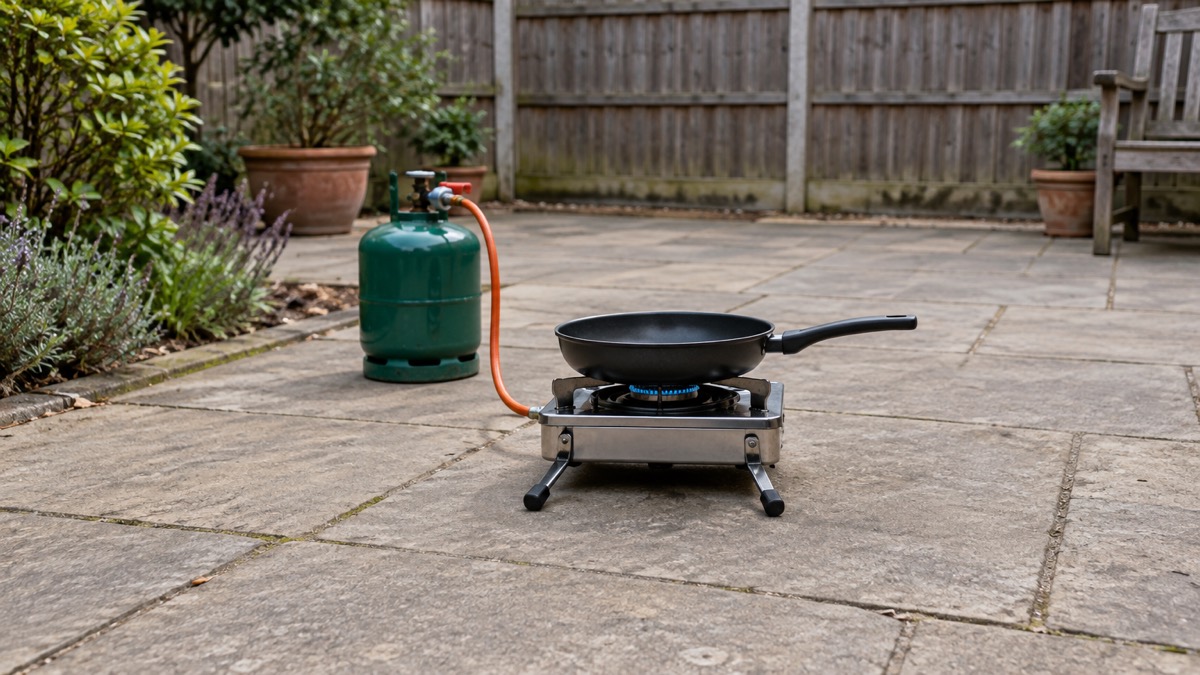
Every fire and rescue service that addresses cooking and outdoor flames gives the same instruction. nidirect's summer fire safety advice says never leave a barbecue unattended and never leave cooking unattended11. Devon and Somerset Fire and Rescue Service says the same for caravans and mobile homes22. The rule applies whoever you are and whatever you are cooking: a lit stove stays with a sober, awake adult until it is off and cool.
This has practical consequences for power cut cooking. Plan meals that do not need long, unwatched simmering. Heat water for hot drinks and for hot water bottles in one session with someone standing by, rather than leaving a pot to itself. If you must step away, turn the stove off first; relighting takes seconds and is always cheaper than a fire.
Scottish Fire and Rescue Service power cut guidance adds a related rule for any open flame in the home: never leave a lit candle alone, and keep candles well away from anything that could catch fire23. If you are cooking outdoors by torchlight, keep your emergency lighting well away from the flame and the fuel, and never use a candle to check a stove, a hose or a cylinder. Our lighting section covers torches, lanterns and candles for power cuts.
Turn everything off before you go to bed or leave the area. Caravan safety guidance from multiple fire and rescue services says to turn off all appliances before you leave the caravan or go to bed22, and the same habit should govern stove use at home: the stove is off, the cylinder valve is closed, and the pan is off the heat before anyone sleeps.
Storing gas cylinders: outside, upright, away from frost and sun
Gas cylinders and cartridges are the part of a stove kit most often stored badly. The official advice is consistent and specific. Gov.uk fire safety guidance for outdoors says to store gas cylinders outside, away from direct sunlight and frost12. Manchester Fire and Rescue Service, advising on portable gas heaters, says to store spare cylinders upright and outside whenever possible25. Devon and Somerset Fire and Rescue Service goes further for cylinders not in use: store them six metres away from the home, and remember that empty canisters are still a hazard26. Devon and Somerset also says simply to turn off gas cylinders when not in use26.
For most households with a small cartridge stove, the cartridges are self-sealing and small enough to store in a shed or garage out of direct sun and away from frost. For larger butane or propane bottles, the six-metre rule from Devon and Somerset Fire and Rescue Service is the standard to aim for, and our page on where to store gas cylinders at home covers the practicalities.
Two further rules govern cylinder handling. Gov.uk fire safety guidance says never smoke whilst changing your gas12, and Humberside Fire and Rescue Service says to make sure the tap is turned off before changing the gas cylinder19. Cheshire Fire and Rescue Service states it as a general rule: always turn off the gas supply before changing the cylinder20. North Yorkshire Fire and Rescue Service adds that you should only change gas cylinders when they are completely empty, and store them away from caravans and vehicles21.
When you finish cooking, the order you turn things off matters. Mid and West Wales Fire and Rescue Service advises turning off the gas cylinder before you turn off the barbecue controls, to ensure any gas in the pipeline is used up27. Applied to a camping stove, that means closing the cylinder valve first, letting the burner consume what is left in the hose, and only then closing the stove's own control. It uses the last of the fuel you have paid for and leaves the hose empty for storage. Our gas cartridges page covers valve types and cold weather behaviour, and our bottled gas page covers butane, propane and regulators for larger bottles.
If you smell gas or suspect a leak
The advice here comes from fire and rescue services writing about caravans, and it transfers directly to any gas stove set-up at home. Lincolnshire County Council's caravan safety guidance says:
"If you suspect that there is a gas leak turn off all appliances and the main cylinder valve, open all doors and windows and do not smoke or turn on any electrical switches or appliances until you have been given the all clear."
Lincolnshire County Council13
Mid and West Wales Fire and Rescue Service gives the identical instruction24. In order:
- Turn off all appliances
- Turn off the main cylinder valve
- Open all doors and windows
- Do not smoke, and do not turn any electrical switch or appliance on or off
- Do not use the stove again until it has been checked and you have the all clear
Gov.uk fire safety guidance adds the preventive step: make sure the gas pipe connection is secure, and if you suspect a leak, turn off the main cylinder valve12. Check connections every time you set up, not just the first time, because hoses work loose and degrade, as the 2024 folding stove recalls show4. If a hose is cracked, stiff or perished, do not use the stove: Cumbria Fire and Rescue Service says to get the hoses replaced or not use the appliance at all8.
Packing the stove away, and keeping pans fit to use
Between emergencies, a stove kit should be stored clean, dry and complete. North Yorkshire Fire and Rescue Service advises always making sure your camping light and stove are clean and properly adjusted21, which is as much about storage as about use: a stove put away dirty can block its burner or corrode its fittings, and one that fails to light in a power cut is no backup at all.
Pack the stove following the maker's guidance for that model. As an example of how small a spirit stove packs down, the maker states that the Trangia Triangle, an ultra-lightweight portable stove, folds to credit card size and packs away into a small bag little bigger than the size of a credit card, with packed dimensions of 44.0cm long, 16.5cm wide and 16.5cm high28. It supports pans or kettles over 10cm in diameter28, so it is a genuine one-pan option that fits in an emergency box. Our page on what fuel to use in a spirit burner covers the fuel side.
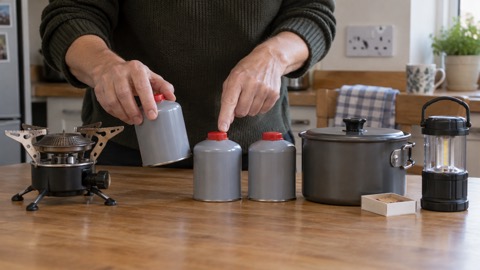
Keep the kit together and know where it is. Met Office snow safety advice on preparing for power cuts lists candles and matches or lighters, torches and batteries, and a mobile phone power pack as the household basics29, and a stove kit belongs on the same shelf: stove, fuel, lighter, pans and a pan handle that works. The MSR pot recall is a reminder to check the pans too, since handles that come loose can spill hot contents14. Our backup stove kit checklist lists it all in one place.
On cleaning, official guidance from Wiltshire and Swindon Prepared, writing about safely cleaning a home after flooding, says to clean and disinfect your kitchen including all countertops, all crockery and cooking items before using them with food30. If your stove kit has been through flood water, or has been stored somewhere damp or dirty, wash and disinfect the pans and utensils before you cook with them, and check the stove and hose for damage before lighting. For the food itself, our emergency food guide covers stores, safety and meals without power.
Choosing between stove types
The facts that matter when choosing are where you will use it, how many pans you need, what fuel you can store, and how much space the packed stove takes. Every type shares the outdoor-use rule1, so the choice is about practicality, not safety trade-offs between types.
A gas cartridge stove gives you instant, adjustable heat from a self-sealing cartridge, and the cartridges store compactly. The 2024 recalls of folding gas stoves over hose degradation4 are a reason to buy from a maker that names its hose specification, to check the hose before every use, and to register the product so you hear about recalls. A two-burner gas stove, such as the type covered on our Optimus Gemini II page, lets you run a pan and a kettle at once, which matters if you are heating water for drinks and food at the same time; note that the earlier Gemini model was recalled in 2022 over a gas leak fault3, another argument for a recall check before you buy second-hand.
A spirit burner stove, such as the Trangia Triangle, burns liquid fuel in an open burner with no hose and no valve to degrade, and packs down to almost nothing28. It suits a household that wants the simplest possible backup and is happy cooking one pan at a time. Our gas cartridge or spirit burner comparison sets the two side by side, and our butane or propane comparison covers the fuel choice for bottled gas stoves.
Whatever you choose, the stove is only part of the answer. In a winter power cut, cooking a hot meal matters, but so does keeping one room warm, stopping draughts, and having the right clothing and bedding. A camping stove will not heat a room, and must never be used to try: it is a cooking appliance for the outdoors, used on flat ground, never left alone, with its fuel stored outside and upright. Get those habits right and a modest stove will see you through most power cuts the UK throws at your household.
Sources (30)
- Food safety in a power cut: advice for consumers, Gov.uk, 2023-07-26
- Calor 4.5kg butane cylinder recall, Calor, 2021-10
- Product recall: Optimus Gemini Portable 2-Burner Gas Stove, Gov.uk, 2022-09-29
- Product recall: Vango folding gas stoves, Gov.uk, 2024-06-06
- Product recall: OEX Folding Gas Stoves, Gov.uk, 2024-06-06
- Recall of Flogas Gold Butane Gas Cylinders, Bromley Council, 2024-12-10
- Carbon monoxide dangers if camping, caravanning or boating, nidirect, 2026-04-02
- Safety outdoors, Cumbria Fire and Rescue Service, 2026-10-29
- Stay safe this summer: essential tips from NIFRS, Northern Ireland Fire and Rescue Service, 2026-06-22
- Barbecue safety, Mid and West Wales Fire and Rescue Service, 2026-10-29
- Fire and summer safety advice, nidirect, 2026-07-03
- Fire safety outdoors, Gov.uk, 2022-05-25
- Caravan safety, Lincolnshire County Council, 2026-10-29
- Product recall: MSR Trail Lite and Reactor camping cooking pots, Gov.uk, 2024-03-25
- Help prevent wildfires, Oxfordshire County Council, 2026
- Camping safety, North Wales Fire and Rescue Service, 2026-10-29
- Camping safety, Manchester Fire and Rescue Service, 2026-10-29
- Food safety in the kitchen: power cuts, Food Standards Scotland, 2026-10-25
- Barbecue safety, Humberside Fire and Rescue Service, 2026-10-29
- Camping safety, Cheshire Fire and Rescue Service, 2025-07-26
- Caravans and camping, North Yorkshire Fire and Rescue Service, 2026-05-13
- Caravans and mobile homes, Devon and Somerset Fire and Rescue Service, 2026
- Power cuts, Scottish Fire and Rescue Service, 2026-10-25
- Caravan safety advice, Mid and West Wales Fire and Rescue Service, 2026-10-29
- Portable heaters, Manchester Fire and Rescue Service, 2026-10-29
- Caravans and mobile homes, Dorset and Wiltshire Fire and Rescue Service, 2025-06-20
- Stay safe this summer booklet, Mid and West Wales Fire and Rescue Service, 2013-03
- Trangia Triangle Stove, Vango, 2026-10-25
- Stay safe in snow, Met Office, 2026-10-25
- Flooding and health: safely cleaning your home, Wiltshire and Swindon Prepared, 2026-10-25
 Before-Winter Heating Checks
 Backup Stove Kit Checklist
 Wood Burner Lighting Kit
 Keeping One Room Warm
 Clothing and Bedding for Cold
 Stopping Draughts
 Hot Water Bottle Safety
 Wheat Bags and Fire Risk
 Electric Blanket Safety
 Portable Heater Types
 Portable Heater Safety
 Wood Burners in a Power Cut
 Using a Wood Burner Safely
 Open Fires and Fire Guards
 Firewood and Seasoning Logs