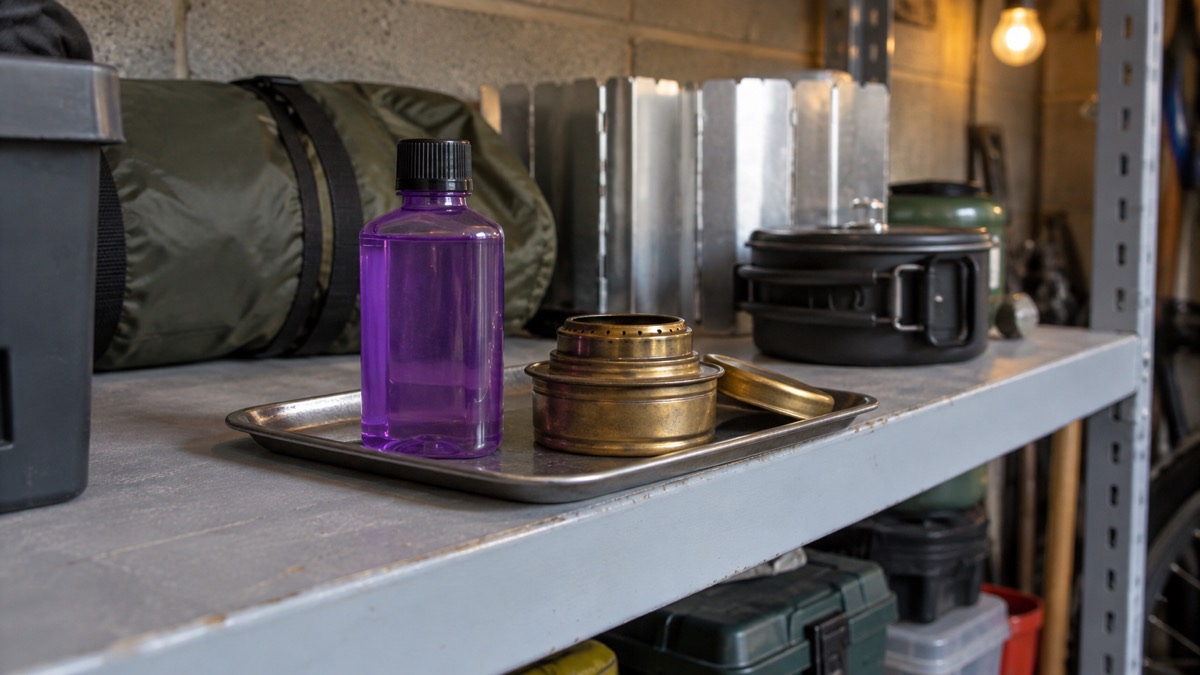
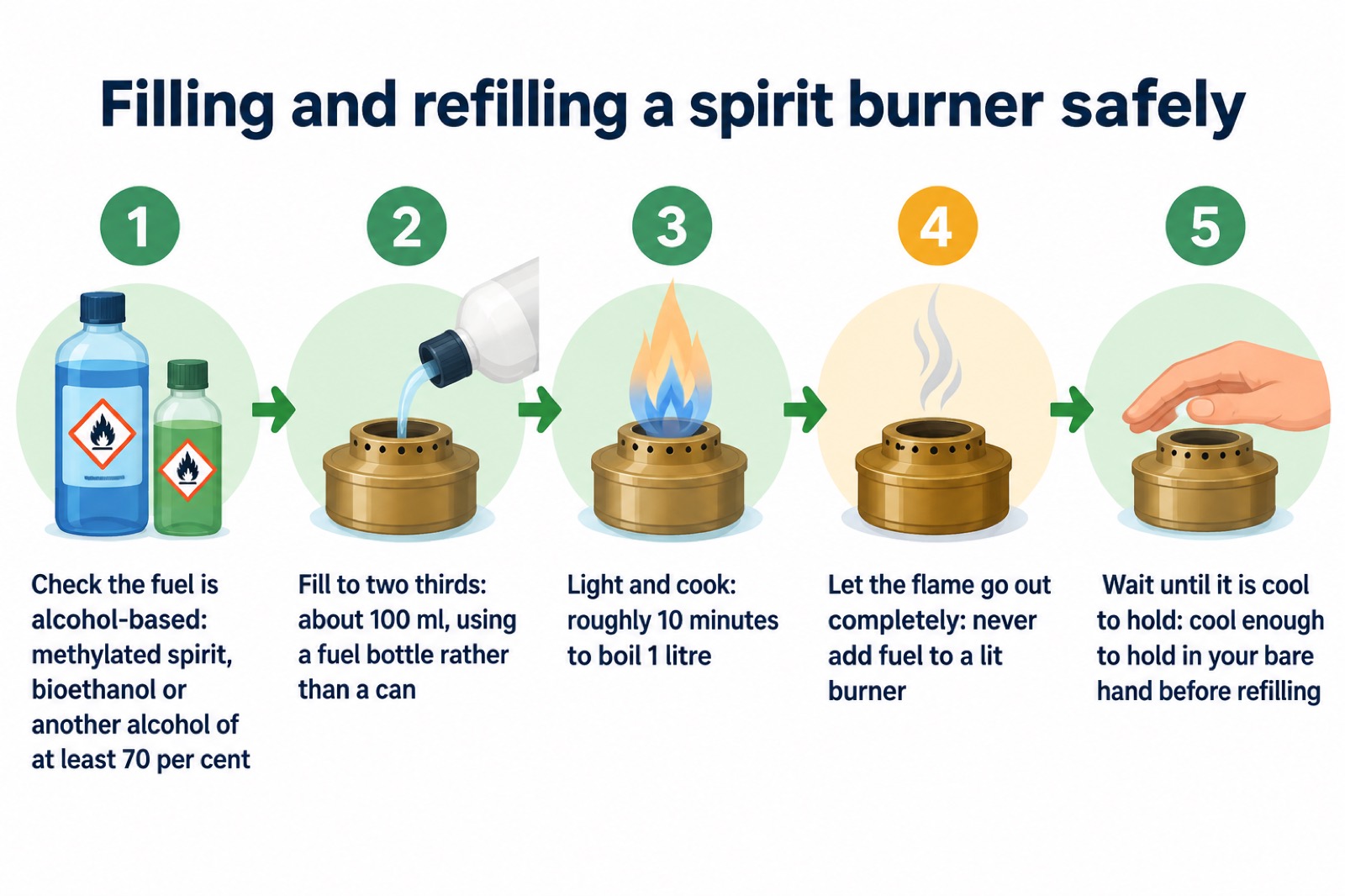
A Trangia spirit burner takes alcohol-based fuel and nothing else. Trangia's own instruction is blunt: "ONLY USE alcohol-based fuel, never petrol or other oil-based fuel"1. In practice that means methylated spirit, bioethanol or another alcohol fuel of at least 70 per cent strength, poured in until the burner is no more than two thirds full, which is about 100 ml2.
That fill gives you roughly ten minutes to boil a litre of water, according to the maker's figures for the burner2. It is a small, simple stove with no loose parts and no maintenance, and it has been the heart of Trangia's stove range since the first one was introduced2. The one thing it will not tolerate is the wrong fuel, and the consequences of getting that wrong are serious.
This page covers what to put in, what never to put in, how much, how to top up safely and how to keep spare fuel at home. If you are still deciding what kind of stove suits your household, the guide to camping stoves for a power cut sets the types side by side, and gas or spirit stoves compares the two main choices.
Use alcohol-based fuel only
Trangia describes the spirit burner as intended only for alcohol-based fuels, giving methylated spirit, T-sprit and bioethanol as examples3. The English guide adds that other alcohols based on methanol or ethanol, such as surgical spirits or wood alcohol, are safe alternatives2. A minimum of 70 per cent alcohol will work2.
Ethanol gives the best effect, and Trangia notes you can find it as pure as 96 per cent; the drawback is that it produces more soot than methanol2. Methanol burns cleaner but Trangia warns that it creates toxic fumes, so it needs care2. For most households the practical choice is ordinary methylated spirit or a bioethanol fuel.
Trangia names recommended fuels by country, which is useful because product names differ:
| Country | Fuel Trangia recommends | Source |
|---|---|---|
| England | La Hacienda Bio Ethanol; FireDragon Ethanol | 2 |
| Ireland | Bartoline Methylated spirit | 2 |
If you are buying fuel for a household stove rather than a campsite, the safety questions are different from a night under canvas. The page on whether it is safe to use a camping stove indoors covers ventilation and carbon monoxide, and the backup stove kit checklist lists what to keep with the stove.
Never petrol or other oil-based fuel
Trangia lists the fuels that must not go near the burner: petrol, diesel, kerosene and lamp oil2. In the Swedish guide the instruction is equally direct, naming petrol, diesel, paraffin and lamp oil as oil-based fuels that are not to be used in this burner3. White gas, the fuel sold for multi-fuel stoves, is a petroleum product of the same family and is not on Trangia's list of permitted fuels for the spirit burner.
This is not a manufacturer being fussy. Fire and rescue services across the UK give the same warning about petrol and other flammable liquids. The Trangia maker states that oil-based fuels must not be used in its spirit burner, naming petrol, diesel, paraffin and lamp oil among them2. Fire and rescue services say: "Never use petrol, white spirit, paraffin, or other flammable liquids to light your BBQ"4. "Never use petrol or paraffin to light a solid fuel stove"5. "Never use petrol or paraffin to start or revive your barbeque"6. "Never use accelerants such as petrol or paraffin to light your fire"7.
The pattern is consistent: volatile liquid fuels flash and spread in a way that solid or alcohol fuels do not, and adding them to something already alight is how people are badly burned. A spirit burner is a small open vessel of liquid fuel, so the same rule applies with even less margin for error.
Why the wrong fuel is dangerous in a spirit burner
The spirit burner is a brass cup with a cotton wick, and it works by letting alcohol vapour burn at the surface2. It has no pressurised fuel line, no jet and no seals, which is why Trangia describes it as having no loose parts that can break and being completely maintenance free2. That simplicity is also why it cannot cope with petroleum fuels: they burn hotter and flash more readily, and Trangia warns they damage the wick2.
The wick matters more than it sounds. Once contaminated or burnt, the burner will not vapourise fuel properly, and a burner that will not light evenly is one people tend to top up while it is still warm. Trangia's rule for refilling is absolute: "Never add spirit to the burner until the flame is completely extinguished and the burner has cooled off enough so that you can hold it in your hand"2. The use and care guide puts it as waiting until the burner is cool enough to comfortably hold with bare hands before refilling1.
There is a second hazard that catches people out with alcohol fuels. ROSPA, the Royal Society for the Prevention of Accidents, warns that bioethanol and gel fuel burners burn with a virtually invisible flame, and that "The high risk of accidental burns makes them unsuitable for use in the home"7. Warwickshire Fire and Rescue Service adds that only fuel specifically designed for bioethanol burners should be used, because alternative fuels "can cause hazards, such as excessive smoke or heightened fire risk"8. A Trangia is a camping stove, not a room heater, and it belongs outdoors or in a well-ventilated space, not on a living room floor.
How much fuel to use and how to top up
Fill the burner to no more than two thirds, which Trangia gives as approximately 100 ml2. The same figure appears in the use and care guide1. Do not fill it to the brim: alcohol expands and the burner needs headspace for the vapour to burn cleanly.
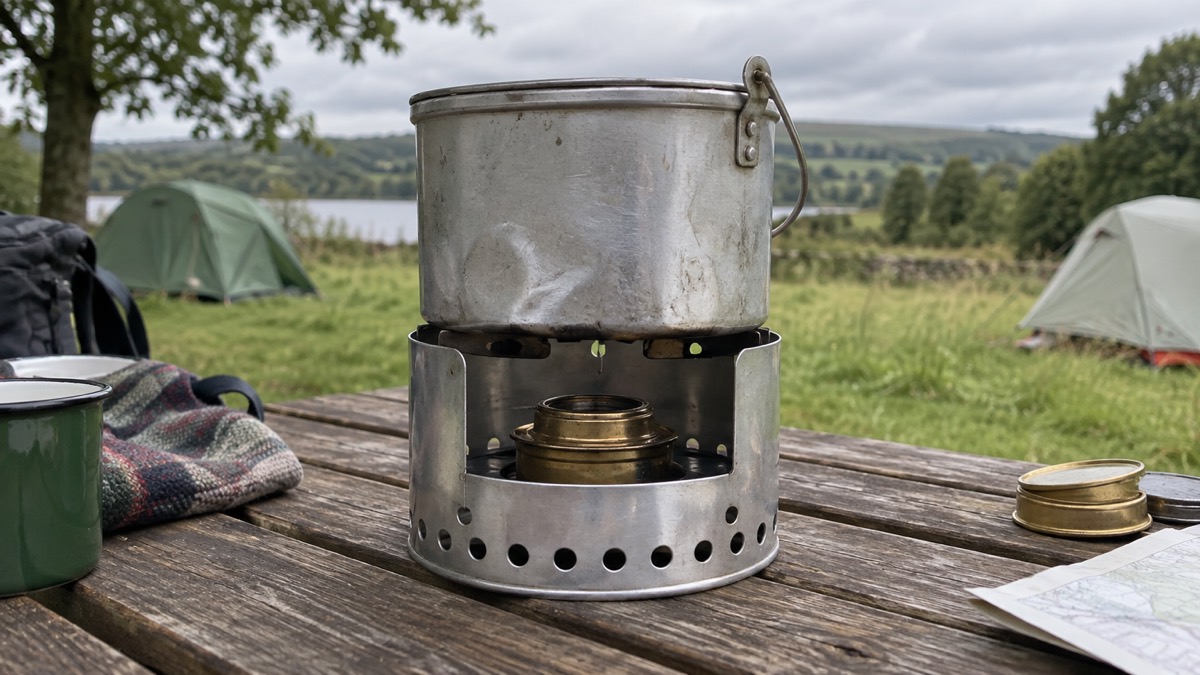
Trangia's advice for judging quantity is refreshingly practical: "Cook something at home before you head out for the first time, and you will get an idea of how much fuel you will need"2. A burner that has just been filled may also need to be burnt in a few times before it reaches full effect, because of the cotton wick inside2.
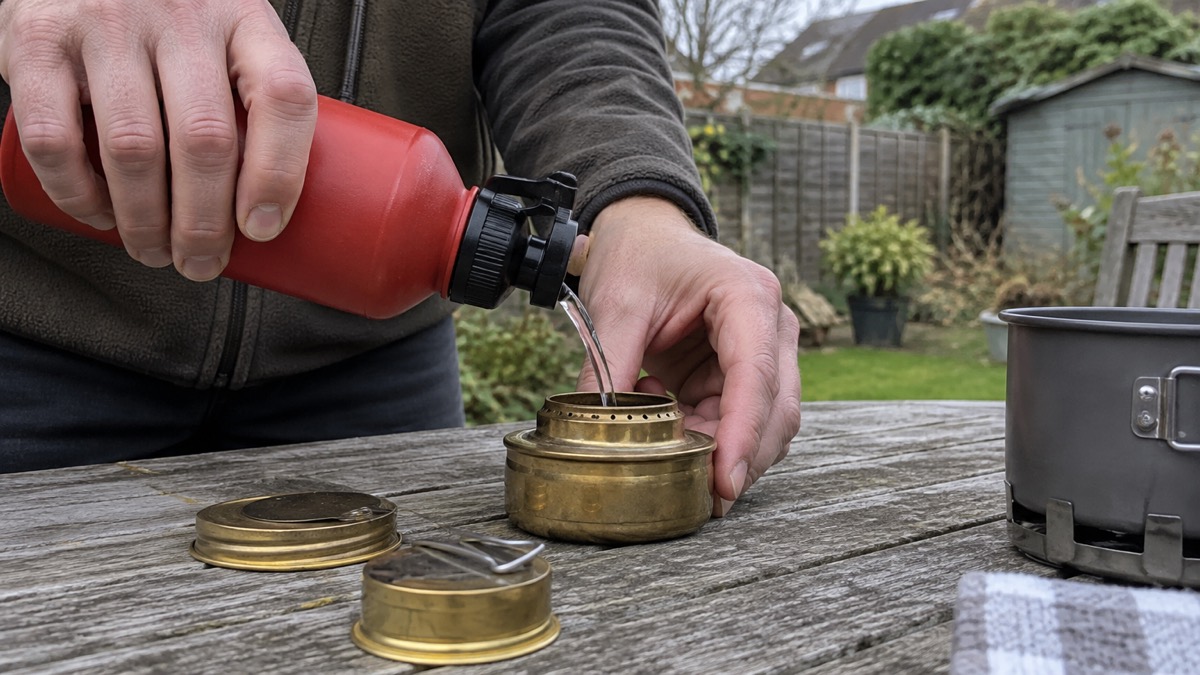
To fill safely, use a Trangia fuel bottle. Trangia explains that the safety cap lets you pour without removing the cap, and says "Never pour directly from a can"2. In cold weather, keep both the fuel and the burner warm, for example by carrying the fuel bottle and burner in an inner pocket close to the body2.
Storing spare fuel and looking after the burner
Trangia's storage advice has two parts. Fuel can be left in the burner for the next day's cooking at the campsite, but otherwise it is better to pour it back into the bottle or burn it up. The maker's warning is clear: "Never store fuel in a burner that will be packed away as it may leak!"2. Fuel contains water, so long storage in the burner risks corrosion, and Trangia advises storing the burner in the yellow plastic bag supplied to avoid it1.
For spare fuel at home, fire and rescue service guidance is the place to start. Spare fuel should be in purpose-made containers and stored away from sources of heat9. Keep it outside the home where possible, and no more than 23 litres, preferably only 9 litres9. Those figures are given for paraffin, but the principle of small quantities in proper containers away from heat applies to any liquid fuel. If you keep petrol for a generator or mower, Dorset and Wiltshire Fire and Rescue Service says it should be in suitable portable metal or plastic containers, one demountable fuel tank, or a combination, with no more than 30 litres kept10.
A spirit burner is not the only option in the Trangia range. The gel burner runs on gel or tablets11, and Trangia also sells a separate multi-fuel burner that Vango lists as able to burn white gas, petrol, kerosene and diesel13. That burner is the right home for petroleum fuels; the spirit burner is not. Trangia notes that a gas burner requires a little more maintenance than a spirit burner and should be maintained regularly from the start1, and that you can buy an extra gas burner and alternate between the two2.
Getting help from Trangia
Trangia is a Swedish company, with its head office and factory in Sweden, and the spirit burner is made there1. The burner's article number is BF602500, which is worth quoting in any enquiry2. It fits all Trangia stoves 25 Large and 27 Small, the Trangia Triangel, the open spirit stove and the Mini Trangia2.
For questions about fuel, parts or a burner that is not working, Trangia lists a customer support address: customersupport@trangia.se14. If your fuel is sooting heavily, Trangia suggests trying a dilution of 10 to 15 per cent water to get better combustion2. If the burner will not light evenly, check the wick has not been contaminated by the wrong fuel, and replace the burner rather than persisting with one that has been used with petrol or paraffin.
If you are building a stove kit for power cuts rather than camping, the heating and cooking section covers the wider question of cooking without mains gas or electricity, and the emergency kit guide sets out what a household should keep ready. For the stove itself, the camping stove safety page explains ventilation and carbon monoxide, which matter far more at home than on a campsite.
Sources (14)
- Use and care, Trangia, 2026
- Guide: the spirit burner, Trangia, 2026
- Guide: spritbrännaren, Trangia, 2026
- Barbecues, Dorset and Wiltshire Fire and Rescue Service, 2026
- Caravans and camping, North Yorkshire Fire and Rescue Service, 2026
- Stay safe this summer, Northern Ireland Fire and Rescue Service, 2026
- Preventing accidents in the home, RoSPA, 2026
- Safe home heating, Warwickshire Fire and Rescue Service, 2026
- Portable heaters, Mid and West Wales Fire and Rescue Service, 2026
- Storing fuel, Dorset and Wiltshire Fire and Rescue Service, 2026
- Guide: gelebrännaren, Trangia, 2022
- Guide: the gel burner, Trangia, 2022
- Trangia multi-fuel burner, Vango, 2026
- Open spirit stove, Trangia, 2026
 Before-Winter Heating Checks
 Backup Stove Kit Checklist
 Wood Burner Lighting Kit
 Heating a Home with the Oven
 Paraffin Heater Indoors
 Changing an LPG Cylinder Safely
 Storing Gas Cylinders at Home
 Wood You Should Never Burn
 Disposing of Ashes Safely
 Open Fire in an Unused Chimney
 Oil Tank Leaks After a Storm