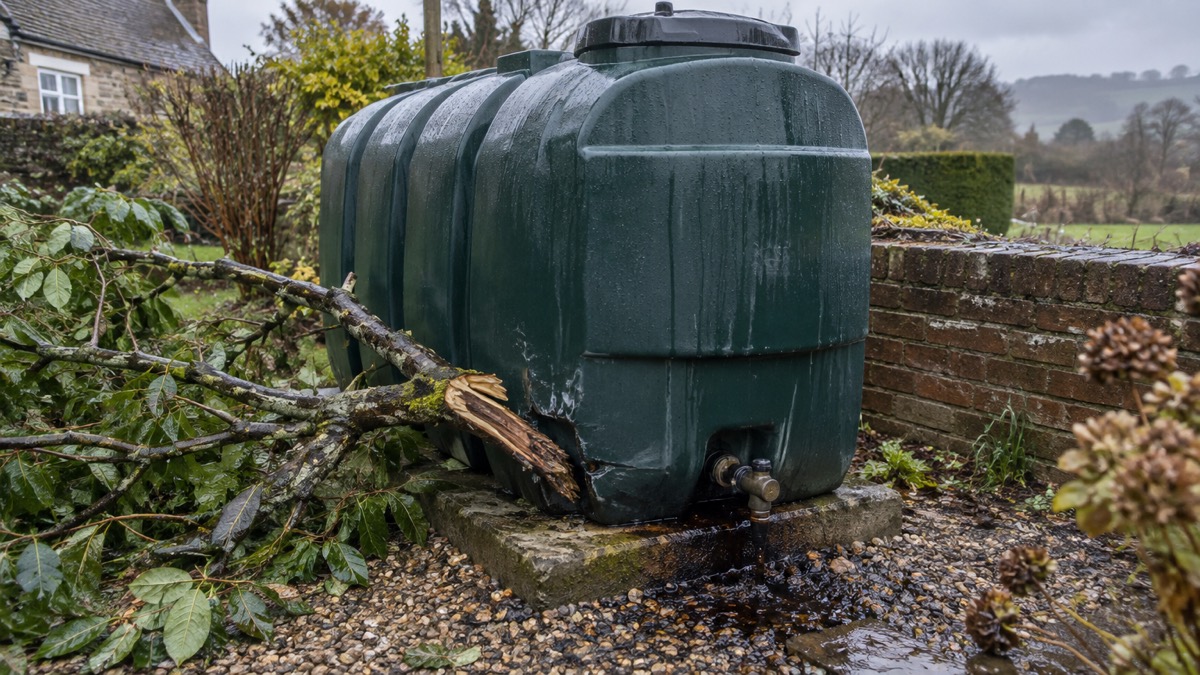
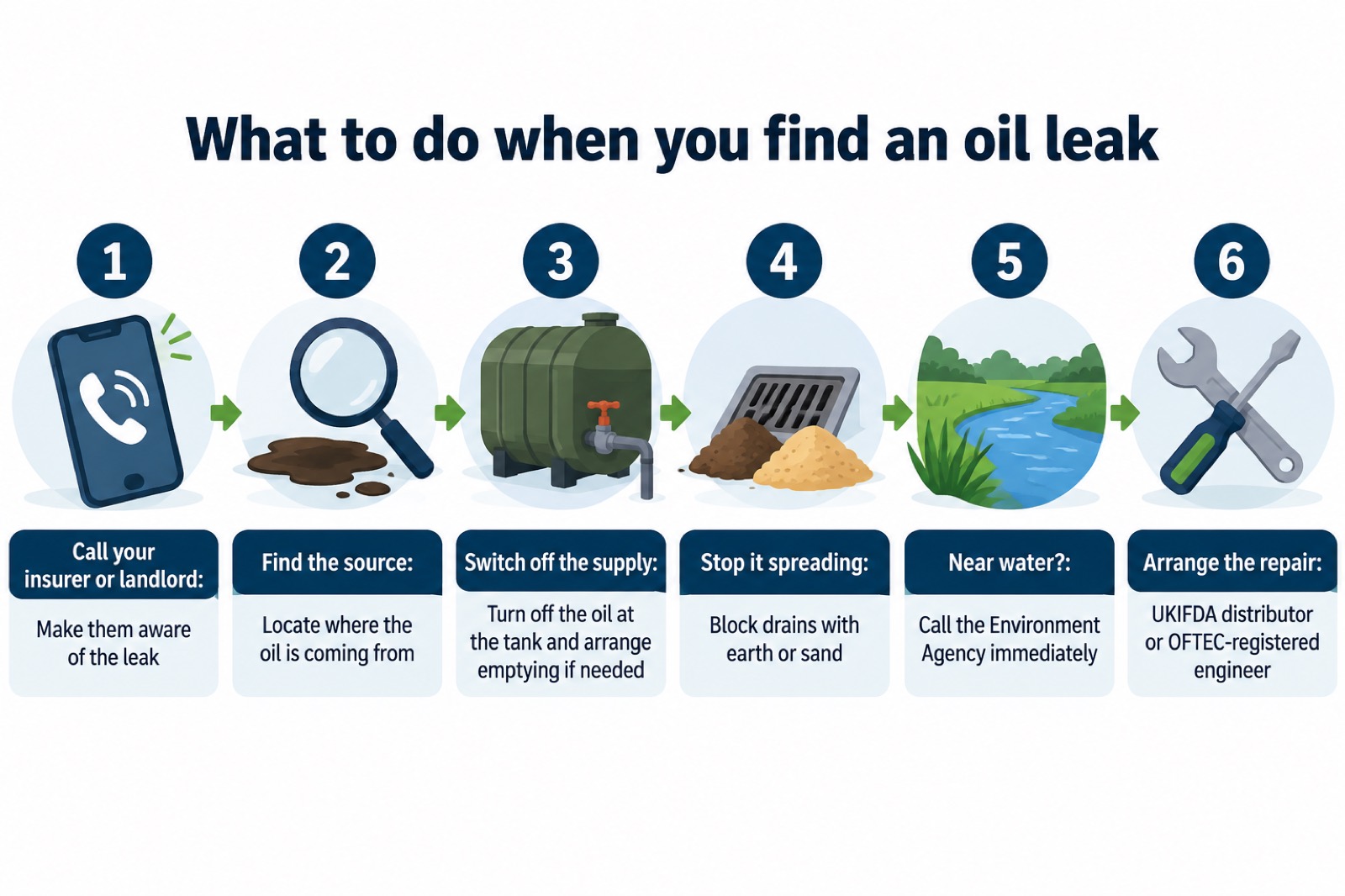
If you think your heating oil tank is leaking, act in this order: call your home insurance company or landlord and make them aware of the leak, find where it is coming from, switch off your oil supply at the tank and arrange to have it emptied if needed, try to stop the leak at the source, and block the spill from entering drains using absorbent materials such as earth or sand1. If the leak could affect a stream, pond or other water supply, call the Environment Agency immediately2.
Storm damage is often the trigger. A tank that has been knocked, flooded or shifted can leak from the tank itself or from its pipework, and the first sign may simply be a level that has fallen faster than your usage explains. If you notice a leak, damage or another problem with your tank or heating system, contact your local heating oil distributor or an OFTEC-registered technician3.
You do not have to diagnose the fault yourself. Your job is to stop the oil spreading, get the right people told, and keep your household safe while it is sorted out. This page sets out who to call first, what to do about water nearby, how insurance fits in, and how to tell an oil problem from a gas one.
If your heating oil tank is leaking: who to contact first
Start with your insurer or landlord, then deal with the tank itself. Official guidance is specific about the order: call your home insurance company or landlord and make them aware of the leak, find where the leak is coming from, switch off your oil supply at the tank and arrange to have it emptied if needed, try to stop the leak at the source, and block the spill from entering drains using absorbent materials such as earth or sand1. Somerset Council gives the same first step, to call your household insurance company or landlord and make them aware of the leak2.
The reason to call the insurer early is practical rather than bureaucratic. OFTEC, the Oil Firing Technical Association, recommends that anyone with a fuel tank checks with their insurers what cover they have for cleaning up an oil leak or spill6. Wessex Water goes further and suggests checking that your home or business insurance company is aware that you have an oil tank and that your policy covers all possible risks related to it7. A leak discovered after a storm is exactly the moment those questions matter.
For the physical damage, the recommendation is to contact your local UKIFDA heating oil distributor or an OFTEC-registered engineer if you have concerns about your oil tank or need to install a new one4. UKIFDA's winter campaign repeats it: if you notice a leak, damage or another problem with your tank or heating system, contact your local heating oil distributor or an OFTEC-registered technician3. An OFTEC registered technician should be able to carry out tank maintenance work on your behalf8.
Remember where the responsibility sits. UKIFDA states plainly that you are responsible for the upkeep of any oil tanks on your property to protect yourself, your home, and the environment4. Nobody else is checking it for you between services.
A leak near a stream, pond or water supply: call the Environment Agency immediately
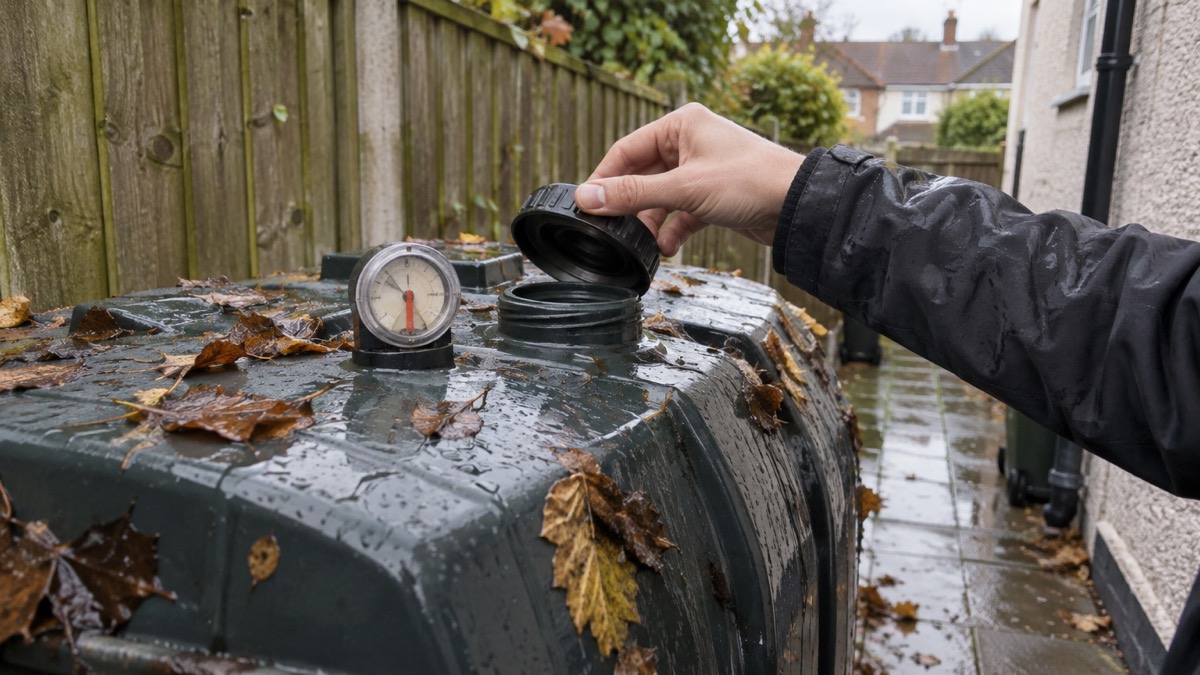
Oil and water do not mix, and a spill that reaches a watercourse spreads far beyond your garden. That is why the advice changes the moment water is in reach. Northumberland Council's guidance is direct: if the leak could affect a stream, pond or other water supply, call the Environment Agency1. Somerset Council adds the word that matters: call the Environment Agency immediately2.
The number to use is the Environment Agency incident line on 0800 80 70 60, which Somerset Council gives specifically for oil pollution of a ditch, rhyne or watercourse2. Cornwall Council lists the same incident hotline as 0800 80 70 60, a freephone line running 24 hours9. Floodline, on 0345 988 1188, is the separate number for river and tidal flooding advice9.
There is a second route when drinking water could be affected. The Drinking Water Inspectorate advises that you notify the environmental health team at your local council if you become aware of, or suspect, a fuel or other chemical spill or leak on your property10. If you suspect a spill or leak of fuel has occurred and you can taste petrol or fuel in your drinking water, contact your water company and local authority immediately11. Wessex Water also offers an email address, heating.oil@wessexwater.co.uk, for more advice about oil storage and leaks7.
Your heating oil distributor or an OFTEC-registered engineer for tank damage
Once the immediate spill is contained and the insurer knows, the repair and inspection work belongs with the oil trade. Contact your local UKIFDA heating oil distributor or an OFTEC-registered engineer if you have concerns about your oil tank or need to install a new one4. If you notice a leak, damage or another problem with your tank or heating system, contact your local heating oil distributor or an OFTEC-registered technician3.
OFTEC registration is the marker to look for. OFTEC is the body the fire and rescue services point oil appliance owners to: the London Fire Brigade lists the Oil Firing Technical Association for oil appliances12, and Greater Manchester Fire and Rescue Service advises getting your heater checked by OFTEC for oil appliances13. OFTEC's own number is 0845 658 508014.
The best moment to have a tank looked at is the annual boiler service. UKIFDA advises having your oil tank inspected at the same time as the boiler service: the OFTEC-registered engineer inspects overall condition, checks for water or condensation, and provides a report of observations and actions4. An annual inspection of your tank by a qualified OFTEC registered engineer is essential, as any water can be identified8. OFTEC adds that fuel tank systems should be installed and checked on a regular basis by OFTEC liquid fuel technicians, and any defects or faulty equipment identified dealt with promptly6.
| What has happened | Who to contact | Why |
|---|---|---|
| Tank or pipework damaged, or you are unsure of its condition | Local UKIFDA heating oil distributor or OFTEC-registered engineer4 | Inspection, repair and replacement of oil tanks and systems |
| Leak or spill discovered | Your insurer or landlord first, then the tank trade1 | Cover for cleanup, and a record of the damage |
| Oil reaching a stream, pond or water supply | Environment Agency immediately2 | Pollution of water is an environmental incident |
| Oil central heating flooded | A qualified person before you switch it on15 | Flooded appliances must be checked before use |
Telling your insurance company about an oil leak
Insurance is the part households most often get wrong, usually by leaving it too late or by never checking what is covered. The first action in official leak guidance is to call your home insurance company or landlord and make them aware of the leak1. Wessex Water lists your insurance company among the people to contact when you have an oil leak7.
Before anything happens, it is worth a conversation. OFTEC recommends that if you have a fuel tank at home, you check with your insurers what cover you have for cleaning up an oil leak or spill6. UKIFDA suggests speaking to your home insurance company about the type of cover you have and what happens in the event of a leak or overspill, and notes that the insurer may also advise on tank placement and security4. Wessex Water's advice is to check that your insurer is aware you have an oil tank and that your policy covers all possible risks related to it7.
Oil leak or gas leak: who handles each
These are two different emergencies with two different responders, and mixing them up wastes time. For a gas leak, contact National Gas16. Call the National Gas Emergency Service immediately17, on 0800 111 9995. If you smell gas, open doors and windows18. Northern Ireland Direct gives the same instruction to contact the Gas Emergency Service immediately19.
For an oil leak, there is no equivalent emergency line for the tank itself: the householder is responsible for the tank's upkeep4, and the response runs through your insurer, your oil distributor or an OFTEC-registered engineer, and the Environment Agency where water is at risk1. If you have a leak at an LPG cylinder or its associated pipework, call the LPG supplier so they can come and make safe19.
Carbon monoxide is the third case, and it can arise from any fuel-burning appliance. Contact Cadent Gas as soon as possible on 0800 111 99920. For solid fuel appliances suspected of leaking carbon monoxide, call HETAS on 0845 634 562621.
| Smell or problem | Who to call | Number |
|---|---|---|
| Gas leak | National Gas Emergency Service5 | 0800 111 999 |
| Carbon monoxide | Cadent Gas20 | 0800 111 999 |
| Solid fuel appliance, suspected carbon monoxide | HETAS21 | 0845 634 5626 |
| LPG cylinder or pipework leak | Your LPG supplier19 | Supplier's own number |
| Oil reaching water | Environment Agency incident line2 | 0800 80 70 60 |
Checking a tank after a storm, and before winter
After a storm, look at the tank and its pipework for damage, and check the level. The Drinking Water Inspectorate notes that if the level in the tank drops more than you would expect it to, based on your usage, this could indicate a leak10. That is the quietest sign of all, and the one most easily missed.
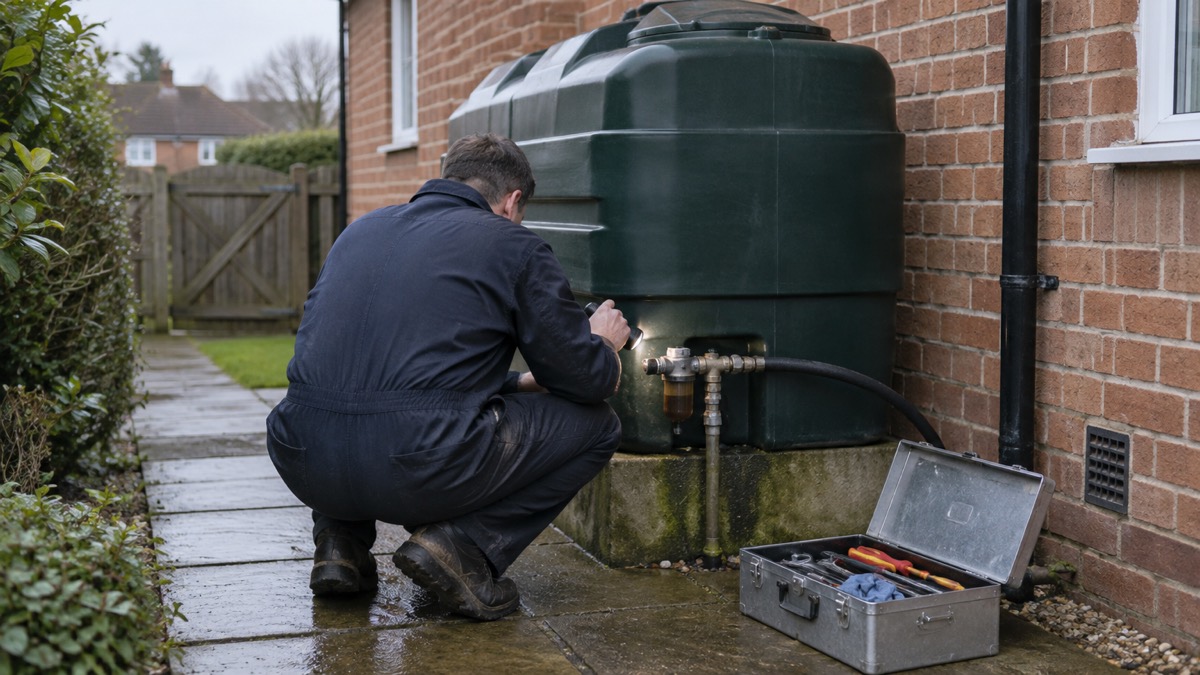
If flooding has been involved, there is a separate safety step. Have your gas or oil central heating checked by a qualified person before switching on the gas or trying to light any appliance15. Do not run a flooded oil boiler to see whether it still works.
Winter checks are mostly about timing. Suffolk Fire and Rescue Service advises checking that you have ordered your winter heating fuel22. UKIFDA warns to allow plenty of time for your local heating oil distributor to deliver, especially in cold weather when demand can increase3. Book the annual service and tank inspection together, as UKIFDA recommends4, and keep the engineer's report.
Where to get help and how to prepare
Keep the numbers you might need where you can find them in the dark: the Environment Agency incident line on 0800 80 70 602, the National Gas Emergency Service on 0800 111 9995, and your insurer's claims line. Add your oil distributor's number and, if you have one, your OFTEC-registered engineer's.
If your heating fails while the tank is out of action, our guide to heating and cooking without mains power or gas covers keeping warm in the meantime, and keeping one room warm when the heating fails is the practical next step. For the wider picture on keeping a supply through the cold months, see heating oil tanks: keeping a supply through winter, and for the scheme that prioritises some oil-heated households, the Cold Weather Priority Scheme. Our before-winter checklist for your heating and stove puts the seasonal checks in order.
If a storm has caused wider damage, our storms, snow and ice guide and flooding guide set out what to do next. For gas and heating failures more generally, see gas and heating failures.
Sources (22)
- Domestic oil, Northumberland County Council, 2026-10-28
- Oil tank leaks, Somerset Council, 2025-07-29
- UKIFDA Winter 2026-27 Campaign, UKIFDA, 2026-09-28
- Tank care and security, UKIFDA, 2026-02-18
- Emergency, Basingstoke and Deane Borough Council, 2026-10-29
- Are you insured for a fuel tank leak?, OFTEC, 2026-10-29
- Oil storage and leaks, Wessex Water, 2026-10-28
- Help and advice, UKIFDA, 2026-01-29
- Flooding useful links and numbers, Cornwall Council, 2026-10-29
- Oil fuel and other hydrocarbons, Drinking Water Inspectorate, 2026-10-28
- Taste and odour in drinking water, Drinking Water Inspectorate, 2024-08-13
- Portable heaters, gas fires and open fires, London Fire Brigade, 2026-10-25
- Stay fire safe, Greater Manchester Fire and Rescue Service, 2026-10-29
- Carbon monoxide, Public Health Wales, 2025-12-08
- Clearing up after a flood, Oxford City Council, 2026-10-29
- Report flooding or a burst water main, GOV.UK, 2026-10-29
- Gas supply issues, Buckinghamshire Council, 2026-10-25
- Energy, power supply and utilities, nidirect, 2025-10-23
- LPG safety guidance, Liquid Gas UK, 2022
- Carbon monoxide, Cheshire Fire and Rescue Service, 2026-05-20
- Carbon monoxide awareness, Warwickshire County Council, 2026-10-29
- Seasonal winter, Suffolk Fire and Rescue Service, 2026-10-29
 Before-Winter Heating Checks
 Backup Stove Kit Checklist
 Wood Burner Lighting Kit
 Heating a Home with the Oven
 Paraffin Heater Indoors
 Changing an LPG Cylinder Safely
 Storing Gas Cylinders at Home
 Wood You Should Never Burn
 Disposing of Ashes Safely
 Open Fire in an Unused Chimney
 Trangia Spirit Burner Fuel