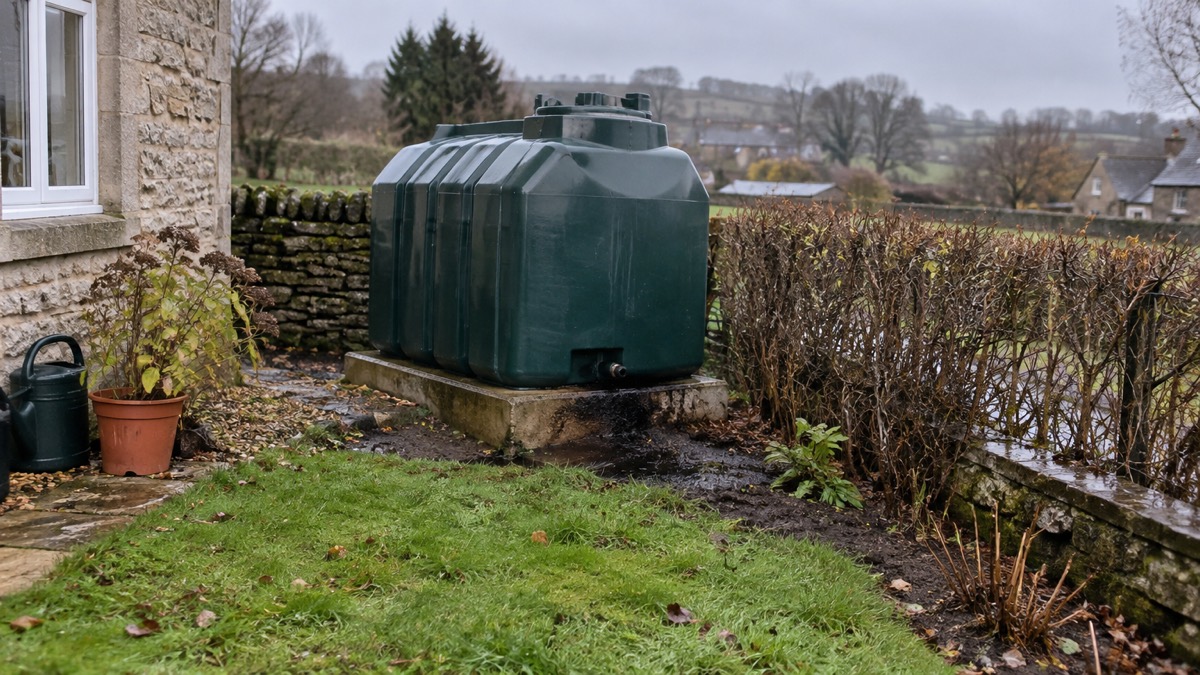
If you smell oil or find a stain near your tank, act in this order: call your home insurance company or landlord and make them aware of the leak, find where it is coming from, switch off your oil supply at the tank and arrange to have it emptied if needed, try to stop the leak at the source, and block the spill from entering drains using absorbent materials such as earth or sand1. If the leak could affect a stream, pond or other water supply, call the Environment Agency immediately1.
Do not try to clean up the oil spill yourself, and never use detergents or a hose to wash it away3. If repair or replacement is required, do not attempt to do this yourself1. It is your responsibility to keep your domestic oil storage tank safe, and faulty or badly maintained domestic central heating oil tanks cause numerous pollution incidents1.
The good news is that most of this is preventable. A regular look at the tank, a check on how much oil you are using, and an annual visit from a qualified engineer catch most problems before they become a spill. This page sets out what to do now, how to stop the oil spreading, who to tell, and the warning signs that a tank is failing.
Switch off the oil supply and find where the leak is coming from
The first practical step is to stop more oil leaving the tank. Switch off your oil supply at the tank, and arrange to have the tank emptied if needed1. Then find where the leak is coming from, so you can tell your insurer, your landlord or an engineer exactly what has failed1.
If you cannot tell whether the problem is the tank, the pipework or the boiler, turn off your heating and boiler5. That stops the system pushing more fuel through a faulty line while you work out what has happened. The same principle applies to water leaks in the home: the fastest way to stop the flow is to turn off the supply at the stop tap6. If you are dealing with water as well as oil, our guide to water leaks on your property explains how to trace and isolate them.
Once the supply is off, look at the tank itself. Check the tank and associated pipework are in good condition, and look for the warning signs covered further down this page7. Do not open anything up, disconnect a line or try to plug a fitting: repairs are a job for a qualified technician1.
Stopping the oil spreading
Oil that reaches a drain, a ditch or a stream becomes a pollution incident, and the clean-up becomes far harder. Government guidance is to try to stop the leak at the source and to block the spill from entering drains using absorbent materials such as earth or sand1. Earth and sand are the materials the guidance names, and they are usually to hand in a garden.
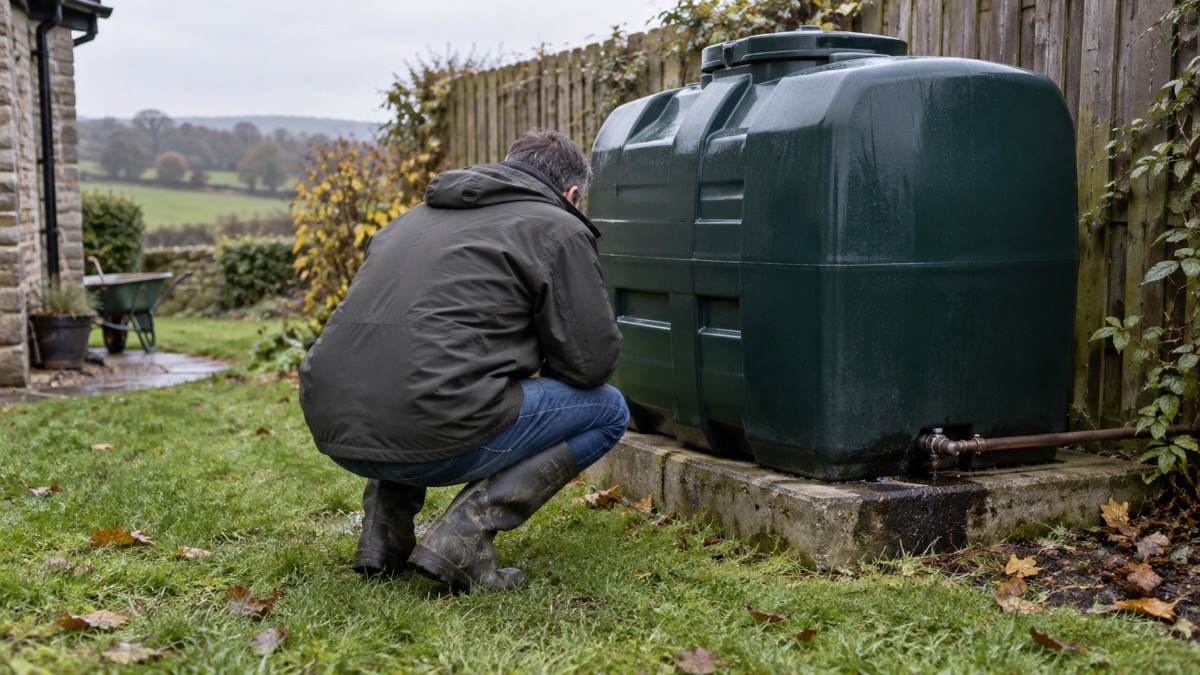
Never use detergents or a hose to wash the spill away2. Washing it away does not remove it; it spreads it further and can carry it into surface water drains. Do not try to clean up the oil spill yourself3. Your job is to contain it and to keep people and animals away from it until the professionals arrive.
Where your tank sits matters here. Siting a tank as far away from water sources (ditches, soakaways, groundwater, streams, rivers and lakes) as possible minimises the contamination risk in the event of a leak8. If you are having a tank installed or replaced, that is a decision worth taking seriously. An oil tank also needs to be a minimum of 1.8 metres from any openings to buildings, such as doors and windows; if that distance is not possible, a fire barrier can be built between the tank and the hazard9.
Call the Environment Agency at once if a stream, pond or water supply could be affected
Oil and water do not mix, and a small spill can travel a long way. If the leak could affect a stream, pond or other water supply, call the Environment Agency immediately1. The same applies if the spill is at risk of contaminating a stream or other watercourse, where the Environment Agency emergency hotline should be contacted10.
The number to ring is the Environment Agency incident hotline on 0800 80 70 60, a 24-hour service11. Oil pollution of a ditch, rhyne or watercourse should be reported to the Environment Agency incident line on 0800 80 70 601. Keep the number somewhere you can find it in a hurry, not only on a phone that may be in the house.
| Situation | Who to call | Number |
|---|---|---|
| Leak could affect a stream, pond or water supply | Environment Agency incident hotline | 0800 80 70 6011 |
| Oil pollution of a ditch, rhyne or watercourse | Environment Agency incident line | 0800 80 70 601 |
| Leak on your property, no water at risk | Your home insurer or landlord | Your policy or tenancy documents1 |
If your household gets its drinking water from a private supply rather than the mains, the risk is more direct. If you notice a change in the taste or smell of your water after an oil spill, stop using it and seek advice; our guide to water in an emergency covers what to do when a supply is in doubt.
Your insurer or landlord: who to tell first
Call your home insurance company or landlord and make them aware of the leak1. That is the first call in official guidance, and it is the one that starts the process of assessment, clean-up and repair. Government guidance also says to get help from your insurer and your oil supply company3.
If you rent the property, let your landlord know about the leak as soon as possible and check your tenancy agreement, as it may be their responsibility to arrange the repair13. Keep a record of when you reported it and what you were told.
Insurance is worth understanding before anything goes wrong, not after. Some policies will only cover you for the cost of replacing lost oil, not for any clean-up, and most companies will not cover you at all if a leak is caused by lack of maintenance1. Speak to your home insurance company about the type of cover you have and what happens in the event of a leak or overspill; your insurer may also advise on tank placement and security9. OFTEC, the oil heating trade body, publishes guidance on whether you are insured for a fuel tank leak14.
A significant spill can also bring major liabilities to compensate adjacent landowners1. That is another reason the first call matters: your insurer needs to know early, while the spill is still small.
Warning signs of a failing tank
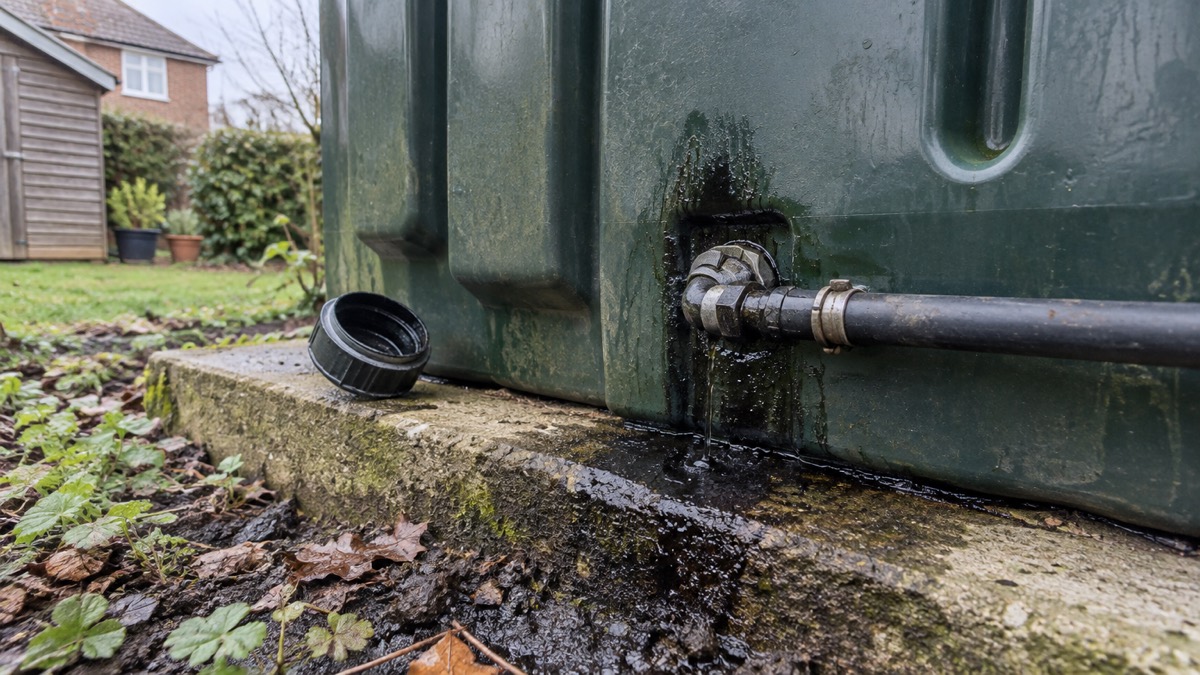
Most failing tanks give notice. OFTEC lists the warning signs to look out for, and bulging is one of them15. A tank that has changed shape is telling you something. Alongside that, watch for black stains, and know how much oil you use so that an unexplained drop stands out.
Government guidance sets out a simple routine: check the condition of your tank and boiler regularly, watch out for black stains, know how much oil you use, get your heating system serviced regularly, do not overfill your oil tank, keep the fill points clear, and review your home insurance policy to make sure you are covered for oil leaks or spills2.
| Warning sign | What it can mean | What to do |
|---|---|---|
| Black stains on or around the tank | Oil escaping from the tank or pipework2 | Switch off the supply and call your insurer1 |
| Bulging | A tank that is failing15 | Treat as a leak and call an engineer1 |
| Missing or damaged cover | Water and debris getting in4 | Have it replaced by a qualified technician4 |
| Level dropping faster than your usage explains | A possible leak10 | Check for spillage and arrange a pressure test16 |
Water is a quieter problem. Condensation build-up or rainwater entering the storage tank are the most common causes of water in your tank4. Water build-up can be stirred up during a fuel delivery and cause the fuel to break down, so if water is detected, seek specialist advice about safe removal9. A missing cover is one route in; an annual inspection is how you find out.
Knowing how much oil you use
Your oil level is a diagnostic tool. If you notice the level in the tank drops more than you would expect it to, based on your usage, this could indicate a leak10. Keep a regular check on oil consumption: if you appear to be using more than usual but there is no evidence of oil spillage around the tank, it could indicate defective underground pipework16. Installers can pressure test lines, and you should check that your household insurance covers it16.
There is a second reason to watch the level. Keeping at least 12 inches (300mm) of oil in your tank can help reduce the risk of sediment and other contaminants being drawn into your heating system12. UKIFDA, the trade body for liquid fuel distributors, puts the same point plainly: keeping at least 12 inches of oil in your tank will prevent disturbing the sediment that settles at the base, which could clog pipes9.
A simple written record, kept with your boiler paperwork, does the job: the date, the level and anything unusual. If the numbers stop making sense, you have your evidence ready for the engineer.
Water getting into the tank
Water in a heating oil tank is common and worth taking seriously. Condensation build-up or rainwater entering the storage tank are the most common causes4. Once inside, water can be stirred up during a fuel delivery and cause the fuel to break down9. If water is detected, seek specialist advice about safe removal rather than trying to drain it yourself9.
An annual inspection of your tank by a qualified OFTEC registered engineer is essential, as any water can be identified and dealt with4. That single visit covers water, the condition of the tank and pipework, and the state of the fittings. OFTEC advises that fuel tank systems should be installed and checked on a regular basis by OFTEC liquid fuel technicians, and that any defects or faulty equipment identified should be dealt with promptly14.
Check too that the tank and associated pipework are in good condition, that the tank is locked and secure, that you monitor the level, and that the installation meets local building regulations7. Government guidance on oil storage sets out the rules for home tanks3.
Repairs and replacement: never do them yourself
If repair or replacement is required, do not attempt to do this yourself1. That is the clearest instruction on this page, and it covers everything from a dripping valve to a split tank. Oil systems are not a DIY job, and a botched repair can turn a small leak into a large spill.
The same applies to the clean-up: do not try to clean up the oil spill yourself3. Your insurer or oil supply company will arrange the right people3. If your tank needs replacing, the new one must meet the rules: your oil storage container must have a sticker in a prominent position that tells you how to look after your oil and what to do if you have a spill3.
Never lock or block the tank vent or breather, as this will cause the tank to split and cause further damage9. It is a tempting mistake when securing a tank against theft, and it causes exactly the failure you are trying to prevent.
Securing the tank and preventing the next leak
Prevention is mostly a routine. Check the condition of your tank and boiler regularly, watch for black stains, know how much oil you use, get your heating system serviced regularly, do not overfill the tank, keep the fill points clear, and review your home insurance policy to make sure you are covered for oil leaks or spills2.
Theft is the other risk. Lock and secure the tank, and consider fitting CCTV to monitor it; security lights can also have a very positive effect and make any property a less attractive target4. Never lock or block the vent or breather while doing so9.
| Task | How often | Why it matters |
|---|---|---|
| Visual check of tank, base and pipework | Regularly2 | Catches stains, bulging and missing covers early2 |
| Read the oil level | Regularly2 | An unexpected drop can indicate a leak10 |
| Boiler and heating service | Regularly2 | Faulty or badly maintained tanks cause pollution incidents2 |
| Inspection by a qualified OFTEC registered engineer | Annually4 | Identifies water and defects before they become a spill4 |
| Review home insurance cover | Now, then at renewal2 | Some policies exclude clean-up or leaks from poor maintenance1 |
If your heating fails rather than leaks, our guide to gas and heating failures covers what to do next. And if a leak has left you without heat in cold weather, storms, snow and ice sets out how to keep the household warm and safe.
Sources (16)
- Oil tank leaks, Somerset Council, 2025-07-29
- Domestic oil, Northumberland County Council, 2026-10-28
- Oil storage regulations and safety: home, GOV.UK, 2026-10-29
- Help and advice, UKIFDA, 2026-01-29
- I've got a leak: emergency, what do I do?, Yorkshire Water, 2026-10-28
- What should I do if I find a leak in or around my home or business?, WaterSafe, 2026-10-29
- Tastes and smells, Wessex Water, 2026-10-28
- Oil storage and leaks, Wessex Water, 2026-10-28
- Tank care and security, UKIFDA, 2026-02-18
- Oil fuel and other hydrocarbons, Drinking Water Inspectorate, 2026-10-28
- Flooding support, Lancashire County Council, 2026-10-29
- UKIFDA Winter 2026-27 Campaign, UKIFDA, 2026-09-28
- Leaks inside your property, Wessex Water, 2026-10-28
- Are you insured for a fuel tank leak?, OFTEC, 2026-10-29
- Warning signs to look out for, OFTEC, 2026-10-29
- Snow and ice, Ceredigion County Council, 2026-10-29
 Home Fire Safety Checklist
 Bedtime Fire Safety Checks
 Fire Risk Checks for Carers
 Why a CO Alarm Is Beeping
 Smoke Alarm Keeps Chirping
 Testing Smoke and CO Alarms
 Replacing Smoke and CO Alarms
 Where to Fit Smoke Alarms
 How Many Smoke Alarms
 Where to Put a CO Alarm
 Do I Need a CO Alarm
 Can a CO Alarm Detect a Gas Leak
 Trapped by Fire What to Do
 Putting Out a Chip Pan Fire
 Electrical Fire Safety