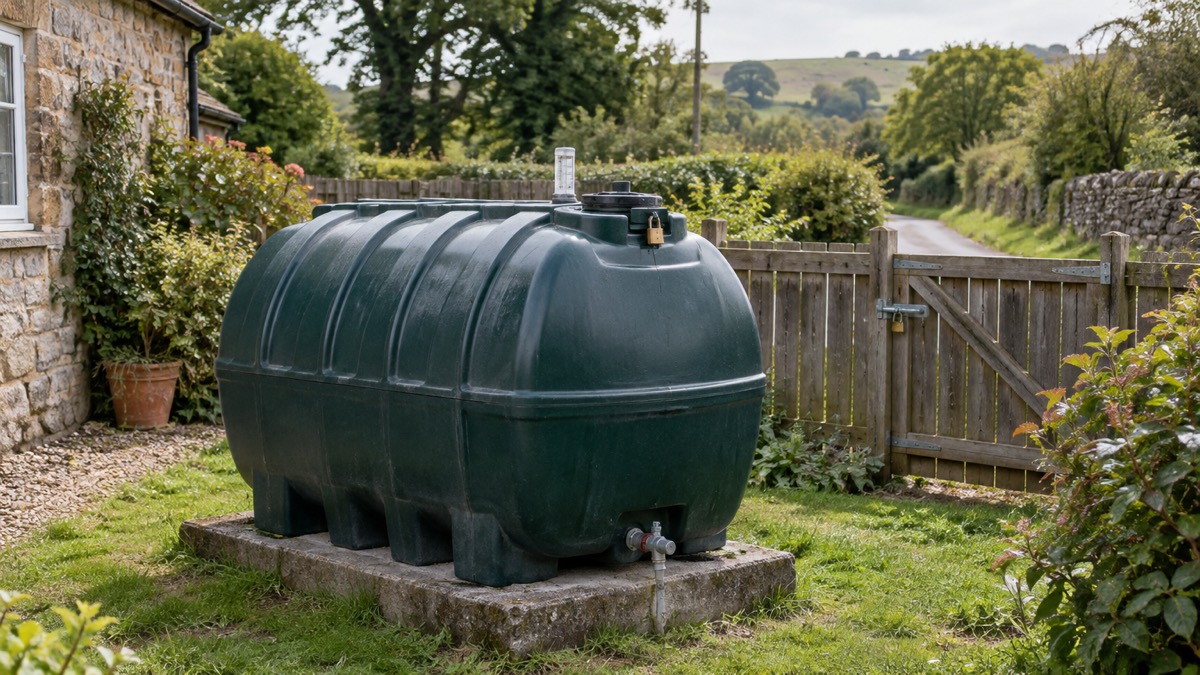
If your oil has dropped faster than your usage explains, treat it as a theft until you have ruled it out. Check the tank and pipework for leaks first, note the gauge reading and the date, then report it to the police on 101. If you are securing a tank before anything happens, the priorities are a correctly fitted and securely attached fuel gauge, a locked lid, a special lockable cap at the fill point, and lighting over the tank area1.
Heating oil tanks are attractive to thieves because they are visible, often sited away from the house, and hold a lot of fuel. The Police Service of Northern Ireland puts it plainly: fuel oil tanks can be seen as rich and easy pickings by thieves, targeting farms, transport depots and domestic properties, particularly in more rural locations1. UKIFDA adds that consumers in isolated locations, especially with tanks sited near the road, should be especially vigilant4.
The good news is that most of what protects a tank is cheap and simple, and much of it is the same maintenance that keeps the tank sound. A locked, well-lit, regularly checked tank with a secure gauge is a much harder target than an open one, and it also makes any loss easier to spot early.
Signs your heating oil has been stolen
The first sign is usually the gauge. If the level has fallen sharply and your heating has not been running unusually hard, suspect theft or a leak. Keep an eye on your oil use: if you suddenly use more oil than expected, you should check your tank and pipework for leaks7. That instruction cuts both ways, which is why the physical inspection matters as much as the reading.
Walk round the tank and look closely. Inspect it regularly for signs of damage: cracks, splits, bulging or discoloration on plastic tanks, and signs of rust or corrosion on metal tanks. Check the tank supports, pipes, connections and fittings, and if the tank is over 20 years old, seek advice on replacement8. A tank in poor condition is both a leak risk and easier to tamper with.
Look at the ground and the surrounding plants. Black stains and dead plants or grass around your tank are a warning sign of a leak9. If the ground is clean and the level has still dropped, theft becomes more likely. Check the fill cap and lid: a cap left off, forced or missing points to interference, and it also lets rain in.
Finally, think about timing. Tanks are often targeted shortly after a delivery, when they are fullest, and in the run-up to winter when fuel is expensive and demand is high. If you have just had a top-up and the level falls within days, that pattern is worth reporting.
What to do straight away if oil has gone
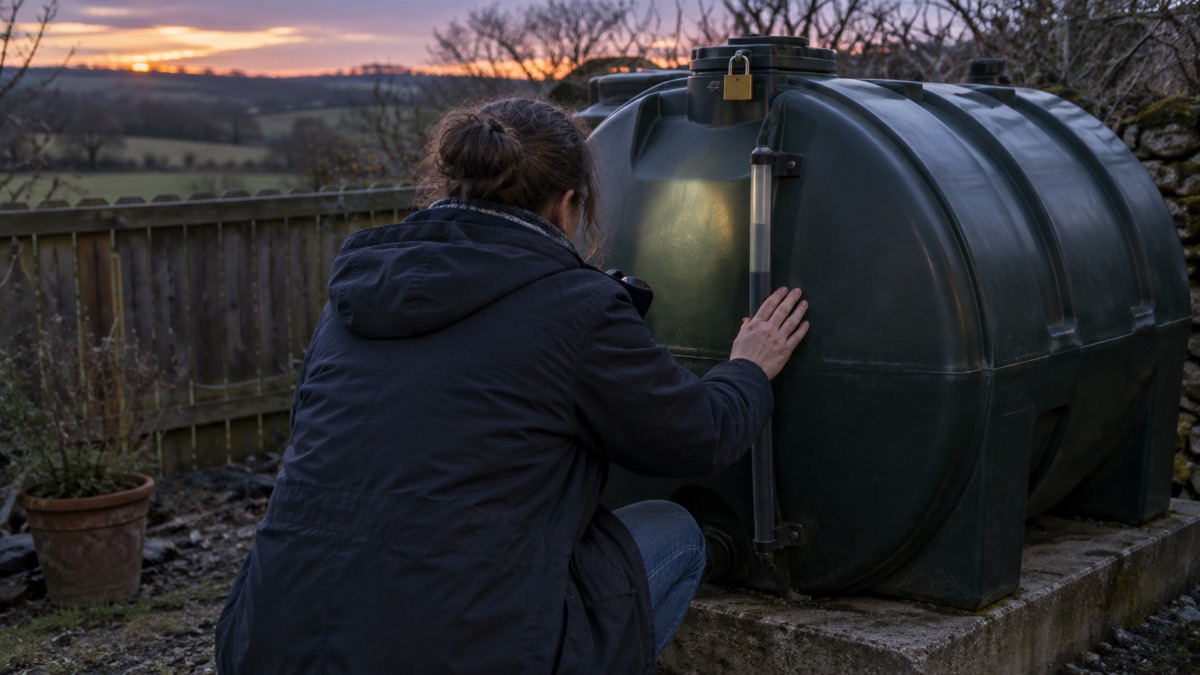
Report it, then make the tank safe. Report suspicious activity by calling Crimestoppers on 0800 555 111 or the police on 1015. Ask for your Local Crime Prevention Officer10.
Then deal with the tank itself. If there is any sign of a leak or spill as well as a loss, stop the oil spreading if you can, and follow the advice on your tank sticker and on the Oil Care website11. Call your household insurance company or landlord and make them aware of the leak9. Switch off your oil supply at the tank, try to stop the leak at the source, and block the spill from entering drains using absorbent materials such as earth or sand9.
Do not attempt repairs yourself. Tanks are heavy and difficult to move without the correct equipment and expertise, and an oil leak could result in serious environmental contamination that may not be covered by home insurance12. Use an OFTEC registered technician for anything involving the tank, pipework or appliance13.
If the theft has left you without heat, do not improvise. Get your heater checked by the Oil Firing Technical Association (OFTEC) before relying on it again13, and see our guide to gas and heating failures for keeping warm in the meantime.
Locks, alarms and gauges that protect a tank
Start with the gauge, because a loose one is both a security weakness and a water risk. Check that the fuel gauge is installed correctly and securely attached2. Make sure it is installed correctly, secured to the tank at the top3. Then make sure the sensor is tightly secured without any gaps, otherwise rain water could get into your oil tank and cause issues with your heating system8.
Lock the openings. Lock tank lids with suitable locks, and use a special lockable cap at the fill point of vent-and-fill tanks2. If you are away from the property for long periods, get a secure lock for the tank and ensure the area is well lit to avoid anyone trying to access your oil8. Give keys or combinations to the distributor if you will be absent during deliveries2.
If you have already been hit, go further. Install a tank cage or guard, particularly important if you have already suffered a fuel theft; welded cages offer the best protection while still allowing tanker access and can be alarmed1. Consider tank security features such as a lockable fuel cap, sensor lighting and coverage15.
On alarms, UKIFDA describes remote electronic liquid fuel level gauges which will set off an audible alarm if the liquid fuel level in the tank suddenly drops or falls below a quarter full4. That is the type of device to ask a supplier about if you want an alert rather than a daily visual check. Separately, and for the house rather than the tank, fit a working smoke alarm on every floor of your home and a heat alarm in your kitchen, so you are alerted quickly if there is a fire16.
| Measure | What it does | Best suited to |
|---|---|---|
| Securely fitted gauge | Shows the level; a loose one lets rain in2 | Every tank |
| Locking lid and fill cap | Stops casual siphoning and tampering2 | Every tank |
| Lighting over the tank area | Removes cover after dark8 | Tanks away from the house |
| Electronic level gauge with audible alarm | Sounds if the level drops suddenly or falls below a quarter full4 | Households wanting an alert |
| Welded tank cage or guard | Physical barrier, can be alarmed, allows tanker access1 | Tanks already targeted |
Check your home insurance covers stolen oil
Most home insurance will cover the costs of replacing the lost oil and any damage caused to the fabric of your home following an oil spill from a domestic liquid fuel heating system17. But the detail matters, and it is worth reading before you need it. You must check whether your home insurance covers fuel spills or leaks and whether there are any stipulations or limitations to your policy18.

The gaps are real. Some policies will only cover you for the cost of replacing lost oil, not for any clean up, and most companies will not cover you at all if a leak is caused by lack of maintenance9. If you have a fuel tank at home, check with your insurers what cover you have for cleaning up an oil leak or spill6. Check your household insurance as the repair might be covered17.
Keep the paperwork that supports a claim: the delivery notes, your gauge readings and dates, and any report you have made to the police. If your policy requires a maintained tank or a regular service, keep those records too: most companies will not cover you at all if a leak is caused by lack of maintenance9.
Where to report theft and get help
Report the theft to the police on 101, and report suspicious activity anonymously through Crimestoppers on 0800 555 1115. Ask for your Local Crime Prevention Officer10. If you have information about deliberate firesetting rather than theft, that goes to FireStoppers on 0800 169 555819.
For the tank and heating system, use an OFTEC registered technician. Get your heater checked by the Oil Firing Technical Association (OFTEC)13, and have the tank inspected by a qualified engineer as part of routine care20. For leaks and pollution, your water company and your local council environmental health team are the people to contact; your insurance company is the first call for the damage itself12.
In Northern Ireland, the Police Service of Northern Ireland publishes dedicated advice on protecting heating oil, and the Northern Ireland Environment Agency urges householders to check oil tanks at the winter fuel top-up1. In Scotland and Wales the reporting routes are the same non-emergency numbers, but support services differ; see our guide to Scotland and Northern Ireland: reporting crime and getting support.
Rural crime schemes and Neighbourhood Watch are worth joining. By working together, residents can make their own property and their neighbourhood safer21. See our page on joining or starting a Neighbourhood Watch and, for the wider picture on isolated properties, rural and remote homes.
Keeping the tank in condition so a theft is obvious
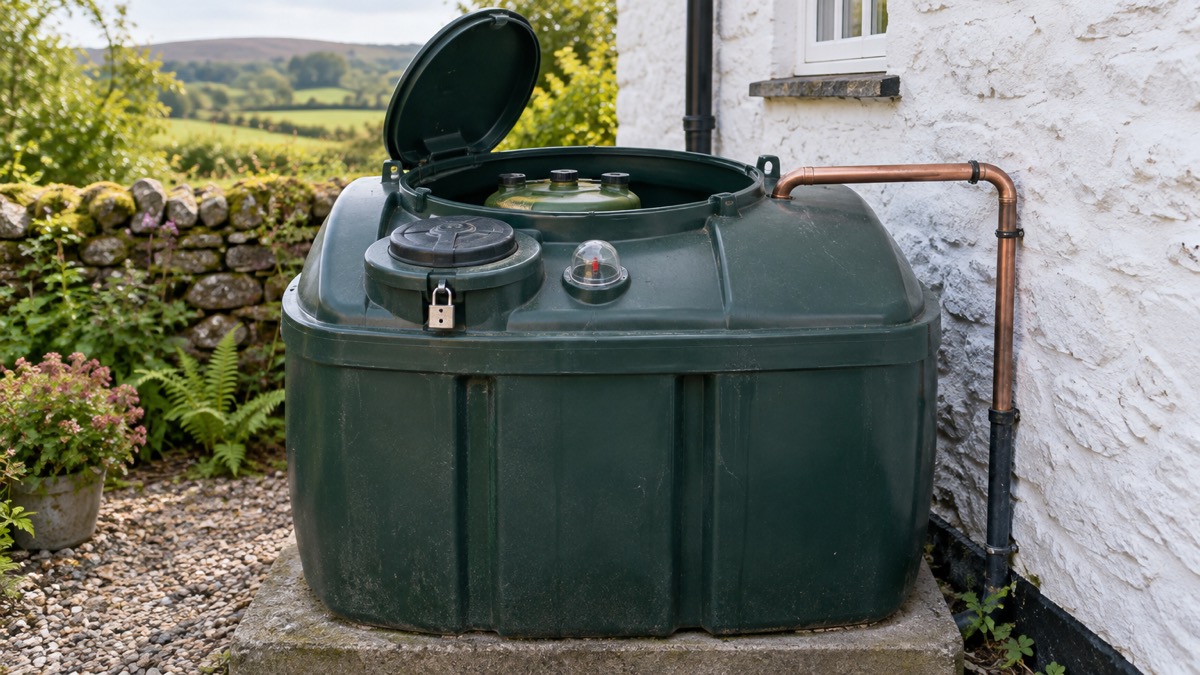
A well-maintained tank makes any interference obvious, and it also protects you against the leak that a theft can be mistaken for. Check the condition of your tank and boiler regularly, watch out for black stains, know how much oil you use, get your heating system serviced regularly, do not overfill your oil tank, keep the fill points clear, and review your home insurance policy to make sure you are covered for oil leaks or spills11.
Check your storage tank for any visible signs of cracks or rust that could cause leaks, and ensure all lids and caps are fully sealed to prevent water contamination, which can damage your system22. Check your oil tank, its base and the surrounding area for cracks, leaks or signs of rust, and clear away any overgrown areas to keep access routes safe for deliveries23. Include your oil tank in your service and ensure all caps, lids and vents are secure to prevent damage from rainwater, melting snow and other contaminants16.
Householders should have their storage facilities regularly checked for water and other contaminants as well as the condition of the tank itself4. Check your tank levels regularly, and avoid running too low, which can lead to inefficient use or emergency orders24. In cold weather you may use more oil than usual, so monitor levels carefully22.
On siting and screening, keep the fire separation in mind. An oil tank needs to be a minimum of 1.8 metres from any openings to buildings, doors, windows or other structures; if this distance is not possible a fire barrier can be built between the tank and the hazard2. On bunding, in some regions it is mandatory for tanks to be bunded to minimise pollution risk from fuel spills; in others a risk assessment by an OFTEC registered technician decides, with installations near a river, well or controlled water typically requiring bunding10. Bunding protects against pollution, not against theft, so a bunded tank still needs its lock, gauge and lighting.
Sources (23)
- Protecting heating oil, Police Service of Northern Ireland, 2026
- Tank care and security, UKIFDA, 2026
- Oil tank security, UKIFDA, 2025
- Help and advice, UKIFDA, 2026
- Extreme weather summer guide, London Fire Brigade, 2024
- Oil storage regulations and safety, GOV.UK, 2026
- NIEA urges householders to check oil tanks, Department of Agriculture, Environment and Rural Affairs, 2023
- Advice on oil tank checks for households, OFTEC, 2025
- Oil tank leaks, Somerset Council, 2025
- Minimise pollution risk from fuel spills, OFTEC, 2026
- Domestic oil, Northumberland County Council, 2026
- Five reasons households should not attempt DIY repairs, OFTEC, 2026
- OFTEC top tips to beat the freeze, OFTEC, 2024
- Fire safety escape, Fire Kills, 2026
- RP001 Advice on Home Safety Leaflet Tri-fold, Police Service of Northern Ireland
- Stay fire safe, Greater Manchester Fire and Rescue Service, 2026
- Are you insured for a fuel tank leak?, OFTEC, 2026
- Warning signs to look out for, OFTEC, 2026
- Firewise-UK, Greater Manchester Fire and Rescue Service, 2025
- Tastes and smells, Wessex Water, 2026
- Ten heating tips to avoid a costly winter breakdown, OFTEC, 2025
- UKIFDA winter heating checklist 2025, UKIFDA, 2025
- Rising oil prices: what it means for rural households, Community Action Norfolk, 2026
 After a Break-In Checklist
 Holiday Security Checklist
 Moving Home Locks Checklist
 When to Call 999 or 101
 Reporting a Burglary Anonymously
 Doorstep Caller Will Not Leave
 Car Running While De-Icing
 Checking a Doorstep Caller
 Burglary at Christmas
 Cash in a Fire Safe
 Making a House Look Occupied
 Police Approved Products
 Reporting a Bogus Caller