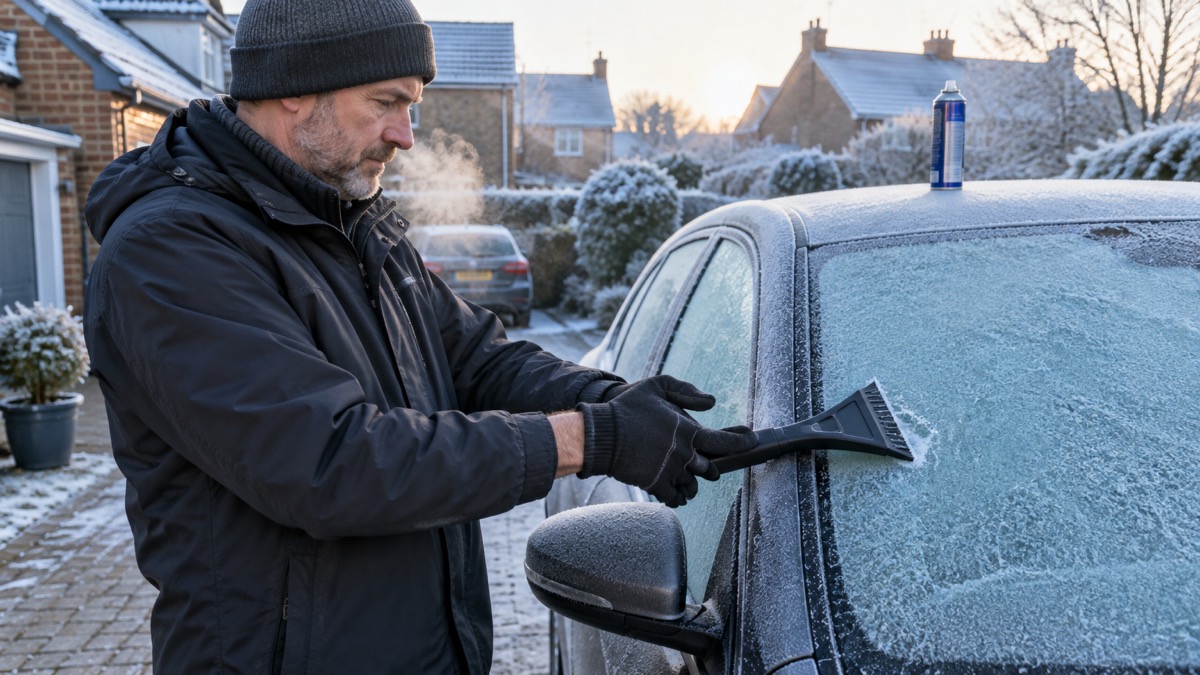
Leaving the engine running to warm the car on a frosty morning is illegal, and it can cost you the car. Sussex Police's crime prevention guidance is blunt: it is illegal to leave a vehicle running unattended while you de-ice it or warm it up, and your insurer will not pay out if it is stolen while you do1. The same advice applies whether the car is on the street or on your own drive, and whether you are holding the key or using a phone.
What to do instead is simple. Clear the ice with the engine off, or sit in the car while it warms. Give yourself an extra 10 minutes so you are not tempted to cut corners2. Clear every window, the lights, the number plate and the roof before you set off, because driving with snow or ice that reduces your visibility may itself be a criminal offence3.
This page sets out the law, why the insurance position is what it is, how to de-ice properly without leaving the engine running, and what to do if the car is taken.
It is illegal to leave your car running unattended while you de-ice it
The offence is not about how long you are gone or whether you can see the car from the kitchen window. It is about the vehicle being left running and unattended, and police crime prevention guidance treats de-icing and warming up as the classic cases1. A thief who finds a car with the engine running, the keys in it and the windows clearing does not need to break in. They open the door and drive away.
There is a second legal risk that catches people out on the same morning. Driving with snow or ice on the car may potentially be a criminal offence if it reduces your visibility, and the guidance is to remove all snowfall from the roof before setting off3. A slab of snow off the roof can slide down over the windscreen as you brake, or blow off into the path of the car behind. So the job is not finished when the driver's window is clear.
It helps to know what the law does not say. There is no law stopping you from clearing snow and ice on the pavement outside your home or from public spaces, so you can clear a safe path to the car without worrying about liability6. The restriction is on the unattended, running car, not on the shovel.
Why your insurer will not pay if the car is taken
The insurance consequence is the part that surprises people, and it follows directly from the police guidance: if the car is stolen while it is running and unattended, the insurer will not pay out1. This is not a technicality buried in the small print. Leaving a car running with the keys in it is treated as leaving it open to theft, and a theft claim can be refused on that basis.
The financial loss is not just the car. Think about what else goes with it: the winter kit in the boot, a phone on the passenger seat, a bag left on the back seat, tools for work. None of that is covered either if the claim itself is refused.
The same principle runs through home insurance more widely: cover depends on taking reasonable care, and insurers look hard at whether you did. Somerset Council's guidance on heating oil tanks makes the point in a different context, noting that most companies will not cover you at all if a leak is caused by lack of maintenance10. The lesson carries across: the policy assumes you have not made the loss easy.
If you want to understand how insurers treat security conditions on a policy, from locks and alarms to unoccupancy, our guide to home insurance conditions explains what insurers typically expect and how to check your own schedule. For the car specifically, the rule is short: an unattended, running vehicle is the one risk you cannot insure against by hoping.
How to de-ice without leaving the engine running unattended
The safe routine takes a few minutes longer and removes the risk entirely. Work through it in this order.
- Allow the time. Give yourself an extra 10 minutes to de-ice the car, so you are not rushing2. South Wales Fire and Rescue Service makes the same point: leave enough time before work to properly de-ice every window3.
- Clear it all, not a porthole. Thoroughly de-ice the windscreen, back and side windows, outside and inside, and do not simply clear a porthole to look through11. Clear the lights, the number plate and the roof as well4.
- Check the wipers and demist. Check your wiper blades and replace them if worn, and do not set off until the inside of the glass has de-misted11.
- Keep de-icer where you can reach it. Keep some de-icer in the house, not frozen inside a car you cannot open12. A frozen lock is its own delay; one council suggests using a lighter to warm a key for a frozen lock2.
- Then drive gently. Pull away in second gear and ease off the clutch gently to avoid wheel-spin, and use the highest gear possible2.
If you do warm the car, sit in it while the engine runs. That is the whole difference between a legal, insured warm-up and an illegal, uninsured one.
Warming the car up: stay with it or leave it off
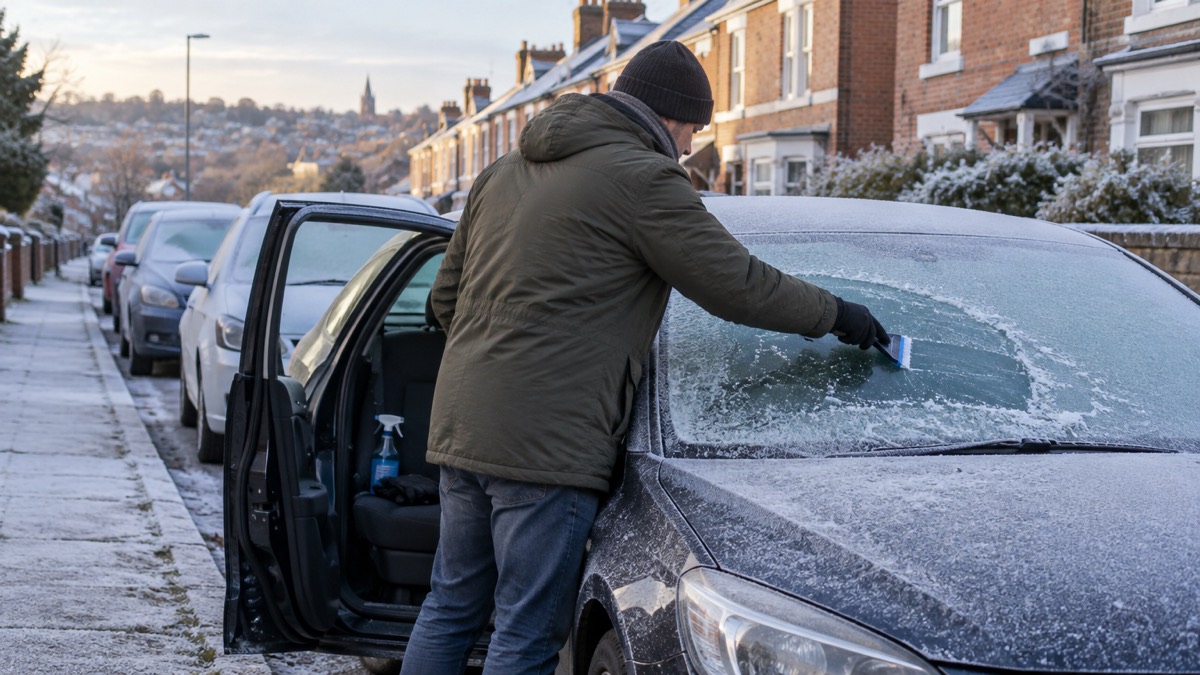
There are two lawful ways to start a frosty morning, and the choice is yours.
Stay with it. If you want the heater on, sit in the car while it warms. The engine is attended, the car cannot be driven off without you, and the insurance position is intact. It costs you a few minutes of your morning, and it is the option to take when the ice is thick or the car is slow to demist.
Leave it off. Clear the ice by hand with the engine off, then drive away gently. This is the quicker option on a light frost and the one that never puts the car at risk. Keep the scraper and de-icer in the car so you are never caught without them13.
Whichever you choose, the winter kit in the boot matters more than the warm-up. The Met Office's list is a good standard to work to: an ice scraper and de-icer, a torch, a paper road atlas, an in-car phone charger, warm clothes and blankets, high-visibility clothing, jump leads, an empty fuel can, food and drink, a shovel, warning triangles and sunglasses14. Northern Ireland's guidance adds a bottle of water or flask of hot drink and some snacks in case you get stuck15, and the Met Office's heavy snow advice is to tie something brightly coloured to the aerial if you have to stop5.
Remote start, keyless cars and the private driveway
Remote start and keyless entry do not change the rule. A car started by a phone or a fob and left with nobody in it is still running and unattended, so the offence and the insurance exclusion apply exactly as they would with the key in the ignition1. The technology makes the mistake easier to make, because you can start the car from the kitchen without ever going outside.
A private driveway is not a loophole either. The risk that matters is the theft, and a thief on a drive has the same open door and the same running engine as one on the street. Treat the drive as you would the road: stay with the car while it runs, or leave the engine off.
Keyless cars bring a separate risk worth knowing about, because it happens whether or not you are de-icing. Relay attacks let a thief capture the signal from a key inside the house and use it to open and start the car on the drive. Our guide to keyless car theft explains how relay attacks work and the practical steps that stop them, from storing keys away from the door to physical steering locks.
Once you are moving, the ice itself is the next hazard. The Highway Code warns that if the steering feels unresponsive this may indicate ice and your vehicle losing its grip on the road, and that when travelling on ice tyres make virtually no noise16. If your tyres are making almost no sound on the road, that is a sign you may be driving on ice18. Slow down, look well ahead for hazards and keep your speed down19. It is safer not to drive in icy conditions at all, but if you absolutely must, keep yourself and others safe19.
What to do if your car is stolen
Report it to the police straight away. Have the registration, make, model and colour ready, and tell your insurer as soon as you can. Be prepared for the insurer to refuse a theft claim where the car was left running and unattended, because that is the position in the police guidance1.
If the theft happened at home, the same steps as any other crime apply. Our guide to after a burglary covers crime numbers, insurers, repairs and support, and the principles carry across to a car taken off the drive. For when to ring 999 and when to ring 101, see when to call 999 or 101.
There is a wider point about the morning routine. A car warming up on a drive is a signal that someone is at home and about to leave, and it is one of the moments when a house is briefly less watched. If you are heading out, make sure the house is locked properly behind you; our guide to leaving your home locked when you have to evacuate covers the quick check to run before you go.
Where to get help and how to prepare
The law and the insurance position are the same across England, Scotland, Wales and Northern Ireland, because they turn on the theft risk rather than on where you park. What differs is the winter advice published around you. Transport Scotland publishes driving in bad weather guidance18, and Northern Ireland has nidirect guidance on driving in adverse weather16.
For the wider picture, our guide to storms, snow and ice covers preparing a household for a cold snap, and keeping your home protected in a power cut is useful if the weather takes out the electricity as well. If you are building up the kit you keep in the car and at home, the emergency kit section sets out what a UK household should keep ready.
The single most useful habit is the one this page has been building towards: build the extra 10 minutes into the morning, clear the car properly with the engine off or sit in it while it warms, and never leave it running with nobody in it2.
Sources (19)
- Preventing car and vehicle theft, Sussex Police, 2026-11-02
- Safe driving in winter, Nottinghamshire County Council, 2026-10-29
- Adverse driving conditions, South Wales Fire and Rescue Service, 2026-08-28
- Ice weather warning: information and advice, nidirect, 2026-02-16
- Travelling in heavy snow and ice, Met Office, 2026-10-25
- The Snow Code, Derbyshire County Council, 2026-10-29
- Snow wardens, Warwickshire County Council, 2026-10-29
- Snow and ice, Ceredigion County Council, 2026-10-29
- Extreme weather, Flintshire County Council, 2026-10-29
- Domestic oil storage tank leaks, Somerset Council, 2025-07-29
- Winter driving, Derbyshire County Council, 2026-10-29
- WeatherReady weather hacks, Met Office, 2026-10-25
- Emergency kit checklist, Neath Port Talbot Council, 2026-10-29
- Winter car kit, Met Office, 2026-10-25
- Keep warm in winter, Derbyshire County Council, 2026-10-29
- Driving in adverse weather conditions (rules 226 to 237), nidirect, 2026-10-29
- The Highway Code: driving in adverse weather conditions, GOV.UK, 2026-10-29
- Driving in bad weather, Transport Scotland, 2026-10-29
- Stay safe in ice, Met Office, 2026-10-28
 After a Break-In Checklist
 Holiday Security Checklist
 Moving Home Locks Checklist
 When to Call 999 or 101
 Reporting a Burglary Anonymously
 Doorstep Caller Will Not Leave
 Checking a Doorstep Caller
 Burglary at Christmas
 Cash in a Fire Safe
 Heating Oil Tank Theft
 Making a House Look Occupied
 Police Approved Products
 Reporting a Bogus Caller