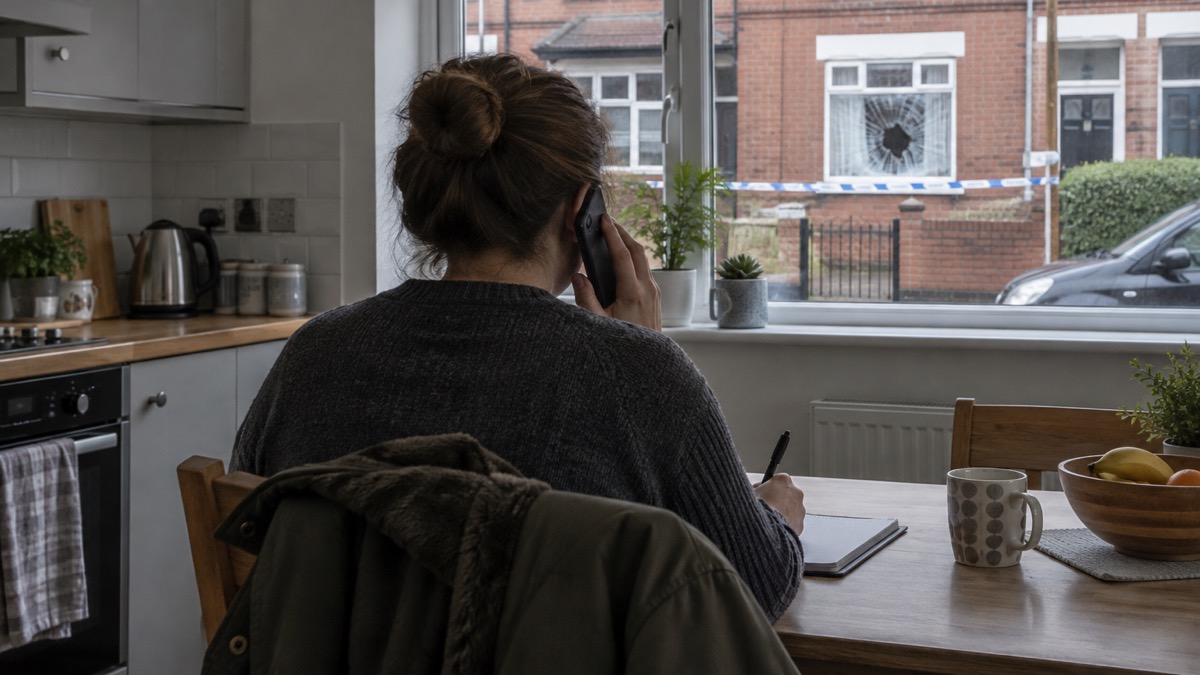
If you have information about a burglary and do not want to give your name, you can pass it to the independent charity Crimestoppers on 0800 555 111 or through Crimestoppers-uk.org1. You do not have to be the victim, and you do not have to make a statement or go to court. The charity's role is to take what you know and pass it on.
There is one exception that comes before everything else. If a burglary is happening now, or someone is in immediate danger, call 9992. That applies whether you are the householder, a neighbour or a passer-by. An anonymous route is for information after the event, not for a crime in progress.
The rest of this guide sets out how the anonymous route works, what to put in a report so it is useful, what changes if you give your name instead, and where to get support afterwards.
Call 999 if the burglary is happening now
A burglary in progress is an emergency, and the police are clear that 999 is for a crime that is in progress or where someone is in immediate danger2. The same applies if you think an intruder is still inside a property: Police Scotland's advice is to call 999 if you think the intruder is still there4. Do not go in to check, and do not approach a neighbour's house to look.
If you cannot speak safely, there are two established ways to get the call through. On a mobile, dial 999 and then press 55 when prompted; the operator is notified and transfers the call to the police6. On a landline, if you do not speak or answer questions and the operator can only hear background noise, they will transfer your call to the police7. Both routes exist so that a caller who cannot talk can still summon help.
Once the immediate danger has passed, the anonymous route becomes useful. Information about a burglary that has already happened, or about someone you believe is responsible, can go to Crimestoppers without your name attached1. That includes information about suspicious activity you noticed beforehand, which the police ask the public to report8.
Report anonymously through Crimestoppers
Crimestoppers is an independent charity that takes crime information anonymously. Gloucestershire Constabulary directs people with information about a burglary, as a witness rather than a victim, to give it anonymously to Crimestoppers on 0800 555 111 or at Crimestoppers-uk.org1. The same number appears across police and fire service guidance as the anonymous route for everything from deliberate fire setting to bogus callers9.
The charity's reach is wider than burglary. Police Scotland points people to Crimestoppers to report scammers and fraudsters anonymously12. FireStoppers takes anonymous reports of deliberate firesetting9. For doorstep crime, you can report it online, by phone, or in person11.
What anonymity means in practice is set out plainly: no mobile number, address or location of calls is tracked3. You are not asked for your name, and the information is passed on without it. That is the whole point of the service, and it is why it suits a neighbour who saw something, a delivery driver, or anyone who would rather not be identified.
| Route | Number or address | When to use it |
|---|---|---|
| Emergency | 999 | A burglary in progress, or danger to life2 |
| Crimestoppers | 0800 555 111 or Crimestoppers-uk.org | Information given anonymously, after the event1 |
| Police non-emergency | Online, by phone or in person | A named report of a burglary that has happened4 |
If you have information about suspicious activity connected to terrorism rather than burglary, that goes through a separate anonymous online reporting form run by the police's ACT campaign13. It is not the right route for a house burglary, but it is worth knowing it exists if what you saw does not fit an ordinary crime.
What to include in an anonymous report
An anonymous report is only as useful as the detail in it. The principle the fire service sets out for reporting an incident applies equally here: provide as much detail as possible about location and access, but make sure you are in a safe place while you do it14. For a burglary, that means the address, how to get to it, and what you actually saw or know, rather than what you assume.
A useful report tends to cover:
- Where: the full address, and any detail that helps someone find it, such as a flat number or a rear access point.
- When: the date and time you saw or heard something, as precisely as you can.
- What: a description of people, vehicles or activity, and what was taken if you know.
- Why you are reporting it: whether you saw it, heard it, or have other information.
- What you are not sure about: say so. An honest account is more use than a confident guess.
Do not put yourself in a position of danger to gather more. The fire service's instruction to make sure you are in a safe place before giving detail is the right instinct for any report14. If you are reporting from inside a property that has been broken into, get out and call 999 rather than staying to describe the scene.
"Please provide as much detail as possible about location and access, but also make sure you are in a safe place"
If the burglary is at a neighbour's home and they are away, the same details help: the address, when you last saw the property secure, and what drew your attention. You do not need their permission to pass information anonymously, and you are not making a statement by doing so.
Anonymous or named: what changes for the police and your insurer
The choice between an anonymous report and a named one is not about honesty. It is about what you want to happen next, and there are real differences.
An anonymous report through Crimestoppers passes information to the police without your identity attached1. It can prompt action, but it does not create a crime reference number in your name, and it does not give you a record you can take to an insurer. If you are the householder and you intend to claim, you will normally need to report to the police in your own name so that a crime number is issued. Avon and Somerset Police, for example, tell parcel theft victims to contact the police to get a crime reference number15.
A named report to the police can be made online, by phone or in person4. The police stress that your identity will be protected and that you should not be concerned about wasting police time16. That reassurance matters: many people hesitate because they think a small detail is not worth a call.
For insurance, the key point is not anonymity but evidence. Most policies only cover burglary claims on an unoccupied home if there are signs of forced entry17. If your home will be empty, you are advised to inform the police18. Neither of those conditions depends on whether a witness gave their name, but the claim itself will depend on a police report and a crime number.
| Anonymous via Crimestoppers | Named report to the police | |
|---|---|---|
| Your identity | Not taken; calls not tracked3 | Protected, and you are urged not to worry about wasting time16 |
| How to do it | 0800 555 111 or online1 | Online, by phone or in person4 |
| Crime reference number | Not issued in your name | Issued, which insurers normally expect15 |
| Giving evidence later | Not committed | May be asked to help further |
If you are the victim and you also want to pass on something you would rather not be named for, the two routes are not exclusive. You can report in your own name for the claim and give separate information anonymously.
What happens after you report
After an anonymous report, the information is passed to the police without your details. You will not usually hear back, because there is no name or number to contact. That is the trade-off for anonymity: you may never know whether it helped, but the information still enters the system.
After a named report, the police will give you a crime reference number, which you need for insurance and for any follow-up. Keep it somewhere safe. If you later remember something, quote the number when you call.
If the burglary is connected to fraud, the reporting route differs. Report Fraud deals with all fraud unless the suspect is known to the victim or is vulnerable, in which case call 10119. If you have lost money to a phishing message, tell your bank and report it as a crime to Report Fraud in England, Wales and Northern Ireland, or to Police Scotland in Scotland20. The same split applies to hacked accounts: in Scotland, contact the police on 10121. Online crime and abuse can be reported to the police through the usual channels22.
For support, Victim Support is the leading independent charity supporting victims of crime and traumatic events in England and Wales. Its service is free, confidential and available to anyone affected by crime or traumatic events, regardless of whether it was reported or how long ago it happened5. That last point matters: you do not need to have gone to the police to use it. In Scotland, ask about local support when you report, or through the routes Police Scotland lists.
If you are coming home to a break-in, the practical steps are set out in Coming Home to a Break-In: What to Do First, and the paperwork and repairs in After a Burglary: Crime Numbers, Insurers, Repairs and Support. For the wider picture on reporting crime and getting support in Scotland and Northern Ireland, see Scotland and Northern Ireland: Reporting Crime and Getting Support. And if you are weighing up whether a report is worth making at all, the police's own answer is that it is: do not be concerned about wasting their time16.
Sources (23)
- Burglary, Gloucestershire Constabulary, 2026-11-02
- Contact the police, GOV.UK, 2026-10-29
- Wildfirewise, Mid and West Wales Fire and Rescue Service, 2026-10-29
- Break-in and housebreaking, Police Scotland, 2026-11-02
- Community involvement, Dorset Prepared, 2026-03-25
- If you can't speak when you call 999, Bath and North East Somerset Council, 2026
- How to make a silent 999 call, Police.uk, 2026-11-02
- Threat levels, ProtectUK, 2026-05-01
- Amber wildfire alert issued, Dorset and Wiltshire Fire and Rescue Service, 2026-04-21
- Warning as exceptional weather conditions due over the weekend, Dorset and Wiltshire Fire and Rescue Service, 2026-07-09
- Bogus callers, Belfast City Council, 2026-10-29
- Shut out scammers, Police Scotland, 2026-11-02
- ACT report suspicious activity, ProtectUK, 2026-06-01
- Amber wildfire alert issued for Dorset and Wiltshire, Dorset and Wiltshire Fire and Rescue Service, 2021-04-05
- Doorstep crime, Avon and Somerset Police, 2026-11-02
- ACT report suspicious activity, ProtectUK, 2026-06-01
- Pre-holiday routine, Avon and Somerset Police, 2026-11-02
- Be prepared, Lancaster City Council, 2026-10-26
- Others who can help, Devon and Cornwall Police, 2026-10-29
- Phishing, National Cyber Security Centre, 2026
- Recovering hacked accounts, National Cyber Security Centre, 2026
- Keeping yourself safe online, Avon and Somerset Police, 2026-03-26
- Rogue traders and doorstep crime, Police Scotland, 2026-11-02
 After a Break-In Checklist
 Holiday Security Checklist
 Moving Home Locks Checklist
 When to Call 999 or 101
 Doorstep Caller Will Not Leave
 Car Running While De-Icing
 Checking a Doorstep Caller
 Burglary at Christmas
 Cash in a Fire Safe
 Heating Oil Tank Theft
 Making a House Look Occupied
 Police Approved Products
 Reporting a Bogus Caller