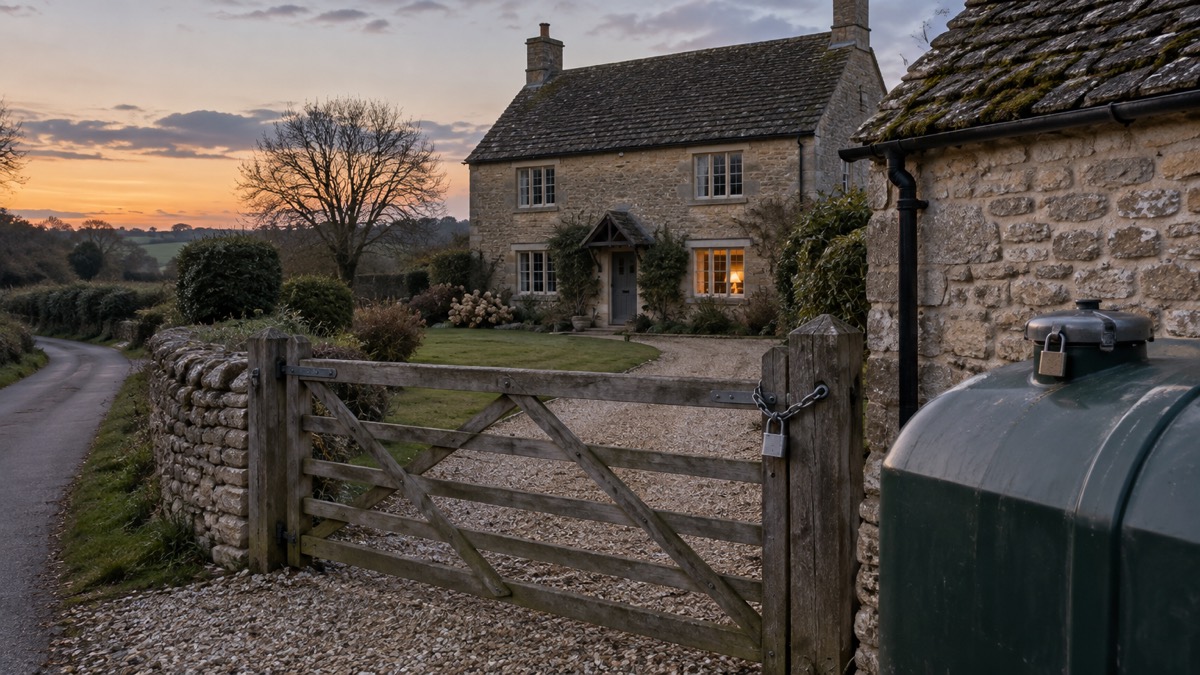
A rural home faces the same risks as a town house, plus a few of its own. Outbuildings full of tools and machinery, a heating oil tank in the yard, long driveways and the nearest neighbour a field away all change what is worth protecting and how quickly anyone will notice something wrong. The security basics still matter most: the Police Service of Northern Ireland's house security guidance is blunt that good home security, such as using window and door locks, is the best way to reduce your chances of being burgled1.
The first practical step costs nothing. Sign up for free local crime and incident alerts, so news of break-ins, suspicious vehicles or scams in your area reaches you the same day rather than weeks later. In Scotland, Neighbourhood Watch Scotland sends free message alerts about incidents and crime prevention in your area2. Equivalent schemes run across England and Wales, and most take a few minutes to join online.
The second step is to accept that help travels further to reach you. Fire and rescue services ask rural households to make their home number or name clearly visible from the road, and to keep access, including side gates, clear for firefighters3. This page sets out what to sign up for, how to secure outbuildings, oil tanks and vehicles, how to keep an isolated house looking occupied, and exactly who to call when you see something that is not right.
Sign up for free local crime alerts
The single most useful thing a rural household can do is join its local alert scheme, because in the countryside news travels slowly by word of mouth and an alert service closes that gap. Neighbourhood Watch Scotland offers free message alerts from key information providers regarding incidents and crime prevention in your area2. You choose how the messages reach you and what you hear about.
If you live or work in the Scottish Borders, the council's own SB Alert scheme sends free information relevant to your area straight to your inbox or phone8. In North Wales, the local police force asks residents to register for Community Alerts9. In Lancashire, the resilience forum's Stay In The Know service sends news and information about risks in your area, how to prepare and how to respond, via Neighbourhood Alert10. Elsewhere, storm and emergency guidance is consistent: sign up to receive alerts and information about risks in your area11, and use the Government's Prepare website, which lists trusted sources of alerts covering your area12.
| Scheme | Area | What you get | How to join |
|---|---|---|---|
| Neighbourhood Watch Scotland | Scotland | Free message alerts on incidents and crime prevention in your area2 | Via the Neighbourhood Watch Scotland service2 |
| SB Alert | Scottish Borders | Free local information straight to your inbox or phone8 | Join through Scottish Borders Council8 |
| Community Alerts | North Wales | Local police community alerts9 | Register online9 |
| Stay In The Know | Lancashire | News on local risks, how to prepare and respond10 | Sign up via Neighbourhood Alert10 |
Alert schemes are not only about crime. The same habit of registering keeps you informed when other rural risks turn real. Scottish Water offers free text alerts about interruptions to your water supply13. If your property is in a flood risk area, sign up for flood warnings by text, phone or email to stay informed14, and household emergency guidance likewise tells you to sign up for flood warnings if appropriate in your area15. One registration habit, several kinds of warning.
What the alerts cover
Alert messages fall into two broad groups, and both matter to a rural household. The first is incidents: what has actually happened nearby, such as break-ins, thefts from outbuildings, suspicious vehicles or bogus callers working the area. The second is crime prevention: advice on what to do while a particular risk is active, which is where a local scheme earns its keep. Neighbourhood Watch Scotland describes its alerts as covering both incidents and crime prevention in your area2.
For a rural reader, the incident side is the valuable part. A theft from a shed three farms away, reported through an alert the same morning, tells you to check your own shed and watch for the vehicle described. Without the alert, you might hear about it at a market a fortnight later. The prevention side carries advice you can act on straight away, from crime prevention to keeping your property and outbuildings secure, so the alerts are worth reading even when nothing has happened nearby.
Treat alerts as one channel among several. Flood warnings, water supply alerts and storm warnings arrive through their own services11, and the Government's Prepare website brings together trusted sources of alerts covering your area12. If you run a farm or smallholding, ask locally whether a farm watch or similar scheme operates in your force area, since these build on the same alert principle for agricultural theft.
Why help takes longer to reach a remote home
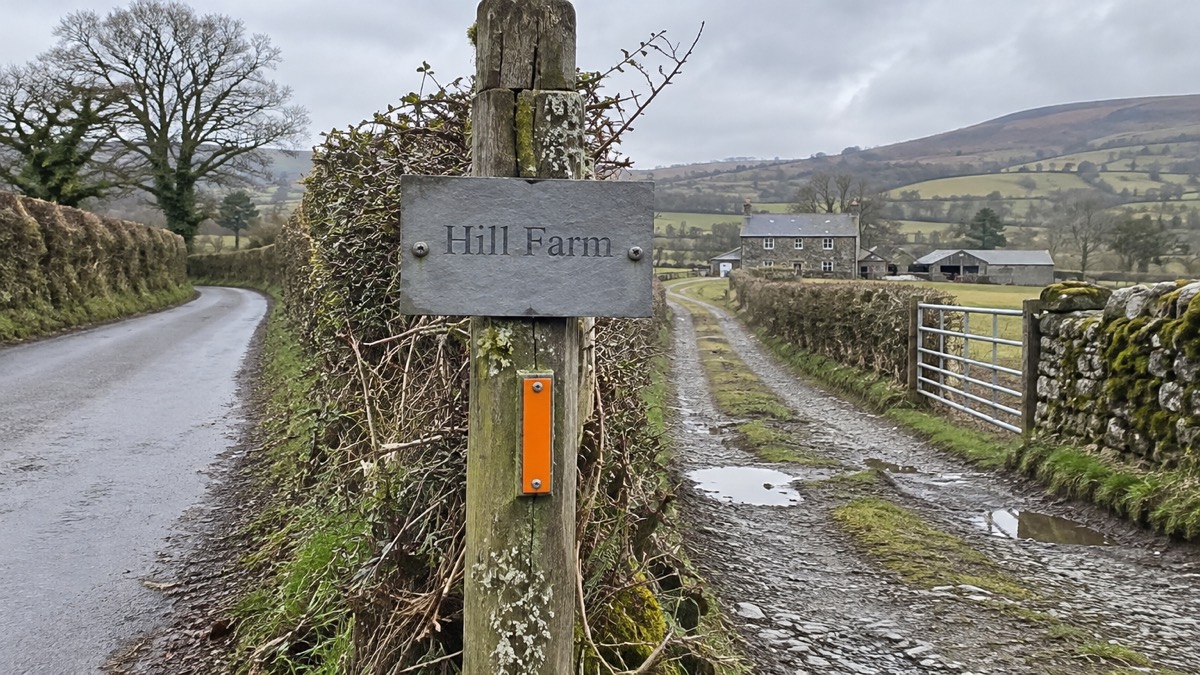
Distance is the working reality of rural life, and it shapes what you should do before and during an emergency. A fire engine or police car has further to travel, may have to find an unmarked lane, and may need to get through gates you control. That is why the fire and rescue service's rural advice concentrates on two things you can fix in an afternoon: make your home number or name clearly visible from the road or main access point, so firefighters can easily locate your address in the event of a fire4, and keep access clear for firefighters to easily get to your property, including side gates3.
The same distance changes what you should do during a fire. If someone is still inside a burning building, wait for the fire and rescue service and tell them about the person, because they will find them quicker than you16. Going back into the building slows down the firefighters' efforts to rescue anyone else missing and puts your own life in danger16. In a remote spot, where the crew has already travelled miles to reach you, anything that delays them costs more.
Location tools help close the distance gap. Fire and rescue guidance for rural areas asks callers to provide information to fire control from apps such as What3Words or Ordnance Survey Locate, to help fire and rescue services find your exact location17. Install one of these on your phone before you need it, and note the reference for your own property, your field entrances and any outbuildings.
Securing outbuildings, sheds and vehicles
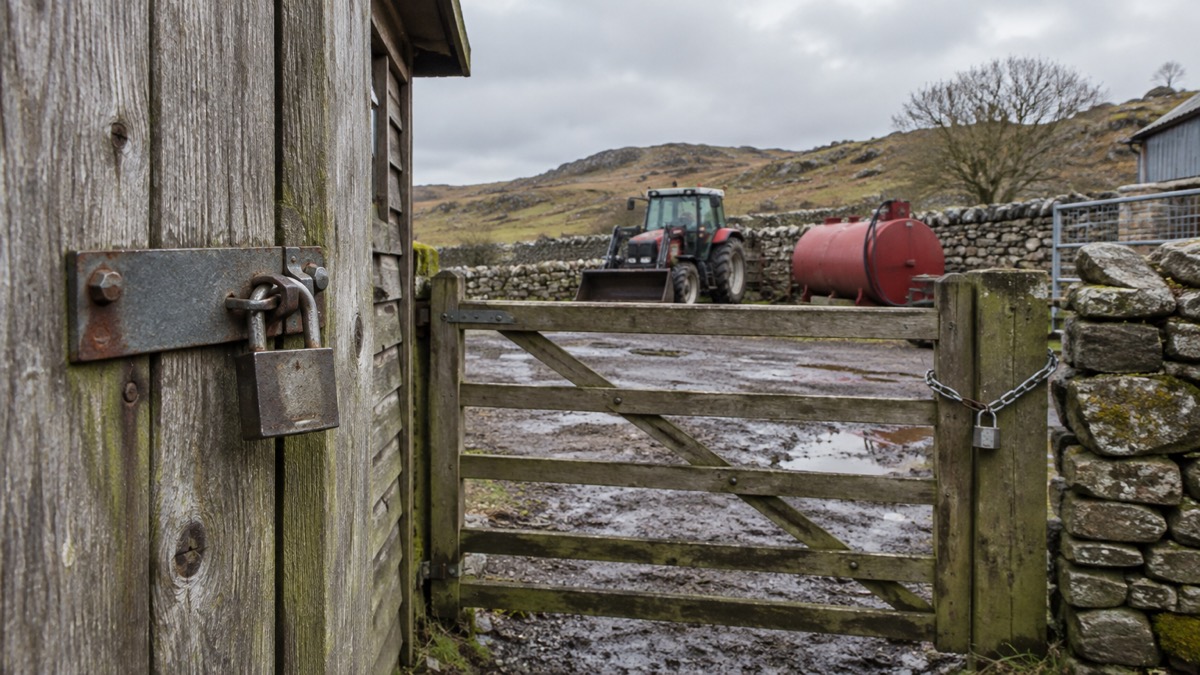
Outbuildings are the weak point of most rural properties, because they hold the things thieves can move quickly: tools, quad bikes, machinery, fuel and scrap metal. The rule from the official securing your home guidance is absolute: never leave garages, outbuildings or sheds unlocked, especially if they are connected to your property5. A connected garage or shed that is left open hands an intruder a covered place to work on your back door or window, out of sight of the road.
Keep every entry point secure, including sheds and garages, but also perimeter walls, fencing and gates19. The perimeter matters in the countryside more than in town, because your boundary is probably long and partly hidden. Walk it and look for the places where a vehicle could be brought close to a shed and loaded without being seen from the house.
Tools and ladders deserve their own attention. Lock garden tools away securely in a shed or garage, and lock ladders away or secure them with a chain or padlock to a strong post or wall5. An unsecured ladder left against a barn is an invitation to reach the upper floor of your house or strip lead from a roof.
- Never leave garages, outbuildings or sheds unlocked, especially ones connected to the house5
- Keep perimeter walls, fencing and gates secure as entry points19
- Lock garden tools away securely in a shed or garage5
- Chain ladders to a strong post or wall, or lock them away5
- Install locks to the area of your oil tank to make it hard for an intruder to gain access to the rear of your home20
Metal theft is a specific rural risk. The Police Service of Northern Ireland notes that the value of scrap copper, lead and other metals makes their theft attractive to criminals, with roofs on churches, sports club buildings, unoccupied dwellings and buildings under construction among the targets1. If you own or look after an outbuilding with a lead or copper roof, treat it as a target and ask your insurer and your local Crime Prevention Officer what they recommend. Our page on protecting an empty property from metal theft covers unoccupied buildings in more detail.
Heating oil is the other rural staple that gets stolen. The police home safety advice is to install locks to the area of the tank, to make it hard for an intruder to gain access to the rear of your home20. For a fuller treatment of tank security, see how to stop heating oil being stolen. Vehicles, from quad bikes to cars, follow the same logic as outbuildings: locked away when possible, keys kept with you, and never left where they can be rolled or driven out unseen. If you are worried about cars parked at the property, our pages on keyless car theft and catalytic converter theft set out the specific steps.
Lighting, locks and keeping the property looking occupied
The core of rural home security is the same as anywhere: good home security, such as using window and door locks, is the best way to reduce your chances of being burgled1. Start with the doors and windows of the house itself, then work outwards to the yard. Our guides to doors and locks and windows explain the standards and hardware in detail.
Lighting and alarms carry official backing as deterrents. Cheshire Fire and Rescue Service, advising on arson prevention, tells property owners to consider security systems such as intruder alarms and security lighting to deter intruders21. In a rural setting, lighting has a second job: it makes the long approach to your house legible to you and to anyone passing, so a figure in the yard is visible rather than a shadow. Placement matters more than brightness, and our page on outdoor lights that deter burglars covers the types and where to put them. If your broadband or mobile signal is weak, which is common in remote spots, check alarms and cameras on a weak signal before choosing a system, and see burglar alarms and home cameras for the options.
An occupied-looking house is a harder target, and distance works in your favour if you use it. The fire service's rural wildfire guidance asks households to make a 10-metre safety zone around the home, removing combustible materials, wood piles, felled trees and other debris3, and North Yorkshire Fire and Rescue Service similarly advises a cleared zone of 5 to 10 foot around all sides of your home by removing combustible materials such as felled trees and long grass17. That same cleared ground does double duty for security: it removes cover close to the house and makes the property look managed and watched. Wood piles stacked against a wall are both a fire risk and a stepping stone to a window.
- Use window and door locks as the foundation of home security1
- Consider intruder alarms and security lighting to deter intruders21
- Clear a safety zone around the house of wood piles, felled trees and debris3
- Check that all property exit routes are clear from inside and outside the home17
- Keep access, including side gates, clear for firefighters3
Exit routes belong on the security checklist as well as the fire plan. North Yorkshire Fire and Rescue Service advises checking that all property exit routes are clear from inside and outside the home17. A gate jammed shut by years of growth is a problem twice over: it delays you getting out and delays the emergency services getting in.
Staying in touch with neighbours when the nearest one is a field away
Distance between households is the rural security problem that no lock solves. The official keeping warm guidance captures the habit that matters: stay in contact with friends and family, especially if you have been stuck in the house for a few days, and check up on elderly relatives or neighbours who might need help22. Turn that into a standing arrangement: agree with your nearest neighbours who checks on whom after a storm, a power cut or a spate of break-ins, and by what means.
For people who live alone, the fire and rescue service's home safety partnerships guidance is specific about why this matters. People who live alone are more at risk from fire, but only when combined with other risk and vulnerability factors, and this is likely to be because there is no one around to help with alerting the occupant to risky behaviours, or to alert them to a fire or help with evacuation23. Living alone in a remote house is not in itself dangerous, but it removes the everyday safety net of someone else noticing. Build the net deliberately: regular calls, a neighbour who knows your routine, and a fire safety visit.
If you support someone who lives alone and might not manage alone in an emergency, you can refer them for a home fire safety assessment. Greater Manchester Fire and Rescue Service asks carers and neighbours to refer the person using its Online Home Fire Safety Check tool, or by telephoning 0800 555 815 if you do not have internet access, and the permission of the person being referred is required24. Similar arrangements exist in other service areas. Our community resilience guide covers setting up something more formal with several households.
What to do if you see or suspect a crime nearby
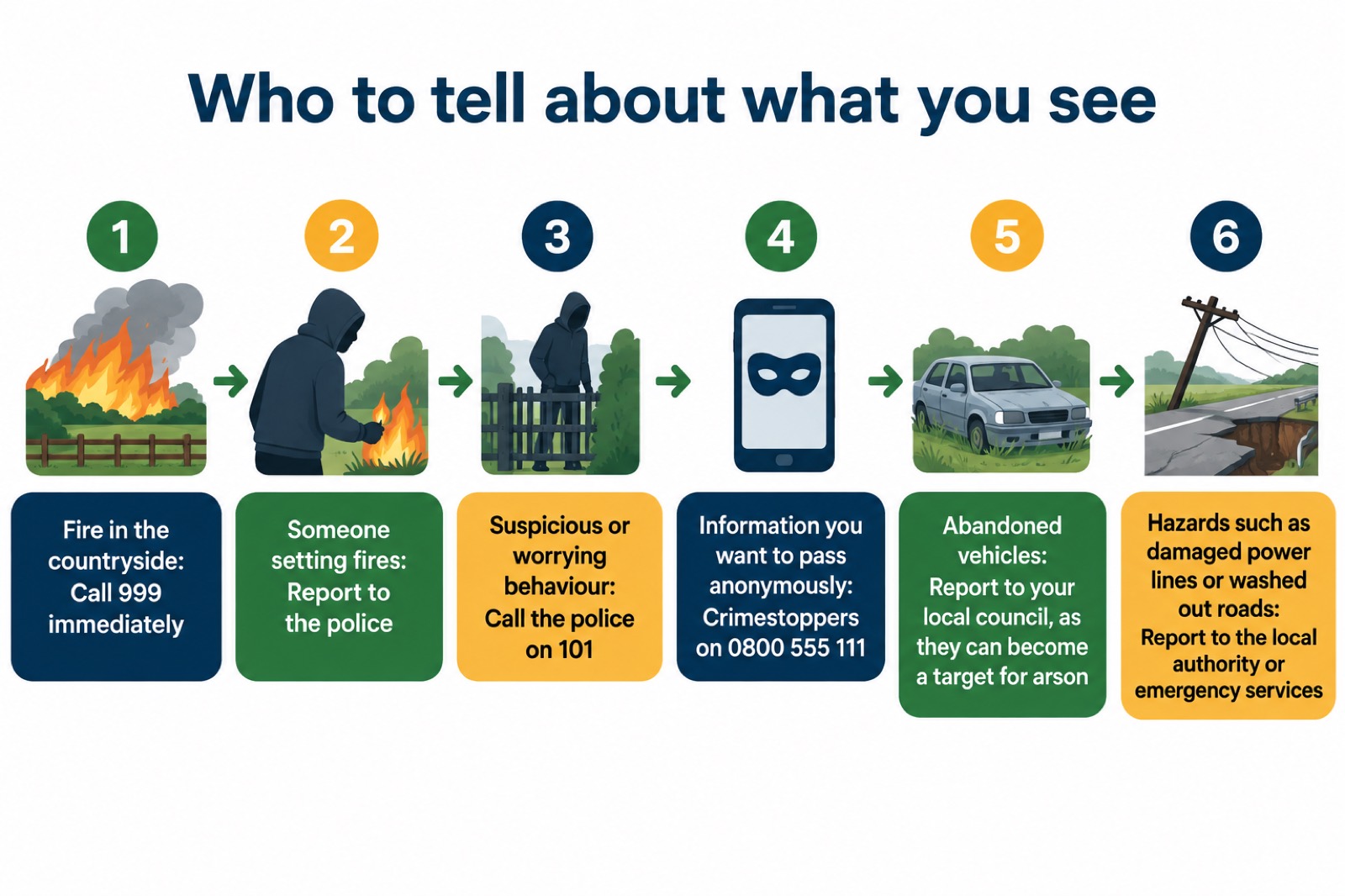
Trust what you notice, and report it. The national ACT guidance on reporting suspicious activity is direct: report suspicious or worrying behaviour, gathering materials or equipment, storing dangerous materials, hostile reconnaissance and financing if you believe it to be suspicious or it causes a threat25. In the countryside, the everyday version of that is a vehicle parked where it has no reason to be, someone taking photographs of farm buildings, or unfamiliar callers asking odd questions about who lives where.
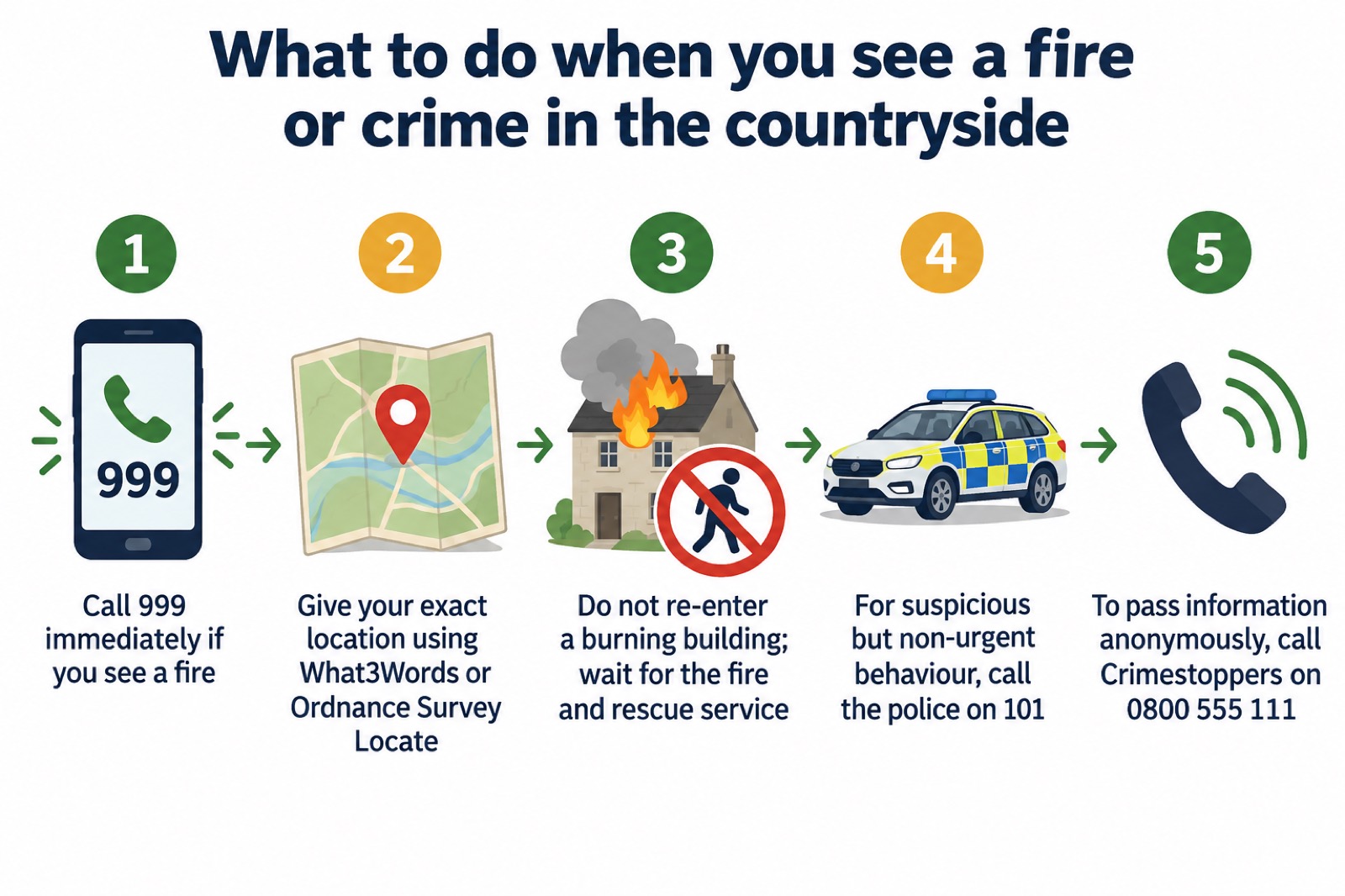
Fire in the countryside is the emergency case. The Northern Ireland Fire and Rescue Service asks everyone to stay vigilant to fire in the countryside and, if you see a fire, to call 999 immediately18. Its advice also covers the human cause: if you see someone setting fires, report it to the Police Service of Northern Ireland18. Elsewhere in the UK, the same report goes to your local force.
Abandoned vehicles are worth reporting even when nothing is happening, because they can become a target for arson19. Report them to your local council19. The same readiness applies to hazards that are not crime but endanger people: report hazards to health and safety, such as damaged power lines, washed out roads, gas leaks, dead animals or chemical releases, to the local authority or emergency services26.
Where to report crime and get local help
For non-emergencies, the numbers are simple. If you see or suspect someone of acting suspiciously, recklessly or irresponsibly in the countryside, contact the police on 101, or pass information anonymously to Crimestoppers on 0800 555 1114. Use 999 when a crime or fire is happening now. When you call about something rural, give the location precisely: What3Words or Ordnance Survey Locate references help emergency services find your exact location in rural areas17.
For prevention advice rather than reporting, your police force has a dedicated contact. The Police Service of Northern Ireland's house security guidance says you can contact your local Crime Prevention Officer for further advice, and that Crime Prevention Officers can advise individuals and address larger audiences1. Cheshire Fire and Rescue Service gives the same route: further advice on home security can be obtained from your local Police Crime Prevention Officer21. A Crime Prevention Officer can walk your farmyard with you, which is worth requesting after any incident or if you have taken on a new property.
Fire and rescue services offer their own free help, and rural households are a priority for it. In Scotland, the Scottish Fire and Rescue Service offers free Home Fire Safety Visits that assess fire risks, help you develop a home fire escape plan, advise on smoke, heat and carbon monoxide alarms, and explain current Scottish fire alarm requirements6. When you request a visit in Scotland, you get advice on making an emergency plan and free smoke alarms fitted7. For lower income elderly or disabled homeowners in Scotland, support to install alarms may be available from Care and Repair Scotland27.
| Help | Who provides it | How to get it |
|---|---|---|
| Local security advice | Your police Crime Prevention Officer1 | Contact your local police force |
| Anonymous crime information | Crimestoppers4 | Call 0800 555 111 |
| Non-emergency police contact | Police4 | Call 101 |
| Home fire safety visit | Scottish Fire and Rescue Service6 | Request a free visit; free smoke alarms fitted |
| Home Fire Safety Assessment referral | Greater Manchester Fire and Rescue Service24 | Online tool, or call 0800 555 815 without internet |
| Alarm installation support | Care and Repair Scotland27 | For lower income elderly or disabled homeowners |
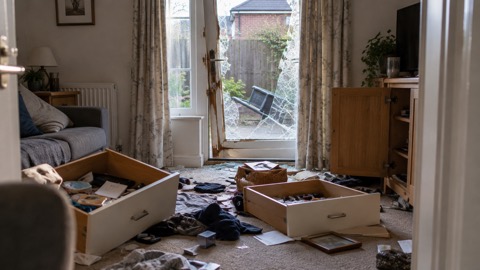
If a break-in does happen, the steps afterwards are the same wherever you live, and our guides to coming home to a break-in and after a burglary take you through them. What differs in the countryside is that the scene may not be found for days, so photograph outbuildings and their contents now and keep a record of serial numbers, which supports both the police investigation and your insurance claim. Our page on property marking and keeping a record of valuables explains the options.
Sources (27)
- House security, Police Service of Northern Ireland, 2026-11-02
- Shut Out Scammers: more information, Police Scotland
- Wildfires in rural areas, Devon and Somerset Fire and Rescue Service, 2026
- Wildfire safety advice, Devon and Somerset Fire and Rescue Service, 2026
- Securing your home, nidirect, 2024-01-23
- Sensory support: Home Fire Safety Visits, South Lanarkshire Council, 2026-10-29
- Christmas safety tips, Warwickshire County Council, 2026-10-29
- Emergency planning: SB Alert, Scottish Borders Council
- Show some respect this Bonfire Night, North Wales Fire and Rescue Service, 2026-10-30
- Extra help available for those who need it, Lancashire Resilience Forum, 2026-10-29
- Storms and gales: protect yourself, Lancashire Resilience Forum, 2026-10-29
- Prepare your community, Greater Manchester Combined Authority, 2026-10-29
- Find and share information in an emergency, Ready Scotland, 2026-03-24
- Staying safe in flooding, West Midlands Ambulance Service NHS Foundation Trust, 2026-05-20
- Preparing for an emergency, Nottinghamshire County Council, 2026-10-29
- If you have a fire, Devon and Somerset Fire and Rescue Service, 2026
- Protecting your home from wildfires, North Yorkshire Fire and Rescue Service, 2026-06-15
- NIFRS statement: wildfire operational update, Northern Ireland Fire and Rescue Service, 2026-04-28
- Reducing arson risk, London Fire Brigade, 2026-10-25
- Advice on home safety leaflet, Police Service of Northern Ireland, 2022
- Protect your property from arson, Cheshire Fire and Rescue Service, 2024-05-30
- Keeping warm, Cumberland Council, 2026
- Home safety partnerships, Devon and Somerset Fire and Rescue Service, 2026
- Additional advice for carers, Greater Manchester Fire and Rescue Service, 2026-10-29
- ACT: report suspicious activity, ProtectUK, 2026-06-01
- Prepare yourself, Greater Manchester Combined Authority, 2026-10-29
- Fire and smoke alarms in Scottish homes, Scottish Government, 2024-08-14
 After a Break-In Checklist
 Holiday Security Checklist
 Moving Home Locks Checklist
 After a Burglary
 Bogus Callers
 Coming Home to a Break-In
 Catalytic Converter Theft
 Riots and Disorder Near Home
 Securing a Damaged Home
 Dogs as a Burglar Deterrent
 Doorstep Selling and Your Rights
 Empty Homes and Long Absences
 Leaving Home on Holiday
 How Burglars Choose a Home
 Home Insurance Conditions